Saturday, November 23, 2019

Pulitzer Prize Winner James McPherson Confirms that No Mainstream Historian Was Contacted by the NYT for Its 1619 History Project

You would imagine that America's "newspaper of reference" might start questioning itself, or at least some of its presumptions, when none other than the World Socialist Web Site, of all groups (!), is skeptical enough to bring an interview with one of America's, and one of the world's, leading historians, and when it turns out that his testimony shows to what extent the New York Times's latest anti-American scheme, the 1619 project, is hopelessly warped (thanks to Glenn Reynolds).

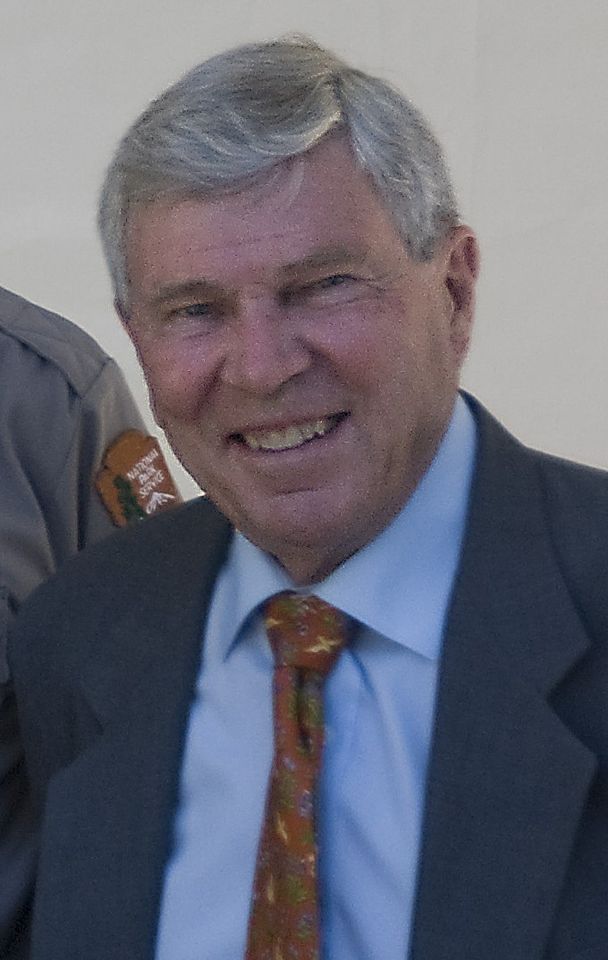
The scholar whom Tom Mackaman spoke to was "James McPherson, professor emeritus of history at Princeton University [and] the author of dozens of books and articles, including the Pulitzer Prize-winning Battle Cry of Freedom, widely regarded as the authoritative account of the Civil War".
Q. What was your initial reaction to the 1619 Project?
A. Well, I didn’t know anything about it until I got my Sunday paper, with the magazine section entirely devoted to the 1619 Project. Because this is a subject I’ve long been interested in I sat down and started to read some of the essays. I’d say that, almost from the outset, I was disturbed by what seemed like a very unbalanced, one-sided account, which lacked context and perspective on the complexity of slavery, which was clearly, obviously, not an exclusively American institution, but existed throughout history. And slavery in the United States was only a small part of a larger world process that unfolded over many centuries. And in the United States, too, there was not only slavery but also an antislavery movement. So I thought the account, which emphasized American racism—which is obviously a major part of the history, no question about it—but it focused so narrowly on that part of the story that it left most of the history out.

So I read a few of the essays and skimmed the rest, but didn’t pursue much more about it because it seemed to me that I wasn’t learning very much new. And I was a little bit unhappy with the idea that people who did not have a good knowledge of the subject would be influenced by this and would then have a biased or narrow view.
Q. Are you aware that the glossy magazine is being distributed to schools across the country, and the Chicago public school district has already announced that it will be part of the curriculum?
A. I knew that its purpose was for education, but I haven’t heard many of the details of that, including what you’ve just mentioned.
 … Q. You mentioned that you were totally surprised when you found Project 1619 in your Sunday paper. You are one of the leading historians of the Civil War and slavery. And the Times did not approach you?
A. No, they didn’t, no.
Q. We’ve spoken to a lot of historians, leading scholars in the fields of slavery, the Civil War, the American Revolution, and we’re finding that none of them were approached. Although the Times doesn’t list its sources, what do you think, in terms of scholarship, this 1619 Project is basing itself on?
A. I don’t really know. …
 … Q. Nikole Hannah-Jones, the lead writer and leader of the 1619 Project, includes a statement in her essay—and I would say that this is the thesis of the project—that “anti-black racism runs in the very DNA of this country.”
A. Yes, I saw that too. It does not make very much sense to me. I suppose she’s using DNA metaphorically. She argues that racism is the central theme of American history. It is certainly part of the history. But again, I think it lacks context, lacks perspective on the entire course of slavery and how slavery began and how slavery in the United States was hardly unique. And racial convictions, or “anti-other” convictions, have been central to many societies.

But the idea that racism is a permanent condition, well that’s just not true. And it also doesn’t account for the countervailing tendencies in American history as well. Because opposition to slavery, and opposition to racism, has also been an important theme in American history.
Q. Could you speak on this a little bit more? Because elsewhere in her essay, Hannah-Jones writes that “black Americans have fought back alone” to make America a democracy.
A. From the Quakers in the 18th century, on through the abolitionists in the antebellum, to the radical Republicans in the Civil War and Reconstruction, to the NAACP which was an interracial organization founded in 1909, down through the Civil Rights movement in the 1950s and 1960s, there have been a lot of whites who have fought against slavery and racial discrimination, and against racism. Almost from the beginning of American history that’s been true. And that’s what’s missing from this perspective.
 … Q. Maybe you could speak on Lincoln. Nikole Hannah-Jones refers to Lincoln as viewing African Americans as “an obstacle to national unity.” And then she moves on. I think that that’s a vast oversimplification.
A. It is a vast oversimplification. Lincoln became increasingly convinced, as many of the Union soldiers did, that that the Union could not be preserved if that disturbing factor—slavery—remained. And Lincoln’s frequently quoted statement, in his famous letter to Horace Greeley, that, ‘my primary object is to preserve the Union. If I could do that without freeing the slaves, I would do that. But if I could do it by freeing the slaves, I would do that.’ (The full text of Lincoln’s letter to Greeley’s New York Tribune.) He’d in fact already made up his mind when he wrote that letter. He had already drafted the Emancipation Proclamation, and he was preparing the way for it. He had become convinced by the summer of 1862 that he could never achieve his primary goal—the preservation of the Union—without getting rid of slavery. And this was the first step toward doing that.
 … Q. Another element implicit in the 1619 Project is that all white people in the South were unified behind slavery.
A. George Frederickson [(1934-2008) - TM] came up with the idea of “herrenvolk democracy.” … The herrenvolk idea was an ideological effort to undercut class conflict among whites in the South by saying that all whites are superior to all blacks, all whites are in the same category, they are not of different classes. You may not be a slaveholder and you may not have much money, but you are white. Well, not every white southerner bought that argument. And that’s especially true in parts of the South where slavery was marginal to the social order: western Virginia, eastern Tennessee, western North Carolina.
Q. Part of the Republican critique of slavery that emerges in the 1850s is the idea that slavery degraded all labor.
A. That was a part of the “free labor ideology” that 50 years ago Eric Foner wrote about so effectively. Slavery undermined the concept of the dignity of labor and held down the white working man because labor was identified in the South with slavery. Hinton Rowan Helper made that a theme of his famous book.
 … Q. Another argument frequently made, and that is at least implicit in the 1619 Project, is that the Civil War didn’t accomplish all that much, that what followed it in the South—Jim Crow—was simply slavery by another name.
A. The Civil War accomplished three things. First, it preserved the United States as one nation. Second, it abolished the institution of slavery. Those two were, in effect, permanent achievements. The United States is still a single nation. Slavery doesn’t exist anymore. The third thing the Civil War accomplished was a potential, and partial, transformation, in the status of the freed slaves, who with the 14th and 15th amendments achieved, on paper at least, civil and political equality. But the struggle ever since 1870, when the 15th amendment was ratified, has been how to transform this achievement on paper into real achievement in the society.

The people you’re talking about claim that it’s never gone beyond slavery, or that something almost as bad as slavery replaced slavery. The way I see it, while the bottle is not full, it is half full. I acknowledge that it is half empty. But it’s also half full. So with the abolition of slavery you have at least the partial achievement of a substantive freedom for the freed slaves.

Even though Jim Crow, segregation, disenfranchisement, lynching, all of these things became blots on the United States in the later 19th century, and well into the 20th, at least children couldn’t be sold apart from their parents, wives couldn’t be sold apart from their husbands, and marriage was now a legal institution for freedpeople. That’s a significant step beyond slavery as it existed before 1865. It’s the ancient question about whether the glass is half full or half empty. It’s both. And this is what the people who say the Civil War didn’t accomplish anything are missing. The Civil War did fill up half the bottle.
Q. Yet another argument that’s made is that the Civil War, and emancipation in the United States, came late, compared to Great Britain which did in 1833, and it’s argued, “Look, the British did it voluntarily without a great civil war.”
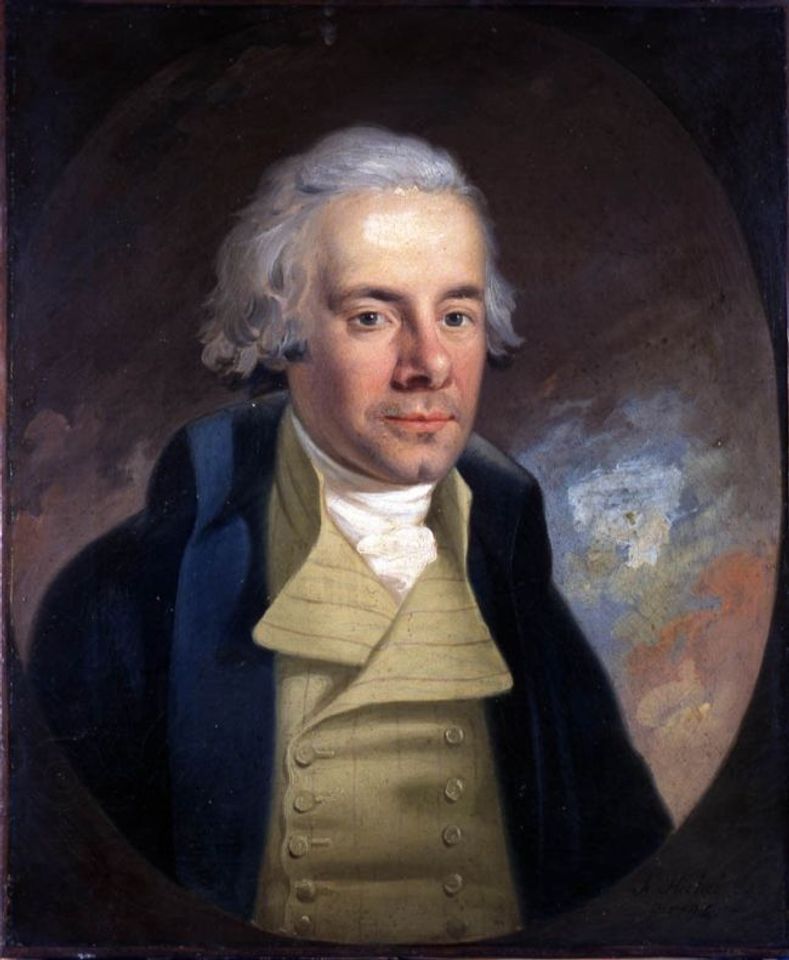
A. Well antislavery in Great Britain emerged in the late 18th century, with Wilberforce and Buxton
William Wilberforce (1759–1833)
and so on, and became focused early on the abolition of slavery everywhere. In the British constitution Parliament is all-powerful. And there’s nothing like the protections for the institution of slavery that exist in the American Constitution in the British political order. If you gain a majority in Parliament, which the antislavery forces in Britain did in the early 1830s, you can pass legislation banning slavery, which is exactly what happened. And the slaveholders in the Caribbean, who obviously opposed this, had very little power in Parliament.

Meanwhile, the slaveholders in the United States actually controlled the government through their domination of the Democratic Party, right through the 1850s. In fact, the principal reason for secession in 1861 was because they had lost control of the United States government for the first time ever.
Q. This relates to your concept of the “counterrevolution of 1861.” Can you explain that?
A. I called it a “preemptive counterrevolution.” This is a concept I borrowed shamelessly from my colleague here at Princeton, Arno Mayer, who wrote on preemptive counterrevolution in Europe in the 20th century. The slaveholders saw the triumph of the Republicans in 1860 as a potential revolution that would abolish slavery. That’s how the Republicans got votes in 1860. They saw Abraham Lincoln and his Republican Party as just as bad as the abolitionists. In order to preempt that revolution that would have overthrown slavery in the South, they undertook what I called, and borrowing this from Arno Mayer, a preemptive counterrevolution, which was secession. But secession, ironically, brought on the very revolution that it attempted to preempt, through the war: the abolition of slavery.
 … Q. … Let me ask you about the American Revolution, even though I know this was not your research field. The 1619 Project also attacks it as founding a slavocracy. There is a historian, Gerald Horne, who has recently argued that it was waged as a slaveholders’ counterrevolution, to protect their property rights.
A. Well, the American Revolution was first and foremost a war for independence. But there was also a more social dimension to the American Revolution, and a movement toward greater democracy, though they didn’t like to use that term. And it coincided with, and partially caused, the abolition of slavery in half of the states, the northern states, as well as a manumission movement among Virginia slaveholders. It was not a revolution in the sense of the French Revolution, which followed it by a decade, or the Soviet Revolution of 1917, but that doesn’t mean it didn’t accomplish anything. It’s accomplishments were more political than social and economic, but nevertheless there were some social and economic dimensions to it, progressive dimensions I would say.

Out of the Revolution came an anti-slavery ethos, which never disappeared, even though the period from the 1790s to the 1830s was a quiet period in the antislavery movement—though there was the Missouri Compromise of 1820. Nevertheless, the anti-slavery ethos that did come out of the Revolution was a subterranean movement that erupted in the 1830s and shaped American political discourse.
Related: 1619, Mao, & 9-11: History According to the NYT — Plus, a Remarkable Issue of National Geographic Reveals the Leftists' "Blame America First" Approach to History

1619: Wondering Why Slavery Persisted for Almost 75 Years After the Founding of the USA? According to Lincoln, the Democrat Party's "Principled" Opposition to "Hate Speech"

Who, Exactly, Is It Who Should Apologize for Slavery and Make Reparations? America? The South? The Descendants of the Planters? …

Update: How bizarre that you would have to depend on the World Socialist Web Site to give a more nuanced, balanced view of slavery than you would find in The New York Times by Rod Dreher  (via Instapundit).
Reason’s Cathy Young tweets an explanation for much of the New York Times’ craziness in the last few years:
“Interesting fact about Gerald Horne, the historian whose work is most commonly cited as basis for the ‘1619 Project’ (or at least the claim that the ‘real’ goal of the American Revolution was to preserve slavery): he’s an actual, pro-Soviet Communist.”
RELATED: 1619, Mao, & 9-11: History According to the NYT — Plus, a Remarkable Issue of National Geographic Reveals the Leftists' "Blame America First" Approach to History

• Wilfred Reilly on 1619: quite a few contemporary Black problems have very little to do with slavery

NO MAINSTREAM HISTORIAN CONTACTED FOR THE 1619 PROJECT

• "Out of the Revolution came an anti-slavery ethos, which never disappeared": Pulitzer Prize Winner James McPherson Confirms that No Mainstream Historian Was Contacted by the NYT for Its 1619 History Project

• Gordon Wood: "The Revolution unleashed antislavery sentiments that led to the first abolition movements in the history of the world" — another Pulitzer-Winning Historian Had No Warning about the NYT's 1619 Project

• A Black Political Scientist "didn’t know about the 1619 Project until it came out"; "These people are kind of just making it up as they go"

• Clayborne Carson: Another Black Historian Kept in the Dark About 1619

• If historians did not hear of the NYT's history (sic) plan, chances are great that the 1619 Project was being deliberately kept a tight secret

• Oxford Historian Richard Carwardine: 1619 is “a preposterous and one-dimensional reading of the American past”

• World Socialists: "the 1619 Project is a politically motivated falsification of history" by the New York Times, aka "the mouthpiece of the Democratic Party"

THE NEW YORK TIMES OR THE NEW "WOKE" TIMES?
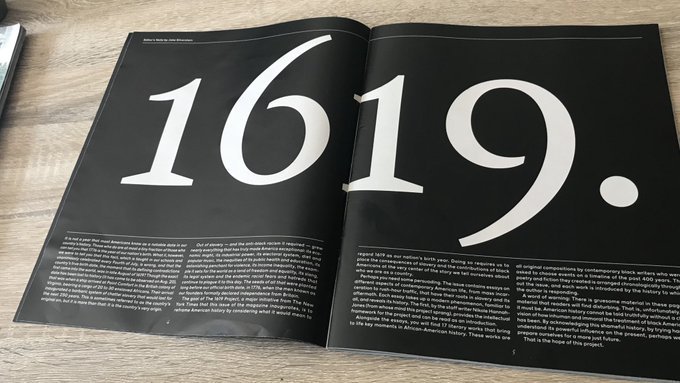
• Dan Gainor on 1619 and rewriting history: "To the Left elite like the NY Times, there’s no narrative they want to destroy more than American exceptionalism"

• Utterly preposterous claims: The 1619 project is a cynical political ploy, aimed at piercing the heart of the American understanding of justice

From Washington to Grant, not a single American deserves an iota of gratitude, or even understanding, from Nikole Hannah-Jones; however, modern autocrats, if leftist and foreign, aren't "all bad"

• One of the Main Sources for the NYT's 1619 Project Is a Career Communist Propagandist who Defends Stalinism

• A Pulitzer Prize?! Among the 1619 Defenders Is "a Fringe Academic" with "a Fetish for Authoritarian Terror" and "a Soft Spot" for Mugabe, Castro, and Even Stalin

• Influenced by Farrakhan's Nation of Islam?! 1619 Project's History "Expert" Believes the Aztecs' Pyramids Were Built with Help from Africans Who Crossed the Atlantic Prior to the "Barbaric Devils" of Columbus (Whom She Likens to Hitler)

• 1793, 1776, or 1619: Is the New York Times Distinguishable from Teen Vogue? Is It Living in a Parallel Universe? Or Is It Simply Losing Its Mind in an Industry-Wide Nervous Breakdown?

• No longer America's "newspaper of record," the "New Woke Times" is now but a college campus paper, where kids like 1619 writer Nikole Hannah-Jones run the asylum and determine what news is fit to print

• The Departure of Bari Weiss: "Propagandists", Ethical Collapse, and the "New McCarthyism" — "The radical left are running" the New York Times, "and no dissent is tolerated"

• "Full of left-wing sophomoric drivel": The New York Times — already drowning in a fantasy-land of alternately running pro-Soviet Union apologia and their anti-American founding “1619 Project” series — promises to narrow what they view as acceptable opinion even more

• "Deeply Ashamed" of the… New York Times (!),  An Oblivious Founder of the Error-Ridden 1619 Project Uses Words that Have to Be Seen to Be Believed ("We as a News Organization Should Not Be Running Something That Is Offering Misinformation to the Public, Unchecked")

• Allen C Guelzo: The New York Times offers bitterness, fragility, and intellectual corruption—The 1619 Project is not history; it is conspiracy theory

• The 1619 Project is an exercise in religious indoctrination: Ignoring, downplaying, or rewriting the history of 1861 to 1865, the Left and the NYT must minimize, downplay, or ignore the deaths of 620,000 Americans

• 1619: It takes an absurdly blind fanaticism to insist that today’s free and prosperous America is rotten and institutionally oppressive

• The MSM newsrooms and their public shaming terror campaigns — the "bullying campus Marxism" is closer to cult religion than politics: Unceasingly searching out thoughtcrime, the American left has lost its mind

Fake But Accurate: The People Behind the NYT's 1619 Project Make a "Small" Clarification, But Only Begrudgingly and Half-Heartedly, Because Said Mistake Actually Undermines The 1619 Project's Entire Premise


THE REVOLUTION OF THE 1770s

• The Collapse of the Fourth Estate by Peter Wood: No one has been able to identify a single leader, soldier, or supporter of the Revolution who wanted to protect his right to hold slaves (A declaration that slavery is the founding institution of America and the center of everything important in our history is a ground-breaking claim, of the same type as claims that America condones rape culture, that 9/11 was an inside job, that vaccinations cause autism, that the Moon landing was a hoax, or that ancient astronauts built the pyramids)

• Mary Beth Norton:  In 1774, a year before Dunmore's proclamation, Americans had already in fact become independent

• Most of the founders, including Thomas Jefferson, opposed slavery’s continued existence, writes Rick Atkinson, despite the fact that many of them owned slaves

• Leslie Harris: Far from being fought to preserve slavery, the Revolutionary War became a primary disrupter of slavery in the North American Colonies (even the NYT's fact-checker on the 1619 Project disagrees with its "conclusions": "It took 60 more years for the British government to finally end slavery in its Caribbean colonies")

• Sean Wilentz on 1619: the movement in London to abolish the slave trade formed only in 1787, largely inspired by… American (!) antislavery opinion that had arisen in the 1760s and 1770s

• 1619 & Slavery's Fatal Lie: it is more accurate to say that what makes America unique isn't slavery but the effort to abolish it

• 1619 & 1772: Most of the founders, including Jefferson, opposed slavery’s continued existence, despite many of them owning slaves; And Britain would remain the world's foremost slave-trading nation into the nineteenth century

• Wilfred Reilly on 1619: Slavery was legal in Britain in 1776, and it remained so in all overseas British colonies until 1833

• Not 1619 but 1641: In Fact, the American Revolution of 1776 Sought to Avoid the Excesses of the English Revolution Over a Century Earlier

• James Oakes on 1619: "Slavery made the slaveholders rich; But it made the South poor; And it didn’t make the North rich — So the legacy of slavery is poverty, not wealth"

• One of the steps of defeating truth is to destroy evidence of the truth, says Bob Woodson; Because the North's Civil War statues — as well as American history itself — are evidence of America's redemption from slavery, it's important for the Left to remove evidence of the truth

TEACHING GENERATIONS OF KIDS FALSEHOODS ABOUT THE U.S.
• 1619: No wonder this place is crawling with young socialists and America-haters — the utter failure of the U.S. educational system to teach the history of America’s founding

• 1619: Invariably Taking the Progressive Side — The Ratio of Democratic to Republican Voter Registration in History Departments is More than 33 to 1

• Denying the grandeur of the nation’s founding—Wilfred McClay on 1619: "Most of my students are shocked to learn that that slavery is not uniquely American"

Inciting Hate Already in Kindergarten: 1619 "Education" Is Part of Far-Left Indoctrination by People Who Hate America to Kids in College, in School, and Even in Elementary Classes

• "Distortions, half-truths, and outright falsehoods": Where does the 1619 project state that Africans themselves were central players in the slave trade? That's right: Nowhere

• John Podhoretz on 1619: the idea of reducing US history to the fact that some people owned slaves is a reductio ad absurdum and the definition of bad faith

• The 1619 Africans in Virginia were not ‘enslaved’, a black historian points out; they were indentured servants — just like the majority of European whites were

"Two thirds of the people, white as well as black, who crossed the Atlantic in the first 200 years are indentured servants" notes Dolores Janiewski; "The poor people, black and white, share common interests"

LAST BUT NOT LEAST…
Wondering Why Slavery Persisted for Almost 75 Years After the Founding of the USA? According to Lincoln, the Democrat Party's "Principled" Opposition to "Hate Speech"

• Victoria Bynum on 1619 and a NYT writer's "ignorance of history": "As dehumanizing and brutal as slavery was, the institution was not a giant concentration camp"

• Dennis Prager: The Left Couldn't Care Less About Blacks

• The Secret About Black Lives Matter; In Fact, the Outfit's Name Ought to Be BSD or BAD

• The Real Reason Why Aunt Jemima, Uncle Ben, and the Land O'Lakes Maid Must Vanish

• The Confederate Flag: Another Brick in the Leftwing Activists' (Self-Serving) Demonization of America and Rewriting of History

Who, Exactly, Is It Who Should Apologize for Slavery and Make Reparations? America? The South? The Descendants of the Planters? …

• Anti-Americanism in the Age of the Coronavirus, the NBA, and 1619

Friday, November 15, 2019

1619, Mao, & 9-11: History According to the NYT—Plus, a Remarkable Issue of National Geographic Reveals the Leftists' "Blame America First" Approach to History


Over the past few months, the New York Times has opined three times on historical questions, both ancient and recent.

How valid, how pretty (sic), have the results been?

First, the 1619 Project, which is designed to call America's entire history a scam, for which Americans deserve to be shamed and punished. (I forgot where I read it, but this is hardly unrelated to the fact it appears that the Democrats' 2020 candidates want less to govern Americans than to punish Americans.) Update: thanks for the Instapundit link, Glenn…

(The present post is mainly about the 1619 take, and la pièce de résistance is a remarkable document by the left-leaning National Geographic's attempt to share in and to contribute to the leftist message — below, in the third part of this post. After a presentation of the Times's, i.e., the leftists', twisted view of history (part 1 of this post) and a discussion thereof (part 2) — not least Europe's contribution to the demonization of the United States (for almost two centuries, if not more!) — the final, 3rd, part, will feature an in-depth examination of a fully left-leaning article that actually manages to utterly debunk the leftists' (and the Europeans') entire (self-serving) premise.)

Second, America's paper of record described the "narrative" within the "arch of history" of communist China's founder as a rise from poverty to (apparently well-deserved) fame and glory. Mao Zedong "began as an obscure peasant", the Times wrote (quoting its own 1976 obituary), and he "died one of history's greatest revolutionary figures."  (By the way: don't forget that Trump ‘May Be Responsible for Many More Millions of Deaths’ than Hitler, Stalin, and Mao — hardly an implausible conclusion to make, when you reflect upon the fact that the NYT' headline for a 1953 Kremlin obituary was: Stalin Rose From Czarist Oppression to Transform Russia Into Mighty Socialist State.)

So, China's revolutionary, who went out of his way to murder 45 million people, deserves nothing but praise and hagiography. While America's revolutionaries must be condemned irrevocably for having slaves (as was part of daily life at the time, indeed had been so the world over up until their era, when Founding Fathers such as George Washington and Thomas Jefferson went out of their way to begin the abolition thereof) — slaves who, by all accounts, were treated in a relatively humane fashion. (By the way, does the average American — does the average foreigner (!) — know that African-Americans in North America lived about twice as long as their fellow slaves in South America, as well as far longer than in Africa… itself? Probably not. That would make the demonization of the United States — along with what is alleged to be white privilege — much harder to accomplish…)
Third, on the 18th anniversary of 9/11, the "newspaper of record" sent out a commemorative tweet ignoring the Islamist terrorists ("airplanes took aim" — compare with guns kill people and must be banned; an irreverent Iowahawk adds, "And 18 years later, we still somehow allow airplanes to be legal. Let that sink in"), managing to downplay the number of the victims (is 2977 closer to "more than 2000" or simply to nearly 3,000?).

The Times also referred to their cold-blooded murders as simple deaths; not to mention they made the chief part of the story the fact that "families will gather at Ground Zero" and that "there will be an outpouring of grief." (On June 6, do we put the main focus on the young American, British, and Canadian soldiers storming ashore in Normandy in 1944 or on the (relatively banal) "annual ritual[s] of mourning" by their families in subsequent years and decades where "once more", common civilians remember their loved ones?)

Likewise, when Abu Bakr al-Baghdadi was killed in October 2019, the Washington Post referred to the ISIS terrorist-in-chief (at least temporarily) as an austere religious scholar while Bloomberg News tried to outdo the Democracy Dies in Darkness newspaper with a fawning headline hailing an up-from-the-bootstraps story. [Update: In December 2019, The Times labels American embassy-storming militants in Baghdad as mourners. "Keep rooting for our enemies", comments Glen Reynolds, "and people might start calling you enemies of the people, guys."]

As an aside, may it be pointed out that the New York Times approach to 9/11 sounds remarkably like that of their fellow leftist, Ilhan Omar, when she describes the crimes of the Islamists as "some people did something," all the while going ballistic at the alleged sins of Americans.

Granted, Omar managed to backtrack somewhat subsequently, saying on CBS’s “Face the Nation” that
9/11 was an attack on all Americans. It was an attack on all of us, and I certainly could not understand the weight of the pain that the families of the victims of 9/11 must feel.
But the Minnesota representative immediately hedges this with a "But": she tempers this with what she finds objectionable — truly shocking — which is that
It’s important for us to make sure that we are not forgetting the aftermath of 9/11, [when] many Americans found themselves now having their civil rights stripped from them, and so what I was speaking to was that as a Muslim, not only was I suffering as an American who was attacked on that day, but the next day I woke up as my fellow Americans were now treating me as suspect.
First of all, when people bring up the suffering and the hundreds of post-9/11 anti-Muslim crimes, they refrain from explaining that many, if not most, of these "hate crimes" are little else than such things as anonymous phone calls with insults.

Forgive me if I am so callous not to get extremely upset about this type of "crime" and would prefer suffering such types of crimes by far, 1,000 times over, to getting blown to smithereens by aircraft used as missiles and having skyscrapers collapse on my head. Or, as a French father wrote four years after 130 people were killed by Islamists in the 2015 attacks in Paris, "They killed my daughter at Le Bataclan, and their women dare to pout about not being allowed to wear a veil!"

Having said that, there is simply no truth to any part of Ilhan Omar's statement: in the aftermath of 9/11, everybody lost civil rights (just look at airport security). Indeed, Americans, whatever their race, creed, or religion, lost civil rights precisely because America was, and is, doing its utmost to show impartiality to the Muslim American community, by targeting everyone as potential suspects…
(End of the brief Omar aside…)


[Update: Likewise, when Qasem Soleimani was taken out two to three months later (on January 3, 2020), A.J. Caschetta wrote that
The terror general’s postmortem fan club members are all denizens of the Left — media figures, celebrities, politicians, and academics.

 … exaggerations of Soleimani’s greatness and the depth of his intellect are common. Time magazine compared him to Cardinal Richelieu and Machiavelli. Prompted by Fareed Zakaria’s claim that Soleimani was “regarded in Iran as a completely heroic figure, personally very brave,” Anderson Cooper compared him to Charles de Gaulle. Rosanna Arquette compared Trump to Hitler for killing the great Soleimani. … The Hollywood script of Trump as bumbling reactionary is more honed among the professoriate, but the elements are the same. It follows well-established patterns developed during the Reagan and both Bush presidencies. No surprise, then, that both Iraq and Iran experts agree that Iran’s leaders are wilier than Trump.]
Such journalistic (sic) perspectives as we have seen in the above three examples have lead Greg Price to observe that:
I would genuinely like to ask the editors of the New York Times if they regret the outcome of the Cold War

Whatever the case: According to leftists, Americans are sinners and need to be shamed, with every molehill made into a mountain. By contrast, America's adversaries, from Mao's communists to Bin Laden's Islamists, are heroic or at least blameless and need to be excused, with every mountain made into a molehill.

To conclude: don't you recognize the NYT's approach to history, whether it's by mainstream media types or simple left-leaning citizens, as well as to current events? Previous generations called it "BLAME AMERICA FIRST!"

(Even as a teenager, I protested: "Why 'first'? There is no 'first'!" It should be called "Blame America alone"!  And so t'is.)

The message to America and to Americans is:

You have nothing to be proud of.

Indeed, the only thing you ought to feel is shame!

Shame!

SHAME!

From Mike Gonzalez in the Federalist:
the series is but yet another attempt to make Americans [and foreigners alike (!)] question [the] country’s very core
Adds Lyman Stone:
the 1619 Project … isn’t mostly about helping Americans understand the role played by plantation agriculture in American history. It’s mostly about convincing Americans [and foreigners alike (!)] that “America” and “slavery” are essentially synonyms.
It’s mostly about trying to tell readers they should feel sort of, kind of, at least a little bit bad about being American, because, didn’t you hear? As several articles say explicitly, America, in its basic DNA, is not a liberal democracy, constitutional republic, or federation. It’s a slave society.

Nothing is more repellent than the next generation of American (as well as foreign, chiefly European) schoolchildren and college students believing that the country lacks “a history to be proud of”, that America is uniquely, demonically evil,  and even that America invented slavery. (As Glenn Reynolds puts it, tongue in cheek, It’s almost as if our education system is in the hands of our nation’s enemies.)

Over at RealClearInvestigations, John Murawski chimes in:
 … the spread of ethnic studies from college campuses to K-12 education is raising alarm among those who find the field one-sided, ideological and frightening. They note, for example, that college students generally take such courses voluntarily, whereas as high-schoolers and middle-schoolers may not have a choice.

"It comes dangerously close to turning American exceptionalism on its head: Yes, we're exceptional – exceptionally evil,” said Will Swaim, president of the California Policy Center, a free market think tank. "It is remindful of re-education camps in Vietnam or China. It is indoctrination rather than education.”
Update: (A surprised) Pulitzer Prize Winner James McPherson Confirms that No Mainstream Historian Was Contacted by the NYT for Its 1619 History Project
 
Instapundit's Sarah Hoyt raises her voice:
Sure, there was slavery in America in the seventeenth century.  Bad news guys. There was slavery everywhere in the seventeenth century, pretty much.

 … Within [the Declaration of Independence], these words — these revolutionary, crazy words — contained the seeds of real justice, contained the fall of slavery, contained… we don’t know yet, but contained the possibility of a future we can build, a future that’s more equitable than all the past.

 … The left wants to revile and destroy our founding fathers in order to make themselves appear revolutionary and new, and innovative.

 … Yes, the founders were men who lived and died in a world full of slavery. But what they built had within it the end of slavery. All kinds of slavery.  It was a mental revolution. The kind that can’t be reset.
Over at the Cat Rotator's Quarterly, TXRed puts things in perspective;
That the Spanish and Prortugese had already been bringing African slaves over, and that almost every other people on the American continents practiced slavery, and that the rest of the planet practiced slavery, doesn’t seem to matter. That slavery is still practiced today, in part because some religious texts positively command it, doesn’t matter to those who are concerned with chattel slavery of Africans as practiced in the British colonies.

Yes, slavery has been around as long as humans have been around in sufficient numbers to get into disputes. And it continues, either openly as slavery, or as debt-peonage, or concubinage, or debt-slavery, or “life servants,” or “gift servants.” Only Europeans tried to end the practice, because they believed that all men were created equal, and that enslaving people was no longer a right and moral practice. But that doesn’t count, or so the New York Times and other sources suggest.
Me being me, I have to wave my penalty flag. First off, slavery is not unique to the Americas, Europeans, or Africans. Everyone enslaved everyone else, ever since waaaay back when.
Africans enslaved other Africans, and sold them to everyone else. Until almost 1800, it was native Africans who controlled the sale of slaves to Europeans in west Africa. …
The Mongols, and later Tatars captured millions of Europeans and sold them into slavery over the course of time from around 1000 until the 1700s. The last slave raids against England and Iceland were in the late 1600s! Part of the job of the Royal Navy was to keep Barbary Pirates from landing and kidnapping English men and women to sell in North Africa. … Indian groups owned slaves just like Euro-Americans did.
… Having practiced chattel slavery makes the US neither unique nor especially evil. It means we were like other humans since the eighth day of creation. 
Over at Minding the Campus, Peter Wood points out that the 1619 Project comes in the wake of
Ta-Nehisi Coates’ anti-white screed Between the World and Me (2015) … now the second most-assigned book in the country in college summer reading programs. Coates treats slavery as an institution that was never truly abolished. It continues as the pervasive racism of American society.

 … The Times launched its 1619 Project on August 18 to a great deal of fanfare. 1619 is the year that the first black African slaves landed at Jamestown. It is a noteworthy date, but not quite what the beginning of slavery in the New World or in what would become the United States. The Spanish [and the Portuguese — see below] had brought African slaves long before. And we have at least one account by an early Spanish soldier, Cabeza de Vaca, who was captured and enslaved by Native Americans in the South in the 1520s. Slavery was an indigenous American institution long before Europeans got here.

Be that as it may, the Times wants to re-imagine the European version of America as founded on slavery and stained in every possible way by the continuing effects of slavery. This is a political project more than a historical one. Its unacknowledged goal is to taint all opposition to progressive political goals as rooted in the perpetuation of oppression, and perhaps to delegitimize America itself.

 … But the 1619 Project also reduces the lives of African Americans to perpetual victimhood, and it ignores the glorious ideal of freedom in American history. It reverses the traditional conception of America as an exceptional land of liberty to conceive of it as an exceptional land of slavery and oppression.

 … The 1619 Project creates a new kind of Black Legend, which casts America as uniquely, demonically evil.

The Times is calculating that Americans are already primed to believe this new Black Legend. They have been softened up by the pseudo-history of Howard Zinn, whose elaborately distorted vision in A People’s History of the United States has been swallowed whole by millions. (A nod of appreciation is due to Mary Grabar whose new book Debunking Howard Zinn is a long-overdue corrective to the Marxist storyteller.) Others are hoping the 1619 Project will flatten what is left of resistance to anti-American mythmaking in K-12 and college history courses. The new Black Legend is already comfortably ensconced in many of our high schools and colleges. The first book college students read very likely treats it as fact.

 … The campaign to delegitimize America, to recast it as a uniquely evil force for slavery and oppression, has triumphed in a myriad of classrooms in American [and European] higher education.

 … The college administrators … deans, provosts, and presidents … are already true believers in The 1619 Project … The institutional stamp of higher education tells incoming college students throughout the country: We believe in the Black Legend of American villainy. And you should too. After all, the editors at The New York Times who commissioned The 1619 Project learned their defamatory history in college.
Do not think that Europe's role in this is secondary or passive. Au contraireEurope's influence in these teachings is paramount and must not be minimized.

From the Europeans' school benches in the 19th century to the establishment in the United States of the Frankfurt School — certainly the European élites' most successful gambit has been to take over at least parts of American education over the course of the 20th century — with the more or less willing aid of the Democrat Party.

I am the son of diplomats who, every three years, would be posted in the embassy of a different national capital — among the places I lived in through my childhood were Denmark, the United States, France, and Belgium:
In Scandinavia I learned about slavery in America along with the treatment of the Indians.

In France I learned about slavery in America along with the treatment of the Indians.

In Belgium I learned about slavery in America along with the treatment of the Indians.

In Scandinavia we did not learn much about the Sámi people — a people, and a word, even most Scandinavians would barely recognize (they are better known as Lapps or Laplanders, but with no Swedish blood-letting attached to their names, only romantic folklore).

In France we did not learn much about Napoleon's conquest of Haiti and the horrors perpetrated on the blacks of that island, along with the reenslavement (!) of the former slaves liberated during the French Revolution.

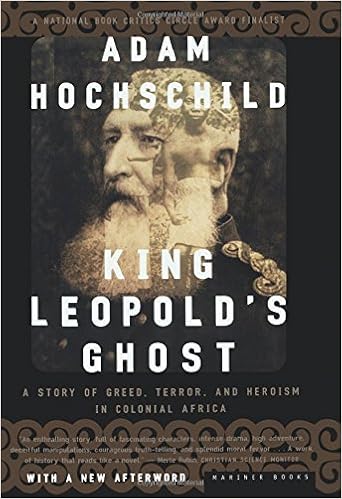
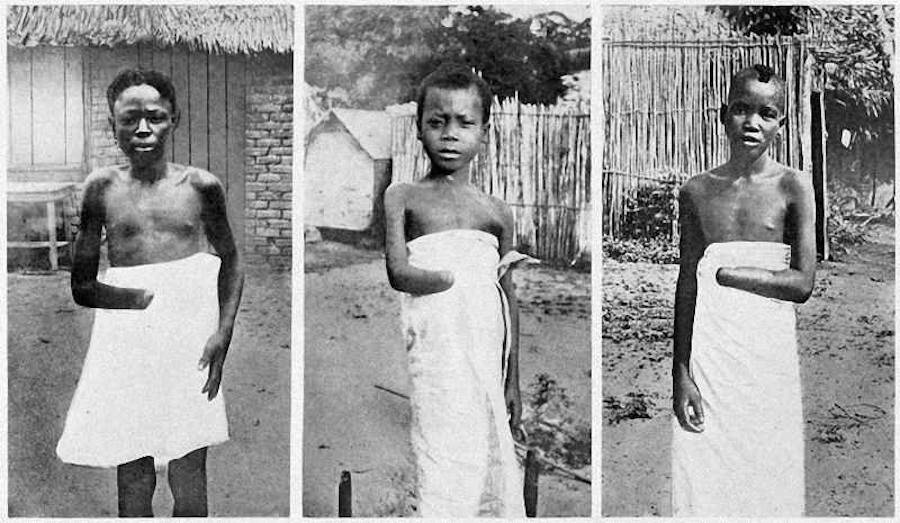
In Belgium we did not learn much about the kingdom's Congo — where, 20 to 40 years after Appomattox, indeed all the way into the early 20th century, blacks were not only the equivalents of slaves, but the terror and brutality meted upon them dwarfed any punishment seen on a Southern plantation, the most terrifying being the most horrific instances of maiming (having hands and/or feet chopped off) if they did not meet their masters' expectations. Marco Margaritoff:
Through the enslavement of locals who worked or starved to death, Belgium made a fortune. Hundreds of thousands of Congolese fled, while tens of thousands were killed or had their arms cut off for rebelling. Between 1880 and 1920, the population plummeted from 20 million to 10 million.

Nor, needless to say, does any American schoolchild learn much, if anything, about the Sami, Haiti, or King Leopold's Congo Free State.
When King Leopold's Ghost (A Story of Greed, Terror, and Heroism in Colonial Africa) was translated into French and Dutch, writes Adam Hochschild,
The Belgian prime minister clearly wanted the row to end. "The colonial past is completely past," he told the [Guardian]. "There is really no strong emotional link any more. . . . It's history."
That's it. The only country where the "past" — if and when leaning towards the negative — is never "completely past" is the United States. The only sins, real or alleged, that there is a strong emotional link to is America's.

As Walt Whitman wrote in the midst of civil war, around 1863 or 1864,
The Democratic Republic has paid her to-day the terrible and resplendent compliment of the united wish of all the nations of the world that her Union should be broken, her future cut off, and that she should be compell’d to descend to the level of kingdoms and empires ordinarily great! There is certainly not one government in Europe but is now watching the war in this country, with the ardent prayer that the united States may be effectually split, crippled, and dismember’d by it. There is not one but would help toward that dismemberment, if it dared. I say such is the ardent wish to-day of England and of France, as governments, and of all the nations of Europe, as governments. I think indeed it is to-day the real, heart-felt wish of all the nations of the world

 … We need this hot lesson of general hatred, and henceforth must never forget it. Never again will we trust the moral sense nor abstract friendliness of a single government of the world.
The reason is very simple: the hatred for America started in the 1780s, when George Washington, instead of executing the Hessian prisoners, instead of keeping the mercenaries imprisoned, or instead of simply sending them home, offered them to remain in the United States and become citizens, even giving them, as far as I remember, free land.

Coupled with comparatively minute amounts of taxes, this led to two fears in Europe's more or less oppressive kingdoms. First, that their countries would become deserted, as whole strata of their populations started emigrating to the land of the free and the brave (for instance, one tenth of the Danish people, one fourth of the Swedish, and one third of the Norwegian); and, two, that their populations would not emigrate (and who could tell which scenario was worse?!) but might start demanding the same rights and freedoms, not to mention the same comparatively low taxes, in their homelands as in America. 

In that perspective, it is no coincidence that it was after the revolutions of 1848, that the European élites eventually started treating their populations better and invented the public school, while passing the message, overtly or covertly, and foremost to their nations' respective children, that those Yankees were hypocrites, racists, violent, and without an iota of compassion within them.

The people, convinced that they (and that their élites) are compassionate, tolerant, and overflowing with wisdom, take these (self-serving) notions to heart and have been doing so for more than a century.

(Similarly, the whole purpose of the social studies systems that grew in Europe throughout the 19th century seems to be to prove that the average person cannot be trusted and therefore that popular government does not work.)

As mentioned earlier, among the most disastrous events of the past 100 years is the Frankfurt School's success in importing European myths to America's schools.

Listen to Mike Gonzalez in the Federalist again:
Edmund Burke wrote in 1790, “To make us love our country, our country ought to be lovely,” and [Howard] Zinn, [Herbert] Marcuse, [Ta-Nehisi Coates, Bryan Stevenson,] and the writers of the “1619 Project” understood that the obverse is also true: You make children believe their nation has been hideous from the start, and you have the makings of a peaceful revolution.
No wonder that, as Jamie Kirchik put it, Barack Obama
entered the White House with a deep conviction that many of the world’s problems were chiefly the consequence of American hubris [which the apologizer-in-chief with the brilliant forward-looking policy of smart diplomacy basically referred to as] disastrous acts of American imperialist aggression
As the Stéphane blog puts it,
we can turn the subject in all directions, in the final analysis, the only problem in the world turns out to be the United States. … In short, nothing is ever right. On the one hand Americans are scolded for acting the part of the world's policeman, on the other, for not acting with the responsibility and the diligence of the world's policeman.
Let Pascal Bruckner have the final word: as it turns out,
there exists in Europe a group of shallow critics [echoed by their American counterparts, better known as leftists and as Democrats] for whom the worst crime by a tyrant like Milosevic [or Saddam, Ho, Mao, Stalin, Hitler, Santa Anna, George III] … can never match the fundamental crime of America's intrinsic sin: the very fact of its existence. (Il existe en Europe un groupe de critiques primaires, pour qui le pire crime d’un tyran comme Milosevic … ne pourra jamais égaler le crime fondamental de l’Amérique — le simple fait d’exister.)
In a sense, it is less an anti-American position per se than a position against independence and self-rule (which the Americans have tried to be champions of for the past two and a half centuries).
Related: 1619: Wondering Why Slavery Persisted for Almost 75 Years After the Founding of the USA? According to Lincoln, the Democrat Party's "Principled" Opposition to "Hate Speech"

Who, Exactly, Is It Who Should Apologize for Slavery and Make Reparations? America? The South? The Descendants of the Planters? …

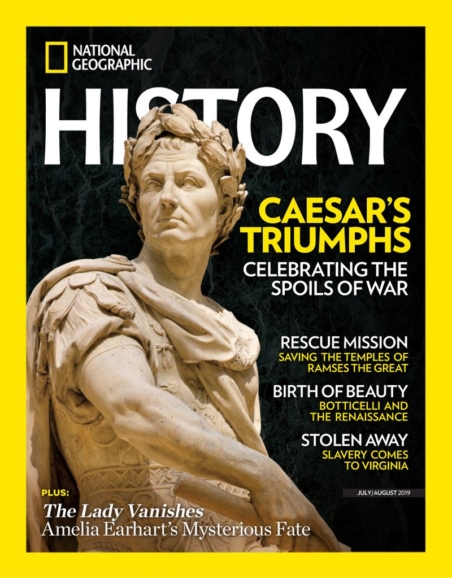
And what all of the above does is bring us to is this post's pièce de résistance. It so happens that the National Geographic got the NYT's message, as its History offspring sets out to join in the demonization of Americans, the nation's birth (its birth defect), and America's very existence.

Like the Journolist — or, more recently, like the Bidens' shady dealings in Ukraine for which all the media outlets hastened to use the exact same dismissive adjective ("inaccurate") to describe a story they had had no more than a few days to investigate — it seems that a number of MSM reporters, editors, and publications have all agreed more or less in secret to set out a broadside of the same, or of a similar, message at the same time.

Over the decades, once-neutral periodicals like the National Geographic, and once-conservative periodicals like the Reader's Digest, have been taken over by leftists and become left-leaning publications. 

Lyman Stone, Peter Wood, and TXRed are among those who have written lengthy articles whose factual details entirely undercut and debunk the 1619 project. (As it turns out, The United States Was a Footnote in Slavery’s History.)

But most of those writers are conservative. What is remarkable about the National Geographic article by "a historian of the African diaspora" is that it is introduced by an opening paragraph presuming America's guilt. Likewise, Dr. Kelley Fanto Deetz's piece ends with finger-wagging about the depth of American guilt. However, if you read the article, "400 years ago, enslaved Africans first arrived in Virginia", the National Geographic's quarterly offshoot is entirely open about the mutiple-nation, multiple-continent, existence of slavery, hiding nothing and in fact giving far more details than our conservative friends do.

What is fascinating about leftists' written history is how they try to get all, or most, details correct, but in the end, they still manage to pull off the "Blame America First Alone" editorializing.

The article starts familiarly enough — with castigation of the United States (or of the future United States):
In late August 1619, “20 and odd” captive Africans first touched the soil at Point Comfort (now Fort Monroe National Monument), part of England’s new colony in Virginia. These men and women had been stolen from their homes in Africa, forced to board a ship, and sailed for months into the unknown. The first Africans in an English colony, their arrival is considered by many historians to be the beginning of a 400-year story filled with tragedy, endurance, survival, and a legacy of resilience, inequality, and oppression.
But what follows, especially the first half of the article, is surprisingly neutral and objective — again, that is, until the conclusion.

Here, the Congolese are not the victims as in the late 19th and early 20th century, they are central in the group of oppressors.

Prepare to be surprised as we take the National Geographic's "400 years ago, enslaved Africans first arrived in Virginia" from the following subhead:

Slavery in Africa

On the west coast of central Africa in the 1600s, the Portuguese were in the midst of a war with Ndongo, a powerful west African kingdom located between the Lukala and Kwanza rivers, in present-day Angola. The people of Ndongo lived in developed cities and towns surrounding their capital city, Kabasa. The capital was where royalty lived, along with approximately 50,000 citizens. In 1618, Portuguese forces aligned with Ndongo’s adversaries, neighboring Imbangala mercenaries, to invade the kingdom. They captured thousands of prisoners to sell into slavery.

These political relationships were spawned 135 years earlier. In 1483, the Portuguese first forged a relationship with the Kingdom of Kongo. Portuguese explorers aimed to spread Catholicism in Africa, colonize both people and land, and grow rich. Upon developing a trade deal with the Portuguese, the Kongo King Nkuwu converted to Catholicism. After his death, his son and heir, King Nzinga Mbemba, took the name King Afonso I and declared the kingdom a Catholic state, firmly bonding the two nations.

In 1512, Afonso I negotiated an agreement with the Portuguese giving them rights to land and direct access to Kongo’s prisoners of war, who would be sold into the transatlantic slave trade. This arrangement provided a model that other European nations and western and central African kingdoms would follow for centuries afterward. (See also: Tracing slaves to their African homelands.)
The first people sold were mostly prisoners of war. African kingdoms were often in conflict, at times absorbing smaller nations or kinship groups into themselves. The vast ethnic, linguistic, and religious diversity in these kingdoms allowed for easily identifiable differences among groups, making it easier for kingdoms to sell their enemies in exchange for weapons and goods to expand and protect their territories. Grand empires, such as the Kongo, Dahomey, Yoruba, Benin, and Asante, were vying for wealth and power in their regions, and Europeans were in need of laborers to build their colonies. It was the ideal circumstance to bring about the largest forced migration in human history.

In just two years, 1618 and 1619, the Portuguese-Imbangala alliance resulted in the capture and enslavement of thousands of Ndongo people, filling at least 36 ships with human cargo. These captives would be sent to the Spanish and Portuguese colonies in Central and South America to work as laborers. It was through this arrangement that slavery would spread to British North America in 1619, when chaos intervened and the destiny of those “20 and odd” Africans was redirected to a place called the Colony of Virginia on the Atlantic coast.
To repeat: In just two years, the Portuguese-Imbangala alliance results in the capture and enslavement of so many Africans that the 1000s upon 1000s of prisoners will fill no less than 36 ships with human cargo. In the second of those two years, a single ship bearing still more African slaves to Iberian America is "accidentally" captured by pirates and sent instead to an English colony, resulting in the unpremeditated landing in Virginia of some 20 Africans

But: neither the Portuguese nor the Spanish nor the English need to be unduly censured for this; neither do the Imbangala nor does any part of Africa. 

No, the only country that deserves castigation is the one that won't be founded for another 150 to 160 years!

They entered the Middle Passage, a phrase used to describe both the trip itself and the shipping of people from the coasts of Africa to the European colonies in the Americas. Conditions aboard the ships were dreadful; a lack of food and water, physical abuse, and severe overcrowding led to the death of approximately 30 percent of the captives on any given ship.

 … It was because of [the] complex political climate that the Africans aboard the San Juan Bautista found themselves in an unexpected turn of events. In late July or early August 1619, just weeks before the Ndongo captives would have been sold through the port of Veracruz, the ship was attacked by pirates searching for Spanish gold.
 … The English colonies were expanding and the captives supplied them with an instant and distinguishable work force. The Spanish and Portuguese capture and enslavement of Africans as laborers in the Atlantic world was common practice by the time Jamestown was established, and the British followed suit. By the end of the 17th century, the colonies’ reliance on indentured servants had shifted toward that of enslaved African people.

Got that? Barely mentioned so far have been the United States — for obvious reasons — as well as their direct colonial forebears (ibid), and neither have their cousins, the colonists' countrymen in Britain (re–ibid). And yet, notice that, as we approach the conclusion of the article, Dr. Kelley Fanto Deetz ("a historian of the African diaspora") loses all interest in, say, the thousands of Ndongo slaves who filled at least 36 ships with human cargo, as she focuses only on the US of A.

By all means, the 20-odd slaves arriving in Virginia by a fluke are not uninteresting, far from it, nor is the fate of the thousands of slaves that would follow them over the next two centuries inside what would exclusively become the territory of the USA, but we know where we are headed as the historian of the African diaspora starts to editorialize by echoing Barack Obama's speech that racism is "part of our [i.e., of Americans'] DNA." This is not anything I have a problem with, offhand, but why does racism never seem to be part of the DNA of, say, Portugal, Spain, France, or Belgium? Or part of the DNA of, say, the Kongo, Benin, Asante, or Imbangala nations?

As an Economist article on slavery in South America's largest country (Brazil) signals, sporting a chart from the Transatlantic Slave Trade Database, the 400,000 slaves brought to mainland North America are a minute part of three and a half centuries of transatlantic slave trade from Africa (only the — tiny — archipelago of the Danish West Indies imported fewer slaves) — thus proving that, in fact, The United States Was a Footnote in Slavery’s History

And yet, the National Geographic article will basically apply the final subhead, "Dark Legacy," to the United States alone.
National Geographic History:
 … Early Virginia census records [mark] the beginnings of a racial caste, formalized into Virginia law by the early 1650s, the enslaved status of African women was written into Virginia law as their children automatically inherited their status and were enslaved at birth, regardless of the father’s identity. This set up slavery as a permanent, hereditary condition. A series of laws, called slave codes, followed, each one cementing racism firmly in the DNA of the United States. 
 … The first Africans in Virginia were followed by more than 400,000 people captured and brought directly from West and central African to the North American slave ports, from New England to New Orleans.

Dark legacy

  most African Americans can only trace their ancestors back to the late 19th century, following emancipation, when African Americans were free to record their own full legal names. Scientific advances in genetics have also given people new tools to find their ancestors via DNA, but creating a full family tree remains unlikely. Few family histories will ever be complete, yet another legacy of the inhumane treatment of enslaved Africans and their descendants. 

Looking back to 1619, one realizes it is time to recognize how racist ideology fed the colonization of the Americas and the systematic enslavement and oppression of both Native Americans and captive Africans. Looking forward, one must also see how necessary it is for humanity to try to tell the full story of the millions of Africans who were stolen away.
Dr. Kelley Fanto Deetz ends on what is seemingly a general note on the Americas, but by this point, the latter half of the article — most of which I have not quoted as you can read it at the link — has only, or mainly, focused on the colonies that would become U.S. states, and it is as clear that the average reader will focus on the U.S. as it is that the "historian of the African diaspora" fully embraces the New York Times's 1619 Project.


Again: The obvious question is if the United States is to be castigated for these sins, why on Earth is it the only, or the main, nation to be so described (and demonized)?  How about the Spanish, Portuguese, and British kingdoms?  How about the Kongo, Dahomey, Yoruba, Benin, and Asante empires?  How about the Arabs? And the Muslims? The Arabs and the Muslims? How do they fit in?

Ask George Avery, who goes even further outside the box:
Relatively speaking, the United States was a minor player in the African Slave Trade — only about 5% of the Africans imported to the New World came to the United States. Of the 10.7 million Africans who survived the ocean voyage, a mere 388,000 were shipped directly to North America. The largest recipients of imported African slaves were Brazil, Cuba. Jamaica, and the other Caribbean colonies. The lifespan of those brought into what is now the United States vastly exceeded those of the other 95%, and the United States was the only purchaser of African slaves where the population grew naturally in slavery – the death rate among the rest was higher than the birth rate. …

The World Slave Trade

The Trans-Saharan and Indian Ocean African slave trade, which began by Arabs as early as the 8th Century AD, dwarfed the Trans-Atlantic slave trade and continued up to the 20th Century. Between the start of the Atlantic Slave Trade and 1900, it is estimated that the eastern-bound Arab slave traders sold over 17 million Africans into slavery in the Middle East and India, compared to about 12 million to the new world – and the Eastern-bound slave trade had been ongoing for at least 600 years at the START of that period.
In any case, this is how the leftist journalist and/or historian operates: he or she camouflages his writing as straightforward facts-only-ma'am reporting, after a quick sting at the beginning, and then brings editorializing in, more or less subversively, at the end.

Leave it to the wide(r)-angle lens of someone like The Federalist's to point out the true story of slavery in the United States is America's Story Is of Increased Refusal to Tolerate Slavery.
 … in 1775, there was no free soil anywhere in the Western hemisphere. Slavery was a universal law. While I cannot say for certain, it is possible there was no free soil in the entire world—that is, no society that categorically forbade all slavery. … In other words, Americans were early adopters of abolition.
More than that, adds Kevin Gutzman in Reclaiming 1619:
Virtually as soon as independence came, the abolition of slavery began.