Monday, May 11, 2020

An insoluble race problem? Black Political Scientist: "I didn’t know about the 1619 Project until it came out"; "These people are kind of just making it up as they go"


The World Socialists' Tom Mackaman is back in form as he interviews a black political scientist about the 1619 Project. It turns out, to no one's surprise, that Adolph Reed was no more aware of the New York Times' pet project until its publication than white historians were…
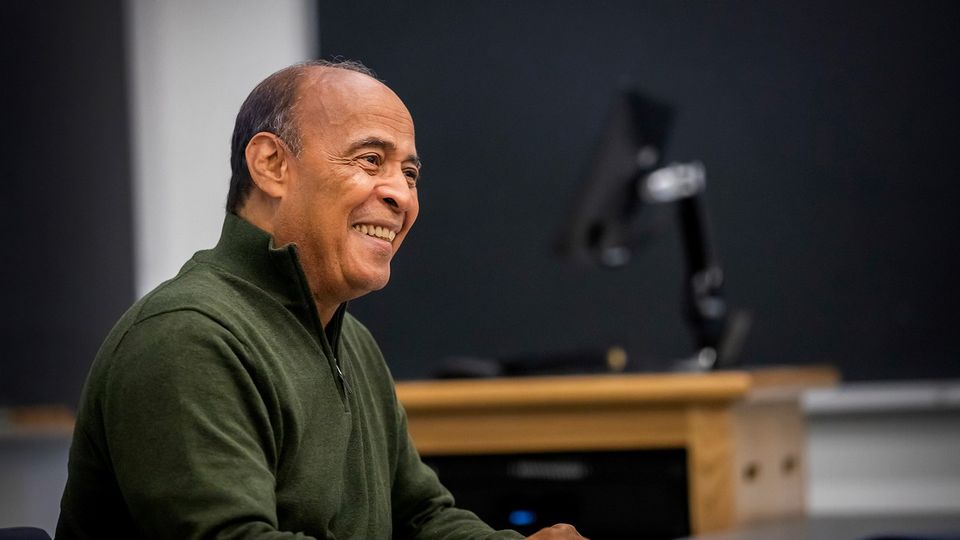
Adolph Reed, Jr., is Professor Emeritus of Political Science at the University of Pennsylvania. He is the author of numerous books and articles dealing with race and class in American society and writes regularly for the New Republic.
 … Q. Let me ask a little bit about your initial reaction to the 1619 Project. I have spoken to several historians who concentrated their criticism on Nikole Hannah-Jones’ lead essay, which is meant to frame the whole thing, and also Matthew Desmond's claim that American capitalism is basically the direct descendent of chattel slavery. Maybe you can help us to understand the rest of the magazine, which is being pushed as a curriculum for school children. It seems to me that what the rest of the essays do is focus on a particular social problem—traffic jams in Atlanta, lack of national healthcare, high sugar in the American diet, and so on—and argue by implication that that's all coming out of slavery. The dominant tendency in academia is to attribute all social problems to race, or to other forms of identity, but the 1619 Project goes farther still, saying that they are all rooted in slavery.
A. I didn’t know about the 1619 Project until it came out, and frankly when I learned about it my reaction was a big sigh. But again, the relation to history has passed to the appropriation of the past in support of what whatever kind of ‘just-so’ stories about the present are desired. This approach has taken root within the Academy. It's like all bets are off.

 … What are the stakes that people imagine to be bound up with demonstrating that capitalism in this country emerged from slavery and racism, which are treated as two different labels for the same pathology? Ultimately, it’s a race reductionist argument. What the Afro-pessimist types or black nationalist types get out of it is an insistence that we can’t ever talk about anything except race. And that's partly because talking about race is the things they have to sell.

If you follow through the logic of disparities discourse, and watch the studies and follow the citations, what you get is a sort of bold announcement of findings, but finding that anybody who has been reading a newspaper over the last 50 or 70 years would assume from the outset: blacks have it worse, and women have it worse, and so on.

It’s in part an expression of a generic pathology of sociology, the most banal expression of academic life. You follow the safe path. You replicate the findings. But it’s not just supposed to be a matter of finding a disparity in and of itself, like differences in the number of days of sunshine in a year. It’s supposed to be a promise that in finding or confirming the disparity in this or that domain that it will bring some kind of mediation of the problem. But the work never calls for that.
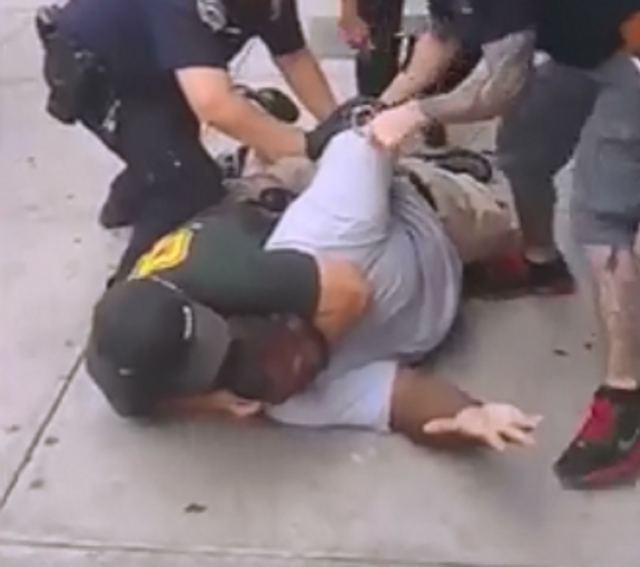
 
Q. You make important points about the way social problems are approached. As an example, we have a scourge of police violence in this country. Over 1,000 Americans are killed each year by police. And the common knowledge, so to speak, is that this is a racial problem. The reality is that the largest number of those killed are white, but blacks are disproportionately killed. But if the position is that this is simply a racial problem, there is no real solution on offer. We have a militarized police force operating under conditions of extreme social inequality, with lots of guns on the streets, with soldiers coming back from serving in neocolonial wars abroad becoming police officers. And all of this is excised in the racialist argument, which if taken at face value, boils down to allegations about racial attitudes among police.
A. Cedric Johnson [3] has made good points on this and I’ve spoken with him at considerable length about the criminal justice system. To overdraw the point, a black Yale graduate who works on Wall Street is no doubt several times more likely to be jacked up by the police on the platform of Metro North than his white counterpart, out of mistaken identity. And that mistaken identity is what we might call racism. But it’s a shorthand. He’s still less likely to be jacked up by the police than the broke white guy in northeast Philadelphia or west Baltimore.

 … So that’s kind of natural enough and you don’t need to have a devil theory like the crack epidemic to explain it—all of this pointless back-and-forth about how the cultural and political authorities are responding to the opioid crisis compared to how they responded to the crack epidemic. I mean, it’s all beside the point.
Q. I was remembering your response to Hurricane Katrina. New Orleans is your hometown, right?
A. Yes.
Q. Maybe you could say something about that because I think you made a strong critique of identity politics in the context of that disaster.
A. First of all, the narrative that only black people lived in the most flood-prone areas was false. The Lakeview section of the city, which was built on reclaimed marshland on the lakefront when I was too small to remember, in the first decades after World War II, was every bit as much below sea level as the Lower Ninth Ward and flooded as completely.

I guess we owe something to Anderson Cooper and Soledad O'Brien for when they began to recoil from, and then eventually to rebel against, the victim-blaming in the aftermath of the hurricane. But what was unfortunate about that moment was that, even though they were moved by it, the power of the iconography, of the disproportionate representation of poor black people on the overpasses in the Convention Center and the Superdome, fed this idea that “nothing has changed,” that there is this insoluble race problem.

Well the first question is, where do you think that the people who brought you those tropical drinks and turned down your bed in the hotel lived? I mean how do you think they lived? Did it never occur to you to wonder what their wages were or anything like that?

Of course it’s a poor city. But it turns out that, proportionally, blacks weren't displaced at a higher rate than whites. It's just that there are a lot more blacks in the city. And also blacks actually didn't die at a higher rate than whites. But the best predictor, or a better predictor than race, of who was able to evacuate first of all, who was able to survive the period of evacuation under relatively decent circumstances, and who was able to come back to the city afterwards—every step along the way, class was a better predictor than race. Class as in a sociological sense, class as access to resources—both monetary and other resources; your lack of dependence on a job, your access to social networks. But it didn't appear to be that way so there becomes this narrative that the story of Katrina’s displacement proves the continuing significance, or new significance, of race.

Well, it turns out that the concrete version of the story is that it shows the power of class and the impact of neoliberalism. Before Mitch Landrieu was elected mayor in 2010 there hadn't been a white mayor since his father left office in 1977. So you had a black government all the way through. But now even with the coming back to the city, for a year or two afterwards, when you’d drive around the city—and granted this is informal observation, but I did it on every trip there and kept tabs—but following the recovery it's not only that the more affluent neighborhoods recovered without regard to race, but that even within the better-off neighborhoods and more affluent blocks, the bigger houses came back first.

But where it really gets corrosive is this narrative that the city was being depopulated of blacks so that whites could take it back. And the first few weeks after the inundation you could certainly find people saying, “We’ll get rid of the crime. Let it all go to Houston.” But it was also pretty clear after a few weeks that the governing elite didn't really have any interest in altering the political regime. Now post-Katrina, and this is a big irony given the race line of arguing, if anything the ruling class in the city is now more seamlessly interracial and biracial than it had been previously.
Q. I think identity politics makes for some strange bedfellows. There's some agreement between the likes of Hannah-Jones and the far right, for example the neo-Confederates you were mentioning when we sat down, who oppose the concept of equality. But she, in the 1619 Project, also calls the Declaration of Independence a “founding myth.”
A. Every state is going to have its founding myths, if you think of them as ideals. But what is so important about Jim Oakes’ book, Scorpion’s Sting, is that you can see this tension about human equality that was rooted in the founding documents and debates. It’s especially ironic to consider, for instance, the three-fifths compromise to the Constitution, which was an expression of exactly the opposite political value that the people who invoke it as part of an Afro-pessimist discourse claim. These people are kind of just making it up as they go, or reinventing the past to suit the purposes of the present.

Right from the outset. Those first 20 people weren't slaves. There wasn’t chattel slavery yet in British North America. But the 1619 Project assumes, in whatever way, that slavery was the natural condition of Africans. And that’s where the Afro-pessimist types wind up sharing a cup of tea with the likes of James Henry Hammond. [James Henry Hammond was a Democratic Party Senator from South Carolina (1857-1860) and leading proponent of slavery in the lead-up to the Civil War]
Q. Let me ask you about what in academia is called “critical race theory” and how you see it at work in the 1619 Project.
A. It’s another expression of reductionism. On the most pedestrian level it’s an observation that what you see is a function of where you stand. At that level there's nothing in it that wasn't in Marx's early writings, or in Mannheim. But then you get an appropriation of the standpoint theory for identity that says for example, all blacks think the same way. It’s taxonomic, a reification. So the retort to that critique has been “intersectionality.” Yes, there’s a black perspective, but what you do is fragment it, so there are multiple black perspectives, because each potential—or each sacralized—social position becomes discrete. That's what gives you intersectionality.

But listening to how people talk about intersectionality, it just seems like dissociative personality disorder. How do you carve out when your male is talking, and your black is talking, and when your steelworker is talking? It seems like the kind of perspective that can work only at a level of abstraction at which no one ever asks to see something concrete. Herbert Butterfield, in The Whig Interpretation of History, back in 1931, had this great criticism of what he calls concepts that are incapable of concrete visualization. But we have this world of theory where big cultural abstractions kind of cross-pollinate and relieve the theorists of historical work.
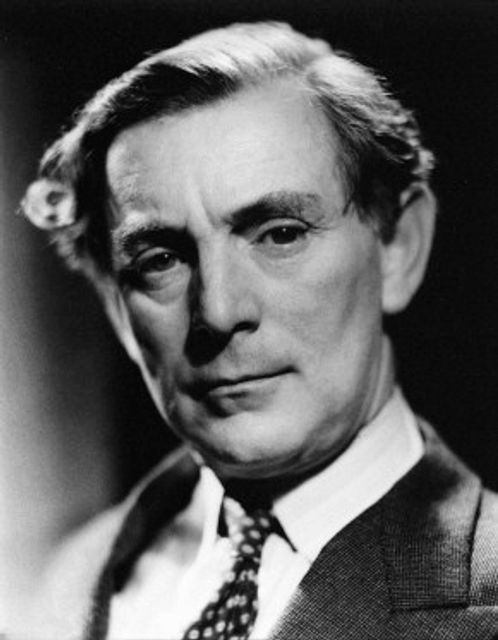
Herbert Butterfield
Q. We’ve spoken to a number of leading historians, including James McPherson, James Oakes, Gordon Wood and Victoria Bynum, and Hannah-Jones launched into a Twitter tirade against them, dismissing them as “white historians.” She is not a historian, but she is the recipient of a MacArthur Foundation “genius grant,” just like Ta-Nehisi Coates and Ibram X. Kendi have been in recent years.
A. I have spent most of my adult life trying to avoid the kind of old-fashioned Stalinist conspiracy theory, but it’s getting hard. My dad used to say that in one sense ideology is the mechanism that harmonizes the principles that you want to believe with what advances your material interest.

And so I understand that the people of MacArthur, for instance, think they're doing something quite different. But when they look for voices, the voices that they look for are the voices that say ultimately, “Well it's a tragedy that's hopeless. We have to atone as individuals. Do whatever you can do to confront disparity.”

I've been joking for a number of years that here at Penn the university administration has three core values: Building the endowment, already at $16 billion. Buying up as much on the real estate as they can on both sides of the Schuylkill River. And diversity. And they're genuinely committed to all three of those because they think that part of their mission is to make the ruling class look like the photo of America.

I made a reference once to Coates being an autodidact, and what I meant by that was that he did not know history, that he’s not a historian. Kendi’s book, I don’t know anyone who has actually read it.
Q. Stamped from the Beginning is the title. There couldn’t be a more anti-historical title. In just four words it mixes biblical and genetic metaphors. He’s now on a national speaking tour.
A. It’s a career path. A number of years ago Ken Warren at the University of Chicago and I ran a seminar, and what we noticed is that a lot of students of color were applying to PhD programs saying that they wanted to get a credential to help them become public intellectuals. And it's only gotten more and more normalized. I mean at this point like if you look at faculty home pages, or even graduate student pages, they read like they're prepared by the William Morris Agency, for example assistant professors claiming 15 subfields of expertise. It's like the bios are written for MSNBC.
Q. I think one element of it is that there's this presumption that it's somehow all “left.” But then you look, and well it's funded by the MacArthur Foundation, and the New York Times loves it, and the Ivy League boards of trustees loves it, so how left can it be? How could it possibly be radical?
A. I've seen some students take umbrage to describing slavery as a labor system, that that is somehow demeaning. I don’t know if you remember this, but there was a controversy a few years ago where this textbook made a reference to the transatlantic slave trade, and then, in the context of the transatlantic slave trade, made a statement that Africans were brought to the New World to work, or were brought as workers. There was a big to-do about this. But the simple structure of the paragraph makes clear that whoever wrote this text was not claiming that African workers weren't slaves, since they were brought here through the transatlantic slave trade. My son Touré Reed, who is a historian at Illinois State University, puts it this way, “There is a tendency to think of slavery as a permanent sadistic camp.” And that’s what comes through in the movies, too.
Q. Right. The idea, and I think the 1619 Project very much promotes this, that slavery was created as a form of racial oppression, rather than a form of labor exploitation that ultimately became rationalized ideologically by racism.

Even when slavery existed, its form of exploitation was so conspicuous, and so brutal, that it obscured other forms of exploitation, including wage labor. But now it’s 2019, and you have the New York Times arguing that every social ill that we have today is descended directly from slavery. As if wage labor exploitation hasn’t happened, as if it’s not happening at the Times itself. As if the great majority of African Americans today are not exploited today as wage laborers, alongside whites.
A. Right. I’ve had this argument with the proponents of reparations. And my question for them all along has been, how can you imagine putting together a political alliance that would be broad enough so that you win on this issue? And if you can’t imagine it, then what are you really doing? And their answer is, “Well, don't you think black people deserve something?” Well, a lot of people deserve a lot.
Q. I agree. The people behind the 1619 Project would of course deny they're advocating a race war. But if blacks and white have immutable, intrinsic, and supra-historical differences, that’s the logic of the position.
A. That's also the punchline of Afro-pessimism, that racism is ubiquitous. That everybody hates blacks or embraces anti-blackness. It's everywhere and there’s this global condition of whiteness.
Q. Hannah-Jones writes that anti-black racism is stamped in the national DNA.
A. The only place that can lead, if it’s impermeable, if it’s immutable, is race war.

The “legacy of slavery” construct is also one I’ve hated for as long as I can remember because, in the first place, why would the legacy of slavery be more meaningful than the legacy of sharecropping and Jim Crow and the legacy of the Great Migration? Or even the New Deal and the CIO? But what's ideologically useful about the legacy of the slavery trope is that it can mean two seemingly quite different things. One is that it can be invoked as proof that blacks are inferior, because slavery has forged an indelible mark. Or it can be invoked as a cultural pathology argument. But it's a misunderstanding to assume that there's a sharp contrast between cultural arguments about inequality and biological arguments. They're basically the same. …
 … Q. I have not tried to search out a historical linkage to this before, but it seems to me that going all the way back to the antebellum it has been the Democratic Party that has done the heavy lifting in promoting racial identity. Of course, there’s a division of labor with the Republicans since the late 1960s and Nixon’s so-called “southern strategy.” Not so long ago, people referred to Republican politicians using “dog whistles” for racism. With Trump it’s become a bullhorn. But the Times’ 1619 Project reflects the agenda of the Democratic Party today. They’re trying to cobble together an electoral coalition based on identities.
A. Absolutely. It’s fascinating to watch Hillary Clinton in 2016 because I remember very well 1992, when the cutting edge of Clintonism was showing there was a new Democratic Party that was going to make Wall Street grateful. It wasn’t a party that was going to coddle black and poor people. And Bill Clinton was very clear about that. That’s what the Crime Bill and Welfare Reform were all about. To see the Clintons presenting themselves as the avatars of racial justice against Bernie Sanders in 2016 was really extraordinary.
Q. Thank you for speaking with us. Before we conclude, let me ask you what you are working on now.
A. Well I’ve started doing a column every month in the New Republic, but I'm trying to finish a book that actually started at the beginning of the Obama era. I was approached by Verso to do a book on Obama and I said no, but I would consider doing a book on Obama-mania, by which I mean the phenomenon that people who should have known better got so excited about him.
Q. You had a really prescient essay on Obama way back in 1996, when he was in Illinois state senator. You referred to him as “a smooth Harvard lawyer with impeccable do-good credentials and vacuous-to-repressive neoliberal politics,” and predicted he was the wave of the future. …
RELATED: 1619, Mao, & 9-11: History According to the NYT — Plus, a Remarkable Issue of National Geographic Reveals the Leftists' "Blame America First" Approach to History
• Wilfred Reilly on 1619: quite a few contemporary Black problems have very little to do with slavery

NO MAINSTREAM HISTORIAN CONTACTED FOR THE 1619 PROJECT

• "Out of the Revolution came an anti-slavery ethos, which never disappeared": Pulitzer Prize Winner James McPherson Confirms that No Mainstream Historian Was Contacted by the NYT for Its 1619 History Project

• Gordon Wood: "The Revolution unleashed antislavery sentiments that led to the first abolition movements in the history of the world" — another Pulitzer-Winning Historian Had No Warning about the NYT's 1619 Project

• A Black Political Scientist "didn’t know about the 1619 Project until it came out"; "These people are kind of just making it up as they go"

• Clayborne Carson: Another Black Historian Kept in the Dark About 1619

• If historians did not hear of the NYT's history (sic) plan, chances are great that the 1619 Project was being deliberately kept a tight secret

• Oxford Historian Richard Carwardine: 1619 is “a preposterous and one-dimensional reading of the American past”

• World Socialists: "the 1619 Project is a politically motivated falsification of history" by the New York Times, aka "the mouthpiece of the Democratic Party"

THE NEW YORK TIMES OR THE NEW "WOKE" TIMES?
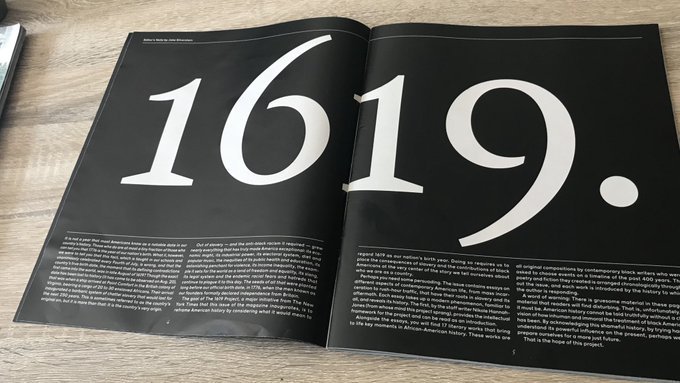
• Dan Gainor on 1619 and rewriting history: "To the Left elite like the NY Times, there’s no narrative they want to destroy more than American exceptionalism"

• Utterly preposterous claims: The 1619 project is a cynical political ploy, aimed at piercing the heart of the American understanding of justice

From Washington to Grant, not a single American deserves an iota of gratitude, or even understanding, from Nikole Hannah-Jones; however, modern autocrats, if leftist and foreign, aren't "all bad"

• One of the Main Sources for the NYT's 1619 Project Is a Career Communist Propagandist who Defends Stalinism

• A Pulitzer Prize?! Among the 1619 Defenders Is "a Fringe Academic" with "a Fetish for Authoritarian Terror" and "a Soft Spot" for Mugabe, Castro, and Even Stalin

• Influenced by Farrakhan's Nation of Islam?! 1619 Project's History "Expert" Believes the Aztecs' Pyramids Were Built with Help from Africans Who Crossed the Atlantic Prior to the "Barbaric Devils" of Columbus (Whom She Likens to Hitler)

• 1793, 1776, or 1619: Is the New York Times Distinguishable from Teen Vogue? Is It Living in a Parallel Universe? Or Is It Simply Losing Its Mind in an Industry-Wide Nervous Breakdown?

• No longer America's "newspaper of record," the "New Woke Times" is now but a college campus paper, where kids like 1619 writer Nikole Hannah-Jones run the asylum and determine what news is fit to print

• The Departure of Bari Weiss: "Propagandists", Ethical Collapse, and the "New McCarthyism" — "The radical left are running" the New York Times, "and no dissent is tolerated"

• "Full of left-wing sophomoric drivel": The New York Times — already drowning in a fantasy-land of alternately running pro-Soviet Union apologia and their anti-American founding “1619 Project” series — promises to narrow what they view as acceptable opinion even more

• "Deeply Ashamed" of the… New York Times (!),  An Oblivious Founder of the Error-Ridden 1619 Project Uses Words that Have to Be Seen to Be Believed ("We as a News Organization Should Not Be Running Something That Is Offering Misinformation to the Public, Unchecked")

• Allen C Guelzo: The New York Times offers bitterness, fragility, and intellectual corruption—The 1619 Project is not history; it is conspiracy theory

• The 1619 Project is an exercise in religious indoctrination: Ignoring, downplaying, or rewriting the history of 1861 to 1865, the Left and the NYT must minimize, downplay, or ignore the deaths of 620,000 Americans

• 1619: It takes an absurdly blind fanaticism to insist that today’s free and prosperous America is rotten and institutionally oppressive

• The MSM newsrooms and their public shaming terror campaigns — the "bullying campus Marxism" is closer to cult religion than politics: Unceasingly searching out thoughtcrime, the American left has lost its mind

Fake But Accurate: The People Behind the NYT's 1619 Project Make a "Small" Clarification, But Only Begrudgingly and Half-Heartedly, Because Said Mistake Actually Undermines The 1619 Project's Entire Premise


THE REVOLUTION OF THE 1770s

• The Collapse of the Fourth Estate by Peter Wood: No one has been able to identify a single leader, soldier, or supporter of the Revolution who wanted to protect his right to hold slaves (A declaration that slavery is the founding institution of America and the center of everything important in our history is a ground-breaking claim, of the same type as claims that America condones rape culture, that 9/11 was an inside job, that vaccinations cause autism, that the Moon landing was a hoax, or that ancient astronauts built the pyramids)

• Mary Beth Norton:  In 1774, a year before Dunmore's proclamation, Americans had already in fact become independent

• Most of the founders, including Thomas Jefferson, opposed slavery’s continued existence, writes Rick Atkinson, despite the fact that many of them owned slaves

• Leslie Harris: Far from being fought to preserve slavery, the Revolutionary War became a primary disrupter of slavery in the North American Colonies (even the NYT's fact-checker on the 1619 Project disagrees with its "conclusions": "It took 60 more years for the British government to finally end slavery in its Caribbean colonies")

• Sean Wilentz on 1619: the movement in London to abolish the slave trade formed only in 1787, largely inspired by… American (!) antislavery opinion that had arisen in the 1760s and 1770s

• 1619 & Slavery's Fatal Lie: it is more accurate to say that what makes America unique isn't slavery but the effort to abolish it

• 1619 & 1772: Most of the founders, including Jefferson, opposed slavery’s continued existence, despite many of them owning slaves; And Britain would remain the world's foremost slave-trading nation into the nineteenth century

• Wilfred Reilly on 1619: Slavery was legal in Britain in 1776, and it remained so in all overseas British colonies until 1833

• Not 1619 but 1641: In Fact, the American Revolution of 1776 Sought to Avoid the Excesses of the English Revolution Over a Century Earlier

• James Oakes on 1619: "Slavery made the slaveholders rich; But it made the South poor; And it didn’t make the North rich — So the legacy of slavery is poverty, not wealth"

• One of the steps of defeating truth is to destroy evidence of the truth, says Bob Woodson; Because the North's Civil War statues — as well as American history itself — are evidence of America's redemption from slavery, it's important for the Left to remove evidence of the truth

TEACHING GENERATIONS OF KIDS FALSEHOODS ABOUT THE U.S.
• 1619: No wonder this place is crawling with young socialists and America-haters — the utter failure of the U.S. educational system to teach the history of America’s founding

• 1619: Invariably Taking the Progressive Side — The Ratio of Democratic to Republican Voter Registration in History Departments is More than 33 to 1

• Denying the grandeur of the nation’s founding—Wilfred McClay on 1619: "Most of my students are shocked to learn that that slavery is not uniquely American"

Inciting Hate Already in Kindergarten: 1619 "Education" Is Part of Far-Left Indoctrination by People Who Hate America to Kids in College, in School, and Even in Elementary Classes

• "Distortions, half-truths, and outright falsehoods": Where does the 1619 project state that Africans themselves were central players in the slave trade? That's right: Nowhere

• John Podhoretz on 1619: the idea of reducing US history to the fact that some people owned slaves is a reductio ad absurdum and the definition of bad faith

• The 1619 Africans in Virginia were not ‘enslaved’, a black historian points out; they were indentured servants — just like the majority of European whites were

"Two thirds of the people, white as well as black, who crossed the Atlantic in the first 200 years are indentured servants" notes Dolores Janiewski; "The poor people, black and white, share common interests"

LAST BUT NOT LEAST…

Wondering Why Slavery Persisted for Almost 75 Years After the Founding of the USA? According to Lincoln, the Democrat Party's "Principled" Opposition to "Hate Speech"

• Victoria Bynum on 1619 and a NYT writer's "ignorance of history": "As dehumanizing and brutal as slavery was, the institution was not a giant concentration camp"

• Dennis Prager: The Left Couldn't Care Less About Blacks

• The Secret About the Black Lives Matter Outfit; In Fact, Its Name Ought to Be BSD or BAD

• The Real Reason Why Aunt Jemima, Uncle Ben, and the Land O'Lakes Maid Must Vanish

• The Confederate Flag: Another Brick in the Leftwing Activists' (Self-Serving) Demonization of America and Rewriting of History

Who, Exactly, Is It Who Should Apologize for Slavery and Make Reparations? America? The South? The Descendants of the Planters? …

• Anti-Americanism in the Age of the Coronavirus, the NBA, and 1619

Radio Courtoisie — Commentaire de l'Actualité Américaine


Le 15 janvier 2020, le patron d'émission du Libre journal du Nouveau Monde recevait trois invités à Radio Courtoisie pour aborder un “commentaire de l'actualité américaine”.

Cliquez sur le lien pour entendre l'émission d'une heure et demie…
Evelyne Joslain, assistée de Stanislas, reçoit : 
  • Paul Reen, membre du groupe des Républicains américains à Paris 
  • Anntoinette Lorrain, membre du groupe des Républicains américains à Paris
  • Erik Svane, membre du groupe des Républicains américains à Paris
Thème : “commentaire de l’actualité aux Etats-Unis”
Evelyne Joslain est l'auteur d'une poignée de livres sur les États-Unis.

Wednesday, May 06, 2020

A Pulitzer Prize?! Among the 1619 Defenders Is "a Fringe Academic" with "a Fetish for Authoritarian Terror" and "a Soft Spot" for Mugabe, Castro, and Even Stalin


As the 1619 Project wins a Pulitzer Prize (showing exactly, if it is still necessary, how much — or, rather, how little — the "Walter Duranty" prize is worth) — albeit, only for commentary — the Capital Research Center points out that among the project's "sturdy scholarly source[s]" who stand outraged about American slavery, is one Professor Gerald Horne, who turns out to be "a fringe academic" harboring, as he does, "a soft spot" for Zimbabwe's Robert Mugabe, Cuba's Fidel Castro, and even the Soviet Union's Joseph Stalin.

American slavery bad? Agreed.

But where are the principles involved when one professor who (rightly) joins in condemning slavery (albeit only in America) turns out to be someone with "a fetish for authoritarian terror" abroad?

As you can see, the only time that slavery, or murder, or society in general, or anything at all, is/are bad — actually a shame and a disgrace and an outrage — it's when they take place in the U.S. of A., and in its free market system.

When they concern any other country or any other system — especially if they are rivals of Uncle Sam — then they are not only neutral, they are a positive good. 
• See also 1619, Mao, & 9-11: History According to the NYT — Plus, a Remarkable Issue of National Geographic Reveals the Leftists' "Blame America First" Approach to History
The Pulitzer Prize win leads to a question from The New Neo:
Hey, if Arafat could get a Nobel Peace Prize, and Obama could get one for merely existing, and Walter Duranty can get a Pulitzer for dastardly lies, why not give it to the NY Times for its bogus anti-American “history” lesson known as the 1619 Project (I’ve written about the project many times before)?

 … No surprise there.

Nobel peace prizes and Pulitzer prizes increasingly have become awards not for objective accomplishments in their respective fields, but for politically correct (that is, leftist) achievements. The achievement of the 1619 Project is as leftist propaganda, which is now the most basic function of the news. The project has already become accepted as a study guide – one of its goals from the start – in many public schools, and as such will serve to shape the views of a new generation:

 … The MSM and entities connected with the press are not content to write propaganda for adult readers only. They want to get the ears of children, and to do that, education is key.
Sarah Hoyt adds that
ALL THE GREAT AWARDS AND PRIZES HAVE LONG SINCE — AS IN MOST OF MY ADULT LIFE — BEEN SKINSUITED. THEY NOW REWARD ONLY POLITICALLY-CORRECT-THINKING. OBJECTIVITY IS PUNISHED
FYI, here is the description of the Capital Research Center's Architects of Woke:
The Architects of Woke series takes aim at far-left post-modernist and Marxist thinkers and activists responsible for the spread of identity politics from college campuses to society at large. 
 The sixth episode, “The 1619 Project's Fake History”, covers the New York Times Magazine's 1619 Project. Directed by Nikole Hannah-Jones, the project attempts to reframe our understanding of American history by alleging the central event in the founding of the United States was the first importation of enslaved Africans to Virginia in 1619 and not the Declaration of Independence in 1776. The project has been notably criticized by esteemed historians for its factual errors. Despite this, schools across the nation have embedded the 1619 Project into their curriculums, perhaps endangering our nation's understanding of its founding for generations to come...
 … The Architects of Woke is hosted and directed by filmmaker Rob Montz …
RELATED: 1619, Mao, & 9-11: History According to the NYT — Plus, a Remarkable Issue of National Geographic Reveals the Leftists' "Blame America First" Approach to History

• Wilfred Reilly on 1619: quite a few contemporary Black problems have very little to do with slavery

NO MAINSTREAM HISTORIAN CONTACTED FOR THE 1619 PROJECT

• "Out of the Revolution came an anti-slavery ethos, which never disappeared": Pulitzer Prize Winner James McPherson Confirms that No Mainstream Historian Was Contacted by the NYT for Its 1619 History Project

• Gordon Wood: "The Revolution unleashed antislavery sentiments that led to the first abolition movements in the history of the world" — another Pulitzer-Winning Historian Had No Warning about the NYT's 1619 Project

• A Black Political Scientist "didn’t know about the 1619 Project until it came out"; "These people are kind of just making it up as they go"

• Clayborne Carson: Another Black Historian Kept in the Dark About 1619

• If historians did not hear of the NYT's history (sic) plan, chances are great that the 1619 Project was being deliberately kept a tight secret

• Oxford Historian Richard Carwardine: 1619 is “a preposterous and one-dimensional reading of the American past”

• World Socialists: "the 1619 Project is a politically motivated falsification of history" by the New York Times, aka "the mouthpiece of the Democratic Party"

THE NEW YORK TIMES OR THE NEW "WOKE" TIMES?

• Dan Gainor on 1619 and rewriting history: "To the Left elite like the NY Times, there’s no narrative they want to destroy more than American exceptionalism"

• Utterly preposterous claims: The 1619 project is a cynical political ploy, aimed at piercing the heart of the American understanding of justice

From Washington to Grant, not a single American deserves an iota of gratitude, or even understanding, from Nikole Hannah-Jones; however, modern autocrats, if leftist and foreign, aren't "all bad"

• One of the Main Sources for the NYT's 1619 Project Is a Career Communist Propagandist who Defends Stalinism

• A Pulitzer Prize?! Among the 1619 Defenders Is "a Fringe Academic" with "a Fetish for Authoritarian Terror" and "a Soft Spot" for Mugabe, Castro, and Even Stalin

• Influenced by Farrakhan's Nation of Islam?! 1619 Project's History "Expert" Believes the Aztecs' Pyramids Were Built with Help from Africans Who Crossed the Atlantic Prior to the "Barbaric Devils" of Columbus (Whom She Likens to Hitler)

• 1793, 1776, or 1619: Is the New York Times Distinguishable from Teen Vogue? Is It Living in a Parallel Universe? Or Is It Simply Losing Its Mind in an Industry-Wide Nervous Breakdown?

• No longer America's "newspaper of record," the "New Woke Times" is now but a college campus paper, where kids like 1619 writer Nikole Hannah-Jones run the asylum and determine what news is fit to print

• The Departure of Bari Weiss: "Propagandists", Ethical Collapse, and the "New McCarthyism" — "The radical left are running" the New York Times, "and no dissent is tolerated"

• "Full of left-wing sophomoric drivel": The New York Times — already drowning in a fantasy-land of alternately running pro-Soviet Union apologia and their anti-American founding “1619 Project” series — promises to narrow what they view as acceptable opinion even more

• "Deeply Ashamed" of the… New York Times (!),  An Oblivious Founder of the Error-Ridden 1619 Project Uses Words that Have to Be Seen to Be Believed ("We as a News Organization Should Not Be Running Something That Is Offering Misinformation to the Public, Unchecked")

• Allen C Guelzo: The New York Times offers bitterness, fragility, and intellectual corruption—The 1619 Project is not history; it is conspiracy theory

• The 1619 Project is an exercise in religious indoctrination: Ignoring, downplaying, or rewriting the history of 1861 to 1865, the Left and the NYT must minimize, downplay, or ignore the deaths of 620,000 Americans

• 1619: It takes an absurdly blind fanaticism to insist that today’s free and prosperous America is rotten and institutionally oppressive

• The MSM newsrooms and their public shaming terror campaigns — the "bullying campus Marxism" is closer to cult religion than politics: Unceasingly searching out thoughtcrime, the American left has lost its mind

Fake But Accurate: The People Behind the NYT's 1619 Project Make a "Small" Clarification, But Only Begrudgingly and Half-Heartedly, Because Said Mistake Actually Undermines The 1619 Project's Entire Premise


THE REVOLUTION OF THE 1770s

• The Collapse of the Fourth Estate by Peter Wood: No one has been able to identify a single leader, soldier, or supporter of the Revolution who wanted to protect his right to hold slaves (A declaration that slavery is the founding institution of America and the center of everything important in our history is a ground-breaking claim, of the same type as claims that America condones rape culture, that 9/11 was an inside job, that vaccinations cause autism, that the Moon landing was a hoax, or that ancient astronauts built the pyramids)

• Mary Beth Norton:  In 1774, a year before Dunmore's proclamation, Americans had already in fact become independent

• Most of the founders, including Thomas Jefferson, opposed slavery’s continued existence, writes Rick Atkinson, despite the fact that many of them owned slaves

• Leslie Harris: Far from being fought to preserve slavery, the Revolutionary War became a primary disrupter of slavery in the North American Colonies (even the NYT's fact-checker on the 1619 Project disagrees with its "conclusions": "It took 60 more years for the British government to finally end slavery in its Caribbean colonies")

• Sean Wilentz on 1619: the movement in London to abolish the slave trade formed only in 1787, largely inspired by… American (!) antislavery opinion that had arisen in the 1760s and 1770s

• 1619 & Slavery's Fatal Lie: it is more accurate to say that what makes America unique isn't slavery but the effort to abolish it

• 1619 & 1772: Most of the founders, including Jefferson, opposed slavery’s continued existence, despite many of them owning slaves; And Britain would remain the world's foremost slave-trading nation into the nineteenth century

• Wilfred Reilly on 1619: Slavery was legal in Britain in 1776, and it remained so in all overseas British colonies until 1833

• Not 1619 but 1641: In Fact, the American Revolution of 1776 Sought to Avoid the Excesses of the English Revolution Over a Century Earlier

• James Oakes on 1619: "Slavery made the slaveholders rich; But it made the South poor; And it didn’t make the North rich — So the legacy of slavery is poverty, not wealth"

• One of the steps of defeating truth is to destroy evidence of the truth, says Bob Woodson; Because the North's Civil War statues — as well as American history itself — are evidence of America's redemption from slavery, it's important for the Left to remove evidence of the truth

TEACHING GENERATIONS OF KIDS FALSEHOODS ABOUT THE U.S.

• 1619: No wonder this place is crawling with young socialists and America-haters — the utter failure of the U.S. educational system to teach the history of America’s founding

• 1619: Invariably Taking the Progressive Side — The Ratio of Democratic to Republican Voter Registration in History Departments is More than 33 to 1

• Denying the grandeur of the nation’s founding—Wilfred McClay on 1619: "Most of my students are shocked to learn that that slavery is not uniquely American"

Inciting Hate Already in Kindergarten: 1619 "Education" Is Part of Far-Left Indoctrination by People Who Hate America to Kids in College, in School, and Even in Elementary Classes

• "Distortions, half-truths, and outright falsehoods": Where does the 1619 project state that Africans themselves were central players in the slave trade? That's right: Nowhere

• John Podhoretz on 1619: the idea of reducing US history to the fact that some people owned slaves is a reductio ad absurdum and the definition of bad faith

• The 1619 Africans in Virginia were not ‘enslaved’, a black historian points out; they were indentured servants — just like the majority of European whites were

"Two thirds of the people, white as well as black, who crossed the Atlantic in the first 200 years are indentured servants" notes Dolores Janiewski; "The poor people, black and white, share common interests"

LAST BUT NOT LEAST…

Wondering Why Slavery Persisted for Almost 75 Years After the Founding of the USA? According to Lincoln, the Democrat Party's "Principled" Opposition to "Hate Speech"

• Victoria Bynum on 1619 and a NYT writer's "ignorance of history": "As dehumanizing and brutal as slavery was, the institution was not a giant concentration camp"

• Dennis Prager: The Left Couldn't Care Less About Blacks

• The Secret About the Black Lives Matter Outfit; In Fact, Its Name Ought to Be BSD or BAD

• The Real Reason Why Aunt Jemima, Uncle Ben, and the Land O'Lakes Maid Must Vanish

• The Confederate Flag: Another Brick in the Leftwing Activists' (Self-Serving) Demonization of America and Rewriting of History

Who, Exactly, Is It Who Should Apologize for Slavery and Make Reparations? America? The South? The Descendants of the Planters? …

• Anti-Americanism in the Age of the Coronavirus, the NBA, and 1619

Tuesday, May 05, 2020

Wilfred Reilly on 1619: Quite a few contemporary Black problems have very little to do with slavery


The United States of America began in 1776, not 1619
declares Wilfred Reilly in Quillette with regards to the 1619 Project, which has now won a Pulitzer Prize (showing exactly, if it is still necessary, how much — or, rather, how little — that prize is worth).
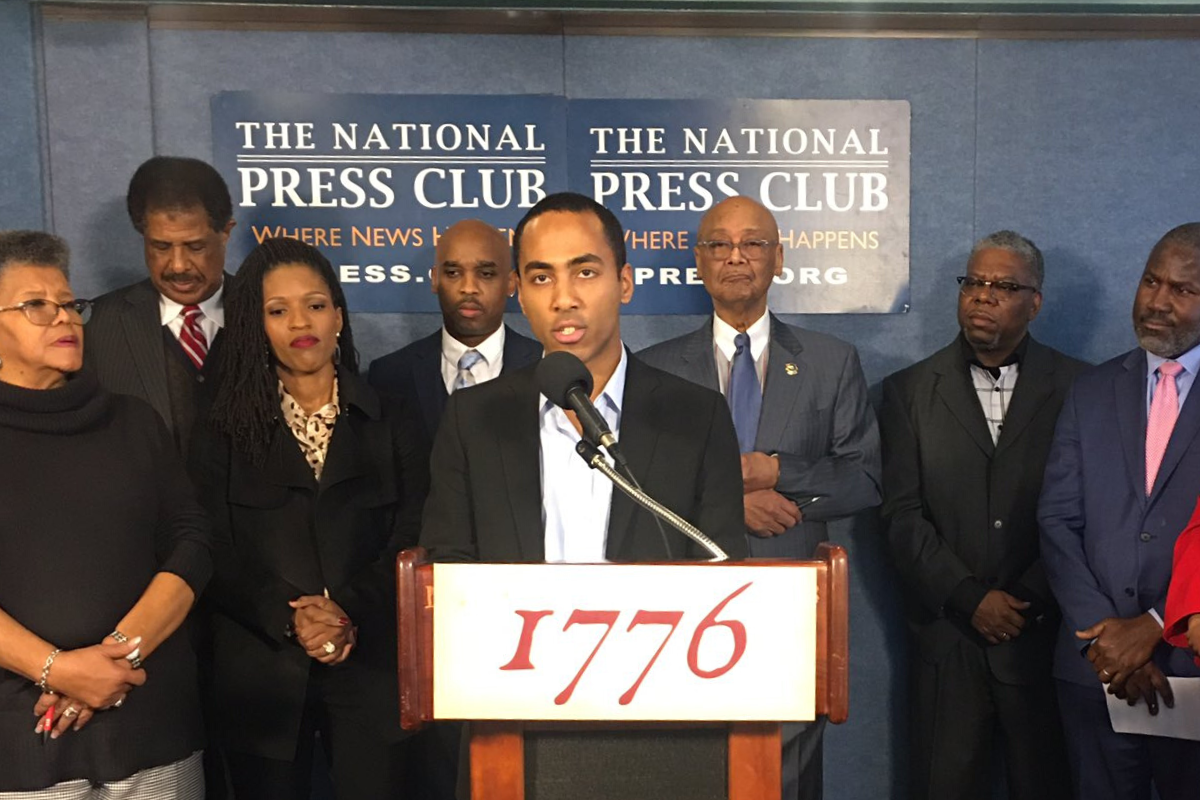
That one sentence is the thesis statement of “1776”—a non-partisan black-led response to the New York Times’s “1619 Project” initiative, which launched last week at D.C.’s National Press Club. I am pleased and proud to be a part of 1776, along with founder Bob Woodson, Glenn Loury, Coleman Hughes, Jason Hill, Carol Swain, John Wood, Taleeb Starkes, Robert Cherry, and many others. From my perspective as a member, 1776 has three core goals:
(1) rebutting some outright historical inaccuracies in the 1619 Project;
(2) discussing tragedies like slavery and segregation honestly while clarifying that these were not the most important historical foundations of the United States; and
(3) presenting an alternative inspirational view of the lessons of our nation’s history to Americans of all races.

 … I will note that my recent book Taboo: Ten Facts You Can’t Talk About makes this same point at some length, pointing out that quite a few contemporary Black problems have very little to do with slavery. For example, the Black rate of “illegitimate” out-of-wedlock childbirths was 11 percent in 1938, barely 70 years after slavery ended, but today hovers around 74 percent—and the illegitimacy rate today is approximately 35 percent for American whites. The welfare policies of the 1960s frankly have been a greater cause of this multi-colored social issue than racialized oppression 150 years ago.

The same could be said of a dozen other issues, from opioid and cocaine abuse to high rates of local incarceration, which seem to bedevil our poor white countrymen roughly as much as blacks, while having little effect on West Indian immigrants who are also almost entirely descended from slaves.

A third—at the very least—strategic omission that is consistent throughout almost all the 1619 Project essays is a focus on American slavery in isolation, to the frequent exclusion of both
(1) narratives about the successful American anti-slavery movement and
(2) narratives about the far harsher slave trades conducted around the globe for most of history.

As yet another internationally famous professor, Princeton University’s James McPherson, has pointed out, slavery in the U.S. was not unique, but rather “only a small part of a larger world process that unfolded over many centuries.” In all likelihood, human beings have been capturing and trading slaves since the first Neolithic battle leaders progressed past simply killing and eating their war captives. Slavery was common in ancient Greece—where Aristotle famously described the unhappy life of a slave as being composed of “work,” “beatings,” and possibly “feedings”—universal in Republican and Imperial Rome, and (under the guise of “chattel serfdom”) not abolished in Russia until 1866.
 
If this even needs to be said, beautiful people of colour kept slaves as well. In fact, one of the world’s most significant slave trades, the Barbary Slave Trade, was focused almost entirely around the sale of white European slaves to Moorish and Black purchasers in North Africa. The Barbary Trade operated from the 16th century to the late 18th century, inspired a verse in the U.S. Marine Corps Hymn (“to the shores of Trip-o-li”), and even helped add the word “slave” to English-language dictionaries: The term comes from “Slav,” an ethnic descriptor for the residents of chaotic Eastern European states (today’s Bosnia, etc.) who were frequently sold into slavery to masters of all shades. While some desire on the part of 1619 participants to focus on the evils of our own society is understandable, it is hardly honest to attribute the unique characteristics of American society to slavery, when essentially all societies had slavery historically and only one became the USA. As the 1776 bossman Bob Woodson has noted, lies and omissions are not effective tools with which to fight racism.

All that said, it is not enough merely to critique an opponent’s worldview: A successful movement must provide a worldview of its own. Three core elements of my view of slavery—and, I think it is fair to say, 1776’s as well—are:
(1) recognizing that an anti-slavery movement led by white and Black people of goodwill existed in this country as long as slavery did, and won in the end;
(2) recognizing that slavery did not “build the USA,” but rather made the pre-bellum South into something of a backwater, due largely to the proud if subtle resistance of the slaves themselves; and
(3) recognizing that America paid a diverse butcher’s bill of hundreds of thousands of lives, during the Civil War, in order to FREE the slaves.

A rock-ribbed anti-slavery movement dates back almost literally to the American founding. As early as the 1770s, Black New Englanders, thousands of whom were Revolutionary War veterans, began a petition-writing campaign that targeted Northern state legislatures and demanded an end to slavery. These petitions, essentially, worked. By the 1790s, 10 states and territories, containing more than 50 percent of the free population of the new nation—Maine, New Hampshire, Vermont, Massachusetts, Rhode Island, Connecticut, New York, Pennsylvania, the North-West Territory, and the Indiana Territory—were free land by law. And the anti-slavery upswell continued. In 1794, Congress prohibited any participation by American ships in the Atlantic slave trade. In 1808, the Act Prohibiting Importation of Slaves made any shipment of enslaved persons from abroad into the USA a crime. Finally, in 1865 all slavery was declared illegal, at the Constitutional level, in the United States. Since that last milestone, 154 years ago, it is worth noting that the population of the country has grown 874 percent (38,000,000 to 333,000,000) and our GDP has increased 11,796 percent ($15 billion to $18.638 trillion), with both increases driven largely by modern-era foreign immigration.

Even within the South, when slavery legally existed, there is little evidence that reliance on feudal serfdom made American slave states richer than their free counterparts. In fact, historian Mark Schulman points out that before the Civil War, “the vast majority of industrial manufacturing” and other competitive industrial work took place in the U.S. North. In 1860, the South had about 25 percent of the USA’s free population, but “only 10 percent of the country’s capital.” The same was true for physical plant: the North had five times as many modern factories, and at least 10 times as many trained factory workers. Overall, 90 percent or more of the nation’s skilled-trades workers were based in the North. In his magisterial Black Rednecks and White Liberals, Thomas Sowell goes a step beyond Schulman, arguing that the prevalence of slavery in the antebellum South actually led to a mocking attitude toward hard work that continues to plague both “white trash” and inner-city Black communities today.

Finally, any cost-benefit analysis of the impact of slavery on the USA would be incomplete without including the costs of freeing the slaves. In fiscal terms alone, the price tag for the Civil War was a high one. Between 1861 and 1865, the U.S. national debt surged from $65 million to $2.77 billion, an increase of many tens of billions in today’s dollars. And, even this pales in comparison to the great conflict’s human toll. According to History.com’s Jennie Cohen, the generally accepted figure for Union Army battle deaths during the Civil War is 360,222. The equivalent figure for Confederate deaths, which many historians consider a low-ball, is 258,000. All told, about one in 10 American men of military age in 1860 died as a direct result of the Civil War. Among Southern white men in their early 20s, 22.6 percent—nearly one in four—died during the war. It seems no exaggeration to estimate that more than one Union soldier died for every 10 slaves freed. If the USA owed a bill for slavery, we have, arguably, already paid it.

The vision of 1776 goes far beyond disagreement with the political Left about questions of historical slavery. When I talked to the project’s founder founder Bob Woodson on February 3rd, he described the broader vision behind 1619 as “just more of the same.” Sounding quite similar to Dr. Oakes, Bob pointed out that the thesis underlying many 1619 Project essays—and, arguably, most arguments on the identitarian Left—can be summed up as “You do not control your own life.” This claim might be dismissed as an exaggeration, but it is not: in what sense can one be said to have free will, if the true cause of (say) the individual decision to father a child out of wedlock was a lost race war back in 1856? Modern ideas of miasmatic racism make the radical argument seem stronger and more tempting: If the REAL reason young brothers struggle with the SAT is “the subtle institutional structural racism of the white gaze,” and not the fact that we study a bit less for the exam, then why ever bother to study more?
RELATED: 1619, Mao, & 9-11: History According to the NYT — Plus, a Remarkable Issue of National Geographic Reveals the Leftists' "Blame America First" Approach to History

• Wilfred Reilly on 1619: quite a few contemporary Black problems have very little to do with slavery

NO MAINSTREAM HISTORIAN CONTACTED FOR THE 1619 PROJECT

• "Out of the Revolution came an anti-slavery ethos, which never disappeared": Pulitzer Prize Winner James McPherson Confirms that No Mainstream Historian Was Contacted by the NYT for Its 1619 History Project

• Gordon Wood: "The Revolution unleashed antislavery sentiments that led to the first abolition movements in the history of the world" — another Pulitzer-Winning Historian Had No Warning about the NYT's 1619 Project

• A Black Political Scientist "didn’t know about the 1619 Project until it came out"; "These people are kind of just making it up as they go"

• Clayborne Carson: Another Black Historian Kept in the Dark About 1619

• If historians did not hear of the NYT's history (sic) plan, chances are great that the 1619 Project was being deliberately kept a tight secret

• Oxford Historian Richard Carwardine: 1619 is “a preposterous and one-dimensional reading of the American past”

• World Socialists: "the 1619 Project is a politically motivated falsification of history" by the New York Times, aka "the mouthpiece of the Democratic Party"

THE NEW YORK TIMES OR THE NEW "WOKE" TIMES?

• Dan Gainor on 1619 and rewriting history: "To the Left elite like the NY Times, there’s no narrative they want to destroy more than American exceptionalism"

• Utterly preposterous claims: The 1619 project is a cynical political ploy, aimed at piercing the heart of the American understanding of justice

From Washington to Grant, not a single American deserves an iota of gratitude, or even understanding, from Nikole Hannah-Jones; however, modern autocrats, if leftist and foreign, aren't "all bad"

• One of the Main Sources for the NYT's 1619 Project Is a Career Communist Propagandist who Defends Stalinism

• A Pulitzer Prize?! Among the 1619 Defenders Is "a Fringe Academic" with "a Fetish for Authoritarian Terror" and "a Soft Spot" for Mugabe, Castro, and Even Stalin

• Influenced by Farrakhan's Nation of Islam?! 1619 Project's History "Expert" Believes the Aztecs' Pyramids Were Built with Help from Africans Who Crossed the Atlantic Prior to the "Barbaric Devils" of Columbus (Whom She Likens to Hitler)

• 1793, 1776, or 1619: Is the New York Times Distinguishable from Teen Vogue? Is It Living in a Parallel Universe? Or Is It Simply Losing Its Mind in an Industry-Wide Nervous Breakdown?

• No longer America's "newspaper of record," the "New Woke Times" is now but a college campus paper, where kids like 1619 writer Nikole Hannah-Jones run the asylum and determine what news is fit to print

• The Departure of Bari Weiss: "Propagandists", Ethical Collapse, and the "New McCarthyism" — "The radical left are running" the New York Times, "and no dissent is tolerated"

• "Full of left-wing sophomoric drivel": The New York Times — already drowning in a fantasy-land of alternately running pro-Soviet Union apologia and their anti-American founding “1619 Project” series — promises to narrow what they view as acceptable opinion even more

• "Deeply Ashamed" of the… New York Times (!),  An Oblivious Founder of the Error-Ridden 1619 Project Uses Words that Have to Be Seen to Be Believed ("We as a News Organization Should Not Be Running Something That Is Offering Misinformation to the Public, Unchecked")

• Allen C Guelzo: The New York Times offers bitterness, fragility, and intellectual corruption—The 1619 Project is not history; it is conspiracy theory

• The 1619 Project is an exercise in religious indoctrination: Ignoring, downplaying, or rewriting the history of 1861 to 1865, the Left and the NYT must minimize, downplay, or ignore the deaths of 620,000 Americans

• 1619: It takes an absurdly blind fanaticism to insist that today’s free and prosperous America is rotten and institutionally oppressive

• The MSM newsrooms and their public shaming terror campaigns — the "bullying campus Marxism" is closer to cult religion than politics: Unceasingly searching out thoughtcrime, the American left has lost its mind

Fake But Accurate: The People Behind the NYT's 1619 Project Make a "Small" Clarification, But Only Begrudgingly and Half-Heartedly, Because Said Mistake Actually Undermines The 1619 Project's Entire Premise


THE REVOLUTION OF THE 1770s

• The Collapse of the Fourth Estate by Peter Wood: No one has been able to identify a single leader, soldier, or supporter of the Revolution who wanted to protect his right to hold slaves (A declaration that slavery is the founding institution of America and the center of everything important in our history is a ground-breaking claim, of the same type as claims that America condones rape culture, that 9/11 was an inside job, that vaccinations cause autism, that the Moon landing was a hoax, or that ancient astronauts built the pyramids)

• Mary Beth Norton:  In 1774, a year before Dunmore's proclamation, Americans had already in fact become independent

• Most of the founders, including Thomas Jefferson, opposed slavery’s continued existence, writes Rick Atkinson, despite the fact that many of them owned slaves

• Leslie Harris: Far from being fought to preserve slavery, the Revolutionary War became a primary disrupter of slavery in the North American Colonies (even the NYT's fact-checker on the 1619 Project disagrees with its "conclusions": "It took 60 more years for the British government to finally end slavery in its Caribbean colonies")

• Sean Wilentz on 1619: the movement in London to abolish the slave trade formed only in 1787, largely inspired by… American (!) antislavery opinion that had arisen in the 1760s and 1770s

• 1619 & Slavery's Fatal Lie: it is more accurate to say that what makes America unique isn't slavery but the effort to abolish it

• 1619 & 1772: Most of the founders, including Jefferson, opposed slavery’s continued existence, despite many of them owning slaves; And Britain would remain the world's foremost slave-trading nation into the nineteenth century

• Wilfred Reilly on 1619: Slavery was legal in Britain in 1776, and it remained so in all overseas British colonies until 1833

• Not 1619 but 1641: In Fact, the American Revolution of 1776 Sought to Avoid the Excesses of the English Revolution Over a Century Earlier

• James Oakes on 1619: "Slavery made the slaveholders rich; But it made the South poor; And it didn’t make the North rich — So the legacy of slavery is poverty, not wealth"

• One of the steps of defeating truth is to destroy evidence of the truth, says Bob Woodson; Because the North's Civil War statues — as well as American history itself — are evidence of America's redemption from slavery, it's important for the Left to remove evidence of the truth

TEACHING GENERATIONS OF KIDS FALSEHOODS ABOUT THE U.S.

• 1619: No wonder this place is crawling with young socialists and America-haters — the utter failure of the U.S. educational system to teach the history of America’s founding

• 1619: Invariably Taking the Progressive Side — The Ratio of Democratic to Republican Voter Registration in History Departments is More than 33 to 1

• Denying the grandeur of the nation’s founding—Wilfred McClay on 1619: "Most of my students are shocked to learn that that slavery is not uniquely American"

Inciting Hate Already in Kindergarten: 1619 "Education" Is Part of Far-Left Indoctrination by People Who Hate America to Kids in College, in School, and Even in Elementary Classes

• "Distortions, half-truths, and outright falsehoods": Where does the 1619 project state that Africans themselves were central players in the slave trade? That's right: Nowhere

• John Podhoretz on 1619: the idea of reducing US history to the fact that some people owned slaves is a reductio ad absurdum and the definition of bad faith

• The 1619 Africans in Virginia were not ‘enslaved’, a black historian points out; they were indentured servants — just like the majority of European whites were

"Two thirds of the people, white as well as black, who crossed the Atlantic in the first 200 years are indentured servants" notes Dolores Janiewski; "The poor people, black and white, share common interests"

LAST BUT NOT LEAST…

Wondering Why Slavery Persisted for Almost 75 Years After the Founding of the USA? According to Lincoln, the Democrat Party's "Principled" Opposition to "Hate Speech"

• Victoria Bynum on 1619 and a NYT writer's "ignorance of history": "As dehumanizing and brutal as slavery was, the institution was not a giant concentration camp"

• Dennis Prager: The Left Couldn't Care Less About Blacks

• The Secret About the Black Lives Matter Outfit; In Fact, Its Name Ought to Be BSD or BAD

• The Real Reason Why Aunt Jemima, Uncle Ben, and the Land O'Lakes Maid Must Vanish

• The Confederate Flag: Another Brick in the Leftwing Activists' (Self-Serving) Demonization of America and Rewriting of History

Who, Exactly, Is It Who Should Apologize for Slavery and Make Reparations? America? The South? The Descendants of the Planters? …

• Anti-Americanism in the Age of the Coronavirus, the NBA, and 1619

You Better Fact-Check Your Text Messages Before Sending Them; Here Is Why

If I am still alive today, it's only because
in the nick of time, I prevented myself
from committing an irreparable gaffe
 
The other day, on Facebook or some
such social media, I came upon a picture
of a female friend (a pretty lass, too)
outside in her garden
 
She was wearing a heavy coat,
and it looked like it was freezing,
so I decided to send her a text:

You look cold!

Except that these days, I hardly type anymore;
I dictate into the phone, and the text comes out
the way I say it — usually.


Incidentally, every punctuation mark must
be dictated too, so I get a lot of ribbing from
my friends — no wonder one of them calls me
Mr. Comma while another calls me New Line
New Line! — when they hear me dictate
a sentence (?!) like
What the journalist asked was colon open quote Did you know that California comma Texas comma Florida comma and New York are the largest states in the USA question mark end quote new line new line The amazed citizen open parenthesis who hails from Illinois close parenthesis answered colon open quote I had no idea exclamation mark exclamation mark exclamation mark end quote
(Of course, even if you are not mumbling,
there is the risk of a "typo" — just a day or two ago,
a friend told me he had no idea what I was talking about, 
turns out that the word "statist" in my SMS had ended up as "status" — 
so you better fact-check yourself)
 
Back to my brush with death:
My sentence was so short and uncontroversial
that I hardly took a second look at it
 
Right before I hit the Send button,
I did fact-check myself, and then
I nearly spit my coffee all over the screen.
 
Can you imagine how my friend would have
reacted if she had received a message reading:
"You look old"?!
 
So raise your coffee mug, and drink a toast 
to your friend Erik, who managed to save
his life in the nick of time.

Monday, May 04, 2020

The Lockdown Is Not Only Useless, Says Veteran Epidemiologist; It Is Counterproductive


For a century or more, one thing that has been so much taken for granted that it is not even a subject of contention anywhere in the world is that three things that are essential for a healthy body and soul as well as in the fight against most, if not all, diseases, are: 1) fresh air, 2) sunshine, and 3) exercise. So what is the deal with the lockdown by keeping us cooped inside our homes?

Actually, the lockdowns are not just useless, reports Daniel Payne at the College Fix, quoting a veteran scholar of epidemiology. They are counterproductive.

The former head of the Department of Biostatistics, Epidemiology, and Research Design at the Rockefeller University in New York City
has warned that the ongoing lockdowns throughout the United States and the rest of the world are almost certainly just prolonging the coronavirus outbreak rather than doing anything to truly mitigate it.

Knut Wittkowski … said in an interview with the Press and the Public Project that the coronavirus could be “exterminated” if we permitted most people to lead normal lives and sheltered the most vulnerable parts of society until the danger had passed.

“[W]hat people are trying to do is flatten the curve. I don’t really know why. But, what happens is if you flatten the curve, you also prolong, to widen it, and it takes more time. And I don’t see a good reason for a respiratory disease to stay in the population longer than necessary,” he said.

With all respiratory diseases, the only thing that stops the disease is herd immunity. About 80% of the people need to have had contact with the virus, and the majority of them won’t even have recognized that they were infected, or they had very, very mild symptoms, especially if they are children. So, it’s very important to keep the schools open and kids mingling to spread the virus to get herd immunity as fast as possible, and then the elderly people, who should be separated, and the nursing homes should be closed during that time, can come back and meet their children and grandchildren after about 4 weeks when the virus has been exterminated,” he added.

Wittkowski argued that the standard cycle of respiratory diseases is a two-week outbreak, including a peak, after which “it’s gone.” He pointed out that even in a regime of “social distancing,” the virus will still find ways to spread, just more slowly:
You cannot stop the spread of a respiratory disease within a family, and you cannot stop it from spreading with neighbors, with people who are delivering, who are physicians—anybody. People are social, and even in times of social distancing, they have contacts, and any of those contacts could spread the disease. It will go slowly, and so it will not build up herd immunity, but it will happen. And it will go on forever unless we let it go.
Asked about Anthony Fauci, the White House medical expert who for weeks has been predicting significant numbers of COVID-19 deaths in America as well as major ongoing disruptions to daily life possibly for years, Wittkowski replied:
“Well, I’m not paid by the government, so I’m entitled to actually do science.”

Wizard of Id: Another Prescient Cartoon Who Seems to Foretell the Coronavirus Outbreak


Another cartoonist, besides Scott Adams, with an uncanny sense of timing, is the Wizard of Id's Mason Mastroianni who manages to capture the Coronavirus scare in a February 27 cartoon. What is "spooky", as one reader writes below, is to bear in mind that all cartoons are written and drawn probably a month or two before publication…
flagmichael  
The spooky thing is knowing this strip was drawn long enough ago for the “novel coronavirus 2019” not to be a widespread fear. Certainly before Iran’s deputy health minister insisted there was no major problem in Iran as he displayed his symptoms.
See also: Dilbert