Thanks to the efforts of the World Socialist Web Site, of all places, we are getting to get an idea of not only how many mainstream historians the New York Times failed to approach for its
1619 project, but that they did not even have any "awareness that it was being done". Following his in-depth talks with
James McPherson, the
WSWS's
Tom Mackaman now brings us (thanks to
the American Conservative's
Rod Dreher) an interview with
Gordon Wood … professor emeritus at Brown University and author of the Pulitzer Prize-winning book The Radicalism of the American Revolution, as well as Empire of Liberty: A History of the Early Republic, 1789–1815, and dozens of other books and articles on the colonial period, the American Revolution and the early republic.
Q. Let me begin by asking you your initial reaction to the 1619 Project. When did you learn about it?
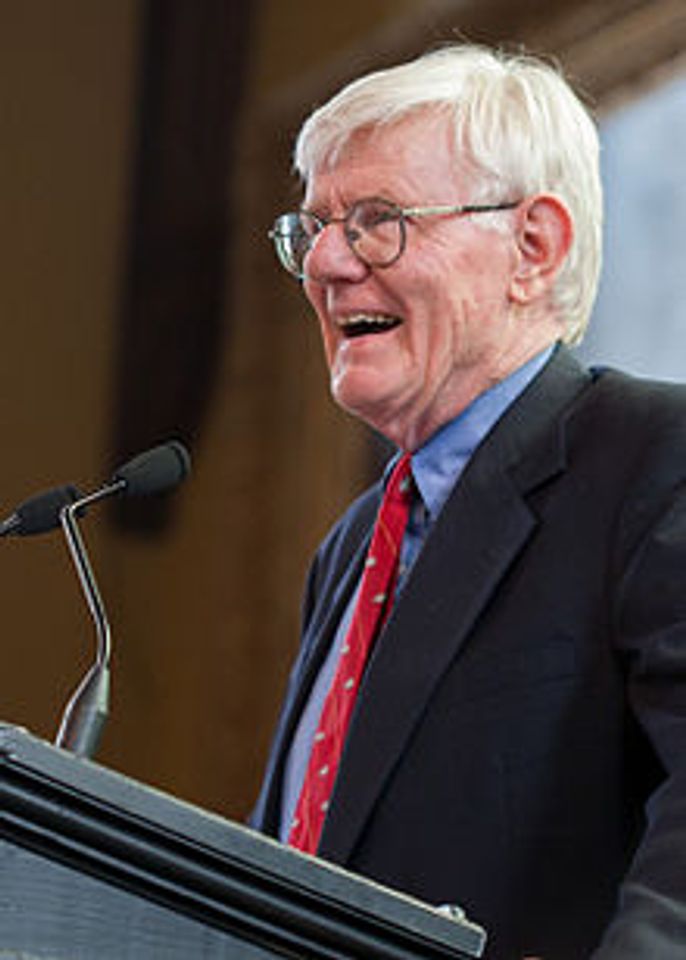
Gordon Wood (2016)
A. Well, I was surprised when I opened my Sunday New York Times in August and found the magazine containing the project. I had no warning about this. … I just couldn’t believe this.
I was surprised, as many other people were, by the scope of this
thing, especially since it’s going to become the basis for high school
education and has the authority of the New York Times behind it, and yet it is so wrong in so many ways.
Q. I want to return to the question of slavery and the American
Revolution, but first I wanted to follow up, because you said you were
not approached. Yet you are certainly one of the foremost authorities on
the American Revolution, which the 1619 Project trains much of its fire
on.
A. Yes, no one ever approached me. None of the leading scholars of
the whole period from the Revolution to the Civil War, as far I know,
have been consulted. I read the Jim McPherson interview and he was just as surprised as I was.
Q. Can you discuss the relationship between the American Revolution and the institution of slavery?
A. One of the things that I have emphasized in my writing is how many
southerners and northerners in 1776 thought slavery was on its last
legs and that it would naturally die away. You can find quotation after
quotation from people seriously thinking that slavery was going to
wither away in several decades. Now we know they couldn’t have been more
wrong. But they lived with illusions and were so wrong about so many
things. We may be living with illusions too. One of the big lessons of
history is to realize how the past doesn’t know its future. We know how
the story turned out, and we somehow assume they should know what we
know, but they don’t, of course.
They don’t know their future any more
than we know our future, and so many of them thought that slavery would
die away, and at first there was considerable evidence that that was
indeed the case.
At the time of the Revolution, the Virginians had more slaves than
they knew what to do with, so they were eager to end the international
slave trade. But the Georgians and the South Carolinians weren’t ready
to do that yet. That was one of the compromises that came out of the
Constitutional Convention. The Deep South was given 20 years to import
more slaves, but most Americans were confident that the despicable
transatlantic slave trade was definitely going to end in 1808.
Q. Under the Jefferson administration?
A. Yes, it was set in the Constitution at 20 years, but everyone knew
this would be ended because nearly everyone knew that this was a
barbaric thing, importing people and so on. Many thought that ending the
slave trade would set slavery itself on the road to extinction. Of course, they were wrong.
I think the important point to make about slavery is that it had
existed for thousands of years without substantial criticism, and it
existed all over the New World. It also existed elsewhere in the world.
Western Europe had already more or less done away with slavery. Perhaps
there was nothing elsewhere comparable to the plantation slavery that
existed in the New World, but slavery was widely prevalent in Africa and
Asia. There is still slavery today in the world.
And it existed in all of these places without substantial criticism.
Then suddenly in the middle of the 18th century you begin to get some
isolated Quakers coming out against it. But it’s the American Revolution
that makes it a problem for the world. And the first real anti-slave
movement takes place in North America. So this is what’s missed by these
essays in the 1619 Project.
Q. The claim made by Nikole Hannah-Jones in the 1619 Project that the
Revolution was really about founding a slavocracy seems to be coming
from arguments made elsewhere that it was really Great Britain that was
the progressive contestant in the conflict, and that the American
Revolution was, in fact, a counterrevolution, basically a conspiracy to
defend slavery.
A. It’s been argued by some historians, people other than
Hannah-Jones, that some planters in colonial Virginia were worried about
what the British might do about slavery. Certainly, Dunmore’s
proclamation in 1775, which promised the slaves freedom if they joined
the Crown’s cause, provoked many hesitant Virginia planters to become
patriots. There may have been individuals who were worried about their
slaves in 1776, but to see the whole revolution in those terms is to
miss the complexity.
In 1776, Britain, despite the Somerset decision, was certainly not
the great champion of antislavery that the Project 1619 suggests.
Indeed, it is the northern states in 1776 that are the world’s leaders
in the antislavery cause. The first anti-slavery meeting in the history
of the world takes place in Philadelphia in 1775. That coincidence I
think is important.
I would have liked to have asked Hannah-Jones, how
would she explain the fact that in 1791 in Virginia at the College of
William and Mary, the Board of Visitors, the board of trustees, who were
big slaveholding planters, awarded an honorary degree to Granville
Sharp, who was the leading British abolitionist of the day. That’s the
kind of question that should provoke historical curiosity. You ask
yourself what were these slaveholding planters thinking? It’s the kind
of question, the kind of seeming anomaly, that should provoke a
historian into research.
The idea that the Revolution occurred as a means of protecting
slavery—I just don’t think there is much evidence for it, and in fact
the contrary is more true to what happened. The Revolution unleashed
antislavery sentiments that led to the first abolition movements in the
history of the world.
Q. In fact, those who claim that the American Revolution was a
counterrevolution to protect slavery focus on the timing of the Somerset
ruling of 1772, which held that slavery wasn’t supported by English
common law, and Dunmore’s promise to free slaves who escape their
masters.
A. To go from these few facts to create such an enormous argument is a
problem. The Somerset decision was limited to England, where there were
very few slaves, and it didn’t apply to the Caribbean. The British
don’t get around to freeing the slaves in the West Indies until 1833,
and if the Revolution hadn’t occurred, might never have done so then,
because all of the southern colonies would have been opposed. So
supposing the Americans hadn’t broken away, there would have been a
larger number of slaveholders in the greater British world who might
have been able to prolong slavery longer than 1833. The West Indies
planters were too weak in the end to resist abolition. They did try to,
but if they had had all those planters in the South still being part of
the British Empire with them, that would have made it more difficult for
the British Parliament to move toward abolition.
Q. Hannah-Jones refers to America’s founding documents as its founding myths…
A. Of course, there are great ironies in our history, but the men and
the documents transcend their time. That Jefferson, a slaveholding
aristocrat, has been—until recently—our spokesman for democracy,
declaring that all men are created equal, is probably the greatest irony
in American history. But the document he wrote and his confidence in
the capacities of ordinary people are real, and not myths.
Jefferson was a very complicated figure. He took a stand against
slavery as a young man in Virginia. He spoke out against it. He couldn’t
get his colleagues to go along, but he was certainly courageous in
voicing his opposition to slavery. Despite his outspokenness on slavery
and other enlightened matters, his colleagues respected him enough to
keep elevating him to positions in the state. His colleagues could have,
as we say today, “cancelled” him if they didn’t have some sympathy for
what he was saying.
Q. And after the Revolution?
A. American leaders think slavery is dying, but they couldn’t have
been more wrong. Slavery grows stronger after the Revolution, but it’s
concentrated in the South. North of the Mason-Dixon line, in every
northern state by 1804, slavery is legally put on the road to
extinction. Now, there’s certain “grandfathering in,” and so you do have
slaves in New Jersey as late as the eve of the Civil War. But in the
northern states, the massive movement against slavery was unprecedented
in the history of the world. So to somehow turn this around and make the
Revolution a means of preserving slavery is strange and contrary to the
evidence.
As a result of the Revolution, slavery is confined to the South, and
that puts the southern planters on the defensive. For the first time
they have to defend the institution. If you go into the colonial records
and look at the writings and diary of someone like William Byrd, who’s a
very distinguished and learned person—he’s a member of the Royal
Society—you’ll find no expressions of guilt whatsoever about slavery. He
took his slaveholding for granted. But after the Revolution that’s no
longer true. Southerners began to feel this anti-slave pressure now.
They react to it by trying to give a positive defense of slavery. They
had no need to defend slavery earlier because it was taken for granted
as a natural part of a hierarchical society.
We should understand that slavery in the colonial period seemed to be
simply the most base status in a whole hierarchy of dependencies and
degrees of unfreedom. Indentured servitude was prevalent everywhere. …
The Revolution attacked bonded servitude and by 1800 it scarcely existed
anywhere in the US.
The elimination of servitude suddenly made slavery more conspicuous
than it had been in a world of degrees of unfreedom. The antislavery
movements arose out of these circumstances. As far as most northerners
were concerned, this most base and despicable form of unfreedom must be
eliminated along with all the other forms of unfreedom. These
dependencies were simply incompatible with the meaning of the
Revolution.
After the Revolution, Virginia had no vested interest in the
international slave trade. Quite the contrary. Virginians began to grow
wheat in place of tobacco. Washington does this, and he comes to see
himself as more a farmer than a planter. He and other farmers begin
renting out their slaves to people in Norfolk and Richmond, where they
are paid wages. And many people thought that this might be the first
step toward the eventual elimination of slavery. These anti-slave
sentiments don’t last long in Virginia, but for a moment it seemed that
Virginia, which dominated the country as no other state ever has, might
abolish slavery as the northern states were doing. In fact, there were
lots of manumissions and other anti-slave moves in Virginia in the
1780s.
But the black rebellion in Saint-Domingue—the Haitian
Revolution—scares the bejesus out of the southerners. Many of the white
Frenchmen fled to North America—to Louisiana, to Charleston, and they
brought their fears of slave uprisings with them. Then, with Gabriel’s
Rebellion in Virginia in 1800, most of the optimism that Virginians had
in 1776—1790 is gone.
Of course, I think the ultimate turning point for both sections is
the Missouri crisis of 1819–1820. Up to that point, both sections lived
with illusions. The Missouri crisis causes the scales to fall away from
the eyes of both northerners and southerners. Northerners come to
realize that the South really intended to perpetuate slavery and extend
it into the West. And southerners come to realize that the North is so
opposed to slavery that it will attempt to block them from extending it
into the West. From that moment on I think the Civil War became
inevitable.
Q. There’s the famous quote from Jefferson that the Missouri crisis
awakened him like a fire bell in the night and that in it he perceived
the death of the union...
A. Right. He’s absolutely panicked by what’s happening … His friend Adams was, of course, opposed to slavery from the
beginning, and this is something that Hannah-Jones should have been
aware of. John Adams is the leading advocate in the Continental Congress
for independence. He’s never been a slaveowner. He hates slavery and he
has no vested interest in it. By 1819–1820, however, he more or less
takes the view that the Virginians have a serious problem with slavery
and they are going to have to work it out for themselves. He’s not going
to preach to them. That’s essentially what he says to Jefferson.
By the early nineteenth century, Jefferson had what Annette
Gordon-Reed calls “New England envy.” His granddaughter marries a New
Englander and moves there, and she tells him how everything’s
flourishing in Connecticut. The farms are all neat, clean and green, and
there are no slaves. He envies the town meetings of New England, those
little ward republics. And he just yearns for something like that for
Virginia.
Q. How it is that the American Revolution raises the dignity of
labor? Because it seems to me that this concept certainly becomes a
burning issue by the time of the Civil War.
A. It’s a good question. Central to the middle class revolution was
an unprecedented celebration of work, especially manual labor, including
the working for money. For centuries going back to the ancient Greeks,
work with one’s hands had been held in contempt. Aristotle had said that
those who worked with their hands and especially those who worked for
money lacked the capacity for virtue. This remained the common view
until the American Revolution changed everything.
The northern celebration of work made the slaveholding South seem
even more anomalous than it was. Assuming that work was despicable and
mean was what justified slavery. Scorn for work and slavery were two
sides of the same coin. …
Slavery required a culture that held labor in contempt. The North,
with its celebration of labor, especially working for money, became even
more different from the lazy, slaveholding South. By the 1850s, the two
sections, though both American, possessed two different cultures.
… Q. The 1619 Project claims basically that nothing has ever gotten any
better. That it’s as bad now as it was during slavery, and instead what
you’re describing is a very changed world...
A. Imagine the inequalities that existed before the Revolution. Not
just in wealth—I mean, we have that now—but in the way in which people
were treated. … juries became somewhat reluctant to convict to
hanging a person for stealing a handkerchief. So the convict was sent as
a bonded servant to the colonies, 50,000 of them. And then when the
American Revolution occurs, Australia becomes the replacement.
I don’t think people realize just what a cruel and brutal world
existed in the Ancién Regime, in the premodern societies of the West,
not just for slaves, but for lots of people who were considered the mean
or lowly sort. And they don’t appreciate what a radical message is
involved in declaring that all men are created equal and what that
message means for our obsession with education, and the implications of
that for our society.
Q. You spoke of the “consensus school” on American history before,
from the 1950s, that saw the Revolution, I think, as essentially a
conservative event. And one of the things that they stressed was that
there was no aristocracy, no native aristocracy, in America, but you
find, if I recall your argument in
The Radicalism of the American Revolution, that though aristocracy was not strong, it was something that was still a powerful factor.
A. … It’s interesting to look at the debates that occur in the New York
ratifying convention in 1788. The leading Anti-Federalist, Melancton
Smith, a very smart guy but a middling sort and with no college graduate
degree, gives the highly educated Alexander Hamilton and Robert
Livingston a run for their money. He calls Hamilton and Livingston
aristocrats and charges that the proposed Constitution was designed to
give more power to the likes of them. Hamilton, who certainly felt
superior to Smith, denied he was an aristocrat. There were no
aristocrats in America, he said; they existed only in Europe. That kind
of concession was multiplied ten thousand-fold in the following decades
in the North, and this denial of obvious social superiority in the face
of middling criticism is denied even today. You see politicians wanting
to play down their distinctiveness, their elite status. “I can have a
beer with Joe Six-pack,” they say, denying their social superiority.
That was already present in the late 1780s. That’s what I mean by
radicalism. It’s a middle-class revolution, and it is essentially
confined to the North.
Q. You were speaking earlier of the despair of Madison, Adams and
Jefferson late in life. And it just occurred to me that they lived to
see Martin Van Buren.
A. That’s right. Van Buren is probably the first real politician in
America elected to the presidency. Unlike his predecessors, he never did
anything great; he never made a great speech, he never wrote a great
document, he never won a great battle. He simply was the most
politically astute operator that the United States had ever seen. He
organized a party in New York that was the basis of his success.
Van Buren regarded the founding fathers as passé. He told his fellow
Americans, look, we don’t need to pay too much attention to those guys.
They were aristocrats, he said. We’re Democrats—meaning both small “d”
and also capital “D.” Those aristocrats don’t have much to say to us.
Did you know that the “founding fathers” in the antebellum period are
not Jefferson and Madison and Washington and Hamilton? In the
antebellum period when most Americans referred to the “founders,” they
meant John Smith, William Penn, William Bradford, John Winthrop and so
on, the founders of the seventeenth century. There’s a good book on this
subject by Wesley Frank Craven [ The Legend of the Founding Fathers (1956)].
It’s Lincoln who rescues the eighteenth-century founders for us. From
the Civil War on, the “founders” become the ones we celebrate today,
the revolutionary leaders. Lincoln makes Jefferson the great hero of
America. “All honor to Jefferson,” he says. Only because of the
Declaration of Independence. Jefferson didn’t have anything to do with
the Constitution, and so Lincoln makes the Declaration the most
important document in American history, which I think is true.
Q. For our readership, perhaps you could discuss something of the
world-historical significance of the Revolution. Of course, we are under
no illusion that it represented a socialist transformation. Yet it was a
powerful revolution in its time.
A. It was very important that the American colonial crisis, the
imperial crisis, occurred right at the height of what we call the
Enlightenment, where Western Europe was full of new ideas and was
confident that culture—what people believed and thought—was man-made and
thus could be changed. The Old World, the Ancién Regime, could be
transformed and made anew. It was an age of revolution, and it’s not
surprising that the French Revolution and other revolutions occur in in
the wake of the American Revolution.
The notion of equality was really crucial. When the Declaration says
that all men are created equal, that is no myth. It is the most powerful
statement ever made in our history, and it lies behind almost
everything we Americans believe in and attempt to do. What that
statement meant is that we are all born equal and the all the
differences that we see among us as adults are due solely to our
differing educations, differing upbringings and differing environments.
The Declaration is an Enlightenment document because it repudiated the
Ancién Regime assumption that all men are created unequal and that
nothing much could be done about it. That’s what it meant to be a
subject in the old society. You were born a patrician or a plebeian and
that was your fate.
Q. One of the ironies of this Project 1619 is that they are saying
the same things about the Declaration of Independence as the fire-eating
proponents of slavery said—that it’s a fraud. Meanwhile, abolitionists
like Frederick Douglass upheld it and said we’re going to make this “all
men are created equal” real.
A. That points up the problem with the whole project. It’s too bad
that it’s going out into the schools with the authority of the New York Times behind it. That’s sad because it will color the views of all these youngsters who will receive the message of the 1619 Project.
See also
Tom Mackaman's previous
Interview with Gordon Wood on the American Revolution
RELATED:
1619, Mao, & 9-11: History According to the NYT — Plus, a Remarkable Issue of National Geographic Reveals the Leftists' "Blame America First" Approach to History
• Wilfred Reilly on 1619:
quite a few contemporary Black problems have very little to do with slavery
NO MAINSTREAM HISTORIAN CONTACTED FOR THE 1619 PROJECT

• "Out of the Revolution came an anti-slavery ethos, which never
disappeared": Pulitzer Prize Winner James McPherson Confirms that
No Mainstream Historian Was Contacted by the NYT for Its 1619 History Project
• Gordon Wood: "The Revolution unleashed antislavery sentiments that led to the
first abolition movements in the history of the world" —
another Pulitzer-Winning Historian Had No Warning about the NYT's 1619 Project
• A Black Political Scientist "didn’t know about the 1619 Project until it came out";
"These people are kind of just making it up as they go"
• Clayborne Carson: Another Black Historian
Kept in the Dark About 1619
• If historians did not hear of the NYT's history (sic) plan,
chances are great that the 1619 Project was being deliberately kept a tight secret
• Oxford Historian Richard Carwardine: 1619 is
“a preposterous and one-dimensional reading of the American past”
• World Socialists:
"the 1619 Project is a politically motivated falsification of history" by the New York Times, aka "the mouthpiece of the Democratic Party"
THE NEW YORK TIMES OR THE NEW "WOKE" TIMES?
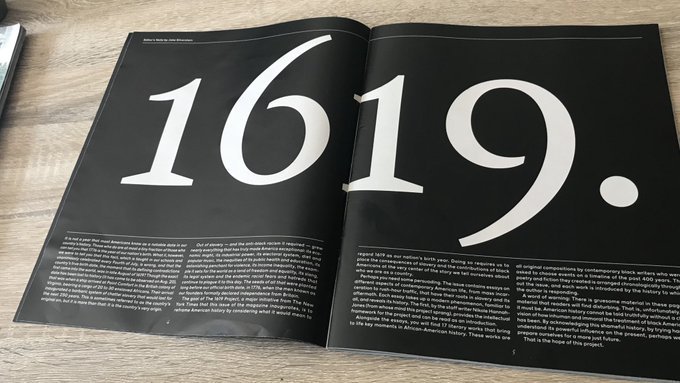
• Dan Gainor on 1619 and rewriting history: "To the Left elite like the NY Times,
there’s no narrative they want to destroy more than American exceptionalism"
• Utterly preposterous claims: The 1619 project is a cynical political ploy,
aimed at piercing the heart of the American understanding of justice
•
From Washington to Grant, not a single American deserves an iota of gratitude, or even understanding, from Nikole
Hannah-Jones; however, modern autocrats, if leftist and foreign, aren't "all bad"
• One of the Main Sources for the NYT's 1619 Project Is
a Career Communist Propagandist who Defends Stalinism
• A Pulitzer Prize?! Among the 1619 Defenders Is
"a Fringe Academic" with "a Fetish for Authoritarian Terror" and "a Soft Spot" for Mugabe, Castro, and Even Stalin
• Influenced by Farrakhan's Nation of Islam?!
1619 Project's History "Expert" Believes the Aztecs' Pyramids Were Built with Help from Africans Who Crossed the Atlantic Prior to the "Barbaric Devils" of Columbus (Whom She Likens to Hitler)
•
1793, 1776, or 1619: Is the New York Times Distinguishable from Teen Vogue? Is It Living in a Parallel Universe? Or Is It
Simply Losing Its Mind in an Industry-Wide Nervous Breakdown?
• No longer America's "newspaper of record,"
the "New Woke Times" is now but a college campus paper, where kids like 1619 writer Nikole Hannah-Jones run the asylum and determine what news is fit to print
• The Departure of Bari Weiss:
"Propagandists", Ethical Collapse, and the
"New McCarthyism" — "The radical left are running" the New York Times, "and no dissent is tolerated"
• "Full of left-wing sophomoric drivel": The New York Times —
already
drowning in a fantasy-land of alternately running pro-Soviet Union
apologia and their anti-American founding “1619 Project” series — promises to narrow what they view as acceptable opinion even more
• "Deeply Ashamed" of the… New York Times (!),
An Oblivious Founder of the Error-Ridden 1619 Project Uses Words that Have to Be Seen to Be Believed ("We as a News Organization Should Not Be Running Something That Is Offering Misinformation to the Public, Unchecked")
• Allen C Guelzo: The New York Times offers bitterness, fragility, and intellectual corruption—
The 1619 Project is not history; it is conspiracy theory
• The 1619 Project is an exercise in religious indoctrination:
Ignoring,
downplaying, or rewriting the history of 1861 to 1865, the Left and the
NYT must minimize, downplay, or ignore the deaths of 620,000 Americans
• 1619: It takes
an absurdly blind fanaticism to insist that today’s free and prosperous America is rotten and institutionally oppressive
• The MSM newsrooms and their public shaming terror campaigns — the "bullying campus Marxism" is
closer to cult religion than politics: Unceasingly searching out thoughtcrime, the American left has lost its mind
•
Fake But Accurate: The People Behind the NYT's 1619 Project Make a
"Small" Clarification, But Only Begrudgingly and Half-Heartedly, Because
Said Mistake Actually Undermines The 1619 Project's Entire Premise
THE REVOLUTION OF THE 1770s
• The Collapse of the Fourth Estate by Peter Wood: No
one has been able to identify a single leader, soldier, or supporter of
the Revolution who wanted to protect his right to hold slaves (A declaration that
slavery is the founding institution of America and the center of
everything important in our history is a ground-breaking claim, of the
same type as claims that America condones rape culture, that 9/11 was an
inside job, that vaccinations cause autism, that the Moon landing was a
hoax, or that ancient astronauts built the pyramids)
 • Mary Beth Norton: In 1774, a year before Dunmore's proclamation, Americans had already in fact become independent
• Most of the founders, including Thomas Jefferson, opposed slavery’s continued existence, writes Rick Atkinson, despite the fact that many of them owned slaves
• Leslie Harris: Far
from being fought to preserve slavery, the Revolutionary War became a
primary disrupter of slavery in the North American Colonies (even
the NYT's fact-checker on the 1619 Project disagrees with its
"conclusions": "It took 60 more years for the British government to
finally
end slavery in its Caribbean colonies")
• Sean Wilentz on 1619: the
movement in London to abolish the slave trade formed only in 1787,
largely inspired by… American (!) antislavery opinion that had arisen in
the 1760s and 1770s
• 1619 & Slavery's Fatal Lie: it is more accurate to say that what makes America unique isn't slavery but the effort to abolish it
• 1619 & 1772: Most of
the founders, including Jefferson, opposed slavery’s continued
existence, despite many of them owning slaves; And Britain would remain the world's foremost slave-trading nation into the nineteenth century
• Wilfred Reilly on 1619: Slavery was legal in Britain in 1776, and it remained so in all overseas British colonies until 1833
• Not 1619 but 1641: In Fact, the American Revolution of 1776 Sought to Avoid the Excesses of the English Revolution Over a Century Earlier
• James Oakes on 1619: "Slavery made the slaveholders rich; But it made the South poor; And it didn’t make the North rich — So the legacy of slavery is poverty, not wealth"
• One of the steps of defeating truth is to destroy evidence of the truth, says Bob Woodson; Because
the North's Civil War statues — as well as American history itself —
are evidence of America's redemption from slavery, it's important for
the Left to remove evidence of the truth
TEACHING GENERATIONS OF KIDS FALSEHOODS ABOUT THE U.S.
 • 1619: No wonder this place is crawling with young socialists and America-haters — the utter failure of the U.S. educational system to teach the history of America’s founding
• 1619: Invariably Taking the Progressive Side — The Ratio of Democratic
to Republican Voter Registration in History Departments is More than 33 to 1
• Denying the grandeur of the nation’s founding—Wilfred McClay on 1619: "Most of my students are shocked to learn that that slavery is not uniquely American"
• Inciting Hate Already in Kindergarten:
1619 "Education" Is Part of Far-Left Indoctrination by People Who Hate
America to Kids in College, in School, and Even in Elementary Classes
• "Distortions, half-truths, and outright falsehoods": Where does the 1619 project state that Africans themselves were central players in the slave trade? That's right: Nowhere
• John Podhoretz on 1619: the idea of reducing US history to the fact that some people owned slaves is a reductio ad absurdum and the definition of bad faith
• The 1619 Africans in Virginia were not ‘enslaved’, a black historian points out; they were indentured servants — just like the majority of European whites were
• "Two thirds of the people, white as well as black, who crossed the Atlantic in the first 200 years are indentured servants" notes Dolores Janiewski; "The poor people, black and white, share common interests"
LAST BUT NOT LEAST…
 • Wondering Why Slavery Persisted for Almost 75 Years After the Founding
of the USA? According to Lincoln, the Democrat Party's "Principled"
Opposition to "Hate Speech"
• Wondering Why Slavery Persisted for Almost 75 Years After the Founding
of the USA? According to Lincoln, the Democrat Party's "Principled"
Opposition to "Hate Speech"
• Victoria Bynum on 1619 and a NYT writer's "ignorance of history": "As dehumanizing and brutal as slavery was, the institution was not a giant concentration camp"
• Dennis Prager: The Left Couldn't Care Less About Blacks
• The Secret About Black Lives Matter; In Fact, the Outfit's Name Ought to Be BSD or BAD
• The Real Reason Why Aunt Jemima, Uncle Ben, and the Land O'Lakes Maid Must Vanish
• The Confederate Flag: Another Brick in the Leftwing Activists' (Self-Serving) Demonization of America and Rewriting of History
• Who, Exactly, Is It
Who Should Apologize for Slavery and Make Reparations? America? The
South? The Descendants of the Planters? …
• Anti-Americanism in the Age of the Coronavirus, the NBA, and 1619



 — it has been brought up a couple of times recently on Instapundit, albeit more as an aside (and remember that in the Army of Davids, Glenn Reynolds is General Dwight (David) Eisenhower) — it bears mentioning that there are quite a few serious scholars who are not convinced that TJ (as my history teacher used to call the man who penned the Declaration of Independence) fathered the children of Sally Hemings.
 (Many, if not most books sold at the Monticello book shop do accept the proposition that TJ shared his bed with Sally and it is important to note that there is a spat between two bodies involved in this controversy — Monticello's Thomas Jefferson Memorial Foundation, which propounds the father story, and the Thomas Jefferson Heritage Society, which denies it.)
 any one of whom could have fathered [say] Eston Hemings" and more likely, indeed, to have done so in view of their character or the lack thereof (dissolute lives and/or a lack of interest in politics and personal renown).
a descent from some male in the Jefferson paternal line [but not necessarily, and conclusively, from Thomas Jefferson himself] …
that have no basis in the actual scientific facts. [The above are linked to the] efforts by many historical revisionists to portray Thomas Jefferson as a hypocrite, a liar, and a fraud.


