Friday, August 16, 2024

"The expedited arrests, trials, and convictions of those who spoke wrongly": England is a country where the regime loathes its people and labors quietly to end them


From south Texas near Mexico and from his online magazine Armas, Joshua Treviño offers profound Reflections on the revolution in England (gracias por el Señor Glenn Reynolds):

 … the American grasp of European affairs is generally poor, a quality amplified by orders of magnitude when discussing the European grasp on American affairs, which is simply abysmal — but the former, the putatively free press of Great Britain, illuminated a truly distressing state of affairs in a nation nearing a full century of decline

 … We [Americans] care about `britain because we see it as a font, and so it is — although it is really England that is the font. We can understand American history as an extended re-litigation of the English Civil War of the mid-seventeenth century, and there is no comparable template in Scottish, and still less in Welsh or Irish, history. America is rooted in England, we feel Aristotelian philia for it — that civic friendship, united in a noble and common purpose, that is the indispensable prerequisite of nationhood — and so England becomes surpassingly important for us. We do not understand ourselves without understanding it. We also do not understand the universality underlying American propositionalism without grasping England and its achievements.

 … the tragedy of Britain of our time is to regard [This sceptred isle] as a positive evil, with the proclamation of Civis Britannicus Sum the assertion of a madman, a slogan of the demented.  

This is the truth, and the sorrow of England now is that its regime — its British regime, let us call it that, because Britain and England are not synonyms — manifestly believes that Duer Miller’s English seed was poisoned. Partly this is a consequence of the British adoption of American thoughts and narratives (they feel Aristotelian philia for us too, after all) even unto their own ruin. The effort to transplant American civic narrative on race and oppression onto English history is morally and intellectually deranging: from the American perspective, England possessed lesser virtues and lesser vices alike versus its American descendants. Partly too it is a consequence of the proximate cause of the civic violence that swept the United Kingdom across the past two weeks: its regime’s determination that the people of England be subjected and subsumed by the importation of millions of foreigners with whom no philia is possible. 

There is a regime narrative undergirding this iron fixation. You see it in the outlets for elite-approved materials at their expositions of history and its interpretations. The regime functionaries administering the British Museum, for example — arguably the single greatest museum of any kind in the world, with only Madrid’s extraordinary El Prado standing in real rivalry — make known their interpretive preferences in the capacious gift shop. There we find shelves upon shelves of books on offer detailing the evils that England has inflicted upon the world. 

 … The British Museum apparatus of commerce also, it so happens, has two sections purveying for purchase materials helpful in ushering the purchaser into the occult. As for the single most-important influence on all British history, which is to say Christianity, it has nothing in particular. This too is a regime choice. 

 … That is in fact happening — it is notable that a mosque is the only religious structure seen on the train from London to Oxford — but it is consequence rather than cause. Islam did not eradicate Christian England: that was the work of the English themselves, who at some point in the twentieth century decided to adopt wholesale American-style propositionalism as the basis of the nation — even unto their own ruin — and thereby cut themselves off from all they had been and meant. Surrendering the past is surrendering the future for which past is prerequisite. 

 … The new religion clambers upon the ruined edifice of the old and apes its forms 

All this is tutelage, of course. The images of Fotis the Ve / Vir and the like pervade the public square in London for instructional purposes. They teach the English their new narrative, their new understanding of self, and their new permitted ambit of thought and belief. In Trafalagar Square, after telling my son about Nelson, I noted that the crossing lights throughout the busy intersections were not the usual green-and-red walking men. Instead they were sex symbols: literally so, two male symbols intertwined on some crossing lights, two female symbols interlocked on others, and (less common) a male symbol and a female one paired. The regime narrative is that this is intrinsically British, and therefore belongs in a quintessentially British space

 … the argument is impossible: to paraphrase Rod Dreher, we have lost our reason and can no longer discern.

This too is a regime choice. 

 … at the rear of the chapel [at Oxford’s Exeter College], behind the golden crucifix, is a large LGBTQIA+ flag.

 … England still exists. The English are still here. But they are well into the long defeat, having saved the world more than once and in more than one way, with nothing to save them but their own twilight struggle. 

 … [Today, London belongs not to the English but] mostly to the regime that propagandizes to [them] that [their] ancestors were evil and the structures that might have ordered [their lives] are mere restraints to be overcome; and it belongs increasingly to the Islamic population of the city that — unlike the English ruling classes — have the confidence and cohesion to assert and defend their own mores and folkways and traditions. That many of those civics, a term I use very loosely here, are inimical to the English is irrelevant, because they know very well that the regime will protect them in those cases, and they know they have superior Aristotelian philia among themselves. Londonistan as a phenomenon is quite real: I had not seen this many women in hijabs since a brief stint working in Jordan decades ago, and I had never seen this many women in a niqab, ever. We should understand clearly what this signifies. The deliberate process that turned London across the past generation into a city in which the native-born population are a minority — for the first time, it should be noted, in two thousand years — is not malign because of any specific characteristics of the non-native population. 

 … I saw a datum asserting that more British Muslims have joined ISIS and al-Nusra in the past fifteen years than have joined the British Army, and this is a massive problem if true, but ultimately one emergent from the flaws in host society, which fails to insist upon itself and its own values. That deliberate process of societal importation is malign, fundamentally, because the process is one in which the regime literally executes what Brecht proposed as mere satire in 1953’s Die Lösung:

After the uprising of the 17th June

The Secretary of the Writers Union

Had leaflets distributed in the Stalinallee

Stating that the people

Had forfeited the confidence of the government

And could win it back only

By redoubled efforts. Would it not be easier

In that case for the government

To dissolve the people

And elect another?

The people are dissolved. Understanding themselves close to dissolution, and instinctually grasping that they are thrust into existential crisis and denied all but pre-political means — they’ve voted time and again against this, and the party institutions of conservatism in Britain have shown themselves worthless at best, antipathetic at worst — they have asserted their Lockean right to appeal to heaven. 

Their numbers are however not large, and they will lose to the regime. The prim horror of it was visible across U.K. media, whose figures positively delighted in reporting the persecution and jailing, not just of those who actually committed property destruction and assault, but of those who expressed disallowed opinions on social media. The Home Secretary appeared on the BBC and reassured viewers that Britain remains a free-speech society, while presiding over the expedited arrests, trials, and convictions of those who spoke wrongly. A father of small children got more than three years for a tweet. A middle-aged woman in Cheshire had her arrest announced by local authorities: she posted incorrect information on Facebook. The list is extensive and growing, each destruction of a wrongthink-posting nobody’s life amplified by the regime pour encourager les autres. The 1381 rebellion of English peasants under Wat Tyler ended with the victorious Richard II, having prevailed in part through a double-cross of the credulous rebels, sneering to them that “villeins ye are still, and villeins ye shall remain,” and this is still the message of the regime in 2024

Like the Canadian state ruthlessly prevailing against the protesting truckers of 2022, and like the American state hunting down the its own dissidents — for example California Attorney General Kamala Harris persecuting the enemies of Planned Parenthood — the British state will relentlessly crush its opposition now. Its functionaries have already persuaded themselves that they are victims of a conspiracy — this too was widely discussed on U.K. regime media — and though Americans have lately mocked their pretensions to reach into the United States and extradite the purported instigators of the recent unrest, our own countrymen ought to consider that a left-leaning regime in Washington, D.C., has every reason to cooperate in that process. This is where the Anglosphere is now, each of its great nations gripped by two-tier and dual-track law and justice. Arsonists who burn Catholic churches are unpursued in Canada; rioters who terrorize communities in the name of racial equity are let go in America; and Muslims wielding weapons are unmolested by the British state. The commonalities are not coincidental. 

Regimes have philia too. 

One of the heartbreaking pleas of the dissident English that did make it through the regime-media barricade was for equal justice under law, for as much police protection for little girls in Southport as for mosques in Birmingham. But this isn’t what policing is for in the United Kingdom. 

We saw an advertisement for Metropolitan Police recruiting in London … this is a mindset tell. This isn’t policing to protect and serve the community: it is quite explicitly a recruitment pitch for those who will best serve criminals. (In a rare bright spot for the native population, the criminal portrayed in the ad was visibly English.) Drug dealing simply does not threaten the regime and its practitioners therefore receive lenient treatment. That the preceding sentence also characterizes the Mexican state ought to place British governance in its proper context. If on the other hand that exhausted and scared teenager posted a meme about immigration, well he can just say goodbye to freedom. If the purpose of a system is what it does, then this is what British law enforcement does: it protects the regime. The English pleading for equal treatment and equal protection thereby betray the fatal flaw in their strategic insight, in that they believe they live in the country they deserve.

The country they actually have is nothing like it. It is a country where the regime loathes its people and labors quietly to end them. It is a country where the apparatus of law and order does not see its writ run throughout the land, which is why it cedes space — and therefore sovereignty — to both Muslim militias in England and Protestant militias in Northern Ireland, while pleading with both cohorts for aid in its mission. It is a country where the armed forces are no longer meaningfully capable of executing their core mission of defending the national territory, with the Royal Navy at a near-five hundred year nadir in real capability.It is a country in which it is possible to walk down particular streets, as indeed we did, and see about as much English-language signage as one might see in Cairo, or Tunis, or Khartoum. …

Thursday, August 15, 2024

One day we woke up and found the art world, and even the formerly staid world of museums, was awash in sexualized garbage, postmodern inanity, and race worship

The idea that poetry, that art generally, should serve as a source — perhaps the primary source — of spiritual sustenance in a secular age is a Romantic notion that continues to resonate powerfully.

In What the Right Gets Wrong About Art (merci à Glenn Reynolds), Roger Kimball writes about an era

in which ugliness has not only triumphed in our culture but is everywhere held up as something one must embrace as attractive? How many more fashion ads featuring hideous “fat positive” females do we need? 

 … Conservatives in the West long ago ceded culture to the Left.

 … Back in 1973, Irving Kristol wrote an essay called “On Capitalism and the Democratic Idea.” In the course of that essay, Kristol touched upon the conservative indifference to the claims of culture. “For two centuries,” he wrote,  

the very important people who managed the affairs of this society could not believe in the importance of ideas—until one day they were shocked to discover that their children, having been captured and shaped by certain ideas, were either rebelling against their authority or seceding from their society. The truth is that ideas are all-important. The massive and seemingly solid institutions of any society—the economic institutions, the political institutions, the religious institutions—are always at the mercy of the ideas in the heads of the people who populate these institutions. The leverage of ideas is so immense that a slight change in the intellectual climate can and will—perhaps slowly but nevertheless inexorably—twist a familiar institution into an unrecognizable shape.

 … one day [“the very important people” who manage the affairs of our society] woke up and found the art world, and even the formerly staid world of museums, was awash in sexualized garbage, postmodern inanity, and race worship. Their indifference mutated first into outrage. Then, as they took note of the prices fetched by the garbage, it mutated into capitulation.

This process did not take place in a vacuum. It was part and parcel of a larger cultural rebellion against bourgeois values that got going in earnest with the advent of modernism. In art, as the Australian philosopher David Stove observed, 

Western Europe found that its anti-academy had become its academy ‘even in the twinkling of an eye.’ The galleries were suddenly full of the art of African societies formerly the most despised. Victorian architecture was all at once the object of a universal detestation, or rather horror. Black music began its long and excruciating revenge on the white man. The Jazz Age, in short, had arrived.

Today, we are living in the aftermath of that avant-garde: all those “adversarial” gestures, poses, ambitions, and tactics that emerged and were legitimized in the 1880s and 1890s, flowered in the first half of the last century, and that live a sort of posthumous existence now in the frantic twilight of postmodernism. Establishment conservatives have done nothing effective to challenge this. On the contrary

 … it is worth noting that great damage has been done — above all to artists, but also to public taste — by romanticizing the tribulations of the nineteenth-century avant-garde. Everyone is brought up on stories of how an obtuse public scorned Manet, censored Gauguin, and drove poor Van Gogh to madness and suicide. But the fact that these great talents went unappreciated has had the undesirable effect of encouraging the thought that, because one is unappreciated, one is therefore a genius. It has also made it extremely difficult to expose fraudulent work as such. For any frank dismissal of art — especially art that cloaks itself in the mantle of the avant-garde — is immediately met by the rejoinder: “Ah, but they made fun of Cézanne, too: they thought that Stravinsky was a charlatan.” 

This is the easiest and also the most shallow response to criticism. It has been adopted as much by the Right as the Left. To quote David Stove again, it is yet another version of what he called “The ‘They All Laughed at Christopher Columbus’ Argument.” … If the Columbus Argument is puerile when applied to politics and morals, it is equally puerile when applied to art. In the first place, most artists whom we now associate with the nineteenth-century avant-garde did not set out to shock or “transgress” moral boundaries: they set out to make art that was a true articulation of the world. Today, the primary — often, it seems, the only — goal of many so-called “cutting edge” artists is to shock and transgress. The art is secondary, a license for bad behavior. 

There is also the uncomfortable and inegalitarian truth that in any age most art is bad or failed art. And in our time, most art is not only bad but also dishonest: a form of therapy or political grumbling masquerading as art. Like everything important in human life, art must be judged on the basis of first-hand experience: no formula can be devised prescribing its assessment, including the formula that what is despised today will be championed as great work tomorrow. The art world today retains little of the idealism that permeated Romanticism, but it remains Romantic in its moralism and hubris about the salvific properties of art.

On second thought, though, I realized that I could give an abbreviated answer to the question implicit in my title in just three words: indifference, capitulation, kitsch. 

[The] familiar but exemplary episodes from the annals of contemporary art [that Roger Kimball mentions regarding the Dada movement, Marcel Duchamp, Pierre Pinoncelli, etc] illustrate the cynical truth of Andy Warhol’s observation that “Art is what you can get away with.” Warhol’s own career, and, indeed, a large part of the contemporary art world testify to the power — if not the truth — of that observation. The sad fact is that today, anything can be not only put forward but also accepted and celebrated as a work of art. 

How Did We Get Here?

What had to happen such that a bisected cow in a tank of formaldehyde is accounted an important work of art? That is a complicated question to which there is no short answer. But if one had to sum up volumes in a single word, a good candidate would be the word “beauty”: What the art world is lacking today is an allegiance to beauty. … But art without beauty was, if not exactly a contradiction in terms, at least a description of failed art.

But if large precincts of the art world have jettisoned the traditional link between art and beauty, they have done nothing to disown the social prerogatives of art. Indeed, we suffer today from a peculiar form of moral anesthesia: an anesthesia based on the delusion that by calling something “art” we thereby purchase for it a blanket exemption from moral criticism — as if being art automatically rendered all moral considerations beside the point.

George Orwell gave classic expression to this point in “Benefit of Clergy: Some Notes on Salvador Dalí.” Acknowledging the deficiency of the philistine response to Dalí’s work — categorical rejection along with denial that Dalí possessed any talent whatever — Orwell goes on to note that the response of the cultural elites was just as impoverished. Essentially, the elite response to Dalí was the response of l’art pour l’art, of extreme aestheticism. “The artist,” Orwell writes,

is to be exempt from the moral laws that are binding on ordinary people. Just pronounce the magic word “Art,” and everything is O.K. Rotting corpses with snails crawling over them are O. K.; kicking little girls in the head is O. K.; even a film like L’Age d’Or [which shows, among other things, detailed shots of a woman defecating] is O.K.

A juror in the obscenity trial in Cincinnati in 1990 over Robert Mapplethorpe’s notorious photographs of the S&M homosexual underworld memorably summed up the paralyzed attitude Orwell described. Acknowledging that he did not like Mapplethorpe’s rebarbative photographs, the juror nonetheless concluded that “if people say it’s art, then I have to go along with it.”

“If people say it’s art, then I have to go along with it.” It is worth pausing to digest that comment. It is also worth confronting it with a question: Why do so many people feel that if something is regarded as art, they “have to go along with it,” no matter how offensive, foolish, or corrosive it might be? Part of the answer has to do with the confusion of art with ‘free speech.’ Another part of the answer has to do with the evolution, and what we might call the institutionalization, of the avant-garde and its posture of defiance.

You know the drill: black-tie dinners at major museums, tout le monde in attendance, celebrating the latest art-world freak: maybe it’s the Chapman brothers with their pubescent female mannequins festooned with erect penises; maybe it’s Mike Kelley with his mutilated dolls, or Jeff Koons with his pornographic sculptures depicting him and his now-former wife having sex, or Cindy Sherman with her narcissistic feminism, or Jenny Holzer with her political slogans. The list is endless. And so is the tedium. Today in the art world, anything goes but almost nothing happens. As with any collusion of snobbery and artistic nullity, such spectacles have their amusing aspects, as Tom Wolfe, for example, has brilliantly shown. In the end, though, the aftermath of the avant-garde has been the opposite of amusing. It has been a cultural disaster. For one thing, by universalizing the spirit of opposition, it has threatened to transform the practice of art into a purely negative enterprise. In large precincts of the art world today, art is oppositional or it is nothing. Celebrity replaces aesthetic achievement as the goal of art. 

The right, especially the libertarian right, has been complicit in this development, first in its indifference, second in its capitulation, third by its embrace of kitsch.

 … The novelist Milan Kundera … noted that “Kitsch is the translation of the stupidity of received ideas into the language of beauty and feeling.” Kitsch is histrionic, self-dramatizing. 

 … it is no secret that much if not most art in recent decades has abandoned beauty, abandoned the ambition to please the viewer aesthetically. Instead, it seeks to shock, discommode, repulse, proselytize, or startle. Beauty is out of place in any art that systematically discounts the aesthetic.

But “beauty” is by no means an unambiguous term. In degenerate or diluted form, it can mean the merely pretty, and in this sense beauty really is an enemy of authentic artistic expression. But beauty is not always the “merely pretty” or agreeable. One thinks, for example, of Dostoyevsky’s observation, in The Brothers Karamazov, that “beauty is the battlefield on which God and the devil war for man’s soul.”

The point is that, in its highest sense, beauty speaks with such great immediacy because it touches something deep within us. Understood in this way, beauty is something that absorbs our attention and delivers us, if but momentarily, from the poverty and incompleteness of everyday life. At its most intense, beauty invites us to forget our subjection to time and imparts an intoxicating sense of self-sufficiency. Our art closes us to the experience of the beautiful. 

 … Art today is enlisted in all manner of extra-artistic projects, from gender politics to the grim linguistic leftism of neo-Marxists, post-structuralists, gender theorists, and all the other exotic fauna who are congregating in and about the art world and the academy. The subjugation of art — and of cultural life generally — to political ends has been one of the great spiritual tragedies of our age. Among much else, it has made it increasingly difficult to appreciate art on its own terms, as affording its own kinds of insights and satisfactions. This situation has made it imperative for critics who care about art to champion its distinctively aesthetic qualities against attempts to reduce art to a species of propaganda.

 … . By the nineteenth century, art had long been free from serving the ideological needs of religion; and yet the spiritual crisis of the age tended to invest art with ever greater existential burdens — burdens that continue, in various ways, to be felt down to this day. The poet Wallace Stevens articulated one important strand of this phenomenon when he observed that “after one has abandoned a belief in God, poetry is that essence which takes its place as life’s redemption.” The idea that poetry, that art generally, should serve as a source — perhaps the primary source — of spiritual sustenance in a secular age is a Romantic notion that continues to resonate powerfully. It helps to explain, for example, the special aura that attaches to art and artists, even now

 … This much, I think, is clear: without an allegiance to beauty, art degenerates into a caricature of itself; it is beauty that animates aesthetic experience, making it so seductive; but aesthetic experience itself degenerates into a kind of fetish or idol if it is held up as an end in itself, untested by the rest of life. As I have put it elsewhere, the trivialization of outrage leads to a kind of moral and aesthetic anesthesia not the least of whose symptoms is the outrage of trivialization.

Tuesday, August 13, 2024

America at the Crossroads: Debate on Radio Courtoisie

Dans le Libre Journal de Géopolitique profonde du 10 août, Nicolas Stoquer reçoit :

• Raphaël Besliu, directeur de la publication de Géopolitique profonde

• Paul Reen, Président de
Republicans in France 

Thème : “L’Amérique à la croisée des chemins” 

Références

Découvrez la revue mensuelle stratégique papier de Géopolitique Profonde :

Allez plus loin en contactant les équipes de Géopolitique Profonde : Solutions | Géopolitique Profonde (geopolitique-profonde.com) 

Monday, August 12, 2024

The Walz Pick: Was the Democrat 'deep bench' nothing but bottom scrapings? And will Tampon Tim be Eagleton-ed?

Damien Bennett can't figure out the Walz pick. 

Honestly, I can't. The Democrat 'deep bench' was nothing but bottom scrapings apparently. Can someone help me out here?

There are quite a number of stories about his politics and record, a lot of gush but also a lot of onions -- actually bushels of onions, which are being reported on both defensively and also aggressively. That's a surprise. It's not one Walz hymn book.

Other than baggage Walz doesn't bring much to the ticket.
  • Poll: Only 17% Of Americans View Tim Walz Positively August 6, 2024
    The 17 [favorable] and 12 [unfavorable] percent marks appear to be so low because many Americans (71 percent) have never heard of him before or are unsure how to rate him.
  • Tim Walz Fails To Inspire Swing State Voters: ‘He Makes Tim Kaine [!] Look Exciting’ August 6, 2024
  • MSNBC Data Guru Delivers Brutal Reality Check To Dems After Walz Pick August 6, 2024   
    MSNBC data analyst Steve Kornacki: “When you look at what Tim Walz actually pulled off to get elected, to get re-elected in 2022, it’s the Biden model, demographically, regionally. You go county by county, there’s not much variance between how Walz did and how Biden did. ... Now go into greater Minnesota, let’s take a look at, like, Stearns County here. Look, Walz lost this by 23 points. What did Biden lose it by? 23 points. And this is the kind of county, by the way, in Minnesota and across the Midwest here, that Democrats are hoping Walz will help them with. ... So, the Walz victory in 2022 looks like what is now a standard Democratic victory in Minnesota: Heavy reliance on the Twin Cities metro area and taking big losses in greater Minnesota. The Democrats’ hope is that he’s going to appeal to the blue-collar areas in these other three states [i.e., Wisconsin, Michigan, Pennsylvania.], maybe he will, but when you look at what he’s done in Minnesota, you don’t quite see that."
  • NBC Analyst: Walz Doesn’t Broaden Democrat AppealTo Blue-Collar Voters August 7, 2024
Low-to-no name recognition; no pull with vanishing key black, hispanic, Jewish, and youth demos; no base beyond metro Minnesota; no star power, no eye candy, no charisma, nothing compelling but his negatives.   

I don't get it. One theory is that Walz is so obviously the wrong choice that KA-mala easily made the pick.


I don't get it. Help me out. 

Let me close with a couplet of election year shit polls:
Fuck off, polls!
Trying to help Duncan out, Duncan answers as follows:

I'm in complete agreement with your assessment of Tampon Tim. However, the MSM has strong counter-narratives working full-time.

For example, CNN (sorry for the vulgarity) suggests the attacks on Walz's military service is just "Swift Boating" a la the anti-Kerry campaign.

https://www.cnn.com/2024/08/09/politics/tim-walz-service-swift-boat-attacks/index.html

When I ask my Lefty friends about Walz, they are mostly unaware of all the dirt this guy drags around. Narratives work until they don't (sharp as a tack Biden). So, a politically astute friend of mine thinks Walz will be Thomas Eagleton-ed...not necessarily for the same reason but something that is both sympathetic and disqualifying.

He suffered from bouts of depression throughout his life, resulting in several hospitalizations, which were kept secret from the public. When they were revealed, it humiliated the McGovern campaign, and Eagleton was forced to quit the race.

When you compare the MSM efforts to prop up the Harris/Walz campaign to your extensive collection of real Walz negatives just in this email, I too wonder how can people choose to be so stupid?

Friday, August 09, 2024

The "Gayest Olympics Ever": Twenty minutes into the future 2009 & 2024

 Damien Bennett can hardly be described as being impressed by the Olympic Games in Paris:

Twenty minutes into the future 2009:
We Are All Socialists Now [Newsweek] February 6, 2009

Twenty minutes into the future 2024:
Hat tip to DH who clued me to #Paris2024.

Oh, and then there is this:
Apparent Drag ‘Parody Of Last Supper’ At Paris 2024 Olympics Opening Ceremony Sparks Controversy July 26, 2024
The Olympics said the performance was an “interpretation of the Greek God [of wine and festivity] Dionysus” to make “us aware of the absurdity of violence between human beings.”
These stupid f*cks -- a key feature of a Dionysian bacchanal was sparagmos:

"In Dionysian rite as represented in myth and literature, a living animal, or sometimes even a human being, is sacrificed by being dismembered. Sparagmos was frequently followed by omophagia (the eating of the raw flesh of the one dismembered)."
These stupid f*cks know nothing, absolutely nothing. Not a one with a passing acquaintance of Euripides:

Pentheus Torn Apart By His Mother Agave And Auntie Ino

Academia has given us generations of cos-play know-nothings preening around the edges of make-believe telling the rest of us what's what. Generations of morons, who, thankfully, haven't it in them to procreate. There is no fixing this. There's only 'wait them out to die out'.

Ladies and gents, something to paste in your God-Take-Me-Now photo album, courtesy of #Paris2024 -- future Jesus:

Twenty minutes behind and closing:

Thursday, August 08, 2024

Three's a Charm! Preparing for WORLD WAR III!

Didn't the Dems keep "screaming that Trump would start WW III"? asks Duncan.

From longtime reader Damian Bennett, we get the following answer: 

WORLD WAR III! 

White House: Trying To Keep Iran From Getting Nuclear Capabilities Via Diplomacy ‘HASN'T WORKED’ August 3, 2024
National Security Communications Adviser John Kirby: “The President has always maintained that we would prefer Iran not to have a nuclear weapon through diplomacy. But he has also made absolutely clear, our policy has been crystal, we will not allow Iran to achieve a nuclear weapons capability. We prefer to do that through diplomacy. That hasn’t worked. And frankly, that’s not really on the table right now. We haven’t been talking to Iran for quite some time, in terms of diplomacy. So, we’ve got to make sure that we’ve got other capabilities, other options available to the President, including potential military options. And the Department of Defense works on that every day. Obviously, we have been focused a lot on the Middle East. We have added resources from a military perspective to the Middle East and we’re talking about what we need to do to adjust given these recent threats, as well.”

Duh-huh. As if this wasn't obvious at least as far back as the 90s.

Too bad this brilliancy escaped them before they had channeled hundreds of BILLIONS in cash, credit, and sanctions relief into Allah's Atomic War Warchest.

Whu-wha-happened?

‘The Middle East Region Is Quieter Today Than It Has Been In Two Decades’ October 7, 2023
Just eight days ago, National Security Adviser Jake Sullivan, speaking at The Atlantic Festival, rattled off a long list of positive developments in the Middle East, developments that were allowing the Biden administration to focus on other regions and other problems.

Brainiacs.

Close out:

“I think [Biden] has been wrong on nearly every major foreign policy and national security issue over the past four decades.” Former Defense Secretary Robert Gates, Duty: Memoirs of a Secretary at War

Wednesday, August 07, 2024

The White House; The Executive Branch; The USA: Who's In Charge?

Kamala Harris may have chosen her vice-president. There is only one question regarding DC. Just one. Damian Bennett has only one question:

 Who's In Charge?

Biden/Harris drop a hint on next genius foreign policy move, hotly anticipated, three years dedicated in the making -- 

WH says Biden and Harris knew nothing. A truly astonishing claim, unbelievable on its face but, considering the players, probably true, begging the Q: 
WHY did they know nothing? 
Dumpster Fire Chief Austin declares he's in charge. Judge Escallier gets hosed. [Clap wipes hands.] And there the circus ends. Please don't bring it up again. Move on. Move along. Get out of here.

I want to rage, but is this somehow more outrageous than the Biden cadaver presidency itself? If you want to rage, where to start? Once you start, there is no end. We are fighting powers that are themselves discombobulated, internally clueless, without a coordinating intelligence, that slosh about in a CYA culture. Powers that congeal into a massive, oozy, amoeboid sprawl that is both everywhere and, because unaccountable, nowhere. It has no one heart at which to strike the fell blow.

BFMTV Features Paul Reen and Other Guests Discussing Kamala Harris's Tim Walz Pick


The Republicans in France group's Paul Reen appears on the BFMTV channel with a number of other guests to discuss Kamala Harris's choice of Tim Walz for the vice-presidency.

Harris/Walz : le choix de la complémentarité ? - 06/08

La course pour la présidentielle se précise aux États-Unis avec le choix par Kamala Harris de son colistier. Il s'appelle Tim Walz. Le gouverneur du Minnesota s'en est dit honoré. Même Joe Biden a salué sa désignation. On y revient avec : Sonia Dridi, correspondante BFMTV à Washington D.C. (États-Unis). Fred Hoffman, porte-parole des "Democrats abroad France". Paul Reen, président de "Republicans in France". Malcolm Biiga, consultant et chroniqueur politique Le Nouvel Economiste. Et Ulysse Gosset, éditorialiste politique internationale BFMTV.


K. Harris "fière" de son choix de colistier - 06/08

Tim Walz, gouverneur du Minessota, est desormais le colistier qui a été choisi par Kamala Harris pour la campagne de l'éléction présidentielle américaine. Comment expliquer ce choix ? On y revient avec : Florian Poras, journaliste BFMTV. Sonia Dridi, correspondante BFMTV à Washington D.C. (États-Unis). Fred Hoffman, porte-parole des "Democrats abroad France". Paul Reen, président de "Republicans in France". Et Malcolm Biiga, consultant et chroniqueur politique Le Nouvel Economiste.

Tuesday, August 06, 2024

Only about 1% of the January 6 protesters actually entered the Capitol (often at the invitation of the Speaker's Capitol Police); In fact, it was the 99% who stayed out of the Capitol who heeded Trump's words


"Why then has the issue of Motive on January 6 been swept off the stage of public discourse?" asks George Shuster in The Real Motive for Jan. 6 (thanks to Evelyne Joslain):

If we examine the true Motive for ourselves, we soon discover that the repeated cries of "insurrection" have tried to stifle analysis of the actual January 6 Motive in favor of accepted "fact.” Despite that relentless attempt, or rather because of it, we should ask ourselves: just who actually had the Motive to disrupt the congressional deliberations taking place in the Capitol Building?

… because the Left has been so relentless to deflect consideration of actual Motive, it is useful to point out that there is an abundance of corroborating evidence. Here is a partial list:

1) Before January 6, it was the Democrat mayor of D.C. and the Democrat speaker who turned down Trump's offer of troops to protect the proceedings in the Capitol, thereby making the path for disruption more open.

2) After January 6, both the mayor and speaker turned D.C. into an armed military zone, with thousands of troops, heavy military equipment, barricades, and barbed wire. The disruption had already succeeded, and now it was useful to make vivid the false "insurrection" narrative. (It never came, and finally the pretense and waste of taxpayer dollars became too embarrassing to continue).

3) It was Democrats in the joint session who tried to truncate the proceedings.

4) When Trump talked to his supporters before they went over to the Capitol, he told them to do so "peacefully and patriotically” -- not the advice one would give if one wanted the proceedings disrupted.

5) Only about one percent of the protesters in D.C. actually entered the Capitol. If Trump's Motive was to disrupt the process, then he must be accounted one of the most ineffective "insurrectionists" of all time. In fact, it was the 99 percent who stayed out of the Capitol that followed his request.

6) Even among that one percent, video the Democrats tried to hide shows that many who entered the Capitol did so at the invitation of the Speaker's Capitol Police, who opened the doors for them and waved them in.

7) The Left not only tried to hide the fact Trump told his supporters beforehand to be peaceful, but also tried to suggest that Trump did nothing to discourage the disruption. A quick review of the timeline demonstrates the opposite. The first protester entered the Capitol at 2:12 P.M. Then:

     a) Just 26 minutes later, Trump tweeted: "Please support our Capitol Police and Law Enforcement. They are truly on the side of our Country. Stay Peaceful.”

     b) At 3:13 Trump tweeted again "to remain peaceful.”

     c) At 4:17 Trump released a video in which he said: " ...you have to go home now. We have to have peace."

     d) At 6:01 Trump tweeted: "Go home with love & in peace."

These tweets were removed by the social media censors. Why did they do so, if not to delete evidence that it was Trump who did not want the proceedings disrupted?

8) On the next day, shortly after Twitter temporarily unlocked his account, Trump released a video condemning the Capitol building disruption. He said he was "outraged," hardly the sentiments of a man who wanted the proceedings interrupted.

9) After the Capitol was cleared and the joint session reconvened, the statutory proceedings were truncated. The Democrats had achieved their disruption Motive.

10) It was the Democrats who later led the rewrite of the Electoral Count Act to remove the procedures that were interrupted on January 6.

11) Both before and after January 6, the Democrats have attempted in multiple channels to quash any claims of 2020 election irregularities, i.e. have pursued the same Motive as disrupting the January 6 joint session.

12) Disruption of government business they do not like is a consistent Democrat strategy, which they not only pursue but praise. Examples include the coordinated "absenteeism" of Democrat State legislators in Texas, disruption of legislative work in the Tennessee State House, disrupting meetings of the Federal Energy Regulatory Commission, praising Antifa and BLM attacks on Federal buildings, and pulling a fire alarm to prevent an unwanted vote in Congress.

In summary, corroborating evidence confirms just who had, and who had not, the Motive to disrupt the January 6 proceedings. The American People should not be deflected from exercising their own independent judgment on this question. They should realize that Trump was concerned about the 2020 election irregularities and wanted them aired on January 6, and still wants that evidence to be heard. It is the Democrats who resisted then, and still do.

Related: • The January 6 Protest Summarized in One Single Sentence
• Let's Stop Using the Words "Trump Tried to Overturn the 2020 Election"; It's Unprofessional Journalism
The Central Absurd Inconsistency of the Ray Epps Conundrum Described in Two Sentences
• Kabuki Theater: the "top 12 strange, stand-out moments" of the January 6th Committee's interview with Ray Epps
• Déjà Vu All Over Again in the Banana Republic of Biden: No, the Democrats did not run better campaigns in 2022; they cheated, as usual
• Isn’t it strange that in Florida, with all those strict rules against cheating, the GOP red tsunami happened as predicted? The Democrats have again fixed, rigged, and stolen an election
• Let’s dispense with the myth that liberals are really against voter fraud; Voter fraud is actually an essential part of their election strategy
• If the Democrats learned anything from their 2016 debacle it’s that they didn’t cheat nearly enough
• What the January 6th protest actually reveals is the criminal determination of the Democrats to establish a one-party state at whatever the cost
• Democrats don't support voter fraud; they just worry about disenfranchising the deceased
• Voter ID: Apparently not allowing minorities to cheat is a form of racial oppression
• Of the 47 countries in Europe today — the nations and the continent that the Democrats are always telling us to emulate — 46 of them currently require government-issued photo IDs to vote
Joe Biden, Why Are You Calling Denmark a White Supremacist Country? And You, Barack Obama: Why Are You Calling Africa a Racist Continent?
• 2020: an almost totalitarian effort by the national political and social media to suppress and ridicule any doubt of the accuracy of the election result
The DOJ and the FBI "have no conscience or soul": “There is a fervor to attack the J6 protesters, ruin their lives, and bankrupt them”
• "I believed a farrago of lies" Writes VIP Whose Leftist Half of the American Electorate was "Taken in By Full-Spectrum Propaganda" Regarding the Jan. 6 (Non-)Riots
• Our élites constantly lecture everyone about "disinformation," about "big lies", etc; They're the biggest liars of all, with zero accountability
Isn't America Being Governed by a Mafia Family Dynasty, setting things up so that there will always be Democrats in power?
• Inside of a month, Democrats have redefined riots and election challenges from the highest form of patriotism to an attack on democracy — And by “democracy”, they mean the Democrat Party
• Voter Fraud: A Note to Leftists Who Claim that "Not a shred of hard evidence has been produced"
Dennis Prager: The Numerous (and Sweeping) Anomalies Regarding the 2020 Election That Cannot Be Ignored
How to Prevent America from Becoming a Totalitarian State

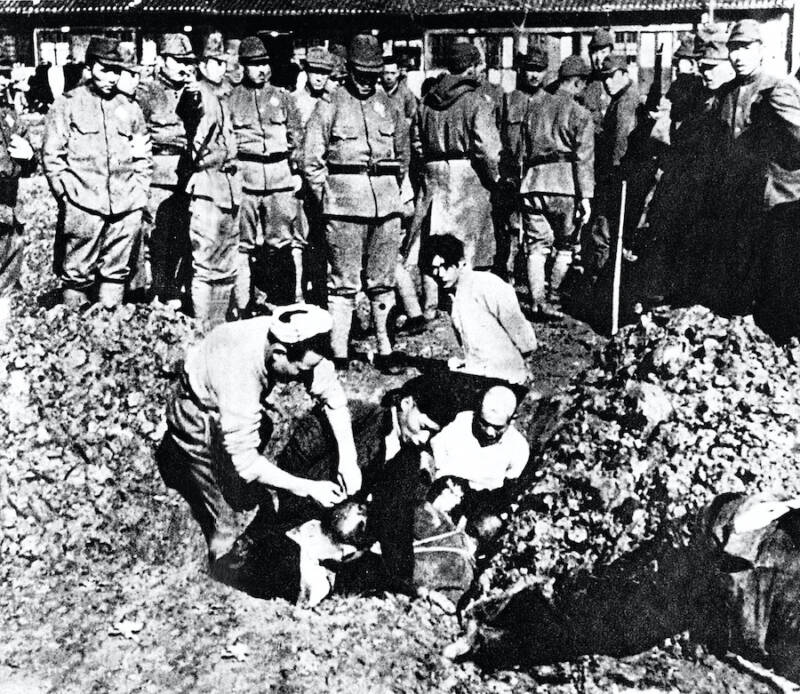
"An unfathomably brutal place": Much like Nazi Germany, the Japanese Empire was one of the most genocidal in world history

Japanese troops burying Chinese people alive during the Nanjing Massacre

The phrase “Nazi Germany” inspires a horrific set of images in the minds of most Westerners

writes the All That's Interesting history website in Andrew Lenoir's article on The Japanese Empire, One Of The Most Genocidal Regimes In History. (No Pasarán continues its yearly tradition of presenting an article on Hiroshima, Japan, and/or World War II every anniversary of the atomic bombing of that city — see previous entries at the bottom of this post.)

But when it comes to “Shōwa Japan” — the term used to designate the wartime Japanese Empire under Emperor Shōwa (or Hirohito) — the same phenomenon tends not to occur. And yet, Japanese war crimes during World War II were just as appalling as Nazi ones. [Actually, the Imperial Japanese Army was not just every bit as evil as the Nazi SS, they were far more lethal during Japan's "Reign of Terror", i.e., far worse.]

In the 1930s and 1940s, Japanese troops committed a number of atrocities across Asia. Some events are well documented, like the Rape of Nanking — also called the Nanjing Massacre — which left as many as 300,000 Chinese civilians dead. But there are also many lesser-known events, like the Bataan Death March, the Rape of Hong Kong, and the Manila Massacre.

[Tokyo's] tactics made World War II-era Japan an unfathomably brutal place. By some estimates, there were upwards of 40 million deaths in the Pacific Theater — about half of whom were civilians killed by Japan’s military. [During WWII, Japan Killed 7 Times More People (Most of Them Civilians) than They Lost, reports Victor Davis Hanson.]

 … Following Japan’s opening to the West [in 1853], the Japanese launched one of the most rapid modernization efforts in history — and planted many seeds that would later mutate into Japanese war crimes during World War II. 

 … [In 1937], tensions between the Japanese and Chinese escalated into the Second Sino-Japanese War. This would be followed by the Pacific Theater of World War II (though some argue that the Pacific War essentially began at the same time the Second Sino-Japanese War did). The ensuing battles would lead to some of the worst war crimes of the century.

 … the Japanese Empire fought on [despite international condemnation], often resorting to brutal tactics to obtain victory. Their determination to win by any means was gruesomely illustrated when Japanese troops marched on the city of Nanking.

The city — today better known as Nanjing — was then the capital of China, as well as one of its wealthiest cities. But when Nanking fell on December 13, 1937, forces under the command of Emperor Hirohito’s uncle, Prince Yasuhiko Asaka, surrounded the Chinese troops. The Japanese soldiers were allegedly commanded to “kill all the captives.” And then, the Rape of Nanking began.

What followed was a six-week massacre that may have killed over 300,000 people in the city. Up to 80,000 women and girls were raped, and many of these rape victims did not survive their assaults. Those who did live were often left mutilated. Indeed, the horrific stories of murder, rape, and torture are so numerous, one cannot possibly cover all of them in one article.

 … Another infamous story from the Nanjing Massacre is the “Contest to Kill 100 People Using a Sword.” As the name suggests, it was a competition between two Japanese officers, Toshiaki Mukai and Tsuyoshi Noda, to see who would be the first person to kill 100 Chinese people with a sword.

 … From accounts throughout the campaign in China, Japanese soldiers routinely slaughtered captured soldiers and civilians. As reported by Daqing Yang in an essay titled Diary of a Japanese Army Medical Doctor, 1937, this was an open secret. One doctor’s diary entry from 1937 described the machine-gunning of 80 “men and women of all ages” near Nanking.

Clearly acts of terrorism, these mass rapes and massacres can also be seen as a facet of genocidal violence perpetrated by the Japanese Empire. In many cases, the mutilated bodies of victims were left out for others to see, which undoubtedly had a horrific impact on the survivors left behind. 

 … In other war crimes, … it seems the cruelty had other practical purposes, like further advancing Japan’s scientific knowledge. Certain prisoners of war and civilians — most of whom were Chinese — were transported to facilities like Unit 731, where Japanese medical officers performed inhumane experiments on human beings before killing them.

 … One lingering accusation heard most often by American World War II veterans is that the Japanese were the worst to their captives of any Axis Power. Upon examination, there does seem to be some truth here. According to the MacArthur Memorial Education Programs, prisoners of war suffered a 4 percent death rate in Europe and a 27 percent death rate in the Pacific.

 … In one particularly brutal case of Japanese war crimes against Western prisoners, staff members at a Japanese university dissected downed American pilots — while they were still alive — as reported by the Daily Mail.

 … Though most people in the West understand the magnitude of the Nazi Holocaust and the European Theater in modern times, few grasp the extent of Japan’s brutality during World War II. Much like Nazi Germany, the Japanese Empire was one of the most genocidal in world history.

However, in the years since the war ended, Germany has made strides to confront its history. This includes prosecuting former Nazis, erecting memorials to Holocaust victims, preserving death camps, and making it illegal to deny that the systematic mass murder of 6 million Jews happened. But Japan has done comparatively little to address its war crimes.

Jeff Jacoby had this to say about the "
unfathomably brutal place"
:
Horrific as the attacks on Hiroshima and Nagasaki were, President Truman’s other options would have cost more lives; in the Boston Globe,
Jeff
addresses the bloodiest land battle in the Pacific Theater for U.S. forces which ended only after the Nazi surrender and therefore after the end of the war in Europe.

Long before he won fame for his biographies of Douglas MacArthur, John F. Kennedy, and Winston Churchill, William Manchester was a young Marine corporal serving in the Pacific theater during World War II. He was severely wounded in the fighting on Okinawa, Japan, in June 1945, an experience he described in his wartime memoir, “Goodbye, Darkness.”

The violence on Okinawa was unimaginably savage. During the 12-week battle for the island, more than 12,500 Americans were killed and nearly 37,000 wounded. Japan’s losses were even more appalling. Determined to fight to the death rather than surrender the remote southern island, well over 100,000 Japanese soldiers were killed. The US Navy suffered the worst losses in its history. Waves of suicide attacks by Japanese aircraft resulted in the sinking of 34 American ships and the deaths of 5,000 US sailors. Bloody as the fighting was, however, everyone knew that it was only a foretaste of the losses Americans would sustain in a few months, when the climactic assault on Japan itself was expected to begin.

 … the bombings were the least deadly of the choices America faced. Every other option — invading Japan, increased firebombing, starving the Japanese into defeat, or letting the Soviet Union invade — would have killed even more people. The Bomb brought a quick end to the worst war in history. Awful as it was, Truman was right to use it.


As more and more shipwrecks from World War II are discovered (such as three sunken aircraft carriers from the Battle of Midway, one American, two Japanese), debate never ends regarding the atomic bombings of Hiroshima and Nagasaki

Related:
• Hiroshima 15: Examining the Issues Surrounding the Dropping of Atomic Bombs on Japan (Erik Svane) 

• Hiroshima 21: Didn't the Atomic Bombs Prevent the Red Army from Sweeping Through Western Europe and the Entire Continent from Falling Under Stalin's Iron Fist? 

• Hiroshima 17: During WWII, Japan Killed 7 Times More People (Most of Them Civilians) than They Lost (Victor Davis Hanson) 

• Hiroshima 18: The Imperial Japanese Army was every bit as evil as the Nazi SS, and more lethal (Trent Telenko)

• Hiroshima 19: The Horrific Treatment of Civilians During Japan's "Reign of Terror"

• Hiroshima 14: "I regard Hiroshima revisionism as the greatest hoax in American history" (Robert Maddox)

• Hiroshima 13: Although It Is Not Said Openly, Hiroshima Also Played a Purifying Role, IE the Baptism of a New Japan, the Event that Put an End to 50 Years of Crimes (Le Monde)

• Hiroshima 20: The Day the Pilot Who Led the Attack on Pearl Harbour Met the Pilot of the Enola Gay

• Hiroshima 12: Political Correctness in Japan: The comment "tramples on the feelings of victims", so… Shut the F**k Up and Lose Your Job! (re the forced resignation of Japan's defense (!) minister)

• Hiroshima 11: If Western elites cannot find perfection in history, they see no good at all; most never learned the narrative of WWII, only what was wrong about it (Victor Davis Hanson)

• Hiroshima 10: If Not for the Atom Bombs, Japan, as we know it today, would not exist (S L Sanger, author of “Working on the Bomb”)

• Hiroshima 9: Over one million warning leaflets were dropped over Hiroshima, Nagasaki, and 33 other Japanese cities 5 days before the Hiroshima bombing (Bill Whittle)

• Hiroshima 8: Was It Wrong to Use the Atom Bomb on Japan? (Father Wilson Miscamble)

• Hiroshima 7: Some Facts About Hiroshima and World War II That You Hear Neither From America's MSM, University Élites, and History Books, Nor From Japan's (New York Times)

• Hiroshima 16: Did Japan's top officers know a bomber was approaching Nagasaki, 5 hours beforehand, and do nothing?

• Hiroshima 6: "Lance or spear practice was a regular women's exercise to practice for the anticipated U.S. landing" (a Japanese American)

• Hiroshima 5: Japan's plans for defense involved mobilizing the civilian population, including women and children, for the customary suicidal battle tactics (Thomas Sowell)

• Hiroshima 4: "Les 300 000 morts d'Hiroshima ont épargné bien davantage de Japonais, qui auraient été écrasés sous des bombes ordinaires" (Charles de Gaulle)

• Hiroshima 3: A mainland invasion could have resulted in millions of Japanese deaths—and that's not counting civilians (Wall Street Journal)

• Hiroshima 2: Hand-wringing over Hiroshima is just virtue-signaling by people who never said a bad word about Stalin or Mao’s mass murders (Glenn Reynolds)

• Hiroshima 1: Unlike the ends of the majority of conflicts, World War II in the Pacific grew increasingly bloody as U.S. forces approached the Japanese homeland (Erik Svane)