
Calvin and Hobbes by Bill Watterson

Behind the Façades in France: What expats and the mainstream media (French and American alike) fail to notice (or fail to tell you) about French attitudes, principles, values, and official positions…

We're entering a sexless world where men and women are meaningless categoriessays Benny Huang (a tip o' the hat to Maggie's Farm's Bird Dog).
Using the “wrong” pronoun in casual conversation can cost you big bucks these days—even when it happens to be the right one. Gresham-Barlow School District in Oregon was forced to cough up $60,000 to a teacher who prefers the pronoun “they” because she “identifies” as neither male nor female. The teacher, Leo Soell, was granted damages in order to compensate her for the emotional distress of being “misgendered.” For the uninitiated, “misgendering” is nothing more than using the correct pronoun to refer to a person who prefers to be called something else. In the old days we just called it good grammar.
… “Civil rights” is no longer about parity between men and women or the moral equivalence of same-sex relationships vis-à-vis opposite-sex relationships. Even the idea that men can be women (and vice versa) has lost its novelty. Now it’s about the abolition of sex itself.
For everyone’s sake I hope we have finally reached peak insanity.
There are a million variations on the concept of gender identity with exciting new ones being introduced all the time. Besides men who think they are women (and vice versa), there are also genderqueer, two-spirit, and intersex people. There are transmasculine people, who are not the same as transmen, just as there are transfeminine people, who are not the same as transwomen.
Most of my female readers will be shocked to learn that they’re actually ciswomen. A ciswoman is a woman who believes she’s a woman. Nearly every woman you’ve ever met is a ciswoman, which makes you wonder what the superfluous prefix is for.
Answer: to drive home the idea that there are different kinds of women, some of whom are male. We call those transwomen. Ciswomen and transwomen are two equally valid categories of women with neither group considered more deserving of the “woman” title than the other.
This whole movement, I am convinced, can only lead to complete androgyny—that ambiguous gray area between the masculine and feminine spheres. It is the Left’s ultimate goal even if some of their useful idiots don’t know it yet. We’ll get there one Lifetime television special at a time.
… Feminists absolutely abhor masculinity, except among women. They attack all symbols of masculinity as exclusionary, misogynistic, and chauvinistic. They seek out boys clubs to annihilate them, often by the brute force of slanderous rape claims. See the Rolling Stone rape hoax or the Duke Lacrosse rape hoax. Nor do feminists care for femininity, except among men. Anything that is soft, pink, or glittery sends them into fits of rage—which kind of makes me wonder why they’re called “feminists” in the first place.
In order to understand just how we got here and where we’re going, allow me to invoke a metaphor. Think of men as forks and women as spoons. Within the last hundred years or so we have come to see the two utensils as different in form and function but nonetheless a complementary matched set. But then along came the feminists who declared that spoons can do anything that forks can do! That statement isn’t technically true (and neither is its inverse) but we accepted it because every time we disputed it we were accused of hating spoons. We defended ourselves from the charge only to have our pleas fall on deaf ears.
Then came the homosexuals who decided that forks and spoons weren’t really complementary at all. Two forks or two spoons were just as good as the traditional fork-spoon combo because, in the final analysis, they’re all just tableware. This assertion was a tougher sell because most people could see that forks and spoons are inherently different. The homosexuals dismissed these substantive differences by comparing them to superficial differences such as the color of the eating utensils. So now when we sit down to eat we no longer expect to find a fork and spoon on the table and we blush with embarrassment to think that we ever did.
Then came the transgenders who proclaimed that sometimes a fork can actually be a spoon and vice versa. Looking like a fork, with all the defining characteristics of a fork, doesn’t necessarily mean that a utensil is a fork. Utensils are now free to “identify” as one or the other. Cut off the tines if that’s what it takes, or just leave them on—it doesn’t matter. From the moment the fork decides it’s a spoon that’s what it is. Each utensil’s word is final. All of us will be forced to use the fork as a spoon, to refer to it as a spoon, and to store it alongside the other spoons in the silverware drawer. If some of the other spoons don’t like it they need to get with the times.
As crazy as that sounds, we’re not done yet. The next step is to abolish the concepts of forkness and spoonness altogether. From now on we will all use sporks! Sporks are wonderful things because they’re interchangeable. No more messing around with two separate utensils when one will do the trick.
Call me old fashioned but I don’t want to eat all my meals with a spork. Sporks remind me of meals I’ve eaten at sketchy fried chicken restaurants. I want to live in a world in which all the forks are forks, all the spoons are spoons, and everyone knows the difference. They’re both beautiful in their own way and they both serve a purpose. Sporks are a lousy substitute.


Hillary Clinton would have you believe she's the underdog in this race simply because she's a womanwrites Benny Huang (a tip o' the hat to Maggie's Farm's Bird Dog).
Hillary Clinton breathed new life into her “girl power” campaign when she complained last week in a New York Magazine interview about latent sexism. According to Mrs. Clinton, she’d encountered people at campaign events who told her
“I really admire you, I really like you, I just don’t know if I can vote for a woman to be president.”Yeah—said no one ever. It’s as if someone said to her “You’re awesome, I love you, but I’m just too sexist to check the box next to your name.” We’re supposed to believe that sexism is now so pervasive that even her supporters are affected. I’m sorry, but I’m not taking Hillary’s word for it.
But she wasn’t done fishing for pity. “Unpacking this, understanding it, is for writers like you,” she told the interviewer, Rebecca Traister. “I’m just trying to cope with it. Deal with it. Live through it.” Oh, okay. So now Hillary wants a medal for bravery too. It must be hard remaining stoic in the face of all the imaginary slights she is forced to endure on a daily basis.
Her anecdote has got to be one of the most self-serving I have ever heard, just too perfect to be genuine. Stories like this one cast her as the underdog taking on the sexist establishment. Who would ever guess that she is the establishment and arguably the most powerful woman who’s ever lived? Poor Hillary, she’s up against tough odds; you know, with the Democratic superdelegates lined up to vote for her and corporate America bankrolling her campaign.
In order for her candidacy to be a notable “first,” Hillary Clinton must be seen as smashing through the proverbial glass ceiling. Otherwise, where’s the accomplishment? The solution is to invent sexism where it doesn’t really exist; hence the invented quote she relayed to New York Magazine. She’s trying to turn the 2016 election into a test of how far we have progressed as a nation in terms of women’s rights. If she loses, America fails the test. It’s basically the Obama con job all over again, using sex rather than race.
… If the New York Magazine interview is any indicator, the sex-based campaign is back like Freddy Krueger. I guess when all you’ve got is the woman card, you just keep playing it over and over again. Every moment she spends discussing the historic “first” that awaits us if we just have the courage to elect her is a moment she doesn’t have to spend talking about her email server, Benghazi, the Clinton Foundation, the Lolita Express, her speeches to Wall Street execs, or her voting record.
… But let’s unravel what [Nancy] Pelosi’s saying. Apparently Hillary has a great record on national security—except for the biggest national security vote of her life when she signed on to a “grotesque mistake.” But no matter! The important thing here is that we elect a woman, regardless of her voting record. Girl power!
… For the remainder of the campaign, Hillary is going to stick with what she knows—identity politics. She’s come so far and the future’s looking bright for her. Only two things stand between her and the White House—the FBI and a very weak candidate named Donald Trump. From now until November—and likely for the rest of her political career—Hillary Clinton will do nothing but play that tattered woman card, ceaselessly and without shame.

 Ed Driscoll reminds us of Ronald Reagan’s two great speeches on the 40th Anniversary of D-Day…

Democrats don't support voter fraudnotes Benny Huang wryly;
they just worry about disenfranchising the deceased.Related: Voting rights, voting wrongs:
Who says there’s no such thing as life after death? If voting rolls are any indicator, dead people these days are living very active lifestyles. According to an investigative report by CBS2, Los Angeles’s CBS affiliate, some dead people continue to vote years after meeting their maker.
The investigation revealed that 265 dead voters across five counties in southern California voted in recent elections, 215 of them in Los Angeles County. Some of the deceased cast ballots in multiple elections. Thirty-two of those deceased voters were found to have voted eight times since kicking the bucket. One woman who died in 1988 managed to vote in 2014.
I can think of only two explanations—either the Zombie Apocalypse is upon us or someone’s been cheatin’. I lean toward the latter.
Don’t let anyone tell you that voter fraud is a victimless crime. Every ballot illegitimately cast cancels out someone else’s vote. It’s no different than reaching into the ballot box and removing a ballot. It’s a suckerpunch to the democratic process and should be punished severely.
Oddly enough, some people seem to react to voter fraud and voter suppression very differently, as if they’re different phenomena meriting different responses. Voter suppression is considered such a heinous crime that no incident of it will be tolerated—unless perpetrated by billy-club wielding black racists, of course—while voter fraud is considered regrettable but ultimately immaterial. After all, what’s a few votes here and there? Is it really going to tip an election one way or the other? The answer, in some instances, is yes; though that’s not really the point. There’s a principle at stake here and the principle applies whether the margin of victory is a handful of votes or a million.
Any attempt to root out corruption in the electoral process is bound to meet stiff resistance from so-called “civil rights” groups that will invariably stir up racial fears. Voter ID laws, the reformers’ tool of choice for combatting voter fraud, have been painted as an attempt to resurrect Jim Crow. Minority voters lack suitable forms of identification, they say, and making them obtain an ID amounts to an unconstitutional poll tax. It’s a weak argument made even weaker by the fact that some states provide IDs for free.
Some notable “civil rights” organizations continue to oppose voter ID, grasping at increasingly ephemeral straws to justify their position. Nothing will satisfy them except anarchy at the polling stations—no controls, no verification, and no integrity in the final tally. That’s the way they like it.
Cleaning up voter rolls, however, is not the same as voter ID. What objection could there possibly be? You guess it—cleaning up voter rolls is raaaaacist! Or at least that’s the contention of the corrupt, disreputable NAACP. A recent attempt by Florida Governor Rick Scott, a Republican, to weed out noncitizens and other people who have no legal right to vote has been challenged by the NAACP and members of the opposition party. Florida House Minority Leader Mark Pattford weighed in: “[Governor Scott] can probably find more reports of UFOs and space aliens in Florida than there are reports of fraudulent voting in the state.”
Pattford surely knows that Miami, which is about an hour south of his district in West Palm Beach, was rocked with one of the biggest voter fraud cases in American history less than twenty years ago. The city’s Democratic mayor, Xavier Suarez, was removed from office in 1998 when it was discovered that his campaign had won the previous year’s primary by tampering with absentee ballots. Among the 895 ballots examined, 197 were found to be suspicious. Some were cast by, you guessed it, dead people.
… The argument against cleaning up voter rolls seems to be that any attempt to purge ineligible voters will, either by happenstance or design, purge eligible voters too—and minorities disproportionately. So just to be on the safe side, let’s not purge any.
Here we are back at the flawed premise that no one is harmed when voter fraud is tolerated. Let’s examine for a moment the dead voters discovered in the CBS2 investigation to see just how wrongheaded that notion is. According to their investigation, 32 dead voters voted in at least eight elections; that’s 256 illegally cast ballots. We also know that the other 233 dead voters voted at least once. By combining the two we know that 489 ballots were illegally cast and the same number of voters were disenfranchised. Again, that’s a minimum. But rather than doing something about it some people prefer not to see a problem and compare the whole affair to UFO sightings.
The states’ voting rolls are saturated with names that don’t belong there—noncitizens, the deceased, people who have moved away, and in some cases, fictitious people.
… This is the stuff of banana republics.
To take another (far worse) crime, how prevalent is murder? Not very, if you take the statistics in percentage (something like 0.0048 %). Well, no matter how rare murder is, you still need to criminalize it as much for justice — to bring perpetrators (however rare they may be) to justice — as for prevention — to prevent people from being tempted to use it.
The last I heard, one needs some sort of poll card to cast a ballot in Britain, as indeed one does in every other democracy on this planet. Due to the Democrats' hysterical race-baiting, we have been subjected to the (absurd) spectacle of being the only country where having this (common-sense) requirement can only be viewed as vile, outrageous prejudice. Well, if it is racist to require voter ID in America, then Britain and every other democracy on the planet (including, of course, in Africa) can only qualify as racist as well.


A [British] school has banned whistles to signal the end of playtime as staff are worried the “aggressive” noise will scare childrenreports the Daily Telegraph's Elizabeth Roberts (cheers for the Instapundit link, mate).
Staff at St Monica's Catholic Primary School in Milton Keynes must instead raise a hand in the air to get the attention of pupils at the end of break time.
A teaching assistant at the school, Pamela Cunningham, attacked the ban in a letter to Country Life Magazine.
She said that she keeps her hand-carved whistle in her pocket 'just in case' children don't spot her hand in an emergency.
Professor Alan Smithers, of Buckingham University, branded the move as “crazy” telling the Sunday Times:
“We have become extraordinarily over-sensitive. Does this mean children are not going to be able to play football and hockey because the referees use whistles?”St Monica’s is a voluntary aided school for boys and girls between the ages of three and eleven, with 467 children on roll.
The move comes after students at Christ the King, a Catholic primary school in Leeds, were banned from playing tag (also known as tig) in the playground.As you can expect, the controversy is an object of concern to all but the people directly involved, i.e., the very children, not a single one of whom, apparently, has even dreamed of raising his or her voice in complaint. Bringing to mind the controversy in America over the Redskins sports team, which has everybody in a fizzy, everybody, that is,
The head teacher claimed children have become upset amid the rough and tumble of the traditional chasing game.
Meanwhile students celebrating graduation from the University of East Anglia are no longer allowed to throw their mortarboards in the air.
The university blamed health and safety concerns, saying a number of graduates have been hurt by falling hats in recent years.
The move was criticized by Emma Kenny, a leading child psychologist, who said she has yet to meet a child who was afraid of the whistles. She added: “I think we are at a time where health and safety is eradicating childhood.”


Ken Loach’s new film I, Daniel Blake, which has … earned him his second Palme d’Or at Cannes, tells the story of a middle-aged man and a single mother struggling with Britain’s modern welfare systemwrites Sam Bowman in the Daily Telegraph.
Like many of his other films it’s a story of people being mistreated by faceless bureaucrats in an unfeeling, capitalistic state.
Now I confess I share some of his despair. Trying to get the local council to do something as simple as collect rubbish on my street is a process that makes me reach for my revolver. To depend on such institutions for money to feed myself while jumping through a host of pointless hoops to prove that I really need it – as Loach’s characters do – would be soul-destroying.
Where Loach is wrong is to suppose that this is a failing of modern capitalism. Far from it: the worst bureaucracies are the ones run by the state that we cannot escape.
Remember the process of getting a new phone line? You applied to the Post Office and waited six months to get one. If you were out when the engineers came over you’d have to wait another couple of months. Today the process takes a day or two, because there are half a dozen or more firms competing with each other .
Or think about the hassle that the supposed pleasure of going on holiday once involved. Today, travel agents exist to offer cheap package holidays they’ve bought in bulk. Just 20 years ago, they existed because the airline and hotel industries were so bureaucratic that no ordinary person could deal with them directly. Nowadays the really crushing part of travelling is replacing a lost passport or applying for a visa – the two last big holdouts of government “service”.
In these as in so many other consumer areas, bureaucrats have been scrubbed from our daily lives. Trade and competition – the sort of competition that involves seducing customers from rivals by offering something better – have driven a phenomenal betterment in the lives of everyone, including the protagonists of Ken Loach’s dramas. Both government and business can be bureaucratic, but only businesses have an incentive to improve.It’s hard to capture all this in statistics. How could any bureaucrat measure the added value a person gets from seeing their newborn grandson through a live, free video call from the other side of the world, rather than waiting weeks to see a few photos? How can statistics capture the value of having the sum of human knowledge and every musical recording ever made in our pockets for the price of a few adverts?
Perhaps it’s unfair to compare consumer products with state bureaucracies. But the less we have to deal with private bureaucrats, the less we tolerate their government counterparts pushing us around.… There is one other important point. Loach seems to think that the welfare state has been hollowed out and cut to historically low levels. Actually, since the release of his first great triumph, Cathy Come Home in 1966, welfare payments have become larger and larger in absolute terms and as a percentage of GDP.… The kind of economic growth needed to pay for this would be unthinkable under any other economic system than capitalism. Loach objects to cuts, but the fact is that today’s welfare state is only affordable at all thanks to the free enterprise system that he hates.


I was pleasantly surprised to see the media pause for a moment last week to recall China’s Cultural Revolution on the 50th anniversary of its regrettable birthwrites Benny Huang.
Unlike a lot of the media’s silly anniversaries this one is actually worth remembering.
If you aren’t familiar with the Cultural Revolution just think of Stephen King’s “Children of the Corn” being played out in China rather than rural Nebraska. The movement began in 1966 and lasted about ten years. Children rose up against their elders and seized for themselves the reins of power, humiliating their parents and teachers and sometimes even murdering them. The kids, who were known as Red Guards, had been indoctrinated in the mass murderer Mao Zedong’s unique brand of Marxism-Leninism. They learned almost everything they knew from Mao’s “Little Red Book,” a collection of his sayings that became a fetish object among Chinese youth. Mao whipped them into fits of rage then unleashed them like attack dogs on his political opponents.
So, all in all, it was not unlike contemporary America.
Okay, so that may be a slight exaggeration—emphasis on the slight. The difference between China in 1966 and the United States in 2016 is one of degree, not of kind. We aren’t as far down that dark path today as the Chinese were in the 1960s but it’s a common path nonetheless. We’re not likely to turn back until opinion-shapers stop pooh-poohing the warning signs.
… For those who refuse to see the parallels between Mao’s China and Obama’s America, allow me to examine some common threads.
Religious Persecution
It was not good to be a Christian during the Cultural Revolution—or for that matter a Buddhist, Taoist, or devotee of Confucius. Students defaced religious statues, for example, smashing the faces off of Buddha wherever his image could be found. I don’t find the Buddha-smashing to be all that different from today’s forced removal of anything remotely religious from the public square—and not just from governmental sphere as some on the anti-religious Left would have you believe.
But it wasn’t just statues that suffered [writes a former member of the Red Guards, Yu Xiangzhen, who was just 13 years old when the Cultural Revolution began]: “I regret most what we did to our homeroom teacher Zhang Jilan. I was one of the most active students — if not the most revolutionary — when the class held a struggle session against Ms. Zhang. I pulled accusations out of nowhere, saying she was a heartless and cold woman, which was entirely false. Others accused her of being a Christian because the character ‘Ji’ in her name could refer to Christianity.”
Her teacher was not in fact a Christian, but what if she had been? What then?
The United States today is saturated with anti-Christian bigotry. Religious freedom, which happens to be the first freedom listed in our Constitution, is now a “cloak for prejudice.” Rather than being revered as the cornerstone of our American ideals, latter-day Maoists mock it as the last refuge of scoundrels.
Consider for a moment the horror that liberal media outlets expressed when the Supreme Court upheld the right of Hobby Lobby, a privately-owned Christian company, not to provide abortion-inducing drugs to its employees. Leftists blamed it on having too many Catholics on the Supreme Court. The Huffington Post shrieked: “The Uncomfortable Question: Should We Have Six Catholic Justices on the Supreme Court?” As if it were the justices’ religion rather than the Religious Freedom Restoration Act—signed by Bill Clinton no less!—that had won the day. The Daily Kos didn’t even try to shroud its bigotry with its headline “Five Catholic Appointees Betray their Oath.” The writer’s vitriol was on full display:
“Now all [sic] the Catholic Supreme Court appointees to our Supreme Court—they no longer deserve the name ‘Justice’—have enacted Catholic dogma as the Supreme law of the land.”No, not really.
An Obsession With Youth
It’s no surprise that Mao recruited an army of children to do his bidding. Besides being passionate, young people are also, to put it bluntly, kind of dumb. I don’t mean that to be cruel; I was a kid once too. Wisdom is nonetheless the result of experience and experience cannot be gained any other way than hanging around planet earth for a while.
Since at least the 1960s, we Americans have not revered our elders, something that I attribute to the rise of pop culture and a feeling that the World War II generation, with all its affection for God and country, led us into the ill-fated Vietnam War. Ironically, the Vietnam generation is now in its golden years and they’re finding out what it feels like to be tossed out like rancid leftovers. Paunchy, gray-haired baby-boomers are now considered a bunch of squares, clueless and outdated, which is basically how they viewed their own parents when they were young.
Our obsession with youth can be seen in the youth-oriented entertainment we consume and in the numerous adults who refuse to act their age. Getting old means getting ugly which means a quiet but humiliating exit from the public eye. The biggest criticism of the Tea Party movement has been that it’s too old and too white. Leaving aside for a moment the blatant racism of that statement, what exactly is wrong with being old? It occurs to me that such accusations are used only when persuasive arguments are lacking.
Old people may be wrong but they aren’t wrong because they’re old. That’s a lazy-minded fallacy.
Change for Change’s Sake
Mao Zedong was the “change” candidate before “change” was cool. It was his goal, never perfectly achieved, to strip China of its cultural underpinnings—namely, Confucianism.
He sought to fundamentally transform his nation into something previous generations of Chinese would not have recognized, much the same way that our dear leader pledged to “fundamentally transform” America. Some of us, like me for example, liked our country just fine the way it was.
Mao’s wrath focused on the “four olds”—old ideas, old culture, old customs, old habits. Young Chinese were of course more enthused about demolishing these “vices” than their parents or grandparents who had witnessed their value in action.
Oldness is neither inherently bad nor inherently good. We were right to ditch some old ideas such as slavery but others have served us well. There’s something downright creepy about prying up the foundation of one’s own home for no other reason than because it’s been around a long time. Do these people ever wonder if older ideas are simply the ones that have stood the test of time?
Everywhere I look in contemporary society I see truly awful ideas gaining ground on the basis of their novelty. (Wouldn’t it be great if men could use the women’s locker room?) The flip side of this trend is that some really good ideas are losing ground for no other reason than that they’re old. In days gone by we protected our women but today we send them into combat. Does that make us superior to our ancestors? I say no.
The old model of immigration was the melting pot—which served America well for the better part of two centuries. The new model is the patchwork quilt in which no one is obliged to adapt except the people already living here. The result of the new immigration ethos has been chaos and strife. The old conception of fundamental rights was negative—what government couldn’t do to you—and rights were understood to be endowed by God. The new conception is positive—what government must do on your behalf—and rights are granted by that same government.
Among Mao Zedong’s worst transgressions against humanity was his corruption of an entire generation of young Chinese. He taught them to hate on command, for which he should rightly be condemned. He cracked a lot of eggs but didn’t produce a single omelet. Are we any better? A little, I suppose, though I’m less convinced with each passing day.
 Crash, prang, wallop — what a picture:
The Daily Telegraph presents
Crash, prang, wallop — what a picture:
The Daily Telegraph presents

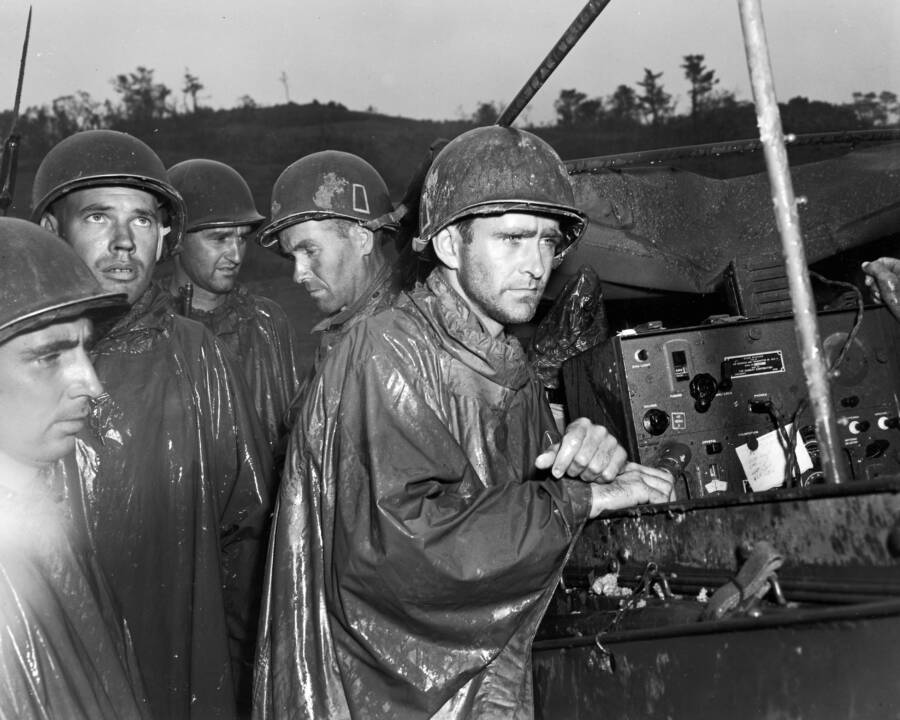 |
| American soldiers on Okinawa in Japan
listening to the radio broadcast announcing the German surrender and the official end of World War II in Europe. The Battle of Okinawa began in April 1945 and lasted until June, and Japan would not officially surrender until September. (All That's Interesting) |
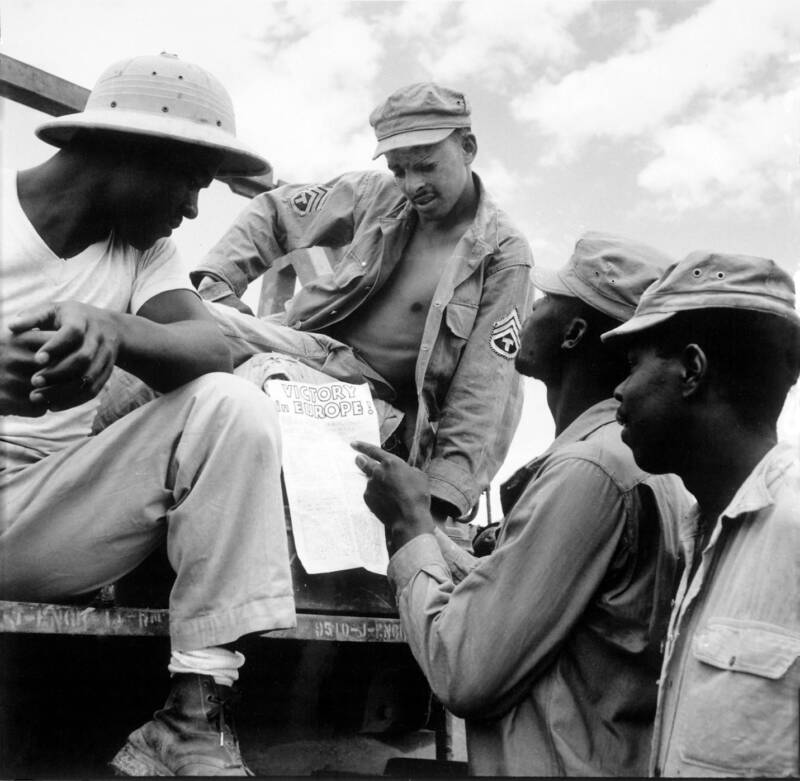 |
| American troops in Burma (now Myanmar) taking a break to read about the Allied victory over Nazi Germany. (All That's Interesting) |

A sampling of revisionist fictions treated in Hiroshima is as follows:Read the whole thing™…
1. That intercepted messages between Tokyo and Japanese diplomats abroad during the summer of 1945 revealed Japan’s willingness to surrender.
None of these messages even hinted that Japan was prepared to surrender under any circumstances. Some members of what Robert P. Newman has referred to as the “civilian elite” were trying to enlist the Soviet Union in brokering a peace that would have permitted Japan to escape with its prewar empire and imperial system intact. Several enterprising revisionists, including Kai Bird and Martin J. Sherwin in their recent Pulitzer Prize-winning American Prometheus: The Triumph and Tragedy of J. Robert Oppenheimer (2006), have misrepresented these messages by the simple device of pretending that the word “peace” meant the same thing as “surrender.” They neglect to inform their readers that as late as 17 July 1945 the Japanese foreign minister stated that “we are not asking [for] the Russians’ mediation in anything like unconditional surrender. . . .”
Sadao Asada’s essay in Hiroshima, based largely on Japanese sources, shows how difficult it was for the Japanese “peace party” to prevail over the hardliners in the government even after both bombs had been dropped and the Soviet Union had entered the war. That they could have done so before these catastrophic events is impossible to credit.
Edward J. Drea points out that regardless of what the diplomats were trying to accomplish, intercepted military traffic (ULTRA) revealed that the Japanese military was “struggling around the clock to turn Kyushu’s beaches [site of the first planned invasion] into massive killing grounds.” And the generals controlled the situation, not the civilians.
Hiroshima was a horrific event, but in the memory of the nation, it also represents the baptism of a new Japan, the event that put an end to fifty years of crimes. Out of this evil came a good, a Japan which repudiated the horrors of militarism and nationalism, engaged in repentance, and focused on growth. Although it is not said so openly, Hiroshima also played a purifying role. If the Japanese committed crimes, they also suffered what no other nation has ever suffered and thus, in the collective unconscious, they have somehow paid their dues.
 Naturally, an article coupling Japan's nuclear plant disaster with 1945's dropping of the atomic bomb on Hiroshima had to appear in Le Monde and so it does, thanks to Philippe Mesmer.
 Pour les 239 225 hibakusha encore de ce monde, l'enchaînement des événements à la centrale de Fukushima et l'extension progressive des zones de retombées radioactives rappellent ce matin d'été ensoleillé, chaud et humide, déchiré par l'éclair d'une explosion d'une violence inouïe, suivie pour certains d'une perte de conscience avant un réveil dans un paysage de cendres, traversé par des survivants hagards, brûlés au dernier degré, la peau en lambeaux, torturés par la soif. Ils se souviennent aussi des jours de pluie noircie par les cendres contaminées, des années à souffrir dans les hôpitaux où les médecins pronostiquaient une mort prochaine. Soixante-cinq ans plus tard, ils n'ont rien oublié.Philippe Mesmer's article is coupled with Gaëlle Dupont's interview of Jean-Marie Bouissou (directeur de recherche au Centre d'études et de recherches internationales de Sciences Po, historien du Japon contemporain, et l'un des meilleurs spécialistes du pays), who states that "La presse ne mène pas le débat" and who gives another viewpoint on the dropping of the atomic bombs.
… "Le pire est à craindre pour les habitants de la région. Le problème est que peu de gens peuvent comprendre, car ils ne connaissent pas les dommages causés à la santé par les radiations." La situation suscite également des réactions de colère, comme celle de Kohta Kiya, qui avait 3 ans au moment de l'attaque atomique de 1945,et qui est aujourd'hui le secrétaire général de la Confédération préfectorale des survivants de la bombe A. "Le gouvernement a fait preuve d'inconscience. Je ne comprends pas comment on peut construire des centrales nucléaires sur un territoire aussi sujet aux séismes." Lui craint de voir la région de Fukushima devenir comme les alentours de la centrale de Tchernobyl, en Ukraine, qui reste une "zone morte avec au centre des matériaux toujours actifs, vingt-cinq ans après".
Hiroshima a été une horreur, mais c'est aussi, dans la mémoire du pays, le baptême d'un nouveau Japon, l'événement qui a mis fin à cinquante ans de crimes. De ce mal est sorti un bien, un Japon qui avait renié les horreurs militaristes et nationalistes, se repentait et se développait. Même si ce n'est pas dit ouvertement, Hiroshima a aussi joué un rôle de purification. Dans l'inconscient collectif, si les Japonais ont commis des crimes, ils ont aussi subi ce qu'aucun autre peuple n'a jamais subi et ont donc, en quelque sorte, payé.
 No mention, of course, is made of the (many more) Japanese people that would have been victims had the bombs not been dropped — which (needless to say) was the entire point behind Fumio Kyuma's comment in the first place!
 In a public appearance [last] Saturday — the unofficial start of the campaign for [Japan's] upcoming election — Kyuma said that dropping the atomic bombs on Hiroshima and Nagasaki in 1945 "ended the war," adding, "I think that it couldn't be helped."Kyuma had to resign as Prime Minister Shinzo Abe's defense minister (and was replaced by Yuriko Koike, Japan's first female defense chief). His comments, more specifically, said:
Otherwise, Kyuma said, the war would have dragged on and the Soviet Union would have ended up occupying northern Japan.
…The comments by Kyuma, who represents Nagasaki in the lower house, caused widespread anger by apparently treating lightly Japan's status as the only country ever targeted by nuclear weapons. Although the debate over the use of nuclear arms is not the taboo it once was, Japan's self-image as a special victim of World War II remains deeply rooted, even as revisionist politicians like Abe have tried to minimize Japan's militarist past.
"I understand that the bombing ended the war, and I think that it couldn't be helped," Kyuma said.
Kyuma, who is from Nagasaki, said the bombing caused great suffering in the city, but he said he did not resent the United States because the bombs prevented the Soviet Union from entering the war with Japan, according to Kyodo news agency.
Kyuma said if Japan had not surrendered, northern Japan could have been occupied by the Soviet Union, which had begun invading Manchuria on the same day Nagasaki was attacked, according to Japanese media.
The remarks, rare for a Japanese cabinet minister, were quickly criticized by atomic bomb victims.
The truth is that the supposedly biased West discusses the contribution of others far more than our former enemies — or Russian and Chinese allies — credit the British or Americans. There is a pattern here.writes Victor Davis Hanson as we approach the anniversary of the Hiroshima bombing.
There is a pattern here. Western elites — the beneficiaries of 60 years of peace and prosperity achieved by the sacrifices to defeat fascism and Communism — are unhappy in their late middle age, and show little gratitude for, or any idea about, what gave them such latitude. If they cannot find perfection in history, they see no good at all. So leisured American academics tell us that Iwo Jima was unnecessary, if not a racist campaign, that Hiroshima had little military value but instead was a strategic ploy to impress Stalin, and that the GI was racist, undisciplined, and reliant only on money and material largess.
There are two disturbing things about the current revisionism that transcend the human need to question orthodoxy. The first is the sheer hypocrisy of it all. Whatever mistakes and lapses committed by the Allies, they pale in comparison to the savagery of the Axis or the Communists. Post-facto critics never tell us what they would have done instead — lay off the German cities and send more ground troops into a pristine Third Reich; don’t bomb, but invade, an untouched Japan in 1946; keep out of WWII entirely; or in its aftermath invade the Soviet Union?
Lost also is any sense of small gratitude. … Such revisionists never ask whether they could have written so freely in the Third Reich, Tojo’s Japan, Mussolini’s Italy, Soviet Russia, Communist Eastern Europe — or today in such egalitarian utopias as China, Cuba, or Venezuela.
Second, revisionism requires knowledge of orthodoxy. One cannot dismiss Iwo Jima as an unnecessary sideshow or allege that Dresden was simple blood rage until one understands the tactical and strategic dilemmas of the age — the hope that wounded and lost B-29s might be saved by emergency fields on Iwo, or that the Russians wanted immediate help from the Allied air command to take the pressure off the eastern front in February 1945.
But again, most Americans never learned the standard narrative of [World] War II — only what was wrong about it. Whereas it is salutary that an American 17-year-old knows something of the Japanese relocation ordered by liberals such as Earl Warren and FDR, or of the creation and the dropping of the atomic bomb by successive Democratic administrations, they might wish to examine what went on in Nanking, Baatan, Wake Island, Guadalcanal, Manila, or Manchuria — atrocities that their sensitive teachers are probably clueless about as well.
… How odd that Swedes and Spaniards who were either neutrals or pro-Nazi during World War II now so often lecture the United States not just about present morality but about the World War II past as well.


unconvinced that President Harry S. Truman and other decision makers knew as much in 1945 as Ms. Southard seems to know in 2015.
In my interviews with some 60 physicists, engineers, military men and ordinary working people who had been closely connected with Hanford and the Manhattan Project, the consensus was that both bombs were necessary, with a bit less consensus on the Nagasaki bomb.The most brutal comment — perhaps the most realistic — was expressed by Leona Marshall Libby, probably the most well-known female scientist in the Manhattan Project.“I have no regrets,” Dr. Libby said. “I think we did right, and we couldn’t have done differently. In wartime, it was a desperate time. … When you are in a war to the death, I don’t think you stand around and ask, ‘Is it right?’ ”A similar viewpoint, from a combat soldier’s profoundly pessimistic perspective, is found in the historian Paul Fussell’s essay “Thank God for the Atom Bomb”. Mr. Fussell was probably headed for action on a Japanese beach, but to his everlasting relief, the Japanese surrendered a few days after the Nagasaki bombing.
 Also check out more than a dozen voices in the
misses the reasons why dropping that second bomb so soon after Hiroshima was important: It prevented the Soviet partition of Japan.
Regarding the Japanese cabinet meeting on the morning of Aug. 9, 1945, it would have been more accurate to say that deliberations on the bomb ceased when news of the Nagasaki bomb arrived and those present recognized that more such bombs were likely. As Secretary of War Henry L. Stimson, Brig. Gen. Leslie Groves and Rear Adm. William R. Purnell have estimated, it was the fear of a third bomb that drove the Japanese to accept unconditional surrender.Moreover, Ms. Southard fails to recognize the abysmal alternatives to a “no drop” decision by President Harry S. Truman, or a delay in the use of the second bomb.Had he decided against dropping the bomb, Hiroshima and Nagasaki, along with Kokura and Niigata, would have been taken off the Manhattan Project list and Maj. Gen. Curtis LeMay would have incinerated them. Instead of becoming billion-dollar tourist attractions, Hiroshima and Nagasaki would be no better known around the world than the other 60-some cities that were razed by American B-29s.
Had the second bomb not been used and had America begun negotiations with the Japanese, the surrender would have been delayed. Stalin’s Red Army was poised in southern Sakhalin for an airdrop on Hokkaido, Japan’s northern-most home island. Then, when the Japanese finally did surrender, a Soviet Army of occupation would have been entrenched in northern Japan, with General Douglas MacArthur and his army in southern Japan. Japan, as we know it today, would not exist.
