Tuesday, May 30, 2017

France's Former Ambassador to Iraq Risks Prison Time on Charges of Tax Fraud and Forgery


A French diplomat and close adviser to the former president Nicolas Sarkozy has gone on trial after he was stopped trying to leave the country with a bag stuffed with banknotes
reports Kim Willshir in The Guardian, with Le Figaro's Anne Jouan adding that the prosecutor is asking for prison time for Monsieur Boillon.
Boris Boillon, who was known as “Sarko Boy”, appeared in a Paris court on Monday on charges of tax fraud and forgery following the discovery.

Boillon, who once appeared on the cover of a celebrity magazine with the headline “The James Bond of the diplomatic world”, was pulled over by customs officers at Gare du Nord in Paris in July 2013 before he boarded a train to Belgium, where he lives with his family near Brussels.

When Boillon opened the sports bag that he was carrying, police found €350,000 (£302,000) and $40,000 (£31,000) in cash wrapped in plastic bags and a plastic box. Boillon claimed he had been paid the money for consultancy work on a stadium construction in Iraq. As well as the fraud charges, he is accused of breaking strict limits on the transfer of cash within the European Union. The forgery charge relates to documents he allegedly presented justifying the cash.

Investigators say they have been unable to trace the source of the money. Boillon, who is facing four charges, could be fined up to €855,000 if found guilty of each and be ordered to serve up to five years in prison.
No Pasarán Boris Boillon has appeared on No Pasarán before, notably when he went on Canal+
to defend Muammar Gaddafi, saying: “He was a terrorist, he is no longer. We mustn’t fall into cliches. We’ve all made mistakes in life and we’ve all the right to be forgiven.”
One cannot refrain from wondering whether the Frenchman's travails aren't due, at least partly, to a political assassination à la François Fillon, in view of the fact that
Boris Boillon — an Arab-[speaker] who served as ambassador in Baghdad — voiced support for George W Bush during the Iraq War! That, of course, makes his sins all the more unforgivable
As Simon Piel and Joan Tilouine confirm in Le Monde,
En Irak, où il fut ambassadeur de 2009 à 2011, il s’était montré favorable à l’intervention américaine. Nommé à Tunis à la chute du régime du dictateur Zine el-Abidine Ben Ali, le jeune diplomate n’avait pas hésité à afficher son corps sculpté sur le Web, uniquement vêtu d’un slip de bain, ou à poser en James Bond dans la presse locale. Son ton franc voire arrogant, mal perçu dans le milieu diplomatique, avait choqué une partie de l’opinion publique tunisienne.

Lorsqu’il reçut pour la première fois des journalistes tunisiens, qui l’interrogèrent sur le rôle de la France durant la révolution, Boris Boillon s’emporta, évoquant « des trucs à la con », des « questions débiles », avant de brutalement mettre un terme à l’entretien filmé et diffusé sur les réseaux sociaux. Une attitude qui poussa des centaines de Tunisiens indignés à se réunir devant l’ambassade de France, trois jours plus tard, en scandant « Boillon dégage ». Contacté par Le Monde, M. Boillon n’a pas donné suite à nos demandes d’entretien.

Monday, May 29, 2017

If it weren’t for anonymous sources, it seems that the media wouldn’t have any sources at all


If it weren’t for anonymous sources,
deadpans Benny Huang on the Constitution website (thanks for the link, Maggie), in an homage to a favorite Instapundit meme,
it seems that the media wouldn’t have any sources at all. In the past two weeks the media have promoted a number of weighty stories that rested upon the credibility of people whose names we are not allowed to know. Two of these stories were veritable bombshells that, if true, should rightly land powerful people in prison. It’s too bad both stories were so thinly sourced.

Perhaps the bigger of the two stories, measured at least by the news coverage that it got, was the Washington Post’s scoop that Donald Trump had allegedly shared classified intelligence with the Russian foreign minister and the Russian ambassador concerning ISIS terror plots. That report was followed by a barrage of stories about exactly which beans were spilled and whether they were really classified beans. Each volley of articles only muddied the waters more.

The second bombshell involved a new development in the Seth Rich murder investigation. Rich, a 27 year-old DNC staffer, was gunned down last July in a wealthy section of Washington, DC. Shortly thereafter, Wikileaks founder Julian Assange very strongly hinted that Rich was the source of embarrassing internal party emails leaked to his organization—emails that showed that the system was rigged against the insurgent candidate Bernie Sanders among other juicy details. If that were the real motive for his murder it would seem to point accusatory fingers at officials in the Democratic Party.

This relatively cold case got a little warmer last week when Rod Wheeler, a private investigator and former DC homicide detective, made the astonishing claim that there was solid evidence on the victim’s laptop that he had been in contact with Wikileaks before he died. This claim seemed a little weak considering the fact that Wheeler had not himself seen the laptop and was not even sure which law enforcement agency had it in their possession. Still, he insisted that a source at the FBI had told him that the laptop was the key to cracking the case. Within about 24 hours, FOX News was claiming to have an anonymous federal investigator who confirmed the veracity of Wheeler’s claim. FOX News has now officially retracted that story, though exactly why is a mystery. The New York Times clearly implied that FOX News backed off under pressure from the victim’s family, which is a pretty lousy reason to retract a story if you ask me. If it’s not true that’s something else entirely.

The problem with anonymous sources is that they only have as much credibility as the news outlets that vouch for them. When reporters use anonymous sources they are affirming that the mysterious individual has placement, access, and above all credibility. The reporter is asking his readers for their trust and, by running the story, the news outlet is backing him up. In days gone by[,] reporters usually received the trust that they sought because people didn’t see the media as a bunch of partisan hacks. These days, just saying that “a little bird told me” doesn’t cut it because the media has sullied its own reputation.

Given the declining trust that the public places in journalists, you might think that journalists would scale back their use of anonymous sources but the opposite seems to be happening. Though I know of no database that tracks how often anonymous sources are cited in a given year, casual observation tells me that the practice is more common now than when I started paying attention to the news in the 1990s. Journalist Paul Fahri, who covers the media beat at the Washington Post, concurs. Writing in 2013, he said that “According to sources who didn’t insist on anonymity, more and more sources are speaking to the news media on the condition of anonymity for the oddest of reasons.” I would argue that this trend has only increased since 2013 and that it’s become an epidemic since the inauguration of Donald J. Trump. The news cycle is starting to feel like a middle school rumor mill in which catty girls snipe at each other from behind a veil of secrecy. The news is no longer the news—it’s all the Washington gossip fit to print. This has to stop, at least until the Fourth Estate reestablishes its credibility with the American people, which could take a very long time.

Yet the media seem incapable of hearing any criticism of their profession or their employers. This attitude was driven home last week when a panel of reporters appearing on CNN reacted in shock, disbelief, and anger when their guest, former Navy SEAL Carl Higbie, stated that he was not convinced President Trump had given classified intel to Russian guests. “Tell you what, name those sources, then we’ll have something to talk about,” said Higbie. The exchange that followed was absolutely priceless, mostly for the reaction of hostess Kate Bolduan who lost it on national television. She was incensed that someone wouldn’t take a mainstream media-approved anonymous source as gold.

Journalist Kirsten Powers interjected with the classic defense of anonymous sourcing—Watergate. That scandal was broken by Bob Woodward of the Washington Post who received some tips from a mysterious man in a suburban DC parking garage. Until 2005 Woodward referred to his source, whose real name was W. Mark Felt, as Deep Throat.

Unfortunately, Woodward set a very bad precedent. In the years since Watergate, anonymous sourcing has become almost de rig[u]eur. Every anonymous source is now treated like a latter-day Deep Throat. Never mind the fact that Woodward used his secret source mostly as a starting point and that he didn’t expect the entire story to hold together on that single source’s credibility.

If Kirsten Powers wants to use Deep Throat as an example of anonymous sourcing at its best I can surely provide counterexamples of anonymous sourcing gone horribly wrong. Two such examples can be found at The New Republic (TNR), a publication that liberals tend to hold in high regard despite the various journalistic abominations it has run over the years.

In 2007, TNR ran three dispatches from a GI in Iraq whom they referred to as “Scott Thomas” (pseudonym) or the Baghdad Diarist. The Diarist wrote of American soldiers behaving more or less like savages: disrespecting the bodies of dead Iraqi civilians and running over dogs with their Bradley fighting vehicles. Readers were supposed to feel as if they were getting the ground truth instead of Pentagon spin when in fact they were merely having their preconceived notions confirmed. Unfortunately for TNR, the Baghdad Diarist was basically making all of this stuff up. A US Army investigation into this blatant misconduct found it baseless. None of the details of his story stacked up, “Scott Thomas” refused to cooperate with TNR’s own inquiry, and eventually TNR retracted the story.

To make matters worse TNR was by then still on probation for another incident that happened nine years prior, from which they claimed they had learned some lessons. In 1998 TNR got burned by one of its associate editors, Stephen Glass, who turned out to be a compulsive liar. An investigation later determined that 27 of Glass’s 41 TNR pieces contained at least some made up material and a few were entirely confabulated. Glass of course hid behind anonymous sources.

 … These two examples illustrate the pitfalls of anonymous sources. The Baghdad Diarist was a real soldier deployed to Iraq but he wasn’t credible. There was no way for TNR readers to assess his credibility because they didn’t know who he was. Believing that his account would never be checked, “Scott Thomas” wrote whatever his imagination could dream up, slimed his brothers-in-arms, and hurt the mission. Stephen Glass’s scandal was even worse because his anonymous sources were entirely fictional, a secret he thought he could keep.

When reporters have leeway to cite anonymous sources there’s really nothing to stop them from pulling these kinds of stunts. They can write anything at all and just attribute it to some guy they met in a parking garage. The guy in the parking garage may or may not exist, may or may not be a crackpot, may or may not have an agenda, may or may not have the access he claims to have. We don’t know.
And, I might add, neither may the journalist himself know, for that matter.
Journalism as a profession has some well-deserved black eyes and it would behoove reporters to start earning back the public trust. Anonymous sources do the opposite. Too often they’ve been used as covers for lousy and unethical reporting.

Sunday, May 28, 2017

CNN's Don Lemon Ain't Too Happy with Morgan Freeman's Answers

The Scoop's Bob Amoroso posts a video showing CNN's Don Lemon interviewing Morgan Freeman:

 … young, inexperienced pups like CNN host Don Lemon attempts to play the victimization “race card” while interviewing acclaimed Academy Award winner Morgan Freeman, who knows a thing or two about real discrimination.

If anything this brief video clip perhaps best illustrates the disconnect between the generations, when it comes to the issue of race among African-Americans, it’s that same disconnect that immigrants first felt coming to America during the 20’s, 30’s 40’s and perhaps even the 50’s.

Lemon attempts to suggest that racial discrimination among African-Americans is by extension an economic issue, saying; “Do you think race plays a role in wealth distribution?”

Freeman momentarily taken aback by the question and seemed a bit bemused responded, “No. You and I are proof of it.”

Which apparently doesn’t satisfy the CNN host, as he tries again to illicit a response more to his liking, suggesting that some individuals might find it too hard to “pull themselves up by the bootstraps.”

Freemen’s bemusement instantly evaporates, and begins schooling the young progressive pup, by reminding him he was born over 70-years ago in a place called Memphis, Tennessee then stating “um, I had a long haul from where I came from to here…but here we are.”

Lemon interjects saying: “not everybody can do that.”

Freemen sitting back on his chair exclaims “BULLSH*T, everybody can!”

Friday, May 26, 2017

Before 007, Roger Moore Starred with Tony Curtis in The Persuaders — Some Interesting Trivia on the TV Series, Courtesy of No Pasarán

Sir Roger Moore's fellow James Bond actors. as well as other celebrities, join in an outpouring to pay homage after the actor's death.

As Sir Roger himself said of 007, his most famous role:
“Now they’ve found the Bond — Daniel Craig…. I always said Sean played Bond as a killer and I played Bond as a lover. I think that Daniel Craig is even more of a killer. He has this superb intensity; he’s a glorious actor.”
Of course, Roger Moore became famous for handful of TV series. Almost unknown in America, The Persuaders became one of the greatest television hits in Europe, with John Barry's haunting theme music and co-starring Tony Curtis.

One fan is No Pasarán's main blogger, who indeed has authored a number of entries on the TV series' trivia page. Among which are:

Originally, the title of the TV series was going to be "The Friendly Persuaders", but because that sounded too close to a Gary Cooper western (Friendly Persuasion (1956)), it was shortened.
Because Roger Moore deemed that no good photos exist of him as a child, the black and white boyhood picture of Brett Sinclair in the opening credits is that of his son Geoffrey Moore

The filmed sequences presenting Danny Wilde and Brett Sinclair in the opening credits were not filmed expressly for said credits but were taken from various early episodes (all of them in Southern Europe), mainly The Persuaders!: Overture (1971) (the two men racing their sports cars, Tony Curtis and Roger Moore distracted by a blonde in a bikini walking between them, Brett flirting with two beauties) and The Persuaders!: Powerswitch (1971) (the water-skiing shots and Danny shown as a businessman at work at a desk)

Tony Curtis was born Bernard Schwartz of Hungarian immigrants. And if you pay attention, you will find the actor sprinkling inside jokes to his origins through the series. In The Persuaders!: Greensleeves (1971), for instance, his character pretends to be Brett Sinclair's new butler, Grzegorz (Gregor), and explains his (fake) East European accent by his being from a "Hun-GAA-rian" from "BU-dapesht" (unfortunately for Danny Wilde, the black beauty from an African republic that he shares this with speaks the language perfectly). Torn from his Paris hotel shower in The Persuaders!: The Old, the New, and the Deadly (1971) by the telephone ringing which turns out to be a wrong phone number, a dripping wet Danny states, "No, this is not Mr Schwartz, you got the wrong room!"

Related: A 7-Year-Old Spots a Celebrity in an Airport, His Heart Sinking When Roger Moore's Autograph Does Not Read "James Bond"; What Happens Next?

Thursday, May 25, 2017

Can't America Impeach Trump and Remove Him from Office? Asks French Radio Channel Giddily; GOP's Reen Answers with One Single Monosyllable

Est-ce l'Amérique peut se déTrumper ? asks French radio in a play on words meaning both Can America unTrump itself and Can America undo its blunder.

Among the guests of Laurent Goumarre's Le Nouveau Rendez-Vous on the France Inter radio channel devoted to the question whether Donald Trump can be impeached — or, rather, removed from office (a number of people seem to think that they are one and the same) — were Jean-Xavier de Lestrade, Samuel Doux (scénariste, réalisateur et auteur), Kid Francescoli (Chanteur), Norman Spinrad (auteur de science-fiction américain), Constance Borde (Représentante en France du parti démocrate), and Eric Fottorino (Journaliste et écrivain), as well as, last but not least, Paul Reen (représentant du Parti Républicain en France).

Notably, Alice Antheaume spent three and a half minutes in a mocking monologue over Donald Trump's tendency for writing tweets. After Christop Bourseiller went on and on for two and a half minutes with an editorial on the possibility of Donald Trump's impeachment and removal for office, Paul Reen answered with a single monosyllable.

Go to the France Inter link to hear the whole debate…

A 7-Year-Old Spots a Celebrity in an Airport, His Heart Sinking When Roger Moore's Autograph Does Not Read "James Bond"; What Happens Next?

In the wake of the passing of Sir Roger Moore, one Mark Williamson posts the following reminiscence (is it his own or someone other's?) on Facebook (cheers to Michael White).

Wednesday, May 24, 2017

Good-Bye, 007; Farewell, Lord Sinclair: RIP Sir Roger Moore (1927-2017)


A good obituary of Roger Moore appears in the Daily Mail thanks to Alexander Robertson and Marc Johnson — cheers to Sarah Hoyt who reveals that
HE WAS MY FIRST CRUSH WHEN I SAW HIM IN THE PERSUADERS.  I WAS TEN.
From the documentary, A Matter of Class:
Here is Roger Moore’s own story, as told by the famous actor himself. This profile also includes the recollections of colleagues and friends like Gregory Peck, Michael Caine, Tony Curtis, Carroll Baker and Maud Adams.
A couple of interesting quotes:
When Sean Connery played James Bond, he played it as the bad boy womanizer. And when Roger Moore played Bond, he played it as the man that — maybe — would marry the heroine …if the circumstances were right.
— Jackie Collins (26:53)

With women, I think the difference between Sean and Roger was that Sean macho'ed them into bed, and Roger loved [laughed?] them into it…
— Michael Caine
Meanwhile, Adrien Guilleminot has a long interesting commentary (en français) on the James Bond films in the Géo monthly.
The Daily Mail includes a selection of Sir Roger's quotes

IN HIS OWN SUAVE WORDS... 

Women have played a big part in my life on and off-screen and I think I’ve finally worked them out. I always make sure I have the last word. That word is ‘yes’.

‘It just gave me a stiff neck’ — explaining why taking Viagra left him neither shaken nor stirred.

Intelligence is my most endearing quality, according to [his wife] Kristina. That’s her Swedish sense of humour.

Being eternally known as Bond has no downside. People call me Mr Bond when we’re out and I don’t mind a bit. Why would I?

‘I had creaking knees and my leading ladies could have been my granddaughters’ — on his last appearance as James Bond in A View To A Kill, aged 57.

‘I lie all the time. I say different people, otherwise you’ll upset somebody’ — on his favourite Bond girl.

I’m one lucky b******. In my early acting years, I was told that to succeed you needed personality, talent and luck in equal measure. I contest that. For me it’s been 99 per cent luck. It’s no good being talented and not being in the right place at the right time.

The saddest thing about ageing is that most of my friends are now ‘in the other room’. I miss David Niven the most. I still can’t watch his films without shedding a tear.

Some of the things I’ve done in my life I’m ashamed of. We don’t talk about those, though. If I could give my younger self some advice it would be: ‘Grow up!’

I still have some of Bond’s suits in my wardrobe, but they don’t fit me now. In the 007 days I was so thin that if I turned sideways you could mark me absent.

My mum instilled in me the proverb: ‘I cried because I had no shoes, until I saw a man who had no feet.’ Those words are always with me and I’m a believer in showing kindness to others and not expecting repayment.

Medicine has always fascinated me and I’m a hypochondriac. It’s not that I wake up every morning and think: ‘I’m dying.’ At my age, I know I am.

Related: A 7-Year-Old Spots a Celebrity in an Airport, His Heart Sinking When Roger Moore's Autograph Does Not Read "James Bond"; What Happens Next?

Before 007, Roger Moore Starred with Tony Curtis in The Persuaders — Some Interesting Trivia on the TV Series, Courtesy of No Pasarán

MSM Headline Scoop: Who Does the Perpetrator of a Terrorist Attack in the UK Turn Out to Be? "An Englishman"

Reporting on the Manchester attack by one Salman Abedi, like all other MSM outlets, is the newspaper 20 Minutes. In that perspective, it is worth remembering that after it was discovered
that the March attack on Westminster bridge was one Khalid Masood, one French article provided the remarkable scoop that "The Assailant Is Allegedly [wait for it…] a 41-Year-Old Englishman." As for the free subway daily mentioned above, it also headlined the critical information, the stunning revelation, that… The Author of the Attack Was English.

Neither article — ain't that incredibly strange? — seems to be found online anymore, not in any case on their original respective websites. Reading the 20 Minutes filler from March, incidentally, it looks suspiciously obvious that the headline was not written by the journalist, but added by an editor. One with an agenda. But, then again, I repeat myself, don't I? Aren't they — MSM editors — all with an agenda?

Related: • Manchester Bomber Identified as Muslim Terrorist, Liberals Worry about ‘Islamophobia’

• Nothing to see here, folks (Lefty media deflects after yet another atrocity)
Stephanopoulos: “This is also likely to inflame anti-Islamic sentiment across Britain, across Europe.”

Martha Raddatz, whose wedding Barack Obama attended, agreed: “It will likely create backlash.”

A backlash? What about the little girls whose lives were so horribly snuffed out, and their survivors? What about their feelings? Much of the media obfuscated for as long as they could. Maybe, they claimed, it was all a big mistake, the carnage caused by “balloons exploding?”

As the hours went by and no names were released, it became more and more certain what had happened, just like when an arrested politician isn’t ID’d by his party affiliation in the first two paragraphs, you can 100 percent take it to the bank that he’s a Democrat.

Same thing in terrorism: When the killer is named, say, Dylann Roof, the public will be informed instantly. When the much more likely scenario unfolds, and the killer is one Salman Abedi, well, his next of kin must be notified … in Libya.

But he’s “homegrown,” and don’t you forget it. An accomplice may have been arrested, but he was a “lone wolf.” ISIS took responsibility, but don’t sweat it. As Obama told us, ISIS is “the j.v.”


Thursday, May 18, 2017

Donald Trump Interview: "We’re going to make it 10%; Now it’s 35% … this would be the biggest tax cut in the history of the country … We want to keep it as simple as possible"


President Donald Trump sat down on May 4 for an interview with The Economist. 
DONALD TRUMP, the President of the United States, along with Steve Mnuchin, the treasury secretary, and Gary Cohn, the director of the National Economic Council, sat down for a conversation with editors from The Economist on May 4th, 2017. What follows is a lightly edited transcript. 
 … we’re bringing our taxes down so low that you won’t even need the barrier because the taxes are so low, that people are going to stay.

 … We’re letting that money come back in. And that has two barriers which you have to watch. It’s got a barrier of the tax, which we will take care of. We’re going to make it 10%. Now it’s 35%...
Sorry, 10%? The repatriation taxes?
The repatriation. Inversion. The corporate inversions, which is a disaster, with the companies leaving. But they want to bring back their money. Number one, the tax is too high but the other thing that’s too high is the bureaucracy.
Mr Mnuchin: Correct.
President Trump: I have a friend who said even if you wanted to bring it back in you can’t because you have to go through so many papers, so many documents, so many…
Mr Mnuchin: We’re going to make it simple
President Trump: You have to do…Steve, they told me you’ve got to sign books and books of stuff, you pay millions of dollars in legal fees and they almost don’t allow you to bring it back in.
Can I ask you a question about the politics of tax?
It should be like one page.
…
Can I ask you about the focus of the tax cut because you’ve spoken about a massive tax cut for ordinary workers…
Right, this would be the biggest tax cut in the history of the country.
But the biggest winners from this tax cut, right now, look as though they will be the very wealthiest Americans.
Well, I don’t believe that. Because they’re losing all of their deductions, I can tell you.
But something like eliminating the estate tax.
I get more deductions, I mean I can tell you this, I get more deductions, they have deductions for birds flying across America, they have deductions for everything. There are more deductions…now you’re going to get an interest deduction, and a charitable deduction. But we’re not going to have all this nonsense that they have right now that complicates things and makes it…you know when we put out that one page, I said, we should really put out a, you know, a big thing, and then I looked at the one page, honestly it’s pretty well covered. Hard to believe.
Will you keep interest deduction in the corporate tax? Will corporate interest payments…Do you want to answer?
Mr Mnuchin: We’re contemplating it. We’re contemplating it.
So what would your preference be Mr President? You know about that very well.
 … we’re contemplating various things, but one of the things that’s very important is simplicity. We want to keep it as simple as possible. Because even if you do, it’s complicated. I mean even if you keep it simple with taxes it gets complicated.
 … But we’re going to be getting a lot of companies moving back and we’re going to get very few companies leaving the United States because we went from the highest tax rate of…not only major, you know they always say major countries, just about the highest tax rate period. And then when you add all the other things. And then when you add the regulations to the tax…I’ve had people tell me, because I’ve cut massive regulations and we’ve just started, believe me. But we’ve cut regulations massively.
…
Read the whole thing…

The Economist paints a Rosy, If Not Heroic, Portrait of Soros, Depicting His Adversaries as Little Better than Racist


Of course, you can count on a mainstream media outlet like The Economist to write a (mostly) flattering, or at least positive, portrait of George Soros, referred to as the "Canary in the global mine".

Not a word about such things as the Hungarian quietly buying District Attorneys' seats (köszönöm to Instapundit)…
An appetite for risk made George Soros a billionaire, but also made him enemies, as has his congenital philanthropy. In recent months these resentments have reached a new, alarming pitch. Two strands of criticism, in America and abroad, seem to have fused, a confluence epitomised by a pair of obscure letters sent by Republican politicians. A group of senators wrote to Rex Tillerson, the secretary of state, and a clutch of congressmen to the comptroller-general, taking aim at the same detail: the role of USAID, America’s foreign-aid agency, in Macedonia, specifically its collaboration with the local arm of Mr Soros’s Open Society Foundations (OSF).

Mr Soros has supported democratic reform in central and eastern Europe since he distributed photocopiers among activists in the 1980s. His programmes avowedly promote free media, fair elections and clean government, rather than opposition parties, but local autocrats often miss the distinction. The Kremlin, which blamed Mr Soros for peaceful uprisings in Russia’s ex-Soviet neighbours in the 2000s, kicked his affiliate out in 2015. Belarus and Uzbekistan have also given him the push.

His political views and hefty donations have led to vitriol in America as well. Denunciations of George W. Bush and the Iraq war made him a bogeyman among right-wing fulminators and conspiracy theorists. His support for Hillary Clinton and disparagement of Donald Trump—an “impostor” and “would-be dictator”—have reinvigorated his assailants. Recently he has developed a controversial sideline in local prosecutorial races, from Louisiana to Illinois, betting that reformist prosecutors can help change the criminal-justice system. Sometimes the candidates he backs seem as baffled by his interest as their rivals, but 12 out of his 15 picks have won.

 … In any case, Mr Soros’s infamy from the bayous to the Balkans is odd. He is certainly no saint. Some of his wealth comes from currency speculation, as when, short-selling the pound in 1992, he “broke the Bank of England”. He has a French conviction for insider trading in 1988. Yet he has given billions to worthy causes. Michael Vachon, a longtime adviser, points out that Mr Soros derives no personal benefit from his advocacy of, say, the rights of Roma or the abolition of the death penalty. In politics, Mr Vachon says, unlike many big-time donors he “is always lobbying for a public purpose, never for private gain”. Often he promotes policies, as on tax, that could cost him.

 … Whatever the causes, as Soros-bashing spreads—the idea of his global meddling gaining a meretricious credibility with repetition—so do other troubling views. One is the cynical claim that peaceful protesters, whether against Mr Trump’s policies or corruption in Romania, take to the streets only if they are bribed: usually, run the calumnies from Bucharest to Washington, by Mr Soros. “If we’d paid all the protesters they say we have,” jokes Laura Silber of OSF, “we’d be bankrupt many times over. It’s an insult to people standing up for their beliefs.” Second, ever-more supposedly democratic leaders are relying on external adversaries to bolster their positions, confecting them if necessary.

In its final paragraph, The Economist basically calls everyone opposed to "Public Enemy Number 1" a racist or an antisemite if not outright a Nazi.
Finally, there is the particular kind of foe that Mr Soros is made to embody. Portrayals of him as an octopus, or, as in a Hungarian billboard, as a puppet-master, inevitably recall the last century’s anti-Semitic propaganda. Some such echoes may be accidental, the conspiracists unconsciously defaulting to ancient tropes, but they are striking. In a tweet praising Mr Orban, for example, Steve King, a Republican congressman, called Mr Soros a “Marxist billionaire”. That chimes with the old slur against Jews whereby, as Tivadar Soros says in his book, “at one and the same time they held in their hands…the Western capitalist countries and Russian Bolshevism.” “He survived the Nazis,” Mr Vachon says of Mr Soros’s current situation, “and he takes a long view.” No doubt, but in some ways this must be depressingly familiar.
 

Is it time for us all to admit what a steaming pile of hypocrisy our entire conversation on race has become?


The doctrine of “separate but equal” is back
deplores Benny Huang on the Constitution website (thanks for the link, Maggie)
—this time at America’s most elite institution of higher learning, Harvard University. On May 23rd, black students will receive their diplomas in a separate commencement ceremony just for them.

Michael Huggins, president of Harvard’s Black Graduate Student Alliance (BGSA), helped organize the ceremony. He says that Harvard’s first black graduation is not about segregation because students of all racial and ethnic backgrounds may “attend.” It’s not clear if he means that students of all races are invited as spectators or as participants but it doesn’t really matter. Harvard wouldn’t allow such an event for white students even if the same ground rules applied.

The BGSA’s next president, law student Jillian Simons, is also proud of the event. “There’s an element of celebration and a very somber tone to it because of the things we’ve had to overcome,” said Simons. Her quizzical comment makes me wonder exactly what she thinks she’s “overcome.” Relentless pandering? Yeah, that would be difficult.

I hope she doesn’t mean that blacks at Harvard had to “overcome” racial prejudice. Blacks at Harvard are actually the benefactors of discriminatory admissions policies that lower the bar just for them. In order to gain admittance to this prestigious institution a black applicant can score 450 points lower on the SATs than an Asian applicant. This policy spurred a coalition of Asian-Americans to sue the university. The case is ongoing though I hope Harvard wins because I oppose all private sector nondiscrimination laws. Even so, we should stop pretending that black students have it harder. They’re given special favors and everyone knows it.

Not that I’m really upset about this hypocritical separate (but equal!) graduation. Let them have it—but then let’s all admit what a steaming pile of hypocrisy our entire conversation on race has become. I don’t want to hear any more talk about “inclusion.” It’s a stupid word that more often means its opposite. And while we’re at it, let’s count Brown v. Board of Education as a tragic mistake; after all, separate can be equal as long as it’s blacks who are excluding whites and not the other way around. Also, let’s stop musing about how hard it is for blacks to find their stride in mainstream society. Who ever said they wanted to?
 
Like all vexing social problems, this one has historical roots that deserve examination. I’ll begin by saying that black Americans did not create the parallel society that they currently cling to. White folks did that. Europeans came to this continent and created what was almost a perfect racial black/white dichotomy. The larger white group was the mainstream, while the smaller black group formed the alternative. Out of necessity, blacks set about creating their own parallel institutions—black universities, black professional organizations, black churches, black businesses, black publications, black sports leagues, black fraternities and black sororities.

These two societies were kept separate by law and custom until about the end of World War II. But then something unprecedented happened—with a little prodding by the so-called civil rights movement, the mainstream white majority relented and agreed to break down its own barriers. In historical terms, this happened remarkably fast and with remarkably little bloodshed. A system that had keep people apart for more than three hundred years unraveled in less than twenty.

And that should have been the end of it.

But it wasn’t—not by a long shot. It turns out that black people had developed a fondness for their parallel institutions. That’s understandable of course, though whites were fond of theirs as well and they still had to give them up. White institutions became integrated bi-racial spaces while black institutions were allowed to persist unchanged.

So the revolutionary transformation brought about by the so-called civil rights movement didn’t change quite everything. Two societies continued to exist even after the 1960s and still do today. One is black and the other was biracial before becoming multiracial over time. There was no grand merger between the two, as many white people imagined there would be.

Harvard’s black graduation ceremony is an excellent example of this. All of the graduates who participate in the black commencement on May 23rd will also graduate with the rest of their class two days later. One ceremony is the multi-hued, pluralistic, let’s-look-like-America graduation; and the other is the monochromatic Jim Crow version. Blacks get two graduations, one of which is set aside for their race. Whites get one ceremony and they have to share it.

How on earth can black America justify this? For starters, they usually try to pretend that their parallel society is still needed because the mainstream society is nearly as white as ever. For a good example of this phenomenon, consider Black Entertainment Television (BET). How many times have you heard it asked why there’s no White Entertainment Television? You know the pat answer to that. Saranya Khurana, who writes at the Odyssey Online, gave the same answer I’ve heard roughly a thousand times: “Most television today is the White Entertainment Television…BET was important for television because it was the first time black Americans had a show to call their own.”
 
So any channel that isn’t explicitly black is white by default? No, that isn’t even remotely true. It may have been closer to the truth when BET was founded in 1983 but even then network television had already featured two black sitcoms (The Jeffersons, Sandford and Son), a black cartoon (Fat Albert and the Cosby Kids), a black music-dance show (Soul Train) and a show about a white family that adopted two black children (Diff’rent Strokes.) So when Khurana says that BET was “the first time black Americans had a show to call their own” she’s wrong.

Black visibility on television only increased in the 1980s. I should know—like most kids of that era I looked forward to watching The Cosby Show every night before bedtime. If I had been a little older I would have watched Eddie Murphy carry Saturday Night Live through some of its toughest seasons before he moved on to a more lucrative career on the big screen. Or I might have watched Arsenio Hall debut as late night’s first black talk show host. During this same period, Oprah Winfrey’s success in daytime television made her a household name.

In the 1990s I graduated to Family Matters, In Living Color, and The Fresh Prince of Bel-Air. All of these programs were hits because Americans of all races tuned in. MTV featured a plethora of black artists including En Vogue, Coolio, and Janet Jackson. Margaret Cho starred in America’s first Asian sitcom, All American Girl. The show flopped but mostly because Margaret Cho isn’t funny. In later years there would be more Asian shows, more black shows, a few Hispanic shows, shows about mixed-race families, shows about step families, shows about same-sex couples, and every other thing you can think of.

So, is BET filling a gap in the entertainment market for black viewers that the white-oriented television industry simply isn’t meeting? Hardly. Television is very multiracial and has been for quite some time. If BET was ever “needed” it certainly isn’t anymore. Yet the channel persists because there’s a demand for it, which is very different from a need. Its viewership consists mostly of blacks who only want to see other blacks when they flick on the television.

White people don’t have that luxury anymore. When they turn on the television they see fewer and fewer people who look like themselves. They certainly don’t have an entire channel of nothing but white people doing stuff white people do. That’s because whites agreed to merge their society, first with blacks, then with everyone else. But the agreement didn’t work both ways.

To a large degree, black America still segregates itself with no end in sight. And isn’t that really the rub of the whole separate but equal Harvard graduation? Sixty years after the so-called civil rights movement it appears that black self-segregation may actually be increasing, which is just insane. Blacks have retreated further into their own spaces, their own dorms, churches, and clubs where they moan about how hard it is being black in America. But it’s just noise, pay it no mind.

Wednesday, May 17, 2017

The Rolling Stone Scandal Is Described Like an "Unexpected" Piece of "Bad Luck", Akin to a Natural Disaster


The sentence used by a CBS journalist to excuse a fellow MSM outlet's is replete with hidden meanings, via Scott Whitlock in Newsbusters (thanks to Instapundit).

Fake News Forgiveness: CBS Yawns at Rolling Stone’s False Rape Story: ‘Happens So Rarely’

By Scott Whitlock
The journalists at CBS This Morning on Tuesday offered breathtakingly little interest into one of the biggest fake news outrages in recent years. Talking to Rolling Stone publisher Jann Wenner about the 50th anniversary of the magazine’s founding, the show’s co-hosts managed just two questions on Rolling Stone’s false accusation of rape at the University of Virginia. Gayle King dismissed the bogus story because it “happens so rarely” at the publication.

Gayle King dismissed the bogus story because … King sympathized, “It happens so rarely to you.” 
Not only does the mainstream media highlight the word "rarely," but the "it happens" construct is akin, almost, to being the passive voice. Rarely or otherwise, it is certainly a very long away from "Rolling Stone is responsible for this piece of fake news."

It is as if the Rolling Stone scandal were like a natural disaster, a bit of bad luck, entirely unexpected… 

In any case, as Barabbus points out, what Gayle King means is the thing that "happens so rarely" is "getting caught".

Tuesday, May 16, 2017

The Reason that Marine Le Pen Lost the French Election Is That, in Reality, the Front National Leader Is a Leftist

Following the defeat of the Front National, Éric Zemmour says on RTL (Dankeschön für Hildegard von Hessen) that Marine Le Pen is a leftist and that all her reflexes are on the Left, confirming, indeed, what No Pasarán has been reporting on the daughter of Jean-Marie Le Pen for years…

• Related: The Leader of the Front National, Allegedly France's
Equivalent of the Tea Party's Extreme Capitalists,
Says That “Obama is way to the right of us”…

• The Question Arises: Is the Le Pen Party Extreme Rightist
or Is It Actually a Reincarnation of the Communist Party? 

• Marine Le Pen: France Should Leave NATO, "Turn Its Back"
on the American "Hyper-Power", and "Turn Towards Russia" 


In Le Figaro, Éric Zemmour adds that Marine has rewritten the King Midas legend upside down: everything golden that she touches, she transforms into lead.

Éric Zemmour a donné son analyse des résultats de l'élection présidentielle, lundi 8 mai sur RTL. Marine Le Pen était dans le viseur. "Elle était donnée à 30% au premier tour, elle finit à 21%. Elle était donnée à plus de 40 % au second tour, elle finit à 35%. Ça, c'est l'effet campagne de Marine Le Pen. À chaque fois, ses idées sont bien plus hautes qu'elle. Il y a un vrai problème Marine Le Pen aujourd'hui", explique le polémiste.

"Marine Le Pen est de gauche"

Pour Éric Zemmour, le principal problème provient de sa stratégie de campagne. En d'autres termes, de la ligne Philippot, plus sociale qu'identitaire, plus économique que culturel. Une stratégie mortifère aux yeux du polémiste. "Même si dans ses discours, elle tient compte davantage de l'identité et de l'immigration, de l'islam qui sont les vrais sujets qui peuvent rassembler au-delà de son électorat, elle retombe dans sa stratégie inspirée de Florian Philippot, de gauche. Elle privilégie le social sur l'identitaire" a-t-il déclaré.

Mais Éric Zemmour ébauche également le scénario qui risque de secouer le FN dans les prochains mois : le remplacement de Marine Le Pen. Lors du débat face à Emmanuel Macron, elle a montré une incompétence crasse et une incapacité à prendre de la hauteur (...) Elle est tombée dans tous les pièges que lui tendait Emmanuel Macron, sans être capable de répliquer sur le plan économique et de parler de la France. Elle n'a pas la culture qu'avait son père ou la génération précédente.", a expliqué Éric Zemmour.

Enfin, après avoir rappelé que la présidente du FN était "de gauche, et que tous ses réflexes [étaient] de gauche", Éric Zemmour a évoqué l'union des droites qui permettrait selon lui d'asseoir des idées "majoritaires dans le pays" (sur l’immigration, l’islam…), mais cela dit-il, "ni Marine Le Pen, ni la droite classique ne veut de cette union". 

Monday, May 15, 2017

What Poll Really Shows Is How Public Education Has Turned Millennials Against America, Its Traditions, and Its Constitutional Rights


What at first seemed like a ray of hope that there could be a reawakening of Constitutional principles turned out, after at the briefest of inspections, to be a chimera
sighs Benny Huang on the Constitution website.
First, the (illusory) good news: a recent poll found that most young adults buy into bedrock principles of the First Amendment such as free speech and free exercise of religion. Several conservative websites picked up on this poll probably because an accompanying press release blared “New National Survey: Vast, Silent Majority of Millennials Overwhelmingly Support Religious and Social Freedoms.” This smelled fishy to me because today’s college students seem enamored with authoritarian college administrations—and enraged with those that aren’t authoritarian enough. They not only accept the enforcement of orthodoxy they demand it.

But I must be wrong about young adults’ authoritarian tendencies because the proof of their classical liberalism is right there in the press release—among 803 young adults surveyed, supermajorities said they supported free exercise of religion and free speech. So rest easy folks, the next generation stands ready to carry the torch of liberty into the future.

Unfortunately the internals of the poll demonstrate that the respondents don’t support basic constitutional rights; not in practice, and not when it really matters. They simply answered “yes” to a few softball questions that allowed them to think of themselves as broad-minded and tolerant.

The poll asked respondents if they agreed with the following statement: “Government should not interfere with the peaceful religious practices of Christians, Moslems, Jews, and people of other faiths.” A whopping 93% said yes. Awesome!

But another question put the lie to these millennials’ supposed libertarian streak. A full 53% disagreed that “Business owners should have the right to refuse service to people when certain practices are not in accordance with their religious beliefs.” There is absolutely no way to reconcile the results of this question with the aforementioned one. These millennials think they have a mindin’-their-own-business attitude toward other people’s lives, but they actually don’t. They want conformity and they want it to be enforced by the government.

The question strongly hints at one of the more controversial issues of the day: private sector nondiscrimination laws that pertain to “sexual orientation” (whatever that is) and their effect on religious business owners who do not wish to participate in same-sex weddings. I believe that the question was intended and generally understood in this way, though its vagueness (“refusing service”) could encompass other efforts to bring religious people to heel. In Washington State, for example, it is illegal for a pharmacy not to sell abortifacients. In California, the ACLU is actually suing a Catholic hospital for refusing to perform so-called “gender reassignment” surgery.

All of these laws make criminals out of religious people who simply want to be left alone to live their lives according to their consciences. These people are not violent and they are not forcing anyone to live according to their beliefs. They’re merely resisting attempts by others to coerce them into doing what they believe is wrong.

Personally, I think these people should have a shield with which to protect themselves from an overbearing government. And in fact they do have such a shield—it’s called the First Amendment. Sadly, 53% of millennials want to deny them that shield. And despite this demonstrated hostility toward other people’s rights they actually think of themselves as defenders of freedom. Pshaw!

But we should cut them some slack. For starters, most of them are victims of the public schools just like me. We learned more about the supposed injustice of American society than we did about our Constitutional rights. The lesson we internalized is that we need a muscular government to set things right.

Also, while many millennials may be confused about their basic philosophy, they are not uniquely confused. Very few of us have really examined our belief systems. If we did, we might not even use term belief system. It’s more of sentiment system—the way we feel about certain issues, rather than what we think about them.

Many of our beliefs go unexamined because we refuse to accept the tension that sometimes exists between two convictions that we experience on a gut level. I think I can shed some light on the two deeply felt convictions at play in this poll because I too once supported some of these intrusive laws, namely race-based private sector nondiscrimination laws.

I too was taught about the bad old days when cartoonish southern bigots had been free to discriminate against blacks. I was glad that the federal government finally showed up to punish these people. What took them so long? I considered these people to be monsters and I wanted them to be publicly humiliated and forced to change. I carried this vengeful desire with me well into my twenties.

You can imagine my shock the first time I encountered a staunch libertarian who told me that he thought it should be legal for private businesses to discriminate. I thought he must be bonkers, racist, or both. I can see now how wrong I was.

The two convictions I once held that were at loggerheads with each other are 1) a traditional American respect for our constitutional right to believe what we wish, to speak those beliefs aloud, and to live in accordance with our consciences without fear of government reprisal and 2) a belief that the government has an affirmative obligation to root out wrong thinking.

For a long time, I believed that both of these precepts could exist side by side with no apparent conflict. I no longer believe that. The second of these convictions amounts to heresy-hunting, which is not compatible with the first. After much meditation I decided that I could support conscience rights or I could support government-sanctioned, government-mandated, and government-enforced belief systems, but I could not support both. I decided to err on the side of freedom. I now consider the second of these convictions to be not just incorrect but oppressive and immoral. Government has no obligation to obliterate its citizens “bad” attitudes.

I know that some people will argue that I’m mischaracterizing the issue here because it’s actions that the government punishes not beliefs. Even if that were true—and it isn’t—actions are still covered under that “free exercise” thing. Anyone who persists in the belief that the government has every right [to] police people’s religious practices as long as they don’t attempt to police their thoughts should at least have the honesty to admit that they don’t really support the First Amendment. When a pollster asks if the government should interfere with other people’s peaceful religious practices, that person should say “Yes, absolutely. Keep those religious wackos on a short leash.” Anything else would be a lie.

Not that I believe for a moment that actions are the primary focus of these repressive laws. The goal is to destroy the thought behind the actions, to drum that person out of society, and to strike fear into anyone who might be tempted to believe the same thing. It’s remarkably effective tactic.

Private sector nondiscrimination laws are an excellent example of the criminalization of belief. The “crime” of refusing to serve someone isn’t actually a crime at all absent the illegal thought. I can refuse to serve someone because I’m too tired and just want to close up shop early, or because I don’t like the customer’s family, or because I don’t serve Yankees fans. Those are all approved reasons, which is to say approved thoughts. I can refuse to rent a room in my house to someone because he voted for Donald Trump—which was apparently all the rage in Washington, DC this past January—but I can’t refuse to rent to that same person because I think he and his boyfriend might have butt sex on the bed. It’s my aversion to his perversion that’s the crime. Without it, I would well within my rights to tell him to take a hike.

Oh, I suppose I can still believe what I want to, I just won’t be able to make a living without violating those beliefs. In time, I’ll make compromises with my own conscience, convincing myself that it’s not so bad to join in a sodomy celebration. They’re just two guys in love, right? If I can’t compromise my beliefs I’ll just lose my livelihood and be pushed out of the job market, that’s all.

But that’s not how America’s supposed to work. We’re supposed to be a free country with certain inalienable rights, some of which are spelled out in our First Amendment. Sadly, I fear those words are becoming a dead letter. Young people appear not to respect that amendment and this poll doesn’t change a thing.

Thursday, May 11, 2017

Nixon and Watergate: What Do the MSM and History Books Fail to Tell Us About the 1970s Scandal?


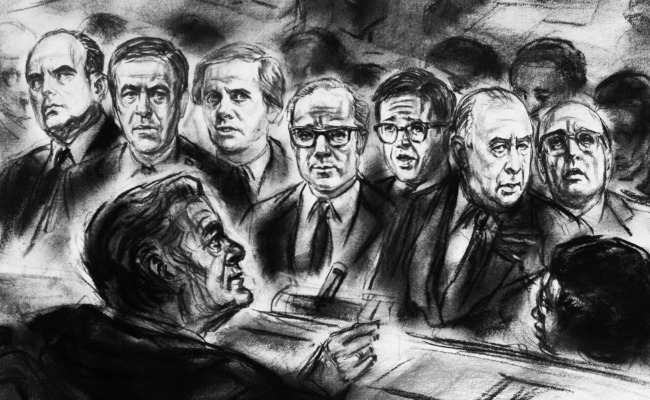
As mainstream media outlets (such as New York Magazine) prove to be determined, nay, eager, to link Donald J Trump to Richard M Nixon and his firing of FBI Director James Comey to "the greatest political scandal in modern American history," we should all pause to wonder whether what happened in 1974 should truly be described as the media bringing down a president of the United States.

Proving that in America, thanks to the media guardians, even at the highest level, crimes and misdemeanors are punished. (Thanks to Instapundit for the link.)

It turns out that that description is false. That is not what happened.

What happened, and what future history books will have to get right, is that various media leaning towards one party, the opposition party, brought down a member — the highest-ranking member in the government, to be sure — of the governing party.

The truest description of what occurred in 1974 is not that the independent media brought down a president of the United States.

What occurred was that the left-leaning MSM brought down a Republican.
Well, right there we have something that Nixon and Trump have in common: they are both Republicans. Just like George W Bush, Sarah Palin, and Ronald Reagan are or were, they are/were villains who also "deserved" to be countered by the mainstream media and by every honest citizen.

Oh — and don't forget the very first Republican elected to the White House, duly countered in the 1860s by members of the Democratic Party and their allies.

Many of the shenanigans between 2009 and 2017 have been described over the years as at least just as bad as the Watergate affair, and yet neither the Washington Post nor any other outlet of the mainstream media ever made much about any wrongdoings affecting Barack Obama's "amazingly scandal-free administration."

As Benny Huang put it a couple of years ago, the media's
journalistic good old days peaked in 1974 when the legendary Woodward and Bernstein duo took down a president named Richard Nixon. I don’t blame the two Washington Post reporters because they uncovered true malfeasance which precipitated a coverup, which in turn precipitated abuses of presidential power. They did their job in keeping politicians honest.

Yet it should not be ignored that previous presidents—FDR, JFK, and LBJ—pulled similar shenanigans. Why couldn’t the Washington Post be bothered to investigate those presidents? Because they were liberal Democrats, of course. They got a pass. The fact that Carl Bernstein was the son of card-carrying communist parents, and that he sought to weaken a president who was trying to salvage a war that Bernstein didn’t want America to win explains a lot too.

Forty years later there’s at least one network that will cover similar abuses by a leftist president. I’m speaking of FOX News, of course.

 … The media in this country [are] still absurdly biased to the Left, making no pretenses of covering issues such as same-sex marriage, illegal immigration, abortion, or global warming with any degree of even-handedness.
Moreover, a certain testimony from four years ago ought to be remembered. In I knew Richard Nixon, Richard Nixon was a friend of mine, and you, Barack are no Richard Nixon (thanks to Instapundit), Bill Kristol writes that
I protest. Will no one stand up for Richard Nixon? Richard Nixon was a combat veteran, a staunch and brave anti-Communist, a man who took on the liberal establishment and at times his own party's as well, a leader who often thought for himself and had the courage of his convictions, a president who assembled a first-rate Cabinet and one who—while flawed both in character and in policy judgment—usually tried to confront the real problems and deal with challenges of his times. Richard Nixon led neither the country nor his own administration from behind.
I worked for Richard Nixon (well, I worked for two months in the Nixon White House in 1970 as a summer intern). I voted for Richard Nixon (in 1972, my first vote, against George McGovern—and one about which I have no regrets). I knew Richard Nixon (very slightly—I met him on a few occasions in groups in the late 1970s and the 1980s, and then a couple of times when I worked for Vice President Quayle). And so I feel obliged to rise to Richard Nixon's defense, and to say, with all due respect, to our current president: Barack Obama, you're no Richard Nixon.
To bring the media's obsession with "Tricky Dick" and Watergate full circle, let us end this post with an excerpt from a five-year-old post (Evidence of Fraud in 2008 Election? A Surprising Number of Parallels with JFK's 1960 Campaign):
Just as interesting is the passage preceding the story of the 1960 election, which explains the downplaying of the Republican candidate while the extolling of the Democrat's alleged virtues. As you read the following passage [from Paul Johnson's A History of the American People], think also of all the ways that Rupert Murdoch has been demonized over the years, as has his Fox News network.
We come now to an important structural change in America. America had always been, from the earliest time, a democratic society, in that men (and indeed women) paid little attention to formal rank, even where it existed. Every man felt he had the right to shake hands with every other man, even the President … But this democratic spirit was balanced by the tribute of respect to those who, for one reason or another — experience, learning, position, wealth, office, or personality — had earned the title of 'boss.' The balance struck between egalitarianism and deference was one of the most remarkable characteristics of America, and one of its great strengths.

The Sixties brought a change. In the space of a decade, the word 'boss' passed almost out of the language, certainly out of universal usage. Deference itself deferred to a new spirit of hostility to authority. It became the fashion to challenge long-established hierarchies, to revolt against them or to ignore them. Nowhere was this spirit more manifest than in the media …

The gradual but cumulatively almost complete transfer of opinion-forming power from the owners and commercial managers of TV stations to the program-makers and presenters was one of the great new facts of life, unheard of before the 1950s, axiomatic by the end of the 1960s. And it was gradually paralleled by a similar shift in the newspaper world, especially on the great dailies and magazines of the East Coast, where political power, with few exceptions, passed from proprietors and major stockholders to editors and writers. Owners like Hearst and McCormick (of the Chicago Tribune), Pulitzer and Henry Luce (of Time-Life), who had once decided the political line of their publications in considerable detail, moved out of the picture and their places were taken by the working journalists. Since the latter tended to be overwhelmingly liberal in their views, this was not just a political but a cultural change of considerable importance. Indeed it is likely that nothing did more to cut America loose from its traditional moorings.

… The change could be seen in 1960, in the way the East Coast media (the New York Times and Washington Post, Time and Newsweek), handled the contest between Nixon and Kennedy.
Update: The press turned a blind eye to the corruption of JFK and LBJ, then raced to overturn the election of a man they despised by Andrew Klavan (thanks to Ed Driscoll):
That changes what Watergate means. That transforms it from a heroic crusade into a political hit job, Democrat hackery masquerading as nobility. The press turned a blind eye to the corruption of JFK and LBJ, then raced to overturn the election of a man they despised — despised in part because he battled the Communism many of them had espoused.

 … Journalism today is a corrupt shadow of even its biased former self. Competition, cutbacks and desperate attempts to appease a dwindling audience have turned former newspapers like the New York Times into little better than college rags run by starry-eyed leftist children and answerable to an audience that demands to have their prejudices confirmed.

As a result, the reportage on the Donald Trump administration has been a two and a half year hit job. The constant, breathless reporting of the incipient end of the administration — this is a tipping point, the walls are closing in, the president will be impeached! — has been nothing but the out-loud infantile fantasies of under-read underage make-believe radicals who are not equipped to do the job they are paid to do.

Sunday, May 07, 2017

U.S. Grant: "No political party can or ought to exist when one of its corner-stones is opposition to freedom of thought"

"No political party can or ought to exist when one of its corner-stones is opposition to freedom of thought and to the right to worship God 'according to the dictate of one's own conscience,' or according to the creed of any religious denomination whatever."

— Ulysses S. Grant, second Republican president of the USA

Related: What Caused Secession and Ergo the Civil War? Was It Slavery and/or States' Rights? Or Wasn't It Rather Something Else — the Election of a Ghastly Republican to the White House?