Showing posts sorted by relevance for query nixon. Sort by date Show all posts

Wednesday, December 19, 2018

The Troubling Parallels Between Today and the Watergate Era: The media was determined to "reverse the verdict of the election by non-constitutional means"; Trump 2016? No, Nixon 1972


What if, in the 1970s, Richard Nixon had had access to a Twitter account?

I'm askin', because your eyes are likely to open wide in disbelief as you read the description of the Watergate "scandal" in Paul Johnson's History of the American People.

You probably have always thought that no matter how good a president Richard Milhous Nixon may have been in certain areas, nobody can deny (nobody, that is, but a zealous — and untrustworthy — Republican hard-liner) that he was a shady (or a "flawed") character who, in no uncertain way, failed in one area that truly mattered, as Tricky Dick obviously did something very wrong (and illegal) and he was therefore some kind of conflicted Shakespearean soul who brought the scandal upon himself.

All I can say is: Prepare to be disillusioned.
(Update: thanks for the Instapundit link, Ed.)

Indeed, as you read about a Republican president's travails in the 1970s, you are going to think you are reading about the valiant fight to bring down the equivalent of Adolf Hitler by the likes of… Jim Acosta, Nancy Pelosi, and — yes — Robert Mueller.

In fact, as you read below, you are likely to think that so many coincidences can't be accidental, that the author can only have been writing with Donald Trump's White House in mind. As it happens, Paul Johnson's History of the American People was first published in 1997, the year after Bill Clinton's reelection.

Plus ça change…

(When you're done reading the (lengthy) excerpt in the post below, don't forget to check out Nixon and Watergate: What Do the MSM and History Books Fail to Tell Us About the 1970s Scandal? Money shot Money quote: "The truest description of what occurred in 1974 is not that the independent media brought down a president of the United States. What occurred was that the left-leaning MSM brought down a Republican.")

Without further ado, let us return to what Paul Johnson calls

"Watergate and the Putsch Against the Executive"
 … In parts of the media, there was an inclination to deny the legitimacy of Nixon's presidency and to seek to reverse the verdict by non-constitutional means.  …  'Remember,' Nixon told his staff, 'the press is the enemy.  When news is concerned, nobody in the press is a friend.  They are all enemies.'  That was increasingly true. …

 … at the time it was the triumphant Nixon who seemed to be in control, and his success not only humiliated the media liberals but actually frightened them.    …    The aim was to use the power of the press and TV to reverse the electoral verdict of 1972 which was felt to be, in some metaphorical sense, illegitimate — rather as conservative Germans, in the 1920s, had regarded the entire Weimar regime as illegitimate, or Latin American army generals, in the 1960s and 1970s, regarded elected but radical governments as illegitimate.  The media in the 1970s, rather like the Hispanic generals, felt that they were in some deep but intuitive sense the repository of the honor and conscience of the nation and had a quasi-constitutional duty to assert it in times of crises, whatever the means or the consequences.

This view was given some spurious justification by what was coming to be called the 'Imperial presidency,'  That the power of the executive had been growing since Woodrow Wilson's times, with dips in the Twenties and again in the late Forties and Fifties, was undeniable.

 … Nixon's reciprocal hostility to the media and his unwillingness to trust them, even more pronounced than under LBJ, persuaded some editors that 'something was going on,' which fitted into their other critical assumptions on what they termed the 'Nixon regime.'  And of course something was going on.  The White House was a power center engaged in all kinds of activities which would not always bear scrutiny.  It necessarily engaged, in a wicked, actual world, in the realpolitik which was theoretically banned by an idealistic Constitution.

 … Bad habits had set in under FDR

 … Though Truman and Eisenhower, who hated underhand dealings, kept clear of clandestine activities by their staff and the CIA, as a rule, they were generally aware of them and considered that in dealing with Soviet Russia and other totalitarian terror regimes, they were unavoidable

 … Kennedy's chief regret was that he had not made his brother Bobby head of the CIA, to bring it under family control

 … Under Kennedy and Johnson, phone-tapping increased markedly.  So did 'bugging' and 'taping.'
 … Until the Nixon era, the media was extremely selective in the publicity it gave to presidential wrongdoing

 … The anti-Nixon campaign, especially in the Washington Post and the New York Times, was continual, venomous, unscrupulous, inventive, and sometimes unlawful.  This was to be expected, and though it lowered the standard of US journalism, it was something Nixon was prepared to put up with.  What was more serious, and a matter which could not be ignored, was the theft, purchase, or leaking of secret material to these two papers (and others) and its subsequent appearance in print.  Under the First Amendment, legislation designed to protect military security, such as the British Official Secrets Act, was generally thought to be unconstitutional.

 … The appearance of secret material in newspapers shot up in spectacular fashion after Nixon assumed the presidency.     …     It is not known how many US lives were lost as a result of these leaks, but the damage to US interests was in some cases considerable

'Pentagon papers'

 … The administration discovered that publication of the source notes of the Pentagon papers, if analyzed by KGB experts, could jeopardize a whole range of CIA codes and operations.  So serious were the security breaches that at one point it was thought Ellsberg was a Soviet agent.

 … The Plumbers were engaged in a variety of activities of an entirely justifiable nature. … This break-in was the point at which the Nixon administration, albeit quite unknown to the President, overstepped the bounds of legality.  But at least it could be claimed that the infraction was dictated by national security

 … election-year dirty tricks were common.  Johnson had certainly 'bugged' Republican Party headquarters during the Goldwater campaign

 … However, in the paranoid atmosphere generated by the media's anti-Nixon vendetta, anything served as ammunition to hurl against the 'enemy.'  The Washington Post's editor, Ben Bradlee, was particularly angry, not to say hysterical

 … a series of 'investigative' articles seeking to make the Watergate burglary a major moral issue.

 … The campaign might have had no impact but the Post was lucky.  A publicity-hungry judge, John Sirica, known as 'Maximum John' from the severity of his sentences — and not a judge under any other circumstances likely to enjoy the approval of the liberal media — gave the burglars, when they came before him, provisional life-sentences to force them to provide evidence against members of the administration.

 … sadly typical of the judicial vendetta by means of which members of the Nixon administration were hounded and convicted of various offenses, chiefly obstructing justice — a notoriously easy charge to press home, granted a prejudiced judge.  In some cases the accused had no alternative but to plea-bargain, pleading guilty to lesser offenses, in order to avoid the financial ruin of an expensive defense.  Some of the sentences bore no conceivable relation to the gravity, or non-gravity, of the original offenses.

Thus the Watergate scandal 'broke,' and allowed the machinery of Congressional investigation, where of course the Democrats enjoyed majority control, to make a frontal assault on the 'Imperial Presidency.'

 … the witch hunters

 … These transcribed tapes, which the courts and Congressional investigators insisted Nixon hand over, were used to mount a putative impeachment of the President.  The witchhunt in the Senate was led by Sam Ervin, the man who had successfully covered up LBJ's crimes in the Bobby Baker affair, a shrewd and resourceful operator who concealed his acuteness and partisanship under a cloud of Southern wisecracking

(Haldeman had been driven into resignation by the witchhunters)

 … feeding all the damaging material they could muster to an eager anti-Nixon media … It became difficult for the President to handle an international crisis.  On October 6, 1973 a treacherous attack was launched on Israel, without warning, by Egypt and Syria, which had picked Yom Kippur, the holiest day in the Jewish calendar, for this Pearl-Harbor-type strike.  Both the CIA and Israel's secret intelligence service, Mossad, were caught napping, and the results were devastating.  The Israelis lost a fifth of their air force and a third of their tanks in four days, and it became necessary to resupply them.  The American media did not let up in its hunt for Nixon's scalp, but he actually had to deal with the crisis and save Israel from annihilation.  Nixon acted with great courage and decisiveness, cutting through red-tape, military and diplomatic obstructiveness and insisting that Israel be resupplied.

Without the resupply, which transformed Israel's sagging morale, it is likely that the Israeli army would have been destroyed and the entire Israeli nation exterminated.  Indeed it is probable that this is precisely what would have happened, had Nixon already been driven from his post at this stage.  As it was, he was still around to save Israel.  In many ways, October 1973, his last major international achievement, was his finest hour.

 … With darker times coming, the pressures on Nixon increased, and he strove desperately to combine two objects:  to preserve his presidency and to do what was in the national interest.

 … while Nixon was struggling to save Israel, he had been fanged by the man he called 'the viper we planted in our bosom,' Archibald Cox, special prosecutor charged with the Watergate inquiry

 …  It was at this point that hysteria usually associated with American witchhunts took over, and all reason, balance, and consideration for the national interest was abandoned.  It was an ugly moment in America's story and on which future historians      …    are likely to judge a dark hour in the history of a republic which prides itself in its love of order and its patient submissions to the rule of law
Incidentally, note that this blog has previously used Paul Johnson's monumental History of the American People to point out parallels between modern-day politics and elections in the 1960s and the 1970s:
Let us end with a five-year-old post: in I knew Richard Nixon, Richard Nixon was a friend of mine, and you, Barack are no Richard Nixon (thanks to Instapundit), Bill Kristol hits, deliberately or otherwise, on the reasons why America's 37th president was so hated:
Will no one stand up for Richard Nixon? Richard Nixon was a combat veteran, a staunch and brave anti-Communist, a man who took on the liberal establishment and at times his own party's as well, a leader who often thought for himself and had the courage of his convictions, a president who assembled a first-rate Cabinet and one who—while flawed both in character and in policy judgment—usually tried to confront the real problems and deal with challenges of his times.
(As it happens, the former Weekly Standard [RIP] editor's NeverTrump attitude is all the more startling when you realize that Bill Kristol obviously seems to know all about the demonization and the hounding of a Republican president.)

Update: The press turned a blind eye to the corruption of JFK and LBJ, then raced to overturn the election of a man they despised by Andrew Klavan (thanks to Ed Driscoll):
That changes what Watergate means. That transforms it from a heroic crusade into a political hit job, Democrat hackery masquerading as nobility. The press turned a blind eye to the corruption of JFK and LBJ, then raced to overturn the election of a man they despised — despised in part because he battled the Communism many of them had espoused.

 … Journalism today is a corrupt shadow of even its biased former self. Competition, cutbacks and desperate attempts to appease a dwindling audience have turned former newspapers like the New York Times into little better than college rags run by starry-eyed leftist children and answerable to an audience that demands to have their prejudices confirmed.

As a result, the reportage on the Donald Trump administration has been a two and a half year hit job. The constant, breathless reporting of the incipient end of the administration — this is a tipping point, the walls are closing in, the president will be impeached! — has been nothing but the out-loud infantile fantasies of under-read underage make-believe radicals who are not equipped to do the job they are paid to do.
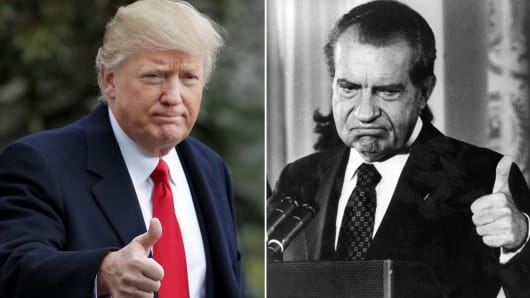


Update: What Trump learned from Watergate by Don Surber (thanks to Ed Driscoll):
The [Watergate] archives have revealed that Nixon was railroaded.

In American Spectator, [Geoff] Shepard wrote,
"There is documented proof of a series of secret meetings between Chief Judge John Sirica and Watergate prosecutors. I don’t know which is the bigger surprise: that they were secretly meeting to resolve issues in advance of trial or that they were documenting their agreements in memos to their files."
 … Archibald Cox in retrospect made Jimmy the Weasel Comey look honest.

The deep state won.

Shepard wrote,
"It should have come as no surprise that Cox delegated the Watergate Special Prosecution Force recruiting to James Vorenberg, a fellow law professor who had taught criminal law. Vorenberg hired only people whom he knew or who were recommended by people he knew, and he assembled a specially selected team of some 70 lawyers, virtually all Ivy League graduates, the top 17 of whom had worked together in the Kennedy/Johnson Department of Justice. Readers should note the constitutional inversion here: these were the very people voted out of office with Nixon’s 1968 election, now in control of the government’s investigative and prosecutorial powers. Vorenberg announced at their first press conference in June 1973 their intent to investigate each and every allegation of wrongdoing by the Nixon administration since it had assumed office some five years prior."
Sound familiar?

That is why this will not happen again, or at least not to President Donald John Trump. He learned the lesson of Watergate.

We said of Sarah Palin, we cannot spare her; she fights. Donald Trump does not simply fight; he wins.

He was in his 20s when he beat the deep state the first time. Nixon's HUD sued him in its administrative court, hoping to coerce an admission of guilt. Trump's lawyer -- the commie-beating Roy Cohn -- advised him to take HUD to real court. 2 years later, the charges were dropped.

 … President Trump learned from President Nixon's mishandling of the press.

 … after a year of propaganda by the media and Democrats, the public fell for the Democrat lies. Kennedy somehow became the victim. And he never had to give up drunk driving. Always bear in mind, the Germans were the best-educated people in the world when they fell for Nazism.

 … President Trump learned from Nixon's firing of Cox, which created a backlash. He kept Mueller, which avoided an obstruction of justice claim.

The president has needled and ridiculed the hapless Democrats, but he also has given them everything they asked for. When they objected to his July 25 phone call to Ukraine, President Trump released the transcript. There will be no nonsense about the cover-up being worse than the crime on his watch.

That transcript should have ended the controversy, but Adam Schiff is insane, Jerry Nadler is a fool, and the press is corrupt. Down the rabbit hole of impeachment they dove.

Public sentiment, the law, and the facts are in President Donald John Trump's favor. He learned from Nixon. it is not paranoia when they really are out to kill you.

Thursday, May 11, 2017

Nixon and Watergate: What Do the MSM and History Books Fail to Tell Us About the 1970s Scandal?


As mainstream media outlets (such as New York Magazine) prove to be determined, nay, eager, to link Donald J Trump to Richard M Nixon and his firing of FBI Director James Comey to "the greatest political scandal in modern American history," we should all pause to wonder whether what happened in 1974 should truly be described as the media bringing down a president of the United States.

Proving that in America, thanks to the media guardians, even at the highest level, crimes and misdemeanors are punished. (Thanks to Instapundit for the link.)

It turns out that that description is false. That is not what happened.

What happened, and what future history books will have to get right, is that various media leaning towards one party, the opposition party, brought down a member — the highest-ranking member in the government, to be sure — of the governing party.

The truest description of what occurred in 1974 is not that the independent media brought down a president of the United States.

What occurred was that the left-leaning MSM brought down a Republican.

Well, right there we have something that Nixon and Trump have in common: they are both Republicans. Just like George W Bush, Sarah Palin, and Ronald Reagan are or were, they are/were villains who also "deserved" to be countered by the mainstream media and by every honest citizen.

Oh — and don't forget the very first Republican elected to the White House, duly countered in the 1860s by members of the Democratic Party and their allies.

Many of the shenanigans between 2009 and 2017 have been described over the years as at least just as bad as the Watergate affair, and yet neither the Washington Post nor any other outlet of the mainstream media ever made much about any wrongdoings affecting Barack Obama's "amazingly scandal-free administration."

As Benny Huang put it a couple of years ago, the media's
journalistic good old days peaked in 1974 when the legendary Woodward and Bernstein duo took down a president named Richard Nixon. I don’t blame the two Washington Post reporters because they uncovered true malfeasance which precipitated a coverup, which in turn precipitated abuses of presidential power. They did their job in keeping politicians honest.

Yet it should not be ignored that previous presidents—FDR, JFK, and LBJ—pulled similar shenanigans. Why couldn’t the Washington Post be bothered to investigate those presidents? Because they were liberal Democrats, of course. They got a pass. The fact that Carl Bernstein was the son of card-carrying communist parents, and that he sought to weaken a president who was trying to salvage a war that Bernstein didn’t want America to win explains a lot too.

Forty years later there’s at least one network that will cover similar abuses by a leftist president. I’m speaking of FOX News, of course.

 … The media in this country [are] still absurdly biased to the Left, making no pretenses of covering issues such as same-sex marriage, illegal immigration, abortion, or global warming with any degree of even-handedness.
Moreover, a certain testimony from four years ago ought to be remembered. In I knew Richard Nixon, Richard Nixon was a friend of mine, and you, Barack are no Richard Nixon (thanks to Instapundit), Bill Kristol writes that
I protest. Will no one stand up for Richard Nixon? Richard Nixon was a combat veteran, a staunch and brave anti-Communist, a man who took on the liberal establishment and at times his own party's as well, a leader who often thought for himself and had the courage of his convictions, a president who assembled a first-rate Cabinet and one who—while flawed both in character and in policy judgment—usually tried to confront the real problems and deal with challenges of his times. Richard Nixon led neither the country nor his own administration from behind.
I worked for Richard Nixon (well, I worked for two months in the Nixon White House in 1970 as a summer intern). I voted for Richard Nixon (in 1972, my first vote, against George McGovern—and one about which I have no regrets). I knew Richard Nixon (very slightly—I met him on a few occasions in groups in the late 1970s and the 1980s, and then a couple of times when I worked for Vice President Quayle). And so I feel obliged to rise to Richard Nixon's defense, and to say, with all due respect, to our current president: Barack Obama, you're no Richard Nixon.
To bring the media's obsession with "Tricky Dick" and Watergate full circle, let us end this post with an excerpt from a five-year-old post (Evidence of Fraud in 2008 Election? A Surprising Number of Parallels with JFK's 1960 Campaign):
Just as interesting is the passage preceding the story of the 1960 election, which explains the downplaying of the Republican candidate while the extolling of the Democrat's alleged virtues. As you read the following passage [from Paul Johnson's A History of the American People], think also of all the ways that Rupert Murdoch has been demonized over the years, as has his Fox News network.
We come now to an important structural change in America. America had always been, from the earliest time, a democratic society, in that men (and indeed women) paid little attention to formal rank, even where it existed. Every man felt he had the right to shake hands with every other man, even the President … But this democratic spirit was balanced by the tribute of respect to those who, for one reason or another — experience, learning, position, wealth, office, or personality — had earned the title of 'boss.' The balance struck between egalitarianism and deference was one of the most remarkable characteristics of America, and one of its great strengths.

The Sixties brought a change. In the space of a decade, the word 'boss' passed almost out of the language, certainly out of universal usage. Deference itself deferred to a new spirit of hostility to authority. It became the fashion to challenge long-established hierarchies, to revolt against them or to ignore them. Nowhere was this spirit more manifest than in the media …

The gradual but cumulatively almost complete transfer of opinion-forming power from the owners and commercial managers of TV stations to the program-makers and presenters was one of the great new facts of life, unheard of before the 1950s, axiomatic by the end of the 1960s. And it was gradually paralleled by a similar shift in the newspaper world, especially on the great dailies and magazines of the East Coast, where political power, with few exceptions, passed from proprietors and major stockholders to editors and writers. Owners like Hearst and McCormick (of the Chicago Tribune), Pulitzer and Henry Luce (of Time-Life), who had once decided the political line of their publications in considerable detail, moved out of the picture and their places were taken by the working journalists. Since the latter tended to be overwhelmingly liberal in their views, this was not just a political but a cultural change of considerable importance. Indeed it is likely that nothing did more to cut America loose from its traditional moorings.

… The change could be seen in 1960, in the way the East Coast media (the New York Times and Washington Post, Time and Newsweek), handled the contest between Nixon and Kennedy.
Update: The press turned a blind eye to the corruption of JFK and LBJ, then raced to overturn the election of a man they despised by Andrew Klavan (thanks to Ed Driscoll):
That changes what Watergate means. That transforms it from a heroic crusade into a political hit job, Democrat hackery masquerading as nobility. The press turned a blind eye to the corruption of JFK and LBJ, then raced to overturn the election of a man they despised — despised in part because he battled the Communism many of them had espoused.

 … Journalism today is a corrupt shadow of even its biased former self. Competition, cutbacks and desperate attempts to appease a dwindling audience have turned former newspapers like the New York Times into little better than college rags run by starry-eyed leftist children and answerable to an audience that demands to have their prejudices confirmed.

As a result, the reportage on the Donald Trump administration has been a two and a half year hit job. The constant, breathless reporting of the incipient end of the administration — this is a tipping point, the walls are closing in, the president will be impeached! — has been nothing but the out-loud infantile fantasies of under-read underage make-believe radicals who are not equipped to do the job they are paid to do.

Wednesday, December 18, 2019

Watergate—Trump learned from President Nixon's mishandling of the press: "it is not paranoia when they really are out to kill you"


From What Trump learned from Watergate by Don Surber (thanks to Ed Driscoll and welcome, Farm Maggie):
The [Watergate] archives have revealed that Nixon was railroaded.

In American Spectator, [Geoff] Shepard wrote,
"There is documented proof of a series of secret meetings between Chief Judge John Sirica and Watergate prosecutors. I don’t know which is the bigger surprise: that they were secretly meeting to resolve issues in advance of trial or that they were documenting their agreements in memos to their files."
 … Archibald Cox in retrospect made Jimmy the Weasel Comey look honest.

The deep state won.

Shepard wrote,
"It should have come as no surprise that Cox delegated the Watergate Special Prosecution Force recruiting to James Vorenberg, a fellow law professor who had taught criminal law. Vorenberg hired only people whom he knew or who were recommended by people he knew, and he assembled a specially selected team of some 70 lawyers, virtually all Ivy League graduates, the top 17 of whom had worked together in the Kennedy/Johnson Department of Justice. Readers should note the constitutional inversion here: these were the very people voted out of office with Nixon’s 1968 election, now in control of the government’s investigative and prosecutorial powers. Vorenberg announced at their first press conference in June 1973 their intent to investigate each and every allegation of wrongdoing by the Nixon administration since it had assumed office some five years prior."
Sound familiar?

That is why this will not happen again, or at least not to President Donald John Trump. He learned the lesson of Watergate.

We said of Sarah Palin, we cannot spare her; she fights. Donald Trump does not simply fight; he wins.

He was in his 20s when he beat the deep state the first time. Nixon's HUD sued him in its administrative court, hoping to coerce an admission of guilt. Trump's lawyer -- the commie-beating Roy Cohn -- advised him to take HUD to real court. 2 years later, the charges were dropped.

 … President Trump learned from President Nixon's mishandling of the press.

 … after a year of propaganda by the media and Democrats, the public fell for the Democrat lies. Kennedy somehow became the victim. And he never had to give up drunk driving. Always bear in mind, the Germans were the best-educated people in the world when they fell for Nazism.

 … President Trump learned from Nixon's firing of Cox, which created a backlash. He kept Mueller, which avoided an obstruction of justice claim.

The president has needled and ridiculed the hapless Democrats, but he also has given them everything they asked for. When they objected to his July 25 phone call to Ukraine, President Trump released the transcript. There will be no nonsense about the cover-up being worse than the crime on his watch.

That transcript should have ended the controversy, but Adam Schiff is insane, Jerry Nadler is a fool, and the press is corrupt. Down the rabbit hole of impeachment they dove.

Public sentiment, the law, and the facts are in President Donald John Trump's favor. He learned from Nixon. it is not paranoia when they really are out to kill you.
Related: The Troubling Parallels Between Today and the Watergate Era: The media was determined to "reverse the verdict of the election by non-constitutional means"; Trump 2016? No, Nixon 1972

Monday, April 22, 2024

Paraphrasing Eisenhower, Richard Nixon warned against "the Media Élitist Complex"; "Sullivan vs New York Times is in effect a license to lie"


On this, the 30th anniversary of the death of Richard Nixon, we get an excerpt from the oral history collections of the University of Georgia (thanks to Vincent Bourdonneau — as well as to Sarah Hoyt), a number of which seem to have started circulating recently.

Notice notably the 37th president's take on the élites, without seemingly realizing to what extent they were united across country boundaries and borders and to what extent they pose a danger to America and to the world…

The élite class is the same all over the world: they go to the same parties and they drink the [same] cocktails, etc, they have the same snobbish characteristics… 

Then we have Nixon Warning of the Media's UNLIMITED Power: 

The problem is, that [the media in this country] have a sense of self-righteousness, a double standard on issue after issue after issue. They can find everything wrong with somebody else, but they will not look inside, and ever admit they could be wrong themselves. And — what was involved here, in the Watergate thing, was the unfairness of it. Oh, there was a legitimate thing to investigate, but they refused to balance it. They allowed their advocacy to get ahead of their reporting — which is their job to do. 

You know, President Eisenhower, in his farewell address, wrote about, and warned against, the power of the military-industrial complex. … When I get old enough, and decide to retire … I think I would warn against the media-élitist complex. You know, the media is always talking about the imperial presidency — the power of the imperial presidency — I think we oughta hear a little bit of discussion of the imperial media, and its power. … The media's power is unlimited. And some would say, "Well, what about libel suits?" Forget it. After the Supreme Court's decision in Sullivan vs New York Times a few years ago. … I wouldn't like to leave the fate of this country to the editors of the Washington Post. …

Let's face it, Sullivan vs New York Times is in effect a license to lie. … I believe in a free press. I do not want government control under any circumstances, or government censorship, of either radio, television, or newspapers. But I am simply suggesting here that all of the media should look within themselves, look through that microscope at themselves, look in the mirror now and then, rather than looking out there to others.


At the same time, we cannot ignore the outstanding book by Evelyne Joslain, a bona fide French conservative who laments that neither Nixon nor Reagan (no "Reagan revolution", alas, on the cultural front), for all their (undeniable) virtues, seemed to show true awareness of the takeover of the culture by the left and their march through the institutions.

Nixon was … the first Republican president confronted with the [Left's] culture war and viciously harassed by the opposition [while] Reagan did nothing about the persecution of political correctness. He let it happen.

In the perspective of all the above, let us jump 25 to 30 years forward, to see the treatment of Richard Milhous Nixon compared with that of Donald John Trump (who, according to La Révolution Culturelle, is the only presidential candidate to see the true nature of the Left):

• The Troubling Parallels Between Today and the Watergate Era: The media was determined to "reverse the verdict of the election by non-constitutional means"; Trump 2016? Trump 2020? Trump 2024? No, Nixon 1972

• Watergate—Trump learned from President Nixon's mishandling of the press: "it is not paranoia when they really are out to kill you"

• Nixon and Watergate: What Do the MSM and History Books Fail to Tell Us About the 1970s Scandal? 

 • Evidence of Fraud in 2008 Election? A Surprising Number of Parallels with JFK's 1960 Campaign

Sunday, April 22, 2012

Evidence of Fraud in 2008 Election? A Surprising Number of Parallels with JFK's 1960 Campaign

In some ways the most dangerous kind of politician is a man who is good at PR and nothing else
writes Paul Johnson in his monumental History of the American People.

No, he was not talking about the current occupant of the White House (his book was written in 1999, after all — before Obama had even published his (first) autobiography), but about John F Kennedy, and I am speaking as a former Kennedy devotee and Camelot maniac. (Yes, even if the book was written before 911 and even the George W Bush presidency, it is a must-read — as you will see below.)

I was coaxed into pulling Paul Johnson's masterpiece from my shelves again, as I read Instapundit's review of the PJMedia piece on what the Wikileaks memos say about the 2008 election, getting increasingly angry as I read through the J Christian Adams original.
What we do know is this: First, that people in the McCain campaign thought they had evidence of election tampering that cost McCain the election. Second, that McCain thought it best for the country to do nothing about it, in part because of fears of mob violence.
Interestingly, Glenn Reynolds calls his link to J Christian Adams' article "Bad Call." That turns out to be entirely appropriate, in view of the fact that Bernie Marcus recently pointed out (video) that
the Republicans play the rules of … golf. In golf, if you miss a putt or you touch the ball, you call a shot on yourself. We're playing the game of golf. The Democrats are playing ice hockey. It's a killer game. And that's the difference in politics.
This brings to mind uncounted parallels with the 1960 election, rarely if ever disclosed in mainstream history books, and which I only learned through Paul Johnson's History of the American People, the reading of which sometimes made my eyes pop out as previously-undisclosed facts (of the unpalatable sort) were revealed.

As I re-read part of the book this morning, it turns out that there are many more parallels than you would at first assume.

Just consider:
By all historical standards, Nixon should have been an American media hero. He was a natural candidate for laurels in the grand old tradition of self-help, of pulling yourself up by your own bootstraps. He came from nowhere.
Think of John McCain, who should have been — and who was! — an American hero for other reasons, linked to dramatic combat, horrific jail conditions (with — very — violent wardens, of a decidedly racist bent), and the ever-present risk of death in a foreign country. (In France, while both of Obama's autobiographies became best-sellers, McCain's autobiography, with its full life (written past the age of 60) and with all the drama of its war "adventures", was not even translated.)
Yet, from start to finish, the media, especially the 'quality' press, distrusted [Nixon], consistently denigrated him, and sought to destroy him, indeed in a sense did destroy him. At every crisis in his career — except the last — he had to appeal above the heads of the media to the great mass of the ordinary American people, the 'silent majority' as he called them.
When I first read Paul Johnson's book, incidentally, I remember thinking, But of course! What has always been described as an unsavory character trait in Richard Mulhouse Nixon — his alleged paranoia — turns out perhaps not to have been so paranoid at all and to have been provoked by those who claimed to be innocent bystanders, if not the actual entirely-innocent victims of "Tricky Dick"… (If only for Paul Johnson's description of Watergate — which he likens, persuasively, to a witch hunt — you must read A History of the American People.)
By contrast, the media did everything in its power to build up and sustain the beatific myth of John F. Kennedy, throughout his life and long after his death, until it finally collapsed in ruins under the weight of incontrovertible evidence. The media protected him, suppressed what it knew to be the truth about him, and if necessary lied about him, on a scale which it had never done even for Franklin Roosevelt.
C'mon. Don't tell me that I really need to point out the parallels here with Barack Hussein Obama, the anointed One come to save America and Americans from their own demons.
And this was all the more surprising because Kennedy had most of the characteristics of an American anti-hero. … the running theme of the Kennedy family [was] how to turn money into political power … Maximum use was made of Jack's war career in all his campaigns. … Old Joe set about making Kennedy first a congressman, then a senator, then president. This train of events is worth studying because it shows the extent to which money paved the way to political power in mid-20th-century America …
Again: need I really point out the parallels with Obama, and his war-chest(s), along with his billion-dollar campaigns and his spending sprees? At this point of the book, Paul Johnson brings an interesting aside:
As Tip O'Neill put it: …
'I'd have to say that [Jack] was only nominally a Democrat. He was a Kennedy, which more than family affiliation. It quickly developed into an entire political party, with its own people, its own approach and its own strategies.'
The man who got it right at the time was the British Prime Minister Harold Macmillan. He grasped the important point that electing a Kennedy was not so much giving office to an individual as handing over power to a family business, a clan, almost a milieu, with a set of attitudes about how office was to be acquired and used which at no point coincided with the American ethic. Having paid his first visit after Kennedy's election as President, Macmillan was asked on his return what it was like in Kennedy's Washington.
'Oh,' said he, 'it's rather like watching the Borgia brothers take over a respectable North Italian city.'
But let's get back to the election of 1960 (as you read the few next parts, remember all the nasty things you have heard through the years about Tricky Dick).
Nixon had deliberately decided to keep Catholicism out of the campaign, and succeeded in doing so. The day after the result, he said to his aide Pete Flanigan:
'Pete, here's one thing we can be satisfied about. The campaign has laid to rest for ever the issue of a candidate's religion in presidential politics. Bad for me, perhaps, but good for America.'
In fact, Kennedy's catholicism won him the election … In the Northern industrial states, where the margins were very close, the swing of the Catholic vote to a Catholic candidate made all the difference.
Think of McCain opining that the election of a black man was good for America — which it undoubtedly was. But regarding America's alleged nightmarish racism, note that it was precisely Barack Obama's race that won him, or that helped win him, the election — as much among minorities as among liberal whites pining to demonstrate their status as "good" whites.

Unfortunately, there is a more ominous parallel between 1960 and 2008 (although not necessarily in the states specifically mentioned), which should overshadow Nixon's (and McCain's) satisfaction with the (respective) result(s), along with pride in his (in their) countrymen. Indeed, why be satisfied with a result (and why be proud of your country) if the result was the product of cheating?
This was a crooked election, especially in Texas and Illinois, two states notorious for fraud, and both of which Kennedy won. In Texas, which gave its twenty-four college votes to Kennedy, by a margin of 46,000 votes (out of 2.3 million), one expert made the calculation that
'a minimum of 100,000 votes for the Kennedy-Johnson ticket simply were non-existent.'
… (in one polling station, where only 4,895 voters were registered, 6,138 votes were counted as cast)
Then again, perhaps there does turn out to be a parallel between 1960 and 2008 in regards to one of the states mentioned: …
In Illinois, Nixon carried 93 of the state's 102 counties, yet lost the state by 8,858 votes. This was entirely due to an enormous Democratic turnout in Chicago, under the control of the notorious Democratic city boss and mayor, Richard Daley. Daley gave Kennedy the Windy City by the astonishing margin of 450,000 votes, and the evidence was overwhelming that fraud was committed on a large scale in Kennedy's favor.
An interesting side-note:
The mafia played an important part in this fraud. Afterwards, its boss Giancana often boasted to Judith Campbell, the mistress he shared with the President, 'Listen, honey, if it wasn't for me your boyfriend wouldn't even be in the White House.'
I don't suppose the mafia helped Obama in 2008; however — No, I wouldn't want to call into question the honesty and the civility of members of ACORN and of the Black Panthers (for fear of being labeled a racist, natch).

While reading History of the American People the first time, I remember thinking: it can't be possible that the MSM history books wouldn't mention this, so probably the fraud was tiny, and/or hard to prove, and not worth mentioning, so perhaps Paul Johnson is exaggerating, if ever so slightly. Then I came to this part:
If Nixon, instead of Kennedy, had carried Texas and Illinois, the shift in electoral votes would have given him the presidency, and the evidence of electoral fraud makes it clear that Kennedy's overall 112,803 vote plurality was a myth: Nixon probably won overall by about 250,000 votes. Evidence of fraud in the two states was so blatant that a number of senior figures, including Eisenhower, urged Nixon to make a formal legal challenge to the result. But Nixon declined. … A legal challenge … would have produced a 'constitutional nightmare' and worked heavily against the national interest.
Doesn't this sound like the Wikileaks memo stating that "McCain felt the crowds assembled in support of Obama and such would be detrimental to our country and it would do our nation no good for this to drag out like last go around" — Bernie Marcus's dependable, mature golf player acting responsibly to prevent the ice hockey players from going berserk?

Just as interesting is the passage preceding the story of the 1960 election, which explains the downplaying of the Republican candidate while the extolling of the Democrat's alleged virtues. As you read the following passage, think also of all the ways that Rupert Murdoch has been demonized over the years, as has his Fox News network.
We come now to an important structural change in America. America had always been, from the earliest time, a democratic society, in that men (and indeed women) paid little attention to formal rank, even where it existed. Every man felt he had the right to shake hands with every other man, even the President … But this democratic spirit was balanced by the tribute of respect to those who, for one reason or another — experience, learning, position, wealth, office, or personality — had earned the title of 'boss.' The balance struck between egalitarianism and deference was one of the most remarkable characteristics of America, and one of its great strengths.

The Sixties brought a change. In the space of a decade, the word 'boss' passed almost out of the language, certainly out of universal usage. Deference itself deferred to a new spirit of hostility to authority. It became the fashion to challenge long-established hierarchies, to revolt against them or to ignore them. Nowhere was this spirit more manifest than in the media …

The gradual but cumulatively almost complete transfer of opinion-forming power from the owners and commercial managers of TV stations to the program-makers and presenters was one of the great new facts of life, unheard of before the 1950s, axiomatic by the end of the 1960s. And it was gradually paralleled by a similar shift in the newspaper world, especially on the great dailies and magazines of the East Coast, where political power, with few exceptions, passed from proprietors and major stockholders to editors and writers. Owners like Hearst and McCormick (of the Chicago Tribune), Pulitzer and Henry Luce (of Time-Life), who had once decided the political line of their publications in considerable detail, moved out of the picture and their places were taken by the working journalists. Since the latter tended to be overwhelmingly liberal in their views, this was not just a political but a cultural change of considerable importance. Indeed it is likely that nothing did more to cut America loose from its traditional moorings.

… The change could be seen in 1960, in the way the East Coast media (the New York Times and Washington Post, Time and Newsweek), handled the contest between Nixon and Kennedy.
The final word?
There is a sense in which Kennedy, who loved to use words like 'bearing,' 'results,' and 'in,' was a professional sportsman, a political huckster, and a propagandist rather than a serious statesman
Note: After spending hours writing the above, I decided to do a search of Paul Johnson in the No Pasarán archives, discovering to my great surprise that I had actually used A History of the American People once in the past to compare the elections of the 1960 and 2008, and that in… November 2008 no less (!)
Here t'is: Stealing the Election: The 1960 and the 2008 Contests Compared

Update: I knew Richard Nixon, Richard Nixon was a friend of mine, and you, Barack are no Richard Nixon (thanks to Instapundit)

Update: The Watergate Cover-Up Trial: Justice Denied? (thanks to Instapundit)
There were real crimes and real criminals. But newly found documents suggest a denial of due process of law to the defendants, a move that did the Constitution no favors.

Thursday, November 05, 2020

Evidence of Fraud in 2020 Election? A Surprising Number of Parallels with JFK's 1960 Campaign

Note: The following post originally appeared eight years ago, in April 2012, as that year's elections were moving forward, under the same title except for one word — the year…

In some ways the most dangerous kind of politician is a man who is good at PR and nothing else
writes Paul Johnson in his monumental History of the American People.

No, he was not talking about the current occupant [Barack Obama] of the White House (his book was written in 1999, after all — before Obama had even published his (first) autobiography), but about John F Kennedy, and I am speaking as a former Kennedy devotee and Camelot maniac. (Yes, even if the book was written before 911 and even the George W Bush presidency, it is a must-read — as you will see below.)

I was coaxed into pulling Paul Johnson's masterpiece from my shelves again, as I read Instapundit's review of the PJMedia piece on what the Wikileaks memos say about the 2008 election, getting increasingly angry as I read through the J Christian Adams original.
What we do know is this: First, that people in the McCain campaign thought they had evidence of election tampering that cost McCain the election. Second, that McCain thought it best for the country to do nothing about it, in part because of fears of mob violence.
Interestingly, Glenn Reynolds calls his link to J Christian Adams' article "Bad Call." That turns out to be entirely appropriate, in view of the fact that Bernie Marcus recently pointed out (video) that
the Republicans play the rules of … golf. In golf, if you miss a putt or you touch the ball, you call a shot on yourself. We're playing the game of golf. The Democrats are playing ice hockey. It's a killer game. And that's the difference in politics.
This brings to mind uncounted parallels with the 1960 election, rarely if ever disclosed in mainstream history books, and which I only learned through Paul Johnson's History of the American People, the reading of which sometimes made my eyes pop out as previously-undisclosed facts (of the unpalatable sort) were revealed.

As I re-read part of the book this morning, it turns out that there are many more parallels than you would at first assume.

Just consider:
By all historical standards, Nixon should have been an American media hero. He was a natural candidate for laurels in the grand old tradition of self-help, of pulling yourself up by your own bootstraps. He came from nowhere.
Think of John McCain, who should have been — and who was! — an American hero for other reasons, linked to dramatic combat, horrific jail conditions (with — very — violent wardens, of a decidedly racist bent), and the ever-present risk of death in a foreign country. (In France, while both of Obama's autobiographies became best-sellers, McCain's autobiography, with its full life (written past the age of 60) and with all the drama of its war "adventures", was not even translated.)
Yet, from start to finish, the media, especially the 'quality' press, distrusted [Nixon], consistently denigrated him, and sought to destroy him, indeed in a sense did destroy him. At every crisis in his career — except the last — he had to appeal above the heads of the media to the great mass of the ordinary American people, the 'silent majority' as he called them.

When I first read Paul Johnson's book, incidentally, I remember thinking, But of course! What has always been described as an unsavory character trait in Richard Mulhouse Nixon — his alleged paranoia — turns out perhaps not to have been so paranoid at all and to have been provoked by those who claimed to be innocent bystanders, if not the actual entirely-innocent victims of "Tricky Dick"… (If only for Paul Johnson's description of Watergate — which he likens, persuasively, to a witch hunt — you must read A History of the American People.)

[2020 update: and cannot similar lines be written about Donald Trump?]

By contrast, the media did everything in its power to build up and sustain the beatific myth of John F. Kennedy, throughout his life and long after his death, until it finally collapsed in ruins under the weight of incontrovertible evidence. The media protected him, suppressed what it knew to be the truth about him, and if necessary lied about him, on a scale which it had never done even for Franklin Roosevelt.
C'mon. Don't tell me that I really need to point out the parallels here with Barack Hussein Obama, the anointed One come to save America and Americans from their own demons.
And this was all the more surprising because Kennedy had most of the characteristics of an American anti-hero. … the running theme of the Kennedy family [was] how to turn money into political power … Maximum use was made of Jack's war career in all his campaigns. … Old Joe set about making Kennedy first a congressman, then a senator, then president. This train of events is worth studying because it shows the extent to which money paved the way to political power in mid-20th-century America …
Again: need I really point out the parallels with Obama, and his war-chest(s), along with his billion-dollar campaigns and his spending sprees? At this point of the book, Paul Johnson brings an interesting aside:
As Tip O'Neill put it: …
'I'd have to say that [Jack] was only nominally a Democrat. He was a Kennedy, which more than family affiliation. It quickly developed into an entire political party, with its own people, its own approach and its own strategies.'
The man who got it right at the time was the British Prime Minister Harold Macmillan. He grasped the important point that electing a Kennedy was not so much giving office to an individual as handing over power to a family business, a clan, almost a milieu, with a set of attitudes about how office was to be acquired and used which at no point coincided with the American ethic. Having paid his first visit after Kennedy's election as President, Macmillan was asked on his return what it was like in Kennedy's Washington.
'Oh,' said he, 'it's rather like watching the Borgia brothers take over a respectable North Italian city.'
But let's get back to the election of 1960 (as you read the few next parts, remember all the nasty things you have heard through the years about Tricky Dick).
Nixon had deliberately decided to keep Catholicism out of the campaign, and succeeded in doing so. The day after the result, he said to his aide Pete Flanigan:
'Pete, here's one thing we can be satisfied about. The campaign has laid to rest for ever the issue of a candidate's religion in presidential politics. Bad for me, perhaps, but good for America.'
In fact, Kennedy's catholicism won him the election … In the Northern industrial states, where the margins were very close, the swing of the Catholic vote to a Catholic candidate made all the difference.
Think of McCain opining that the election of a black man was good for America — which it undoubtedly was. But regarding America's alleged nightmarish racism, note that it was precisely Barack Obama's race that won him, or that helped win him, the election — as much among minorities as among liberal whites pining to demonstrate their status as "good" whites.

Unfortunately, there is a more ominous parallel between 1960 and 2008 (although not necessarily in the states specifically mentioned), which should overshadow Nixon's (and McCain's) satisfaction with the (respective) result(s), along with pride in his (in their) countrymen. Indeed, why be satisfied with a result (and why be proud of your country) if the result was the product of cheating?
This was a crooked election, especially in Texas and Illinois, two states notorious for fraud, and both of which Kennedy won. In Texas, which gave its twenty-four college votes to Kennedy, by a margin of 46,000 votes (out of 2.3 million), one expert made the calculation that
'a minimum of 100,000 votes for the Kennedy-Johnson ticket simply were non-existent.'
… (in one polling station, where only 4,895 voters were registered, 6,138 votes were counted as cast)
Then again, perhaps there does turn out to be a parallel between 1960 and 2008 in regards to one of the states mentioned: …
In Illinois, Nixon carried 93 of the state's 102 counties, yet lost the state by 8,858 votes. This was entirely due to an enormous Democratic turnout in Chicago, under the control of the notorious Democratic city boss and mayor, Richard Daley. Daley gave Kennedy the Windy City by the astonishing margin of 450,000 votes, and the evidence was overwhelming that fraud was committed on a large scale in Kennedy's favor.
An interesting side-note:
The mafia played an important part in this fraud. Afterwards, its boss Giancana often boasted to Judith Campbell, the mistress he shared with the President, 'Listen, honey, if it wasn't for me your boyfriend wouldn't even be in the White House.'
I don't suppose the mafia helped Obama in 2008; however — No, I wouldn't want to call into question the honesty and the civility of members of ACORN and of the Black Panthers (for fear of being labeled a racist, natch).

While reading History of the American People the first time, I remember thinking: it can't be possible that the MSM history books wouldn't mention this, so probably the fraud was tiny, and/or hard to prove, and not worth mentioning, so perhaps Paul Johnson is exaggerating, if ever so slightly. Then I came to this part:
If Nixon, instead of Kennedy, had carried Texas and Illinois, the shift in electoral votes would have given him the presidency, and the evidence of electoral fraud makes it clear that Kennedy's overall 112,803 vote plurality was a myth: Nixon probably won overall by about 250,000 votes. Evidence of fraud in the two states was so blatant that a number of senior figures, including Eisenhower, urged Nixon to make a formal legal challenge to the result. But Nixon declined. … A legal challenge … would have produced a 'constitutional nightmare' and worked heavily against the national interest.
Doesn't this sound like the Wikileaks memo stating that "McCain felt the crowds assembled in support of Obama and such would be detrimental to our country and it would do our nation no good for this to drag out like last go around" — Bernie Marcus's dependable, mature golf player acting responsibly to prevent the ice hockey players from going berserk?

Just as interesting is the passage preceding the story of the 1960 election, which explains the downplaying of the Republican candidate while the extolling of the Democrat's alleged virtues. As you read the following passage, think also of all the ways that Rupert Murdoch has been demonized over the years, as has his Fox News network.
We come now to an important structural change in America. America had always been, from the earliest time, a democratic society, in that men (and indeed women) paid little attention to formal rank, even where it existed. Every man felt he had the right to shake hands with every other man, even the President … But this democratic spirit was balanced by the tribute of respect to those who, for one reason or another — experience, learning, position, wealth, office, or personality — had earned the title of 'boss.' The balance struck between egalitarianism and deference was one of the most remarkable characteristics of America, and one of its great strengths.

The Sixties brought a change. In the space of a decade, the word 'boss' passed almost out of the language, certainly out of universal usage. Deference itself deferred to a new spirit of hostility to authority. It became the fashion to challenge long-established hierarchies, to revolt against them or to ignore them. Nowhere was this spirit more manifest than in the media …

The gradual but cumulatively almost complete transfer of opinion-forming power from the owners and commercial managers of TV stations to the program-makers and presenters was one of the great new facts of life, unheard of before the 1950s, axiomatic by the end of the 1960s. And it was gradually paralleled by a similar shift in the newspaper world, especially on the great dailies and magazines of the East Coast, where political power, with few exceptions, passed from proprietors and major stockholders to editors and writers. Owners like Hearst and McCormick (of the Chicago Tribune), Pulitzer and Henry Luce (of Time-Life), who had once decided the political line of their publications in considerable detail, moved out of the picture and their places were taken by the working journalists. Since the latter tended to be overwhelmingly liberal in their views, this was not just a political but a cultural change of considerable importance. Indeed it is likely that nothing did more to cut America loose from its traditional moorings.

… The change could be seen in 1960, in the way the East Coast media (the New York Times and Washington Post, Time and Newsweek), handled the contest between Nixon and Kennedy.
The final word?
There is a sense in which Kennedy, who loved to use words like 'bearing,' 'results,' and 'in,' was a professional sportsman, a political huckster, and a propagandist rather than a serious statesman
Related: From November 2008: Stealing the Election: The 1960 and the 2008 Contests Compared

• I knew Richard Nixon, Richard Nixon was a friend of mine, and you, Barack are no Richard Nixon (thanks to Instapundit)

• The Watergate Cover-Up Trial: Justice Denied? (thanks to Instapundit)
There were real crimes and real criminals. But newly found documents suggest a denial of due process of law to the defendants, a move that did the Constitution no favors.

Wednesday, September 07, 2016

The Great Switch hypothesis: The theory that the perpetually racist South suddenly changed party allegiance because of “civil rights” reforms is simply not supported by the facts


In an attempt to break the Democrats’ near monopoly on the black vote, Donald Trump last week visited a black church in Detroit and held a roundtable meeting with black civic leaders in Philadelphia.
Then Benny Huang gets to the meat of the matter:
But it was his remarks in Everett, Washington that really got Democrats’ knickers in a bunch. “It is the Democratic Party that is the party of slavery, the party of Jim Crow and the party of opposition,” said Trump.

Democrats can’t deny these historical truths so they try to render them irrelevant by resorting to the Great Switch hypothesis. Yes, they will admit, the Democrats used to be a bunch of racist dirtbags but the parties have “switched,” so please don’t bring it up.

To be sure, there was a “switch” in American politics but it occurred within the Democratic Party. For the great majority of its history, the Democrats were a white grievance party that discriminated against blacks but from the 1960s onward they despised and scapegoated whites instead. Plus ça change, plus c’est la même chose. Today they offer blacks preference—a commodity that Republicans, most of whom still believe that people should be treated without regard to race, can’t compete with. Judging by voting patterns, blacks appear to like preference quite a bit. Whites who don’t like being treated as second class citizens are labeled “racists”and treated as the ideological heirs of Jim Crow.

That’s not of course how Democrats tell the story. According to their childishly simple version, white southerners were, are, and ever shall be racist. If you want to know which party pushes a racist agenda just take note of which party white southerners prefer. The South has traditionally voted as a bloc (the “solid South”) because it has always been animated by racism–or so the legend goes.

The Great Switch supposedly happened sometime in the 1960s when the Democrats repented of their bigoted ways and the Republicans rushed in to woo the racist voters they left behind. The precise moment that the Great Switch took place is hard to pinpoint though 1964 is often cited because it was the year of the Civil Rights Act. Democrats never explain how exactly the Republicans won over the racist South by voting 80% in favor of the Civil Rights Act (a horrible law, by the way), but that’s their story and they’re sticking to it. Another year often cited is 1968 when Richard Nixon employed a so-called “southern strategy”—coded appeals to southerners’ latent racism—to win election.

The South’s messy breakup with the Democratic Party is a lot more complicated than Democrats would have you believe. It involves third parties, double-talking politicians, and divergent party wings. It also involves imprecise definitions of what constitutes the South. For the purposes of this article, I will define the South as the eleven former Confederate States of America: Texas, Louisiana, Arkansas, Tennessee, Alabama, Mississippi, Florida, Georgia, South Carolina, North Carolina, and Virginia.

A perspective on the South’s political transformation can be found by examining Electoral College returns. Anyone who examines the evidence, I believe, will find that the Democrats’ tidy “switch” hypothesis disintegrates under examination.

The solid South really was solidly Democratic from the end of Reconstruction through 1924. Democratic unity, however, began to exhibit cracks when the party nominated Al Smith for president in 1928. Smith, a Catholic, lost five out of eleven southern states. While anti-Catholic bigotry may have played a role in his disappointing returns, Smith won only one state outside of the South. Southerners were in fact Smith’s biggest supporters.

Franklin Roosevelt was enormously popular in the South, winning every southern state in four consecutive elections. According to today’s liberal Democrats’ logic, I must conclude that Roosevelt was a racist; and as a matter of fact, he kind of was—at least toward Japanese-Americans. Is that why the solid South supported Roosevelt? Well, no.

Race isn’t now and wasn’t then the be-all and end-all of southern politics. The South supported FDR because they were blind supporters of the Democratic Party and because the South benefited from the New Deal’s transfer of wealth from rich states to poor states.

In 1948, the South was again fractured with the Democratic incumbent Harry Truman winning seven southern states and losing four to the Dixiecrat Strom Thurmond. In late July of that year Truman had issued an executive order desegregating the armed forces and still he managed to win seven states and a supermajority of their electoral votes. Truman was less popular in the South than Roosevelt but he was still popular. I don’t know how this could possibly have happened unless southern politics was not singularly focused on the issue of race as we have been led to believe.
 
The solid South once again failed to live up to its name in the 1950s. In the first of two matchups between Dwight Eisenhower and the liberal Democrat Adlai Stevenson, the South was divided with Stevenson winning seven states and Eisenhower winning four. Four years later, Eisenhower fared slightly better in the South. In both elections, Stevenson was trounced almost everywhere outside of the South.

The 1960 election is problematic for the proponents of the Great Switch hypothesis because their darling John F. Kennedy was the racist party’s candidate—this being still four or eight years before the supposed switch took place. The electoral map that year was a patchwork—six southern states plus five faithless electors going to Kennedy, three states going to Nixon, and two states—Mississippi and Alabama—going to Virginia Senator Harry F. Byrd, who wasn’t actually a declared candidate. Who was the racist candidate in this election? This being pre-switch, I guess it would have to be Kennedy. How else could he have won a majority of southern states and a supermajority of southern electoral votes?

In 1964 the South was again split, with six states going to Johnson (who was pretty racist, by the way) and five going to Barry Goldwater. Goldwater had voted against the Civil Rights Act though his party didn’t. Johnson, on the other hand, had a long history of segregationist sympathies and he belonged to the party that filibustered the bill, though he signed it into law. Who’s the racist here? We can’t tell simply by looking at which candidate southerners preferred because they were divided. Also, was this election pre-switch or post-switch? That depends on whom you ask.

Dixieland was once again divided in 1968 when one state voted for Humphrey, five for Nixon and five for the independent George Wallace, a former Democrat who would later return to his party. Nixon crushed Humphrey across the map.

If Nixon had courted racist southerners in 1968, he burned them by introducing minority hiring quotas in his first term. I don’t mean to imply that Nixon’s support for discriminatory hiring practices (against whites) is in any way laudable but it does seem an odd way to win the redneck vote. And yet the South voted overwhelmingly for Nixon in 1972—just like the rest of America. That’s right, every southern state broke for the guy most responsible for minority hiring quotas. Southerners gave him more support than they had four years earlier. What happened?

Things got really weird in 1976 when the South was once again solid and blue. Four years after all eleven southern states voted for the Republican Nixon, ten switched back and voted for the Democrat Carter. As a southerner himself, Jimmy Carter knew how to talk to southern audiences but he was no conservative and certainly not a a crypto-segregationist. How could this have happened post-switch? Either the Democrats became racist again for one election cycle or the South stopped being racist for one election cycle.

The South turned on Carter in 1980 much like the rest of America though his home state of Georgia stuck by him. Southern support for the Democrats would continue to plummet through the elections of 1984 and 1988 but would resurge again with the candidacy of another liberal southern governor, Bill Clinton.

The theory that the perpetually racist South suddenly changed party allegiance because of “civil rights” reforms is simply not supported by the facts.

A more plausible explanation is that racial issues were never the sole driver, or even the primary driver, of southern voting trends.

Southerners did begin to leave the party in the 1960s and 1970s, though mostly because the Democrats were well on their way to becoming the anti-Christian party, the job-killing party, and the blame-America-first party.

But here’s another idea—is it possible that white southerners began to leave the Democratic Party because they found that the party had already rejected them? It’s a theory worth exploring.

Friday, September 25, 2015

When Far Leftists, Even Would-Be Assassins, Utter Historical Falsehoods, the MSM's Anchors Fail to Challenge Them


An post on Progressives Today shows all that's wrong with progressives as well as all that's wrong with the mainstream media (thanks to Ed Driscoll).

The radical leftist who tried to assassinate President Gerald Ford 40 years ago is interviewed by CNN's Alisyn Camerota. This allows Sara Jane Moore to opine that she has always been a “pretty good citizen” in addition to making the following remark:
“I don’t know about the rest of the country, but in San Francisco people were saying this all the time [speaking about killing Ford]. Number one, we elect our presidents, we don’t appoint them, and Gerald Ford was appointed, and he was appointed by a crook, if you will pardon the expression. So, uh, it wasn’t a unique feeling. It was partly that there were other people who had talked about it.” 
There you have it, according to commenter John:
If she isn’t the poster child for netherworld leftist drivel I don’t know who is.
While Jeff H adds:
The “Dem/lib/prog/commie/satanist [sorry for the redundancy]®” mindset, in one short statement.
True enough, and of course what is most egregious are the historical falsehoods throughout her statement.

Sara Jane Moore makes it sound like Gerald Ford was a crook because Richard Nixon was a crook (whether either was, or both were, will not be debated here today) and suggests that assassination was the only option available because otherwise both were immune to punishment.

But the facts — the incontrovertible facts and the uncontroversial facts — say otherwise. Ford was not appointed. SJM's suggestion is that Nixon illegally took over a democratic process, and among the candidates he — illegally, unconstitutionally — considered to succeed him in the White House (crooks, all of them, in all probability) he finally singled out one Gerald Ford.

Of course, that's nonsense. Gerald Ford was not appointed, by Nixon or by anyone else, he became president when Nixon resigned. As (duly elected) vice-president, moreover, he was the only person who could (in an entirely legal fashion) succeed the duly elected and the prematurely departed president. As for the suggestion that either or both of these crooks were immune to punishment, doesn't Ford's accession to the Oval Office lie on the fact that Nixon was forced to give up his presidency and leave the White House?

So, yes, we elect our presidents, we don't appoint them, but Gerald Ford was not appointed, the duly elected vice-president duly succeeded the duly elected president when the latter was forced to resign.

What is most jarring, perhaps, is how none of these simple historical corrections are ever brought up, however briefly, by the MSM anchor.

By contrast, in the wake of the Center for Medical Progress's exposition of the shenanigans of Planned Parenthood, the organization's spokesmen as well as the Republicans backing their cause have been berated by the mainstream media journalists (or should that be "journalists", with quotation marks?), most recently George Stephanopoulos. Might not Alisyn Camerotahave, indeed, have been the MSM anchor who repeatedly interrupted David Daleiden?

Do you remember all the outrage the MSM types voiced after Rudy Giuliani suggested Barack Obama did not love his country?

In any case, this helps explain why the mainstream media is always standing accused of using double standards.