Behind the Façades in France: What expats and the mainstream media (French and American alike) fail to notice (or fail to tell you) about French attitudes, principles, values, and official positions…
The Oppressive Male Sketch:
In a modern-day classroom, somewhere in North America or Europe, a TEACHER is duly doing her job (as well as her duty) and teaching the younger generation about all the evils, all the abuses, and all the lies of Western civilization in general and of America in particular. Today's subject matter is the horrific treatment and the intolerable oppression of women throughout the ages at the hands of the patriarchy. (Here, the TEACHER is a woman, but, with slight changes to her lines, the character could just as well be a male feminist played by a male.) With apologies to the Monty Python gang
• TEACHER: They bled us white, the bastards! They’ve taken everything we have! They did nothing but oppress us! And not just us! They oppressed our mothers! And our mothers' mothers—
• LITTLE GIRL CHIMES IN: And our mothers' mothers' mothers!
• TEACHER: Yeah—
• LITTLE GIRL KEEPS GOING: And our mothers' mothers' mothers' mothers!
• TEACHER: Alright, Fran. Don't belabor the point. And what have they ever given us in return?!
Silence…
Another little girl timidly raises a finger.
• LITTLE GIRL Nº 2: This classroom…
• TEACHER: Whut?
• LITTLE GIRL Nº 2: This classroom; Every object in this classroom, they made.
• TEACHER: Oh yeah yeah they did do that for us, uh-huh that’s true…
• LITTLE BOY Nº 1: And every object in my home, and [pointing to the classmate who just spoke] in her home…
• LITTLE GIRL Nº 3: And also in your home, Mrs. Fotzbinkle…
• TEACHER: Yeah, alright, I'll grant you that the objects in this school and in our homes are two things the members of the male species have done—
• LITTLE BOY Nº 2: And also the homes themselves, the very buildings, and the cities that they form…
• TEACHER: Oh well obviously the cities, I mean the cities go without saying, don’t
they?! … But apart from the homes, the buildings, and the cities…
Other KIDS, none of whom seem to have understood the purpose of the TEACHER's speech and of her (thoroughly) rhetorical question, start chatting amongst themselves
• VOICES FROM AROUND THE CLASSROOM: The machines… The factories… The motors… The cars… The vehicles… The ships… The locomotives… The airplanes… The rockets…The medicine… The hospitals… In olden days, the sail ships and the horse carriages…
• TEACHER: Yeah, alright, fair enough—
But women were oppressed! They were denied the right to vote!!
• LITTLE GIRL Nº 2: Well, for most of history, most men around the globe didn't have the vote either.
•
LITTLE BOY Nº 3: In fact, Mrs. Fotzbinkle, most men — and women — were so dirt-poor, they rarely had anything to do but try to survive and they never got
around to leaving the farm beyond — what was it? — a 20-km radius…
• LITTLE GIRL Nº 1: Unless they went to war
• LITTLE BOY Nº 4: That's true
• LITTLE GIRL Nº 2: Yes, Mrs. Fotzbinkle, if we can vote we have the capitalists to thank for that…
• LITTLE BOY Nº 3: Didn't men used to cast their votes for their entire families?
• LITTLE GIRL Nº 3: And far from being the patriarchy and oppressive — aren't most of men, at least in the West, like, in fact loving and… obedient and acting like milquetoasts?
• LITTLE BOY Nº 5: Remember the Grace Bedell story that you read to us, Mrs. Fotzbinkle?
The
little girl who informed Abe Lincoln that if he grew a
beard women would get their
husbands, their sons, and their brothers to vote for him, simply by "teasing" them to do so…
• TEACHER: Alright, fair enough, but don't you dare start diminishing the contributions of women! Don't forget women used to sew all the clothes and all the garments that we —
• LITTLE BOY Nº 3: — and they!
• TEACHER: — and they — used to
wear!
• LITTLE GIRL Nº 1: But the tools to make the clothes — the needles and the thread and the scissors and all the other instruments in the sewing kit —
• LITTLE BOY Nº 3: The sewing machine!!
• LITTLE GIRL Nº 1: —those were made by men, who also gathered the wool and manufactured the fabric.
• LITTLE GIRL Nº 4: In fact, men invented the machines that made farming easy, that made poverty retreat, and that prevented a man from destroying his health and dying at an early age
• LITTLE GIRL Nº 5: plus all the gadgets in the modern kitchen and the modern home that prevented a woman from ever leaving the home
• LITTLE BOY Nº 4: In fact, when you think about it, all or most of these inventions were invented, or were improved, by the people who are the most hated today around the globe — males, capitalists, and Americans
• LITTLE GIRL Nº 2: And thanks to men, it's safe to walk in the streets
• TEACHER: What are you saying?! For centuries, women were kept in the kitchen!!
•
LITTLE BOY Nº 2: Well, while women were in the kitchen, Mrs. Fotzbinkle, with a roof
over their heads, men were not exactly out partying in town
• LITTLE GIRL Nº 5: Nor were they going to the brothel
• LITTLE GIRL Nº 1: The "brothel'? What's that?
• EVERYBODY ELSE (in unison): Never mind!
• LITTLE BOY Nº 1: True enough: They were out in the fields, whatever the weather — boiling sun or freezing rain —
• LITTLE GIRL Nº 6: Or they were off going to war!
• LITTLE BOY Nº 2: No wonder women live longer than men
• TEACHER: No brothels?! Men could go out and be sluts and frolic with loose women! Women were banned from doing the equivalent! How about that?! Huh?! Huh?! How about that?!
• LITTLE BOY Nº 3: Well, in the olden days, it was necessary because there were few methods to prevent a girl from getting pregnant…
• LITTLE GIRL Nº 2: Plus, it wasn't the men per se who kept women per se from going out, it was a given girl's father, her brothers, and her uncles…
• TEACHER: See?! See?!
• LITTLE GIRL Nº 2: …ANNND her mother, ANNND her aunts, ANNND her grand-mother…
• LITTLE BOY Nº 1: And don't forget, Mrs. Fotzbinkle: the pill, and other forms of contraception, were all invented by men
• LITTLE GIRL Nº 6: like all the medicine
• LITTLE BOY Nº 4: like all the medicine that has made everyone — males and females alike — healthier and unlikely to die at an early age…
• LITTLE GIRL Nº 3: The medicine that has rid mothers and babies alike from the common risk of dying in childbirth…
That's it! The TEACHER has had enough!
• TEACHER: Alright!! But apart from the homes! — the buildings! — the cities! — the factories! — the kitchens! — the cars! — the horse carriages! — the ships! — the planes! — the motors! — the machines! — the hospitals! — the medicine! — and the contraceptives! (pause) — what have men ever done for us?!?!
Timidly, a little girl raises her a finger…
• LITTLE GIRL Nº 1: They cherish us, and they shower us with love
• TEACHER: "Love"?!?! Oh, SHUT UP!!
Life imitates the Onion, Monty Python, and Zissou:
For many sea anglers it could be the end of the line. The European Union wants to impose quotas on recreational fishermen limiting the number of fish they may catch.
Assuming the sextant is ratched-up tight this story will follow the per as usual EU-course: Publication; Silence; Denial-followed-by-Enforcement (at least for those countries choosing to play pretend).
Rather like carting around a bond company stooge on the voyage (without the charm of course).
As the blogosphere rallies in support of ¡No Pasarán!'s restoration to the Internet, some commenters have misunderstood the very title of the blog, going as far as to wonder whether, based on its title (“They shall not pass” or "None shall pass", aligned with the Left during the Spanish Civil War), ¡No Pasarán! isn't a pro-communist blog or even a communist blog.
The short answer is No (or, in Spanish, "¡No!") — not at all. On the contrary: thumbing its nose at leftists — by appropriating their battle cry — the blog's raison d'être is to denounce anti-Americans of all stripes — domestic as well as foreign.
Certainly, if you are familiar with the blog's banner, you would agree that it is highly unlikely that a (pro-)communist would ridicule the famous photo of Che Guevara by having El Che (or, as we
called the Dissident Frogman's doctored photo, Mi-Che) wear Mickey Mouse
ears on the top of his noggin.
In keeping with the cheeky and irreverent element, recall that "None shall pass" is also the motto of the black knight in Monty Python and the Holy Grail (although we hope to have been more successful than John Cleese).
The blog was born in 2004 — when a number of ex-pats living in France (mainly Paris), most of them on the right, one single left-leaning member, grew increasingly outraged over the amount of anti-Americanism in French media and French society rising in spite of (or because of) the
horrendous attacks on 911; and continuing with the George W Bush decision to invade Iraq in order to remove Saddam Hussein. They adopted the slogan: This (i.e., this anti-Americanism, French or other) will not go unanswered.
Having said that, here is some historical background: Although best remembered as the war cry of the Spanish republicans (sic — a misnomer if there ever was one; actually a mix of socialists and communists) against Franco’s army during the Civil War in the 1930s, the origin of “They shall not pass” or "None shall pass" actually has nothing to do with communism or any political leaning.
It was purely military, originating a generation earlier when the French poilus in World War I made a vow regarding the German invaders, notably at Verdun: “Ils ne passeront pas!”
And No Pasarán has never shied from telling the atrocious truth about leftists, in Spain, in France, in America, or anywhere else. (Indeed, that is (was?) the blog's raison d'être.) As Paul Johnson put it,
Throughout the Spanish war, Stalinism was assisted not only by superb public relations but by naivety, gullibility and, it must also be said, the mendacity and corruption of Western intellectuals.
You have read Ed Driscoll's collection of movie reviews of “The Odyssey”— good as well as bad — on Instapundit (if you haven't, do check 'em out). Now The Economist joins the fray.
Calling Christopher Nolan's film "an epic mistake", the London weekly turns to the favorite adjective of the Monty Python troupe to dismiss the movie about "Odysseus, the sacker of cities" as A very silly adaptation of “The Odyssey”. (Thanks for the Instalinks to Ed and to Sarah who comments: WHEN EVEN THE ECONOMIST THINKS YOU’RE TOO WOKE.)
Warning: the film review, which happens to be this week's story most read by subscribers of The Economist, contains a spoiler (!) at the end of the very first paragraph quoted below:
The film itself is unlikely to allay any anxieties about anachronisms.
In everything from its scenery to its psychology it says far more about
the modern West than about ancient Greece. Startling liberties are taken
with the plot to turn Odysseus, the archetypally flawed ancient hero,
into a simple modern goody by flattening his flaws. Any bad behaviour is
explained away either by drug use or hinted to be due to proto-PTSD (the
overdiagnosis epidemic having apparently reached the ancient shores of
Ithaca). The ending, which has him pierced by arrows and turned into a
St Sebastian-style pincushion, is sillier still.
… Sir Christopher’s retelling … is
manifestly a product of the present day. Female characters offer
frequent apologias for feminism (not a noted strong suit of the
ancients). The casus belli of the Trojan war is given as a desire
to improve trade routes, as if Agamemnon were merely a blameless
advocate for free trade rather than one of antiquity’s greatest thugs.
… The simplistic, visual modern world has taken Homer and turned him into
social-media spats and an absurd Cyclops—and thus into a tragedy that is
all its own. ■
When asked, by Newsletter editorCaroline Mimbs Nyce, "how might this version reflect our current cultural moment?", Alexandra Schwartz confirms the Economist's review, answering that
The thing that feels the most contemporary to me is the film’s treatment
of women, who are universally depicted as prisoners of a patriarchal
world. Helen’s famous face has been disfigured, presumably by her angry
husband, Menelaus; the sorceress Circe uses her witchcraft in
self-defense, seemingly as a result of traumatic encounters with men.
Nolan has been criticized for his thin treatment of women in the past,
and I sense he’s making up for it here—but I fear this approach is
differently reductive.
In the New Criterion, Mark Steyn reviews Paul Anthony Rahe’s “Soft Despotism, Democracy's Drift: Montesquieu, Rousseau, Tocqueville, and the Modern Prospect” noting that though the advent of enlightenment ideas open humanity to a great many breakthroughs and possibilities. It finally boils down to the fact of Benjamin Franklin’s warning that a Republic is a fine thing if you can keep it.
Ah, but I wonder if those early settlers would recognize the people, and their assumptions about the role of government. Mr. Levin’s listener was trying to articulate something profound but elusive. It’s not something you can sell the film rights for —there are no aliens vaporizing the White House, as in Independence Day; no God- zilla rampaging down Fifth Avenue and hurling the Empire State Building into the East River. No bangs, just the whimper of the same old same old civilizational ennui, as it gradually dawns that Admiral Yamamoto’s sleeping giant may be merely a supersized version of Monty Python’s dead parrot.
Paul A. Rahe’s new book on the subject is called Soft Despotism, Democracy’s Drift, which nicely captures how soothing and beguiling the process is.[1] Today, the animating principles of the American idea are entirely absent from public discourse. To the new Administration, American exceptionalism means an exceptional effort to harness an exceptionally big government in the cause of exceptionally massive spending. The can-do spirit means Ty’Sheoma Bethea can do with some government money: A high-school student in Dillon, South Carolina, Miss Bethea wrote to the President to ask him to do something about the peeling paint in her classroom. He read the letter out approvingly in a televised address to Congress. Imagine if Miss Bethea gets her way, and the national bureaucracy in Washington becomes responsible for grade- school paint jobs from Maine to Hawaii. What size of government would be required for such a project? And is it compatible with a constitutional republic?
The trick to devolving any society into that of a oafish welfare state is to make sure that no-one asks that question, no-one wonders who’s authority something really belongs under, and no-one sees past the benefit they can take from the rest of society. In short, it’s how you decimate the self-selected American model in favor of one imposed on us in an underhanded manner from without. It’s way was one where one does not permit the citizen to consult citizen. The idea is to pretend that government has consulted the citizen when it really hasn’t.
“It does not tyrannize, it gets in the way.” The all-pervasive micro-regulatory state “enervates,” but nicely, gradually, so after a while you don’t even notice. And in exchange for liberty it offers security: the “right” to health care; the “right” to housing; the “right” to a job—although who needs that once you’ve got all the others? The proposed European Constitution extends the laundry list: the constitutional right to clean water and environmental protection. Every right you could ever want, except the right to be free from undue intrusions by the state. M. Giscard d’Estaing, the former French president and chairman of the European constitutional convention, told me at the time that he had bought a copy of the U.S. Constitution at a bookstore in Washington and carried it around with him in his pocket. Try doing that with his Euro-constitution, and you’ll be walking with a limp after ten minutes and calling for a sedan chair after twenty: As Professor Rahe notes, it’s 450 pages long. And, when your “constitution” is that big, imagine how swollen the attendant bureaucracy and regulation is. The author points out that, in France, “80 per cent of the legislation passed by the National Assembly in Paris originates in Brussels”—that is, at the European Union’s civil service. Who drafts it? Who approves it? Who do you call to complain? Who do you run against and in what election? And where do you go to escape it?
Nonetheless, I wouldn’t fear too much of a “progressive” retort to Rahe’s survey of our philosophical heritage. Not only are there too many large words in it, there are too many big, uncorruptable ideas that are to clear and meaningful to be bogged down with the emotionalized detritus of the class warfare politics that bear little resemblance to what the label promises: take up the banner of the left and you will find yourself with the same oppression as the worst sorts of monarchy. Fall for the pretend-concern about people, and you will find yourself without rights as an individual.
Thus, Tocqueville’s great insight—that what prevents the “state popular” from declining into a “state despotic” is the strength of the intermediary institutions between the sovereign and the individual. The French revolution abolished everything and subordinated all institutions to the rule of central authority. The New World was more fortunate: “The principle and lifeblood of American liberty” was, according to Tocqueville, municipal independence. “With the state government, they had limited contact; with the national government, they had almost none,” writes Professor Rahe:
In New England, their world was the township; in the South, it was the county; and elsewhere it was one or the other or both… . Self-government was the liberty that they had fought the War of Independence to retain, and this was a liberty that in considerable measure Americans in the age of Andrew Jackson still enjoyed.
The strange thing is that this model of a liberation movement is precisely the opposite of what even revolutionary liberation movements appear to want even today. If they aren’t misrepresenting those goals, they’re demonstrating just how little they understand liberty to begin with. It all seems to comes down to trying to rename you avarice for centralizing power in an all-powerful state, as liberation. It’s as hideous and anti-intellectual an inversion as you’ll ever find.
Du point de vue structure on peut faire un paralele entre ce pont et les tours du World Trade Center, les deux sont en structure métallique, en France on construit les ponts et les immeubles en béton même la tour Montparnasse a un noyau en béton et les prochaines tours comme celle de Marseille seront entièrement en béton, de la a en tirer une conclusion c'est peut être un peur rapide, mais on peut se poser la question.
Hey, I’m just asking questions, here!
From a structural point of view, one can make a link between this bridge
[failure] and the collapse of the World Trade Center. Both are metal structures. In France the bridges and buildings are built from concrete, even the Montparnasse Tower has a concrete frame, and the next biggest tower like that in Marseilles will be entirely made of concrete. To leap to conclusions might cause fear, but one can still ask the question.This idiot is clearly not an engineer. They economic limit of concrete is somewhere near 20 floors in most places, perhaps up to 40 at this point given the rising price of steel as a commodity right now. Looking around even a cittythe size of Paris, it’s obvious that the number of tall buildings around “Courageux anonyme” is pretty limited.
His rationalization reminds me of that Monty Python routine where they figure out that the woman couldn't be a witch because witches are made of wood and wood floats – or doesn’t. They had it about as straight as these “89-istas.” To begin with, no-one has built a bridge with span distances like that out of concrete for about 50 years, and when they do use concrete, it's in the form of pre-cast beams that are set on abutments like steel, and behave like steel. Applying non-engineering analogy based reasoning to an engineering problem is par for the course for your average conpiracist “truther.”
Jean-Claude Milner and Fabrice Jambois wax eloquently about Karl Marx as Le Monde puts a volume of (Marx's) philosophy on sale, while stating (reassuringly?) on the front page (top right, in reddish purple) that Karl Marx has not said his last word. (While France's élites and Le Monde's editors think it educative to add a volume of Marx's thoughts to a collection of philosophers for the undying benefit of the country's citizens, Atlas Shrugged has still not been translated to French…)
In Jean Birnbaum's interview of Jean-Claude Milner, the philosopher (?) states that Marx's economic doctrines "entirely" deserve the interest they are currently regaining — this in spite of the fact that, as Milner himself acknowledges, the "great thinker" had nothing but contempt for matters as diverse as the State, suffrage, the institutions, powers, the right of law (just about anything, really, that had to do with… the functioning of a state and a nation!, something you come to realize as the list starts reading like Monty Python's What have the Romans ever done for us?). Milner adds that although Lenin's "improvisations" in statesmanship led to catastrophe, they happened to be nothing if not "brilliant".
Je serai le premier à soutenir que les doctrines économiques de Marx méritent entièrement le regain d'intérêt dont elles bénéficient. Mais est-ce là l'essentiel ? Je ne le crois pas. Pour la politique, on ne peut pas passer sous silence le prix que Marx a dû payer pour se détacher de Hegel : l'absence de toute réflexion véritable sur les institutions. Sur l'Etat, sur le suffrage, sur les pouvoirs, sur le droit, rien que de la critique hautaine. C'est pourquoi il a fallu que Lénine improvise - brillamment, certes, mais l'improvisation dans ces domaines est interdite : elle a conduit à la catastrophe.
…"rien que de la critique hautaine"! Isn't this the reason — the real reason — that Marx is so beloved by the Left in the Western world?
former communist told us of his intense resentment of the fact that he was smart and had nothing, while the rich were dumb and had a lot. "That," he said "was how I became a Marxist. I hated the rich." We were shocked. We had thought that virtually all intellectuals came to their views via their intellect, not via their resentments … His route to Marxism was a very common one. "The number of people who become Marxists by reading Marx," I still remember him saying, "can be counted on the fingers of one hand."
Does this sound like an idea for a Monty Python sketch, or what?
Brazilians prostitutes are taking English lessons for in time for the 2014 World Cup, we learn from Claire Maupas (obrigado para OT), and that in order to better "satisfy" the (non-Portuguese-speaking) tourists and their expectations.
In order to negotiate prices with clients and to clearly understand their stated fantasies, the ladies of the noite will learn, among many other things, how to say condom — although the Portuguese expression is far more romantic (camisa-de-vênus means "Venus shirt").
Whether lessons really need to last 6 to 8 months sounds dubious to this webmaster…
By the way, have your heard of Aprosmig?
Yep, kudos for guessing it right away, it's the name of the local
hookers association, the one that is going to be teaching English to
Minas Gerais streetwalkers (for free), and you can Like their page on Facebook (warning, this may not be recommended, as some of your amigos — and amigas — might misunderstand the sentiment)…
In related news, Giovana da Silva (aka Mara) was the proud — and beaming — winner of the
Miss Brazilian Prostitute title, also organized by the Associação das Prostitutas de Minas Gerais…
…
It seems to me that Uncle Sam, the eternal multilateralist, is learning his lesson all over again – and sweating it out. The Apathetic European standing next to him seems to be enjoying watching the waifish innocent townsfolk die at the hands of tin pot dictators and insurgents, while manning his precambrianMonty Python-esque artillery.
Al Liby … says the cartoons, which depicted Muhammad as the bloodthirsty founder of a violent religion that preaches hatred and jihad against infidels, were "offensive" to Muslims.
Then, we are informed of the consequences of depicting "Muhammad as the bloodthirsty founder of a violent religion that preaches hatred and jihad against infidels". What are the consequences of this, you ask? Well, the soil of offending countries
must be reduced to "an ocean of blood." [And] it's now time to apply those Islamic values and burn the country to the ground.
And no, it may feel like it, but you're not watching a Monty Python sketch.
While we're at it, remember how we keep getting told how the Americans deserve any comeuppance of theirs and all tragedies headed their way, while the French and other wise, sentient members of the peace camp who profess understanding for the Arab world and Muslim sensitivities and who wield wise, humane policies? Well, it just so happens that, according to the Hal Lindsey piece, the main target of Anas al Liby is… France!
A 40-minute videotape released last week by an al-Qaida leader living in France exhorted French Muslims to rise up and punish France for what Anas al Liby calls France's disrespect for Islam.
… French soil, he declared, must be reduced to "an ocean of blood." This event will signal "the beginning of the end of Western Civilization."
Al Liby concluded that France's disrespect for Islam was another example of Western contempt for Islamic values, so it's now time to apply those Islamic values and burn the country to the ground.
Garçon, can we have some more of that dish of wise and tolerant policies?…
«Stunned, European diplomats have tried in vain to explain to Arab ambassadors that, in the West, governments neither own nor muzzle an often unwise and tasteless press. Hurt feelings and much worse are the price we are supposed to pay for free expression so central to consensual government. Hindus, Christians, Buddhists, Jews or Muslims in secular democracies simply don't burn foreign embassies when their faith is impugned in the free press.»
Indeed our very own American idiots have spoken the loudest, and eclipsing the reasoned words from the White House and State Department. The Danes, and indeed anyone else defending the Enlightenment in Europe are in fact waiting patiently for support from the EU 3 and the US, only to find Al Gore engaging in treason:
«"The thoughtless way in which visas are now handled, that is a mistake," Gore said during the Jiddah Economic Forum. "The worst thing we can possibly do is to cut off the channels of friendship and mutual understanding between Saudi Arabia and the United States."
Gore told the largely Saudi audience, many of them educated at U.S. universities, that Arabs in the United States had been "indiscriminately rounded up, often on minor charges of overstaying a visa or not having a green card in proper order, and held in conditions that were just unforgivable."»
For his benefit, never mind the fact that Gore is lie-ing. Most of the 9-11 hijackers were Saudis, and that a few thousand people in lower Manhattan, (now deceased,) would have benefited greatly from some scrutiny. Instead he plays the lefty shell game: emotions, not actions (and the intentions behind those acts) are not just comparable, but those unconscious feelings are the goal, if not the tool of his concept of government. Just to put things in perspective, it’s also the tool charismatic despots use when their thirst for power is accompanied by a need to be loved.
Other morons still, are shamefully baiting abroad for their own domestic leverage at home.
«Schroeder's call was linked to the row raging around the world over the printing of cartoons of Prophet Mohammed(S), which Muslims consider as blasphemous. "European integration is built upon the foundation of respect of other cultures, tolerance and the recognition of diversity," Schroeder told the seventh annual edition of the forum, whose theme is: "Honoring Identity and Celebrating common grounds."
"This includes refraining from acts that hurt honest religious sentiment.»
...as if leftists didn’t hate and fear religion at home, much as they can’t grasp the tenets of Western civilization. That include their freedom to peck it to death to maintain their political currency.
One of the most powerful weapons against the anti-American crowd, I have always felt, is Monty Python's Life of Brian.
There is of course the What have the Romans ever done for us scene (video), and then there is the scene where Brian and his revolutionary comrades from the People’s Front of Judea are sneaking through Jerusalem's sewers in order to strike a blow against the occupying hegemon and hyperpower, i.e., against "the bastards" who have "bled us white".
Suddenly, the members from the People’s Front of Judea bump into the members of the Campaign for Free Gallilee. When the groups realize they are both on a mission to kidnap Pilate's wife, they immediately start slugging it out with each other.
“Brothers, brothers!" shouts a despairing Brian. "We mustn’t fight each other." He pleads with them to return to their senses: "Surely we should be united against the common enemy.”
As one, all the fighters freeze and, turning in unison to defend themselves against this new foe, shout out in horror: “The Judean People’s Front!?!”
Everybody relaxes, and lets out sighs and nervous laughter. "Oh, yeah yeah, yes, yeh he’s right”
Anyway, that scene is what came to mind as I have been reading about the travails that Attac and its president, Jacques Nikonoff, have been going through…
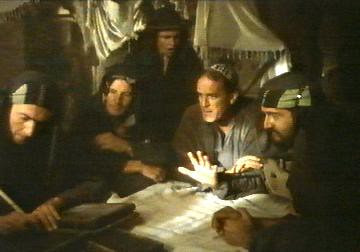
In the scene, the members of one of the most patriotic, determined, extremist, and intransigeant resistance groups fighting against the Roman occupier have gathered in a dark room for a secret meeting. All the men of the People's Front of Judea are masked, except for their leaders, and when the scene starts, the top honcho is ending a pep talk.
Furious about the Roman Empire's occupation of their land, Reg spits out: “They bled us white, the bastards! They’ve taken everything we have.” He continues raving and ranting about how they took everything from their “fathers” and their “fathers' fathers”, before ending with a majestic rhetorical question. “And what have they ever given us in return?” With that, he stops, and crosses his arms, feeling very satisfied. He realizes that he has made one of the best speeches of his career.
Just then, a shy masked commando raises a finger. “The aqueduct…”
“Oh yeah yeah they did give us that, uh-huh that’s true…”
Another commando, as masked as his colleague, chimes in. “And the sanitation…”
Stan, Reg's second-in-command sitting next to him, intervenes with naïve energy: “Oh yeah, the sanitation, Reg. Remember what the city used to be like.”
Murmurs of agreement rise from the commandos in the room.
The meeting is not at all going in the direction Reg expected it to, and he's starting to lose patience: “Yeah, all right, I’ll grant you the aqueduct and the sanitation are two things the Romans have done…”
Another terrorist interrupts him: “And the roads…”
Reg, brusquely: “Oh well obviously the roads, I mean the roads go without saying, don’t they?! … But apart from the sanitation, the aqueduct, and the roads…”
Other terrorists, who have definitely not understood the purpose of their leader’s speech and his rhetorical question, chime in: “Irrigation” “Medicine” “Education” “Public baths” “And the wine” while their comrades nod and murmur words of agreement (“Yuh, yuh that’s something we’d really miss, Reg, if the Romans left”).
Stan adds, innocently: “And it’s safe to walk in the streets at night now, Reg”. Reg’s lips have become ever more pursed and his expression ever darker as he taps his fingers impatiently, but nobody seems to notice, least of all Francis, Reg’s other neighbor, who adds with joviality: “Yeah, they certainly know how to keep order. Let’s face it, they’re the only ones who could in a place like this!” (general laughter)
Finally, with a sharp voice, Reg cuts the discussion short: “Alright, but apart from the sanitation, the medicine, education, wine, public order, irrigation, the roads, a fresh-water system, and public health, what have the Romans ever done for us?”
To that I will add a No Pasarán post from 2004, the blog's first year of operation (yup, this blog is celebrating its 10th anniversary next Spring, how 'bout that?), reproducing what is perhaps the best sketch ever — and certainly the most thought-inspiring — in the history of comedy.
In the scene (video below),
the members of one of the most patriotic, determined, extremist, and
intransigent resistance groups fighting against the Roman occupier have
gathered in a dark room for a secret meeting. All the men of the
People's Front of Judea are masked, except for their leaders, and when
the scene starts, the top honcho is ending a pep talk.
Furious about the Roman Empire's occupation of their land, Reg
spits out: “They bled us white, the bastards! They’ve taken everything
we have.” He continues raving and ranting about how they took everything
from their “fathers” and their “fathers' fathers”, before ending with a
majestic rhetorical question. “And what have they ever given us in
return?!” With that, he stops, and crosses his arms, feeling very
satisfied. He realizes that he has made one of the best speeches of his
career.
Just then, a shy masked commando raises a finger. “The aqueduct…”
“Oh yeah yeah they did give us that, uh-huh that’s true…”
Another commando, as masked as his colleague, chimes in. “And the sanitation…”
Stan,
Reg's second-in-command sitting next to him, intervenes with naïve
energy: “Oh yeah, the sanitation, Reg. Remember what the city used to be
like.”
Murmurs of agreement rise from the commandos in the room.
The meeting is not at all going in the direction Reg
expected it to, and he's starting to lose patience: “Yeah, all right,
I’ll grant you the aqueduct and the sanitation are two things the Romans
have done…”
Another terrorist interrupts him: “And the roads…”
Reg,
brusquely: “Oh well obviously the roads, I mean the roads go without
saying, don’t they?! … But apart from the sanitation, the aqueduct, and
the roads…”
Other terrorists, who have definitely not
understood the purpose of their leader’s speech and his rhetorical
question, chime in: “Irrigation” “Medicine” “Education” “Public baths”
“And the wine” while their comrades nod and murmur words of agreement
(“Yuh, yuh that’s something we’d really miss, Reg, if the Romans left”).
Stan adds, innocently: “And it’s safe to walk in the streets at night now, Reg”. Reg’s
lips have become ever more pursed and his expression ever darker as he
taps his fingers impatiently, but nobody seems to notice, least of all Francis,
Reg’s other neighbor, who adds with joviality: “Yeah, they certainly
know how to keep order. Let’s face it, they’re the only ones who could
in a place like this!” (general laughter).
Finally, with a sharp voice, Reg
cuts the discussion short: “Alright, but apart from the sanitation, the
medicine, education, wine, public order, irrigation, the roads, a
fresh-water system, and public health, what have the Romans ever done
for us?”
A shy finger goes up…“Brought peace…”
“Oh, peace! SHUT UP!”
****
There you have it! The only way that the liberals can perpetuate their self-serving self-image (of themselves as valiant resistance fighters arriving to help the people like gallant knights on white horses) is by ignoring facts, inconvenient and otherwise, and getting people, adversaries as well as followers, to keep their mouthes closed about said facts.
[Good intentions such as eliminating hunger and poverty] have been
damaging our continent for the past 40 years. If the industrial nations
really want to help the Africans, they should finally terminate this
awful aid.
It sounds like government programs in the West:
As absurd as it may sound: Development aid is one of the reasons for Africa's
problems. If the West were to cancel these payments, normal Africans
wouldn't even notice. Only the functionaries would be hard hit. Which is
why they maintain that the world would stop turning without this development aid.
This Fox News report is one of the most ludicrous things I have read in recent times. Four hours into its flight across the Pacific Ocean, an L.A.-to-Tokyo plane is "forced" (sic) to turn around and fly back to California. Why? What warranted this? Technical failure? A drunk passenger getting loud and threatening? A group of terrorists?
No. Mid-flight, personnel found a… stowaway aboard. An unexpected person who does not seem to have been displaying any kind of particularly peculiar or unwelcome behavior beyond the fact that he or she wasn't supposed to be on board, no more, no less.
Why on earth not continue the flight and, upon landing (wait for this astoundingly bright solution to the problem), turn the person over to local (to Japanese) authorities?! Have him (or her) detained, perhaps, while making sure to have the stowaway fly back to the point of origin on the very next available flight?! (Alternatively, the stowaway might pay the airline for a ticket and, insofar as the person's papers are in order, be allowed into the Land of the Rising Sun…)
It seems to me that that — that that simple, straight-forward solution — would be the first reaction of any pilot with a brain, any flight attendant with a brain, any air company CEO with a brain, any airport director (whether at the point of departure or arrival) with a brain. Does no one in the flight industry have common sense anymore?
Supermodel Chrissy Teigen live-tweeted her
disastrous experience aboard a Japan-bound jet that made a U-turn about
four hours into the flight due to an unauthorized person on board.
Teigen, 32, who was on the flight
with her husband, crooner John Legend, reported her Tokyo-bound All
Nippon Airways jet turned around halfway into the flight because “we
have a passenger who isn’t supposed to be on this plane.”
"A flying first for me: 4 hours into an 11-hour flight
and we are turning around because we have a passenger who isn't supposed
to be on this plane. Why...why do we all gotta go back, I do not know,"
Teigen said in a tweet.
Certainly, this is far worse than my own recent experience — trying to board an airliner with two pets — but doesn't it show the general direction (away from the friendlyskies) that the airplane service industry is going?
The following complaint is very long, filling two fully typed pages, and if you ask me why you should care, I agree — there is not much of a reason why you should (and, who knows, you might even come down in favor of the airport authorities) — but at the midpoint of the letter (see where I inserted a bullet point), I head away from my experience into a more general discussion of what seems to have been screwing up airlines in the past decade or two.
As you read this (or part of it, if you want to skip to the bullet point), recall the words of Lao-Tzu from 2,600 years ago
“The more laws and restrictions there are, The poorer people become. ...
The more rules and regulations you create,
The more thieves and robbers [the more criminals] you create as well.”
Here, with no further ado, is the (slightly redacted) complaint in question:
Air France
December 18, 2017
Dear Sirs,
I wish to issue a complaint about the treatment I received at Air France's Aviator desk in Copenhagen on December 1, when I was denied access to flight AF1051 due to the presence of two cats traveling with me.
On the other hand — needless to say — I am grateful to Air France that I was allowed to board the same flight 24 hours later (along with both felines and this time one hard box), even more so due to the non-refundable status of the first ticket being changed with no charge.
Still, when I arrived with the cats on December 1, I was carrying a bag for each cat. They were two soft bags, authorized specifically by Air France, as can be confirmed by your recordings of my conversations with Air France staff not only on Monday November 27 but also on Thursday November 30. During the latter, the representative was so insistent on getting her facts right that she asked me to hang up from our (long) conversation while she went to check with her supervisor before calling back …/… with "good news" (her words). I asked her to make sure to put the authorization of the two soft bags in "writing" in a note on the [computer] reservation.
On December 1, therefore, I duly went through all the steps of getting registered at Kastrup airport, getting as far as having my boarding pass issued (seat 21A). Then it was over to a special desk to get my cat tickets paid for (a hefty price of 1150 Danish Crowns).
Here we started bumping into obstacles — mainly, a(n incomprehensible) rule that allows no more than one cat per passenger in the cabin, while other cats must go into the hold. It seems like it's a rule which theoretically would allow 100 pets on board a given plane, barking, meowing, whimpering in the hypothetical situation where each passenger showed up with one pet. That was not the case on December 1 (nor on December 2).
For 30 minutes to an hour, Aviator staff called back and forth, ringing one supervisor after another to give them permission to either 1) allow two cats in the cabin — as the Air France note specifically directed staff to do! — or 2) put one of the two cats in the cabin and the other in the hold in a hard box instead of a soft bag (admittedly, I was far from keen with regards to the second alternative).
Time was running out, which could have been used to fetch a hard box in the airport's basement (your airport personnel were the ones who mentioned this possibility!), to lend me or to sell to me (I am not sure which).
All the while, I was treated to one catastrophic scare scenario after another explaining the rules (what if a passenger brought five kittens?! what if an animal was crushed in the hold?! what if you brought a lawsuit against us?!) — some of which admittedly made a modicum a sense — with no one capable of making a simple decision to slightly bend the rules.
Have they watched Monty Python and The Holy Grail too many times, and do they think that kitty cats are like the movie's cute white bunny that can turn into the vicious killer rabbit of Caerbannog, leaping from neck to neck to bite off one knight's head after another?
Finally, some supervisor said that because two cats would not be allowed in the cabin and because one cat would not be allowed in the hold in a soft bag, I would not be allowed to board at all — in spite of Air France's specific directions. This anonymous pencil pusher refused to talk to me or even give me his name.
I had no choice but to leave the airport, not knowing when and if I could get another flight and wondering whether my non-refundable ticket would be changed free of charge (thankfully, it was, and that for the following evening) while spending Saturday hunting for a hard box for the hold cat (no easy task, as it turned out — most boxes being for dogs of a larger size).
• On a more general note:
Aren't all the scandals of the past couple of years — the Kentucky doctor dragged off a plane in Chicago (David Dao), the young mother whose stroller was violently grabbed by a flight attendant (Olivia Morgan) — due to airline employees' inordinate focus on following rules — and on treating passengers like children who should remain quiet and obey — instead of being the smiling face of a service agency?
Indeed: isn't the very presence of a plethora of more rules — many of which did not exist in the "laissez-faire" era of only 10 to 20 years ago (which in itself would seem to prove that [contrary to common-sense bans about bringing handguns aboard, for example] the new edicts are relatively non-essential and unimportant, almost gratuitous) — a thing that causes, consciously or otherwise, employees to be more focused on the rules than on the passengers and on providing service?
A number of these new directives are close to unfathomable: regarding pets, besides the one-only-in-the-cabin, you have — all airlines have? — if I understand correctly, recently decided to ban every type of hard box for sale except for that of one single vendor; and apparently there is a decree that unless you declare a traveling pet 24 hours prior to boarding — i.e., if you show up with the pet unannounced at the airport counter — it will be denied admittance.
Where do these rules come from, anyway? Are lawyers with nothing to do dreaming them up, like Woody Allen in Bananas, to justify their salary?
Then there are bans like the one on changing places to an empty seat with more legroom — unless you pull out your credit card — which make travelers think that we are to be treated more like a flock of sheep or, rather, a herd of milch-cows.
In any case, the heads of your Copenhagen crew seem to be they have to act as policemen and/or as judge, and follow the rules religiously.
However, in real life, aren't real police officers and real judges flexible at times? In what country does a citizen not hear, at one time or another, "This time, I'm letting you off with a warning" or "Okay, we'll let it go this time — but don't do it again"? In other words, the very sworn representatives of the state (!) and its rule of law (!) do not act like robots, and use (and are allowed to use) their discretion as well as their common sense, rendering a service to a citizen when and if the situation warrants it.
In legal terms, today's citizens seem to suffer from an incapacity and a mental refusal to see the difference between
malum in se
(conduct inherently wrong by nature like theft and murder) and
malum prohibitum
(non-damaging statute-based rules), as well as to determine
mens rea
in one's fellow human being (to what degree was a fellow's misdeed intentional, if at all?).
To return to the Air France/Aviator supervisor in Denmark, who is definitely part of the service industry, but who seems incapable of taking the initiative to overlook rules when and if the situation warrants it — a passenger stranded with two cats in the airport as an airliner readies to take off — in spite of specific directions by Air France on said passenger's computer reservation to do so.
The Scandinavian peoples' love affair with rule-following allowed for no decision, no initiative, no capacity to improvise, no motivation to say, "Let's see if we can't find a solution and make this customer (and his furry friends) happy."
As I said, there were several solutions available — including going around the rules and, in a cabin of some 100 people, allowing two cats (there may have been one or two more) for one passenger.
Indeed, this was exactly which happened earlier this year, on my evening flight of January 9 when I traveled in the opposite direction. Then, the ground crew at Charles de Gaulle airport brought the Air France captain out from his cockpit and the plane to the terminal (this does sound a bit extreme, you realize), where he told duly me he would accept two cats on his aircraft if I could find a passenger agreeing to take the second feline. (Needless to say, chances are close to 100% that in a group of about 100, you will find a high number of people willing to take responsibility for a cute kitty-cat for less than two hours.)
Now, a final word of praise: while one cat went into the hold on December 2, the Aviator personnel who made my reservation was so kind to put me and the other animal in a row all by ourselves. This is the kind of service and thoughtfulness that I fully appreciate.
The [airline] industry ranked seventh-to-last out of 43 industries in the American Customer Satisfaction Index in 2016. All aspects of air travel have been criticized, such as airfare, booking flights, getting onto the plane and even the flight itself.
As the 70th anniversary of Stalin's death is commemorated (celebrated?), it is far from inappropriate to tackle a growing narrative, the fact that in the past few years, we hear more and more the simplistic phrase that Russia was the true victor of the Second World War.
And more than that: In Europe, this has become especially egregious, not least in France, where it has become routine to hear that "Russia defeated Hitler" and even — with anti-Americanism never lurking far from the surface — that "the Soviets bled and died for us" and "the Red Army (were the ones who truly) liberated Europe" from Nazism. (Notice how they never — should I replace that with "they no longer"? — say that "Stalin liberated Europe" — probably because that sounds too ridiculous.)
So it's far from inappropriate not only to recollect not only how the Soviets "won", or helped to win World War II, but how they behaved after the Germans surrendered, i.e., during "peacetime."
Because the French are in despair due to the malfeasance of our political class and the lack of a credible saving successor, some are taking the easy way out, that is to say, aiming for utopia.Thus, we happily swallow the myths built by Putin in the tradition of his late USSR and with all the humor of his late KGB.
All these myths are perfect inversions of factual reality, starting with this example of historical revisionism: « It was the Russians who defeated Hitler and who died en masse for us French people.»
… Communism, Nazism, and now Islamism and Eurasianism… Evils and perils always come from the East!
Although the leaders of the western states quickly understood the
threat posed by the new Soviet Empire to freedom and democracy, many of
their citizens did not.
Between 1941 and 1945 so much praise had been heaped upon Uncle Joe,
the defenders of Stalingrad, heroic factory workers of the Volga and
suchlike, that thereafter it proved a hard task to disabuse many people
of their illusions about Mother Russia.
… the supply of useful idiots — western apologists for the Soviet Union — seemed limitless
After a brief introduction underneath the photo below, the following post is divided into the following seven chapters:
1) How Did World War II Start Anyway, and by Whom Was It Started?
2) Paranoia? The Red Scare? Witch Hunts?
3) The Red Army's Huge Losses
4) Was Soviet Victory Possible Without Yankee Can-Do?
5) The Red Army Under World War II and the Treatment of Veterans in the Aftermath
6) 3 Mind-Boggling Revelations About a Century of Russian History
7) Conclusion
"You celebrated the liberation in 1945" said one Estonian to a West European. "But for us, the liberation was the beginning of an occupation of 45 years."
Indeed, Tallinn's museum on the 20th century is called the Museum of OccupationS and Freedom (in the plural). Likewise, the Museum of the Occupation in Riga (see its History of KGB Operations in Latvia
exhibit) speaks not of the occupation in the singular, but of three occupations, from 1940 to 1991: first that of Russia (the Soviet Union), then Germany's (the Third Reich's), and then again Russia's (the USSR's).
First, the occupation by the Vozhd, then by der Führer, then by the Vozhd again.
"We survived the Germans" said a Polish woman after leaving Auschwitz; "But we won't be escaping the Russians"(The Nazis and the Final Solution, RMC Découverte). Antony Beevor:
The Poles had no illusions in either direction, trapped as they were [in Warsaw in 1944] between the two pitiless totalitarian systems which fed off each other. [One] Home Army poet wrote:
'We await you red plague / to deliver us from the black death.'
In 2019, National Review
published a journalist’s recollection of the Fall of the Berlin Wall 30
years earlier. A couple of years after the wall came down, John Fund
visited [Peter Janz, who was the energetic first secretary of the East German
Embassy in Washington during the 1980s, and] asked him
when he first realized that he was working for a regime that didn’t
serve its people and was built on untruths.
He explained that as the son of Communist Party insiders, he had gone
to high school in Moscow and been trained for a career as a top
government official. But a school vacation trip he and four fellow East
German classmates earned to the Baltic States changed his perspective.
He explained that he and his friends had been taught that Estonia,
Latvia, and Lithuania had all been liberated by Stalin from Nazi rule
during World War II. They were now proud, loyal republics of the Soviet
Union. But when he and his friends spoke Russian on the streets, they
were met with hostile glares and suspicion by the local population. When
they switched to German, they were approached by curious passersby and
greeted warmly. “I suddenly realized my world was upside down. Nazis had
indeed brutalized the Baltic States, but the Soviets had been at least
as bad and stayed far longer”
Indeed, a few years back, a Lithuanian testified that his father had said if he had the choice, he
would rather live under 10 years of Nazi occupation than under one single year of
communist occupation.
Today, when people extol the Soviet soldiers dying for our freedom, I invariably reply by saying that I would love to take a vacation with them. Oh? What? Why? Yes, we could travel together through the countries of Eastern Europe, and I would serve as your bodyguard: every time you feel like saying the Red Army liberated the continent, I will put my hand over your mouth so you don't end up in an insane asylum.
1) HOW DID WORLD WAR II START ANYWAY, AND WHOM BY?
This brings up a critical issue of foremost importance: that the German invasion, the
Wehrmacht's juggernaut, and the Nazi whole or partial occupation of countries throughout
Europe, whether the Balts or the Scandinavians or Holland or France (not to mention eventually the… Soviet Union itself),
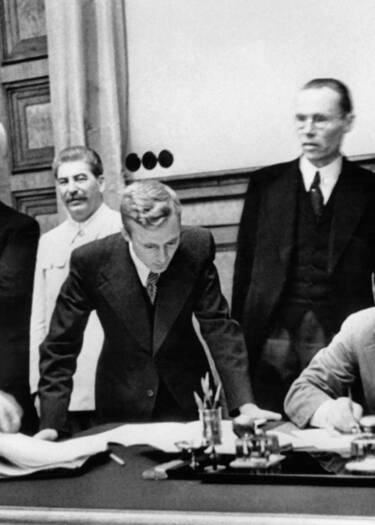
could only have occurred and only did in fact come about because of one thing and one thing only: the Molotov-Ribbentrop Pact. Which also unleashed Stalin's Red Army, and at roughly the same time.
the signing in Moscow of the infamous Ribbentrop-Molotov non-aggression
pact between … Nazi Germany and the Soviet Union and the accompanying
secret protocols on cooperation in dividing between them “the
bloodlands” in the middle. Not surprisingly, the state legatee of one
of the original signatories is getting quite defensive about it:
… The [Kremlin's] message is loud and clear: don’t single out Russia (or the Soviet Union) because you all cosied up to Hitler just as bad.
There are, however, a few reasons why the Ribbentrop-Molotov (or the
Molotov-Ribbentrop, as Russians seem to prefer it) pact stands out:
1. While the shameful Western appeasement of Hitler, culminating in
the infamy of Munich, allowed the Reich to bloodlessly dismember the
sovereign and democratic Czechoslovakia, neither Great Britain nor
France participated in or benefited from Germany’s cannibalism of this
“faraway country of which we know little”. The difference is that while
the West remains ashamed of Munich (a name which quickly become
synonymous with a craven sell-out), a few years back, Russia’s culture
minister Vladimir Medinsky called the Ribbentrop-Molotov pact “a great achievement of Soviet diplomacy”.
2. Unlike all the other agreements signed with Germany during the
1930s, it was the Ribbentrop-Molotov pact that green-lit the armed
German aggression and led to the outbreak of the deadliest war in human
history. It’s difficult to blame Germany’s neighbours or countries
threatened by the Soviet Union (like Poland, Romania and the Baltic
states) for trying to stay on Germany’s good side. It was naive and in
any case it didn’t work in the end, as they all later found out to their
detriment and downfall. [The] Soviet Union, on the other hand, not only
climbed into bed with Nazi Germany but it fully and enthusiastically
consummated this marriage of convenience.
3. Unlike other agreements cited above, thanks to the “secret
protocols” attached to the Ribbentrop-Molotov pact, the Soviet Union was
both a co-aggressor in and a co-beneficiary of the start of World War
Two. Stalin has relatively bloodlessly acquired the by-then
(mid-September) almost defenseless eastern Poland (subsequently
incorporated into Belarussian and Ukrainian Soviet Republics; these
historically Polish areas remain today parts of Belarus and Ukraine),
Bessarabia from Romania (incorporated into the Moldovan Soviet
Republic), the Baltic States of Lithuania, Latvia and Estonia, as well
as being given a free hand in the invasion of Finland, a country which
otherwise might have counted on German friendship and support. All these
aggressive territorial gains were the consequence of the
Ribbentrop-Molotov division of Eastern Europe between the Reich and the
Soviet Union into the respective spheres of interest, soon confirmed as
the “facts on the ground” by Wehrmacht and Red Army.
4. While Britain and France, their empires and their allies, fought
Germany for almost two years after September 1939, first through the
period of the “phony war”, then through the Blitzkrieg in the West and
the Battle of Britain, the Soviet Union remained a de facto
Nazi ally, continuing to cooperate in security matters and supplying
Germany with food and raw materials. Grain trains were still rolling
west across the border with the Reich as Wehrmacht was launching
Operation Barbarossa in the morning of 22 June 1941. During the period
of Nazi-Soviet cooperation, Germany conquered Poland, Norway, Denmark,
Belgium, the Netherlands, Luxembourg, France, Yugoslavia and Greece.
Soviet exports helped to feed and build up the German war machine before
it was unleashed against the West in 1940; German troops surging into
the Low Countries walked on their stomachs (to borrow from Napoleon)
full of bread baked from Russian wheat or were carried on the tanks and
trucks made with Russian coal and ores. Never forget that for Russia,
World War Two – or the Great Patriotic War as it is called there –
begins only in June 1941, not September 1939, as it does it all Western
history books. [See Jeff Jacoby's argument below for arguing that WWII did not actually start in September (on September 1), but in August (on August 23).]
5. It’s true that the Ribbentrop-Molotov pact was partly defensive in
nature as far as the Soviet Union was concerned, aiming to postpone the
inevitable armed clash between the two rival totalitarianisms and in the
meantime give Russia some essential breathing space to build up its
army and strategic reserves (the top leadership of the Soviet armed
forces was decapitated by Stalin during the purges in 1937-8, leaving
them even more unprepared to face Germany than would have otherwise been
the case). But as I pointed out above, it was also offensive and
directly benefited Stalin’s territorial ambitions while it lasted. In
some ways, the legacy of the pact lives on in the shape of Poland’s
post-war borders, which have nothing to do with its thousand-year
history. This is the real #TruthAboutWWII and this is why the
Ribbentrop-Molotov pact remains singled out in the infamy of the
interwar European democracy.
As mentioned, Jeff Jacoby is just as, if not even more, explicit: World War II may not actually have started on September 1, 1939, as is traditionally written, but nine days earlier. And the rapprochement of Nazis and communists is not surprising when it is remembered, as Jeff Jacoby writes, that
for the first two
years of World War II, Nazi Germany and Soviet Russia were allies. They
secretly planned and jointly began the war that inflicted such horror
and destruction. Later, of course, Hitler double-crossed Stalin and
ordered the Wehrmacht to invade the Soviet Union in June 1941. But
before that turning point, the two totalitarian powers cooperated
closely.
… From 1939 through mid-1941, Soviet Russia
collaborated with the Nazis in wreaking slaughter and savagery on the
nations of Europe.
… There is no denying that a vast number of
Soviet citizens lost their lives in World War II. Without the Russian
people’s appalling suffering and sacrifice, the Allies might not have
triumphed in the end.
But there is also no denying that Moscow
was Nazi Germany’s partner in unleashing the war, the deadliest in human
history, in the first place. Victory Day is a good opportunity to
review the record of Russian culpability in plunging the world into war —
a record the Kremlin’s propagandists have been trying to obscure for
decades.
World War II is commonly said to have started on Sept. 1, 1939, when German forces invaded Poland. But it would perhaps be more
accurate to date the start of the war nine days earlier. On Aug. 23,
1939, German Foreign Minister Joachim von Ribbentrop and Soviet Foreign
Minister Vyacheslav Molotov signed a treaty of non-aggression, whereby
their governments agreed to conquer and divide Poland and the rest of
Eastern Europe. It was under the terms of this pact that the Nazi
Wehrmacht moved into western Poland on Sept. 1 and Josef Stalin’s Red
Army invaded Poland from the east 16 days later.
… In the months that
followed the Nazi-Soviet takeover of Poland, as Hitler’s troops
conquered Denmark, Norway, Belgium, Holland, and France and bombed much
of London into rubble, Stalin’s forces continued their illegal war of aggression and conquest [the Baltic states (Estonia, Latvia, Lithuania),
the formerly Romanian territories of
Bessarabia and northern Bukovina, and Finland]
Lest anyone would like to reiterate the myth that the Nazi-Soviet pact was borne of necessity, to give the USSR breathing space, FEE's Benjamin Williams writes that
Stalin’s first gift after the pact was awarding Germany around 600 German Communists, most of whom were Jews.
He had them extradited to the Gestapo in Brest-Litovsk, a symbolic
location steeped in historical implications.
… Margarete Buber-Neumann, a former communist turned staunch
anti-communist, was one such individual transferred from Soviet
imprisonment to the hands of the Gestapo in 1940. Surviving the brutal
conditions of both a Soviet prison and a Nazi concentration camp,
Buber-Neumann later penned the memoir "Under Two Dictators," detailing
the harsh realities of life under the totalitarian regimes of Stalin and
Hitler.
… We should resist the call to ignore the sobering reality of the Soviet
Union's complicity. One cannot forget that the initial alliance forged
between Stalin and Hitler was rooted not in necessity but sprouted from
the soil of Stalin's socialist ideology.
As it happens, "history has long held that Stalin spent the two intervening years building up his defenses against a Nazi attack." It seems much more logical that "Soviet warplanning reflected its expansionist orientation" and that Koba was simply preparing his own attacks on the USSR's own neighbors. Indeed, in his book about Soviet Grand Strategy, 1939-1941, Albert L Weeks goes even further:
With the gradual declassifying of former Soviet documents, though,
historians are learning more and more about Stalin's grand plan during
the years 1939-1941. Longtime Soviet expert Albert L. Weeks has studied
the newly-released information and come to a different conclusion about
the Soviet Union's pre-war buildup_it was not precaution against German
invasion at all. In fact, Weeks argues, the evidence now suggests Soviet
mobilization was aimed at an eventual invasion of Nazi Germany. The
Soviets were quietly biding their time between 1939 and 1941, allowing
the capitalist powers to destroy one another, all the while preparing
for their own Westward march. Stalin, Weeks shows, wasn't waiting for a
Nazi attack—Hitler simply beat him to the punch.
There was scarcely a
crime the Nazis or the knights of Bushido had committed, or even
imagined, which the Soviet regime hand not also perpetrated, usually on
an even larger scale. It ran precisely the type of system which had
produced the war and its horrors. More specifically, the Nazi-Soviet
Pact of September 1939 and the Japanese-Soviet Pact of April 1941 had
made the Axis aggressions possible.
2) PARANOIA? THE RED SCARE? WITCH HUNTS?
Shouldn't "McCarthyism" be a term which should be abolished? (Just like all the other words made up by leftists — racism, sexism, misogyny, transphobia, etc, etc, etc, should be declared non grata, certainly by conservatives.) No matter what sins and private demons the Wisconsin senator might have (or might not have) been obsessed about, let us ask a question: who was the head of the Soviet Union when the Grand Chute native entered the Senate and during most of his career?
Joseph Stalin.
Wasn't Tail-Gunner Joe right to be wary of the Red Tyrant?
Was it, is it, truly a good description of someone who is wary about communists, local or foreign, as being "paranoid"?
Was it a scare, a "Red Scare," to be wary of people, domestically and internationally (Westerners outright on Moscow's payroll — whether overtly communist or not — or useful idiots), who praised the great Guide (the Vozhd) of the Peoples, indeed participated in what Gail Heriot calls a cult of Stalin?
When accused of being a traitor whose testimony before Congress encouraged HUAC's "witch hunt", Elia Kazan made the movie On the Waterfront and said later, Witches do not exist, but Stalin's spies certainly did so. David Horowitz:
there is no secret anymore that virtually all the victims of the
blacklist were also defenders of a monster regime that was America's
sworn enemy
It's amazing how people still smirk about American "paranoia" and "Red Scares" and "witch hunts", although the USSR's crimes have been known for a long time.
As Monty Python or the Protest Warriors would say, tongue firmly in cheek,
The West's useful idiots, its Drama Queens, and the Russians themselves have forgotten that the Stalinist USSR in 1939 was "a totalitarian state characterized by repression, deportation, and massive executions"
(…If they ever knew it…
) with an apparatus including psychopaths such as Lavrentiy Beria and
Vasily Blokhin, the Red Tyrant's chief executioner of the NKVD.
As David Satter wrote in the Wall Street Journal at the time of the centennial of the Bolshevik Revolution:
… the stage for decades of murder on an
industrial scale [led in total to] no fewer than 20 million Soviet citizens
were put to death by the regime or died as a direct result of its
repressive policies. This does not include the millions who died in the
wars, epidemics and famines that were predictable consequences of
Bolshevik policies, if not directly caused by them.
To this list should be added nearly a million Gulag prisoners
released during World War II into Red Army penal battalions, where they
faced almost certain death; the partisans and civilians killed in the
postwar revolts against Soviet rule in Ukraine and the Baltics; and
dying Gulag inmates freed so that their deaths would not count in
official statistics.
… The
effect of murder on this scale was to create a “new man” supposedly
influenced by nothing but the good of the Soviet cause. The meaning of
this was demonstrated during the battle of Stalingrad, when Red Army
blocking units shot thousands of their fellow soldiers who tried to
flee. Soviet forces also shot civilians who sought shelter on the German
side, children who filled German water bottles in the Volga, and
civilians forced at gunpoint to recover the bodies of German soldiers.
Gen. Vasily Chuikov, the army commander in Stalingrad, justified these
tactics in his memoirs by saying “a Soviet citizen cannot conceive of
his life apart from his Soviet country.”
Notice that (rightly) nobody snickers, rolls their eyes, or lets out deep sighs about American "paranoia" regarding Nazis or the Brown scare or the witch hunt by (yes) HUAC — which was founded in 1938, before World War II (this is something you probably did not learn in school) — and whose targets were originally not just communists but… Nazis, at a time when the two dictatorships were soon to become allies (!), allied (as seen above) by the Molotov-Ribbentrop Pact.
Stalin
set about building a new universe, in which every old loyalty to kin,
friends, colleagues was extinguished and replaced by one fealty alone -
to "The People", of whose interests he was sole arbiter.
… The victims often had no clue what "crime" they had committed.
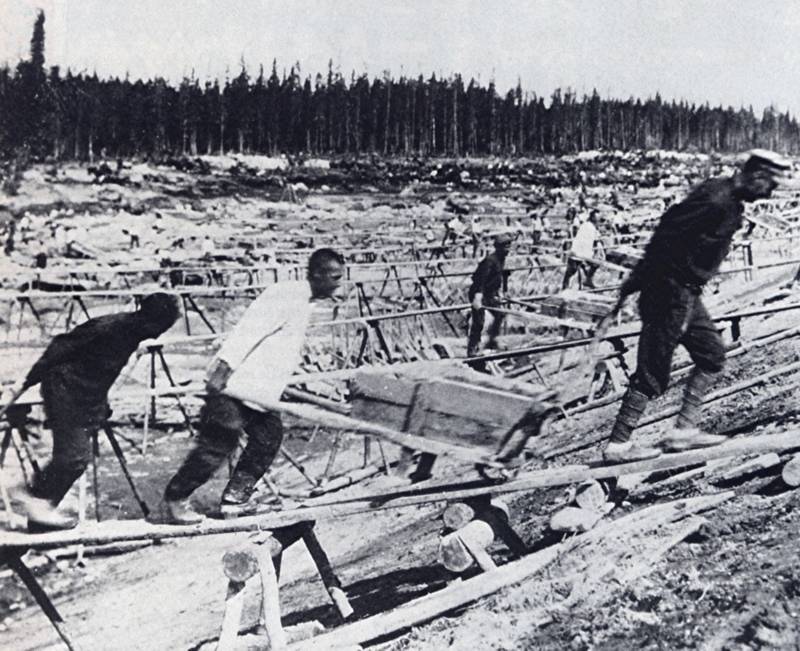
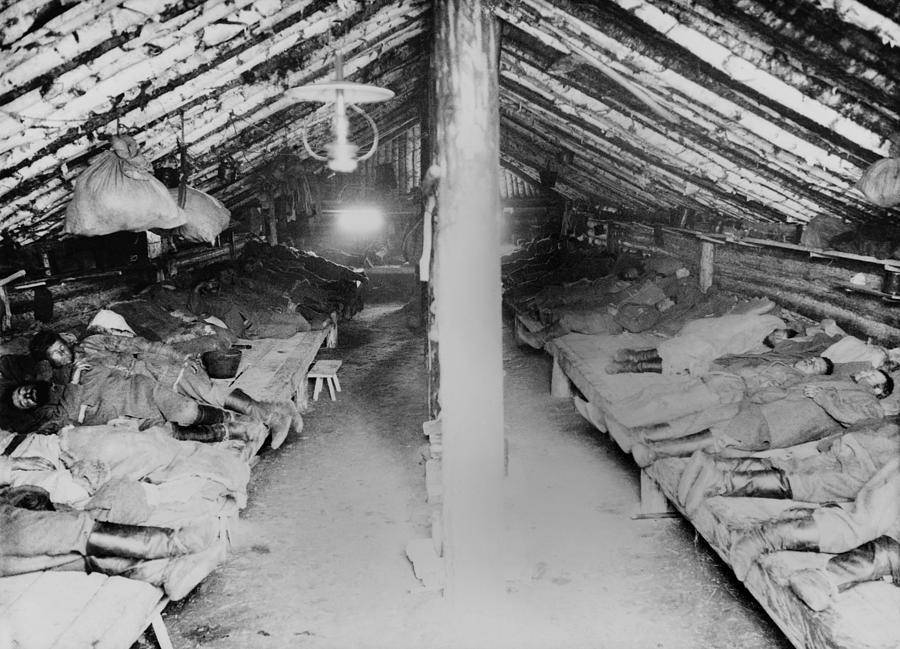
They were merely shipped to the Gulag, where they slaved until hunger, disease or execution ended their sufferings.
In 1942, the death rate in Russia's camps reached 25 per cent - in that one year, a quarter of the vast prison population died.
… This is the society which historian Orlando Figes chronicles in terrifying detail in his new book, The Whisperers.
… Yet the war brought scant relief to the inmates of the Gulag.
While some ordinary criminals, mere thieves and cutthroats, were released to fight, political prisoners remained enslaved.
When the war ended, the Gulag population actually expanded.
A million new prisoners were admitted between 1945 and 1950.
"We Seem to Have Forgotten Everything" regarding Communist Russia wrote a couple of commentators in Le Monde, referring to the Gulags and to what they called nothing less than The West's Soviet Holocaust Denial.
the Soviet Union did most of
the bleeding and dying destroying Nazi Germany. Their losses were so
staggering that to this day nobody know exactly how many died fighting
the Great Patriotic War. Hell, not even Moscow is certain how many
divisions the country raised during the war -- some estimates go as high
as 600 or more.
You want
perspective? The U.S. didn't raise even 100 divisions, from a
population base comparable to the U.S.S.R.'s. American combat and
combat-related deaths totaled 407,300, with a further 12,000 or so
civilians killed. The Soviets lost between 9 and 12 million soldiers,
with 8 million civilians lost to "military activity and crimes against
humanity," plus a further 5-10 million dead due to war-related famine
and disease.
Those losses
are beyond staggering. Somewhere between 23 million and 30 million
Soviets lost their lives between June 22, 1941 and May 7, 1945. That's
roughly 18,000 people per day.
After 17 years of hard fighting against Islamic terrorism, our total losses don't even approach the Soviet's daily average.
In fact, the three nations with the most soldier deaths — not to mention the most civilian deaths — were communist Russia along with (wait for it)… Nazi Germany and Imperial Japan.
Does that tell us all those nations were the most patriotic and should be praised to the heavens? Or — simply —
that those nations were all of 'em dictatorships? Dictatorships who have
little need of valuing the lives of their soldiery/citizenry and have little compunction of
sacrificing them on the battlefield.
This
is not to excuse Communism, Joseph Stalin, or the Red Army's notorious
war crimes -- including the officially winked-at rape of some two
million German women in the war's last months.
As it happens, Stephen's Vodkapundit has penned a lengthy post against leftists trying to replace the Yanks as the good guys of the war with the Soviet communists.
With regards to dictatorships, the greatest aces during World War II were Germany's pilots, not
those of the allies (40 enemy planes shot down by America's top ace compared with close to 300 shot down by Germany's!). Why? Because while the democracy's pilots were
rotated and transferred back to their offices, the German pilots flew until their deaths.
… les
pilotes alliés volaient un certain nombre de missions au front, et
étaient ensuite transférés sur d’autres postes une fois que ce nombre de
missions était atteint. En revanche, les pilotes Allemands volaient
jusqu’a la mort.
So, to a certain extent, it can be said that — at least in military matters — dictatorship has certain upsides.
In a must-read article about whether Russians worship war and death ("Geography is not just physical but spiritual, so any place where
Russians fought a heroic battle—in Belarus, in Crimea, in Kiev—belongs
to Russia …/… Russia as the savior, the suffering hero, the eternally betrayed victim"), Commentary's Gary Saul Morson puts it this way:
The Soviet government had already grown used to squandering millions of
lives in class warfare, industrialization, the collectivization of
agriculture, slave labor, and the frozen camps of Siberia, and it could
hardly have been more profligate with human life during the war. There
is no doubt that much loss of life was self-inflicted. Even in besieged
and starving Leningrad, the secret police continued their relentless
arrests. Soldiers were treated as an infinite, essentially inanimate
resource, so mine fields were cleared by having soldiers walk over them.
To prevent men from retreating, “blocking detachments” of machine
gunners were placed behind them. … Some soldiers received adequate food
only in 1945 from captured German food stocks. Officers stole soldiers’
food and treated their underlings with shocking brutality. Soldiers
recalled fearing their own superiors more than the Germans.
As Antony Beevor says about The Soviet Role in World War II about "heartless sacrifices" and the "blood debt to the Red Army": regarding the "staggering disregard for human life on the part of Stalin",
One can never expect the army of a liberal democracy to fight as ruthlessly as that of a dictatorship
It was not always propaganda (whether for external or internal use); it was also fear of punishment. In his monumental The Second World War (almost 1,000 pages), Antony Beevor mentions that
The Stakhanovite mentality was deeply ingrained in the Red Army, and officers felt compelled to inflate and even invent accounts, as a junior officer explained.
"A report had to be sent in every morning and evening on the losses inflicted on the enemy and on the heroism of the men in the regiment. I had to carry these reports because I had been appointed liaison officer since our battery had no gns left … One morning just out of curiosity I read a paper marked 'SECRET' sent by the regimental commander. It said that troops of the regiment had repulsed the enemy's attack and damaged two tanks, suppressed the fire of four batteries, and killed a dozen of Hitler's soldiers and officers with artillery, rifle, and machine-gun fire. And yet I knew perfectly well that the Germans had been sitting peacefully all day in their trenches and that our 75 mm guns did not fire a single shell. I cannot really say that this report surprised me. By that time we were already used to following the example of the Sovinform Bureau [an official news agency]."
Furthermore, adds Beevor, a large number of deaths were Gulag prisoners
On 28 July [1942], Stalin issued his Order No. 227 entitled 'Ni shagu nazad ' — 'Not one step back' — … The retreat mentality must be decisively eliminated. …
… Blocking groups were to be set up in each army to gun down those who retreated. Punishment battalions were strengthened that month with 30,000 Gulag prisoners up to the age of forty, however weak and under-nourished. In that year [1942], 352,560 prisoners of the Gulag, a quarter of its whole population, died.
So: how many of the USSR's wartime deaths were due to Soviet troops ordered to gun down fellow comrades trying (probably for good reason, most of the time) to retreat?
As for executions, an incredible 300.000 Soviet soldiers seem to have been executed by their countrymen, a number — another number — that never seems to be added to that of the USSR's "sacrifices."
Many Red Army troops who weren't executed were again persecuted, but this time by their liberators and countrymen,convinced that all Soviet prisoners were potential traitors. “I was
always hungry” remembered one who was released from prison in 1953 at the death of Stalin.
Responding to a Quora question, a former infantry marine replies that Churchill and Stalin both discussed which army was superior, the British Army or the Red Army?
Churchill,
somewhat appalled at the enormous blood sacrifice being made by the Red
Army suggested that the troops would be of a higher quality of they
received more than two weeks training. I believe British soldiers were
receiving 12–20 weeks of training before shipping out. For comparison
the US Army was 12–13 weeks.
Stalin
replies to Churchill with the infamous line, “quantity has its own
quality”, meaning of course that he was going to continue to pour
untrained conscripted recruits into battle at huge cost because they
kept on winning and he had many more.
… in
the final months of the war, the Germans were killing as many Russians
EVERY month as the British lost in the entire five+ years of the war.
Needless to say, tony Winkler feels it necessary to add that he
mentioned the war losses not to belittle the Russian forces but rather to point out their great sacrifice
4) WAS SOVIET VICTORY POSSIBLE WITHOUT YANKEE CAN-DO?
As they stand in awe of the rapid advances of the Red Army, a number of people and Drama Queens are fond of declaring, hardly wrongly, that the Allies would never have won without the Soviets. (Hardly wrong, but to those who nonetheless want to voice their gratitude to comrade Stalin's USSR, don't forget this post's initial point, that there would have been no war to speak of in the first place, had not the Molotov-Ribbentrop Pact (les coulisses de l'accord secret entre Hitler et Staline) been signed.
In any case, what people rarely mention is one simple truth: that the Soviets would not have won without the Americans; they would have lost.
Roosevelt's
decision to aid the Soviet Union was genuinely altruistic as well as
munificent. Soviet Lend-Lease took time to get under way, much to the
president's exasperation, but in scale and scope would play a major part
in the eventual Soviet victory (a fact which most Russian historians
are still loath to acknowledge). Apart from high-quality steel,
anti-aircraft guns, aircraft, and huge consignments of food which saved
the Soviet Union from famine in the winter of 1942-3, the greatest
contribution was to the mobility of the Red Army. Its dramatic advances
later in the war were possible thanks only to American Jeeps and trucks.
… [The] greatest problem [of Zhukov's armies] was not German resistance but the difficulties of their supply service, desperately trying to keep up with them on bad winter roads and without any rail line functioning. Had it not been for the American trucks provided under Lend-lease, the Red Army would never have made it to Berlin before the Americans.
Quite correct. There is a lot of evidence that the USA was instrumental in the victory of the Red Army, not least through the very own testimony of none other than… the Vozhd (!) himself:
The United States is a country of machines
Josef Stalin is quoted as saying in 1943 in W. Averell Harriman and Elie Abel's Special Envoy to Churchill and Stalin, 1941-1946 (Random House, N.Y., 1975, p. 277 );
Without the use of
these machines through Lend-Lease, we would lose this war.
In Khrushchev's memoirs, the Vozhd's successor quotes Stalin as saying the same thing.
In total, American aid amounted to approximately $180 billion (in today's dollars): 400,000 jeeps and trucks, 14,000 planes, 8,000 tractors, 13,000 tanks, more than 1.5 million blankets, 15 million pairs of boots, 107,000 tons of cotton, 2.7 million tons of fuel (for planes, trucks, and tanks), 4.5 million tons of food (which Stalin distributed "parsimoniously", with about 1 million Soviet soldiers dying because the packages were not sent to them). The United States even shipped an entire Ford factory to the Soviet Union that made tires for military vehicles.
The United States shipped more than $12 billion in Lend-Lease aid to
Stalin's Russia during World War II. Materials lent, beginning in late
1941 before the Japanese attack on Pearl Harbor, included airplanes and
tanks, locomotives and rails, construction materials, entire military
production assembly lines, food and clothing, aviation fuel, and much
else. Lend-Lease is now recognized by post-Soviet Russian historians as
essential to the Soviet war effort. Wielding many facts and statistics
never before published in the U.S., author Albert L. Weeks keenly
analyzes the diplomatic rationale for and results of this assistance.
Russia's Life-Saver is a brilliant contribution to the study of
U.S.-Soviet relations and its role in World War II.
Indeed, in Stalin's War (A New History of World War II), this comes up for criticism by Sean McMeekin, who
reveals the
extent to which Soviet Communism was rescued by the US and Britain’s
self-defeating strategic moves, beginning with Lend-Lease aid, as
American and British supply boards agreed almost blindly to every Soviet
demand. Stalin’s war machine, McMeekin shows, was substantially reliant
on American materiél from warplanes, tanks, trucks, jeeps, motorcycles,
fuel, ammunition, and explosives, to industrial inputs and technology
transfer, to the foodstuffs which fed the Red Army.
This
unreciprocated American generosity gave Stalin’s armies the mobile
striking power to conquer most of Eurasia, from Berlin to Beijing, for
Communism.
And we will see, in the second of the "3 Mind-Boggling Revelations About a Century of Russian History", exactly how Stalin proposed to repay the Anglo-Americans for that generous aid. The Economist adds that
Aside from the chief villain, Western leaders too come in for quiet
but deserved scorn. Both Franklin Roosevelt and Harry Truman failed to
grasp their counterpart’s malevolence. Winston Churchill made casual
deals that consigned millions of people to slavery and torment. The
foreigners thought Stalin was a curmudgeonly ally to be coaxed and
cajoled. He treated them as enemies to be outwitted. Far from provoking
Stalin into unnecessary hostility, the Western powers were not nearly
tough enough.
Soviet communism had just marked its
first birthday when Solzhenitsyn was born. He grew up knowing nothing
else. During World War II, while in his mid-20s, he fought in the Red
Army against the Nazi German invasion—for which he was twice decorated.
His war-time service, when he witnessed Soviet atrocities against both
soldiers and civilians, led him to start questioning the moral
legitimacy of the Soviet regime and the Marxist ideology upon which it
rested. Recalling this time many years later, he wrote:
There is nothing that so assists the awakening of omniscience within
us as insistent thoughts about one’s own transgressions, errors,
mistakes. After the difficult cycles of such ponderings over many years,
whenever I mentioned the heartlessness of our highest-ranking
bureaucrats, the cruelty of our executioners, I remember myself in my
Captain’s shoulder boards and the forward march of my battery through
East Prussia, enshrouded in fire, and I say: So were we any better?
… All of his books, short stories, and poems are literary gems and/or historical masterpieces, but none surpasses The Gulag Archipelago
in importance to the world. It remains a gripping account of life in
the vast network of Soviet prison camps where people were enslaved,
overworked, tortured, and killed for—in many cases—nothing more than
opposing socialism, communism, Stalin, the Party, or some other aspect
of the vaunted “workers’ paradise.” It’s been described as “an
unrelenting indictment of communist ideology.” Terror was the modus operandi from its founding philosophical father Karl Marx to his acolytes in Russia, Lenin and Stalin.
Once the reconquest of the national territory was completed, another chapter opened: in Romania first, in Hungary, then in West Prussia, the Soviet soldiers indulged in "an orgy of war crimes", in the forefront of which were a massive wave of rapes.
… The total impunity they enjoyed then preceded the silence that covered their crimes in the history of the war later told inside the USSR.
Much has been said recently about the instances of rape. For instance, in The Second World War, Antony Beevor reports on refugees from the capital of Königsberg:
Leonid Rabichev, a signals lieutenant with the 31st Army, described the scenes beyond Goldap. 'All the roads were filled with old people, women and children, large families moving slowly on carts, on vehicles or on foot towards the west. Our tank troops, infantry, artillery, signals caught up with them and cleared the way for themselves by pushing their horses and carts and belongings into the ditches on either side of the road. Then thousands of them forced the old women and children aside. Forgetting their honour and duty and forgetting about the retreating German units, they pounced on the women and girls.
'Women, mothers and their daughters, lie to the right and the left of the highway and in front of each stands a laughing gang of men with their trousers down. Those already covered in blood and losing consciousness are dragged to the side. Children trying to help them have been shot. There is laughter and roaring and jeering, screams and moans. And the soldiers' commanders — majors and lieutenant colonels‚ are standing there on the highway. Some are laughing, but some are also conducting the event so that all their soldiers without exception could take part.
'This is not an initiation rite, and it has nothing to so with revenge against the accursed occupiers, this is just hellish diabolical group sex. This represents a complete lack of control and the brutal logic of a crowd gone mad. I was sitting in the cabin of our one-and-a-half-ton truck, shaken, while my driver Demidov was standing in one of the queues. I was thinking of Flaubert's Carthage. The colonel, who had only just been conducting proceedings, could not resist the temptation and joined one of the queues, while the major was shooting the witnesses, the children and old men who were having hysterics'
At last the soldiers were told to finish quickly and and get back on their vehicles, because another unit was blocked behind them. Later, when they overtook another refugee column, Rabichev saw similar scenes repeated. 'As far as the eye can see, there are corpses of women, old people and children, among piles of clothing and overturned carts …'
'Russian soldiers were raping every German female from eight to eighty,' observed the Soviet war correspondent Natalya Gesse, a close friend of Sakharov. 'It was an army of rapists. Not only because they were crazed with lust, this was also a form of vengeance.'
Incredibly, leftists are willing to forgive this, because vengeance demanded that the Nazis/the Germans/the Fascists be punished — even though the wives, sisters, and daughters at home were hardly engaged in (or even aware of?) the blood-letting. (These are the same leftists who went berserk over Guantanamo and over male prisoners [the Ba'ath party was founded quite consciously as the Iraqi/Syrian equivalent of Germany's Nazi Party] humiliated — but neither raped nor tortured in any way — at Iraq's Abu Ghraib prison in 2004.) Similarly, during the Bush years (scandals always seem to work their way into Europe's news outlets when a Republican is in the White House), a scandal erupted in France about G.I. rapes of French women after D-Day — although the numbers were minuscule compared to the Red Army (nothing like we have just read about the Soviet campaign of rape and pillage) and the G.I.s, when guilty, were punished — including with the death penalty.
The only problem with the vengeance on Germany narrative is that the girls and women raped were not all German nor all Nazi — indeed, a number of them were… Russian and/or members of the… communist party.
Soviet troops … showed no pity to Hungarian women when Malinovsky gave them free reign of the capital in celebration of victory. 'In many places they are raping women,' a fifteen-year-old boy wrote in his diary. 'Women are being hidden everywhere.' Nurses in the improvised hospitals were raped and stabbed afterwards. Students at the university were among the first victims. According to some accounts, the most attractive women were held for up to two weeks and forced to act as prostitutes. Bishop József Grosz heard that '70 percent of women, from girls of twelve to mothers in the ninth month of pregnancy, [were] raped.' Other more reliable reports put the proportion at 10 per cent.
Hungarian Communists addressed an appeal to the Red Army, describing the 'rampant, demented hatred', which even their own comrades had suffered. 'Mothers were raped by drunken soldiers in front of their own children and husbands. Girls as young as 12 were dragged from their fathers and mothers to be violated by 10-15 soldiers and often infected with venereal diseases. After the first group, others came who followed their example … Several comrades lost their lives trying to protect their wives and daughters'
… 'they seized houses and the women there who had failed to flee or hide. They were given one hour for that. And then the next group followed. They would use women from the ages of fourteen to fifty'
… Vasily Grossman … noted the 'horror in the eyes of women and girls. Terrible things are happening to German women … Soviet girls who have been liberated from camps are suffering greatly too.'
… A very detailed report from the 1st Ukrainian Front subsequently revealed that young women and girls taken from the Soviet Union for forced labour were also suffering from gangrape. Having longed for liberation, they were shattered to find themselves so abused by men they had thought of as comrades and brothers. 'All this', concluded Gernal Tsygankov, 'provides fertile ground for unhealthy, negative mood to grow among liberated Soviet citizens; it causes discontent and mistrust before their return to the mother country.' But his recommendations did not mention tightening Red Army discipline
I don't think there is much controversy in the West that a great debt of gratitude is owed to the Red Army.
But how much gratitude was there for the Russian soldiers in the USSR proper after the war?
If the common narrative were true, after all, you might think that there was a deep sense of love and respect for the Soviet troops in Eastern Europe not to mention in the USSR itself.
In fact, already during the war, the NKVD was surprised by anger swelling in the Red Army — as much towards Germany as towards the Soviet Union itself. Antony Beevor:
Most of the incoherent anger came from encountering a standard of living, even in farmworkers' houses, which was unimaginable in the Soviet Union. The bitter thought was almost universal: So why did they invade us and loot our country if they were so much richer? Field censorship, alarmed by the letters home which described what soldiers had discovered, passed them to the NKVD. The Soviet authorities became nervous about the widespread perception that all the propaganda about their 'workers' paradise' as opposed to the terrible conditions in capitalist coeltries was a lie. They were all too conscious of the way that the Decembrist revolt of 1825 had been influenced by the better way of life which Russian armies had seen in western Europe in 1814.
Many troops would end in the gulag:
The longing for political change in the ranks of the Red Army had made the Soviet leadership very suspicious. Soldiers and officers alike had become outspoken in their criticisms of the Communist system. The Soviet authorities also feared foreign influences, after their soldiers had seen far better living conditions in Germany. SMERSh again referred to the threat of a 'Decembrist' mood, a reference to the young officers who returned from Paris after the defeat of Napoleon, recognizing that Russia remained politically primitive. 'A merciless fight is necessary against these attitudes,' the SMERSh report concluded. Arrests for 'systematic anti-Soviet talk and terroristic intentions' rose dramatically. In that year of victory, which saw little more than four months of fighting, 135,056 Red Army officers and soldiers and 273 senior officers were arrested for 'counter-revolutionary crimes'. Back in the Soviet Union, informers were at work and NKVD arrests in the early morning had become a re-established pattern.
… The population of the Gulag and of forced-labour battalions swelled to its largest level. The new convicts included both civilians and an estimated three million Red Army soldiers, sentenced for having collaborated as Hiwis, or simply for having surrendered. Large numbers of others, including eleven generals, were executed after brutal interrogations at the screening centres run by SMERSh and the NKVD.
… The bloody revolts which took place in Gulag camps in the years after the war were almost all led by former Red Army officers and men.
After the end of World War II, the first president elected in the USA was America's top general of the war (And not by automatism, but through a presidential campaign duly led against the opposing party).
Stalin, afraid of [Georgy] Zhukov's immense popularity both in the Soviet Union and abroad, began to torment him in minor ways. He blamed him for not having found Hitler, when SMERSh had already confirmed the identity of his corpse.
… Zhukov did not discover that the body had been found until twenty years later. Stalin also used the deliberate mystery to suggest that Hitler had fled to Bavaria, which was occupied by the Americans. It was part of his campaign to insinuate that the Americans had a secret pact with the Nazis.
… the most decorated general officer in the history of the Soviet Union and Russia … who, in the course of World War II, played the most pivotal role in leading the Red Army drive through much of Eastern Europe
… He then commanded the Leningrad front (front: roughly equivalent to an
army group) and prepared the city for defense, took over the
southwestern front to defend Stalingrad and was involved operation
Uranus, the Stalingrad counteroffensive that trapped and later destroyed
the German 6th Army.
… he then commanded the forces that took Berlin which drove Adolf Hitler to suicide
… However Stalin was getting paranoid because Zhukov established good
relationships with the other commanders-in-chief, Dwight David
Eisenhower (US), Bernard Law Montgomery (UK) and Jean de Lattre de
Tassigny (France).
… Being [a] famous war hero, hugely popular with the military, Zhukov was
viewed by Stalin as a potential threat to his leadership. He replaced
Zhukov with Vasily Sokolovsky on 10 April 1946. After an unpleasant
session of the Main Military Council—in which Zhukov was bitterly
attacked and accused of political unreliability and hostility to the
Party Central Committee—he was stripped of his position as
Commander-in-Chief of the Soviet Ground Forces. He was assigned command
of the Odessa Military District, far from Moscow and lacking in
strategic significance and troops.
President Putin has made unlawful all published mention of the
unspeakable cruelties the Soviet regime inflicted on its own citizens —
shooting an estimated 300,000 soldiers for alleged desertion or
cowardice — in order to prevail. Antony Beevor’s books, and for that
matter my own, are nowadays banned because they describe the Red Army’s
1945 campaign of rape and pillage in Germany
(not to mention "dissidents … executed by hundreds and thousands in state prisons… or in the forests of Katyn.")
Likewise, a Russian general (of all people), Dmitri Volkogonov, who, after biographies of Lenin and Stalin, was preparing a 10-volume official Soviet history of the Great Patriotic War during glasnost in the 1980s and 1990s, was forced to resign when the army discovered that the general had unearthed facts that contradicted the official version of events. In the perspective of the current war with Ukraine, Ellis Mishulovich wrote five years ago that
The Soviets’ crushing defeat in the Cold War aggravated Russia’s
security problems. From the standpoint of most Russian foreign-policy
observers, NATO’s main goal since 1991 has been to capitalize on the
collapse of the Soviet Union by permanently advancing its frontiers into
the Slavic heartland. The Russians also see an unprecedented new
strategic challenge in the rise of the European Union. If fully
successful, European integration would create a massive new superpower
on Russia’s doorstep, with a population of more than half a billion and
an economy of comparable size to that of the United States. Accordingly,
Russia’s principal objectives since the turn of the century have been
the weakening and eventual dismemberment of NATO and the derailment of
the European “ever-closer union” project.
system, which we called the “Dead Hand” (Mertvaia Ruka),
6) THREE MIND-BOGGLING REVELATIONS ABOUT A CENTURY OF RUSSIAN HISTORY
Three critical things about the Russia's history of the last century which is unknown, both by people on the left and on the right — and presumably even by Russians — the revelation of which turns out to be quite mind-boggling.
A) Moscow and its foreign defenders never fail to mention the massive amount of deaths, 20 million souls, lost during the Great Patriotic War. How many people are aware that Russia lost just as many people during the Russian Revolution?!
B)Stalin was determined not to stop at Germany but to betray his erstwhile allies and let his 400 divisions continue their march West and seize all of Western Europe. Only when the Vozhd heard of America's atomic bomb, did the NKVD and SMERSh decide to drop those plans.
C) At the time of his death, the Vozhd was planning a holocaust of his country's Jews, showing beyond any doubt that Stalin and his communists were quite the very equals of Hitler and his Nazis.
Here are more details:
A) Awe over the Russia's losses during the Great Patriotic War are far from inappropriate but they should be tempered by the fact that during the five years of the Russian Revolution — following Russia's exit from the Great War, allegedly the bloodshed that warranted a revolution in the first place — far more were killed than during said World War I while as many were killed as during World War II two decades later.
Indeed, writes Sean McMeekin in his The Russian Revolution,
By the time the Bolsheviks had snuffed out the last resistance five years later, over twenty million people had died.
The first time you hear this, it sounds totally mind-boggling.
The more or less openly admitted point behind the whole idea of focusing again and again and again on the sky-high numbers of Russia's devastating losses during the Great Patriotic War is to shame Westerners and get them to tone down any criticism of the Kremlin during as well as after World War II.
If, however, it were to become well-known that the hardly believable numbers of victims is similar to another event in the same country ("the modern Soviet nation — essentially a renamed Russian Empire") only two decades prior (then under Vladimir Lenin) — and the whites and reds during the Russian Revolution presumably did not use such war weapons, even if less modern equivalents, as heavy bombers and Stalin's Organs aka Katysha rockets — some skepticism might (rightfully or otherwise) arise in those shamed to silence.
Indeed, it is somewhat reminiscent of China's opium wars which we are regularly told (by Chinese and Westerners alike) are shameful and something that Britain, if not the entire West or the entire white race, must atone for. In June 2001, after the death of a Chinese pilot in a collision with an American Air Force plane, I wrote one of my very first online posts, called Chinese Outrage: Humiliations' Hidden Agenda —
I … fully understand why Chinese authorities
speak of the necessity to restore national pride and repair past
humiliations. Remembering, for instance, the (admittedly shameful)
Opium War of the 1840s allows the Chinese to forget the 20 million
people slaughtered during the Taiping Rebellion 10 years later at the
hands of their fellow Chinese countrymen. Remembering with bitterness
periods of foreign domination and the attendant "national humiliation"
covers up the fact that for much of their history, recent and
otherwise, the Chinese have suffered far more at the hands of their
fellow citizens and of their leaders in Beijing.
Coupled with calls for the need for patriotism and national pride, the
claims of victimization, past and present, at the hands of mischievous
foreigners — along with the vilification of same foreigners as well as
any Chinese citizen who might be "manipulated" by foreign influence —
induces the populace to: discount the horrendous sufferings imposed on
occupied Tibet by the People's Liberation Army; condone Beijing's saber-rattling over Taiwan
(even though war, if it comes to that, and the attendant hardships for
Chinese people, both on the mainland and on the island, will come as a
result entirely of Beijing's aggressive policies); and, perhaps most importantly, frown on dissidents and forgo their calls for democratization.
In that perspective, if asked who lost the greatest numbers of people during WWII, most people (pro- or anti-Soviet or neutral) would say the USSR. Actually, it was China. (Something which, incidentally, people around the globe do not know about, precisely because Beijing has refrained from advertising China's sacrifices, since the fighting was mainly conducted by the Kuomintang's nationalist army and not by Mao's communists.)
B) The Vozhd planned on betraying his allies, have his armies keep marching westwards, and conquer the rest of Europe. Antony Beevor's The Second World War:
'It must be very pleasant for you', [Averell] Harriman said, making conversation, 'to be in Berlin after all your country has suffered.' The Soviet leader eyed him. 'Tsar Alexander went all the way to Paris,' he replied.
That was not entirely a joke. Well before Churchill's fantasy of Unthinkable, a meeting of the Politburo in 1944 had decided to order the Stavka to plan for the invasion of France and Italy, a General Shtemenko later told Beria's son. The Red Army offensive was to be combined with a seizure of power by the local Communist Parties. In addition, Shtemenko explained, 'a landing in Norway was provided for, as well as the seizure of the straits [with Denmark]. A substantial budget was allocated for the realization of these plans. It was expected that the Americans would abandon a Europe fallen into chaos, while Britain and France would be paralysed by their colonial problems. The Soviet Union possessed 400 experienced divisions, ready to bound forward like tigers. It was calculated that the whole operation would take no more than a month … All these plans were aborted when Stalin learned from [Beria] that the Americans had the atom bomb and were putting it into mass production.'
… Stalin had achieved everything he wanted at Potsdam, even though he had been forced to cancel the invasion of western Europe out of fear of the atom bomb
Brown starts off with a claim that “we fired the first shot” in the Cold
War, during the final days of World War Two. He says President Truman
“rushed” to drop the atom bomb on Japan, not just to achieve final
victory over Japan, but to “prevent the Soviets from joining the battle
in the Pacific.”
Besides Steven's points, we have that of The Economist — "Far from provoking
Stalin into unnecessary hostility, the Western powers were not nearly
tough enough" — and now there is now the additional point of Antony Beevor's The Second World War debunking the Left's wailing over Hiroshima. Not only did it end the war in the Pacific, but — probably even more importantly — it turns out that it straight out prevented Stalin's Evil Empire from overrunning the entire European continent.
In any case, this is how Stalin prepared to show his gratitude for America's Lend-Lease aid, including "airplanes and
tanks, locomotives and rails, construction materials, entire military
production assembly lines, food and clothing, aviation fuel, and much
else."
While leftists praise the triumphs of the Red Army, they
ignore the communist troops' exactions, while they have no bone
criticizing such Western allies as Bomber Harris. And of course, they ignore
the fact that, as Paul Johnson writes in his History of the American People,
These
horrifying raids [that] culminated in the destruction of Dresden on the night
of February 13-14, 1945 [were] a blow agreed upon at Yalta by FDR and
Churchill to please Stalin
the fact is that hand-wringing over Hiroshima is just so much
virtue-signaling by people who probably never said a bad word about
Stalin or Mao’s mass murders.
C) As the French weekly Le Point reveals, the Vozhd was preparing his own "final solution" when he died 70 years ago (a death, incidentally, that was quite murky). After the war, Stalin opened some of the Nazi concentration camps again (notably Ravensbrück) and
What [Joshua Rubenstein's book, The Last Days of Stalin] recalls is... how death prevented the Soviets' top honcho from once again rivaling Hitler in horror.Everything was ready, in fact, to deport two and a half million Russian Jews to Siberia and Kazakhstan.Camps near the Arctic Circle had been built and others enlarged.Wardens had been hired.Trains planned for convoys of deportees.In
the last weeks of his life, Stalin, who had already sent two and a half
million people to the gulag, including 35,000 children, was preparing
to double the total, with the roundups of Jews, the number of men and
women promisedto a more or less slow death.
In
fact, as so often in his ruthless conduct of the vast people of the
Soviet Empire, Stalin needed a new enemy within to rekindle the fighting
spirit of his followers.
… The death of Stalin will undoubtedly have made it possible to avoid a Soviet Holocaust.But we will had to wait another forty years before the system that could have implemented this other final solution collapsed.The one that Ronald Reagan rightly called "the evil empire".
Solzhenitsyn famously said that there was no difference between the Nazis and the communists, except that the Germans used gas for their killings while the communists used hunger.
7) CONCLUSION
As No Pasarán wrote almost 20 years ago (about what is really an old theory),
it turns out that there's a new "theory" out: this one concerns too few
Americans dying! Too few Americans dying in World War II! That's the
new self-serving "opinion" coming from "the peace camp" (mainly Germany,
so far, but we can expect this "lucid" viewpoint to spread to other
"peace camp" countries soon). As Tyranno testifies on David's Medienkritik, "A growing conversation I hear more and more often about how the 'Soviets really won the war' because they lost more men."
Actually, this "rewriting of history" really isn't that
new. It's not really about too many or too few Americans dying, or
whatever, and it's not about one people's irrational thinking or their
attraction to violence and war, either. It's always, always, always,
about handing America the "you can't win" card: "Heads I win, tails you
lose", goes the Europeans' self-serving opinions, so that, in every
case, they can look down their noses at those hopeless and hapless
Yanks.
… some readers may wonder about the expression "rewriting of history":
"Surely, the Soviets did lose 20 million people during World War II, and
who are you to sneer at that?!" Well, obviously I do not wish to
totally undermine the true sacrifices undertaken by the Red Army and
Soviet civilians. And anybody who would downplay the role of the Red
Army in winning the war would be a fool. But still, a few comments need
to be made.
The figure of 20 million lives lost comes mainly from
the authorities of a one-party régime, the same government whose
information ministry fed us (and its own people) year in and year out
with facts such as those that poverty had been eradicated and that,
every year, industrial and farm production had gone up by so many exact
percentage points [whether
it's counting the country's wheat harvests or the
number of campus chapters of the Young Democratic Socialists
of America]. Still, I see no reason to doubt the fact that the
USSR lost more people during the Great Patriotic War than any other
country [except, as we have seen and as we have since learned, China].
You cannot mention the extra-large losses suffered by Soviet
troops during World War II without also factoring in the fact that the
country was led by a régime and a mass murderer for whom human life held
little meaning. By means of comparison, Iraq suffered hundreds of
thousands of deaths during its war with Iran (as did Iran). Is this
supposed to be subscribed only to sense of duty and sacrifice of the
Iraqi and Iranian soldiers, or should Saddam Hussein's dictatorship (and that of the Ayatollahs) be factored in?
In this perspective, more than a few Soviet deaths were at the hands of their comrades, who were ordered to fire on their own should they retreat. For Stalin — as for Hitler, Saddam
(the man who openly admired the Soviet dictator), and the Ayatollahs
mentioned above — sound military policy was hardly alone at the top of
his concerns. Other topics (related amongst each other) included
patriotic pride, the search for material worthy of propaganda, and a
lack of concern for the individual's life, which in turn meant fighting
unnecessary fights and lost battles to the last man, when retreat would
have been wiser.
I remember reading about a respected former Soviet general
having written the first volume of what was supposed to be the Russian
army's official history of the Great Patriotic War, and the project
being canceled in the 1990s, because [Dmitri Volkogonov] had insisted on including the
good, the bad, and the ugly; meaning the mistakes, grievous and other,
committed by Stalin and the Soviet high command.
As far as the relatively lower casualty rates of American
troops is concerned, a democracy can hardly expect to fight a war with citizen soldiers,
if those free individuals don't think the elected leaders are doing
their utmost to support them and, as far as is possible, to keep them
out of harm's way.
Here's the clincher of this posting: the
people who leap to the defense of, and laud, the USSR's actions during
WWII are the same who are always ready to castigate America and mock
Americans' bravery, losses, sacrifices, and martial reasoning and war
plans, while ridiculing anybody, American or other, who seems to accept
Washington's claims at face value.
There's an expression for this: it's called doublestandards. Of the self-serving kind.
For
several generations, Americans (and their friends abroad) have (not
wrongly, far from it) responded to foreign critics of Uncle Sam, "if it wasn't for the U.S. Army, you would all be speaking German."
It sounds like it's more true to respond to critics of the United States and it's people, "if
it wasn't for the U.S. Army, you would all be speaking Russian" (which,
needless to say, is just as bad or, in the words of at least one
Lithuanian [see this post's intro], far worse — ten times worse).
Let me end with a personal experience:
In
the North of Copenhagen is a graveyard and mausoleum for all the Danes
killed during the war (most of them resistance fighters executed outright or sent as prisoners to concentration camps
and murdered there by the Nazis, including my great-uncle). And every May 4, on
the day of liberation, there is a commemoration at Mindelunden i Ryvangen with a speaker. Every
year, the crowds are immense.
The
speaker a couple of years back not only spoke of the years of darkness
but thanked the Anglo-Americans for coming up swiftly to Denmark and
preventing the country from suffering "a second occupation". Indeed,
Montgomery's British forces rushed to the North of Germany, beating the
Red Army in forcing the surrender of the German forces in Northern
Germany and occupied Denmark (that will be the content of a future post), and thus avoiding the fate of Poland, Romania, Bulgaria, and all the other Eastern countries — for 40-something years.
You
praise the Russians for winning World War II. If it hadn't been for the
Anglo-Americans, wouldn't the Russians, wouldn't Stalin, have continued
all the way to the Atlantic Ocean, taking all of Western Europe (or at least the mainland) as
well?
If you will allow me:
God bless Montgomery. God bless Eisenhower. God bless Patton.
Thank God for the Anglo-American armies.
I
doubt there were many in the crowd who disagreed with Uffe
Ellemann-Jensen. Indeed, the perennial popularity of figures like
Montgomery and Sir Winston Churchill
is due at least as much to the fact that they prevented a post-war
Russian occupation as to the fact that, instead of surrendering, they
kept fighting the Nazis.
Following the Nazi surrender, Marshall Montgomery paid a visit to Copenhagen and drove through its streets. From May to July 1945, British ships accosted and RAF planes landed in droves. Normally,
with a disciplined army having surrendered, such a show of force would be
unnecessary. But they weren't there for the surrendering German prisoners; they
were there to guard against the Red Army
Accompanied by his uncle, my father went to Copenhagen and visited the city's harbor and airfields to see the British armada at the harbor and the planes landing in the airfields. He was all of 12 years old.
Montgomery driving through Copenhagen on May 12, 1945 (my father's photo at age 12)
HMS Birmingham docks on May 10, 1945 (photo by Eskil Svane, 12)
HMS Birmingham in København Harbor on May 10
HMS Birmingham was quite popular with the Danish people
Mosquitoes at Kastrup airfield, July1, 1945
A Spitfire on Kastrup airfield as the RAF holds on airshow (and probably not just for the Danes, but for any Soviet diplomat present)
Douglas Dakota DC3s on show at Denmark's largest airfield
After the German occupiers' surrender, my father and his younger brother Lennart attach Danish flags to their trusty bicycles