Showing posts sorted by relevance for query mélenchon. Sort by date Show all posts

Tuesday, April 10, 2012

Smart Diplomacy: A French Presidential Candidate Vows to Valiantly Fight the American Empire and Bring the World Out From Under Its Domineering Shadow

It's not much longer than a filler, but the Le Monde piece by Gilles Paris has a chilling description of the foreign views of Jean-Luc Mélenchon, whose "leftist" (communistic) front, le Front de Gauche, may surpass Marine Le Pen's Front National during the first round of the French presidential elections to become the third-largest party in France.

A new Internationale, an "Internationale of the pavement", is the diplomatic project of Mélenchon, whose world vision begins (and ends) with the United States, "the primary problem in the world", what with "their 700,000 troops present on five continents". With the fight against terrorism or the cause of Tibet being only — deliberate — distractions to distract the populace (for in Mélenchon's viewpoint, only Palestine is a worthy cause), it is against America's "multiform" domination — from the Chicago School to NATO — that he wants to go into battle and take the world out from under the shadow of the United Statesian Empire.

(Oh, and keep in mind — this is during the friendly, peaceful reign of Barack the Redeemer, aka He Who Would Repair the Mistakes of Bush the Clueless and Make the World Come Together Thanks to His Smart Diplomacy.)

The New York Times' Maïa de la Baume and Steven Erlanger have a report on Mélenchon on the front page of the International Herald Tribune:
They sang “The Internationale,” carried red flags and shouted “Resistance!” They booed whenever the word “rich” was pronounced, and they applauded when their leader, Jean-Luc Mélenchon, called the far right “professional racists” and the Socialist candidate “a pedal-boat captain.”

… Mr. Mélenchon is now running third in many polls for the French presidential elections this month.

With the first round of voting two weeks away, the far left is running just ahead of the far right of the National Front and its candidate, Marine Le Pen. Together, those on both wings of the French spectrum, who share strong criticism of globalization and the European Union, could take 30 percent or more of the vote in a race with 10 candidates, which would be more than either President Nicolas Sarkozy or the Socialist candidate, François Hollande, the two front-runners.

And how the voters on the so-called fringe choose to cast their ballots in the second-round runoff on May 6 is likely to decide the race.

… He once confessed that he was bored in Brussels and dreamed of creating a French equivalent of the German Die Linke, a hard-left party rooted in the old East German Communist party. He has defended the Chinese repression over Tibet, admires Venezuela’s Hugo Chávez and has called the United States “the first problem of the world,” criticizing what he considers to be America’s malign military hegemony.
And the original text from the Le Monde article by Gilles Paris:
LE BILLET

L'ombre de l'empire américain

Jeter à la rivière le clivage classique entre atlantistes et gaullo-mitterrandistes, au profit d'une " Internationale du pavé " - celui qui finit par voler après avoir été longtemps battu -, tel est le projet diplomatique de Jean-Luc Mélenchon. Sa vision du monde part des Etats-Unis, " premier problème du monde " avec " leurs 700 000 hommes de troupes présents sur cinq continents ". C'est contre leur domination multiforme - de l'Ecole de Chicago à l'OTAN -, étendue à une Europe conservatrice et libérale, qu'il appelle au combat. La lutte contre le terrorisme ou la cause du Tibet ne sont, pour lui, que des acouphènes de nature à distraire le populo. Seule la cause palestinienne mérite quand même, selon lui, qu'on s'y intéresse. L'ombre portée de l'empire " étasunien " explique aussi l'attirance de M. Mélenchon pour les pays de l'Alliance bolivarienne, préférés aux émergents : l'Equateur de Rafael Correa plus encore que le Venezuela de Hugo Chavez, qui fait traduire Victor Hugo, ou Cuba, qu'il se refuse à qualifier de dictature. Cuba, où un autre internationaliste, vêtu de blanc, vient de remporter une victoire symbolique propre à désespérer le candidat du Front de gauche, en obtenant que le Vendredi Saint y soit désormais chômé.

par Gilles Paris


FG poster: "Seize power: Let's make the banks pay, not the peoples"
(that's the "peoples" — i.e., the peoples of the Earth — not the "people")


Sunday, April 22, 2012

Sarkozy's Principal Opponent in France's Presidential Election? Victor Hugo and “Les Misérables”

Suddenly, Victor Hugo has become [President Nicolas Sarkozy's] principal opponent
writes Robert Zaretsky of the University of Houston Honors College.
Whether it is the Socialist candidate, François Hollande, or the candidate of the far left, Jean-Luc Mélenchon, citing from or identifying with this hulking literary figure — the 19th century’s greatest poet, novelist and bard of the Revolution — has become de rigueur.

… Long before his death in 1885, Hugo had become France’s four-letter word for revolutionary purity. This reputation was set in motion by Hugo’s ferocious opposition to Napoleon III, who had overthrown France’s Second Republic in 1851 and revived his uncle’s empire and dictatorship.

… [In “Les Misérables,” the riotous work that channeled Hugo’s republican and revolutionary sentiments and that marks its 150th anniversary this year,] Hugo’s concern was the lot of the laboring poor in 1862.

Indeed, this was the meaning of the word “misérables.” At first synonymous with poverty, the word “misère” morphed into “les misérables” — the riffraff and rabble, the superfluous and scum, all thrown up by a society in the throws of rapid industrialization and financial speculation. Through the trials of Valjean and Marius, Cosette and Gavroche, Hugo conveyed the fragility of lives and livelihoods in the face of vast economic and technological forces.

… A technocrat, Hollande declared just a few years back that he never bothered with novels. Similarly, Sarkozy once insisted that the French electorate was ready for a new kind of leader: one who quoted from television shows rather than “The Princess of Clèves.”

… Recently, however, this cultural landscape, flat as a crêpe, has been rented by the man Le Nouvel Observateur calls the “great troublemaker,” Jean-Luc Mélenchon. With his trademark red tie and carnation, the leader of the Left Front — an alliance of Communists and disaffected Socialists — Mélenchon has barreled into third place in the national polls.

Mélenchon’s politics are unabashedly radical (and for many critics utterly impractical): full retirement pension at the age of 60, the nationalization of energy industries and a dramatic increase in the minimum wage. They are also fully republican: greater independence within the European Union, greater distance from Germany’s suffocating economic policies and greater freedom for the French to pursue their nation’s destiny. At the same time, he disconcertingly expresses his admiration of Fidel Castro, plays down China’s repression in Tibet, all the while insisting that while Hugo Chávez is not a political model, he is a source of inspiration.

But the other Hugo has been an even greater source of inspiration for Mélenchon. At meetings, he casts a conspiratorial smile to industrial or transportation workers and confides: “I’ve been told I’m too intellectual for you. But the people are, in fact, too cultivated for their leaders.” Donning his glasses, he then reads from “Les Misérables” about the sans-culottes of 1793: “These violent men, ragged, bellowing and wild-eyed, who with clubs and pikes poured through the ancient streets of Paris.”

What Hugo’s sans-culottes wanted was “work for all men, education for their children...liberty, equality and fraternity. In a word, they wanted progress.” While Hollande belatedly announced that “Les Misérables” is his favorite book — thus usurping his previous favorite book, “Le Petit Prince” — Mélenchon now owns the novel. With Hugo’s help, he channels in remarkable ways the anxiety of a growing number of French citizens who ask if progress is possible only by accepting the economic and monetary policies of European institutions that seem no less relentless and rigid as Inspector Javert. Or, instead, as Mélenchon insists, ask if progress is desirable only when “the people reign”?

Also check out:
• Smart Diplomacy: A French Presidential Candidate Vows to Valiantly Fight the American Empire and Bring the World Out From Under Its Domineering Shadow

In his opinion piece, meanwhile, Olivier Guez describes
Jean-Luc Mélenchon, that great orator, [as rekindling] the spirit of revolutionary mythology by summoning Robespierre, Fidel Castro, Jean Jaurès, Hugo Chávez and Victor Hugo, while throwing to the wolves the bosses, the bourgeois, the journalists, Wall Street and the CAC 40 index on the Paris bourse.
However, with Sam Island's picture of an Eiffel Tower sticking its head in the sand, the French journalist writing for the Frankfurter Allgemeine Zeitung echoes John Vinocur and Liz Alderman as he adds:
But few things have been said about the gravity of the French economic crisis: the deficits in France’s public accounts and balance of payments; its drop in competitiveness; its decline in international commerce; its apathetic growth.

Nor have we heard much about the threat of increased unemployment and reduced purchasing power from the austerity measures that the markets expect any president to take — right after the election, of course. As for civil war in Syria, the perilous transitions in Arab countries, Al Qaeda’s progress in the Sahel, or Iran’s nuclear program, the candidates have behaved as if nothing were the matter — as if France were tacitly abandoning all influence abroad.

These omissions say a great deal about the state of a country that has rarely seemed so avid in its navel-gazing, so inward-looking. In short, France in 2012 is an old nation that increasingly cultivates the temptation to be an island unto itself.

… But all 10 candidates had one enemy in common: globalization, that perpetual movement of capital, people and merchandise that endangers the French social model cherished by 90 percent of French people even as it threatens to definitively bring them to ruin. Among all inhabitants of developed nations, it seems, none hate globalization more than the French. All their political leaders have promised to “fight against” it. But no one fights globalization alone. No one can lie down alone in the path of history with impunity, not even the nation of the artiste Jean Dujardin.

Thursday, April 19, 2012

A Miserable Precedent? In France's 1st Election Round, Extremism’s Total Promises to Beat Either Mainstream Candidate


The election in France on Sunday won’t decide its next president but will more likely offer a miserable precedent
notes John Vinocur in the International Herald Tribune:
a success for a “Rejection Front” that combines the bleak compatibility of the extreme left and right.

Notionally at least, with the Left Front and National Fronts scores added together, the beyond-the-mainstream candidates’ total share of the vote could beat the individual first-round scores of either President Nicolas Sarkozy or the Socialist, François Hollande.

That doesn’t change the near certainty that Marine Le Pen at the far right and Jean-Luc Mélenchon on the left’s distant shore get eliminated on April 22 while Hollande and Sarkozy advance to the final round two weeks later.

But if the Rejection Front (my designation) does as well as most polls suggest, France will have legitimized two political currents that spurn serious solutions for France’s economic grief, reject civility and common sense and variously propose regression through loony yet authoritarian economics, class warfare, class or racial prejudices, anti-Western instincts, and the politics of endless rage.

Sarkozy and Hollande are each projected to win between 26 and 29 percent of the votes cast in the first round among 10 contenders. That means that if parallel estimates hold for Le Pen (16 to 18 percent) and Mélenchon (around 15), extremism’s total beats either mainstream guy.

This isn’t a nerdy detail, but a miserable political signpost in an important and usually intelligent country struggling to retain influence in the world.

Mélenchon, who has Communist Party backing, infantilizes the French with promises of an “insurrection” that in the face of the country’s pledges of austerity would create 500,000 new places in public nurseries, 200,000 new low-rent apartments per year, total reimbursement of all individual health expenditure and tenured status for 800,000 public service workers now without permanent contracts. It is not clear how the Left Front would handle the costs (the health bill alone is estimated at €40 billion yearly), but Mélenchon has given a hint: confiscation of annual individual income above €360,000.

Mélenchon’s world-view goes hand in hand with his economics. He describes the United States as “the world’s primary problem” and wants the U.S. Sixth Fleet out of the Mediterranean. More: Hugo Chávez of Venezuela is a hero, the Chinese invasion of Tibet was justified, and Cuba isn’t a dictatorship.

More on Mélenchon's s worldview: A French Presidential Candidate Vows to Valiantly Fight the American Empire and Bring the World Out From Under Its Domineering Shadow.
In a French political universe where no one need tell a significant percentage of the truth, dealing in fantasy is an easy alternative. The problem with Mélenchon is that his routine is showing it works in 2012 France. As Daniel Cohn-Bendit, the left-wing ecologist politician, has said, “He’s succeeded in restoring national nostalgia for old-time class conflict and statist tradition.”

While Mélenchon’s role in the Rejection Front refuses reality, Marine Le Pen’s National Front summons French instincts in the direction of bigotry and spite.
Read the whole thing but be sure not to miss John Vinocur's conclusion:
Through their complaisant maneuvering, Sarkozy and Hollande have reduced the stature of responsible politics in France and with it given both halves of the Rejection Front enough momentum so that, side by side, they may enter the National Assembly in June legislative elections. Leaving this likely indelible (and repugnant) trace behind, the quality of the French presidential race and runoff round beginning Monday has no place to go but up.

Thursday, April 18, 2024

"You Have Wiped Israel Off the Map!" Clash on French TV As Pro-Palestine Speaker Tries to Gaslight the Fact that Her Palestine Logo Has Made Israel Vanish


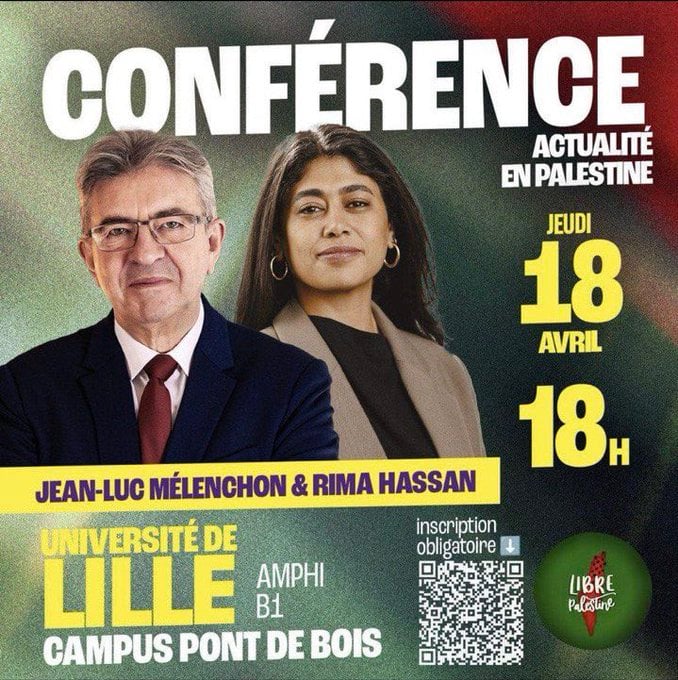
A conference on Palestine at the university of Lille by one of France's main leftist parties has been shut down after it transpired that the logo of the conference showing a map of the region — a map of, quote, "FREE Palestine" — has made Israel vanish.

More than that: The ban took place in the wake of an LFI poster showing Jean-Luc Mélenchon and Rima Hassan announcing a conference on "the current situation in Palestine" with the word Israel nowhere to be seen and, as mentioned, the Jewish state having totally disappeared in the "FREE Palestine" map (at bottom right).

La France Insoumise (LFI or Unyielding France) is France's most far-left party, a kind of successor to the French Communist Party, with former (?) Communist Jean-Luc Mélenchon as its head and regular presidential candidate.

From the Morandini talk show on the C News channel:

“There is no Israel on the poster. Does that mean that you want Israel to disappear?!” Jean-Marc Morandini asked an LFI representative repeatedly. “But not at all! We want the Palestinian people to be free. The logo is very clear,” replied Karima Khatim, an LFI municipal representative from Blanc-Mesnil.

Very quickly, tempers rose. "You are showing bad faith! You don't understand anything! What this poster shows is the destruction of Israel! Your party is an anti-Semitic party!" charged Karim Maloum. “Sir, just for your words, I could sue you! People are fed up with being called anti-Semites when they [do nothing but] defend the Palestinian cause. We want a two-state solution,” declared Karima Khatim.

"You do?!" retorted Jean-Marc Morandini, again and again. "Really?! Where do you see two states on the poster?! There is a difference between what you say and what we see. Where do you see the two states?!" But he never got an answer from his guest.

"You cannot in any way see the presence of Israel on this poster. All the facts speak against you. You are incapable of recognizing what is going on. You are exasperating the viewers of CNews," said Captain Hervé Moreau.

Check out the Morandini website for the videos: the arguing is in French (naturellement), but it is not hard to understand how Karima Khatim is going ballistic, interrupting everybody, and gaslighting her audience (as well as herself?), claiming that she can't see where there is a problem.

This is the second ban in Europe within the space of a day or two — the other on the other side of the spectrum, concerning a conference on National Conservatism in Brussels.

As it happens, President Macron has announced that he disagrees with the Lille region prefect's ban, stating that 

I am for respecting the laws of la République. Afterwards, as far as I am concerned, I am always in favor of people being able to express themselves freely, even as I am prepared to fight their ideas
But that might seem to smack of double standards: the C News channel is seen as so far to the right (although not with regards to American issues, not to the point of preferring Trump over Biden) that there have been rumors that there are members of the French government who are attempting to shut it down as well.

Related • To Peacenik Protesters Everywhere (Pro-Palestinian or Other): 
The People that Hamas Slaughtered Mercilessly at Israel's Rave — They Are YOU! 

• The Genocide Charge Against Israel: What is
the Difference Between War and Genocide in the First Place?

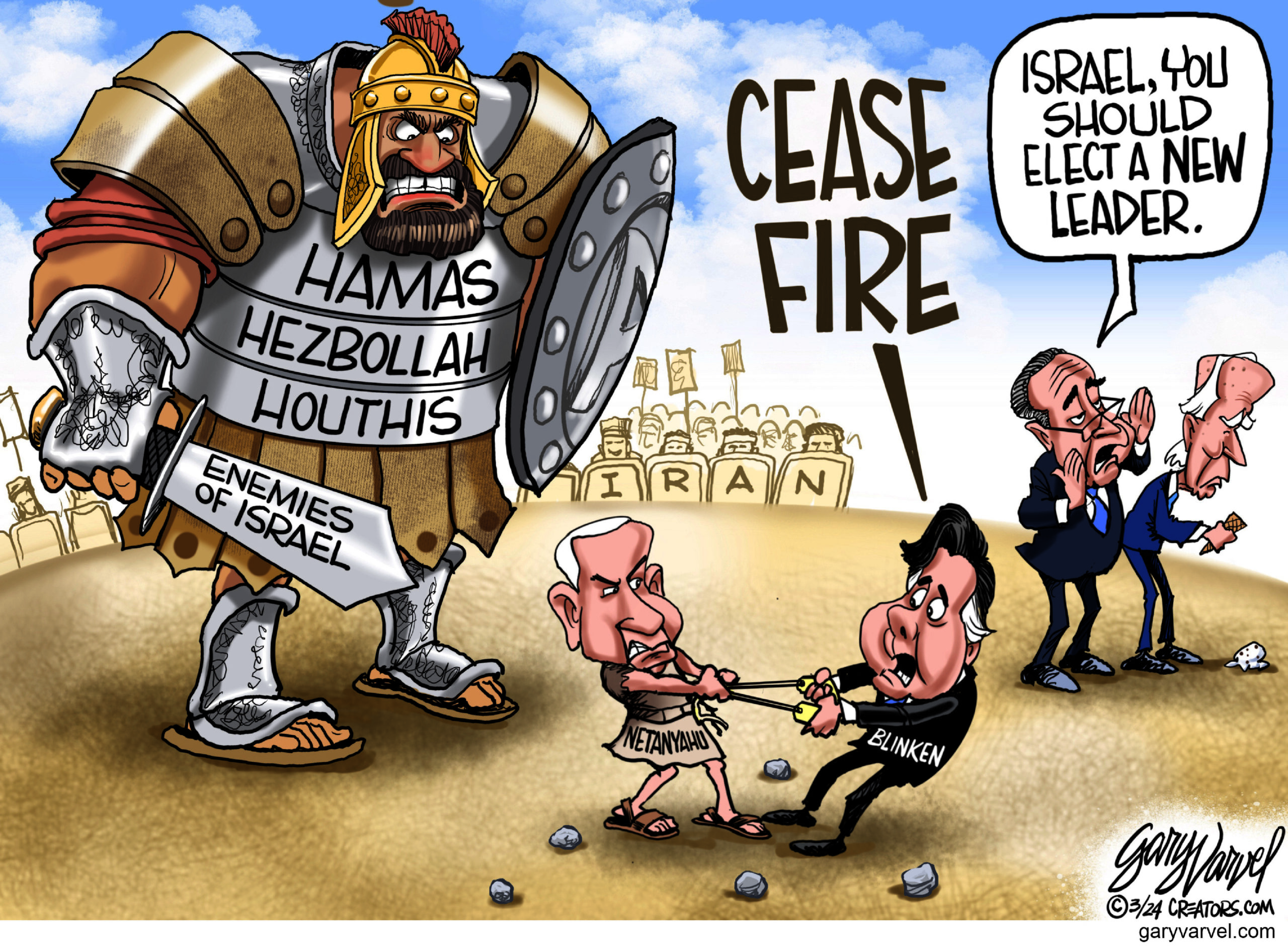
• A Gary Varvel cartoon on the current Middle East crisis and the truth about its roots

Thursday, February 19, 2026

RIP Quentin Deranque, 23: In the Streets of Lyon, a Young French Rightist Is Beaten to Death (Video)

On February 12, a handful of young women belonging to a right-leaning group called Némésis came out in Lyon to protest against a university meeting of the LFI (La France Insoumise party) deputy Rima Hassan, and among the dozen security personnel they had retained was a young Catholic math student named Quentin Deranque. 

That day, the seven women in le Collectif Némésis, an anti-immigration collective fighting violence against Western women are confronted by a dozen members of La Jeune Garde (The Young Guard), an Antifa-type organization created by LFI's Raphaël Arnault (and officially dissolved last June), some of whom land blows on and try to strangle some of the girls. The rightists fight back and it soon became "like a rugby match" (BFMTV video, Le Parisien videoLe Progrès video, and — best, IMO — Le Monde video). According to The Guardian

Images broadcast by TF1 of the alleged attack showed several people hitting three others who were lying on the ground, two of whom managed to escape. One witness told AFP: “People were hitting each other with iron bars.”

After Quentin Deranque falls down, the kicks keep coming, and two days later, he dies of a severe brain injury. It soon turns out that among the suspects arrested are collaborators of deputies from the radical La France Insoumise party. 
While the Left has duly gone through the gestures of condemning the murder — participating, for instance, in the minute of silence at the National Assembly — in practice, its reaction has been more of a cornucopia of blame missives fired against the (far) right, from a student saying "I am in favor of Quentin's death" as he tears down RNJ posters commemorating the late student and a mother in Caen holding a baby saying "No to violence from the far right" to VIPs claiming that "We are the ones who were attacked. People in Lyon are scared, because of the far right!" and demanding (as did LFI's Mathilde Panot) that Nemesis be kept away from the party's organizations, "or it's going to end badly!

If you feel all of this is sounding reminiscent of the Leftist drama queens' reactions to the deaths of Americans like Charlie Kirk and Andrew Breitbart, you're not alone. More than a few Frenchmen have written as much in the past few days, such as Gregory Vanden Bruel, in From Charlie Kirk to Quentin, the Far Left Kills, or Patrick Atlan , in trying to explain How to Recognize FascismGregory Vanden Bruel:
Quentin's death reminds us that far-left activists act with complete impunity, watchdogs of the very power they claim to fight, punks with their decadent ideas and yet lapdogs whenever courage is required. Anyone who has spent five minutes, fifty times, every day, facing them knows this. The antifascists, who have adopted this label to cloak their nauseating methods in a veneer of respectability, intimidate, flour-bomb, beat, and kill, but, since their victims are right-wing, morality no longer holds any weight in their eyes: all means are justified, even the most "impactful," to use the words of the French left's Lider Maximo.

La mort de Quentin nous rappelle que les militants d’extrême gauche agissent en toute impunité, chiens de garde du pouvoir qu’ils pensent combattre, punks à chiens d’idées décadentes et toutous dès qu’il s’agit d’être courageux. Quiconque s’est trouvé cinq minutes, cinquante fois, tous les jours face à eux le savent. Les antifascistes, qui se sont attribués cette étiquette pour couvrir leurs méthodes nauséabondes d’un vernis de respectabilité, intimident, enfarinent, frappent et tuent, mais, comme leurs victimes sont de droite, il n’existe plus, à leurs yeux, de morale qui vaille : tous les moyens sont permis, même les plus « impactants » pour reprendre les termes du lider maximo de la gauche française.
La France Insoumise hurls broadside after broadside against the right, which allegedly wishes to "transform political debate into a form of civil war" while the LFI's leader, Jean-Luc Mélenchon, goes so far as to ask for the dissolution of Némésis because the collective made entirely of females roughly between 18 and 30 "is dangerous. It attacks our leaders, it threatens our lives." (Mise à jour: Merci à Sarah pour l'Instalien and to Tappa Keggabru for providing an English-language France 24 video.)

As the pauvre extrême gauche's Mathilde Panot tried to diminish the death of Quentin in the Assemblée Nationale, comparing one assassination to others in the past (notice that French Wikipedia's descriptions of Quentin Deranque and especially Némésis are so extremely partisan throughout that they are almost unreadable), the prime minister, Sébastien Lecornu, has responded to the president of the La France Insoumise group in the National Assembly, "What you have just done is absolutely despicable and abject!" As a leftist assitant to a politician was denied entry to the National Assembly,  President Macron has condemned "an unprecedented surge of violence". 

Meanwhile, one of the main presenters of CNews, sort of France's Fox News, has declared that the leftist television channels "are putting a target on our backs." 

As you know, conservatives both inside and outside the United States are (rightly) questioning the mainstream media for branding them far right (in contrast to their opponents being described only as "the left"), but the murder of Quentin Deranque has finally led to the French interior ministry branding several as "extrême gauche" (the far left). This led in turn the LFI's Jean-Luc Mélenchon — who is caricatured on the front page of Charlie Hebdo with blood on his hands — to react with fury, denouncing France as a "the banana republic" "à la Trump".

Thursday, June 07, 2012

In a French Journalism School Poll, the Left's Hollande won 100% of the Votes While the Right's Sarkozy Obtained Not A Single Vote in Either Round


In Europe, it turns out, and particularly in France, most journalists are leftists just like in the United States.

Before France's presidential election, a poll was held in le Centre de formation des journalistes de Paris, writes Alain Frachon, with the first round showing the left and the far left out ahead, with incumbent President Nicolas Sarkozy obtaining not a single vote, and with François Hollande winning the second round handily, with 100% of the votes, "à la North Korea".
A l'occasion du scrutin présidentiel, le Centre de formation des journalistes de Paris organise un vote parmi les étudiants de première année. François Hollande et Jean-Luc Mélenchon arrivent en tête du premier tour ; Nicolas Sarkozy n'obtient pas une voix. Le candidat socialiste rassemble 100 % des suffrages au deuxième tour. Un score à la nord-coréenne ! Grognards et grognons de l'UMP y voient la confirmation de ce qu'ils disent : la presse est partisane.
Alain Frachon part alors aux États-Unis pour évoquer
une grosse étude intitulée L'Elite médiatique. C'est du costaud, argumenté, documenté. Le livre [de trois politologues américains, Robert Lichter, Stanley Rothman, Linda Lichter] démontre que la plupart des journalistes aux Etats-Unis sont des électeurs du Parti démocrate. Il établit un parti pris systématiquement antirépublicain dans la couverture des grands quotidiens et des grandes chaînes de télévision. Il dénonce ce qu'il appelle "un biais journalistique presque inconscient" en faveur de la gauche, mélange de suffisance élitiste et de complexe de supériorité morale, qui, dit-il, ne reflète aucunement l'état de l'opinion.
Retour en France, où Le Monde revient sur vote au Centre de formation des journalistes de Paris :
" Les journalistes sont tous de gauche ", assure une femme. Elle en veut pour preuve le sondage réalisé dans une école de journalistes : 100 % des étudiants ont voté pour l'autre bord. " Dès le départ, ils sont hostiles ", dit-elle. On parle ensuite d'Audrey Pulvar et Arnaud Montebourg, d'Anne Sinclair et Dominique Strauss-Kahn, de François Hollande et Valérie Trierweiler, pour montrer jusqu'où vont ces affinités électives.
Voir aussi : Le Monde a-t-il contribué à la chute de Nicolas Sarkozy ?

Wednesday, July 06, 2016

Former Prime Minister Michel Rocard, 3-Time Candidate for the Presidency, Is Dead

A former French prime minister who thrice tried to run for the presidency has died, reports Le Monde (No Pasarán's Michel Rocard posts).
Michel Rocard avait le « parler-vrai », la dent dure et le jugement acéré. Nul doute qu’il se serait gaussé de l’avalanche d’hommages qui lui ont été rendus, au lendemain de sa mort le 2 juillet.
A gauche, bien sûr, François Hollande a salué ce socialiste capable de « concilier utopie et modernité », Manuel Valls a évoqué avec émotion ce « visionnaire » qui fut son « père en politique », Lionel Jospin cette « référence », Emmanuel Macron cet « exemple », Jean-Pierre Chevènement ce « militant sincère qui croyait à la force des idées », ou Jean-Luc Mélenchon cet « éclaireur » dont « la vie est une leçon ».

A droite, tout autant, où Jacques Chirac et Nicolas Sarkozy, Alain Juppé ou François Fillon ont dit leur respect pour l’homme d’Etat. A l’extrême droite même, puisque Marine Le Pen a adressé ses condoléances aux proches de cet « homme de conviction ». Sans oublier Nicolas Hulot et Brigitte Bardot.

 … L’homme de gauche Rocard mérite ces hommages, évidemment. … Pour son pragmatisme tenace, sa capacité d’innovation autant que de conciliation, le premier ministre Rocard (1988-1991) ne mérite pas moins l’éloge.
 … La frustration de constater que les qualités reconnues à Michel Rocard – une exigence de morale en politique, un inlassable engagement pour ses idées, une inépuisable ouverture d’esprit – paraissent si peu et si mal répandues aujourd’hui.
Le regret est de voir disparaître un homme, et une voix, qui incarnait une conception noble de l’action publique : celle qui fonde l’ambition et l’exercice du pouvoir sur la force et la justesse des idées, du savoir et de la culture. Et non celle qui instrumentalise les idées au service de la seule stratégie qui vaille, la conquête du pouvoir. C’est ce qui a fait sa singularité et lui confère aujourd’hui une aura particulière. C’est aussi, et il le reconnaissait lucidement, ce qui a fait sa faiblesse pendant quarante ans.

Sunday, April 22, 2012

“The left longs for Mitterrand and the right longs for De Gaulle”: Extreme Parties Poised to Capture 30% of French Vote on Sunday


François Kahn has had enough of the French mainstream
reports Nicola Clark.
Raised in a conservative Parisian family, his sympathies growing up were on the right. About 10 years ago, he switched his allegiance to the Socialists, who seemed to embody values that had grown important to him, such as equality and social justice.

But on Sunday, the first round of France’s presidential elections, Mr. Kahn, a 30-year-old strategic planner and graduate of one of France’s top business schools, will be voting for Jean-Luc Mélenchon, a former teacher and Trotskyist, whose party, the Front de Gauche, groups a hodgepodge of former Communists, environmentalists and anti-globalists disheartened by a presidential race that many voters feel is out of touch with their bread-and-butter concerns about jobs, the rising cost of living and the future of their state pension and health care benefits.

“The Socialists have really become a party of the center-right,” Mr. Kahn said. “It’s almost like they are too embarrassed to be on the left.”

Such frustrations are manifesting themselves across France in stronger-than-usual support for so-called fringe candidates on both the left and the right. Together, the extreme wings of French politics are poised to capture as much as 30 percent of the vote on Sunday, according to opinion polls taken in the weeks before Sunday’s election. … That is more than either of the two front-runners, President Nicolas Sarkozy and his Socialist challenger, François Hollande, are expected to take among a field of 10 candidates.

… The choice amounts to either doubling down on France’s Socialist traditions and ample — some say, unaffordable — welfare state, or moving farther toward the kinds of reforms aimed at trimming the state and opening French labor markets that Mr. Sarkozy has long promised but has been largely unable to deliver.

For the moment, at least, voters are in effect saying they want neither, or at least not the polite solutions put forward so far by the politicians of France’s two main political parties.

“The French mistrust of politicians and institutions has never been so high as it is today,” said Pascal Perrineau, director of the Center for Political Research at the Institut d’Études Politiques in Paris, also known as Sciences Po. “We are experiencing a major crisis of confidence.”

… “The left longs for Mitterrand and the right longs for De Gaulle,” said Mr. Perrineau of Sciences Po. “This all has a direct impact politically,” and is reflected in the high rates of abstention and willingness to vote for the far right and far left.

“The French are telling us something,” Mr. Perrineau said.


See also:
• A Miserable Precedent? In France's 1st Election Round, Extremism’s Total Promises to Beat Either Mainstream Candidate
• While France Goes Berserk Because of 1 Lone Member of the American Nazi Party, French Extremists Promise to Win Most Votes in Sunday's Election

Monday, February 10, 2025

LCI: Trump and Musk, "the New Revolutionaries" Who Have the Gall to Criticize Europe as the "Cathedral to Bureaucracy"


Russia and the future of the Ukraine war were the initial subjects of Darius Rochebin's Sunday 6 pm show on LCI with part of the focus on Donald Trump's telephone call to Vladimir Putin. And as the subject changed (at about 29:30) to President Trump's domestic fight against the swamp — and to cries of outrage about Elon Musk calling Europe a "cathedral to bureaucracy" — Vanessa Biard-Schaeffer, a member of Republicans Overseas France (ROF), was brought into the debate (from about 30:50 to 50:50, video at the link), where she proceeded to be… regularly interrupted, although she persisted and held her own.

18H Darius Rochebin du dimanche 9 février 2025

Publié hier à 19h54

Au sommaire : Toretsk tombée aux mains de l'armée russe ? Trump/Poutine : un nouveau coup de fil ? Trump/Musk : les nouveaux révolutionnaires ? Musk s'en prend à l'administration européenne.

Source : 18h Darius Rochebin

The pundits on LCI thunder against Trump and Musk (who the hell does Musk think he is?!) before one of them puffs his chest with pride, stating that he is proud of being European — presumably in no need whatsoever of administrative simplification. It might do them good to read Nicolas Conquer's Figaro article ("While America seeks to restore its ability to be one step ahead, Europe persists in a systematic distrust of risk, success, and initiative"). A word, writes The Smallest Minority, that  we should all know (Americans, French, other foreigners, and not least pundits on… French TV shows) is Statolatry (thanks to Instapundit's Sarah).

Economist Ludwig Von Mises coined the word to describe the literal worship of government. He said: “People frequently call socialism a religion, It is indeed the religion of self-deification.”

Statolatry is about worship for the state to replace a God they have rejected, a relationship with some entity more powerful than themselves to which they swear their love and fealty, the goal of which is to receive blessings (which are drawn the public till).

The people on the statolatrist left have landed on a toxic mixture of statism, politics, mysticism, and atheism rolled up into a loose ball called “progressivism” as a substitute for Judeo-Christian theology. Progressivism is as much a religion as Catholicism, it just replaces a Pope with government, counting on the senior leadership of [leftist parties] to be their High Priests.


LCI :

Présenté par Darius Rochebin tous les dimanches. Chaque dimanche, à 18h, Darius Rochebin reçoit une personnalité française ou internationale marquant l’actualité. Les interviews sont menées dans un esprit d’ouverture à tous les domaines et de diversité des opinions. De Marine Le Pen à Jean-Luc Mélenchon, en passant par François Hollande ou Edouard Philippe, les acteurs politiques de tous bords et leurs interventions exclusives ont jalonné l’émission durant l’année écoulée. Il s’ensuit le duel des idées, qui oppose Luc Ferry à Daniel Cohn-Bendit.

Friday, March 30, 2012

When You’ve Lost Slate.fr, you’ve Lost Middle Earth

That notwithstanding, at least they question pointless Marxist dinosaur Jean-Luc Mélenchon’s notion that he’s « for the worker ».
"I can give you the phone numbers of every trade unionists in the struggle, I know them all," says Laurence Sauvage, CGT syndicalist and Regional Councillor of Nord-Pas de Calais, responsible for monitoring the social struggles in the Left Party ("the Front of the struggle"). He states that, unlike other candidates, his organization is simply responding to requests from company employees threatened with closure.
It sounds much better in the original Klingon:
«Je peux vous donner les numéros de tous les syndicalistes en lutte, je les connais tous», explique Laurence Sauvage, syndicaliste CGT et conseillère régionale du Nord-Pas-de-Calais, chargée du suivi des luttes sociales au Parti de gauche («le Front des luttes»). Qui précise que, contrairement aux autres candidats, son organisation ne fait que répondre aux demandes des salariés des entreprises menacées de fermeture.
Or not. When you’re left to protesting against businesses over the issue of them going under, what exactly are you doing for their (former) employees?

Monday, March 25, 2013

Rest in Peace Hugo Chávez, Says a Mural in Paris Filled with Portraits of Venezuela's Caudillo

This Maria Thunholm photo of a mural from the Northwest of Paris saying "Rest in Peace Hugo Chávez" adjoining a massive portrait of Venezuela's late Caudillo was shared with us by Carine, a New-York-based Frenchwoman who asked if we now understood why she doesn't miss France…

Indeed, melanietoulouse comments :
you have to see it, to believe it… :D Comme les larmes et les phrases de Jean-Luc Mélenchon qui n’a jamais vécu sous une dictature communiste, brrr…
Apart from that, feel free to visit the Swedish photographer's photo website

On the same wall in the same street (Rue Ordener) is another mural saying "Long Live Chavez!" along with "Patria O Muerte" (Fatherland or Death).

Saturday, August 25, 2012

François Hollande, Man of Mystery?


The French have never been passionate about François Hollande, their new president. A professional politician, never a government minister, he has been engaged in the machinations of the Socialist Party for most of his career.
Thus starts the book review by Steven Erlanger.
But a new book about the inner workings of his campaign suggests that Mr. Hollande is a man of self-mastery and doggedness, with unplumbed depths. According to Laurent Binet, the novelist who wrote the book, Mr. Hollande is “a control freak,” a kind of “war machine” with a mysterious core, who detests Mr. Sarkozy and carefully managed the rivalrous personalities of the Socialist Party.

Embedded in the campaign with the understanding that he would publish only after the election, Mr. Binet, 40, whose parents were Communists, said in an interview that he initially favored Jean-Luc Mélenchon, a candidate further to the left. Mr. Binet said he was “seduced” by Mr. Hollande but still found him a mystery, a man who is affable but keeps his real self in reserve.

“I noted this in him,” Mr. Binet wrote. “What we take too often for joviality masks a fundamental irony that he only abandons in exceptional circumstances, when the gravity of the moment demands it.”

… “Mitterrand was a mystery, and he was called the Sphinx, and you could see it in his face,” Mr. Binet said. “But with Hollande it was perhaps more clever. He looks like the guy next door, but it’s much more complicated than that.”

… What seemed to animate Mr. Hollande, besides his commitment to winning the presidency, was his distaste for the incumbent, Mr. Sarkozy.

… But one of his few regrets during the long campaign, Mr. Hollande admits, is when he called Mr. Sarkozy a “sale mec,” or a nasty piece of work, a remark in an off-the-record lunch with French journalists that was quickly leaked. Mr. Hollande also said he regretted wasting his time making a trip to London, since foreign policy has little impact on French presidential campaigns.

Friday, August 31, 2012

The Le Monde Reader Who Uses Catty Caricature "United Stateser" Is Published 3 Times in 2 Weeks

Two weeks ago, Le Monde Watch revealed a Le Monde reader who, because of his haughtiness towards the United States and its people, had two letters published in the space of three days!

Two weeks later, believe it or not, Le Monde publishes a third letter to the editor of André Fromon's! Yet another letter which — on s'en doute — uses the catty expression United Statesers.

Actually, it turns out, André Fromon has been published no less than six times since the beginning of summer (and nine times since last year)! (Not all of which concern America, as it happens…)

By contrast, when I asked a colleague at the International Herald Tribune (an American newspaper, oui, but published in Paris) what was their policy regarding letters to the editor, I was told that they tried to avoid publishing any given reader more than twice in three months…

Mais bon : André Fromon (who called Jean-Luc Mélenchon a courageous, brave, and elegant leader) is hostile to the Anglo-Saxons and speaks of United Stateser citizens, so what can one say; it's entirely normal for Le Monde to give him so much space…

Thursday, April 19, 2012

A Good Reason to Vote for the Left in France? More Sex Partners, More Fellatio, and More Sodomy

Oh how wonderful it is to be a leftist, purrs Frédéric Joignot in Le Monde's weekly magazine M. He is speaking of Hot Vidéo magazine's IFOP poll, according to which voters on the left get more sex than voters on the right.

Leftists will have an average of 9 partners during their lifetime, while 23% of members of Nicolas Sarkozy's UMP party will only have one.

You will make love 7.6 times per month if you vote for the Socialists' François Hollande, 6.7 times if you vote for Sarkozy, 5.9% if you vote for François Bayrou's center party.

92% of far-left women engage in fellatio, while only 69% of rightist women do so.

Of an average of 45% of Frenchmen who engage in sodomy, 48% are on the left, with 57% of Jean-Luc Mélenchon's Front de Gauche so engaged.

The poll concludes that voters on the right and in the center have a more "more stable" and a "less intense" sexual life than voters on the left. Still, they declare themselves to be satisfied. As do voters on the left…

Thursday, May 03, 2012

Pinning Down the Master of Evasion, French Socialist François Hollande

…if Hollande wins, the French will have chosen a man at ease with generalities who aspires to be “willful” and “dignified,” a symbol of “brotherhood” and “bringing people together”
writes John Vinocur in his International Herald Tribune column, which opens with
one of those rare political moments when the campaign-screech and repetitive mumbling stopped.

Last week, a French television interviewer asked François Hollande, the favorite to win France’s presidential election on Sunday, if he thought there were too many foreigners in France. Simple question, and one central to a campaign where extremists of the right and left won 30 percent of the votes in a first-round ballot.

Yet Hollande would not answer yes or no. He reached for legalisms instead.

The journalist poked again: “Why this tendency to evade things? What’s your profound conviction? You aren’t telling us.” More references followed from Hollande involving the status of legal foreign residents and the possible expulsion of illegals.

The interviewer insisted: “Deep inside, what’s your conviction?”

“I’m not a commentator on public life,” Hollande replied. “I am the next president of France.”

… As standard-bearer of a program of “change” — his own watchword Hollande doesn’t offer explicit and decisive plans for reforms in French economic and civic life, remains silent about the pain and disruption that would come with any serious structural changes, and relies on the lingering unpopularity of President Nicolas Sarkozy to put the Socialists in office.

Evasive? Think of this: Here is a self-described Man of the Left who, with a pol’s calculation, refuses to say on national television that no, France doesn’t have too many foreigners. Sarkozy, at least, has risked claiming the opposite.

Instead, to deal with the rubbed-raw issues of Muslim immigration and integration, Hollande flees anything that sounds like a call for an affirmative action program.

His friends say charm and amiability are at the center of Hollande’s character. His political enemies argue he is an eternal maneuverer, more calculating than courageous. And, indeed, the Socialist candidate stepped around any word of criticism for the left-wing extremist Jean-Luc Mélenchon when he compared Sarkozy to Vichy’s pro-Nazi collaborators.

Even Hollande’s eldest son Thomas, a lawyer, has described his father’s personality as “elusive.”

Wednesday, May 02, 2012

The recent level of Sarkophobia in the French media is unprecedented

The Economist's Élysée blog has a post on The rise of Sarkophobia:
Nicolas Sarkozy chase [of] the National Front vote ahead of Sunday’s second round … is unpleasant and divisive stuff, even if, arithmetically, Mr Sarkozy has nowhere else than the National Front to go for votes. But to jump from this to a comparison with Marshall Pétain, France’s collaborationist leader during the second world war, shows just how unrestrained the anti-Sarkozy feeling among some people has become. L’Humanité, a communist daily whose influence is greater than its 51,000 circulation would suggest, last week ran a cover likening Mr Sarkozy to Pétain … Jean-Luc Mélenchon has accused Mr Sarkozy of using language “directly taken from the collaboration” with Vichy France.

The recent level of Sarkophobia in the French media is unprecedented. L’Express has compiled a series of anti-Sarkozy front pages that makes this point visually. Among them you can find stories about Mr Sarkozy entitled “The Yob of the Republic”, or “The Shame of the Fifth Republic” (both from Marianne).