Showing posts sorted by relevance for query harry jaffa. Sort by date Show all posts

Wednesday, May 20, 2026

"Break Their Spirit" with "Maximum Warfare": What Nobody Tells You About Reconstruction in the South After the American Civil War


As the nation reacts to the "disgustingly violent" call by Hakeem Jeffries for "maximum warfare" against members of the GOP (and, more specifically, of Donald Trump's MAGA movement) and for Dems to "break their spirit", I think back to last summer.

One of the things that I did during last year's summer months (during which this blog was, for unexplained reasons, banned for 112 days) was read Ron Chernow's biography of Ulysses Simpson Grant. (This proved an unexpected boon, as reading about Grant's travails and hardships proved to be somewhat therapeutic for me; This year, I am reading his Pulitzer Prize-winner, Washington — A Life.) I knew a lot about the Civil War; but what occurred during Reconstruction was eye-opening, to say the least.

The present post will detail the era of Reconstruction. But prior to that, if you will allow me, I will quote the single most significant single passage in the entire book, which deals with the battles of the Civil War. First of all, we have his closest ally during the war comparing his friend's military sense with that of the top general of the Confederacy:
Perhaps the person who best explained Grant's strategic superiority was Sherman, who stated that while Lee attacked the front porch, Grant would attack the kitchen and bedroom.  In his earthy way, Sherman expressed the view that Grant engaged in total warfare that eroded enemy supply lines and infrastructure, while Lee remained highly focused on the battle at hand, without a long-term strategy for the war.
But the single most important quote of the 900-page book concerns 
shattering … the mystique of rebel soldiers.  The South, Grant noted, had demonstrated dash and pluck at the outset of battle, but his own men had exhibited the true staying power.  Reflecting on this after the war, he said, "I used to find that the first day, or the first period of a battle, was most successful to the South, but if we held on to the second or third day, we were sure to beat them, and we always did." 
This is astounding. Truly astounding.  Grant is suggesting, basically, regarding all the Union generals who preceded him — those who have generally been called incompetent — that if they had only persisted instead of panicking and immediately retreating, there is a good chance that they would have ended up winning their battles in the end. Precisely like Grant himself did after initial setbacks, most famously at Shiloh.
• Sherman, as night settled over the field at Shiloh at the end of the first day of fighting: 
"Well, Grant, we've had the devil's own day, haven't we?" 
Grant: "Yes. Lick'em tomorrow, though."
 
• Earlier that day, upon asked by an officer whether the Union Army should make preparations for a retreat from Pittsburgh Landing, Grant replied:  "Retreat? No! I propose to attack at daylight and whip them."
Now back to the second part of Ron Chernow's Grant, and his dealings with the South's Democrats during his presidency. 

Of course I had been aware of the basic tenets of Reconstruction, but I hardly realized to what a devastating as well as an illuminating extent the Democrat Party of yore reflected the Democrat Party of today. (See my post on how I personally take notes when reading a book, which you may possibly find inspiring…) 
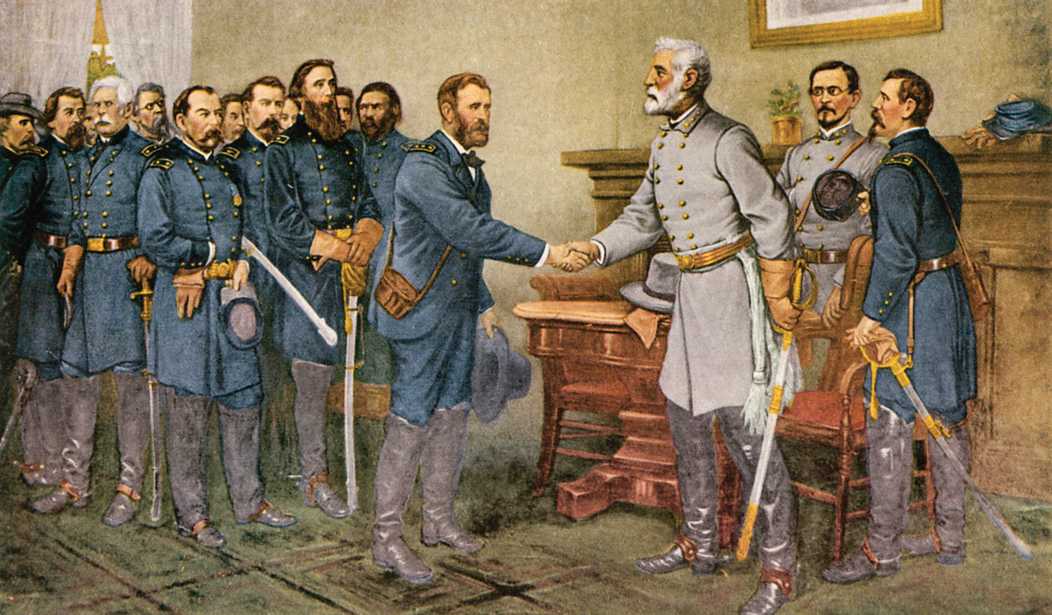
The Union was finally abolishing slavery once and for all … But the Civil War did not end at Appomattox Court House, nor even at Bennett Place, scene of the last major surrender of the war on April 26. In fact, it arguably never ended. Democrats simply shifted from firing cannons and rifles on a battlefield to weaponizing courts, laws, the press, and riots. 
 
One of the most misleading claims in modern politics is, “This is not the Democrat Party of your grandfathers.” It is — and of your great-great-great-grandfathers.  
 
 … In the 1800s as much as in the 2000s, the Democrat Party utilized politically-fueled domestic terrorism, election fraud, character assassination, extreme rhetoric, race-baiting, and emotionally manipulative propaganda. 
 
 … From the Red Shirts and the KKK to Antifa and the anti-ICE rioters, from John C. Calhoun to Joe Biden, from Jim Crow to sanctuary policies and CRT, there is a continuum of Democrat lies, tyranny, racism, and violence. In the 19th century, Democrats justified the Fort Pillow massacre and the KKK assassination of Rep. James Hinds (R-Ark.), and in the 21st century, they justify a 1,347% increase in assaults against ICE and the assassination of Charlie Kirk

Catherine Salgado's words were echoed, 70 and 25 years earlier, by the deep thoughts of Harry Jaffa on American history. From Harry Jaffa's book A New Birth of Freedom, we learn that far from defending States' Rights or any kind of rights — as many conservatives (North as well as South) enamored with the rebel spirit seem to think is warranted — such Southern Democrats as John C. Calhoun were rather dabbling in Socialism and Marxism before Marxism had even become a common household word. As I have written, regarding The Greatest Myth in U.S. HistoryYes, the Civil War Era Did Feature Champions of States' Rights, But No, They Were Not in the South (Au Contraire: they were in the North). Harry Jaffa:

 … if ever there was a nation annihilated politically on the battlefield that nonetheless imposed the yoke of its thought upon its conquerors, it was the Confederacy 

 … The echo of Calhoun in the [nihilistic] words of [one of the modern era's chief justices] is evidence that the Confederacy is alive and well and that the Union victory at Appomatox [sic] has not been accompanied by any ascendancy of the words of the principles of the Gettysburg Address

 … we will see in Calhoun the generation of the most powerful forces that today dominate the intellectual life, not only of the United States, but also of the Western world generally

 … The idea of progress led Hegel, Marx, and Calhoun radically to depreciate the role of reason in all their predecessors, whether statesmen or philosophers

 …  one might call Calhoun the founding father of "interest group liberalism" in twentieth-century American political science.  Calhoun's theoretical writings are a landmark in the transition from individual rights to group rights as the ground of constitutionalism and the rule of law …  More than anyone else, Rousseau is Calhoun's intellectual progenitor 

Indeed, the Trump administration's fight against pervasive fraud, vote-rigging, gun control, double standards in law courts, and Democratic demonization of its opponents (of whatever race), resembles nothing more than the Democrat Party — although far less violent (so far?) — in the 1870s, 1860s, and 1850s. This has been touched on numerous times on this blog over the past 22 years.

Related History Posts:
• What Caused Secession and Ergo the Civil War? Was It Slavery and/or States' Rights? Or Wasn't It Rather Something Else — the Election of a Ghastly Republican to the White House?
• During the Winter of 1860-1861, Did the South's Democrats Obtain Their Aim — the Secession of 7 Slave States — Thanks to Elections Filled with Stealth, Lies, Voter Fraud, Intimidation, Violence, and Murder? (Wait 'til You Hear About… Georgia's Dark Secret)
• Abraham Lincoln and the Founding Fathers' Supposed Embrace of Slavery Along with Their Alleged Rejection of Women's Rights 
• Wondering Why Slavery Persisted for Almost 75 Years After the Founding of the USA? According to Lincoln, the Democrat Party's "Principled" Opposition to "Hate Speech"
The Greatest Myth in U.S. History: Yes, the Civil War Era Did Feature Champions of States' Rights, But No, They Were Not in the South (Au Contraire)
• Harry Jaffa on the Civil War Era: For Democrats of the 21st Century as of the 19th, "the emancipation from morality was/is itself seen as moral progress"
• Why Does Nobody Ever Fret About Scandinavia's — Dreadful — 19th-C Slavery Conditions?
• A Century and Half of Apartheid Policies: From Its 1828 Foundation, the Democrat Party Has Never Shed Its Racist Past
• The Confederate Flag: Another Brick in the Leftwing Activists' (Self-Serving) Demonization of America and Rewriting of History
How to Prevent America from Becoming a Totalitarian State
• Inside of a month, Democrats have redefined riots and election challenges from the highest form of patriotism to an attack on democracy — And by “democracy”, they mean the Democrat Party
• Why They Don't Tell You the Whole Truth: The 1619 Project Summarized in One Single Sentence 

 
And here we get to the meat of this post, the part of Ron Chernow's biography of Grant dealing with the Reconstruction years:

In describing the Klan's tight grip over the region, Grant summoned his most emphatic language, saying its purpose was "by force and terror … to deprive colored citizens of the right to bear arms [!!] and the right to a free ballot, to suppress schools in which colored children were taught, and to reduce the colored people to a condition closely akin to that of slavery."

 … In countering the Klan, Grant found himself back in familiar territory, operating as general in chief.  Whenever he returned to war-related issues, Grant showed a sure grasp of both his values and methods.  He knew that the Klan threatened to unravel everything he and Lincoln and Union soldiers had accomplished at great cost in blood and treasure.

 …  [Horace] Greeley was famous for his withering slurs against Democrats, having once said that while not all Democrats were horse thieves, all horse thieves were Democrats. He had denounced them as "traitors, slave-whippers, drunkards and lecherous beasts."

 … "If the Devil himself were at the helm of the ship of state," the abolitionist and woman's rights activist Lydia Maria Child responded, "my conscience would not allow me to aid in removing him to make room for the Democratic party."  She believed that when Liberal Republicans endorsed "state sovereignty," it meant "when the Ku Klux renew their plans to exterminate Republicans, white and black, they shall be dealt with by Southern civil authority — that is, by judges and jurors who are themselves members of the Ku Klux association"

 … No Southern state presented more insurmountable problems to Grant than Louisiana, which had become a hotbed of hatred and corruption.

 … the worst slaughter perpetrated against blacks during Reconstruction.  Staggered by [the 1872] cold-blooded massacre, Grant told the Senate "a butchery of citizens was committed at Colfax, which in bloodthirstiness and barbarity is hardly surpassed by any acts of savage warfare."

The Colfax murderers thus walked off scot-free, sending a powerful message to white supremacists that they could slay blacks without any penalty. …   such unalloyed sadism

 … As Grant attempted to normalize federal relations with former Confederate states, he struggled with a newly emergent white supremacist groups, hydra-headed offshoots of the Klan with names such as the White League, "rifle clubs." Red Shirts, and Knights of the White Camelia.  They tiptoed around prosecution by claiming to be county militia.  Unlike the Klan, which was a secret paramilitary group … Harper's Weekly wasn't far from the mark when it termed the White League "an unmasked Ku Klux"

 … The battle [in New Orleans] had witnessed an extraordinary event:  James Longstreet now fired on men he had commanded during the war, his small army having killed twenty-one White Leaguers

 … To Grant, it looked as if the country might be lurching toward a second Civil War 

 … Many saw the Louisiana violence as the opening shot of a second Civil War and a revitalized Confederacy, albeit clothed in a new form.  Discussing the mood in New Orleans, Sheridan told Orville Babcock, "I have so often heard expressions that the new rebellion was to be fought under the stars & stripes and in the north as well as the South — that the mistake made in 1861 was to have had their own flag."

 … Grant's personal tragedy was simultaneously an American tragedy. Grant predicted to John Roy Lynch that the northern retreat from Reconstruction would lead to Democrats recapturing power in the South as well as "future mischief of a very serious nature … It requires no prophet to foresee that the national government will soon be at a great disadvantage and that the results of the war of the rebellion will have been in a large measure lost …"

This wasn't a minor statement:  the victorious Union general of the Civil War was saying that terror tactics perpetrated by southern whites had nullified the outcome of the rebellion.  All those hundreds of thousands dead, the millions maimed and wounded, the mourning of widows and orphans — all that suffering, all that tumult, on some level, had been for naught.  Slavery had been abolished, but it had been replaced by a caste-ridden form of second-class citizenship for southern blacks, and that counted as a national shame.  
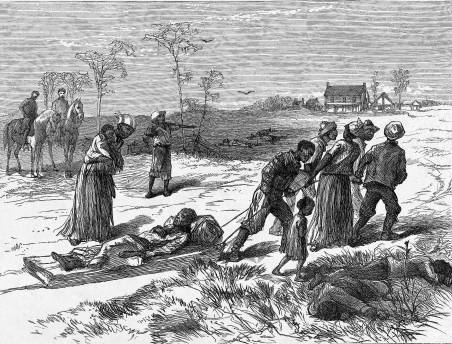
The Little-Known Story Of The Colfax Massacre, The Worst Episode Of Racial Violence During Reconstruction, happens to be discussed on the All That's Interesting website:

After the 1872 gubernatorial election in Louisiana, KKK members and former Confederates stormed a courthouse occupied by Black militiamen — and killed as many as 150 of them.

The clash took place in the small town of Colfax, Louisiana. A white mob of Democrats that lost the election tried to seize control of a courthouse defended by Black Republicans. And the election dispute quickly turned into a massacre.

 … What triggered the violent race massacre? And how did the Colfax Massacre help end Reconstruction and tip the balance toward segregation and Jim Crow rule?

 … One Southern paper laid the blame at the feet of the “scalawags and carpetbaggers,” common terms for southern and northern Republicans who supported Reconstruction. 


Here are some extended notes from Ron Chernow's biography of General Grant, which repeats all the main quotes featured above, in addition to a number of other quotes of interest:

 … Before long, Grant's stonehearted faith would be severely tested as the new president [Andrew Johnson] went from being too harsh toward Confederate leaders to being too obliging   

In Part Three,  "A Life of Peace", Grant is elected to the White House

As the charitable victor at Appomattox, Grant stood as the foremost symbol of a merciful attitude towards the defeated states.  At the same time, as the leading Union general, fully committed to the war's agenda of preserving the Union and ending slavery, Grant was no less associated with protecting the four million freed people.  How to reconcile these two often incompatible impulses as they clashed in post-war America would define the rest of Grant's life and would prove, in many ways, as baffling a problem as winning the war

 …In Andrew Johnson, Grant would had to deal with a new president who would swing from excessive hostility toward the South to excessive leniency, alienating at both ends of the spectrum … As Grant put it, "As soon as the slave-holders put their thumb upon him [Johnson] … he became their slave."

 … Most consequential for Grant's historic reputation was the way southerners of the Lost Cause school would begin to idealize Lee

 … Grant came to believe that Lee, far from accepting the war's outcome gracefully, was secretly hostile to it and abetted southern fantasies that their defeated cause would rise anew

Mosby repaid [Grant's] surprising kindness be becoming a steadfast friend and ally of Grant

 … There was so much skulduggery between France and the rebels during the Civil War that Grant classified Napoleon III as "an active part of the rebellion"  

 … a new form of bondage, establishing the foundations of the Jim Crow system that later ruled southern race relations

 … "Liberty has been won," contended Senator Charles Sumner.  "The battle for equality is still pending."  Unless freed blacks received the vote, warned Frederick Douglass, "we should have slavery back again, in spirit if not in form"

 … For all their excessive zeal militant Republicans would produce some of the most powerful legislation in American history to accord equal rights to African Americans

 … [Regarding the] so-called carpetbaggers … In southern mythology, they would be demonized as corrupt parasites, but many were motivated by idealism and paid a steep price for their courage.  Southern whites who supported Reconstruction, called "scalawags," faced similar antipathy

 … The sadism [in New Orleans in 1866] was … wanton [and] a chilling display of racial hatred

This violence seemed a grotesque continuation of the Civil War by other means, and one member of the white rabble went so far as to brag, "We have fought for four years these god-damned Yankees and sons of bitches in the field, and now we will fight them in the city."

 … black and white Republicans were being murdered with abandon in southern states

 … Gruffly dismissed … as mere "rumors of Negro murders," [allegedly] unworthy of serious consideration … [this] would become a standard Democratic defense in future years

Doesn't this sound like how Democrats and the MSM have characterized election fraud in the past few decades?

 … In many parts of Texas, Grant asserted, a Union man wasn't safe outside the umbrella of federal military protection

 … for southern blacks and white Republicans the First Reconstruction Act promised sorely needed protection against the indiscriminate white terror directed at them with alarming frequency

… [Between] the Second Reconstruction Act [and] the Third Reconstruction Act, [Ron Chernow mentions the] Ku Klux Klan, its arcane name derived from the Greek word kuklos, for band or circle 

… Never before in American history had there been such racially integrated governmental meetings, and they pioneered in establishing public schools and contesting discrimination

 … More than 80 percent of black delegates were literate, but the handful of illiterates provided endless fodder for vicious satire in the white press, creating an enduring caricature of Reconstruction as a period of misrule by inept black politicians.

 … Nothing alarmed white southerners more than the specter of blacks casting votes.  The united power of blacks, carpetbaggers, and scalawags produced a stunning string of Republican election victories in fall 1867 across a region long solidly democratic

 … [The slogan of Grant's 1868 presidential campaign was] "Let us have peace" … Henry Adams wisecracked that "Let Us Have Peace" meant only "Leave Me Alone" 

 … Grant, having never set eyes on the Great Plains, wanted his son Buck to see them  whilst still occupied … "the Buffalo and the Indian, both rapidly disappearing now."

Grant rhapsodied about the beauty of the American West, only regretting the "three epidemics" that had plagued it:  the pistol, the bowie knife, and whiskey

 [There were] troubling sign that Grant, in his new political incarnation, might ignore professional advice and prove unwilling to modify his traditional style to accommodate new political realities

 … Democrats ran what the historian David W. Blight has branded "one of the most explicitly racist presidential campaigns in American history."  Grant railed at the "desperate and unscrupulous" tactics of Democrats, but Republicans didn't shy away from invective either

 … Blacks still couldn't vote in many northern states, whereas they could vote in most formerly Confederate states.

 … The campaign's most chilling feature was the huge wave of murder and arson orchestrated by the Ku Klux Klan against black and white Republicans in the South

 … speculation about [Grant's] strained relations with Sherman … [their] radically different worldviews

[At this point Grant wins the 1868 election on November 3, "by a comfortable but not overwhelming margin", trouncing Horatio Seymour however in an electoral landslide of 214 to 80.] 

 … Sherman … had monitored Grant's rise with decidedly mixed emotions, believing that "if forced to choose between the penitentiary and the White House for four years, I would choose the penitentiary, thank you."

 … the Department of the Interior, a notorious mare's nest of corruption.  It is important to note that corruption was rife in many departments before Grant took office … Grant would prove a far more assertive president than his modest inaugural address had suggested

 … "The chief business of the executive had become the distribution of patronage."  Abraham Lincoln had been besieged by office seekers who cluttered the stairs and corridors day and night.  One day a friend asked Lincoln whether he was depressed because the Union army had suffered a military setback.  He smiled wanly and saud, "No, it isn't the army.  It is the post office in Brownsville, Missouri." 

 … Grant knew that, for every friend he won through an appointment, he earned a hundred enemies in rejected suitors 

 … Elated at this appointment, Rabbi Isaac Mayer Wise said it showed "that President Grant had revoked General Grant's notorious order No. 11." 

 … As James M. McPherson has pointed out, eleven of the first twelve amendments to the Constitution constrained governmental power; starting with the Thirteenth Amendment, six of the next seven enlarged it.  The war also centralized power, welding states closer together and forging a new sense of nationhood.  As Grant told a relative, "Since the late civil war the feeling of nationality had become stronger than it had ever been before"

 … The mounting wealth also meant the dominant Republican Party was torn between its idealistic, abolitionist past and its business-oriented future

 … In the nineteenth century, Congress was infinitely more powerful than in the twentieth and senators ruled as headstrong barons whose power often rivaled that of presidents   

 … Perhaps more than any other president, Grant oversaw the evolution of Washington from a straggling village into a modern city with well-paved sidewalks, sewers, and water and gas mains

 … Grant showed a a surprisingly keen eye for government architecture … dubbed "General Grant" style … "the dingy, shabby carpets and furniture in this new home"

 … Ben Butler mocked Andrew Johnson as the "drunken tailor" and Grant as the "drunken tanner" … But such random accusations were now more conspicuous by their absence and occurred with nowhere near their frequency of wartime drinking charges

 … Fired by a crusading spirit, [Adelbert A.] Ames saw carpetbaggers as apostles of "northern liberty" who had "a hold on the hearts of the colored people that nothing can destroy"

 … "When I took command of this military district," he recalled, "I found that the negroes who had been declared free by the United States were not free, in fact they were living under a code that made them worse than slaves, and I found that it was necessary, as commanding officer, to protect them, and I did"

 … On a personal level, Grant extended an olive branch to Confederate generals.  In May 1869, Robert E. Lee came to the White House to discuss a railroad venture.  As at Appomattox, Grant attempted to smooth over an awkward situation with a little levity and small talk.  "You and I, General," said Grant, "have had more to do with destroying railroads than building them."  Lee would not be drawn into this sort of pleasantry.

 … Many of the generals who had defeated the Confederacy were now assigned to pacify Native Americans and often betrayed a punitive, bloody attitude, exemplified by Phil Sheridan's infamous remark "The only good Indians I know are dead."

 … Many in Congress had few qualms about pursuing a policy of outright genocide, which one Nevada congressman calling for "extinction.  And I say that with a full sense of the meaning conveyed by that word."

 … This hopeful, idealistic path, paved with good intentions, had been touted by well-meaning presidents from George Washington to Abraham Lincoln

 … Annexing Santo Domingo could also break British domination of the Caribbean, which forced American vessels "to pass through foreign waters."  

"the crime of Ku Kluxism"

 … [Grant] committed fatal errors by pursuing this momentous policy in a closed-door, top-down style that made sense in wartime, but not in politics.  He didn't prepare the American electorate or mobilize public opinion or rally voters to his side.

 … For many southern whites, however, the idea that their erstwhile slaves could now hold office and even gain the upper hand  in their political lives was intolerable.  It reinforced their growing conviction that secession had been, as The Nation phrased it, "not wicked, but holy and glorious."

 … This fateful moment presented Grant with a domestic challenge as daunting as that faced by any American president, or it inspired hope among blacks and smoldering resentment among many whites.

Black gains can be overstated and certainly were by an alarmed white community:  fewer than 20 percent of state political offices in the South were held by blacks at the hight of Reconstruction. Still, those represented spectacular gains for people so recently held in bondage

 … With a violent backlash well under way, the party of Lincoln began to pay a price for being the vocal paladin of African Americans.  

 … Under Article I, Section 2, of the Constitution, slaveholding states had been entitled to count three of every five slaves as part of their electorate in computing their share of congressional delegates,  Now former slaves would serve as full citizens, swelling the electoral tally for southern states.  This was fine as long as freed people exercised their full voting rights,  Instead, over time, the white South would receive extra delegates in Congress and electoral votes in presidential races while stifling black voting power,  "It was unjust to the North," Grant subsequently lamented,  "In giving the South negro suffrage, we have given the old slave-holders forty votes in the electoral college.  They keep those votes, but disenfranchise the negroes.  That is one of the gravest mistakes in the policy of reconstruction."

 … The new Justice Department would forge its identity in the battle to slay the Ku Klux Klan and such offshoots as the Knights of the White Camelia.  Having disbanded Confederate armies, the North had not stopped the emergence of quasi-military organizations throughout the South.  In describing the Klan's tight grip over the region, Grant summoned his most emphatic language, saying its purpose was "by force and terror … to deprive colored citizens of the right to bear arms [!!!] and the right to a free ballot, to suppress schools in which colored children were taught, and to reduce the colored people to a condition closely akin to that of slavery."

[In the postbellum era, the last word of the KKK often seemed to be dropped, by friend and foe alike, with the organization referred to as "the Ku Klux association," "the Ku Klux businesss," "KuKluxery," "Ku-Klux-Klanism," "traitorism," and "Banditti"]

 … In pursuing the Klan, he showed to advantage his persistence, simplicity, and innate stubbornness.  Through the Justice Department, the federal government would emerge as the undisputed champion of civil liberties in the southern states, carving out a new role

"It seems like we are drifting … back under the leadership of the slave holders," a black Republican moaned.  The southern states had now been readmitted to the Union with full congressional representation, but far from adumbrating a new era of harmony, it signaled the start of a deepening era of polarization.

 … These were ground-breaking decisions that for the first time enabled the federal government instead of state and local governments to punish "private criminal acts"

… these domestic terrorists 

… The man who implemented this bold agenda was [Amos] Akerman, who thought Reconstruction best served the long-term interests of the enlightened South, properly understood.  To those who protested its severity, he responded that nothing was "more idle than to attempt to conciliate by kindness that portion of the Southern people who are still malcontent.  They take all kindness on the part of the government as evidence of timidity."  For Akerman, the Klan's actions "amount to war, and cannot be effectively crushed on any theory."

 … In countering the Klan, Grant found himself back in familiar territory, operating as general in chief.  Whenever he returned to war-related issues, Grant showed a sure grasp of both his values and methods.  He knew that the Klan threatened to unravel everything he and Lincoln and Union soldiers had accomplished at great cost in blood and treasure.

 … By 1872, under Grant's leadership, the Ku Klux Klan had been smashed in the South. (Its later twentieth-century incarnation had no connection to the earlier group other than a common style and ideology.)

 … [Frederick] Douglass marveled at his equal treatment, commenting that "while all the fools are not dead yet, the American people are rapidly outgrowing their slavery-engendered prejudices, and will one day wonder how they could have so long lived under its degrading spell."  Douglass's assignment was yet another example of Grant's appointing African Americans in far greater numbers than any previous president.

 … In a momentous shift, Grant made common cause with party bosses, who increasingly formed the backbone of his support on Capitol Hill

 … Benjamin Moran, secretary of the American legation in London, was stunned by the decline of American support even among Britons who had fervently embraced the Union cause:  "They look upon this [Alabama] claim for consequential damages as dishonest and as confirming the popular English opinion … that we are a tricky people."

 … he learned to to manipulate the levers at his disposal to get things accomplished on Capitol Hill.  After personal betrayals suffered over the Santo Domingo treaty, he decided to reward loyalty above ideology and came to view reformers as two-faced troublemakers while party bosses, however corrupt, at least stuck to their word

 … Grant has suffered from a double standard in the eyes of historians.  When Lincoln employed patronage for political ends, which he did extensively, they have praised him as a master politician; when Grant catered to the same spoilsmen, they have denigrated him as a corrupt opportunist.

 … Part of Grant's need to placate party bosses was that he presided over government in the heyday of senatorial power.  Senators were still elected by state legislatures and business interests

 … [The White House] scandals [were] christened "Grantism" [and the president was] dubbed "Kaiser Grant" … "The people are tired of a man who has not an idea above a horse or a cigar"

 … Greeley was famous for his withering slurs against Democrats, having once said that while not all Democrats were horse thieves, all horse thieves were Democrats. He had denounced them as "traitors, slave-whippers, drunkards and lecherous beasts."

 … the true aim of the new fusion ticket was the "overthrow of Negro supremacy—the anti-Reconstruction agenda, however thinly masked by reform rhetoric
 … "If the Devil himself were at the helm of the ship of state," the abolitionist and woman's rights activist Lydia Maria Child responded, "my conscience would not allow me to aid in removing him to make room for the Democratic party."  She believed that when Liberal Republicans endorsed "state sovereignty," it meant "when the Ku Klux renew their plans to exterminate Republicans, white and black, they shall be dealt with by Southern civil authority — that is, by judges and jurors who are themselves members of the Ku Klux association"

 … "If as a class we are slighted by the Republican party," [Frederick Douglass] noted, "we are as a class murdered by the Democratic party."  He swore he would rather blow his brains out than destroy the Republican Party.

 … Despite his unflagging advocacy for black rights, Grant never forgot the spirit of Appomattox and his desire for harmony between North and South

He continued his relationship with the onetime Confederate partisan John Singleton Mosby, the "Gray Ghost" who had mercilessly harassed his troops in northern Virginia … the two became fast friends during Grant's second term when Mosby turned into a frequent dinner guest at the White House.

… [In 1872] blacks voted Republican in the fairest election in southern states until 1968
 … President-elect Grant rose above the scandal, which predated his administration. But the involvement and the fact that the scandal unfolded on his watch have unfairly linked Grant's name in the history books with a scandal in which he lacked any association

 … He sounded charitable toward Native Americans, advocating "education and civilization" in place of war:  "Wars of extermination … are demoralizing and wicked.  Our superiority of strength, and advances of civilization, should make us lenient towards the Indian."

    35 A Butchery of Citizens 

 … No Southern state presented more insurmountable problems to Grant than Louisiana, which had become a hotbed of hatred and corruption.

 … the worst slaughter perpetrated against blacks during Reconstruction.  Staggered by this cold-blooded massacre, Grant told the Senate "a butchery of citizens was committed at Colfax, which in bloodthirstiness and barbarity is hardly surpassed by any acts of savage warfare."

The Colfax murderers thus walked off scot-free, sending a powerful message to white supremacists that they could slay blacks without any penalty. …   such unalloyed sadism

 … As Grant attempted to normalize federal relations with former Confederate states, he struggled with a newly emergent white supremacist groups, hydra-headed offshoots of the Klan with names such as the White League, "rifle clubs." Red Shirts, and Knights of the White Camelia.  They tiptoed around prosecution by claiming to be county militia.  Unlike the Klan, which was a secret paramilitary group 

 … The battle [in New Orleans] had witnessed an extraordinary event:  James Longstreet now fired on men he had commanded during the war, his small army having killed twenty-one White Leaguers

 … To Grant, it looked as if the country might be lurching toward a second Civil War

    Chapter 36  The Bravest Battle

 … Far from being transitory, the crisis was deep and intractable amd persisted for more than five brutal years.  It would be termed "the Great Depression" until eclipsed by the 1930s downturn

 … He also wanted to revive American shipbuilding, which had been badly damaged during the war.  

Grant expanded this vision by again endorsing a canal to connect the Atlantic to the Pacific Oceans and he had surveys conducted to locate the most feasible site.  Quite visionary about the pathway, Grant maintained that "it would add largely to the wealth of the Pacific coast, and, perhaps, change the whole current of the trade of the world."

 … the baffling subject of race relations … White Democrats had demonstrated that without protection of federal troops, they could resurrect the prewar power structure

 … One of Grant's saving graces was his ability to listen
 … Grant had refused to mince words about Democratic injustices in Louisiana
That Julia Grant, erstwhile southern belle, felt so outraged by Democratic misbehavior in Louisiana says something about the militant mood in the Grant household

The president was running out of room to maneuver as the country backed away from further federal interference in the South.  The outcry over Louisiana began to ring down the final curtain on Reconstruction.  Southern whites increasingly substituted the word "Redemption" — a restoration of white rule — for the hated term "Reconstruction"

 … Many saw the Louisiana violence as the opening shot of a second Civil War and a revitalized Confederacy, albeit clothed in a new form.  Discussing the mood in New Orleans, Sheridan told Orville Babcock, "I have so often heard expressions that the new rebellion was to be fought under the stars & stripes and in the north as well as the South — that the mistake made in 1861 was to have had their own flag."

 …One of the last hurrahs of Reconstruction was the passage of the Civil Rights Act of 1875, enacted by lame-duck Republicans. It outlawed racial segregation in public accommodations, schools, transportation, and juries.  The law had many flaws in its enforcement provisions, but was revolutionary in its principles of equal treatment for all        

MMMMMMM Here is one more piece of evidence that the true civil rights movement was not in the 1960s, as the left-leaning rewriters of history would have you believe, but a hundred years earlier.

 … Democratic governors never bothered to enforce it

    Chapter 37  Let No Guilty Man Escape

 … Governor Adelbert Ames of Mississippi … His darkly prophetic letter previewed the nearly century-long Jim Crow system that would cast blacks back into a state of involuntary servitude to southern whites

 … Ames saw the election as a referendum on race, pure and simple,  "In one phrase — hostility to the negro as a citizen.  The South cares for no other question.  Everything gives way to it.  They support or oppose men, advocate or denounce policies, flatter or murder, yet no such action will help them as far as possible to recover their old power over the negro."  He scoffed at Grant's hollow promise to send troops as "a sham and the election a fraud."  The election had mocked the U.S. Constitution and guaranteed a prolonged night of terror for freed people.  When a Senate committee investigated the elections, it decided it had been won "by the Democrats by a preconceived plan of riots and assassinations," in the words of Senator George Boutwell.

 … Grant's personal tragedy was simultaneously an American tragedy. Grant predicted to John Roy Lynch that the northern retreat from Reconstruction would lead to Democrats recapturing power in the South as well as "future mischief of a very serious nature … It requires no prophet to foresee that the national government will soon be at a great disadvantage and that the results of the war of the rebellion will have been in a large measure lost … "

This wasn't a minor statement:  the victorious Union general of the Civil War was saying that terror tactics perpetrated by southern whites had nullified the outcome of the rebellion.  All those hundreds of thousands dead, the millions maimed and wounded, the mourning of widows and orphans — all that suffering, all that tumult, on some level, had been for naught.  Slavery had been abolished, but it had been replaced by a caste-ridden form of second-class citizenship for southern blacks, and that counted as a national shame.  

        Chapter 39  Redeemers 

 … "I met Mosby on my way to the President's", Hamilton Fish wrote, "and he told me that the language of the Democrats now was more desperate and more threatening and violent [during the election of 1876] than that of the Southern men on the Election of Lincoln in 1860"

 … With memories of the Civil War still fresh, another bloody clash was far from unthinkable

 … [Rutherford B] Hayes would bring an end to Reconstruction.  It was a pyrrhic victory for the Republicans, who sacrificed their ideals in exchange for perpetuating their rule 

 … Reconstruction was now officially dead and the Democratic Party in charge across the South. "Half of what Grant gained at Appomattox," said Wendell Phillips, "Hayes surrendered for us on the 5th of March" [1877].  Yet many Northerners cheered the change. 

 … Americans today know little about the terrorism that engulfed the South during Grant's presidency.  It has been suppressed by a strange national amnesia.  The Klan's ruthless reign is a dark, buried chapter in American history 

 … Could even Abraham Lincoln have appeased the White South while simultaneously protecting its black population?  It seems unlikely.  Grant saw a double standard at work: the country tolerated terror by whites, but not by blacks. 

 … Once Reconstruction collapsed, it left southern blacks for eighty years at the mercy of Jim Crow segregation, lynchings, poll taxes, literacy tests, and other tactics designed to segregate them from whites and deny them the vote.  Black sharecroppers would be degraded to the level of debt-ridden serfs, bound to their former slave owners

 … Grant deserves an honored place in American history, second only to Lincoln, for what he did for the freed slaves.  He got the big issues right during the presidency, even as he bungled many of the small ones

 … In the words of Frederick Douglass, 
"That sturdy old Roman, Benjamin Butler, made the negro a contraband,  
Abraham Lincoln made him a freeman, and                          
Gen. Ulysses S. Grant made him a citizen." 

Thursday, July 22, 2021

Jaffa on the Civil War Era: For Democrats of the 21st Century as of the 19th, "the emancipation from morality was/is itself seen as moral progress"

As you read excerpts from Harry Jaffa's A New Birth of Freedom below, think of all the leftist shenanigans which have rocked America and the Western world in the past dozen years or so and, indeed, back to the 1960s, from the policies of the Barack, Joe, Chuck, and Nancy "dynasty" to the counterculture of the Hippie movements.

Think of the election of 2020, Black Lives Matter, the youth movement, and efforts across the board to muzzle Donald Trump and other conservatives, demonizing one and all as terrorists. As Jonah Goldberg put it in Liberal Fascism,

That is how the liberal Gleichschaltung works; contrary voices are regulated, barred, banned when possible, mocked and marginalized when not. Progressive voices are ecouraged, lionized, amplified — in the name of "diversity," or "liberation," or "unity," and, most of all, "progress."

But especially, think back a century or two, to the Democrats' decisions of the 1860s, the 1850s, and the 1830s, and how the ideas of Alexander Stephens, Stephen Douglas, and John Calhoun have prevailed over the promises of the American Revolution and the values of Abe Lincoln's Republican party…

It turns out that the liberal Gleichschaltung worked not much differently from the 1830s to the 1860s and beyond…

This is the first post in a series of three on the Civil War era compared with modern times, and evidence of the lack of scruples in the Democrat party since its very inception.

 Without further ado, I give you Harry Jaffa's A New Birth of Freedom:

 … if ever there was a nation annihilated politically on the battlefield that nonetheless imposed the yoke of its thought upon its conquerors, it was the Confederacy 

 … The echo of Calhoun in the [nihilistic] words of [one of the modern era's chief justices] is evidence that the Confederacy is alive and well and that the Union victory at Appomatox [sic] has not been accompanied by any ascendancy of the words of the principles of the Gettysburg Address

  … Atheistic nihilism transforms the "bourgeois" and highly moral individualism of the American Revolution into something entirely different.  That older individualism was based on the idea of unalienable rights endowed by man's Creator.  Such rights were not unconditional.  They were to be exercised only in accordance with the laws of nature and of nature's God, which were moral laws.  Rights and duties were in reciprocal relationship.

From now on, "rights" would be understood as the unconditional empowerment of the individual to do as he pleased

 … we will see in Calhoun the generation of the most powerful forces that today dominate the intellectual life, not only of the United States, but also of the Western world generally

The idea of progress led Hegel, Marx, and Calhoun radically to depreciate the role of reason in all their predecessors, whether statesmen or philosophers

 … The piety professed by Calhoun collapsed into atheism.  Why continue to praise God for what man's unaided powers alone can accomplish?  The progress of science meant that mankind now had the power, and the responsibility, of a God who created ex nihilo.  To be possessed of such power meant that man, like God, was beyond good and evil

 … Self-realization was in fact the only correlate of the new atheism.  As there could no longer be any distinction between man and God, which distinction is as fundamental to the Declaration of Independence as to the Bible, there could be no distinction between base and noble desires.  All desires were understood to be created equal, since all desires were seen as originating in that highest of all authorities, the self-creating self.  Each human being was to be his own God, obeying only those restrictions that were enforced upon him by the fact that he was not yet himself the universal tyrant.  In time, however, Science would enable everyone to act as if he were the universal tyrant.

As these doctrines were filtered trough the intellectual establishment of modern liberal regimes, of which Chief Justice Rehnquist is a typical representative, the emancipation from morality was itself seen as moral progress, and the opponents of that emancipation were seen as the reactionary enemies of both freedom and morality.  The essence of the new Liberalism was to make each human being, as far as possible, a universal tyrant within his own world, commanding all the pleasures possible in that world, and emancipated from everything except those limits upon his power which Science had not yet conquered.  Thus would the return to a Garden of Eden — but one in which there would be no forbidden fruit — be accomplished.

 … the overwhelming power of Darwinism upon the intellectual life of Western man in the later nineteenth and early twentieth centuries

 … The doctrine … that might makes right, certainly enlisted Hitler and Stalin among its disciples, along with many others.  It denies any legitimacy to the distinction between noble failure and base success, a distinction fundamental to the idea of human dignity as enshrined in the tradition of biblical and classical ethics, no less than in the Declaration of Independence.  What Becker writes here constitutes as well an endorsement of Calhoun's theory of the concurrent majority, by which only those minorities that are powerful enough to obstruct the will of the majority are entitled to the veto power.  Hence Southern slaveholders had minority rights, but Southern slaves (or free Negroes) had none

 … The great proposition of human equality, the central idea of the Gettysburg Address as of the Declaration, … means that laws are rightfully for the benefit of the governed, not of the government. It means that … Those who live under the law have an equal right in the making of the law, and those who make the law have a corresponding duty to live under the law.

 … the overwhelming majority of these [black] Americans regarded their destiny to be in the United States.  They were, after all, sold into slavery by black tribesmen, who captured them in order to sell them, and who slaughtered the ones they did not sell.  No resentment of slavery, however profound, engendered any love of a mythical African homeland.  To have asked them to return to Africa was not unlike asking American Jews whose parents or grand-parents fled czarist or Stalinist tyranny to return to Russia.  However involuntary their emigration from Africa, American Negroes, whether free or slave, have always seen America itself as the only promised land.  Both Christianity and the Declaration of Independence embodied promises to all men.  They saw no better or equal hope anywhere else, and certainly not in Africa.  The truth is that the slaves, ignorant and illiterate as they may have seemed, were far from unintelligent.  

 … submitting to compulsion is not submitting to authority.  An authority, properly so called, is someone whose commands we recognize as carrying with them obligation

"Truth" becomes merely a euphemism for what men believe, or say they believe, in order to persuade (or deceive) others for basely interested reasons.

[Abraham Lincoln said that] "You will find that all the arguments in favor of king-craft were of this class; they always bestrode the necks of the people, not because they wanted to do it, but because  the people were better off for being ridden."…

 … Jefferson and Lincoln both understood that the process of resolving political differences peacefully by free elections was possible only within a system combining majority rule and minority rights, a system resting upon certain axiomatic premises.  In Jefferson's words, "The republican is the only form of government which is not eternally at open or secret war with the rights of mankind." [i.e., including the democratic form of government] 

 … For Stephens it was sufficient refutation of the Founders' belief in human equality to say that it had become anachronistic

 … one might call Calhoun the founding father of "interest group liberalism" in twentieth-century American political science.  Calhoun's theoretical writings are a landmark in the transition from individual rights to group rights as the ground of constitutionalism and the rule of law …  More than anyone else, Rousseau is Calhoun's intellectual progenitor

 … That there are forces operating on the souls of men exactly as gravitation act upon their bodies, and upon all bodies, is the axiomatic premise of Calhoun's political science.  As this leaves no room for moral virtue as traditionally understood, so it leaves no room for human freedom as traditionally understood 

 … Had Calhoun been writing in a later generation, he would have declared himself to have carefully avoided any "value judgments"

 … "truth is great and will prevail, unless deprived of her natural weapons, free argument and debate, errors ceasing to be dangerous when it is permitted freely to contradict them"
— Thomas Jefferson's 1779/1786 Virginia Statute for Religious Freedom

 … It is no accident that the civil rights movement, ever since the passage of the great Civil Rights Act of 1964 and 1965, has been based almost entirely upon the idea of group as opposed to individual rights.  As a theoretical concept, "black power" is no different from the "white power" espoused by Calhoun

More quotes from Harry Jaffa's A New Birth of Freedom here

Related: • What Caused Secession and Ergo the Civil War? Was It Slavery and/or States' Rights? Or Wasn't It Rather Something Else — the Election of a Ghastly Republican to the White House?
• Wondering Why Slavery Persisted for Almost 75 Years After the Founding of the USA? According to Lincoln, the Democrat Party's "Principled" Opposition to "Hate Speech"
• Why Does Nobody Ever Fret About Scandinavia's — Dreadful — 19th-C Slavery Conditions?
• The Confederate Flag: Another Brick in the Leftwing Activists' (Self-Serving) Demonization of America and Rewriting of History
How to Prevent America from Becoming a Totalitarian State
• Inside of a month, Democrats have redefined riots and election challenges from the highest form of patriotism to an attack on democracy — And by “democracy”, they mean the Democrat Party

Sunday, December 13, 2009

Highly Recommended: Harry Jaffa's A New Birth of Freedom

It is my opinion that a modern history book on the Civil War or on the life of Abraham Lincoln without a reference to Harry Jaffa's A New Birth of Freedom, however brief, can only be incomplete. But not only books on the Civil War and Old Abe, along with tomes discussing of the rights and/or wrongs of secession.

More than that: any book on Thomas Jefferson, on James Madison, on the revolutionary era, and, in fact, on American history in general, old and modern, without a reference to Harry Jaffa's latest book is incomplete, as is any book on today's liberal and progressive ideology…

Some excerpts of the book that discusses natural law versus positive law and constitutional rights versus revolutionary rights, while mentioning Plato, Aristotle, Rousseau, Karl Marx, and Locke's Second Treatise of Civil Government:
No one can write properly about the American Civil War without taking note of the fact that Jefferson, in 1774, declared the "abolition of domestic slavery" to be "the great object of desire" in the American colonies

Slavery, of course, is nothing but taxation without representation carried to its ultimate extreme

Individual rights become valuable only insofar as they result in a good society — a society in whcih man's moral and intellectual virtues can find their fullest measure of opportunity. There is in Jefferson none of that radical individualism that sees the rights of the individual transcending and opposing the moral demands of a good society. The opposition between the demands of society and the rights of the individual, so familiar in our time, arose only as those rights were no longer understood to be natural rights subject to the natural law.

An elected government has no more moral or legal right to arrogate authority or employ powers not delegated to it by the people through the Constitution than a nonelected government

No one can rightfully demand obedience of another, however plausible his claims to superior ability, until he has proved that his ability will be devoted, not to exploiting, but to benefiting the other

Jefferson: "that truth is great and will prevail if left to herself, that she is the proper and sufficient antagonist to error, and has nothing to fear from the conflict, unless by human interposition disarmed of her natural weapons, free argument and debate, errors ceasing to be dangerous when it is permitted freely to contradict them"

A morality governed by prudence is largely beyond the ken of our latter-day abolitionist historians. For them, prudential compromises in dealing with slavery are regarded as mere excuses for inaction. They have much in common with Chief Justice Roger Taney, who in the Dred Scott decision of 1857, declared that the Signers of the Declaration of Independence could not have regarded slavery as wrong, since they did not abolish it — ignoring the fact that, in any event, they had no power to abolish it! For such historians as these, the portrayal of a "racist" American Founding is a necessary preamble to the disavowal of any authority to the principles of the Revolution, notably those enshrined in the Declaration

We understand … why it is against our interest to become tyrants as why it is in our interest to prevent tyrants from ruling us. That is the argument of Plato as well as Aristotle. It is the argument of the American Revolution, the Declaration of Independence, and the Gettysburg Address. Yet it is an argument held in almost no esteem today. How is that possible?
The answer is that in our time, truth has been disarmed by the opinion that reason is impotent to know what it just or unjust, right or wrong, true or false. If there is no truth, or if the truth is beyond the power of the human mind to know, then free argument and debate as means of arriving at the truth are meaningless. Truth is thereby disarmed of her natural weapons a priori. This challenge to the principle of a free society is one that neither Jefferson nor Lincoln anticipated. Nonetheless, we assert categorically that the common sense of the subject as it appeared to Jefferson and Lincoln, although it has been denied by the mainstream of Western thought for more than a century, has not been refuted.

Self-realization was in fact the only correlate of the new atheism. As there could no longer be any distinction between man and God, which distinction is as fundamental to the Declaration of Independence as to the Bible, there could be no distinction between base and noble desires. All desires were understood to be created equal, since all desires were seen as originating in that highest of all authorities, the self-creating self. Each human being was to be his own God, obeying only those restrictions that were enforced upon him by the fact that he was not yet himself the universal tyrant. In time, however, Science would enable everyone to act as if he were the universal tyrant.
As these doctrines were filtered trough the intellectual establishment of modern liberal regimes, of which Chief Justice Rehnquist is a typical representative, the emancipation from morality was itself seen as moral progress, and the opponents of that emancipation were seen as the reactionary enemies of both freedom and morality. The essence of the new Liberalism was to make each human being, as far as possible, a universal tyrant within his own world, commanding all the pleasures possible in that world, and emancipated from everything except those limits upon his power which Science had not yet conquered. Thus would the return to a Garden of Eden — but one in which there would be no forbidden fruit — be accomplished.

The great proposition of human equality, the central idea of the Gettysburg Address as of the Declaration, … means that laws are rightfully for the benefit of the governed, not of the government. It means that those who live under the laws should share in making them and that those who make the laws must live under them.

It was hardly remarkable that a nation of slaveholders, upon declaring independence, did not at once abolish slavery. What was remarkable — perhaps more remarkable than any other event in human history — was that a nation of slaveholders declared that all men are created equal and thereby made the abolition of slavery a moral and political necessity.

Some latter-day critics of Lincoln wrongly attribute to him the leveling egalitarianism of twentieth-century socialism and welfare statism. In taking property from those who earn it and giving it to those who do not, in coming between the hand and the mouth of the producer or laborer, such egalitarianism reproduces the essential characteristics of slavery. Lincoln's doctrine of the relationship of capital and labor, which he elaborated in his first annual message to Congress, proposes no such thing. For Lincoln, the guarantee of rights means the guarantee that there shall be no intervention by law or government, as far as possible, between the work of any man's hand and his mouth

Those who live under the law have an equal right in the making of the law, and those who make the law have a corresponding duty to live under the law.

It is impossible to understand the quarrel over the right of secession that Lincoln addresses on July 4, 1861 — as it is impossible to understand either the American Revolution or the Civil War — without understanding the divergent interpretations of this doctrine [the right of revolution] of the Declaration as applied to the transformation of the Union from the Articles of Confederation to the Constitution

The freedom and equality of rights propounded in the American Revolution were never understood to describe conditions belonging to or enjoyed by human beings without struggle or effort. They were not "entitlements" in the sense of gifts bestowed from above

[A historian like] Allan Nevins … thought that the institution of slavery was wrong because it was anachronistic, differing in this from Lincoln, who held slavery anachronistic because it was wrong.

Since Napoleon, the plebiscite has been the resource of tyrants to claim democratic (or republican) legitimacy for their regimes

Interview with the Hoover Institution's Peter Robinson:
Almost everything, the great statements of Lincoln, most of them are reviving and rephrasing things that he got from Jefferson. In the Notes on Virginia, Jefferson says that "Will the liberties of the people be secure when we have abolished their only sure foundation, the belief of the gift of God may not be violated but with his wrath?" And that is followed by "I tremble for my country when I remember that God is just." Lincoln's second inaugural was all there, see?!

What is the institutional root of evil in the world in which we inhabit? There is no question but that it is in the universities. That's where the teaching begins, that's where the high school and grade school teachers go to college and they learn that morality is subjective and they think [that] that is sophisticated thing to say

Imaginary dialogue with Ted Bundy: "I used to believe that [in the moral law] until I took my first college course in philosophy"

Friday, July 23, 2021

The Greatest Myth in U.S. History: Yes, the Civil War Era Did Feature Champions of States' Rights, But No, They Were Not in the South (Au Contraire)


Plus ça change…  Did you know that in the 1850s, members of the Democrat party were referred to regularly as fire eaters or as locofocos? It kind of sounds like Trump Derangement Syndrome (TDS) and Bush Derangement Syndrome (BDS), does it not? Do not forget that one of this blog's most prominent posts over the past 17 years explained how we are (now) living in The Era of the Drama Queens.

As conservatives have started warning of a second civil war, it turns out that the (first) Civil War and its era has lots to teach us, not least the myths (or lies) that still are generally accepted 160 years afterwards, by all parts (North as well as South, conservative as well as leftist). 

Two of the main myths that will be covered in this and a future post are 1) who it was who really fought for States' Rights in the mid-19th century and 2) the credibility and trustworthiness of the South's secession conventions over the winter of 1860-1861 (guess what: over a century (!) afterwards, it was discovered that Georgia, of all places, voted… against secession).

This is the second post in a series of three on the Civil War era compared with modern times, and evidence of the lack of scruples in the Democrat party since its very inception.

While Joe Biden's Democrat administration engages in truth-stretching while attempting to censor the opposition and while working to undermine states' rights and election integrity through the federalizing of the election process, it is time to debunk one of the biggest myths in American, nay, world, history — not to call it one of human history's biggest lies…

That myth, or lie, is that between 1861 and 1865, the South, i.e., the Democrats, fought, at least partially, for the principle of States' Rights. Notice that I am not saying, unequivocally, that they fought for slavery (although that would not be wrong), and nothing else. I am saying that the facts show that States' Rights was the furthest thing from their mind.

Indeed, nothing could be further from the truth. In fact, you may be startled to learn that the truth is the exact opposite.

Before the war, the only people fighting for state-right principles were from, yes, the states of the North, while the South was deliberately working to undermine the issue.

You don't believe me? Remember: among the things Northern citizens took for granted were:
• ignoring Southern demands that fugitive slaves be returned,
• a prohibition against slavery in of half the Union,
• banning slave owners from traveling into the North's free-soil states with any member of their chattel (lest they be freed),
• and allowing blacks the right to be an American citizen, as much of the particular state as of the Union (the nation). 

Through the years, and the decades, all of these "States' rights" were undermined, completely or partially, directly or indirectly, by the South and/or the Democratic party. Meanwhile, Americans were told that it was uncouth to debate "the particular institution," and the U.S. post office banned abolition literature  (known today as "hate speech") in the mail.

Indeed, these incessant harassment campaigns is what gave birth to, what caused the rise of, and what provoked the growing popularity of, the nascent Republican party.

Northern states wished to refrain from returning fugitives to the South, if they were not fugitive criminals (white or black) but only fugitive slaves, and this "state right" was nullified by the Compromise of 1850 which created the Fugitive Slave Law.  In 1854, the Kansas-Nebraska Act gutted the Missouri Compromise, allowing slavery where it had previously been banned, North of latitude 36°30'. In 1857, the Supreme Court declared that blacks couldn't be citizens, anywhere in the nation, which was nothing less than a revolutionary move suggesting that the Compromise of 1820 had been null and void from the very moment it had been agreed on, 40 years earlier. 

So it was the Northern states, not the Southern, along with members of the nascent Republican Party, who represented the roots and the epitome of the American Revolution — local self-government, I/we want to be left alone, and Don't Tread on Me/on Us — whereas the South was attempting, if anything, to undermine states' rights and shanghai, surreptitiously, said Northern states into nationalizing politicians' and bureaucrats' power to interfere into the lives of citizens and subjects, whether white or black.

In Crisis of the House Divided, Harry Jaffa writes that

In the decade before the Civil War the South never turned to state-right principles except to defend the institution of slavery.  If state-right principles were sacred to the South, it would not have demanded the rigorous fugitive slave law it did

 … if it were accepted as settled legal doctrine that the right to property in slaves was "expressly affirmed" in the Constitution, there could be no legal barrier to a future decision pronouncing slavery lawful in all the states, old as well as new, North as well as South

As it happens, the Southern strategy of undermining states' rights forms the nucleus of Abraham Lincoln's House Divided speech. in which the Illinois lawyer warned that, eventually, Southerners would be allowed to take their slaves into any part of the country that they wished, and that eventually slavery must become the law of the land, legal in the North as well as in the South, in states as well as territories. 

As much to the point is the fact that this undermining of American society seemed to be part of a stealth campaign. Read the entire 1858 speech, and it becomes clear that what Lincoln is warning about is a covert power grab by leaders of the Democratic party — with the help of political allies on the Supreme Court (whose supposed wisdom we are all supposed to defer to).  (Notice that the first two sentences quoted below are akin to another modern issue, Democrats pressing for a one-time acceptance of millions of illegal aliens in the USA and promising that that will put an end to the matter once and for all…)

We are now far into the fifth year, since a policy was initiated, with the avowed object, and confident promise, of putting an end to slavery agitation.

Under the operation of that policy, that agitation has not only, not ceased, but has constantly augmented.

In my opinion, it will not cease, until a crisis shall have been reached, and passed -

"A house divided against itself cannot stand."

I believe this government cannot endure, permanently half slave and half free.

I do not expect the Union to be dissolved - I do not expect the house to fall - but I do expect it will cease to be divided.

It will become all one thing, or all the other.

Either the opponents of slavery, will arrest the further spread of it, and place it where the public mind shall rest in the belief that it is in course of ultimate extinction; or its advocates will push it forward till it shall become alike lawful in all the States, old as well as new-North as well as South.

Have we no tendency to the latter condition?

It is often thought that Lincoln's June 1858 speech is optimistic (by leaving out the last sentence above) — that one day all of America will be slave-free. In reality, as Abe's question demonstrates, it is precisely the opposite: a pessimistic warning that those in favor of universal slavery are winning — through stealth, hidden agendas, backroom deals, "dark and mysterious" cabals, deliberate temporary pauses, the use of misleading language, and the twisting of the meaning of words

All in the name of putting the American people asleep; declawing the Constitution and the Bill of Rights as well as the fabric of the entire country; and undermining, yes, States' Rights and the Tenth Amendment. Read the words in bold, and see if they don't remind you of the agendas, overt or other, of the Barack, Joe, Chuck, and Nancy "dynasty."

Let any one who doubts, carefully contemplate that now almost complete legal combination - piece of machinery so to speak- compounded of the Nebraska doctrine, and the Dred Scott decision. Let him consider not only what work the machinery is adapted to do, and how well adapted; but also, let him study the history of its construction, and trace, if he can, or rather fail, if he can, to trace the evidences of design and concert of action, among its chief bosses, from the beginning.

 … This necessity had not been overlooked; but had been provided for, as well as might be, in the notable argument of "squatter sovereignty," otherwise called "sacred right of self government," which latter phrase, though expressive of the only rightful basis of any government, was so perverted in this attempted use of it as to amount to just this: That if any one man, choose to enslave another, no third man shall be allowed to object.

 … the Nebraska doctrine, or what is left of it, is to educate and mould public opinion, at least Northern public opinion, to not care whether slavery is voted down or voted up.

This shows exactly where we now are; and partially also, whither we are tending.

It will throw additional light on the latter, to go back, and run the mind over the string of historical facts already stated. Several things will now appear less dark and mysterious than they did when they were transpiring. The people were to be left "perfectly free" "subject only to the Constitution." What the Constitution had to do with it, outsides could not then see. Plainly enough now, it was an exactly fitted nitch for the Dred Scott decision to afterward come in, and declare that perfect freedom of the people, to be just no freedom at all.

Why was the amendment, expressly declaring the right of the people to exclude slavery, voted down? Plainly enough now, the adoption of it, would have spoiled the nitch for the Dred Scott decision.

 … These things look like the cautious patting and petting of a spirited horse, preparatory to mounting him, when it is dreaded that he may give the rider a fall.

 … We cannot absolutely know that all these exact adaptations are the result of preconcert. But when we see a lot of framed timbers, different potions of which we know have been gotten out at different times and places and by different workmen,- Stephen, Franklin, Roger and James [Senator Douglas, former President Pierce, Supreme Court Chief Taney, and incumbent President Buchanan], for instance-and we see these timbers joined together, and see they exactly make the frame of a house or a mill, all the tenons and mortieses exactly fitting, and all the lengths and proportions of the different pieces exactly adapted to their respective places, and not a piece too many or too few-not omitting even scaffolding-or, if a single piece be lacking, we see the place in the frame exactly fitted and prepared to yet bring such piece in-in such a case, we find it impossible not to believe that Stephen and Franklin and Roger and James all understood one another from the beginning, and all worked upon a common plan or draft drawn up before the first lick was struck.

 … In what cases the power of the states is so restrained by the U.S. Constitution is left an open question, precisely as the same question, as to the restraint on the power of the territories was left open in the Nebraska act. Put that and that together, and we have another nice little nitch, which we may, ere long, see filled with another Supreme Court decision, declaring that the Constitution of the United States does not permit a state to exclude slavery from its limits.

And this may be expected if the doctrine of "care not whether slavery be voted down or voted up," shall gain upon the public mind sufficiently to give promise that such a decision can be maintained when made.

Such a decision is all that slavery now lacks of being alike lawful in all the States.

Welcome or unwelcome, such decision is probably coming, and will soon be upon us, unless the power of the present political dynasty shall be met and overthrown.

We shall lie down pleasantly dreaming that the people of Missouri are on the verge of making their State free; and we shall awake to the reality, instead, that the Supreme Court has made Illinois a slave State.

To meet and overthrow the power of that dynasty, is the work now before all those who would prevent that consummation
.

What the South was fighting for, then, was not States' Rights, but "Southern Rights", which had nothing to do with States' Rights or with human rights or with any other kind of rights at all. For it meant the the (covert and devious) end of cooperation with the North's free-soilers, the end of bringing, or outright owning of, slaves North of the Mason-Dixon line, and thus the court-imposed (We had nothing to do with that, but now all of us have no choice, sad to say, but obey) expansion of "the peculiar institution."

 This eventually gave rise to the Republican party's platform that slavery would be allowed to continue in the states where it existed (Northern Republicans, mainly, defending states rights, again, in this case of… the South!) but that it should not be extended into the territories, just as it had been prohibited for decades.

The South, or rather the Democratic party, had long dominated all three branches of government and could not tolerate the loss of power, even if only temporary.  As Harry Jaffa notes, "the numbers of federal offices held by Southerners were far out of proportion to the number and size of the Southern states." They included "the principle embassies" … "both army and navy" … "the executive department" … "Southern presidents" and "the judges of the Supreme Court"

With the 1860 election of a ghastly Republican, the fire-eaters and locofocos went berserk and decided to tear America apart for the following four years. (Hmm… Where have we seen that — if, fortunately, with less bloody consequences — in more recent times?)

It is mind-boggling to read the South's hysterical reactions to Lincoln's first inaugural speech — with appeals to bonds of affection, the mystic chords of memory, battlefields and patriot graves, living hearts and hearthstones, the chorus of the Union, and the better angels of our nature — styling it hateful and replete with provocations. (Call it LDS (Lincoln Derangement Syndrome).)

This is evidence that Dinesh D'Souza is right, needless to say, when he points out that it is (deliberately) misleading to call the Civil War a conflict between North and South, between Yankees and Rebs, when in fact it was a struggle between the Democrats (in the North as well as in the South), on the one hand, and the Republicans (in the North alone), on the other.

Plus ça change…

Related: • What Caused Secession and Ergo the Civil War? Was It Slavery and/or States' Rights? Or Wasn't It Rather Something Else — the Election of a Ghastly Republican to the White House?
• Wondering Why Slavery Persisted for Almost 75 Years After the Founding of the USA? According to Lincoln, the Democrat Party's "Principled" Opposition to "Hate Speech"
• During the Winter of 1860-1861, Did the South's Democrats Obtain Their Aim — the Secession of 7 Slave States — Thanks to Elections Filled with Stealth, Lies, Voter Fraud, Intimidation, Violence, and Murder? (Wait 'til You Hear About… Georgia's Dark Secret)
• "Break Their Spirit" with "Maximum Warfare": What Nobody Tells You About Reconstruction in the South After the American Civil War
• Why Does Nobody Ever Fret About Scandinavia's — Dreadful — 19th-C Slavery Conditions?
• The Confederate Flag: Another Brick in the Leftwing Activists' (Self-Serving) Demonization of America and Rewriting of History
How to Prevent America from Becoming a Totalitarian State
• Inside of a month, Democrats have redefined riots and election challenges from the highest form of patriotism to an attack on democracy — And by “democracy”, they mean the Democrat Party