

As the nation reacts to the "disgustingly violent" call by Hakeem Jeffries for "maximum warfare" against members of the GOP (and, more specifically, of Donald Trump's MAGA movement) and for Dems to "break their spirit", I think back to last summer.
Perhaps the person who best explained Grant's strategic superiority was Sherman, who stated that while Lee attacked the front porch, Grant would attack the kitchen and bedroom. In his earthy way, Sherman expressed the view that Grant engaged in total warfare that eroded enemy supply lines and infrastructure, while Lee remained highly focused on the battle at hand, without a long-term strategy for the war.
shattering … the mystique of rebel soldiers. The South, Grant noted, had demonstrated dash and pluck at the outset of battle, but his own men had exhibited the true staying power. Reflecting on this after the war, he said, "I used to find that the first day, or the first period of a battle, was most successful to the South, but if we held on to the second or third day, we were sure to beat them, and we always did."
• Sherman, as night settled over the field at Shiloh at the end of the first day of fighting:
"Well, Grant, we've had the devil's own day, haven't we?"Grant: "Yes. Lick'em tomorrow, though."• Earlier that day, upon asked by an officer whether the Union Army should make preparations for a retreat from Pittsburgh Landing, Grant replied: "Retreat? No! I propose to attack at daylight and whip them."
Of course I had been aware of the basic tenets of Reconstruction, but I hardly realized to what a devastating as well as an illuminating extent the Democrat Party of yore reflected the Democrat Party of today. (See my post on how I personally take notes when reading a book, which you may possibly find inspiring…)
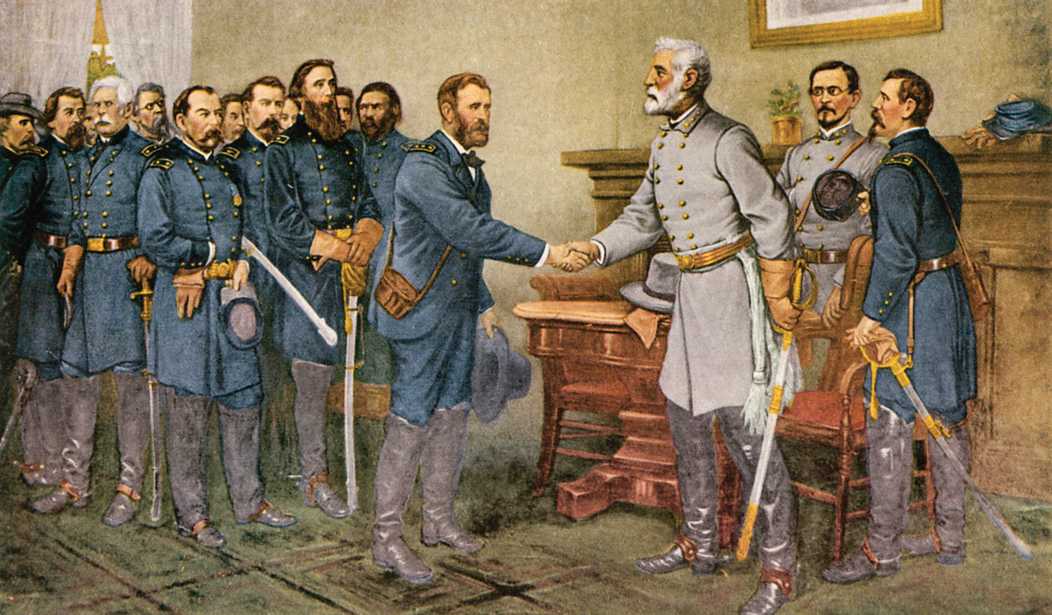
The Union was finally abolishing slavery once and for all … But the Civil War did not end at Appomattox Court House, nor even at Bennett Place, scene of the last major surrender of the war on April 26. In fact, it arguably never ended. Democrats simply shifted from firing cannons and rifles on a battlefield to weaponizing courts, laws, the press, and riots.One of the most misleading claims in modern politics is, “This is not the Democrat Party of your grandfathers.” It is — and of your great-great-great-grandfathers.… In the 1800s as much as in the 2000s, the Democrat Party utilized politically-fueled domestic terrorism, election fraud, character assassination, extreme rhetoric, race-baiting, and emotionally manipulative propaganda.… From the Red Shirts and the KKK to Antifa and the anti-ICE rioters, from John C. Calhoun to Joe Biden, from Jim Crow to sanctuary policies and CRT, there is a continuum of Democrat lies, tyranny, racism, and violence. In the 19th century, Democrats justified the Fort Pillow massacre and the KKK assassination of Rep. James Hinds (R-Ark.), and in the 21st century, they justify a 1,347% increase in assaults against ICE and the assassination of Charlie Kirk.
Catherine Salgado's words were echoed, 70 and 25 years earlier, by the deep thoughts of Harry Jaffa on American history. FromJohn C. Calhoun Harry Jaffa
Indeed, the Trump administration's fight against pervasive fraud, vote-rigging, gun control, double standards in law courts, and Democratic demonization of its opponents (of whatever race), resembles nothing more than the Democrat Party — although far less violent (so far?) — in the 1870s, 1860s, and 1850s. This has been touched on numerous times on this blog over the past 22 years.
Related History Posts:
• What Caused Secession and Ergo the Civil War? Was It
Slavery and/or States' Rights? Or Wasn't It Rather Something
Else — the Election of a Ghastly Republican to the White House?
• During the Winter of 1860-1861, Did the South's Democrats Obtain Their Aim — the Secession of 7 Slave States — Thanks to Elections Filled with Stealth, Lies, Voter Fraud, Intimidation, Violence, and Murder? (Wait 'til You Hear About… Georgia's Dark Secret)
• Abraham Lincoln and the Founding Fathers' Supposed Embrace of Slavery Along with Their Alleged Rejection of Women's Rights
• Wondering Why Slavery Persisted for Almost 75 Years After the Founding of the USA? According to Lincoln, the Democrat Party's "Principled" Opposition to "Hate Speech"
•
• Harry Jaffa on the Civil War Era: For Democrats of the 21st Century as of the 19th, "the emancipation from morality was/is itself seen as moral progress"
• Why Does Nobody Ever Fret About Scandinavia's — Dreadful — 19th-C Slavery Conditions?
• A Century and Half of Apartheid Policies: From Its 1828 Foundation, the Democrat Party Has Never Shed Its Racist Past
• The Confederate Flag: Another Brick in the Leftwing Activists' (Self-Serving) Demonization of America and Rewriting of History
• How to Prevent America from Becoming a Totalitarian State
• Inside of a month, Democrats have redefined riots and election challenges from the highest form of patriotism to an attack on democracy — And by “democracy”, they mean the Democrat Party
• Why They Don't Tell You the Whole Truth: The 1619 Project Summarized in One Single Sentence

And here we get to the meat of this post, the part of Ron Chernow's biography of Grant dealing with the Reconstruction years:
In describing the Klan's tight grip over the region, Grant summoned his most emphatic language, saying its purpose was "by force and terror … to deprive colored citizens of the right to bear arms [!!] and the right to a free ballot, to suppress schools in which colored children were taught, and to reduce the colored people to a condition closely akin to that of slavery."
… In countering the Klan, Grant found himself back in familiar territory, operating as general in chief. Whenever he returned to war-related issues, Grant showed a sure grasp of both his values and methods. He knew that the Klan threatened to unravel everything he and Lincoln and Union soldiers had accomplished at great cost in blood and treasure.
… [Horace] Greeley was famous for his withering slurs against Democrats, having once said that while not all Democrats were horse thieves, all horse thieves were Democrats. He had denounced them as "traitors, slave-whippers, drunkards and lecherous beasts."
… "If the Devil himself were at the helm of the ship of state," the abolitionist and woman's rights activist Lydia Maria Child responded, "my conscience would not allow me to aid in removing him to make room for the Democratic party." She believed that when Liberal Republicans endorsed "state sovereignty," it meant "when the Ku Klux renew their plans to exterminate Republicans, white and black, they shall be dealt with by Southern civil authority — that is, by judges and jurors who are themselves members of the Ku Klux association"
… No Southern state presented more insurmountable problems to Grant than Louisiana, which had become a hotbed of hatred and corruption.
… the worst slaughter perpetrated against blacks during Reconstruction. Staggered by [the 1872] cold-blooded massacre, Grant told the Senate "a butchery of citizens was committed at Colfax, which in bloodthirstiness and barbarity is hardly surpassed by any acts of savage warfare."
The Colfax murderers thus walked off scot-free, sending a powerful message to white supremacists that they could slay blacks without any penalty. … such unalloyed sadism
… As Grant attempted to normalize federal relations with former Confederate states, he struggled with a newly emergent white supremacist groups, hydra-headed offshoots of the Klan with names such as the White League, "rifle clubs." Red Shirts, and Knights of the White Camelia. They tiptoed around prosecution by claiming to be county militia. Unlike the Klan, which was a secret paramilitary group … Harper's Weekly wasn't far from the mark when it termed the White League "an unmasked Ku Klux"
… The battle [in New Orleans] had witnessed an extraordinary event: James Longstreet now fired on men he had commanded during the war, his small army having killed twenty-one White Leaguers
… To Grant, it looked as if the country might be lurching toward a second Civil War
… Many saw the Louisiana violence as the opening shot of a second Civil War and a revitalized Confederacy, albeit clothed in a new form. Discussing the mood in New Orleans, Sheridan told Orville Babcock, "I have so often heard expressions that the new rebellion was to be fought under the stars & stripes and in the north as well as the South — that the mistake made in 1861 was to have had their own flag."
… Grant's personal tragedy was simultaneously an American tragedy. Grant predicted to John Roy Lynch that the northern retreat from Reconstruction would lead to Democrats recapturing power in the South as well as "future mischief of a very serious nature … It requires no prophet to foresee that the national government will soon be at a great disadvantage and that the results of the war of the rebellion will have been in a large measure lost …"
This wasn't a minor statement: the victorious Union general of the Civil War was saying that terror tactics perpetrated by southern whites had nullified the outcome of the rebellion. All those hundreds of thousands dead, the millions maimed and wounded, the mourning of widows and orphans — all that suffering, all that tumult, on some level, had been for naught. Slavery had been abolished, but it had been replaced by a caste-ridden form of second-class citizenship for southern blacks, and that counted as a national shame.
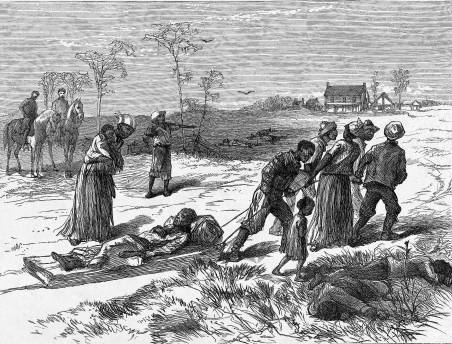
The Little-Known Story Of The Colfax Massacre, The Worst Episode Of Racial Violence During Reconstruction, happens to be discussed on the All That's Interesting website:
After the 1872 gubernatorial election in Louisiana, KKK members and former Confederates stormed a courthouse occupied by Black militiamen — and killed as many as 150 of them.
The clash took place in the small town of Colfax, Louisiana. A white mob of Democrats that lost the election tried to seize control of a courthouse defended by Black Republicans. And the election dispute quickly turned into a massacre.
… What triggered the violent race massacre? And how did the Colfax Massacre help end Reconstruction and tip the balance toward segregation and Jim Crow rule?
… One Southern paper laid the blame at the feet of the “scalawags and carpetbaggers,” common terms for southern and northern Republicans who supported Reconstruction.

Here are some extended notes from Ron Chernow's biography of General Grant, which repeats all the main quotes featured above, in addition to a number of other quotes of interest:
… Before long, Grant's stonehearted faith would be severely tested as the new president [Andrew Johnson] went from being too harsh toward Confederate leaders to being too obliging
In Part Three, "A Life of Peace", Grant is elected to the White House
As the charitable victor at Appomattox, Grant stood as the foremost symbol of a merciful attitude towards the defeated states. At the same time, as the leading Union general, fully committed to the war's agenda of preserving the Union and ending slavery, Grant was no less associated with protecting the four million freed people. How to reconcile these two often incompatible impulses as they clashed in post-war America would define the rest of Grant's life and would prove, in many ways, as baffling a problem as winning the war
…In Andrew Johnson, Grant would had to deal with a new president who would swing from excessive hostility toward the South to excessive leniency, alienating at both ends of the spectrum … As Grant put it, "As soon as the slave-holders put their thumb upon him [Johnson] … he became their slave."
… Most consequential for Grant's historic reputation was the way southerners of the Lost Cause school would begin to idealize Lee
… Grant came to believe that Lee, far from accepting the war's outcome gracefully, was secretly hostile to it and abetted southern fantasies that their defeated cause would rise anew
Mosby repaid [Grant's] surprising kindness be becoming a steadfast friend and ally of Grant
… There was so much skulduggery between France and the rebels during the Civil War that Grant classified Napoleon III as "an active part of the rebellion"
… a new form of bondage, establishing the foundations of the Jim Crow system that later ruled southern race relations
… "Liberty has been won," contended Senator Charles Sumner. "The battle for equality is still pending." Unless freed blacks received the vote, warned Frederick Douglass, "we should have slavery back again, in spirit if not in form"
… For all their excessive zeal militant Republicans would produce some of the most powerful legislation in American history to accord equal rights to African Americans
… [Regarding the] so-called carpetbaggers … In southern mythology, they would be demonized as corrupt parasites, but many were motivated by idealism and paid a steep price for their courage. Southern whites who supported Reconstruction, called "scalawags," faced similar antipathy
… The sadism [in New Orleans in 1866] was … wanton [and] a chilling display of racial hatred
This violence seemed a grotesque continuation of the Civil War by other means, and one member of the white rabble went so far as to brag, "We have fought for four years these god-damned Yankees and sons of bitches in the field, and now we will fight them in the city."
… black and white Republicans were being murdered with abandon in southern states
… Gruffly dismissed … as mere "rumors of Negro murders," [allegedly] unworthy of serious consideration … [this] would become a standard Democratic defense in future years
Doesn't this sound like how Democrats and the MSM have characterized election fraud in the past few decades?
… In many parts of Texas, Grant asserted, a Union man wasn't safe outside the umbrella of federal military protection
… for southern blacks and white Republicans the First Reconstruction Act promised sorely needed protection against the indiscriminate white terror directed at them with alarming frequency
… [Between] the Second Reconstruction Act [and] the Third Reconstruction Act, [Ron Chernow mentions the] Ku Klux Klan, its arcane name derived from the Greek word kuklos, for band or circle
… Never before in American history had there been such racially integrated governmental meetings, and they pioneered in establishing public schools and contesting discrimination
… More than 80 percent of black delegates were literate, but the handful of illiterates provided endless fodder for vicious satire in the white press, creating an enduring caricature of Reconstruction as a period of misrule by inept black politicians.
… Nothing alarmed white southerners more than the specter of blacks casting votes. The united power of blacks, carpetbaggers, and scalawags produced a stunning string of Republican election victories in fall 1867 across a region long solidly democratic
… [The slogan of Grant's 1868 presidential campaign was] "Let us have peace" … Henry Adams wisecracked that "Let Us Have Peace" meant only "Leave Me Alone"
… Grant, having never set eyes on the Great Plains, wanted his son Buck to see them whilst still occupied … "the Buffalo and the Indian, both rapidly disappearing now."
Grant rhapsodied about the beauty of the American West, only regretting the "three epidemics" that had plagued it: the pistol, the bowie knife, and whiskey
[There were] troubling sign that Grant, in his new political incarnation, might ignore professional advice and prove unwilling to modify his traditional style to accommodate new political realities
… Democrats ran what the historian David W. Blight has branded "one of the most explicitly racist presidential campaigns in American history." Grant railed at the "desperate and unscrupulous" tactics of Democrats, but Republicans didn't shy away from invective either
… Blacks still couldn't vote in many northern states, whereas they could vote in most formerly Confederate states.
… The campaign's most chilling feature was the huge wave of murder and arson orchestrated by the Ku Klux Klan against black and white Republicans in the South
… speculation about [Grant's] strained relations with Sherman … [their] radically different worldviews
[At this point Grant wins the 1868 election on November 3, "by a comfortable but not overwhelming margin", trouncing Horatio Seymour however in an electoral landslide of 214 to 80.]
… Sherman … had monitored Grant's rise with decidedly mixed emotions, believing that "if forced to choose between the penitentiary and the White House for four years, I would choose the penitentiary, thank you."… the Department of the Interior, a notorious mare's nest of corruption. It is important to note that corruption was rife in many departments before Grant took office … Grant would prove a far more assertive president than his modest inaugural address had suggested
… "The chief business of the executive had become the distribution of patronage." Abraham Lincoln had been besieged by office seekers who cluttered the stairs and corridors day and night. One day a friend asked Lincoln whether he was depressed because the Union army had suffered a military setback. He smiled wanly and saud, "No, it isn't the army. It is the post office in Brownsville, Missouri."
… Grant knew that, for every friend he won through an appointment, he earned a hundred enemies in rejected suitors
… Elated at this appointment, Rabbi Isaac Mayer Wise said it showed "that President Grant had revoked General Grant's notorious order No. 11."
… As James M. McPherson has pointed out, eleven of the first twelve amendments to the Constitution constrained governmental power; starting with the Thirteenth Amendment, six of the next seven enlarged it. The war also centralized power, welding states closer together and forging a new sense of nationhood. As Grant told a relative, "Since the late civil war the feeling of nationality had become stronger than it had ever been before"
… The mounting wealth also meant the dominant Republican Party was torn between its idealistic, abolitionist past and its business-oriented future
… In the nineteenth century, Congress was infinitely more powerful than in the twentieth and senators ruled as headstrong barons whose power often rivaled that of presidents
… Perhaps more than any other president, Grant oversaw the evolution of Washington from a straggling village into a modern city with well-paved sidewalks, sewers, and water and gas mains
… Grant showed a a surprisingly keen eye for government architecture … dubbed "General Grant" style … "the dingy, shabby carpets and furniture in this new home"
… Ben Butler mocked Andrew Johnson as the "drunken tailor" and Grant as the "drunken tanner" … But such random accusations were now more conspicuous by their absence and occurred with nowhere near their frequency of wartime drinking charges
… Fired by a crusading spirit, [Adelbert A.] Ames saw carpetbaggers as apostles of "northern liberty" who had "a hold on the hearts of the colored people that nothing can destroy"
… "When I took command of this military district," he recalled, "I found that the negroes who had been declared free by the United States were not free, in fact they were living under a code that made them worse than slaves, and I found that it was necessary, as commanding officer, to protect them, and I did"
… On a personal level, Grant extended an olive branch to Confederate generals. In May 1869, Robert E. Lee came to the White House to discuss a railroad venture. As at Appomattox, Grant attempted to smooth over an awkward situation with a little levity and small talk. "You and I, General," said Grant, "have had more to do with destroying railroads than building them." Lee would not be drawn into this sort of pleasantry.
… Many of the generals who had defeated the Confederacy were now assigned to pacify Native Americans and often betrayed a punitive, bloody attitude, exemplified by Phil Sheridan's infamous remark "The only good Indians I know are dead."
… Many in Congress had few qualms about pursuing a policy of outright genocide, which one Nevada congressman calling for "extinction. And I say that with a full sense of the meaning conveyed by that word."
… This hopeful, idealistic path, paved with good intentions, had been touted by well-meaning presidents from George Washington to Abraham Lincoln
… Annexing Santo Domingo could also break British domination of the Caribbean, which forced American vessels "to pass through foreign waters."
"the crime of Ku Kluxism"
… [Grant] committed fatal errors by pursuing this momentous policy in a closed-door, top-down style that made sense in wartime, but not in politics. He didn't prepare the American electorate or mobilize public opinion or rally voters to his side.
… For many southern whites, however, the idea that their erstwhile slaves could now hold office and even gain the upper hand in their political lives was intolerable. It reinforced their growing conviction that secession had been, as The Nation phrased it, "not wicked, but holy and glorious."
… This fateful moment presented Grant with a domestic challenge as daunting as that faced by any American president, or it inspired hope among blacks and smoldering resentment among many whites.
Black gains can be overstated and certainly were by an alarmed white community: fewer than 20 percent of state political offices in the South were held by blacks at the hight of Reconstruction. Still, those represented spectacular gains for people so recently held in bondage
… With a violent backlash well under way, the party of Lincoln began to pay a price for being the vocal paladin of African Americans.
… Under Article I, Section 2, of the Constitution, slaveholding states had been entitled to count three of every five slaves as part of their electorate in computing their share of congressional delegates, Now former slaves would serve as full citizens, swelling the electoral tally for southern states. This was fine as long as freed people exercised their full voting rights, Instead, over time, the white South would receive extra delegates in Congress and electoral votes in presidential races while stifling black voting power, "It was unjust to the North," Grant subsequently lamented, "In giving the South negro suffrage, we have given the old slave-holders forty votes in the electoral college. They keep those votes, but disenfranchise the negroes. That is one of the gravest mistakes in the policy of reconstruction."
… The new Justice Department would forge its identity in the battle to slay the Ku Klux Klan and such offshoots as the Knights of the White Camelia. Having disbanded Confederate armies, the North had not stopped the emergence of quasi-military organizations throughout the South. In describing the Klan's tight grip over the region, Grant summoned his most emphatic language, saying its purpose was "by force and terror … to deprive colored citizens of the right to bear arms [!!!] and the right to a free ballot, to suppress schools in which colored children were taught, and to reduce the colored people to a condition closely akin to that of slavery."
[In the postbellum era, the last word of the KKK often seemed to be dropped, by friend and foe alike, with the organization referred to as "the Ku Klux association," "the Ku Klux businesss," "KuKluxery," "Ku-Klux-Klanism," "traitorism," and "Banditti"]
… In pursuing the Klan, he showed to advantage his persistence, simplicity, and innate stubbornness. Through the Justice Department, the federal government would emerge as the undisputed champion of civil liberties in the southern states, carving out a new role
"It seems like we are drifting … back under the leadership of the slave holders," a black Republican moaned. The southern states had now been readmitted to the Union with full congressional representation, but far from adumbrating a new era of harmony, it signaled the start of a deepening era of polarization.
… These were ground-breaking decisions that for the first time enabled the federal government instead of state and local governments to punish "private criminal acts"
… these domestic terrorists
… The man who implemented this bold agenda was [Amos] Akerman, who thought Reconstruction best served the long-term interests of the enlightened South, properly understood. To those who protested its severity, he responded that nothing was "more idle than to attempt to conciliate by kindness that portion of the Southern people who are still malcontent. They take all kindness on the part of the government as evidence of timidity." For Akerman, the Klan's actions "amount to war, and cannot be effectively crushed on any theory."
… In countering the Klan, Grant found himself back in familiar territory, operating as general in chief. Whenever he returned to war-related issues, Grant showed a sure grasp of both his values and methods. He knew that the Klan threatened to unravel everything he and Lincoln and Union soldiers had accomplished at great cost in blood and treasure.
… By 1872, under Grant's leadership, the Ku Klux Klan had been smashed in the South. (Its later twentieth-century incarnation had no connection to the earlier group other than a common style and ideology.)
… [Frederick] Douglass marveled at his equal treatment, commenting that "while all the fools are not dead yet, the American people are rapidly outgrowing their slavery-engendered prejudices, and will one day wonder how they could have so long lived under its degrading spell." Douglass's assignment was yet another example of Grant's appointing African Americans in far greater numbers than any previous president.
… In a momentous shift, Grant made common cause with party bosses, who increasingly formed the backbone of his support on Capitol Hill
… Benjamin Moran, secretary of the American legation in London, was stunned by the decline of American support even among Britons who had fervently embraced the Union cause: "They look upon this [Alabama] claim for consequential damages as dishonest and as confirming the popular English opinion … that we are a tricky people."
… he learned to to manipulate the levers at his disposal to get things accomplished on Capitol Hill. After personal betrayals suffered over the Santo Domingo treaty, he decided to reward loyalty above ideology and came to view reformers as two-faced troublemakers while party bosses, however corrupt, at least stuck to their word
… Grant has suffered from a double standard in the eyes of historians. When Lincoln employed patronage for political ends, which he did extensively, they have praised him as a master politician; when Grant catered to the same spoilsmen, they have denigrated him as a corrupt opportunist.
… Part of Grant's need to placate party bosses was that he presided over government in the heyday of senatorial power. Senators were still elected by state legislatures and business interests
… [The White House] scandals [were] christened "Grantism" [and the president was] dubbed "Kaiser Grant" … "The people are tired of a man who has not an idea above a horse or a cigar"
… Greeley was famous for his withering slurs against Democrats, having once said that while not all Democrats were horse thieves, all horse thieves were Democrats. He had denounced them as "traitors, slave-whippers, drunkards and lecherous beasts."
… the true aim of the new fusion ticket was the "overthrow of Negro supremacy—the anti-Reconstruction agenda, however thinly masked by reform rhetoric
… "If the Devil himself were at the helm of the ship of state," the abolitionist and woman's rights activist Lydia Maria Child responded, "my conscience would not allow me to aid in removing him to make room for the Democratic party." She believed that when Liberal Republicans endorsed "state sovereignty," it meant "when the Ku Klux renew their plans to exterminate Republicans, white and black, they shall be dealt with by Southern civil authority — that is, by judges and jurors who are themselves members of the Ku Klux association"… "If as a class we are slighted by the Republican party," [Frederick Douglass] noted, "we are as a class murdered by the Democratic party." He swore he would rather blow his brains out than destroy the Republican Party.
… Despite his unflagging advocacy for black rights, Grant never forgot the spirit of Appomattox and his desire for harmony between North and South
He continued his relationship with the onetime Confederate partisan John Singleton Mosby, the "Gray Ghost" who had mercilessly harassed his troops in northern Virginia … the two became fast friends during Grant's second term when Mosby turned into a frequent dinner guest at the White House.
… [In 1872] blacks voted Republican in the fairest election in southern states until 1968
… President-elect Grant rose above the scandal, which predated his administration. But the involvement and the fact that the scandal unfolded on his watch have unfairly linked Grant's name in the history books with a scandal in which he lacked any association… He sounded charitable toward Native Americans, advocating "education and civilization" in place of war: "Wars of extermination … are demoralizing and wicked. Our superiority of strength, and advances of civilization, should make us lenient towards the Indian."
35 A Butchery of Citizens
… No Southern state presented more insurmountable problems to Grant than Louisiana, which had become a hotbed of hatred and corruption.
… the worst slaughter perpetrated against blacks during Reconstruction. Staggered by this cold-blooded massacre, Grant told the Senate "a butchery of citizens was committed at Colfax, which in bloodthirstiness and barbarity is hardly surpassed by any acts of savage warfare."
The Colfax murderers thus walked off scot-free, sending a powerful message to white supremacists that they could slay blacks without any penalty. … such unalloyed sadism
… As Grant attempted to normalize federal relations with former Confederate states, he struggled with a newly emergent white supremacist groups, hydra-headed offshoots of the Klan with names such as the White League, "rifle clubs." Red Shirts, and Knights of the White Camelia. They tiptoed around prosecution by claiming to be county militia. Unlike the Klan, which was a secret paramilitary group
… The battle [in New Orleans] had witnessed an extraordinary event: James Longstreet now fired on men he had commanded during the war, his small army having killed twenty-one White Leaguers
… To Grant, it looked as if the country might be lurching toward a second Civil War
Chapter 36 The Bravest Battle
… Far from being transitory, the crisis was deep and intractable amd persisted for more than five brutal years. It would be termed "the Great Depression" until eclipsed by the 1930s downturn
… He also wanted to revive American shipbuilding, which had been badly damaged during the war.
Grant expanded this vision by again endorsing a canal to connect the Atlantic to the Pacific Oceans and he had surveys conducted to locate the most feasible site. Quite visionary about the pathway, Grant maintained that "it would add largely to the wealth of the Pacific coast, and, perhaps, change the whole current of the trade of the world."
… the baffling subject of race relations … White Democrats had demonstrated that without protection of federal troops, they could resurrect the prewar power structure
… One of Grant's saving graces was his ability to listen
… Grant had refused to mince words about Democratic injustices in Louisiana
That Julia Grant, erstwhile southern belle, felt so outraged by Democratic misbehavior in Louisiana says something about the militant mood in the Grant householdThe president was running out of room to maneuver as the country backed away from further federal interference in the South. The outcry over Louisiana began to ring down the final curtain on Reconstruction. Southern whites increasingly substituted the word "Redemption" — a restoration of white rule — for the hated term "Reconstruction"
… Many saw the Louisiana violence as the opening shot of a second Civil War and a revitalized Confederacy, albeit clothed in a new form. Discussing the mood in New Orleans, Sheridan told Orville Babcock, "I have so often heard expressions that the new rebellion was to be fought under the stars & stripes and in the north as well as the South — that the mistake made in 1861 was to have had their own flag."
…One of the last hurrahs of Reconstruction was the passage of the Civil Rights Act of 1875, enacted by lame-duck Republicans. It outlawed racial segregation in public accommodations, schools, transportation, and juries. The law had many flaws in its enforcement provisions, but was revolutionary in its principles of equal treatment for all
MMMMMMM Here is one more piece of evidence that the true civil rights movement was not in the 1960s, as the left-leaning rewriters of history would have you believe, but a hundred years earlier.
… Democratic governors never bothered to enforce it
Chapter 37 Let No Guilty Man Escape
… Governor Adelbert Ames of Mississippi … His darkly prophetic letter previewed the nearly century-long Jim Crow system that would cast blacks back into a state of involuntary servitude to southern whites
… Ames saw the election as a referendum on race, pure and simple, "In one phrase — hostility to the negro as a citizen. The South cares for no other question. Everything gives way to it. They support or oppose men, advocate or denounce policies, flatter or murder, yet no such action will help them as far as possible to recover their old power over the negro." He scoffed at Grant's hollow promise to send troops as "a sham and the election a fraud." The election had mocked the U.S. Constitution and guaranteed a prolonged night of terror for freed people. When a Senate committee investigated the elections, it decided it had been won "by the Democrats by a preconceived plan of riots and assassinations," in the words of Senator George Boutwell.
… Grant's personal tragedy was simultaneously an American tragedy. Grant predicted to John Roy Lynch that the northern retreat from Reconstruction would lead to Democrats recapturing power in the South as well as "future mischief of a very serious nature … It requires no prophet to foresee that the national government will soon be at a great disadvantage and that the results of the war of the rebellion will have been in a large measure lost … "
This wasn't a minor statement: the victorious Union general of the Civil War was saying that terror tactics perpetrated by southern whites had nullified the outcome of the rebellion. All those hundreds of thousands dead, the millions maimed and wounded, the mourning of widows and orphans — all that suffering, all that tumult, on some level, had been for naught. Slavery had been abolished, but it had been replaced by a caste-ridden form of second-class citizenship for southern blacks, and that counted as a national shame.
Chapter 39 Redeemers
… "I met Mosby on my way to the President's", Hamilton Fish wrote, "and he told me that the language of the Democrats now was more desperate and more threatening and violent [during the election of 1876] than that of the Southern men on the Election of Lincoln in 1860"
… With memories of the Civil War still fresh, another bloody clash was far from unthinkable
… [Rutherford B] Hayes would bring an end to Reconstruction. It was a pyrrhic victory for the Republicans, who sacrificed their ideals in exchange for perpetuating their rule
… Reconstruction was now officially dead and the Democratic Party in charge across the South. "Half of what Grant gained at Appomattox," said Wendell Phillips, "Hayes surrendered for us on the 5th of March" [1877]. Yet many Northerners cheered the change.
… Americans today know little about the terrorism that engulfed the South during Grant's presidency. It has been suppressed by a strange national amnesia. The Klan's ruthless reign is a dark, buried chapter in American history
… Could even Abraham Lincoln have appeased the White South while simultaneously protecting its black population? It seems unlikely. Grant saw a double standard at work: the country tolerated terror by whites, but not by blacks.
… Once Reconstruction collapsed, it left southern blacks for eighty years at the mercy of Jim Crow segregation, lynchings, poll taxes, literacy tests, and other tactics designed to segregate them from whites and deny them the vote. Black sharecroppers would be degraded to the level of debt-ridden serfs, bound to their former slave owners
… Grant deserves an honored place in American history, second only to Lincoln, for what he did for the freed slaves. He got the big issues right during the presidency, even as he bungled many of the small ones
… In the words of Frederick Douglass,
"That sturdy old Roman, Benjamin Butler, made the negro a contraband,
Abraham Lincoln made him a freeman, and
Gen. Ulysses S. Grant made him a citizen."


6 comments:
I found this post extremely useful and well written.
Thank you for creating such reader-friendly content.
Great article! I appreciate the practical approach.
Excellent work. The examples made the concepts very clear.
This article was both informative and inspiring.
Thank you for sharing such valuable information with readers.
Post a Comment