Thursday, May 26, 2016

Hiroshima 12: Political Correctness in Japan: The comment "tramples on the feelings of victims", so… Shut the F**k Up and Lose Your Job!

As Barack Obama heads to Hiroshima, here is another
excerpt
from a compilation of Hiroshima writings:

No mention, of course, is made of the (many more) Japanese people that would have been victims had the bombs not been dropped — which (needless to say) was the entire point behind Fumio Kyuma's comment in the first place!
In a public appearance [last] Saturday — the unofficial start of the campaign for [Japan's] upcoming election — Kyuma said that dropping the atomic bombs on Hiroshima and Nagasaki in 1945 "ended the war," adding, "I think that it couldn't be helped."

Otherwise, Kyuma said, the war would have dragged on and the Soviet Union would have ended up occupying northern Japan.

…The comments by Kyuma, who represents Nagasaki in the lower house, caused widespread anger by apparently treating lightly Japan's status as the only country ever targeted by nuclear weapons. Although the debate over the use of nuclear arms is not the taboo it once was, Japan's self-image as a special victim of World War II remains deeply rooted, even as revisionist politicians like Abe have tried to minimize Japan's militarist past.
Kyuma had to resign as Prime Minister Shinzo Abe's defense minister (and was replaced by Yuriko Koike, Japan's first female defense chief). His comments, more specifically, said:
"I understand that the bombing ended the war, and I think that it couldn't be helped," Kyuma said.

Kyuma, who is from Nagasaki, said the bombing caused great suffering in the city, but he said he did not resent the United States because the bombs prevented the Soviet Union from entering the war with Japan, according to Kyodo news agency.

Kyuma said if Japan had not surrendered, northern Japan could have been occupied by the Soviet Union, which had begun invading Manchuria on the same day Nagasaki was attacked, according to Japanese media.

The remarks, rare for a Japanese cabinet minister, were quickly criticized by atomic bomb victims.

Related:
• Hiroshima 15: Examining the Issues Surrounding the Dropping of Atomic Bombs on Japan (Erik Svane)

• Hiroshima 14: "I regard Hiroshima revisionism as the greatest hoax in American history" (Robert Maddox)

• Hiroshima 13: Although It Is Not Said Openly, Hiroshima Also Played a Purifying Role, IE the Baptism of a New Japan, the Event that Put an End to 50 Years of Crimes (Le Monde)

• Hiroshima 12: Political Correctness in Japan: The comment "tramples on the feelings of victims", so… Shut the F**k Up and Lose Your Job! (re the forced resignation of Japan's defense (!) minister)

• Hiroshima 11: If Western elites cannot find perfection in history, they see no good at all; most never learned the narrative of WW II, only what was wrong about it (Victor Davis Hanson)

• Hiroshima 10: If Not for the Atom Bombs, Japan, as we know it today, would not exist (S L Sanger, author of “Working on the Bomb”)

• Hiroshima 9: Over one million warning leaflets were dropped over Hiroshima, Nagasaki, and 33 other Japanese cities 5 days before the Hiroshima bombing (Bill Whittle)

• Hiroshima 8: Was It Wrong to Use the Atom Bomb on Japan? (Father Wilson Miscamble)

• Hiroshima 7: Some Facts About Hiroshima and World War II That You Hear Neither From America's MSM, University Élites, and History Books, Nor From Japan's (New York Times)

• Hiroshima 6: "Lance or spear practice was a regular women's exercise to practice for the anticipated U.S. landing" (a Japanese American)

• Hiroshima 5: Japan's plans for defense involved mobilizing the civilian population, including women and children, for the customary suicidal battle tactics (Thomas Sowell)

• Hiroshima 4: "Les 300 000 morts d'Hiroshima ont épargné bien davantage de Japonais, qui auraient été écrasés sous des bombes ordinaires" (Charles de Gaulle)

• Hiroshima 3: A mainland invasion could have resulted in millions of Japanese deaths—and that's not counting civilians (Wall Street Journal)

• Hiroshima 2: Hand-wringing over Hiroshima is just virtue-signaling by people who never said a bad word about Stalin or Mao’s mass murders (Glenn Reynolds)

• Hiroshima 1: Unlike the ends of the majority of conflicts, World War II in the Pacific grew increasingly bloody as U.S. forces approached the Japanese homeland (Erik Svane)

Hiroshima 11: If Western elites cannot find perfection in history, they see no good at all; most never learned the narrative of WW II, only what was wrong about it

As Barack Obama heads to Hiroshima, here is another
excerpt
from a compilation of Hiroshima writings:
The truth is that the supposedly biased West discusses the contribution of others far more than our former enemies — or Russian and Chinese allies — credit the British or Americans. There is a pattern here.
writes Victor Davis Hanson as we approach the anniversary of the Hiroshima bombing.
There is a pattern here. Western elites — the beneficiaries of 60 years of peace and prosperity achieved by the sacrifices to defeat fascism and Communism — are unhappy in their late middle age, and show little gratitude for, or any idea about, what gave them such latitude. If they cannot find perfection in history, they see no good at all. So leisured American academics tell us that Iwo Jima was unnecessary, if not a racist campaign, that Hiroshima had little military value but instead was a strategic ploy to impress Stalin, and that the GI was racist, undisciplined, and reliant only on money and material largess.

There are two disturbing things about the current revisionism that transcend the human need to question orthodoxy. The first is the sheer hypocrisy of it all. Whatever mistakes and lapses committed by the Allies, they pale in comparison to the savagery of the Axis or the Communists. Post-facto critics never tell us what they would have done instead — lay off the German cities and send more ground troops into a pristine Third Reich; don’t bomb, but invade, an untouched Japan in 1946; keep out of WWII entirely; or in its aftermath invade the Soviet Union?

Lost also is any sense of small gratitude. … Such revisionists never ask whether they could have written so freely in the Third Reich, Tojo’s Japan, Mussolini’s Italy, Soviet Russia, Communist Eastern Europe — or today in such egalitarian utopias as China, Cuba, or Venezuela.

Second, revisionism requires knowledge of orthodoxy. One cannot dismiss Iwo Jima as an unnecessary sideshow or allege that Dresden was simple blood rage until one understands the tactical and strategic dilemmas of the age — the hope that wounded and lost B-29s might be saved by emergency fields on Iwo, or that the Russians wanted immediate help from the Allied air command to take the pressure off the eastern front in February 1945.

But again, most Americans never learned the standard narrative of [World] War II — only what was wrong about it. Whereas it is salutary that an American 17-year-old knows something of the Japanese relocation ordered by liberals such as Earl Warren and FDR, or of the creation and the dropping of the atomic bomb by successive Democratic administrations, they might wish to examine what went on in Nanking, Baatan, Wake Island, Guadalcanal, Manila, or Manchuria — atrocities that their sensitive teachers are probably clueless about as well.

… How odd that Swedes and Spaniards who were either neutrals or pro-Nazi during World War II now so often lecture the United States not just about present morality but about the World War II past as well.

Related:
• Hiroshima 15: Examining the Issues Surrounding the Dropping of Atomic Bombs on Japan (Erik Svane)

• Hiroshima 14: "I regard Hiroshima revisionism as the greatest hoax in American history" (Robert Maddox)

• Hiroshima 13: Although It Is Not Said Openly, Hiroshima Also Played a Purifying Role, IE the Baptism of a New Japan, the Event that Put an End to 50 Years of Crimes (Le Monde)

• Hiroshima 12: Political Correctness in Japan: The comment "tramples on the feelings of victims", so… Shut the F**k Up and Lose Your Job! (re the forced resignation of Japan's defense (!) minister)

• Hiroshima 11: If Western elites cannot find perfection in history, they see no good at all; most never learned the narrative of WW II, only what was wrong about it (Victor Davis Hanson)

• Hiroshima 10: If Not for the Atom Bombs, Japan, as we know it today, would not exist (S L Sanger, author of “Working on the Bomb”)

• Hiroshima 9: Over one million warning leaflets were dropped over Hiroshima, Nagasaki, and 33 other Japanese cities 5 days before the Hiroshima bombing (Bill Whittle)

• Hiroshima 8: Was It Wrong to Use the Atom Bomb on Japan? (Father Wilson Miscamble)

• Hiroshima 7: Some Facts About Hiroshima and World War II That You Hear Neither From America's MSM, University Élites, and History Books, Nor From Japan's (New York Times)

• Hiroshima 6: "Lance or spear practice was a regular women's exercise to practice for the anticipated U.S. landing" (a Japanese American)

• Hiroshima 5: Japan's plans for defense involved mobilizing the civilian population, including women and children, for the customary suicidal battle tactics (Thomas Sowell)

• Hiroshima 4: "Les 300 000 morts d'Hiroshima ont épargné bien davantage de Japonais, qui auraient été écrasés sous des bombes ordinaires" (Charles de Gaulle)

• Hiroshima 3: A mainland invasion could have resulted in millions of Japanese deaths—and that's not counting civilians (Wall Street Journal)

• Hiroshima 2: Hand-wringing over Hiroshima is just virtue-signaling by people who never said a bad word about Stalin or Mao’s mass murders (Glenn Reynolds)

• Hiroshima 1: Unlike the ends of the majority of conflicts, World War II in the Pacific grew increasingly bloody as U.S. forces approached the Japanese homeland (Erik Svane)

Hiroshima 10: If Not for the Atom Bombs, Japan, as we know it today, would not exist

As Barack Obama heads to Hiroshima, here is another
excerpt
from a compilation of Hiroshima writings:

In reaction to Susan Southard's “Nagasaki, the forgotten city” (Opinion, Aug. 8), S L Sanger responds that, as the author of “Working on the Bomb”, an oral history of the Hanford plutonium works during World War II (Hanford manufactured the plutonium used to fuel the Nagasaki bomb as well as the Trinity test device), he remains
unconvinced that President Harry S. Truman and other decision makers knew as much in 1945 as Ms. Southard seems to know in 2015.

In my interviews with some 60 physicists, engineers, military men and ordinary working people who had been closely connected with Hanford and the Manhattan Project, the consensus was that both bombs were necessary, with a bit less consensus on the Nagasaki bomb.
The most brutal comment — perhaps the most realistic — was expressed by Leona Marshall Libby, probably the most well-known female scientist in the Manhattan Project.
“I have no regrets,” Dr. Libby said. “I think we did right, and we couldn’t have done differently. In wartime, it was a desperate time. … When you are in a war to the death, I don’t think you stand around and ask, ‘Is it right?’ ”
A similar viewpoint, from a combat soldier’s profoundly pessimistic perspective, is found in the historian Paul Fussell’s essay “Thank God for the Atom Bomb”. Mr. Fussell was probably headed for action on a Japanese beach, but to his everlasting relief, the Japanese surrendered a few days after the Nagasaki bombing.
Also check out more than a dozen voices in the
No Pasarán post, Hiroshima, 70 Years Later.

Don A. Farrell adds that Susan Southard
misses the reasons why dropping that second bomb so soon after Hiroshima was important: It prevented the Soviet partition of Japan.

Regarding the Japanese cabinet meeting on the morning of Aug. 9, 1945, it would have been more accurate to say that deliberations on the bomb ceased when news of the Nagasaki bomb arrived and those present recognized that more such bombs were likely. As Secretary of War Henry L. Stimson, Brig. Gen. Leslie Groves and Rear Adm. William R. Purnell have estimated, it was the fear of a third bomb that drove the Japanese to accept unconditional surrender.
Moreover, Ms. Southard fails to recognize the abysmal alternatives to a “no drop” decision by President Harry S. Truman, or a delay in the use of the second bomb. Had he decided against dropping the bomb, Hiroshima and Nagasaki, along with Kokura and Niigata, would have been taken off the Manhattan Project list and Maj. Gen. Curtis LeMay would have incinerated them. Instead of becoming billion-dollar tourist attractions, Hiroshima and Nagasaki would be no better known around the world than the other 60-some cities that were razed by American B-29s.

Had the second bomb not been used and had America begun negotiations with the Japanese, the surrender would have been delayed. Stalin’s Red Army was poised in southern Sakhalin for an airdrop on Hokkaido, Japan’s northern-most home island. Then, when the Japanese finally did surrender, a Soviet Army of occupation would have been entrenched in northern Japan, with General Douglas MacArthur and his army in southern Japan. Japan, as we know it today, would not exist.
Related:
• Hiroshima 15: Examining the Issues Surrounding the Dropping of Atomic Bombs on Japan (Erik Svane)

• Hiroshima 14: "I regard Hiroshima revisionism as the greatest hoax in American history" (Robert Maddox)

• Hiroshima 13: Although It Is Not Said Openly, Hiroshima Also Played a Purifying Role, IE the Baptism of a New Japan, the Event that Put an End to 50 Years of Crimes (Le Monde)

• Hiroshima 12: Political Correctness in Japan: The comment "tramples on the feelings of victims", so… Shut the F**k Up and Lose Your Job! (re the forced resignation of Japan's defense (!) minister)

• Hiroshima 11: If Western elites cannot find perfection in history, they see no good at all; most never learned the narrative of WW II, only what was wrong about it (Victor Davis Hanson)

• Hiroshima 10: If Not for the Atom Bombs, Japan, as we know it today, would not exist (S L Sanger, author of “Working on the Bomb”)

• Hiroshima 9: Over one million warning leaflets were dropped over Hiroshima, Nagasaki, and 33 other Japanese cities 5 days before the Hiroshima bombing (Bill Whittle)

• Hiroshima 8: Was It Wrong to Use the Atom Bomb on Japan? (Father Wilson Miscamble)

• Hiroshima 7: Some Facts About Hiroshima and World War II That You Hear Neither From America's MSM, University Élites, and History Books, Nor From Japan's (New York Times)

• Hiroshima 6: "Lance or spear practice was a regular women's exercise to practice for the anticipated U.S. landing" (a Japanese American)

• Hiroshima 5: Japan's plans for defense involved mobilizing the civilian population, including women and children, for the customary suicidal battle tactics (Thomas Sowell)

• Hiroshima 4: "Les 300 000 morts d'Hiroshima ont épargné bien davantage de Japonais, qui auraient été écrasés sous des bombes ordinaires" (Charles de Gaulle)

• Hiroshima 3: A mainland invasion could have resulted in millions of Japanese deaths—and that's not counting civilians (Wall Street Journal)

• Hiroshima 2: Hand-wringing over Hiroshima is just virtue-signaling by people who never said a bad word about Stalin or Mao’s mass murders (Glenn Reynolds)

• Hiroshima 1: Unlike the ends of the majority of conflicts, World War II in the Pacific grew increasingly bloody as U.S. forces approached the Japanese homeland (Erik Svane)

Hiroshima 9: Over one million warning leaflets were dropped over Hiroshima, Nagasaki, and 33 other Japanese cities 5 days before the Hiroshima bombing

As Barack Obama heads to Hiroshima, here is another
excerpt
from a compilation of Hiroshima writings:
Bill Whittle:
But the Japanese were warned … Over one million of these [Office of War Information warning leaflets] were dropped over Hiroshima, Nagasaki, and 33 other Japanese cities on the 1st of August, 1945 — that's five days before the Hiroshima bombing (01:10, aligato to Glenn Reynolds of Instapundit)

PJTV - Jon Stewart, War Criminals & The True Story of the Atomic Bombs - Bill Whittle from adrv on Vimeo.

Update:

When he planned to go see the Christopher Nolan movie Oppenheimer, Steve Byrne was shocked to learn from his mother that, when she was an infant in the 1940s, her family had been living in Hiroshima. Echoing Bill Whittle's post that Over one million warning leaflets were dropped over Hiroshima, Nagasaki, and 33 other Japanese cities 5 days before the Hiroshima bombing, the conservative-leaning comedian (who is of Korean, not Japanese, heritage) intoned: "Some real perspective. If not for the leaflets dropped by US Armed Forces… I absolutely would not be here today." Upon reading those leaflets, her parents had fled the city, into a tunnel or a shelter in the mountains, and were outside the city on the day the atomic bomb was dropped…

Related:
• Hiroshima 15: Examining the Issues Surrounding the Dropping of Atomic Bombs on Japan (Erik Svane)

• Hiroshima 14: "I regard Hiroshima revisionism as the greatest hoax in American history" (Robert Maddox)

• Hiroshima 13: Although It Is Not Said Openly, Hiroshima Also Played a Purifying Role, IE the Baptism of a New Japan, the Event that Put an End to 50 Years of Crimes (Le Monde)

• Hiroshima 12: Political Correctness in Japan: The comment "tramples on the feelings of victims", so… Shut the F**k Up and Lose Your Job! (re the forced resignation of Japan's defense (!) minister)

• Hiroshima 11: If Western elites cannot find perfection in history, they see no good at all; most never learned the narrative of WW II, only what was wrong about it (Victor Davis Hanson)

• Hiroshima 10: If Not for the Atom Bombs, Japan, as we know it today, would not exist (S L Sanger, author of “Working on the Bomb”)

• Hiroshima 9: Over one million warning leaflets were dropped over Hiroshima, Nagasaki, and 33 other Japanese cities 5 days before the Hiroshima bombing (Bill Whittle)

• Hiroshima 8: Was It Wrong to Use the Atom Bomb on Japan? (Father Wilson Miscamble)

• Hiroshima 7: Some Facts About Hiroshima and World War II That You Hear Neither From America's MSM, University Élites, and History Books, Nor From Japan's (New York Times)

• Hiroshima 6: "Lance or spear practice was a regular women's exercise to practice for the anticipated U.S. landing" (a Japanese American)

• Hiroshima 5: Japan's plans for defense involved mobilizing the civilian population, including women and children, for the customary suicidal battle tactics (Thomas Sowell)

• Hiroshima 4: "Les 300 000 morts d'Hiroshima ont épargné bien davantage de Japonais, qui auraient été écrasés sous des bombes ordinaires" (Charles de Gaulle)

• Hiroshima 3: A mainland invasion could have resulted in millions of Japanese deaths—and that's not counting civilians (Wall Street Journal)

• Hiroshima 2: Hand-wringing over Hiroshima is just virtue-signaling by people who never said a bad word about Stalin or Mao’s mass murders (Glenn Reynolds)

• Hiroshima 1: Unlike the ends of the majority of conflicts, World War II in the Pacific grew increasingly bloody as U.S. forces approached the Japanese homeland (Erik Svane)

Hiroshima 8: Was It Wrong to Use the Atom Bomb on Japan?

As Barack Obama heads to Hiroshima, here is another
excerpt
from a compilation of Hiroshima writings:

Father Wilson Miscamble:
Truman's use of the bomb should be seen as his choosing the least awful of the options available to him (4:04, thanks to Instapundit)
 
Related:
• Hiroshima 15: Examining the Issues Surrounding the Dropping of Atomic Bombs on Japan (Erik Svane)

• Hiroshima 14: "I regard Hiroshima revisionism as the greatest hoax in American history" (Robert Maddox)

• Hiroshima 13: Although It Is Not Said Openly, Hiroshima Also Played a Purifying Role, IE the Baptism of a New Japan, the Event that Put an End to 50 Years of Crimes (Le Monde)

• Hiroshima 12: Political Correctness in Japan: The comment "tramples on the feelings of victims", so… Shut the F**k Up and Lose Your Job! (re the forced resignation of Japan's defense (!) minister)

• Hiroshima 11: If Western elites cannot find perfection in history, they see no good at all; most never learned the narrative of WW II, only what was wrong about it (Victor Davis Hanson)

• Hiroshima 10: If Not for the Atom Bombs, Japan, as we know it today, would not exist (S L Sanger, author of “Working on the Bomb”)

• Hiroshima 9: Over one million warning leaflets were dropped over Hiroshima, Nagasaki, and 33 other Japanese cities 5 days before the Hiroshima bombing (Bill Whittle)

• Hiroshima 8: Was It Wrong to Use the Atom Bomb on Japan? (Father Wilson Miscamble)

• Hiroshima 7: Some Facts About Hiroshima and World War II That You Hear Neither From America's MSM, University Élites, and History Books, Nor From Japan's (New York Times)

• Hiroshima 6: "Lance or spear practice was a regular women's exercise to practice for the anticipated U.S. landing" (a Japanese American)

• Hiroshima 5: Japan's plans for defense involved mobilizing the civilian population, including women and children, for the customary suicidal battle tactics (Thomas Sowell)

• Hiroshima 4: "Les 300 000 morts d'Hiroshima ont épargné bien davantage de Japonais, qui auraient été écrasés sous des bombes ordinaires" (Charles de Gaulle)

• Hiroshima 3: A mainland invasion could have resulted in millions of Japanese deaths—and that's not counting civilians (Wall Street Journal)

• Hiroshima 2: Hand-wringing over Hiroshima is just virtue-signaling by people who never said a bad word about Stalin or Mao’s mass murders (Glenn Reynolds)

• Hiroshima 1: Unlike the ends of the majority of conflicts, World War II in the Pacific grew increasingly bloody as U.S. forces approached the Japanese homeland (Erik Svane)

Wednesday, May 25, 2016

Hiroshima 7: Some Facts About Hiroshima and World War II That You Hear Neither From America's MSM, University Élites, and History Books, Nor From Japan's

As Barack Obama heads to Hiroshima, here is another
excerpt
from a compilation of Hiroshima writings:
…most Japanese are shocked to hear that their nation also tried to build an atomic bomb. “I have no doubt Japan would have used it if it succeeded,” [former schoolteacher Kiwamu Ariga, 81, said].
Independantly from Martin Fackler's New York Times article, it's good to again listen to Bill Whittle take on the liberals' Hiroshima myth (aligato to Instapundit).
Jon Stewart gets his facts wrong about America's use of the Atomic bomb in World War 2. Should Harry Truman have been prosecuted as a war criminal? Whittle takes you back to those fateful days and tells you the facts about the history altering decisions to drop two Atomic bombs on Japanese cities.
As it turns out,
for decades Ishikawa’s role [regarding Japan’s secrecy-wrapped efforts to build an atomic bomb during World War II] went largely unnoticed, as an economically resurgent Japan tried its best to put its wartime past behind it. Since the 1990s, major media have become less inhibited about discussing the war, including Japan’s atomic bomb programs. However, the programs still seem to be easily forgotten in a nation that is more accustomed to thinking of itself as the victim of the deadly American atomic attacks on Hiroshima and Nagasaki.

… “We were brainwashed during the war, and we were brainwashed again after the war,” Mr. Ariga said. “Maybe we will get wise the third time.”
Related:
• Hiroshima 15: Examining the Issues Surrounding the Dropping of Atomic Bombs on Japan (Erik Svane)

• Hiroshima 14: "I regard Hiroshima revisionism as the greatest hoax in American history" (Robert Maddox)

• Hiroshima 13: Although It Is Not Said Openly, Hiroshima Also Played a Purifying Role, IE the Baptism of a New Japan, the Event that Put an End to 50 Years of Crimes (Le Monde)

• Hiroshima 12: Political Correctness in Japan: The comment "tramples on the feelings of victims", so… Shut the F**k Up and Lose Your Job! (re the forced resignation of Japan's defense (!) minister)

• Hiroshima 11: If Western elites cannot find perfection in history, they see no good at all; most never learned the narrative of WW II, only what was wrong about it (Victor Davis Hanson)

• Hiroshima 10: If Not for the Atom Bombs, Japan, as we know it today, would not exist (S L Sanger, author of “Working on the Bomb”)

• Hiroshima 9: Over one million warning leaflets were dropped over Hiroshima, Nagasaki, and 33 other Japanese cities 5 days before the Hiroshima bombing (Bill Whittle)

• Hiroshima 8: Was It Wrong to Use the Atom Bomb on Japan? (Father Wilson Miscamble)

• Hiroshima 7: Some Facts About Hiroshima and World War II That You Hear Neither From America's MSM, University Élites, and History Books, Nor From Japan's (New York Times)

• Hiroshima 6: "Lance or spear practice was a regular women's exercise to practice for the anticipated U.S. landing" (a Japanese American)

• Hiroshima 5: Japan's plans for defense involved mobilizing the civilian population, including women and children, for the customary suicidal battle tactics (Thomas Sowell)

• Hiroshima 4: "Les 300 000 morts d'Hiroshima ont épargné bien davantage de Japonais, qui auraient été écrasés sous des bombes ordinaires" (Charles de Gaulle)

• Hiroshima 3: A mainland invasion could have resulted in millions of Japanese deaths—and that's not counting civilians (Wall Street Journal)

• Hiroshima 2: Hand-wringing over Hiroshima is just virtue-signaling by people who never said a bad word about Stalin or Mao’s mass murders (Glenn Reynolds)

• Hiroshima 1: Unlike the ends of the majority of conflicts, World War II in the Pacific grew increasingly bloody as U.S. forces approached the Japanese homeland (Erik Svane)

Flawed Science, Supported by the Government(s): "Promoting low-fat foods is perhaps the biggest mistake in modern medical history"

Eat fat to get slim. Don’t fear fat; fat is your friend 
— Dr Aseem Malhotra

Thirty years of official health advice urging people to adopt low-fat diets and to lower their cholesterol is having “disastrous health consequences,”
writes Henry Bodkin on the front page of the Daily Telegraph, quoting a leading obesity charity.
“Eating fat does not make you fat,” argues a new report by the National Obesity Forum (NOF) and the Public Health Collaboration, as they demanded a major overhaul of official dietary guidelines.

The report says the low-fat and low-cholesterol message, which has been official policy in the UK since 1983, was based on “flawed science” and had resulted in an increased consumption of junk food and carbohydrates.

The document also accuses major public health bodies of colluding with the food industry, said the misplaced focus meant Britain was failing to address an obesity crisis which is costing the NHS £6 billion a year.

The authors call for a return to “whole foods” such as meat, fish and dairy, as well as high-fat healthy foods like avocados.

The report, which has provoked a broad backlash among the scientific community, also argues that saturated fat does not cause heart disease while full fat dairy products such as milk, yoghurt and cheese, can actually protect the heart.

Professor David Haslam, NOF chairman, said: “As a clinician treating patients all day every day, I quickly realised that guidelines from on high suggesting high carbohydrate, low-fat diets were the universal panacea, where deeply flawed.

“Current efforts have failed, the proof being that obesity levels are higher than they have ever been, and show no chance of reducing despite the best efforts of government and scientists.”

Processed foods labelled “low-fat”, “lite”, “low cholesterol” should be avoided at all costs and people with Type 2 diabetes should eat a fat-rich diet rather than one based on carbohydrates, the report urges.

Dr Aseem Malhotra, consultant cardiologist and member of the Public Health Collaboration, a group of medics, said dietary guidelines promoting low-fat foods “is perhaps the biggest mistake in modern medical history, resulting in devastating consequences for public health”.

“Sadly this unhelpful advice continues to be perpetuated,” he said.

“The current Eatwell guide from Public Health England is in my view more like a metabolic timebomb than a dietary pattern conducive for good health.”

Dr Malhotra also suggested the scientific integrity of the PHE advice had been compromised by commercial interests.

“We must urgently change the message to the public to reverse obesity and Type 2 diabetes,” he added.

“Eat fat to get slim,” he concludes. “Don’t fear fat; fat is your friend.”

Snacking between meals is one of the main causes of the current obesity crisis, the report argues, while added sugar should be avoided because it has “no nutritional value whatsoever”.

Calorie counting is also a damaging red herring when it comes to controlling obesity, said the NOF report, as calories from different foods have “entirely different metabolic effects on the human body, rendering that definition useless”.

 … Responding to the NOF document, Professor Iain Broom, from Robert Gordon University, said: “The continuation of a food policy recommending high carbohydrate, low fat, low calorie intakes as healthy eating is fatally flawed.

“Our populations for almost 40 years have been subjected to an uncontrolled global experiment that has gone drastically wrong.”

Hiroshima 6 by a Japanese American: "Lance or spear practice was a regular women's exercise to practice for the anticipated U.S. landing"

As Barack Obama heads to Hiroshima, here is another
excerpt
from a compilation of Hiroshima writings:
If it were not for the Hiroshima and, yes, the Nagasaki bombing, my Japanese grandmother would have had to fight the American forces, an event for which she and the other women in her neighborhood were preparing
writes a Morehead City (North Carolina) reader to the Federalist Patriot.
Lance or spear practice was a regular women's exercise to practice for the anticipated U.S. landing. My uncle, who was disabled, had been sent to a mandatory training camp to practice with wooden bullets and makeshift weapons to do his civilian share in greeting American forces. Then the bomb was dropped and it was over. Those who recently protested the Hiroshima and Nagasaki bombings don't have a grip on the grim reality of invasion that both Americans AND Japanese were facing. When I first visited the Hiroshima museum, I, too, had been overwhelmed with pity, sorrow, and anger. This was before my family explained to me what the consequences would have been if those bombs had not been dropped.
Related:
• Hiroshima 15: Examining the Issues Surrounding the Dropping of Atomic Bombs on Japan (Erik Svane)

• Hiroshima 14: "I regard Hiroshima revisionism as the greatest hoax in American history" (Robert Maddox)

• Hiroshima 13: Although It Is Not Said Openly, Hiroshima Also Played a Purifying Role, IE the Baptism of a New Japan, the Event that Put an End to 50 Years of Crimes (Le Monde)

• Hiroshima 12: Political Correctness in Japan: The comment "tramples on the feelings of victims", so… Shut the F**k Up and Lose Your Job! (re the forced resignation of Japan's defense (!) minister)

• Hiroshima 11: If Western elites cannot find perfection in history, they see no good at all; most never learned the narrative of WW II, only what was wrong about it (Victor Davis Hanson)

• Hiroshima 10: If Not for the Atom Bombs, Japan, as we know it today, would not exist (S L Sanger, author of “Working on the Bomb”)

• Hiroshima 9: Over one million warning leaflets were dropped over Hiroshima, Nagasaki, and 33 other Japanese cities 5 days before the Hiroshima bombing (Bill Whittle)

• Hiroshima 8: Was It Wrong to Use the Atom Bomb on Japan? (Father Wilson Miscamble)

• Hiroshima 7: Some Facts About Hiroshima and World War II That You Hear Neither From America's MSM, University Élites, and History Books, Nor From Japan's (New York Times)

• Hiroshima 6: "Lance or spear practice was a regular women's exercise to practice for the anticipated U.S. landing" (a Japanese American)

• Hiroshima 5: Japan's plans for defense involved mobilizing the civilian population, including women and children, for the customary suicidal battle tactics (Thomas Sowell)

• Hiroshima 4: "Les 300 000 morts d'Hiroshima ont épargné bien davantage de Japonais, qui auraient été écrasés sous des bombes ordinaires" (Charles de Gaulle)

• Hiroshima 3: A mainland invasion could have resulted in millions of Japanese deaths—and that's not counting civilians (Wall Street Journal)

• Hiroshima 2: Hand-wringing over Hiroshima is just virtue-signaling by people who never said a bad word about Stalin or Mao’s mass murders (Glenn Reynolds)

• Hiroshima 1: Unlike the ends of the majority of conflicts, World War II in the Pacific grew increasingly bloody as U.S. forces approached the Japanese homeland (Erik Svane)

Hiroshima 5: Japan's plans for defense involved mobilizing the civilian population, including women and children, for the customary suicidal battle tactics

As Barack Obama heads to Hiroshima, here is another
excerpt
from a compilation of Hiroshima writings:
The guilt-mongers have twisted the facts of history beyond recognition in order to say that it was unnecessary to drop those atomic bombs. Japan was going to lose the war anyway, they say. What they don't say is — at what price in American lives? Or even in Japanese lives?
Thomas Sowell continues:
Much of the self-righteous nonsense that abounds on so many subjects cannot stand up to three questions: (1) Compared to what? (2) At what cost? and (3) What are the hard facts?

The alternative to the atomic bombs was an invasion of Japan, which was already being planned for 1946, and those plans included casualty estimates even more staggering than the deaths that have left a sea of crosses in American cemeteries at Normandy and elsewhere. "Revisionist" historians have come up with casualty estimates a small fraction of what the American and British military leaders responsible for planning the invasion of Japan had come up with.

Who are we to believe, those who had personally experienced the horrors of the war in the Pacific, and who had a lifetime of military experience, or leftist historians [sic] hot to find something else to blame America for?

Moral relativism à la franchouille
Uncle Sam (wearing a heavy black Muslim-like beard instead of his usual white goattee): As the Al-Qaida barbarians say, you have to know how to massacre civilians from time to time.
(Thanks to Bill; back to Sowell:)
During the island-hopping war in the Pacific, it was not uncommon for thousands of Japanese troops to fight to the death on an island, while the number captured were a few dozen. Even some Japanese soldiers too badly wounded to stand would lie where they fell until an American medical corpsman approached to treat their wounds — and then they would set off a grenade to kill them both.
In the air the same spirit led the kamikaze pilots to deliberately crash their planes into American ships and bombers.

Japan's plans for defense against invasion involved mobilizing the civilian population, including women and children, for the same suicidal battle tactics. That invasion could have been the greatest bloodbath in history.

No mass killing, especially of civilians, can leave any humane person happy. But compared to what? Compared to killing many times more Japanese and seeing many times more American die?
Related:
• Hiroshima 15: Examining the Issues Surrounding the Dropping of Atomic Bombs on Japan (Erik Svane)

• Hiroshima 14: "I regard Hiroshima revisionism as the greatest hoax in American history" (Robert Maddox)

• Hiroshima 13: Although It Is Not Said Openly, Hiroshima Also Played a Purifying Role, IE the Baptism of a New Japan, the Event that Put an End to 50 Years of Crimes (Le Monde)

• Hiroshima 12: Political Correctness in Japan: The comment "tramples on the feelings of victims", so… Shut the F**k Up and Lose Your Job! (re the forced resignation of Japan's defense (!) minister)
• Hiroshima 11: If Western elites cannot find perfection in history, they see no good at all; most never learned the narrative of WW II, only what was wrong about it (Victor Davis Hanson)

• Hiroshima 10: If Not for the Atom Bombs, Japan, as we know it today, would not exist (S L Sanger, author of “Working on the Bomb”)

• Hiroshima 9: Over one million warning leaflets were dropped over Hiroshima, Nagasaki, and 33 other Japanese cities 5 days before the Hiroshima bombing (Bill Whittle)

• Hiroshima 8: Was It Wrong to Use the Atom Bomb on Japan? (Father Wilson Miscamble)

• Hiroshima 7: Some Facts About Hiroshima and World War II That You Hear Neither From America's MSM, University Élites, and History Books, Nor From Japan's (New York Times)

• Hiroshima 6: "Lance or spear practice was a regular women's exercise to practice for the anticipated U.S. landing" (a Japanese American)

• Hiroshima 5: Japan's plans for defense involved mobilizing the civilian population, including women and children, for the customary suicidal battle tactics (Thomas Sowell)

• Hiroshima 4: "Les 300 000 morts d'Hiroshima ont épargné bien davantage de Japonais, qui auraient été écrasés sous des bombes ordinaires" (Charles de Gaulle)

• Hiroshima 3: A mainland invasion could have resulted in millions of Japanese deaths—and that's not counting civilians (Wall Street Journal)

• Hiroshima 2: Hand-wringing over Hiroshima is just virtue-signaling by people who never said a bad word about Stalin or Mao’s mass murders (Glenn Reynolds)

• Hiroshima 1: Unlike the ends of the majority of conflicts, World War II in the Pacific grew increasingly bloody as U.S. forces approached the Japanese homeland (Erik Svane)

Hiroshima 4 by Charles de Gaulle: "Les 300 000 morts d'Hiroshima ont épargné bien davantage de Japonais, qui auraient été écrasés sous des bombes ordinaires"

As Barack Obama heads to Hiroshima, here is another
excerpt
from a compilation of Hiroshima writings:

Il faut juger tout ça à l'échelle de l'Histoire. Les bombardements de Dresde et de Leipzig ont fait plus de morts que les deux bombes atomiques. Les trois cent mille morts d'Hiroshima ont épargné bien davantage de Japonais, qui auraient été écrasés sous des bombes ordinaires. Et surtout, ils ont épargné les dizaines de millions de morts d'une autre guerre mondiale, qui n'aurait pas manqué de suivre de peu la précédente. Les morts par bombardements classiques auraient été des morts inutiles. Les morts d'Hiroshima ont été des morts… nécessaires.
Charles de Gaulle
(C'était de Gaulle,
Alain Peyrefitte)
Related:
• Hiroshima 15: Examining the Issues Surrounding the Dropping of Atomic Bombs on Japan (Erik Svane)

• Hiroshima 14: "I regard Hiroshima revisionism as the greatest hoax in American history" (Robert Maddox)

• Hiroshima 13: Although It Is Not Said Openly, Hiroshima Also Played a Purifying Role, IE the Baptism of a New Japan, the Event that Put an End to 50 Years of Crimes (Le Monde)

• Hiroshima 12: Political Correctness in Japan: The comment "tramples on the feelings of victims", so… Shut the F**k Up and Lose Your Job! (re the forced resignation of Japan's defense (!) minister)
• Hiroshima 11: If Western elites cannot find perfection in history, they see no good at all; most never learned the narrative of WW II, only what was wrong about it (Victor Davis Hanson)

• Hiroshima 10: If Not for the Atom Bombs, Japan, as we know it today, would not exist (S L Sanger, author of “Working on the Bomb”)

• Hiroshima 9: Over one million warning leaflets were dropped over Hiroshima, Nagasaki, and 33 other Japanese cities 5 days before the Hiroshima bombing (Bill Whittle)

• Hiroshima 8: Was It Wrong to Use the Atom Bomb on Japan? (Father Wilson Miscamble)

• Hiroshima 7: Some Facts About Hiroshima and World War II That You Hear Neither From America's MSM, University Élites, and History Books, Nor From Japan's (New York Times)

• Hiroshima 6: "Lance or spear practice was a regular women's exercise to practice for the anticipated U.S. landing" (a Japanese American)

• Hiroshima 5: Japan's plans for defense involved mobilizing the civilian population, including women and children, for the customary suicidal battle tactics (Thomas Sowell)

• Hiroshima 4: "Les 300 000 morts d'Hiroshima ont épargné bien davantage de Japonais, qui auraient été écrasés sous des bombes ordinaires" (Charles de Gaulle)

• Hiroshima 3: A mainland invasion could have resulted in millions of Japanese deaths—and that's not counting civilians (Wall Street Journal)

• Hiroshima 2: Hand-wringing over Hiroshima is just virtue-signaling by people who never said a bad word about Stalin or Mao’s mass murders (Glenn Reynolds)

• Hiroshima 1: Unlike the ends of the majority of conflicts, World War II in the Pacific grew increasingly bloody as U.S. forces approached the Japanese homeland (Erik Svane)

Hiroshima 3: A mainland invasion could have resulted in millions of Japanese deaths—and that's not counting civilians

As Barack Obama heads to Hiroshima, here is another
excerpt
from a compilation of Hiroshima writings:
In 1945, Paul Fussell, was a 21-year-old second lieutenant who'd spent much of the previous year fighting his way through Europe
writes the Wall Street Journal.
At the time of Hiroshima, he was scheduled to participate in the invasion of the Japanese mainland, for which the Truman Administration anticipated casualties of between 200,000 and one million Allied soldiers. No surprise, then, that when news of the bomb reached Lt. Fussell and his men, they had no misgivings about its use:

"We learned to our astonishment that we would not be obliged in a few months to rush up the beaches near Tokyo assault-firing while being machine-gunned, mortared, and shelled, and for all the practiced phlegm of our tough facades we broke down and cried with relief and joy. We were going to live."

Mr. Fussell was writing about American lives. What about Japanese lives? The Japanese army was expected to fight to the last man, as it had during the battles of Iwo Jima and Okinawa. Since the ratio of Japanese to American combat fatalities ran about four to one, a mainland invasion could have resulted in millions of Japanese deaths--and that's not counting civilians. The March 1945 Tokyo fire raid killed about 100,000; such raids would have intensified had the war dragged on. The collective toll from the Hiroshima and Nagasaki bombings is estimated at between 110,000 and 200,000.

Nuclear weapons are often said to pose a unique threat to humanity, and in the wrong hands they do. But when President Truman gave the go-ahead to deploy Fat Man and Little Boy, what those big bombs chiefly represented was salvation: salvation for young Lt. Fussell and all the GIs; salvation for the tens of thousands of Allied POWs the Japanese intended to execute in the event of an invasion; salvation for the grotesquely used Korean "comfort women"; salvation for millions of Asians enslaved by the Japanese.

Not least, and despite the terrible irony, the bombings were salvation for Japan, since they prompted Emperor Hirohito to intervene with his bitterly divided government to end the war, thus laying the groundwork for America's beneficent occupation and the country's subsequent prosperity. To understand the roots of modern Japan's pacifist mentality, so at variance with its old warrior culture, one need only visit Hiroshima's peace park.
Related:
• Hiroshima 15: Examining the Issues Surrounding the Dropping of Atomic Bombs on Japan (Erik Svane)

• Hiroshima 14: "I regard Hiroshima revisionism as the greatest hoax in American history" (Robert Maddox)

• Hiroshima 13: Although It Is Not Said Openly, Hiroshima Also Played a Purifying Role, IE the Baptism of a New Japan, the Event that Put an End to 50 Years of Crimes (Le Monde)

• Hiroshima 12: Political Correctness in Japan: The comment "tramples on the feelings of victims", so… Shut the F**k Up and Lose Your Job! (re the forced resignation of Japan's defense (!) minister)

• Hiroshima 11: If Western elites cannot find perfection in history, they see no good at all; most never learned the narrative of WW II, only what was wrong about it (Victor Davis Hanson)

• Hiroshima 10: If Not for the Atom Bombs, Japan, as we know it today, would not exist (S L Sanger, author of “Working on the Bomb”)

• Hiroshima 9: Over one million warning leaflets were dropped over Hiroshima, Nagasaki, and 33 other Japanese cities 5 days before the Hiroshima bombing (Bill Whittle)

• Hiroshima 8: Was It Wrong to Use the Atom Bomb on Japan? (Father Wilson Miscamble)

• Hiroshima 7: Some Facts About Hiroshima and World War II That You Hear Neither From America's MSM, University Élites, and History Books, Nor From Japan's (New York Times)

• Hiroshima 6: "Lance or spear practice was a regular women's exercise to practice for the anticipated U.S. landing" (a Japanese American)

• Hiroshima 5: Japan's plans for defense involved mobilizing the civilian population, including women and children, for the customary suicidal battle tactics (Thomas Sowell)

• Hiroshima 4: "Les 300 000 morts d'Hiroshima ont épargné bien davantage de Japonais, qui auraient été écrasés sous des bombes ordinaires" (Charles de Gaulle)

• Hiroshima 3: A mainland invasion could have resulted in millions of Japanese deaths—and that's not counting civilians (Wall Street Journal)

• Hiroshima 2: Hand-wringing over Hiroshima is just virtue-signaling by people who never said a bad word about Stalin or Mao’s mass murders (Glenn Reynolds)

• Hiroshima 1: Unlike the ends of the majority of conflicts, World War II in the Pacific grew increasingly bloody as U.S. forces approached the Japanese homeland (Erik Svane)

Hiroshima 2: Hand-wringing over Hiroshima is just virtue-signaling by people who never said a bad word about Stalin or Mao’s mass murders


As Barack Obama heads to the first city targeted by an atomic bomb, Instapundit links to James Martin 's My uncle leveled Hiroshima (We're not sorry). Glenn Reynolds provides the money quote:
the fact is that hand-wringing over Hiroshima is just so much virtue-signaling by people who probably never said a bad word about Stalin or Mao’s mass murders.
Related:
• Hiroshima 15: Examining the Issues Surrounding the Dropping of Atomic Bombs on Japan (Erik Svane)

• Hiroshima 14: "I regard Hiroshima revisionism as the greatest hoax in American history" (Robert Maddox)

• Hiroshima 13: Although It Is Not Said Openly, Hiroshima Also Played a Purifying Role, IE the Baptism of a New Japan, the Event that Put an End to 50 Years of Crimes (Le Monde)

• Hiroshima 12: Political Correctness in Japan: The comment "tramples on the feelings of victims", so… Shut the F**k Up and Lose Your Job! (re the forced resignation of Japan's defense (!) minister)

• Hiroshima 11: If Western elites cannot find perfection in history, they see no good at all; most never learned the narrative of WW II, only what was wrong about it (Victor Davis Hanson)

• Hiroshima 10: If Not for the Atom Bombs, Japan, as we know it today, would not exist (S L Sanger, author of “Working on the Bomb”)

• Hiroshima 9: Over one million warning leaflets were dropped over Hiroshima, Nagasaki, and 33 other Japanese cities 5 days before the Hiroshima bombing (Bill Whittle)

• Hiroshima 8: Was It Wrong to Use the Atom Bomb on Japan? (Father Wilson Miscamble)

• Hiroshima 7: Some Facts About Hiroshima and World War II That You Hear Neither From America's MSM, University Élites, and History Books, Nor From Japan's (New York Times)

• Hiroshima 6: "Lance or spear practice was a regular women's exercise to practice for the anticipated U.S. landing" (a Japanese American)

• Hiroshima 5: Japan's plans for defense involved mobilizing the civilian population, including women and children, for the customary suicidal battle tactics (Thomas Sowell)

• Hiroshima 4: "Les 300 000 morts d'Hiroshima ont épargné bien davantage de Japonais, qui auraient été écrasés sous des bombes ordinaires" (Charles de Gaulle)

• Hiroshima 3: A mainland invasion could have resulted in millions of Japanese deaths—and that's not counting civilians (Wall Street Journal)

• Hiroshima 2: Hand-wringing over Hiroshima is just virtue-signaling by people who never said a bad word about Stalin or Mao’s mass murders (Glenn Reynolds)

• Hiroshima 1: Unlike the ends of the majority of conflicts, World War II in the Pacific grew increasingly bloody as U.S. forces approached the Japanese homeland (Erik Svane)

Hiroshima 1: Unlike the ends of the majority of conflicts, World War II in the Pacific grew increasingly bloody as U.S. forces approached the Japanese homeland

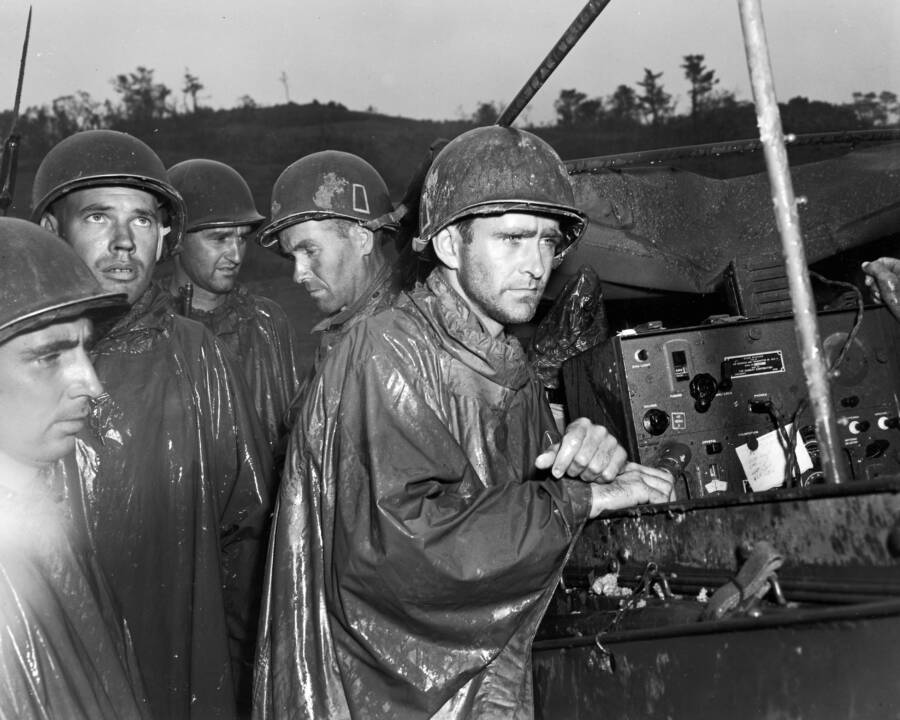
American soldiers on Okinawa in Japan listening to the radio broadcast
announcing the German surrender and the official end of World War II in Europe.
The Battle of Okinawa began in April 1945 and lasted until June,
and
Japan would not officially surrender until September. (All That's Interesting)

As Barack Obama heads to Hiroshima, here is an
excerpt
from a compilation of Hiroshima writings:
A shortened version of the following text appeared in
the International Herald Tribune of January 9, 1998.
In what is perhaps a laudable attempt to declare that underneath the skin, all humans are basically the same (i.e., equally racist), one of your readers compares the World War II ravages of the Japanese and German armies to the massacre at My Lai. Widespread references to "gooks" notwithstanding, the revelation that more than 300 villagers had been killed in one day in Vietnam by fellow Americans immediately brought about uproar, self-questioning, and opposition in U.S. society, not least in military circles which soundly condemned the massacre. In comparison, the few attempts in the past 60 years to simply present the Japanese nation with a straightforward account of its army's involvement in the slaughter of 300,000 civilians at Nanking and other atrocities have been met with wholesale resistance.

Another reader coyly suggests that because they produced the same number of dead, the rape of Nanking is no less racist than the atom bombing of Hiroshima and Nagasaki. He overlooks a fundamental difference. The atom bombs did not appear out of the blue, but after years of gruelling fighting, suffering, and dying at the hands of the fanatical armies of the society which passively allowed its soldiers to slaughter civilians, work prisoners of war to death, and otherwise inflict the most cruel atrocities known to modern man. 

Unlike the majority of wars which flicker out when the outcome becomes obvious, World War II in the Pacific grew increasingly bloody as U.S. forces approached the Japanese homeland. For instance, the battle for Okinawa, the costliest battle for the Americans — and one of the costliest as well for the Japanese — did not end until June 21, 1945, i.e., after the Germans' surrender in the European theater. The prospect of ever-increasing numbers of dead soldiers, and not racism, was the decisive element in deciding the use of the atomic bombs six weeks later. 

In comparison, the Japanese had encountered little effective resistance and few losses in their 1930s occupation of China, and again, at any point during the two-week rape of Nanking, some commander (not least the Emperor) could have stepped in and said "Enough".
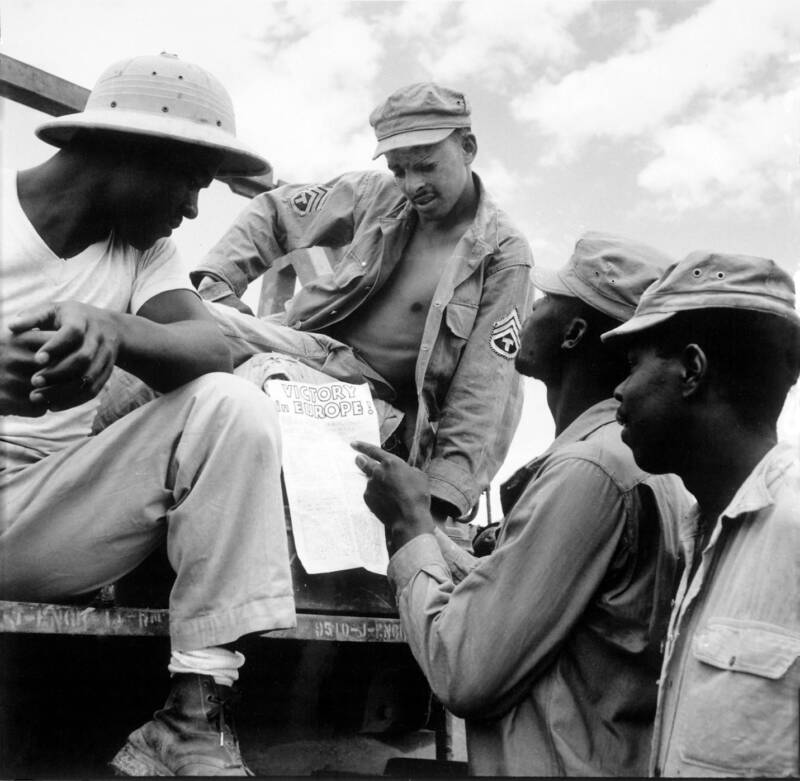
American troops in Burma (now Myanmar) taking a break to read about
the Allied victory over Nazi Germany. (All That's Interesting)
 
Related:
• Hiroshima 15: Examining the Issues Surrounding the Dropping of Atomic Bombs on Japan (Erik Svane)

• Hiroshima 14: "I regard Hiroshima revisionism as the greatest hoax in American history" (Robert Maddox)

• Hiroshima 13: Although It Is Not Said Openly, Hiroshima Also Played a Purifying Role, IE the Baptism of a New Japan, the Event that Put an End to 50 Years of Crimes (Le Monde)

• Hiroshima 12: Political Correctness in Japan: The comment "tramples on the feelings of victims", so… Shut the F**k Up and Lose Your Job! (re the forced resignation of Japan's defense (!) minister)

• Hiroshima 11: If Western elites cannot find perfection in history, they see no good at all; most never learned the narrative of WW II, only what was wrong about it (Victor Davis Hanson)

• Hiroshima 10: If Not for the Atom Bombs, Japan, as we know it today, would not exist (S L Sanger, author of “Working on the Bomb”)

• Hiroshima 9: Over one million warning leaflets were dropped over Hiroshima, Nagasaki, and 33 other Japanese cities 5 days before the Hiroshima bombing (Bill Whittle)

• Hiroshima 8: Was It Wrong to Use the Atom Bomb on Japan? (Father Wilson Miscamble)

• Hiroshima 7: Some Facts About Hiroshima and World War II That You Hear Neither From America's MSM, University Élites, and History Books, Nor From Japan's (New York Times)

• Hiroshima 6: "Lance or spear practice was a regular women's exercise to practice for the anticipated U.S. landing" (a Japanese American)

• Hiroshima 5: Japan's plans for defense involved mobilizing the civilian population, including women and children, for the customary suicidal battle tactics (Thomas Sowell)

• Hiroshima 4: "Les 300 000 morts d'Hiroshima ont épargné bien davantage de Japonais, qui auraient été écrasés sous des bombes ordinaires" (Charles de Gaulle)

• Hiroshima 3: A mainland invasion could have resulted in millions of Japanese deaths—and that's not counting civilians (Wall Street Journal)

• Hiroshima 2: Hand-wringing over Hiroshima is just virtue-signaling by people who never said a bad word about Stalin or Mao’s mass murders (Glenn Reynolds)

• Hiroshima 1: Unlike the ends of the majority of conflicts, World War II in the Pacific grew increasingly bloody as U.S. forces approached the Japanese homeland (Erik Svane)

No Apology for Hiroshima Bomb, Promises an Obama Adviser… by… the Name… of… Ben Rhodes

As I predicted seven years ago, the apologizer-in-chief intends to pay a visit to Hiroshima. After issuing a (faint) apology (!) for World War II at Omaha Beach (!) in June 2009 on the 65th anniversary of the Normandy landings during his first summer in the White House (following an airplane ride from… Dresden, of all places), I predicted that eventually Barack Obama would head for the first city ever to be targeted and destroyed by an atomic bomb.

But wait! Doesn't the White House say there would be no apology for the bombings?

That's right. The president's communications adviser
said that Mr Obama would "not revisit the decision to use the atomic bomb at the end of World War II. Instead, he will offer a forward-looking vision focused on our shared future".
And just who is the president's communications adviser?

That's right: he's the fellow we have heard about recently, thanks to the New York Times. His name is Rhodes… Ben Rhodes…

• Required reading (if you will
forgive me for being so bold):
Hiroshima, 70 Years Later

Sunday, May 22, 2016

Russian forces advance to less than 120 miles from Baghdad


PETROGRAD — The advance guards of General Baratov are now less than 120 miles distant from Bagdad. The Russian forces have already entered Mesopotamia and the occupation of the region of Revanduz represents an important success. This advance gives the Turks little breathing space, for all their efforts to retard the Russian offensive toward Bagdad by the reinforcement of the Khanikin detachment have proved absolutely unavailing. The sixth Turkish army, which is now opposing the British force on the Tigris, in the neighborhood of Kut-el-Amara, is now seriously inconvenienced by the presence of Russian troops on the Persian frontier. 
The New York Herald, European Edition, May 17, 1916