Sunday, September 11, 2011

911 Commemorated in Paris's Luxembourg Garden

On September 11, 2011 — the tenth anniversary of the attacks of 911 — a commemoration was held in the Jardin du Luxembourg with grievers (in the top photo the French Heritage Society's Marie-Sol de la Tour d'Auvergne) laying wreaths at the foot of Bartholdi's model for the Statue of Liberty, including one in the form of the World Trade Center's Twin Towers.

This was followed by speeches and concerts as a drizzle started to fall, all the while an artist was doing a live art rendition of September 19, 2001, changing his canvas as first one building, then the second came down…


See also:
The Skies Shed Tears During Paris Commemoration of 911 Attacks

The America-Bashers' Use of Symbolism on September 11

• Personal Memories of September 11, 2001, in Paris

The Legend of the Squandered Sympathy

• Looking Over TV Shows Inspired by 9-11, Le Monde Discovers (Surprise!) "a Culture of Fear"

Still Looking for "Another" September 11th?

• André Glucksmann: Bin Laden Is Gone, Not The Strategy of Radical Hatred Without Quarter

The French Will Never Forget

Le Monde's 911 Commemorations


The America-Bashers' Use of Symbolism on September 11

As Le Monde Commemorates 911, Plantu is back in his usual style, with a full page inside Le Monde Magazine bringing back 10 years of cartoons that belittle the human toll; or that suggest that Uncle Sam deserved whatever it had coming; or that compare the 2011 attacks of September 11, 2001, to Pinochet's coup d'état in Chile on September 11, 1973.

(This causes him to make —intentionally? — a colossal whopper, saying that 3,000 people died on September 11, 2001, just as 3,000 people died on September 11, 1973; in reality, 3,000 lives were lost during Pinochet's 17 years in power (not one day but close to 6,000 days) — nothing to be proud of, for sure, but facts need to be gotten right and in addition, whatever the toll is, it needs to be compared to those of neighboring régimes, like the 20,000 dead in Fidel Castro's Cuba.)


So No Pasarán is looking back at 10 years' worth of posts (six or seven, really) as well and checking out what it has been saying on the subjects so dear to the hearts of leftists everywhere.

1) Let's first take a look at the "legend", according to which,
in the immediate aftermath of 9/11 the US enjoyed the heartfelt sympathy of the world, only to see this capital of goodwill frittered away by the successive faux pas of an inept and arrogant Bush administration and then definitively exhausted by the launching of an illegitimate war on Iraq in defiance of “world public opinion.”

The Legend of the Squandered Sympathy

(October 10, 2004)
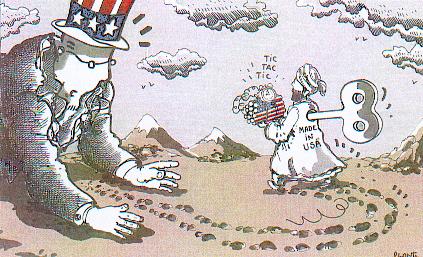
John Rosenthal's Transatlantic Intelligencer article ought to be mandatory reading for anybody studying September 11 and anti-Americanism. In The Legend of the Squandered Sympathy, John Rosenthal notably mentions the cartoon that Plantu saw fit to reproduce on the weekend of the 10th anniversary.
Such was the tenor of Le Monde’s coverage, in effect, just one week after the attacks. The monotonous drone of denunciations continued as the prospect of a military strike against Afghanistan materialized in the weeks ahead, with distraught “New York Jews,” Pashtun warlords and the estranged son of the “O’Dea,” the archetypal all-American family, all chiming in to register their protest and all sounding surprisingly like “third-worldist” Parisian intellectuals – or even indeed like the publisher of Le Monde. (Among other things, the legend of the squandered sympathy occludes the fact that even while a substantial majority of Europeans polled, including in France and Germany, showed spontaneous understanding for American military actions in Afghanistan, large swaths of Europe’s socialist and social-democratic intelligentsia opposed any American military response to the 9/11 attacks whatsoever.) The “boomerang” image went on to become the favored heuristic device of Le Monde and its affiliated publications in their treatment of 9/11. Thus the first issue of the monthly Monde Diplomatique to appear following the events bore the thematic headline “Boomerang Effect” [it also has an article by Maureen Dowd]. In a pictorial variation on the same theme, a special insert in Le Monde itself featured a cartoon depicting a little wind-up Taliban doll, “Made in USA” emblazoned across its back, carrying red, white and blue explosives and circling back toward Uncle Sam.
2) Now let's take a look at the state of democracy and human rights in Chile in 1973 by looking at the (very real) similarities between the overthrow of Manuel Zelaya and that of Salvador Allende

Notice the Similarities with That Other "Coup", the One That Overthrew Leftist Saint© and Martyr™ Salvador Allende?

(July 07, 2009)

In Latin America, José Piñera, armed with evidence including "the momentous Agreement of 23 August 1973 … widely unknown outside Chile", opines that because
President Allende became a tyrant when he broke his solemn oath to respect the Constitution and the Chilean laws [and because] his government [had] fomented the creation of armed militias … the origin of the Pinochet government is that of any revolutionary one, in which only the use of force was left in order to remove a tyrant [and to] "put immediate end" to these constitutional violations . It must be agreed that this was, in fact, an unequivocal call to remove by force the President who had initiated the use of force with the purpose of imposing a communist dictatorship.
…the truth demands recognition that former President Pinochet led a legitimate rebellion against tyranny and that the origin of Chile's civil war --and its victims-- lies with former President Allende and his marxist Socialist party. … The Economist said it clearly at the time: "The temporary death of democracy in Chile will be regrettable, but the blame lies clearly with Dr. Allende and those of his followers who persistently overrode the Constitution" (September 15, 1973).
Resistance to tyrants is obedience to God

Read also about Allende's purported suicide

And check out Romanticists Overlook Allende's Many Faults: Senator Ricardo Núñez Muñoz added in a NYT interview (emphasis mine) that
It’s wrong to say that the CIA, the armed forces, and the bourgeoisie alone brought down the Allende government. It’s obvious we need to admit we made critical economical and political errors that were as decisive if not more decisive
No less a figure than the president of the Partido Socialista, Núñez went on to conclude that
we know another Allende-like experiment would only be a collossal failure.
(Then again, that NYT report was back in 2001…)

3) Finally, we have this for Plantu:

The America-Bashers' Use of Symbolism on September 11

(September 12, 2005)
When confronted with the tragedy that occurred on September 11, 2001, it has become a tradition for some to recall another event that occurred on another September 11.
On that date, in 1973, General Pinochet overthrew Chile's President Allende.
This is supposed to make us think. Hard.
The problem with this, of course, is that there have occurred 500 September 11s in the past 500 years (to take the first round number that came to my mind), with varying occurrences on various continents, in various countries, in various regions, in various cities, in various neighborhoods, and in various personal homes around the world, and just about any one of those occurrences could have been picked to make a comparison with (and provide matter for reflection on, and some kind of metaphysical lesson for) September 11, 2001 (or September 11, 1973, for that matter).
As I have written elsewhere,
If looking down their noses, [America-bashers] ask "Do you know what other event occurred on September 11?", answer "Yes, a terrible tragedy." Pause while they nod approvingly, then add "George Washington lost the battle of Brandywine" (in 1777) or even "Brian De Palma was born on that date" (so was Ferdinand Marcos, by the way), although I'm not sure to what extent that counts as a tragedy. If they object that they are referring to something more recent and more tragic than that, agree and say "you must be talking of Hitler ordering reinforcements to Romania" (1940) or "FDR ordering any Axis ships in U.S. waters shot on sight" (1941) or even "wasn't it the first TV broadcast of a Miss America beauty contest?" (1954). How about, "that was the date (in 1962) that the Beatles recorded their first single at EMI Studios (you know, 'Love Love Me Do')".
This symbolism makes as much sense as noting with alarm that our 40th president sported three names with six letters each, supposedly marking the alleged number of the beast.
(If any association with September 11 should be made — with regards to the 2001 attacks, that is, not the 1973 coup — as several readers have pointed out to me, it would perhaps make more sense to call up the 1669 defeat of the Muslim armies besieging Vienna, bringing an end to the Ottoman advance into Europe.)
But what it all boils down to this: for symbolism to have any kind of meaning, it needs to stay close to its subject and, in my opinion, reflect on the better angels of our nature. What it should especially avoid is collective guilt, not least because that collective guilt is necessarily one-sided, i.e., used exclusively against Americans and their allies (or, historically, by any group against any group's alleged enemies).
For instance, it would probably not be too difficult to search through Chilean history and find some kind of tragedy (nation-wide or otherwise) on a September 11 that proved that the 1973 coup d'état was the Chileans' punishment for the earlier disaster (notwithstanding the fact that many believe that Pinochet's coup averted a far worse catastrophe for the country). In another example, which is actually far more coherent than simply noting a similarity of dates, many state that every setback by Bush or by a Bush ally amounts to (well-deserved) punishment for sending troops to Iraq, but because members of the Coalition of the Willing keep winning elections, this symbolism is discretely ignored. (I call this the wait, wait, wait syndrome.)
The use of symbolism says far more about those who wield it than about those the symbolism is meant to describe (and judge).
So, anyway: we know the date that Pinochet grabbed power in 1973.
Bien.
But what was the date that he relinquished power?
What was the date in 1990 that Pinochet handed power back to a civilian government?
The answer is: March 11.
Now, we all remember what happened in Madrid on March 11, 2004, don't we?
So what is that supposed to mean? What is that supposed to symbolize?
Somehow, we are led to believe, the wholescale murder of 3,000 people in New York and Washington would not, or might not, have occurred had a strongman with no link to (and probably wholly unknown to) the perpetrators not grabbed power on that same date 28 years earlier.
What is the wholescale murder of 191 people in Madrid supposed to mean? That it would not have occurred had that same strongman not handed power back and had he remained in power 14 years earlier?
Your guess is as good as mine…
FURTHER READING:
Le Monde's 911 Commemorations

• Looking Over TV Shows Inspired by 9-11, Le Monde Discovers (Surprise!) "a Culture of Fear"

• Hubert Védrine: Castigating Bush and the Neo-Cons, Former French Foreign Minister Says that the War on Terror Should Have Been Carried Out "With Discretion"

• André Glucksmann: Bin Laden Is Gone, Not The Strategy of Radical Hatred Without Quarter

The French Will Never Forget

The Legend of the Squandered Sympathy

Wes Riddle's "9-11 We Remember"

Wesley Riddle has created a musical tribute to commemorate the attacks of 9-11 (merci à Carine).

This 9-11 video montage is a tribute of those who sacrificed and continue to sacrifice today for our freedom and a remembrance of the tragic events and heroic deeds that took place on September 11, 2001

Saturday, September 10, 2011

Irony Ignored by Noble Minds

A vessel looking for proof that your use of a lawnmower causes baaaad juju and other manmade disasters such as global warning gets stuck in the ice.

Elsewhere: lots of global warming due this winter in the land of the superior, enlightened, know-it-all types. Remember climate isn't weather and vice versa.

Castigating Bush and the Neo-Cons, Former French Foreign Minister Says that the War on Terror Should Have Been Carried Out "With Discretion"

Gaïdz Minassian and Nicolas Weill have an interview in Le Monde of Hubert Védrine, the French foreign minister in 2001 who, needless to say, enjoys the benefit of hindsight.

In the interview, Védrine says that the fight against the terrorists should have been carried out "with discretion"; he castigates the neocons' takeover (from realists like Colin Powell) of George W Bush' foreign policy; he refers to "Bush's Manichean policy" as America's worst foreign policy since the foundation of the republic; he brings us a caricature of the hawks during the Cold War who allegedly wanted nothing but (a real) war with the Soviet Union; he supports a second Obama term ("l'intelligence de Barack Obama est éclatante"), "expecially if he is opposed by a Republican extremist"; and he pays honor to the… honor of France for opposing the Iraq conflict.
Prétendre créer, de l'extérieur, un Afghanistan moderne était illusoire. Et surtout, c'était une erreur tragique de proclamer, comme l'a fait George W. Bush, la "guerre contre le terrorisme" (formule bizarre, le terrorisme n'étant pas une entité, mais une technique) comme le problème numéro un du monde, et de tout articuler de façon binaire autour de cette seule question.
Quel cadeau inespéré aux terroristes, qu'ils aient été capables d'atteindre ce niveau de nuisance et que cela soit reconnu par la première puissance mondiale ! Et quel simplisme ! Il fallait être implacable, et il faut continuer aussi longtemps que nécessaire, mais le faire discrètement.
Est-ce que, dès 2001, vous pressentiez une volonté américaine d'en "découdre" avec l'Irak et se profiler les futures tensions entre Paris et Washington (guerre de 2003) ?
Oui, c'était perceptible, avant même le 11-Septembre. Déjà au printemps 2001, lors d'un voyage à Washington pour rencontrer la nouvelle administration, j'étais revenu convaincu de la volonté de cette équipe — le vice-président Dick Cheney en tête — de s'en prendre à l'Irak dès qu'une opportunité et un prétexte se présenteraient. Et c'était évident à l'avance que la France ne pourrait y souscrire, sauf suivisme aveugle.
On le sait maintenant : dès le lendemain du 11-Septembre, Dick Cheney a convaincu George W. Bush, hésitant, d'attaquer l'Irak. Pays sans aucune responsabilité dans le 11-Septembre, mais cible idéale : régime détestable, indéfendable, accusable sans preuve des pires choses, assez fort apparemment pour que sa défaite lève l'humiliation américaine, pas assez pour ne pas pouvoir être facilement écrasé.
On a le sentiment que, avec ces attentats, la politique étrangère américaine est passée des mains des "réalistes" (Colin Powell, etc.) aux "néocons" (Paul Wolfowitz, Richard Perle, etc.). Quel jugement portez-vous sur cette prise en main ?
Il y avait eu au début de la présidence de George W. Bush des réalistes pondérés (Colin Powell), mais aussi des nationalistes durs voulant "finir le job", interrompu selon eux après la libération du Koweït (Donald Rumsfeld, Dick Cheney), des néocons "occidentalistes", et un président incertain sur son rôle et sa mission.
Après le 11-Septembre, il y a eu clairement une OPA complète des néoconservateurs sur la politique étrangère de George W. Bush, et même, Richard Perle — président du comité des conseillers du Pentagone — s'en vantait publiquement, un alignement sur la politique de la droite israélienne, le Likoud. Mais cela dit, la conseillère à la sécurité nationale, Condoleezza Rice, était déjà sur cette ligne au printemps 2001 à propos du Moyen-Orient.
A mes yeux, il en est résulté la plus mauvaise politique étrangère américaine depuis la fondation des Etats-Unis, la plus intelligente ayant été celle d'Harry Truman, de Marshall, de Dean Acheson après la guerre pour concevoir une stratégie de longue durée envers l'URSS : dissuasion, fermeté, ténacité et patience face à la menace soviétique, sans reconquête ni aventurisme. Cette politique tenace fut poursuivie jusqu'à la fin de la guerre froide avec succès, à la grande fureur des "faucons", ancêtres des néoconservateurs, qui voulaient en découdre sans attendre la chute de l'URSS.
See also:
Le Monde's 911 Commemorations

• Looking Over TV Shows Inspired by 9-11, Le Monde Discovers (Surprise!) "a Culture of Fear"

The America-Bashers' Use of Symbolism on September 11

• André Glucksmann: Bin Laden Is Gone, Not The Strategy of Radical Hatred Without Quarter

The French Will Never Forget

911 Commemorated in Paris's Luxembourg Garden

The Legend of the Squandered Sympathy

Le Monde's 911 Commemorations


Needless to say, Le Monde joins in the 911 commemorations, which include the obligatory reference to the decline of the American empire since the attacks of September 11, 2001.

Cartoonwise, we have the publication of a graphic novel with various artists, French and American, in addition to Plantu's take in the form of an artistic "dialog" with Daryl Cagle.

See also:
• Looking Over TV Shows Inspired by 9-11, Le Monde Discovers (Surprise!) "a Culture of Fear"

• Hubert Védrine: Castigating Bush and the Neo-Cons, Former French Foreign Minister Says that the War on Terror Should Have Been Carried Out "With Discretion"

• André Glucksmann: Bin Laden Is Gone, Not The Strategy of Radical Hatred Without Quarter

The French Will Never Forget

The Legend of the Squandered Sympathy

Friday, September 09, 2011

The French Will Never Forget

On the tenth anniversary of the September 11 attacks, a Paris organization, The French Will Never Forget 911, will be holding an official commemoration on the Place du Trocadéro, with a concert following in the evening…
"On behalf of my fellow citizens, I wish to thank the association « The French Will Never Forget» for organizing this event which bears witness to Franco-American friendship. This friendship began with the birth of the USA, and will continue as our two nations continue to share certain essential values, such as freedom, tolerance and solidarity among nations."
His Excellency Charles H. Rivkin, United States Ambassador to France

"I would very much like to congratulate the association “The French Will Never Forget” on this key event which is remarkable in terms of both its scale and its symbolic value. Ten years after the tragedy of September 11, the entire French nation will express to America its friendship, compassion and support. And on that day, in the presence of the names of the victims whom we will never forget, we will all once again be Americans"
His Excellency François Delattre, French Ambassador to the United States

Dogooderism reaches its' Logical Conclusion

So what if they meant well. They're morons.

The guns being bought back from the streets weren't 9 mm handguns or Glocks. Instead, they were Nerf guns or toy pistols.
More importantly, victory was declared. And all without a single shot fired.
Lane said the five-hour gun buyback was expected to take about 100 toy guns from young people.
"We've got to be willing to exchange everything and anything to get guns off the street," he added.

Thursday, September 08, 2011

Bin Laden Is Gone, Not The Strategy of Radical Hatred Without Quarter

Le 11-Septembre fut d'emblée vécu comme impossible
writes André Glucksmann as Le Monde readers accuse him of being (horrors) pro-American and pro-Israeli while ignoring Arabs' aspirations and their (well-founded) hatred.
Les témoins n'en croient pas leurs yeux, les responsables désemparés s'estiment en pleine science-fiction, les prudents qui veulent raison garder la perdent en fabulant de délirantes conspirations (la CIA, les juifs, de mystérieux spéculateurs immobiliers). Reste que l'impossible a eu lieu et que ce lieu a été nommé sans hasard "Ground Zero", soit l'espace dévasté des premières expériences atomiques.

… Si fulgurant qu'il paraisse, un événement n'est jamais un commencement absolu. Une fois l'effarement général dissipé, force est de constater que l'attaque de New York n'est inouïe ni dans son inspiration, ni par ses acteurs, ni même dans son mode opérationnel. La stratégie de la panique par l'incendie des villes et l'affolement délibéré de la population fut théorisée il y a un siècle et demi par le nihilisme russe, Bakounine, Netchaïev – voyez Les Possédés, de Dostoïevski.
Viser sans discrimination des civils, le projet ne date pas davantage de septembre 2001 : depuis Guernica, les fanatismes profanes ou célestes ont dépeuplé sans remords le XXe siècle. Le mode opérationnel lui-même n'est pas privé d'antécédents : la cible fut attaquée en 1993 (en sous-sol, une voiture bourrée d'explosifs) ; le moyen, un avion détourné, fut essayé à Noël 1994 (l'Airbus d'Alger devait s'écraser sur Paris). Quant au côté suicidaire des tueurs s'érigeant en missiles humains, il n'apparaît invraisemblable qu'aux ingénus : bolcheviques, nazis, intégristes de tout poil abondent de sacrificateurs professionnels résolus à faire don de leur vie pour le "bien de la cause". Les pièces du puzzle s'étalaient ainsi dans le désordre, il manquait le concept qui permet d'imaginer l'inimaginable.
… Le 11-Septembre n'était pas fatal, à condition d'en prévoir la possibilité. On explique l'aveuglement général par la paralysie bureaucratique (CIA contre FBI) et les rivalités au sommet. Explications trop courtes: une vue acérée et consensuelle des risques courus en commun aurait balayé ces conflits rituels et lassants. Tout au contraire, le préjugé de vivre "la fin de l'histoire" enivrait nos bons apôtres: la guerre froide est terminée, les menaces majeures sont abolies ! L'optimisme stratégique célébrait la disparition du grand ennemi unique : plus d'adversaire omniprésent, donc plus d'adversité. Ce raisonnement fallacieux valait passeport pour le meilleur des mondes; les budgets militaires fondaient, la paix universelle était à portée de main, seuls subsistaient des "conflits de faible intensité" qui dévastaient les banlieues du monde sans inquiéter les métropoles vautrées dans leur sécurité.
… Dix ans plus tard, avons-nous franchi le cercle enchanté de nos sommeils euphoriques si cher payés ? Oui et non.
Oui : l'Amérique réévalua ses alliances inconditionnelles. L'Arabie saoudite n'avait-elle pas fourni à Al-Qaida son idéologie (le salafisme), son financement et une base de recrutement (quatorze sur dix-neuf des pirates sont enfants de la bonne société saoudienne) ? Conséquence théorique : "Le fait que, soixante ans durant, les nations occidentales ont excusé et se sont accommodées du manque de liberté au Moyen-Orient n'aida en rien à notre sécurité parce qu'à long terme la stabilité ne peut être achetée au prix de la liberté." (Déclaration de G. W. Bush, le 7 novembre 2003.)
Conséquence pratique : Saddam Hussein, épargné en 1991 sous pression saoudienne au prix du double massacre des Kurdes et des chiites, est pendu. Depuis, les despotes en proie aux soulèvements populaires sont "lâchés" (Tunisie, Egypte, Libye). Méditerranée, Proche et Moyen-Orient s'extirpent d'une histoire froide et de sociétés gelées. La chape de plomb saute pour le meilleur puisque partout les revendications démocratiques étoffent des rêves de liberté.
… Le Vieux Continent navigue à l'aveuglette. Ses complaisances à l'égard de la Russie poutinienne, corrompue jusqu'à l'os, violente et nihiliste, protectrice des Assad, prouvent combien la leçon dissuasive du 11-Septembre s'oublie.
"Une fois renversées les bornes du possible, il est difficile de les relever", stipula Clausewitz, annonçant que l'ère des batailles méga-massacreuses ne finit pas avec Napoléon. La Belle Epoque se gaussa, mais le siècle suivant confirma. Ben Laden a disparu, pas la stratégie des haines radicales et sans merci.

The story of how Coco Chanel metamorphosed from a mere “horizontal collaborator” into an actual German secret agent

Gabrielle Chanel — better known as Coco — was a wretched human being
writes Judith Warner in her book review of Hal Vaughan's Sleeping With the Enemy (Coco Chanel's Secret War) — something that brings to mind other female celebrities who were far from reluctant to take Nazis as lovers in occupied France during World War II.
Anti-Semitic, homophobic, social climbing, opportunistic, ridiculously snobbish and given to sins of phrase-making like “If blonde, use blue perfume,” she was addicted to morphine and actively collaborated with the Germans during the Nazi occupation of Paris. And yet, her clean, modern, kinetic designs, which brought a high-society look to low-regarded fabrics, revolutionized women’s fashion, and to this day have kept her name synonymous with the most glorious notions of French taste and élan.

…Chanel’s … anti-­Semitism was vociferous and well documented …

It wasn’t much of a stretch, then, for Chanel, during wartime, to find herself the mistress of the German intelligence officer Baron Hans Günther von Dincklage, a charming character who had spied on the French fleet in the late 1920s, and who found himself pleasingly single in occupied Paris, having presciently divorced his half-Jewish German wife just before the passage of the Nuremberg Laws. It wasn’t any particular betrayal of her values, or morals or ideals either, for Chanel to find herself traveling to Madrid and Berlin to engage in cloak-and-dagger machinations with her country’s occupier.

The story of how Coco became Chanel has been told many times before over the past half-century, most recently (and, sad to say, much more engagingly) in last year’s “Coco Chanel: The Legend and the Life,” by the British fashion columnist Justine Picardie. The story of how Chanel metamorphosed from a mere “horizontal collaborator” — the mistress of a Nazi — into an actual German secret agent has been less well known, though earlier writers have reported that she had worked for the Germans. It’s here that Vaughan makes his freshest contribution, using a wealth of materials gleaned from wartime police files and intelligence archives, some of which were only recently declassified by French and German authorities, to flesh out precisely how and why she became an agent, and how she sought to profit from her German connections during the war.
Despite her indisputable collaborationist activities, and after a brief period of uncertainty during which she was questioned by a French judge, Chanel eventually got off pretty much scot-free after the war, once again using her wiles to protect herself most expertly. She tipped off the poet and anti-Nazi partisan Pierre Reverdy, a longtime occasional lover, so that he could arrange the arrest of her wartime partner in collaboration, Baron Louis de Vaufreland Piscatory; she paid off the family of the former Nazi chief of SS intelligence Gen. Walter Schellenberg when she heard that he was preparing to publish his memoirs. (It was Schellenberg who had given her the “model hat” assignment.) Vaughan could have done better in providing the context to the seemingly incomprehensible ease of Chanel’s reintegration into French fashion and society, telling more, for example, of the widespread desire for forgetting and moving forward that held sway in Charles de Gaulle's postwar France.

Wednesday, September 07, 2011

Some Facts About Hiroshima and World War II That You Hear Neither From America's MSM, University Élites, and History Books, Nor From Japan's

…most Japanese are shocked to hear that their nation also tried to build an atomic bomb. “I have no doubt Japan would have used it if it succeeded,” [former schoolteacher Kiwamu Ariga, 81, said].
Independantly from Martin Fackler's New York Times article, it's good to again listen to Bill Whittle take on the liberals' Hiroshima myth (aligato to Instapundit).
Jon Stewart gets his facts wrong about America's use of the Atomic bomb in World War 2. Should Harry Truman have been prosecuted as a war criminal? Whittle takes you back to those fateful days and tells you the facts about the history altering decisions to drop two Atomic bombs on Japanese cities.
As it turns out,
for decades Ishikawa’s role [regarding Japan’s secrecy-wrapped efforts to build an atomic bomb during World War II] went largely unnoticed, as an economically resurgent Japan tried its best to put its wartime past behind it. Since the 1990s, major media have become less inhibited about discussing the war, including Japan’s atomic bomb programs. However, the programs still seem to be easily forgotten in a nation that is more accustomed to thinking of itself as the victim of the deadly American atomic attacks on Hiroshima and Nagasaki.
… “We were brainwashed during the war, and we were brainwashed again after the war,” Mr. Ariga said. “Maybe we will get wise the third time.”

Tuesday, September 06, 2011

Marhaba, Michael Savage fans!


Thanks also to Michael Savage for da linky love to ¡No Pasarán!.

You’re an evil genius, and Britons don’t deserve you, your observations and commentary, NOR your mushroom sauce recipe... Britannia rules the knaves, anyway.

It’s as Entertaining as Watching a Bear Peddling a Unicycle

When the lights went out across Europe:

As of 1 September, conventional light bulbs of more than 40 watts will be taken off the market. In the countries of the Arctic Circle, it’s a step into the dark that’s being badly received.
Actually it’s more like watching a bear peddling a unicycle without any background music in a basement full of silent, ruminating Iggy Pop wannabees.
Next will be vacuum cleaners, fans, coffee makers, hair dryers.
Every time you use a coffee maker, Gaia strangles a puppy.

2 Leaders Try Not to Join the Jobless

Nicolas Sarkozy, Barack Obama: two presidents now on parallel paths of bad unemployment numbers, lousy poll scores, and prospects for re-election next year that run from diminished to dubious.
Thus starts John Vinocur's article in the International Herald Tribune.
Not to mention weakening economies, a couple of shooting wars in Libya and Afghanistan, and countrymen who view their nations’ roles in the world as exceptional and universal — although the Americans more in terms of a burden of responsibility and the French as a pick-and-choose entitlement.

… Coming back to France after close to four weeks of unscientific watching and listening on the other side of the Atlantic provides an interesting contrast.

In the United States, the impact of markedly bad unemployment figures of 9.1 percent — the net job change of zero in August was the first of its kind since 1945 — has immense shock value in a country used to jobless rates regularly half those of Western Europe. People are truly taken aback.

Reporting on Mr. Obama’s August vacation island of Martha’s Vineyard, Massachusetts, a center of left-wing chic, The Boston Globe said “Obama fever” on the island had become a memory, replaced by disaffection over partisan deadlock and the stalled economy.

But that was mild stuff compared with criticism coming from core constituencies — environmentalists who describe as a brazen sellout the president’s abandoning a major anti-pollution effort, or blacks complaining that he was avoiding focusing on dramatic employment rates in black communities.

America’s ambient noise has clearly changed. Strikingly, words like weak, ineffectual and mediocre to describe Mr. Obama have migrated and been transmogrified from talk-radio screech into reasonable on-air discussion.

… Mitt Romney, a possible mainstream Republican candidate asked, “Have we ever had a president before who was eager to address the world with an apology on his lips and doubt in his heart?”

… So a little more than three months before an election year, who’s better off? Mr. Sarkozy, who has limited popularity but a certain credibility in crises, or Mr. Obama, whose lifestyle and mannerisms don’t find contempt, but whose competence managing the American economy (and foreign policy) is increasingly in doubt?

… For both French exceptionalists and the general French public, victories are a relative notion — being in the game, being respected, and, when possible, doing things differently, à la française.

That’s a million miles from predicting a Sarkozy victory or an Obama loss, or vice versa. But while the two confront similar issues, an American president has unquestionably higher hurdles to clear in a nation where winning — and not oozing around the edges of loss or decline — is still an instinctive, national expectation.

Monday, September 05, 2011

Our Chinese Future

Xie's family asked why Xie would choose to severely mutilate so much of his body in a suicide attempt.
Voila les Chinoiseries:
Anti-corruption official found dead with 11 knife wounds, police declare it a suicide
Enjoy your “post-American-century, folks!
It was suggested that Xie's suicide was possibly related to work issues, stemming from his failure to be promoted to the standing committee at his office.
And remember: Daddy drinks because you cry!

Looking Over TV Shows Inspired by 9-11, Le Monde Discovers (Surprise!) "a Culture of Fear"

…jamais un événement historique n'aura été si vite, si abondamment représenté et commenté de manière fictionnelle.
Le Monde has a dossier by Macha Séry on TV films and TV series [but not movies] inspired by the 9-11 attacks (The Event, Rubicon, and The Killing, along with even Mad Men and episodes of West Wing), which of course includes the subhead "a culture of fear"; which misspells the name of Georges Bush, while castigating Fox News' alleged "propaganda" in Dubya's favor; and which includes Martine Delahaye's fillers on shows such as Fringe (Fringe), FlashForward (FlashForward), Rescue Me, les Héros du 11-Septembre (Rescue Me), and of course 24 Heures Chrono (24) as well as the documentary Les Routes de la terreur.
Après le 11-Septembre et la guerre en Afghanistan, deux perspectives se sont ouvertes aux scénaristes : dépeindre une Amérique qui doute, traversée par une perte de confiance (séries conspiration-nistes, type « Alias ») ou renforcer le patriotisme en suggérant la victoire morale des Américains.
Dans "Science-fiction et paranoïa", un documentaire américain de 2011, Steven Spielberg avoue qu'il n'aurait jamais fait Rencontre du troisième type et E.T. : « Je pense qu'après le 11-Septembre, j'ai perdu un peu de mon innocence. L'inconnu n'est peut-être pas aussi bienveillant que ça. » Aux espions de l'Est, aux communistes armés de la bombe nucléaire, au fantasme de cinquième colonne, a succédé à l'écran, jusqu'à y proliférer, la figure du terroriste, de l'ennemi invisible, des cellules dormantes.
« A partir de 2002, nota l'historienne Olivia Brender dans une étude publiée en 2007 par l'institut Pierre Renouvin, les personnages d'«Arabes» se multiplièrent dans les séries télévisées. Si, par le nombre d'intrigues où des Arabes furent suspectés à tort d'être des terroristes, la fiction télévisée hollywoodienne sembla assumer un rôle pédagogique en combattant les clichés qu'avaient pu faire naître les attentats du 11-Septembre, force est de constater qu'elle participa insidieusement à alimenter la peur à l'égard des Arabes vivant sur le sol américain. (...) Par sa seule présence physique, le personnage «arabe» crée un danger potentiel. »

As for Radio France, writes Alain Constant, it has prepared a theme for every day:
• terrorisme, état de la menace (jeudi 1er septembre),
• génération 11-Septembre (vendredi 2),
• le 11-Septembre inspire la culture (samedi 3),
• ma vie a changé (dimanche 4),
• la guerre de dix ans (lundi 5),
• l'économie mondiale (mardi 6),
• les religions (mercredi 7),
• les transports (jeudi 8),
• les dix ans des Etats-Unis (vendredi 9).
• Des reportages en direct de New York et du Pakistan seront diffusés
samedi 10, et dimanche 11 pour les cérémonies de commémoration.
France Bleu programme mardi 6 septembre sur ses 43 antennes une journée spéciale, en partenariat avec le Mémorial de Caen. Le lendemain, c'est France Culture qui propose une journée intitulée " New York/Le Caire : le choc des civilisations est-il derrière nous ? ", avec des rendez-vous en direct du Caire, de New York et de Kaboul. Vendredi 9, de 6 heures à minuit, France Inter propose, en direct de New York, des rendez-vous avec de multiples invités, dont Jay McInerney et Patti Smith. Toujours vendredi 9, Le Mouv' diffuse les reportages d'Antoine Giniaux en direct du French Institute.

Sunday, September 04, 2011

French Puss in the Big Apple

After his French owners emigrated to New York, Texas (that's the cat's name) opened his own blog.
Welcome to my weblog!

I finally got my human to finished my weblog so we can have more serious conversations about serious issues: cat food, catnip, napping, playing with your human, domesticating your human…
(Dogs welcome too if they can behave)

Saturday, September 03, 2011

Don't Mess With Tunisia


On either side of a skull and crossbones on a wall in the Tunisian city of Tataouine (which inspired George Lucas, who filmed scenes of the first Star Wars movie near the town, for the name of Luke Skywalker's home planet) are the words "Texas Liberty" and "Don't Mess with Tunisia." (، والقراء Instapundit ترحيب)

P.S. However, those aren't longhorns above the word "Texas" but some sort of Arabic script (Yeah, I too wonder what they mean)

Friday, September 02, 2011

"More taxes, not less spending, is their underlying creed": The patent nonsense of Europe’s most unreconstructed Socialist Party

France’s Socialists have yet to come to terms with the modern world
comments Charlemagne as The Economist analyzes those whom it calls "the dinosaurs".
The oddity is that almost everywhere the European left is in decline. Among the large countries, Socialist parties rule only in Spain, where they look likely to lose November’s election. The only big place where the left has a good chance of returning to power is France, at next spring’s presidential election. Yet France’s Socialist Party also stands out as Europe’s most unreconstructed. Hence the contorted spectacle of a party preparing for power at a time when the markets are challenging its every orthodoxy.

… Next to such patent nonsense [i.e., the French Socialist thinking of an “anarchic globalisation”-denouncing Ségolène Royal or of a “deglobalisation”-promoting Arnaud Montebourg], promises by the two front-running candidates, Martine Aubry and François Hollande, seem merely frozen in time, circa 1981. They want to return to retirement at the age of 60 (it has just been raised to 62), and to invent 300,000 public-sector youth jobs. Each supports Mr Sarkozy’s deficit-reduction targets, but refuses to approve his plan to write a deficit rule into the constitution. More taxes, not less spending, is their underlying creed.

The party is not out of tune with public opinion. The French are almost uniquely hostile to the capitalist system that has made them one of the world’s richest people. …

The causes of French left-wingery are various, but a potent one is the lingering hold of Marxist thinking. Post-war politics on the left was for decades dominated by the Communist Party, which regularly scooped up a quarter of the votes. In the 1950s many intellectuals, including Jean-Paul Sartre, clung to pro-Soviet idealism even after the evils of Stalinism emerged. Others toyed with Trotskyism well into the 1970s. François Mitterrand, who mentored Ms Royal, Ms Aubry and Mr Hollande, was swept to the presidency in 1981 by offering a socialist Utopia as a third way between “the capitalist society which enslaves people” and the “communist society which stifles them”. …

Please allow us a moment of madness

All this requires heroic faith among centrists considering voting Socialist that reason will triumph over fiscal folly. Moreover, experience suggests that the Socialists, if elected, may feel compelled to introduce some signature policy as a sop to their disappointed base. Under Mitterrand, it was the wealth tax. Under Mr Jospin, it was Ms Aubry’s 35-hour working week. With France’s recovery fragile, the prospect of more such lunacy is chilling.

Reporting Data on Things That Have Yet to Happen

The apocalypse brigade continues to onanisticly fools itself:

RATES of mental illnesses including depression and post-traumatic stress will increase as a result of climate change, a report to be released today says.
The paper, prepared for the Climate Institute, says loss of social cohesion in the wake of severe weather events related to climate change could be linked to increased rates of anxiety, depression, post-traumatic stress and substance abuse.
As many as one in five people reported ''emotional injury, stress and despair'' in the wake of these events.
...in the past tense. Honest of them isn’t it?

The conclusion?
Mental illness rise linked to climate
Surely. But isn’t everything?
The report also looks at mental health in the aftermath of major weather events possibly linked to climate change.

It shows that one in 10 primary school children reported symptoms of post-traumatic stress disorder in the wake of cyclone Larry in 2006. More than one in 10 reported symptoms more than three months after the cyclone.
Which is weather, despite the fact that we are told that weather is not climate. Sometimes.

Thursday, September 01, 2011

Market Economy the Leftist Way

I guess with all of that “most ethical congress” transparency stuff on their minds, they forgot to hide their graft and cronyism.

Since Regina Dugan became the director of Darpa, the Pentagon’s top research division has signed millions of dollars’ worth of contracts with her family firm, which in turn owes her at least a quarter-million dollars. It’s an arrangement that has raised eyebrows in the research community, and has now drawn the attention of the Defense Department’s internal auditors and investigators.
She was a program manager at DARPA from 1996-2000 when Clinton was in office. She then founded RedXDefense, the recipient of the contracts in question in 2005.

Her strength was not in engineering as is so firmly touted, but rather in the business of gaming tax money:
The company allowed Dugan to dig into a range of business activities -- she worked on developing relationships, fundraising, legal and financial work, as well as marketing.

It’s Hard Work, but Somebody has to do it

It’s a side effect of France’s one psychosis policy.

Chinese women come home super sluts after studying in France, according to an associate judicial professor lecturing his class.

Poverty in France Has Worsened

On est loin de la promesse faite par le gouvernement, en octobre 2007, de réduire la pauvreté d'un tiers en cinq ans.

After a dip in 2008, poverty in France resurged in 2009 ("France's worst recession since the Second World War"), writes Philippe Le Coeur in Le Monde, with the poverty rate reaching 13.5% (although the median standard of living improved that year) and with the government promising to bring an "exceptional" tax for the country's richest citizens.

Meanwhile, Louis Maurin points out that the number of people living under the poverty level has grown (from 7.5 million to 8.2 million people) between 2002 to 2009, as has the poverty rate (from 12.9% to 13.5%). Needless to say, the Observatoire des inégalités director, interviewed by Anne Chemin, castigates tax decreases (as "wasted money").
…la pauvreté augmente dans notre pays. C'est un tournant historique…

…Si l'on veut améliorer de façon durable la situation de ceux qui sont le plus en difficulté dans notre pays, il faut agir de façon concrète. Imaginez quelle serait la situation de notre pays si les 80 milliards d'euros gâchés chaque année en cadeaux fiscaux aux catégories aisées avaient été consacrés pour moitié à réduire les déficits et pour moitié à des programmes d'investissements concrets, qu'il s'agisse de transports en commun, de logement social, d'accès aux soins !

L'un des volets les plus importants est une vraie réforme du système éducatif, de la maternelle à l'université. Taillé sur mesure pour les milieux favorisés, c'est lui qui fait que les plus démunis le restent de génération en génération. Bref, dans les années 2000, la France a loupé l'occasion de se moderniser. Tout ce que l'on peut espérer, c'est que la crise actuelle débouche sur une véritable remise à plat. Les niches fiscales n'ont déjà plus la cote.