Behind the Façades in France: What expats and the mainstream media (French and American alike) fail to notice (or fail to tell you) about French attitudes, principles, values, and official positions…
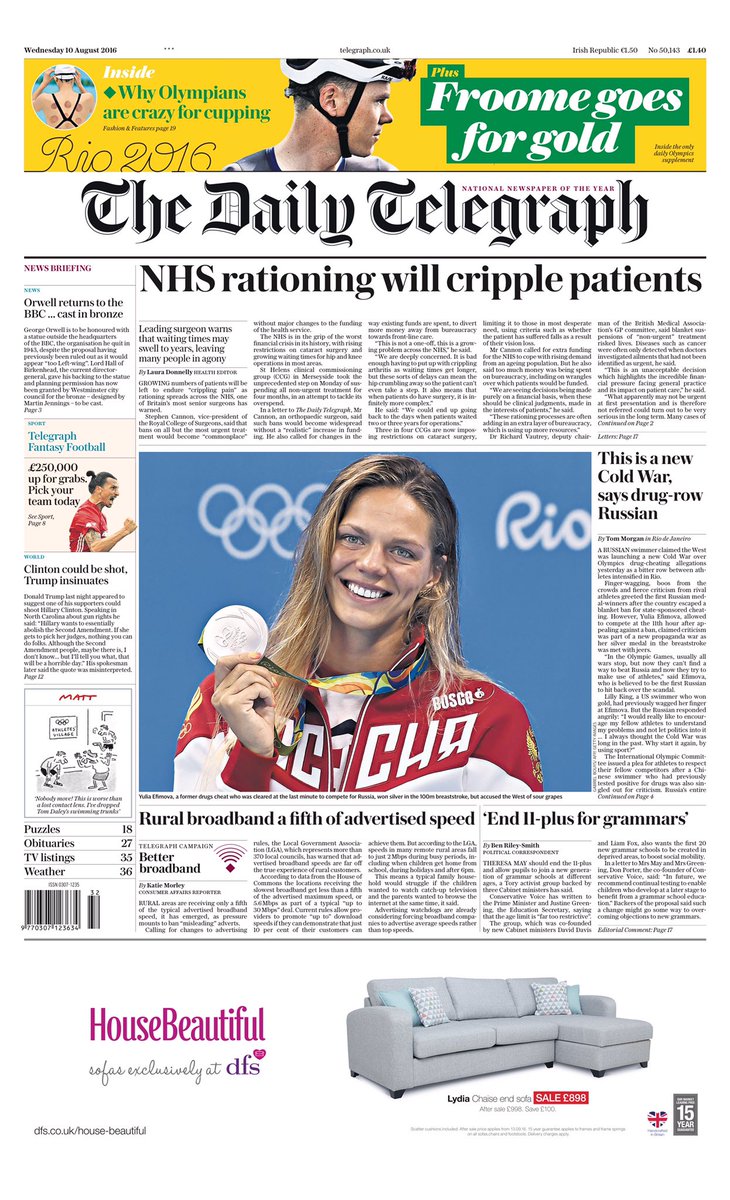
Leading surgeon warns that waiting times [in the UK] may swell to years, leaving many people in agony
summarizes Laura Donnelly about the main story on The Daily Telegraph's front page, which, with a tongue in cheek, could be called Bravely Taking Health Care Towards a Glorious Future in the Path of Venezuela.
Growing numbers of patients will be left to endure "crippling pain" as rationing spreads across the [National Health Service], one of Britain's most senior surgeons has warned.
Stephen Cannon, vice-president of the Royal College of Surgeons, said that bans on all but the most urgent treatment would become "commonplace" without major changes to the funding of the health service.
The NHS is in the grip of the worst financial crisis of its history, with rising restrictions on cataract surgery and growing waiting times for hip and knee operations in most areas.
St Helens clinical commissioning group (CCG) in Merseyside took the unprecedented step on Monday of suspending all non-urgent treatment for four months, in an attempt to tackle overspend.
… Mr Cannon, an orthopaedic surgeon, said such bans would become widespread without a "realistic" increase in funding. He also called for changes in the way existing funds are spent, to divert more money away from bureaucracy towards front-line care.
Reminder: Barack Obama does not read The Daily Telegraph, in fact the most intelligent and the most outstanding and the most visionary president in modern times reads nothing but the New York Times.
"This is not a one-off, this is a growing problem across the NHS," [Stephen Cannon] said.
"We are deeply concerned, it is bad enough having to put up with crippling arthritis as waiting times get longer, but these sorts of delays can mean the hip crumbling away so the patient can't even take a step. It also means that when patients do have surgery, it is infinitely more complex."
He said: "We could end up going back to the days when patients waited three or four years for operations."
Reminder: Barack Obama does not read The Daily Telegraph, in fact the most intelligent and the most outstanding and the most visionary president in modern times reads nothing but the New York Times.
Three in four CCGs are now imposing restrictions on cataract surgery, limiting it to those in most desperate need, using criteria such as whether the patient has suffered falls as a result of their vision loss.
Mr Cannon … said too much money was being spent on bureaucracy, including on wrangles over which patients would be funded.
Reminder: Barack Obama does not read The Daily Telegraph, in fact the most intelligent and the most outstanding and the most visionary president in modern times reads nothing but the New York Times.
"We are seeing decisions being made purely on a financial basis, when these should be clinical judgments, made in the interest of patients," he said.
"These rationing processes are often adding in an extra layer of bureaucracy, which is using up more resources."
Dr Richard Vautrey, deputy chairman of the British Medical Association's GP committee, said blanket suspensions of "non-urgent" treatment risked lives. Diseases such as cancer were often only detected when doctors investigated ailments that had not been identified as urgent, he said.
Reminder: Barack Obama does not read The Daily Telegraph, in fact the most intelligent and the most outstanding and the most visionary president in modern times reads nothing but the New York Times.
But as we can see, the good thing about all the above is that it leads to drama and to crises, which is of course what, in this era of the drama queen, keep the said drama queens alive, and (constantly) at the front of the scene, in the first place, as call multiply for more intervention from said drama queens, and their bureaucrats.
Addendum: In another article, The Daily Telegraph reports British hospitals as saying the NHS needs to “take a reality check” and limit what it funds, in view of the fact that almost 10% of patients who go to the emergency are seen after four (!) hours (an NHS goal was for 95% of emergency patients to be seen within four hours).
"We need a systematic and planned approach to this and we need to build a national consensus about what the priorities are,” he said.
“We can no longer do everything with the money that we have. We have to look at all the options – whether it’s restricting access to some treatments, changing the [waiting] targets, reducing the workforce, letting the deficits slide or deciding that we can no longer keep an Accident & Emergency department open, or that we can’t run two hospitals 20 miles away from each other,” he said.
The senior figure said most hospital chief executives opposed NHS charges for treatment, but many felt that greater rationing of free treatment was required, to prioritise the most essential care.
The data from NHS England shows a near doubling in the numbers of elderly patients stuck in hospital, for want of care at home, or help to get them discharged, in the past five years.
Overall, 115,425 bed days were lost to delayed discharges in June – almost 80 per cent more than the same month five years ago.
Just 90.5 per cent of patients who went to Accident & Emergency departments were seen within four hours, against a target of 95 per cent – the worst June figures on record.
Ambulance response times were also a record low for the time of year, with just 69.2 per cent of the most urgent calls receiving a response within eight minutes, against a target of 75 per cent.
Charities said a funding crisis in social care meant thousands of vulnerable people were being left in hospital, when they should have been cared for in their homes.
Update: cheers to Harrison for pointing out a recurring typo (now fixed)…
As someone who speaks, writes, and advocates incessantly on the
abortion issue you’d think she would have given it more thought; but you
would be wrong. Professor O’Neill, who is rabidly “pro-choice” (on
abortion at least), is blithely unconcerned with when a developing fetus
is actually a person deserving of protection from lethal violence.
O’Neill sat for an interview at the Democratic Convention in Philadelphia with Jason Rantz, a radio host from Seattle’s KIRO. When the topic turned to abortion she became belligerent,
calling out Republicans for being “viciously anti-women” because of
their stance on abortion. When Rantz asked her a hypothetical
question—whether she would oppose abortion if it could be proven
scientifically that a fetus is a human life—she replied: “I don’t care.
Of course I would support abortion.”
Yes, that’s pretty much the same attitude I have encountered over and
over again among the stridently pro-abortion. They generally refuse to
ponder when life begins, a question that isn’t difficult to answer and
doesn’t have anything to do with religion. It’s always “mammograms this”
and “back-alley that,” but never do they talk about that thing they’re
sucking out of the womb with a shop vac.
When I heard Terri O’Neill’s “I don’t care” remark I was reminded of Planned Parenthood’s yearly advice
to its fan club about how to discuss abortion over Thanksgiving dinner.
For several years in a row the abortion giant has warned that “Debating
when life begins…may get you nowhere.”
Yes, that’s true. Once the
pro-abortion fanatics concede that there is no meaningful difference
between a child five minutes before birth and a child five minutes after
birth, the debate is basically over and they lose. They prefer to steer
the conversation elsewhere, usually toward non-sequiturs and straw man
arguments.
Planned Parenthood had yet more advice for your dinner table.
“Instead focus on your shared values and the big picture; for instance,
talk about how you believe everyone should be able to afford to go to
the doctor, or how the decision about when and whether to become a
parent is a personal one.”
Look! Squirrel! Of course procreative decisions are personal
but the fact remains that if you’re pregnant that ship has already
sailed. The kid already exists and you’re already a parent. The question
is whether you and your doctor may legally conspire to snuff out the
child’s life.
Not surprisingly, Planned Parenthood’s president, Cecile Richards,
doesn’t want to talk about when life begins either. Despite overseeing
the world’s largest abortion provider she seems to have given the
question very little thought. In the wake of last year’s Center for
Medical Progress (CMP) undercover videos she appeared on “America with
Jose Ramos” to engage in a little damage control.
Ramos posed what he erroneously called a “philosophical” question: “For
you, when does life start? When does a human being become a human
being?”
Richards talked around in circles for about a minute without giving a
straight answer so Ramos pressed a little harder. “But why would it be
so controversial to say…when do you think life starts?” he asked. “Yeah.
Well, I don’t know if it’s controversial,” she replied. “I don’t know
that it’s really relevant to the conversation.”
Not relevant to the conversation! Yes, she really said that.
The central question of the abortion issue is completely irrelevant to
Cecile Richards. I don’t think it would be unfair to summarize her
position as “I don’t care”—just like Terri O’Neill’s.
“For me, I’m the mother of three children,” Richards continued. “For
me, life began when I delivered them. They’ve been probably the most
important thing in my life ever since. But that’s my own personal
decision.”
Her children’s lives began for her at birth. For some other woman life may begin at another time, earlier or later,
but for Cecile Richards her children only became children when they
ventured down the birth canal. Before that they were goo or an invasive
parasite or something; anything but children. The reality of another
person’s humanity is apparently a big mystery which we must all figure
out for ourselves—or, more accurately, for other people who happen to be
our offspring.
For people who say they want to keep religion out of the debate they
sure seem to be stuck on the metaphysical. Their approach is at least
“philosophical,” to borrow a word from Jorge Ramos, if not downright
religious. They speak as if the genesis of life is a profound mystery,
as if no one’s answer is wrong as long as it is sincerely felt and never
pushed upon another woman. That’s quite simply insane. Other than the
unborn, no one else’s humanity is discerned through the personal
feelings of another person.
Most people, I believe, know in their heart of hearts that abortion
is killing. Not all people, of course. There are a few people who don’t
know much about biology or haven’t given the issue much thought. These
people are easily swayed through relentless propaganda that a fetus is
just two microscopic cells and remains in exactly that state until birth
when it magically sprouts into a baby.
… But plenty of other people know better—particularly people who are
intimately involved in the macabre procedure. These people have no
illusions about the humanity of their victims but, like Terri O’Neill
and Cecile Richards, they just don’t care. For example, two abortion
industry figures seen in last summer’s CMP videos discussed children
being born alive before an abortion could be performed. (See the third and sixth videos
featuring Savita Ginde and Perrin Larton respectively.) That’s a good
thing from their perspective because whole babies are very saleable.
In the third video, “Dr.” Ginde is seen parsing through baby parts in
a petri dish. “Was that just the little bits of the skull?” asked the
undercover videographer David Daleiden. “Mmm-hmm,” says Ginde. “I only
see one leg. Here’s a foot. It’s a baby.”
It’s. A. Baby. She said the word that no Planned Parenthood shill would ever use in a public forum.
For those who insist on denying the humanity of the unborn I would
ask that you defer to the experts—namely the people who kill them for a
living. Don’t ask them the question on a talking heads show, of course,
because they’ll lie. Ask them in the comfort of their own death
chambers. When their guard is down, when they think they can trust you,
they will drop all pretenses and tell it like it is.
A Planned Parenthood employee in Freehold, New Jersey spilled the
beans in 2008 to a young female activist who was conducting an
undercover video sting.
“Is the baby born alive?” asked the young woman who was pretending to
be 22 weeks pregnant. “Usually, for the most part no,” the nurse
replied. “But it does happen where it’s still alive.” The young woman
asked if such a procedure is really an abortion, to which the employee
responded, “No, it’s an actual delivery. But it wouldn’t be able to
survive on its own. So eventually the baby does die.”
This is the way people really talk inside abortion clinics. “Fetuses”
are suddenly referred to as babies and “tissue” becomes feet and legs.
Abortion is a gruesome procedure that kills the most innocent among
us. Most people instinctively know this and none more than the contract
killers who perform abortions for a living. Yet the killing goes on and
on with no end in sight.
Following a few remarks I read in a discussion on Facebook about how the money provided to Tehran was only Iran's to begin with, I wrote back with four points, as follows:
To provide you with an answer concerning Iran, we need to go back to the Cold War…
1) THE SOVIET UNION & RONALD REAGAN
Back in the 1980s, we heard — both from within the US and from people throughout Europe — what a terrible danger America was, what a danger this reactionary president, this clueless cowboy, represented to the world, why we should instead seek to find understanding with the Soviets, who were no worse than we in the West were, they are peaceful just like (in fact, more than) we are/were (remember the Sting song?), and why can't we all live together?
In other words: The problem was not the Soviets — don't be so silly — the problem was… that horrific peril, the United States of America (or the West in general) — more specifically, those monstrous American conservatives!
And the Gipper calling the USSR an "evil empire" — what a joke!
What a scandal that someone ought to be so backwards-thinking:
Don't The Russians Love Their Children Too?
After the wall came down — during which it turned out that all of Moscow's satellites couldn't get out of the Kremlin's sphere fast enough — Eastern Europe's new governments brought Soviet war plans to light: Poland "published a Warsaw Pact map showing detailed plans for Soviet nuclear strikes against western Europe" (no, not Fox News; the Guardian, the UK's most leftist daily).
One Soviet military map of Denmark had "only" five targets destroyed by nuclear bombs… Others featured 27 to 52 mushroom clouds.
"During the Cold War, the Soviet military mapped the entire world, parts of it down to the level of individual buildings. The Soviet maps of US and European cities have details that aren’t on domestic maps made around the same time, things like the precise width of roads, the load-bearing capacity of bridges, and the types of factories … The Soviet map of Chatham also includes the dimensions, carrying capacity, clearance, and even the construction materials of bridges over the River Medway" [Wired]
Most ominously, perhaps, Moscow had published common city maps (not military maps) of main cities for future use — all with the new names that the streets were going to get once they were in commie hands (Karl Marx Straat, l'Avenue Lénine, etc)…
In other words, might not the West's leftists have been wise to show a bit more skepticism with regards to Soviet-signed treaties and to the Kremlin's assurances of peaceful intentions?
2) "SMART DIPLOMACY" & IRAN etc…
What is the point of this?
Well, this brings us to today…
(No, I'm not comparing Reagan to Donald Trump, in no way
— no way whatsoever — except perhaps for one detail: to point out that every four years, it turns out that whoever is the Republican nominee is described as a "fascist" and compared to no less than Adolf Hitler; finally, after 70 years, when one single candidate does seem to happen to come close to fitting the bill, it turns out that the electorate is unimpressed, due to the opposition having cried "wolf" too many times.)
No, I'm not addressing Donald Trump at all here; I'm talking about the most intelligent president ever to grace the Oval Office with his presence and the Nobel Peace Prize laureate's second-to-none smartdiplomacy…
Of course, hasn't the above been the apologizer-in-chief's main contention for 8 years: that nobody is America's enemy, nobody is the world's enemy, except for… America itself, specifically its despicable conservative extremists?
And so we cozy up to countries like Cuba and Iran; don't the Cubans and the Iranians love their children too?
And again we hear the same type of refrain;
Oh, Obama's Iran move is no big deal; remember, it was Iran's money to begin with; it was just unfrozen; the Iranian nuclear program has been stopped.
This is again the "it's all (or mostly) America's fault" scenario.
We must try to understand the Iranians, for America (and/or the West) was — illegally (!) — keeping Iran's money, suggesting that the only thing Iran's leaders wanted to do was use it like Western governments use it, building schools and hospitals, etc…
Reminder: the Iranian régime's assets were frozen for a very specific reason: because the Mullahs took over 50 diplomatic personnel (never mind whose country they belonged to) hostage in the late 1970s. During which time the ayatollahs, and the masses, chanted Death to America and Death to the West — cries that continue with as much alacrity today as they have done, continuously, for 40 to 50 years… In all that time, the ayatollahs have not hesitated to provide support for terrorists in the West, while their nation, the world's leading state sponsor of terrorism, has showed no more concern for diplomatic niceties with Western governments and, indeed, a total lack of respect for same…
Besides, people who don't trust the Bushes, Ted Cruz, and… Ronald Reagan and their ilk suddenly become deeply trusting when it concerns foreign leaders, whether they be from Havana (believe us, Cuba has a far better education system than under Batista) or from Tehran (no nuclear weapons — we promise):
DISPATCHES FROM AMERICA’S NEWEST, FRIENDLIEST, MOST CURIOUS ALLIES:
“Cops have caught ‘hostile’ Iranian snoops shooting pictures and video
at key city sites at least six times since 9/11 — twice the number
previously reported.” Not to mention “a man named Mohammed Alavi was
arrested for providing Iran with the floor plan of America’s largest
nuclear power plant.”
Gosh, someone should tell Ben Rhodes and
John Kerry about this stuff. I’m sure the president would want to know. [Instapundit]
As for Iran's nuclear program having been stopped, where have we heard that before? Oh right, in the 1990s, when another non-warmongering president in the White House sent a previous non-warmongering president to Pyongyang to "successfully" negotiate the end of North Korea's nukes.
Fast-forward to January 2016, when Kim Jong-un boasted that Pyongyang had just detonated its first hydrogen bomb…
For all this, thank Jimmy Carter and Bill Clinton. North Korea couldn’t have done it without their gullibility.
Back in 1994, President Clinton prepared to confront North Korea over
CIA reports it had built nuclear warheads and its subsequent threats to
engulf Japan and South Korea in “a sea of fire.”
Enter self-appointed peacemaker Carter: The ex-prez scurried off to
Pyongyang and negotiated a sellout deal that gave North Korea two new
reactors and $5 billion in aid in return for a promise to quit seeking
nukes.
Clinton embraced this appeasement as achieving “an end to the threat
of nuclear proliferation on the Korean Peninsula” — with compliance
verified by international inspectors. Carter wound up winning the Nobel
Peace Prize for his dubious efforts.
But in 2002, the North Koreans ’fessed up: They’d begun violating the
accord on Day One. Four years later, Pyongyang detonated its first
nuke.
In other words, 12 years after this historic deal, Pyongyang showed that it had never had any to follow the piece of paper it duly signed, whether in spirit or in letter — and, as it were, that it had never had any respect for America or, for that matter, for any of America's politicians, especially the two presidents involved in the deal.
Are we allowed to ask the following question: What does the Iran deal bode for, say, 2028?
And how does it feel to get lectured by a Saudi citizen?
Saudi Prince Bandar: The U.S. nuclear pact with North Korea failed. The Iran deal is worse. “Writing for the London-based Arabic news Web site Elaph, Badar
suggests that President Obama is knowingly making a bad deal, while
President Bill Clinton had made a deal with North Korea with the best
intentions and the best information he had. . . . The Saudi prince says
the new Iran deal and other developments in the region have led him to
conclude that a phrase first used by Henry Kissinger – ‘America’s
enemies should fear America, but America’s friends should fear America
more’ – is correct.” [Instapundit]
Meanwhile, Cuba was never asked to release a single political prisoner (indeed, Americans were told that they have lessons to learn from the Castro brothers' single-party political system) while Iran's Green Movement was allowed to be ruthlessly suppressed in 2009 with not a peep from the White House.
We keep hearing about the sins of America and of the West. Everyday "evidence" that show that women are allegedly not equal and the ignominy of a couple of U.S. bakers refusing to bake a cake for a wedding that they (rightly or otherwise) do not agree with; all the while, not a peep about Iranians engaging in honor killings and hanging homosexuals from cranes or throwing them off the rooftops of high-rises. (Well, maybe it's not a double standard; apparently, the standard is that the only country that must always, constantly, be demonized is America—or the West broadly depicted.) 3) THE ADMINISTRATION'S "SMART DIPLOMACY" ADVISER & THE PRESS
In Rhodes's "narrative" about the Iran deal, negotiations started when
the ostensibly moderate Hassan Rouhani was elected president, providing
an opening for the administration to reach out in friendship. In
reality, as [the NYT's David Samuels] gets administration officials to admit, negotiations
began when "hardliner" Mahmoud Ahmadinejad was still president. It was
Rhodes who framed the Iran deal as a choice between peace and war, and
it was Rhodes who set up a messaging unit to sell the deal that created
an "echo chamber" in the press.
"In the spring of last year," Samuels writes that
legions of arms-control experts began popping
up at think tanks and on social media, and then became key sources for
hundreds of often-clueless reporters. "We created an echo chamber,"
[Rhodes] admitted, when I asked him to explain the onslaught of freshly
minted experts cheerleading for the deal. "They were saying things that
validated what we had given them to say."
When I suggested that
all this dark metafictional play seemed a bit removed from rational
debate over America's future role in the world, Rhodes nodded. "In the
absence of rational discourse, we are going to discourse the [expletive]
out of this," he said. "We had test drives to know who was going to be
able to carry our message effectively, and how to use outside groups
like Ploughshares, the Iran Project and whomever else. So we knew the
tactics that worked." He is proud of the way he sold the Iran deal. "We
drove them crazy," he said of the deal's opponents.
Gleefully blowing raspberries at U.S. conservatives: another example of geniuses knowing who America's, and who the world's, true enemies are! And isn't that what Obama's policies, domestic as well as foreign, have been all about for the past eight years?
Should we ignore that with Obama's "peace in our time" in his second inaugural address, the Nobel Peace Prize winner echoed Chamberlain's hailing the Munich agreement with der Führer in 1938?
Perhaps it doesn't matter, you think…
… as William Jacobson of Legal Insurrection writes about Obama's maximum Kinsley-esque gaffe, "Obamaphiles can’t have it both ways.
"Either, as they say, he’s the most brilliant speech writer ever who
carefully crafts his texts to bring forward historical analogies — in
which case he used the phrase deliberately which is frightening – or
he’s way overblown and did it without realizing the significance."
4) SMART DIPLOMACY & RUSSIA
And this brings us back to the Soviet Union — or, rather, to Russia…
How has this wonderful new "smart diplomacy" worked out?
How about that Obama and Hillary reset with Russia (now that Russian warplanes buzz U.S. Navy vessels)?
Eight years ago we were told that once the crazy cowboy was out of office, and with someone of Obama's stature in the White House, the world (including Iran and North Korea) would respect America again and a new dawn of peace would arise…
Four years ago, Mitt Romney was mocked by Obama — and rebuked by, among others, the New York Times — for calling Russia America's "No. 1 geopolitical foe." "The 1980s, they're now calling to ask for their foreign policy back" sneered Barack Obama, "because, y'know, the Cold War's been over for 20 years."
(Reminder: Back during the 2008 election campaign, the foolish Sarah Palin was vilified for saying another incredibly dimwitted thing, that the election of a pacifist like Barack Obama to the White House "would only encourage Russia’s Putin to invade Ukraine next." Gratefully, more intelligent people than the clueless Republicans, like those writing for Foreign Policy, were around in 2008 to remind everybody that in fact, such an invasion was, and
is, "an extremely far-fetched scenario.")
Besides Ukraine (are we also going to be told that, like the
billions of dollars were Iran's to begin with, the Crimea was/is Russian land? How about the former Warsaw Pact countries of Eastern Europe?), here
are some other headlines from the past 18 months, all from the
New York Times or from (left-leaning) mainstream media newspapers:
Excuse me if, while comparing the international scene between 2008 and 2016, one might tend to raise a voice of doubt that the world (never mind the Middle East alone) has become anything close to safer, much less remaining just as safe, or that America, and America's president, aka the Nobel Peace Prize laureate, is/are more respected than under the "crazy cowboy" and other previous administrations…
To conclude with the subject with which this comment opened:
Incidentally, it's not just Americans who are enamored — rightly or otherwise — of Ronald Reagan, the man who Polandin 1964 said that there is a simple way to have peace — you can surrender. (The Gipper might have added that the way to make the surrender palatable was to pretend that we are always to blame, to convince the people that the fault is invariably ours…)
There is a bust of a world leader in Budapest;
there is another memorial in Prague; in Poland, there is not
one statue of this world leader — there are two.
It is not Mikhail Gorbachev; nor is it Nelson Mandela or Mahatma Gandhi. It is a US president and that president is neither
John "Mr. cool personified" Kennedy nor Jimmy "détente with the Soviets" Carter nor Barack "détente with every single one of clueless America's alleged enemies" Obama…
So when I encounter a book that’s a bit better than the average, as I recently did, it’s only fair that I should comment. The Handbook of Good English (1982), by Edward D. Johnson, also known as The Washington Square Press Handbook of Good English, is a bit more sensible on the topic than most works addressed to the general public in the past half century.
Johnson does begin by serving up a small portion of the usual
unappetizing gruel, perhaps because he felt it was incumbent on any
usage writer to do so. The usual half-truths are repeated: that actives
are “simple and direct” (some are, some aren’t); that the passive “takes
more words than the active” (marginally true sometimes, but often false);
and that it “can be cumbersome and distracting” (he makes it sound like
an elephant, or a deep-sea diving suit). But then things improve, as he
goes on to explain that the passive “has its legitimate uses.”
“Don’t be afraid of the passive voice,” he says firmly. Adults “can
forget that ‘Avoid the passive’ rule”: It’s for kids. “The passive voice
is respectable, is capable of expressing shades of meaning that the
active voice cannot express, and is sometimes more compact and direct
than the active voice.”
When does the passive express a shade of meaning that the active
doesn’t? In what could be called the finger-pointing use of long
passives. A passive with a by-phrase lays stress on the agent. In The money was stolen by a man, judging from those footprints, Johnson points out, the passive ensures that the agent (a man) is at the end of its clause, where it naturally receives stress. The active (a man stole the money) would be stylistically worse.
And when is the passive more compact and direct? One class of such
cases comprises Johnson’s “trouble-saving passive.” If you were to take a
sentence like Smith was arrested, indicted, and found guilty, but the money was never recovered
and try to wrestle it into the active voice, as so many writing guides
insist you should, you would have to find subjects for all the active
verb phrases.
You’d need subjects for arrested Smith (the police department? the county sheriff?), and indicted him (a grand jury, as in the U.S.? the Crown Prosecution Service, as in Britain?), and for found him guilty (a judge? a trial jury?), and for recovered the money
(the detectives? some bank or post office? the people whose cash had
been stolen?). Implementing this pointless and clumsy elaboration would
make the sentence nearly twice as long.
Johnson also notes the utility of what he calls “the pussyfooting
passive,” which he says “is essential in journalism” because “often the
writer does not know who did something or is not free to say who did it,
but he wants to say it was done.”
This is all true. In fact it seems hardly fair to call it pussyfooting. Consider the Wikipedia article on John F. Kennedy: Section 7 begins: “President Kennedy was assassinated in Dallas, Texas … “; “he was shot
once in the back,” and so on. Using an active with Lee Harvey Oswald as
the subject at this point would be a distracting and pointless
anachronism (Oswald has no place in the narrative of the shooting and
the minutes following it). The passive is exactly the right choice.
… this is where modern American writing instruction has brought us.
Totally unmotivated warnings against sentences that have nothing wrong
with them are handed out by people who (unwittingly) often use such
sentences more than the people they criticize. … It’s the blind warning the blind about a
nonexistent danger.
Hoyt is that rare, outspoken conservative in the literary realm. It’s
a confession she didn’t make right away. Keeping her views to herself
took its toll.
“You’re constantly lying and watching every word you speak,” says Hoyt, who contributes to the conservative web site Instapundit. “It’s what I used to feel like at [fantasy] conventions.”
Life is easier now that she’s more open about her political philosophies. Revealing her ideology did have a downside.
“It’s very odd to see people who you’ve been friends with for 15
years say you’re a fascist,” she says of some publishing peers. “It
means they didn’t even bother to read what you wrote. They’re
desperately trying to stay with the ‘in crowd.’”
Groupthink isn’t relegated to Hollywood cocktail parties.
“The moment you say, ‘no, I don’t agree that the Democratic party is
the salvation of mankind and Hillary is our redeemer,’ suddenly you’ve
become a monster. You’re not a person,” says Hoyt, who calls her new
book “Through Fire (Darkship)” a “fictionalized French revolution.”
She says she initially kept her views private in order to break into the publishing industry.
“I recognized the power structure. I came from Europe. I’ve seen It
before,” she says. “I wanted to be published. There’s no great heroism
in not being able to reach the public.”
Congratulations, America: you have voted for a party, and a man, who wanted to "fundamentally transform the United States" and make it into Europe.
Into Europe, where governments dictate health care rules and where the ensuing rules help ensure that new employees are not hired into companies who no longer feel they can afford the price.
Into Europe, where poor and jobless citizens consequently need to turn to the state for aid, and for whose politicians who promise the intervention of "helpful" bureaucrats into their lives the said citizens subsequently vote…
… there is nothing magical or inherently virtuous about the “will of the people”
writes David French in an outstanding National Review column.
The people are just as capable of error, just as capable of
becoming tyrants, as any tin-pot dictator.
Thus, the Founders gave us a republic, if — as Ben Franklin is alleged
to have admonished — we can keep it. Every branch of government checks
the other. The people check the government. The Constitution is supreme
over all, protecting our core civil liberties from the will of the
majority and from the abuse of the rulers. At its heart, the entire
system depends on the understanding that no person is above the law.
But no government — no matter how wisely constructed — can long survive
in the absence of at least some degree of human courage and conviction.
People who abuse power can be stopped only by other people who have the
authority and responsibility to defend our liberties and our way of
life. And, yes, sometimes that means standing in front of democracy to
preserve the principles of the republic.
n 2012, Chief Justice John Roberts had the opportunity to do just
that. He faced an extraordinary federal power-grab — with the national
government for the first time in American history requiring individuals
to purchase a consumer product. The stakes were undeniably high. The
most consequential social program since the Great Society was hanging in
the balance, and if Roberts helped strike it down, he’d not only affect
tens of millions of citizens, it was possible that he could turn a
presidential election.
He punted to the people. He was unwilling to undo the work of their
elected representatives.
In 2016, FBI director James Comey faced a different choice, but one with
similarly high stakes. Evaluating the actions of the presumptive
Democratic nominee for president of the United States, he could have
applied the plain language of the governing statute to her reckless
treatment of classified information. But if he had, in all likelihood,
he would have upended the Democratic primary, and he might also have
turned the presidential election itself.
He punted to the people, laying out the case for accountability without
holding Clinton herself accountable.
I thought of these actions — or failures to act — as the Republican
delegates faced their own fateful decision at the GOP convention. Would
they hand the Party of Lincoln to a man who makes a mockery of the
party’s founding principles as well as the character of its founder?
Would they fulfill their intended roles as actual leaders of one of
America’s two great political parties — as guardians not only of its
electoral prospects but also of its values and ideals?
They punted to a plurality of the people.
Not everyone, of course. There was some brave dissent, and to the
extent the party survives as a viable (and valuable) American political
force, it will rebuild around those dissidents. Yet as I watched men and
women chanting for Donald Trump, I thought of the second part of that
John Adams quote, in which he diagnoses what happens when democracies
start to fail, when the people start to reject the world they made. They
turn to a savior:
They soon cry, “This will not do; we have gone too far! We are all
in the wrong! We are none of us safe! We must unite in some clever
fellow, who can protect us all, — Caesar, Bonaparte, who you will!
Though we distrust, hate, and abhor them all; yet we must submit to one
or another of them, stand by him, cry him up to the skies, and swear
that he is the greatest, best, and finest man that ever lived!”
In other words, when the guardrails crumble, the call for the strong man
echoes the loudest. Make America Safe Again. Make America Work Again.
Make America Great Again. Get on the Trump Train, citizens. Daddy’s
home.
with the announcement of a new ship being named in honor
of Harvey Milk, a Navy veteran and the first openly homosexual elected
official in California. The Village People are reportedly thrilled.
Milk, who was a city supervisor in San Francisco until his 1978
murder, is perhaps best known for his fight against the Briggs
Initiative, a statewide ballot question that would have banned openly
homosexual teachers from public schools. Governor Ronald Reagan, to his
discredit, opposed the measure and it failed by a wide margin. Milk, who had himself been a schoolteacher
on Long Island before moving to San Francisco, took the issue very
personally and for good reason—it targeted homosexual propagandists and
homosexual pederasts like him.
Yes, Harvey Milk liked ’em young. The public first learned of
his taste for teenage boys with the publication of his biography, “The
Mayor of Castro Street” by Randy Shilts. As the San Francisco
Chronicle’s first openly homosexual reporter Shilts covered the “gay
beat” and was of course supportive of the movement. Shilts was also a
friend of Milk’s and his biography reflects a friendly admiration. But
Shilts was also honest—a rare trait in the homosexual movement—and he
refused to obscure Milk’s track record with boys half his age.
According to Shilts’s (laudatory) biography, Milk took in a teen runaway
named Jack McKinley as his lover. “[S]ixteen-year-old old McKinley was
looking for some kind of father figure. Within a few weeks, McKinley
moved into Harvey Milk’s Upper West Side apartment and settled into a
middle class domestic marriage. At thirty-three, Milk was launching a
new life, though he could hardly have imagined the unlikely direction
toward which his new lover would pull him.”
… Aren’t homosexuals revolted by Milk’s underage relationships? Not
really. Their movement has ensured that Milk’s face appears on a postage stamp rather
than on a sex offender registry list where it belongs. In San Francisco
there are a plaza, a high school, and an airport terminal named in his
honor. His birthday is a state holiday
in California. If there are any homosexuals who dissent from all the
Harvey Milk idol worship they are awfully quiet. But aren’t they always?
Of course it would be inaccurate to say that all homosexuals are
child molesters but their community has a predator problem that they are
unwilling to even acknowledge. Homosexuals don’t seem disturbed by
grown men bedding young boys—not unless those grown men happen to be
Catholic priests, Boys Scout leaders, or Republican politicians. In that
case homosexuals become righteously indignant—though not because
kiddy-diddling bothers them.
The real reason they hate child-molesting
priests, child-molesting scoutmasters and child-molesting Republican
politicians is because they oppose, or once opposed, the homosexual
agenda. It’s the hypocrisy of it all that draws homosexuals’ ire. Yet
they cannot see their own hypocrisy. Isn’t there something inconsistent
about condemning the sex criminal and former Republican politician Denny
Hastert while simultaneously naming a ship after the sex criminal and
former Democrat politician Harvey Milk?
The “gay” “rights” movement has always been about sexual liberation
and not necessarily among “consenting adults.” The “consenting adults”
part was really a development of the 1980’s when the movement learned
that the public could be persuaded to soften its stance on sex between
men much more easily than its stance on sex between men and boys. In a
begrudging concession, activists told the child molesters to get lost—or
at least to simmer down.
Chad Sevearence is a good example. Sevearence is the former president
of Charlotte’s LGBT chamber of commerce and a tireless advocate for
that city’s “bathroom bill” that would have forced private businesses to
allow men into the ladies’ room if state legislation hadn’t cut it off
at the pass. Edge Media Network, a homosexual propaganda outlet, named
him “person of the year” in 2015. Sevearence is a registered sex offender, having been convicted in 2000 of fondling a sleeping 15-year old member of his church while he served as a youth minister. The local newspaper, the Charlotte Observer, omitted
this fact in its coverage of the bill which it openly supported on its
editorial page. Sevearence stepped down as president of the LGBT chamber
only after the right-wing (bless their hearts) made a stink about his
criminal record. This is a pattern within the homosexual community—it
takes public embarrassment to prod them to condemn pedophilia or
pederasty because there is no private embarrassment to speak of. If no
one had made a spectacle of Sevearence’s rape of a 15-year old he would
still be leading the Charlotte LGBT chamber of commerce.
Former congressman Barney Frank is another pedo-enabler. You’ve
probably heard of his 1980’s misadventures with Stephen Gobie (aka “Hot
Bottom”), the boyfriend he met through the Washington Blade’s thinly
veiled male prostitution ads. Yes, it’s true that Gobie ran a male
brothel out of Frank’s apartment—but that’s not all. Gobie was also a child pornographer. In 1982, he was convicted
of four felonies, among which was “production of obscene items
involving a juvenile.” The congressman wrote a series of letters on his
official letterhead to Virginia probation officials attesting to Gobie’s
“good character.” Apparently Frank believes that a guy can make
pornography starring children and still be a fundamentally good person.
He’s not judgmental, you see.
Massachusetts’s other “out” former congressman, Gerry Studds, was
more than just a pedo-enabler—he was an honest to goodness kiddy
diddler. In 1983, the House of Representatives voted to censure him for
his myriad sexual liaisons with teenage congressional pages.
… Ordinarily, censure means certain political death but Gerry Studds
was no ordinary congressman. The district he represented happened to be
one of the “gayest” in the nation, containing the rainbow wonderland of
Provincetown and the slightly less “gay” Hyannis. He was reelected six
more times after the page scandal because his constituents just didn’t care. Boffing the pages was really no big deal; it’s not like he voted against funding for AIDS research or something.
Then there’s the godfather of the homosexual mafia, the Oregon real
estate magnate and Human Rights Campaign (HRC) cofounder Terrence Bean.
In 2014, Bean’s ex-boyfriend Kiah Lawson claimed that the two of them
had together seduced a 15-year old boy in a hotel room. Bean was arrested. Unfortunately, the case fell apart at trial because the alleged victim refused to testify,
giving the judge no choice but to toss out the charges. I’m sure that
the alleged victim’s reluctance had nothing to do with the fact that
Bean paid
him $200,000 in hush money. Nor did it have anything to do with the
fact that Bean is one of the most politically connected men in the state
if not the whole country.
There really are two justice systems in this
country—one for rich jerkwads like Terry Bean and one for the rest of
us.
Bean played the victim role well, saying “I look forward to being
able to tell the story of this conspiracy of lies, deceit, blackmail,
malicious prosecution and homophobia now that this case has ended.” Yes,
he actually accused his boyfriend, who implicated himself in the accusation, of being part of a homophobic “conspiracy” against him.
If there’s a campaign within the homosexual community to expose child
predators like Terrence Bean, I’m not aware of it. Outrage is reserved
for those whom they already despise for other reasons, namely for their
“hypocrisy.” A movement that exalts the likes of Harvey Milk can’t
really have any moral qualms about child rape.
What [leftists fail] to grasp is that when openness and tolerance encounter
militant Islam in a dark alley, openness and tolerance get their butts
kicked
Angela Merkel owes her countrymen an apology—and her resignation. In
the wake of four terrorist attacks in the space of a week, all of which
were perpetrated by Muslims and three of which were committed by
refugees, she should have the courage to admit that she was wrong and
that her error has gotten people killed. But that won’t happen.
For those who missed Germany’s week of unspeakable carnage, let’s
take a moment to recap. On July 18th, a 17-year old Afghan refugee went
on a hacking spree using an ax and a knife onboard a train near Wurzburg. Three people were seriously injured. He was reported to have screamed “Allahu Akbar” as he slashed through human flesh. On July 22nd, a man possessing Iranian and German citizenships went on a shooting spree
in Munich, killing nine and wounding 35. When a memorial was held a few
days later to honor the victims, Islamists crashed the scene to shout “Allahu Akbar.” On July 24th, a Syrian asylum seeker hacked a pregnant woman to death
with a machete and wounded two others in Reutlingen. That same day, a
Syrian man killed himself in a suicide bombing in Ansbach, wounding 15
people. In a video recorded before the bombing he pledged his allegiance
to ISIS and called it “an act of revenge against Germans, because they obstruct Islam.”
It wasn’t supposed to be this way. Last December 30th, Chancellor
Merkel delivered a New Year’s address in which she discussed the arrival
of over a million refugees to Germany in 2015. She spouted the
Pollyannaish nonsense that refugees represent an “opportunity for tomorrow”—whatever
that means. Exactly which opportunities Germans will miss out on if
they don’t accept millions of third world savages who hate them is
unclear. The chance to be hacked to death, perhaps?
The very next day, a misogynist mob struck Cologne
and other cities, taking advantage of the New Year’s Eve revelry to
prey upon vulnerable women. Creepy men speaking foreign tongues tore at
their clothes, stole their valuables, and in a few cases, forcibly raped
them. That same night, two train stations in Munich were evacuated when intelligence reports warned of an imminent suicide attack.
Hate to say I told you so, Frau Merkel, but I told you so. A
lot of other people told you so too, including Horst Seehofer, Minister
President of Bavaria, the federal state most impacted by the refugee
crisis. “All our predictions have been proven right,” said Seehofer. “Islamist terrorism has arrived in Germany.”
The tragedy of all this violence is its predictability. Everyone
knows that the third world is a dangerous and violent place but some
people are unwilling to admit that it’s the people who make it
that way. It is literally impossible to import masses of people from a
place like Syria and not import their problematic culture along with
them.
Supporters of the asylum policy have long labored under the flawed
assumption that people fleeing ISIS must necessarily loathe the
organization and everything it stands for. Not necessarily. A November
2015 study
from the Arab Center for Research & Policy Studies found that ISIS
has at least a few admirers among the Syrian refugee population. Four
percent of Syrian refugee expressed a positive view of ISIS and an
additional 9% said that their view was “positive to some extent.” Six
percent were undecided or refused to answer.
‘That’s just a few bad apples,’ they would argue. ‘The vast majority
are peaceful.’ It should be noted here that respondents weren’t asked
what they think of Sharia law, or whether they believe unbelievers
should be forced to lives as dhimmis—second class citizens. They weren’t
asked whether women who wear “revealing” clothing—by Middle Eastern
standards, that is—should be taught some modesty with a little sexual
assault. They weren’t [asked] if they can tolerate other people’s enjoyment
of pork or alcohol. In other words, an ISIS sympathy test isn’t an
effective filter to remove the bad elements.
But even if we assume for a moment that the 87% of respondents who
did not express admiration for ISIS are all good westernized liberals,
the remaining “bad apples” are still an enormous bloc in real numbers.
Approximately 1.1 million refugees arrived in Germany in 2015, and
220,000 thus far in 2016.
If “only” 13% of those refugees support ISIS, that’s still about
170,000 people. Those are on top of the radical Muslims who already
lived in Germany before 2015 of which there many.
Yet Angela Merkel is prepared to plow ahead with this insane refugee
policy, dooming future generations of Germans to minority group status
in their own country. She doesn’t care, she’s childless.
To understand the mindset of the pro-asylum crowd you have to see
this issue through their eyes. They understand that Europe, particularly
Germany, was infected in the relatively recent past with virulent
racism and violence. Since the end of World War II, Europeans have
managed to behave themselves reasonably well—the Balkan wars
notwithstanding. They’ve put down their rifles and their flags and
decided to be really, really nice. Asylum supporters fear that
slamming the door shut to immigration would signal the collapse of
Europe’s post-war ethos of tolerance and openness. That threatening
possibility is, in their estimation, a far greater danger than a flood
of refugees.
In the wake of these attacks, Chancellor Angela Merkel argued
that the assailants “wanted to undermine our sense of community, our
openness and our willingness to help people in need. We firmly reject
this.” Let me translate that for you: If we don’t let more of these
people in, the terrorists win! Yeah, barf. There’s no
indication that the attackers intended to goad Europeans into stemming
the immigrant flow. There’s plenty of evidence that at least two of them
considered themselves to be soldiers of Allah; why wouldn’t they want
reinforcements?
Yet the attitude persists that any attempt to change course is a
capitulation to our worst instincts. … Outrageous! As if Muslims will be forced to clean the streets with
toothbrushes if Austria decides not to be a dumping ground for the
world’s most dysfunctional populations. She paints a picture of
Austria—and presumably the rest of Europe—at a crossroads. Will
Europeans choose openness and tolerance, or will they be seduced by the
dark forces of hate? She fears it will be the latter.
[The New York Times’ central Europe correspondent Alison Smale, author of an abominable
piece entitled “Rise of Austrian Right Lengthens Shadow of Nazi Era”,] is quite right that Europe is standing at a crossroads. If
it doesn’t do something about immigration it will undergo profound and
irreversible societal changes. Indeed, this process is already underway,
with many European nations jettisoning hallowed values such as free
speech in an attempt to assuage angry Muslims. What Smale fails to grasp
is that when openness and tolerance encounter militant Islam in a dark
alley, openness and tolerance get their butts kicked.
Europe must choose its path, for sure, because it cannot be
Islamified and still be nice. Though it’s difficult to imagine modern
Austrians forcing Jews to clean the streets of Vienna with toothbrushes,
I can certainly imagine Muslim immigrants doing exactly that.
The pro-asylum faction’s stubborn attitude that they are the
defenders of decency has proven difficult to counter. In their own minds
they’re Mother Theresa and we’re Hitler. They build bridges, we build
walls. They leave the welcome mat on the front step for their neighbors,
we’re the cranky old guys shouting “Get off my lawn!”
What remains to be seen is if they are capable of learning their
lesson. When a once peaceful country like Germany suffers a mass
shooting, a suicide bombing, and two hacking attacks in the space of a
week, it stands to reason that European ideals are deteriorating.
Yes,
we’re seeing the reemergence of an ugly Europe, embroiled in hate in
violence—but the blame can’t be laid at the feet of those of us who
oppose Islamification. We were the ones screaming from the rooftops,
warning others to do something to avoid this very outcome.
learning French a quarter-century ago at high school in Scotland, the circumflex that perched atop certain vowels (ê) was an enigma. It lacked the flamboyance of the accent aigu (é) or accent grave (è),
modifying pronunciation so subtly I could barely discern it. Nor did it
possess the utility of the tréma, which divided vowel sounds in two (aï).
When I finally found out that the circumflex stood in for a discarded
letter S, everything clicked into place: Opaque words like bête, coût
and huître now morphed into their English equivalents before my eyes,
resolving themselves into “beast,” “cost” and “oyster.”
“Aha,” I thought. “That’s handy.”
As
I stumbled onward through my French textbook, on the other side of the
English Channel the venerable Académie Française was in the throes of a
rather more significant exercise. Guardian of the French language since
1635, the academy in recent times has gained a reputation as being out
of touch — and so, when it approved recommendations in 1990 for the
“rectification” of about 2,400 words, they did not stick. Week-end
should become weekend, said the academy to anyone who would listen.
Oignon (onion) would be better off as ognon. Paraître (to appear) had no
need for its silent circumflex. But no one was listening, and all of
this was quickly forgotten.
Now,
though, the reform has surged back to life. In November, the French
government belatedly decided to revive the 1990 proposals, prompting
educational publishers to announce new editions of their standard works;
from there, the story snowballed
into the biggest French language controversy since the advent of
“freedom fries.” And though the tone-deaf spelling changes and hyphen
cull have raised hackles, what has become most apparent is that the
French really, really love the circumflex.
… It
was the Académie Française that popularized the use of the mark in 1740
when it removed the so-called pre-consonantal S from a host of Old
Latin words and added the circumflex to create hôpital, hôtel, château
and more. The circumflex is also used in a handful of cases to
distinguish homophones: du (of) is pronounced the same as dû (due), but
the circumflex delivers readers from confusion. Either way, for many
French writers the circumflex is as much a badge of honor as it is a
diacritical mark.
All
of which brings us back to the recent uproar over the circumflex’s
rough treatment. Arrêtez! went the cry when the news broke, and a
protest hashtag was coined immediately: #JeSuisCirconflexe.
three summertime beaches installed on the banks of the Seine and along a
city canal, complete with imported sand, potted palm trees and ice
cream stands. Children build sandcastles that won’t be swept away by
tides; their parents sunbathe in swimsuits that will never get wet.
When
the city in 2002 proposed what would become an annual event, the idea
was simply to offer a vacation to those who didn’t have the luxury of
leaving town for one of their own. But in their 15th summer, the beaches
have come to represent more than an urban escape: They offer a vision
of the French capital as a shared public space, a testament to civic
goodwill that offsets the image of a city encircled by troubled suburbs
and torn by racial and economic segregation.
In theory, at least, everyone is welcome at the beaches.
This
year, however, in the aftermath of the Nice attack and, on Tuesday, the
murder of an 85-year-old priest in a Normandy church, that sense of
community is under threat. The Paris Plages have already been identified
as the next potential target for yet another attack, after two in the
city in January and November. As she officially opened the attraction Wednesday, Mayor Anne Hidalgo announced
that concrete blocks, fences and vehicles would be set up along the
riverside promenade near the beaches to “prevent a vehicle entering in
the style of the Nice attack.”
Her announcement came before the revelation that national police had
not necessarily been stationed at the entrance to Nice’s Promenade des
Anglais, where Mohamed Lahouaiej Bouhlel drove a 19-ton truck into crowds gathered to celebrate Bastille Day on July 14, killing 84 and injuring more than 300.
Hidalgo
has gone even further. Several other events associated with summer in
Paris — a basketball tournament in the Bois de Vincennes, outdoor film
screenings in city parks and the temporary transformation of the
Champs-Élysées boulevard into a pedestrian zone — have all been canceled
after the Nice attack. This year, it seems, there is just the beach.
And the beaches themselves are an eerie reminder of Nice. The sand
and the palm trees evoke the general aesthetic of the French Riviera and
the same sense of joie de vivre that was targeted there. The promenade
at the Paris Plages, while smaller than the one at Nice, is a similar
pedestrian thoroughfare packed with vulnerable passersby who can get
away only as fast as their feet can carry them. Above all, there is the
specter of Tunisia, the theme of this year’s six-week-long beach event and the home country of the Nice attacker.
According
to the Paris prosecutor, three of the other suspects detained in
connection with the Nice attack were also either Tunisian or
Franco-Tunisian.
The theme, chosen long ago, is an obvious one in
some ways. After France's brutal conquest of Tunisia in 1881, the two
countries have been inextricably entwined, a tie that has persisted long
beyond Tunisian independence in 1956.
… Despite the French government’s decision to extend the state of
emergency it imposed after the Nice attacks, ordinary Parisians have not
avoided their city’s summer celebration. Quite the opposite.
“You
have to live your life, because it can happen anywhere,” said Justine
Roussillon, a 22-year-old student, referring to the type of terrorist
attacks that shook the capital last year. She and Florent Scieir, 21,
were reclining in two canvas chairs set in the sand. Scieir nodded his
agreement.
“Living your life,” he echoed. “It’s better than staying at home.”
Last week we learned that the Saudi government almost certainly played a role in the 9/11 terrorist attack and that our government kept that secret from the public for about fourteen years.
A brief history of the coverup is in order here. In 2002, a joint congressional committee investigated
the intelligence failures that led to the attack. That committee found
suspicious clues that pointed toward Saudi Arabia—an official “ally” of
the United States known for exporting radical Wahhabi Islam across the world. In a 28-page summary,
the committee detailed the connections between the 9/11 terrorists and
agents of the Saudi government, including Prince Bandar bin Sultan, a
friend of the Bush family. When the 9/11 Commission report was released
in July 2004, the 28 pages were still classified and thus not included.
Robert Mueller, then-FBI director, pushed hard for the findings to
remain under wraps. For the next twelve years they sat in a secret vault
in the basement of the US Capitol—until last week when they were
finally released with some redactions.
The real hero in this
sordid tale is former US Senator Bob Graham (D-Florida). Graham, who
chaired the Senate side of the investigation, spent years
advocating for the documents’ public release. Graham noted that as late
as January 2016 the White House was dragging its heels.
Until the documents were declassified Graham was not able
to speak about their contents, though he did promise a “real smoking
gun.” He was right. In one
FBI memorandum dated July 2, 2002, agents claimed to have found
“incontrovertible evidence that there is support for these terrorists
within the Saudi government.”
… Saudi Arabia is clearly the worst ally we have.
But if
Saudi Arabia is the worst, Pakistan must be a close second. After Navy
SEALs raided Osama bin Laden’s hideout in May 2011, it became
startlingly obvious that the Pakistanis had been his willing hosts for about nine years. For six of those years he was living in a compound in Abbottabad, Pakistan, about a thousand yards from Pakistan’s prestigious military academy. His home was essentially “drone proof” because it fell under the air defense umbrella surrounding the academy.
Further proof of Pakistani government complicity can be found in the fact that government census takers apparently skipped the bin Laden residence. Could census takers have been warned to leave that house alone?
The Pakistani regime’s actions after the raid are also
incriminating. Just days after bin Laden’s death, Pakistan claimed that
it had had the compound “under sharp focus”
since its supposed construction in 2003. How sharp could their focus
have been if bin Laden had continued to live there for years? It also
claimed to have once searched the compound in hopes of finding an al
Qaeda fugitive but came up empty-handed. It didn’t take long for that
story to fall apart. According to satellite imagery the compound did not
existuntil 2005. It seems that someone in the government spun a hasty lie without realizing that the details could be verified.
Pakistan’s treatment of Dr. Shakil Afridi, a physician who assisted
the CIA in confirming bin Laden’s presence in Abbottabad, has been
unconscionable. Rather than giving him a medal, as he deserves, they
gave him a trial at which he was deprived of legal counsel. After the
cursory guilty verdict they tossed him in prison for what will probably
be the remainder of his life. Top Pakistani officials called it “payback” for the bin Laden raid. Dr. Afridi was originally sentenced to 33 years in prison though that sentence was later overturned. He remains in prison on an unrelated murder charge that certainly seems contrived.
Osama bin Laden’s sojourn in Abbottabad was likely not the
first time that he benefitted from Pakistani protection. After the 1998
bombings of US embassies in Kenya and Tanzania, the United States launched
seventy cruise missiles, at a cost of about $1 million each, against
al-Qaeda camps in Afghanistan. The strike amounted to a costly failure
because most of the bad guys, including Osama bin Laden, split the
scene. A cloud of suspicion has hung over Pakistan’s intelligence
service—the ISI—ever since. A very plausible theory is that the US gave
the Pakistanis a heads up to expect cruise missiles passing over en
route to Afghanistan and then someone within the ISI tipped off bin
Laden.
New York Times reporter Carlotta Gall, who spent
twelve years covering Afghanistan and Pakistan, claims to have inside
sources that confirm the plot to save bin Laden’s neck.
… Those are our “friends”—the Pakistanis. They’re as crooked as a
corkscrew, though perhaps not as crooked as the Saudis. We really have
to learn how to choose better company. Our alliances with these two
countries have done us great harm. Have we learned anything?
American liberals trumpet a “wage gap” between men and women,
notwithstanding reams of social science data demonstrating that men’s
higher average earnings reflect life choices, not discrimination. White
House salaries are published, so analysts have shown that Barack Obama’s
own staff manifests the same “pay gap” that Obama and Hillary Clinton
decry in private industry. Democrats have no response; as usual, they
count on voter ignorance.
It is entertaining to see the same drama play out in the United Kingdom: “Jeremy Corbyn accused of hypocrisy for refusing to publish gender pay gap of Labour staff.”
Politicians love to impose burdens, sometimes impossible burdens, on
others, especially business people, but they are much more understanding
when it comes to their own conduct. In 1994, Newt Gingrich and his
colleagues drafted a Contract With America, a key provision of which was
that Congress should live by the same laws it imposes on the rest of
us. That proposal was wildly popular, given that Congress had made a
regular practice of inserting an exception for itself in legislation.
The basic issue hasn’t changed: liberals love to tell the rest of us
what to do, but politicians implicitly admit the unreasonableness of
their own demands by exempting themselves from them. (If you haven’t
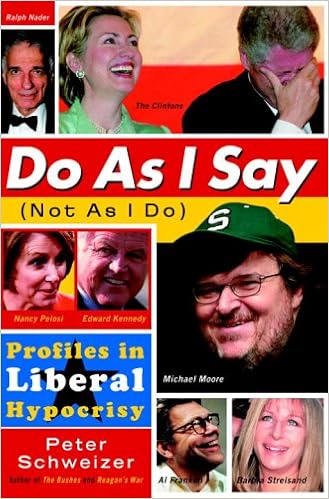
read Peter Schweizer’s Do As I Say (Not As I Do), you should.) This whole phenomenon is an important reason for the rise of Donald Trump.
The Washington examiner's Michael Barone (cheers to Ed Driscoll) links to an article featuring what is perhaps the epitome in Orwellian newspeak:
Prolific blogger Steve Sailer has spotted
an Orwellian passage in a New York Times convention week story on the
decision of Silicon Valley billionaire Peter Thiel to support and speak
at the convention in behalf of Donald Trump. The central thrust of
Silicon Valley-based reporter Farhad Manjoo's story is that Thiel's
Trump endorsement is widely unpopular in Silicon Valley.
"People here pride themselves on a kind of militant
open-mindedness," Manjoo writes. "It is the kind of place that will
severely punish any deviations from accepted schools of thought."
Got that? Open-mindedness means you severely punish any deviations from accepted schools of thought.
Memo to the literary estate of George Orwell: you may have a cause of action for violation of copyright.
If you’re “more tolerant,” why would you “hate” a political figure you disagree with, instead of attempting a bit of empathy to understand both what makes him tick, and what his supporters admire about him?
r_bq">
I did my bit today
writes Antipodius on Ricochet after seeing this thing of beauty.
I sat with the OR resident leftists- a couple of
hearts on their sleeves white folks who keep telling me how horrible
Republicans are and why I should agree with them that religious people
are the source of every problem in the world, and that American police
love to kill black people.
Well, this black man let them have it. I walked them through the
history of the Republican party, the speeches and writings of Frederick
Douglas… and I was just getting started. I told them who founded the
KKK, and which states in the South were for segregation and which party
their governments belonged to. I kept going, indices of economy, family
stability, education of black people in America and how that has
declined since welfare.
Some idiot in the corner piped up about how
blacks in WW2 were not educated and welfare and the 60’s had changed all
that. Well, I happen to have a picture of a Tuskegee P51 Mustang as my
laptop wallpaper…. I waded in with their glorious history. I spoke of
the honour and character of the American “Negro” at the height of
segregation and contrasted that with the black lives matter hooligans
today. I quoted excerpts from Martin Luther King’s speeches and
contrasted them with those of Al Sharpton and Jesse Jackson.
It was dead quiet. And then, I put on my Texas operating hat… and
walked out, but not before saying..
“next time I’m in the tea room… we
can really talk about the state of the American black.. and who exactly
is to blame for his current state.”


 Addendum: In another article, The Daily Telegraph reports British hospitals as saying the NHS needs to “take a reality check” and limit what it funds, in view of the fact that almost 10% of patients who go to the emergency are seen after four (!) hours (an NHS goal was for 95% of emergency patients to be seen within four hours).


 ” a “fictionalized French revolution.”