Saturday, November 26, 2016

Hillary Clinton's Popularity with the "Bankrupt Left" and in the Rest of the World in a Nutshell

 … the bankrupt Left shrugs, “She may be a crook, but she’s our crook.”
writes Victor Davis Hanson as the National Review columnist explains the popularity of Hillary Clinton, in America as well as abroad, in a nutshell.
A Hillary presidency would [have given] the Clintons unprecedented Peronist-like power, in a manner unlike any couple in American history. 
 
Of course, the Clintons are not only corrupt but cynical as well. They accept that the progressive media, the foundations, the universities, the bureaucracies, Hollywood, and Silicon Valley honor power more than trendy left-wing politics; they well understand that their fans will, for them, make the necessary adjustments to contextualize Clinton criminality or amorality. Sexual predations, the demonization of women, graft, and unequal protection under the law are also of no consequence to the inbred, conflicted, and morally challenged media – who will always check in with the Clinton team, like errant dogs who scratch the backdoor of their master after a periodic runaway.
 
The Clintons have contempt for the media precisely because the media are so obsequious. They smile, that, like themselves, the media are easily manipulated and compromised — to the extent of offering their articles, before publication, for Clinton approval (as the New York Times’ Mark Leibovich did; leaking debate questions to the Clinton campaign (as Donna Brazile did); or saying (as Politico’s chief political correspondent did), “I have become a hack. . . . Please don’t share or tell anyone I did this Tell me if I f**ked up anything.” The Clintons view such sycophants not with affection, but with disdain, given that they are moochers no better than the Clintons, with the same base desires, albeit better camouflaged by their pretense of objectivity.

… They have long ago lost any sense of shame — Bill is hourly caricatured as a sexual predator, and the best that can be said of Hillary’s character is that the bankrupt Left shrugs, “She may be a crook, but she’s our crook.”

Shaka, the legendary king who warred across South Africa forging the modern Zulu nation: There’s battle, conquest, siblings turning on each other and murdering each other — it’s better than “Game of Thrones,” and it’s all true


The Daily Show's Trevor Noah was drawn by Jillian Tamaki for an interview with the New York Times.
 … And now for a movie or TV show that has yet to be made: Tell us about your ideal adaptation of any book.

Someone needs to make a movie about Shaka, the legendary Zulu king who warred across South Africa forging the modern Zulu nation. There’s battle, conquest, siblings turning on each other and murdering each other — it’s better than “Game of Thrones,” and it’s all true.

 … What kind of reader were you as a child? Which childhood books and authors stick with you most?

I was a voracious reader as a kid. Being the mixed child of a black Xhosa mom and a white Swiss dad, my existence was illegal in South Africa at the time. When I was little I spent a lot of time indoors so my parents could avoid going to jail, which would not have been fun for any of us. Books were my escape. I loved getting lost in fantasy worlds. I’d read anything by Roald Dahl: “James and the Giant Peach,” “The BFG,” “Charlie and the Chocolate Factory.” I also loved “The Chronicles of Narnia,” but I only got to read them after convincing my very Christian mother that Aslan was a Christ figure and not a false idol.

If you could require the president to read one book, what would it be?

I’d love for him to read my book, actually, if only to satisfy my curiosity of knowing what he thinks about it. I’ve always felt a connection with President Obama through our shared experiences of being mixed race and both having African roots.

Friday, November 25, 2016

Never designed to be popularity contests: The genius of the Electoral College is that it gives everyone a voice and everyone a stake in the election's outcome


Over at the Investor's Business Daily, John Merline points out that
if California was more like the average Democratic state, Trump would currently have a 400,000 vote lead in the nationwide popular vote.

 … As IBD pointed out in a recent editorial, the Electoral College was specifically designed to prevent candidates from winning the presidency simply by appealing to a few heavily-populated, highly partisan regions of the country. The Electoral College forces candidates to compete nationwide if they want to be president. That's a good thing.

Trump was right to say that, if the election were based on the popular vote, he'd have campaigned differently, particularly in states like California and New York where he had no hope of winning the popular vote but could have cut into Hillary's outsized margins and won more votes than her nationwide.

Yes, the Electoral College occasionally produces the odd outcome where the popular vote winner is the election night loser. But without the Electoral College, abnormally partisan states like California could permanently dominate the nation's politics.

To quote directly from the IBD editorial:
The Electoral College is a unique institution, one that has functioned well to balance our nation's broad demographic and geographic interests. To destroy it would destroy what is special about our presidential elections. It's what has made our presidential successions so smooth and peaceful over more than 200 years, longer than any other comparable system for changing leadership in an orderly, democratic fashion.

To begin with, from the 1787 crafting of our Constitution, our presidential elections were never designed to be popularity contests. They were designed to give the individual states a voice in who would lead them. There would have been no United States of America without this provision, since from the beginning the small states were terrified of being dominated and bullied by the bigger states if they joined the union.

The genius of this system is that it gives everyone a voice and everyone a stake in the election's outcome.
 
Imagine for a moment if there was no electoral college, and we decided our elections based solely on popular vote. California, New York, Florida, Texas and a handful of other heavily populated states would dominate. The smaller states would have no say.
 
A popular mayor or governor in, say, California, might be able to cobble together enough votes to win without even being close to a majority of the votes. Dozens of smaller, less-populated states would have virtually no voice in what happened. They would soon be dominated by the highly populated coastal corridors and their mostly left-wing politics. The anger would soon explode, and you'd have secession movements springing up all over the country.

Such a system would increase the rewards for voter fraud and cheating, and make our system rife with voter and legal challenges. Think 2000 was bad? We'd soon be acting like some of the chaotic, autocratic nations that we now look down upon if we got rid of the Electoral College.

As author Robert Curry argues at the American Thinker, a president elected by popular vote "would in effect become the president of the big cities of America, and the last vestiges of political autonomy guaranteed the individual states by the Constitution's electoral system would be swept away."

With our current system, candidates have to take even small states seriously. They have to run as national candidates, not as "California" or "New York" or "Florida" candidates. They have to learn what issues matter to everyone, not just a regional few. That, arguably, was Hillary Clinton's failure — she didn't listen to the angry middle-class voters in the Midwest and South who were suffering from economic changes, and wanted their voices heard.
 
"Modern candidates have to accommodate farmers in rural states, factory workers in industrial states, and software engineers in tech-dominated states," writes Jarrett Stepman, an editor at the Heritage Foundation's DailySignal. "The president must consider the needs and opinions of people across the country instead of just the views of a few, highly populated urban centers."

Not My President — The Difference Between 2008 and 2016


That Was Then
This Is Now
by Branco

Thursday, November 24, 2016

Thanksgiving Cartoons from the New Yorker


Ten Thanksgiving cartoons from the New Yorker

(See also Art Buchwald's attempt to explain the
holiday to the French (and to other foreigners))

Kilomètres Deboutish and le Jour de Merci Donnant

An American tries to explain Thanksgiving to the French.

For four or five decades, this Art Buchwald column from the 1950s was printed every year in the (Paris-Based) International Herald Tribune, on the last Thursday of November.
One of our most important holidays is Thanksgiving Day, known in France as le Jour de Merci Donnant.
Le Jour de Merci Donnant was first started by a group of Pilgrims (Pélérins) who fled from l’Angleterre before the McCarran Act to found a colony in the New World ( le Nouveau Monde) where they could shoot Indians (les Peaux-Rouges) and eat turkey (dinde) to their hearts’ content.
They landed at a place called Plymouth (now a famous voiture Américaine ) in a wooden sailing ship called the Mayflower (or Fleur de Mai) in 1620. But while the Pélérins were killing the dindes, the Peaux-Rouges were killing the Pélérins, and there were several hard winters ahead for both of them. The only way the Peaux-Rouges helped the Pélérins was when they taught them to grow corn (maïs). The reason they did this was because they liked corn with their Pélérins.
In 1623, after another harsh year, the Pélérins’ crops were so good that they decided to have a celebration and give thanks because more maïs was raised by the Pélérins than Pélérins were killed by Peaux-Rouges.

Every year on the Jour de Merci Donnant, parents tell their children an amusing story about the first celebration.
It concerns a brave capitaine named Miles Standish (known in France as Kilometres Deboutish) and a young, shy lieutenant named Jean Alden. Both of them were in love with a flower of Plymouth called Priscilla Mullens (no translation). The vieux capitaine said to the jeune lieutenant :
“Go to the damsel Priscilla ( allez très vite chez Priscilla), the loveliest maiden of Plymouth (la plus jolie demoiselle de Plymouth). Say that a blunt old captain, a man not of words but of action (un vieux Fanfan la Tulipe), offers his hand and his heart, the hand and heart of a soldier. Not in these words, you know, but this, in short, is my meaning.
“I am a maker of war (je suis un fabricant de la guerre) and not a maker of phrases. You, bred as a scholar (vous, qui êtes pain comme un étudiant), can say it in elegant language, such as you read in your books of the pleadings and wooings of lovers, such as you think best adapted to win the heart of the maiden.”
Although Jean was fit to be tied ( convenable à être emballe), friendship prevailed over love and he went to his duty. But instead of using elegant language, he blurted out his mission. Priscilla was muted with amazement and sorrow (rendue muette par l’étonnement et la tristesse).

At length she exclaimed, interrupting the ominous silence: “If the great captain of Plymouth is so very eager to wed me, why does he not come himself and take the trouble to woo me?” (Ou est-il, le vieux Kilometres? Pourquoi ne vient-il pas aupres de moi pour tenter sa chance?)
Jean said that Kilometres Deboutish was very busy and didn’t have time for those things. He staggered on, telling what a wonderful husband Kilometres would make. Finally Priscilla arched her eyebrows and said in a tremulous voice, “Why don’t you speak for yourself, Jean?” (Chacun a son gout.)
And so, on the fourth Thursday in November, American families sit down at a large table brimming with tasty dishes and, for the only time during the year, eat better than the French do.
No one can deny that le Jour de Merci Donnant is a grande fête and no matter how well-fed American families are, they never forget to give thanks to Kilometres Deboutish, who made this great day possible.

Related: Ten Thanksgiving cartoons from the New Yorker

Electoral College: Democracy is all about majority rule; A republic is about the self-rule of a nation of free people


Clinton “won” an election we didn’t have
writes Mark Cunningham acidly in his New York Post article on protests concerning the 2016 election:
Neither side was focused on a national-popular-vote win, because both knew the rules.

And if the rules were different, the whole campaign would’ve differed, too.

Just for starters, a lot more Republicans would’ve voted in California. They had no reason to turn out when everyone knew Clinton would carry the state — and the US Senate race was between two Democrats.

It’s also just plain easier to vote in Democrat-dominated states; Oregon is entirely vote-by-mail. That runs up Dems’ national total, too.

 … Mind you, the Electoral College isn’t even remotely the most “anti-democratic” feature of our government: You could make a better case for that being the US Senate, the Supreme Court or even the states. Not to mention the Bill of Rights . . .

Heck, even the House of Representatives — the most “popular” part of the federal setup — is anti-democratic in key ways: The party that wins the most votes in House races nationwide often winds up scoring the minority of actual house seats.

The thing is, every one of these features is vital to securing our great democracy, which is actually, in the famous 1787 words of Benjamin Franklin, “a Republic — if you can keep it.”

And the whole anti-democratic package is what has allowed us to keep it these 200-plus years.
Let’s go back to “republic”: Democracy is all about majority rule; the word actually means “rule of the people.” A republic is about the self-rule of a nation of free people.

The two words yield a lot of insight into the different thinking of Democrats and Republicans — why, one side loves early voting, vote-by-mail and such schemes, for example, while the other is more eager to honor the profound ritual of going out and casting the ballot on Election Day.

This is much of why the “moral outrage” crowd outrages me: Because they generally don’t even recognize the existence of a different way of thinking, let alone understand it.

Or, God forbid, grant it a shred of legitimacy — even though it’s the actual basis of our entire system.

Look: The Founders were deeply worried about the perils of democracy — its historic instability, its record of oppressing the minority and other potential disasters.

It’s not right to let the majority have its way on everything: Hence the Bill of Rights protections for free speech, a free press and so on.
 
And full-on democracy — every citizen voting on every law, for example — just doesn’t work at large scale, or last long even on a small level. So we elect representatives to do the law-making, and break the country into states so that local decisions largely get made by locals.

More, the Founders focused on creating a republic that would be stable (not static) and strong: They’d actually gathered for the Constitutional Convention because the government set up after the Revolution was neither.

Yet not too strong: Small states didn’t want larger ones to call all the shots, so we got the Senate (where New York is equal to New Hampshire, etc.) to even the playing field.

And the Electoral College protects a similar value — pushing candidates to fight it out state by state, rather than relying on what today would be some godawful national advertising war. (One that, incidentally, would make money even more central to our politics.)

But here’s the biggest thing for the “morally outraged” to ponder: The whole system is set up to ensure that no single election decides all that much — particularly a “fluke” election like the one we’ve just had.

Wednesday, November 23, 2016

Earth to Democrats: It ain't about race!


Normal Americans are thinking about their paychecks, their job security, their health insurance, the price of goods and services and the safety of their children
writes Herman Cain.
Because they always do.

The political class and the media are thinking about race. Because they always do.

So as Donald Trump prepares to take office precisely because he convinced Americans that he is in tune with the same things that are on their minds, you have the astonishing spectacle of Barack Obama during his final overseas tour, warning that he doesn’t want to see America fall under a tribalist nationalism in which everyone sees themselves as members of their group rather than as part of a unified nation.

You first, Mr. President. You first, Democrats. You first, media.

I don’t exactly know how it came to be that the political class is quite so obsessed with race.

 … I find that most of these issues really have very little to do with anyone’s skin color. Tax rates aren’t about skin color. Foreign defense alliances aren’t about skin color. Maintaining roads and bridges isn’t about skin color.

Unless, of course, it’s in your political interests to insist that it is, because everything is about race. And that’s pretty much been the mantra of the left for the past several decades. When they can’t win an argument on substance, they scream racism. And when they’re having trouble defeating a Republican candidate, they manufacture a pretext for calling that person a racist even if any fair and objective assessment of him would suggest that he is not.

 … That said, if Obama is concerned about tribalist nationalism, where does he think it might be coming from? Here’s a thought: Maybe the people who are constantly categorizing people by skin color, nationality and gender have spurred an understandable instinct in people to defend who and what they are.

When Hillary stood there weeks before the election and accused Trump supporters of being racists, sexists, homophobes and xenophobes, it may have had the effect of inspiring people to not only defend their character but also to defend the group from which they came. They might have never thought about it, or considered it very important, if Democrats and the media weren’t in their faces about it all the time.

Maybe every time there’s a shooting that involves the police, America wouldn’t instinctively see it as a racial story . . . but for the fact that this is always the way the news media presents it. Who keeps bringing race into the conversation? Hmm?

Tuesday, November 22, 2016

Do red state Americans and blue state Americans live in the same country anymore?


This election year has been one for the history books
writes Benny Huang
—a jolting roller-coaster ride of scandals, vitriol and clashing world views. And it’s not over yet. As President-elect Donald Trump prepares to assume office the nation is smoldering with riots and miscellaneous mayhem.

As a political junkie, I simply can’t avert my eyes. Sometimes I think that I should tune out for sanity’s sake but there’s just no off switch. This year has made me wish there were.

Do red state Americans and blue state Americans live in the same country anymore? This has gone way beyond the donkey/elephant dichotomy. It’s white vs. black, professionals vs. the working class, rural vs. urban, makers vs. takers, and the faithful vs. secular humanists.

Have we always been this divided? No. But have we ever been this divided? Yes. America has torn itself apart many times before. Between 1861 and 1865 the division was literal. Thank goodness we aren’t as divided now as we were then or else we’d be taking up arms.

It’s usually a war that splits us—first the War of 1812, then the Mexican War, the Civil War, World War I to a lesser extent, and the Vietnam War. There are still plenty people alive today who can remember that last war (er, police action) and still bear its scars, literal and figurative. It was a time when the Greatest Generation asked their sons to march off to war just as they had—and many of their sons said no. Because I was not born until seven years after the last US troops left that country I did not realize how deeply that war affected my elders’ generation until I did some research on it for a book that never got published. The pain is still there, always lurking beneath the surface. It will die with the last baby boomer and not one second sooner.

Memories of the Vietnam War were still very raw when I was a child in the 1980’s though I was blissfully unaware. President Reagan did a lot to stitch our national wounds when he delivered an address at Arlington National Cemetery on Memorial Day 1984 before the internment of a nameless Vietnam War serviceman at the Tomb of the Unknown Soldier. It was a moving speech that a lot of Vietnam veterans had waited a long time to hear. In short, he said thank you—something a lot of them were not accustomed to hearing.
Ronald Reagan
The Reagan era was “morning in America again” to borrow a phrase from Reagan’s 1984 campaign commercial. Though not explicitly mentioned in the ad, it was a reference to the Vietnam War as much as to the “malaise” of the Carter years. Suddenly it was okay again to be a proud American. With a common identity to bind us together, the near constant strife of the 60’s and 70’s finally abated. We disagreed on issues of course but we settled our differences like people from the same country rather than people from different solar systems.

A taste of things to come arrived with the 2000 Florida recount. The national consensus of the 80’s and 90’s was starting to unravel because a significant portion of Americans truly believed that their candidate had been cheated of his rightful victory. They were wrong, of course—George W. Bush was never behind in the vote tally and the Supreme Court did not “select” him—but they really believed it. I suppose I’d be angry too if I labored under their misconception.

Shortly thereafter came 9/11 and a brief period of national unity that I’m not convinced was ever genuine. Iraq tore us apart, as did drones, wiretapping, and Guantanamo. By the time the 2004 election rolled around I was sure we Americans were at the apex of acrimonious division. It couldn’t get any worse, right? How wrong I was. In 2008 we elected a man who ran on the twin slogans of “Hope” and “Change.” Half the population—the half that was still upset about the two previous presidential elections and “Bush’s wars”—swallowed these platitudes and were shocked when we didn’t. Barack Obama divided us further with his identity politicking, his arrogance, and his heavy-handed response to dissenting voices. By 2016 the nation was a powder keg.

That’s the short history of how we got here. But how do we get out?

I have no easy answers. The gap between the utopian Left and the traditionalist Right seems unbridgeable.
 … on the other side of the country, rioters were venting their rage through wanton destruction. Fearful that the election of Donald Trump would spell the dawn of fascism in America, they let loose their primal scream. I don’t mean to mock them as melodramatic—the overheated rhetoric (“fascist”) is theirs not mine. That’s the other America, the one I don’t know.

It occurs to me that people on the Left might perceive my call to reconciliation as nothing but a sore winner’s luxury. Sure, now that my guy won let’s all stand together, right? There’s just one problem: Donald Trump is not “my guy.” Bobby Jindal was my guy until he dropped out and then Ted Cruz was my guy. Mr. Trump was never for one second “my guy.” I took joy in the final election result only because Hillary Clinton lost and because a lot of working stiffs were finally heard after years of being brushed aside.

But perhaps there’s a kernel of truth to the idea that the winners always call for rapprochement simply because they’re the winners. To dissenters, “national unity” always seems like a con job and sometimes they’re right. It can be a polite but disingenuous way of telling others to get in line. It certainly felt that way to me when the triumphalist Barack Obama took office in 2009 with his “elections have consequences” rhetoric. He steamrolled us and shamed us for speaking up with what little voice we had left. We were “obstructionists” and worse, racists. Yet the opposition wanted us to come together around the president so we could get to work fixing our nation’s problems—all of which were Bush’s fault, naturally.

All I can say to those who hear a coded message in this article (“shut up”) is that I don’t mean it that way. I’d like to talk to my countrymen again and I don’t mean shouting across the barricades. Perhaps one way to do that is to revive the principles of federalism so that red states can be free to be “bitter clinger” territory and blue states Prius-land. It will mean that the federal government, and particularly the judiciary, will have to restrain itself and desist from their outlandish definitions of “interstate commerce” and “equal protection,” two phrases that have been misconstrued to gut our ability to craft policy close to home. If that doesn’t work, or if people aren’t even willing to try, I wouldn’t be opposed to a cordial divorce. If a few states have to secede from the Union (California? Texas? Oregon? Hawaii?) to make this life in this country bearable again, that’s a price I’d be willing to pay.

America is two very different countries within the borders of one nation and it will probably remain that way for the foreseeable future.

Sunday, November 20, 2016

Growing Number of French Citizens Demand the Right to Bear Arms and to Self-Defence

After the long list of attacks that have shaken France, from Le Bataclan to Nice, Le Figaro's Esther Paolini reports on a growing number of voices demanding that French citizens be allowed to carry a gun…

Between 2011 and 2015, the number of Frenchmen learning how to shoot has risen by 38% and, needless to say, the politically correct climate makes member of the élites deny any link with the terrorist attacks.
 … la Fédération française de tir (FFT) et son président, Philippe Crochart, réfutent un quelconque lien entre le climat post-attentat et l'augmentation du nombre d'adhérents: ils étaient 145.365 en 2011 et ont dépassé les 201.450 tireurs en 2015, soit une augmentation de 38%.

Pourtant, des Français inquiets et souhaitant s'armer, il en existe. Et ils sont nombreux, à en croire la relative popularité de l'Arpac, l'Association pour le rétablissement du port d'arme citoyen, rassemblant près de 15.000 personnes sur sa page Facebook. L'un de ses représentants se fait appeler Pierre Bourguignon. Il garantit: «Beaucoup de Français sont inquiets depuis le Bataclan et Nice. Leur revendication est plus assumée. Ces personnes ne souhaitent pas rivaliser avec la police mais ils ont conscience que ces dramatiques événements vont se répéter et ils ne se sentent pas assez protégés.» Édouard, l'administrateur de la page Facebook «Droit de porter des armes» depuis quatre ans, explique que, depuis les attentats de novembre 2015, le nombre de ‘likes' a été multiplié par trois sur sa page, pour dépasser les 16.000.

L'Arpac milite notamment pour faire reconnaître «le droit naturel à se défendre», et espère faire évoluer la législation vers l'autorisation du port de l'arme à feu dans l'espace public, sous condition d'une formation théorique et d'une pratique égale à celle dont bénéficie la police (avec notamment une obligation de passage au centre de tir). Et Pierre Bourguignon d'évoquer l'assassinat de Charb. Le dessinateur de Charlie Hebdo, qui pratiquait le tir sportif, avait réclamé, sans succès, l'autorisation de porter une arme.

Saturday, November 19, 2016

Abraham Lincoln's Thoughts on Plans to Ditch or Reform the Constitution and the Electoral College


Doesn't Honest Abe's June 20, 1848, Speech on Internal Improvements (first para below) and his February 13, 1848, letter to a Josephus Hewett (second para) sound like he is talking to those who wish to ditch or at least reform the Constitution and the Electoral College?
I now wish to submit a few remarks on the general proposition of amending the constitution. As a general rule, I think, we would much better let it alone. No slight occasion should tempt us to touch it. Better not take the first step, which may lead to a habit of altering it. Better, rather, habituate ourselves to think of it, as unalterable. It can scarcely be made better than it is. New provisions, would introduce new difficulties, and thus create, and increase appetite for still further change. No sir, let it stand as it is. New hands have never touched it. The men who made it, have done their work, and have passed away. Who shall improve, on what they did?

 … I was once of your opinion … that presidential electors should be dispensed with; but a more thorough knowledge of the causes that first introduced them, has made me doubt. Those causes were briefly these. The convention that framed the constitution had this difficulty: the small states wished to so frame the government as that they might be equal to the large ones regardless of the inequality of the population; the large ones insisted on equality in proportion to population. They compromised it, by basing the House of Representatives on population, and the Senate on states regardless of population; and the executive on both principles, by electors in each state, equal in numbers to her senators and representatives. Now, throw away the machinery of electors, and the compromise is broken up, and the whole yielded to the principle of large states. … Have you reflected on these things?
Related: • How Come So Much of What Honest Abe Spoke of 150 Years Ago Seems Relevant Today?

• The Electoral College: A Few Choice Remarks

To better understand America's electoral college, it might be helpful to make a comparison that brings in the European Union

Why the electoral college? So that every part of the nation has some kind of say over the next executive while preventing large swaths of said nation from being bullied


This week, anti-Trump protesters hit the streets in big cities around the country,
notes Reason's David Harsanyi,
chanting "This is what democracy looks like!"

Yes. That's the problem.
That is precisely the problem.
For many Democrats, the greatest political system is the one that instills their party with the most power. Now that it looks like Hillary Clinton will "win" the fictional popular vote over Donald Trump, people—not just young people who've spent their entire lives being told America is a democracy, but people who know better—are getting hysterical about the Electoral College. Not only is it "unfair" and "undemocratic" but like anything else progressives dislike these days it's also a tool of "white supremacy" and "sexism."

If liberals truly believe majoritarianism is the fairest way to run a government, then why shouldn't 50 percent of states be able to repeal constitutional amendments?

Granted, because of our childish propensity to use the word "fair," I understand that the Electoral College must seem like a relic that undercuts the sacramental notion of "one man, one vote." As if a losing vote ever counts anyway. But if you still generally believe the Founding Fathers did a decent job setting up the conditions for material prosperity and individual freedom to guarantee a stable government and dispersed political power, you should be a big fan of the Electoral College.

If it needs repeating, in the United States of America, we have an Electoral College, wherein the president and vice president aren't elected directly by the voters, but rather by electors who are chosen through the popular votes from each state. Your state's portion of electors equals the number of members in its congressional delegation—one for each member in the House of Representatives plus two for your senators. We have 51 separate elections. This is done so that every part of the nation has some kind of say over the next executive. The president, after all, is not a monarch. He does not make laws. Not even President Barack Obama was supposed to do that. Voters need to view the system as a whole to understand why this is "fair."
 
Diffused democracy weakens the ability of politicians to scaremonger and use emotional appeals to take power. It blunts the vagaries of the electorate. So, naturally, the left has been attacking the Electoral College for years—including talk of a national "compact" to circumvent smaller states.

Need it be repeated again, the Electoral College, and other mechanisms that balance democracy, create moderation and compromise—they stop one party from accumulating too much power. It is certainly possible that Obama's unilateral governance over the past eight years had a lot to do with the pushback of three consecutive losses in the Senate and Congress, and the election of Donald Trump.


To some extent, the Electoral College impels presidents and their political parties to consider all Americans in rhetoric and action. By allowing two senators for both Wyoming, with a population of less than 600,000, and California, with a population of more than 38 million, we create more national cohesion. We protect large swaths of the nation from being bullied. We incentivize Washington, D.C.—both the president and the Senate—to craft policy that meets the needs of Colorado as well as New York.

 … It's also worth remembering that the dynamics of this election would be completely different if the popular vote actually mattered. The election is geared toward winning states, not people. There is no guarantee that Hillary Clinton would have won. There are tons of conservatives in blue states, for instance, who do not vote because they understand that the majority around them have a different political outlook. A direct national election would mean focusing on blue-state Republicans and red-state liberals. I'm not sure that setup works out for Democrats exactly as they imagine.

Electoral College: even under a parliamentary democracy, Hillary Clinton would still have lost, as Republicans have built a huge majority in the House of Representatives


Now the losers of the 2016 election are turning their fire upon the Constitution
writes John Yoo.
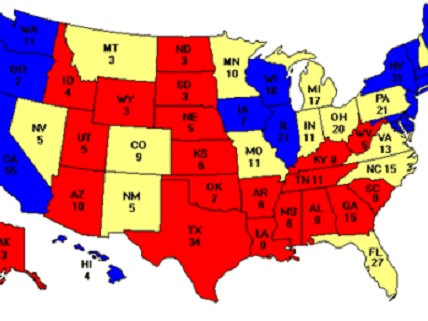
Clinton will win by a slight majority of the vote nationwide, but will not take the oath in January because of the Electoral College. Trump won a significant share of the electors, with more than 300 votes of the 538 at stake.

As they did after losing George W. Bush’s 2000 election by a majority of the Electoral College but not the popular vote, Democrats attack the Constitution’s method for selecting the president as fundamentally undemocratic.

Former Obama Attorney General Eric Holder went on a talk show to demand that the United States elect the president by simple nationwide majority vote, while failed 1988 Democratic candidate Mike Dukakis declared that the nation should have thrown out the Electoral College “150 years ago.”
 
These liberal officials have a point. The Electoral College is not democratic, if by democratic they mean rule by simple majority.
  
 … The Electoral College further encourages candidates to campaign state by state, particularly in the large “battleground” states that Clinton ultimately lost, such as Florida, Ohio, Pennsylvania, Michigan, and Wisconsin. If Democrats had their way, candidates would ignore the states and campaign solely in the population centers that Clinton easily won, such as New York, Los Angeles, and Chicago.

But the Electoral College’s exaggeration of the power of the states is not some bizarre mistake or a constitutional version of the appendix.

The Framers specifically designed the Electoral College to dilute democracy and favor the states. Democrats who disagree are at war with the federalism that the Framers hardwired throughout the Constitution itself.
 
They forget that fundamental features of the Constitution are even more anti-democratic than the Electoral College.

 … If Democrats oppose the undemocratic nature of the Electoral College, they should seek to uproot other restraints on democracy.

They should start with judicial review, which gives nine federal judges, appointed for life, the power to strike down legislation. They could continue with the Bill of Rights, which exists solely to prevent the majority from infringing on the rights of individuals, no matter how great the benefit to society. They could finish with the administrative state, where unelected bureaucrats exercise most nation regulatory power.

Liberals, of course, would never oppose these undemocratic aspects of our government, because they more often than not advance their agenda.

The Electoral College has other positive features, despite its complicated process.

 … If Democrats oppose the Electoral College, it only is in keeping with their broad hostility to the Constitution’s founding of a republican government, not a democratic one.

They are also only arguing to benefit themselves now, not to defend principle. For if they were serious, they should argue that the United States adopt a parliamentary democracy — indeed, the very goal of Woodrow Wilson, the intellectual father of progressivism.

In most of our democratic allies, such as Great Britain, Germany, and Japan, the majority party in the legislature selects a prime minister, who becomes head of the executive branch as well. But even under that system, Hillary Clinton would still have lost, as Republicans have built a huge majority in the House of Representatives over the last three elections.

Nothing better shows how liberal attacks on the Electoral College amount to nothing more than sour grapes and constitutional cherry-picking.

Friday, November 18, 2016

In a democracy, it's never a good idea to mock the people for too long

In Le Figaro Ivan Rioufol writes that
In a democracy, it's never a good idea to mock the people for too long, accusing it of incarnating populism, or firing broadsides against those who speak in its name. For that type of scorn, Hillary Clinton paid dearly. A similar reaction is to be expected in France.
In Le Figaro Ivan Rioufol écrit qu'
En démocratie, il n'est jamais bon de se moquer trop longtemps du peuple, en l'accusant d'incarner le populisme, ou en accablant ceux qui parlent en son nom. Ce mépris [Hillary] Clinton l'a payé cher. Une semblable réaction est à attendre en France.

Why a Black Voter in Southern France Voted for Trump

An African-American from New York living in the Basque country, Marjorie explains to France Info how she is disappointed by Barack Obama and that she voted for Donald Trump because he was the least bad candidate.

Thursday, November 17, 2016

There are some people in this world, let’s just call them Social Justice Warriors, who see a racist under every bed


And the award for dumbest reporter in America goes 
announces Benny Huang
to… Josh Feldman of Mediaite! During game seven of the World Series, Feldman noticed three cards in the stands each bearing the letter ‘K’ and began wondering via Twitter if the Klan was rearing its ugly head. He quickly dashed off an embarrassing piece entitled “Wait, What’s That KKK Sign Doing at the World Series?” He was apparently not the only one who believed that the three K’s were somehow related to the Ku Klux Klan. Feldman’s piece relied on a Twitterstorm of perplexed and angry messages from people who also perceived racist intent behind the three K’s.

This is what happens when bandwagon-jumpers tune in to watch baseball for the first time in their lives. If these people knew anything about the sport they would know that ‘K’ is baseball shorthand for a strikeout. It’s common for fans to tally strikeouts by holding up cards with the letter ‘K’ on them. Three K’s means three strikeouts—not Ku Klux Klan. Sheesh. Even I knew that and I haven’t watched an entire baseball game in years. After the error was discovered, Mediate altered the story, claiming that “some Twittters” made the foolish mistake, omitting the fact that the most prominent of these Twitterers was their very own Josh Feldman.

The whole incident would be funny if it weren’t so sad. Did these people really think that the KKK crashed the World Series? Yes, they probably did. As ridiculous as it sounds, they honestly believe that the KKK is a force to be reckoned with in modern American life and not just a negligible group of fringe yahoos who are justifiably held in universal contempt.

Apocryphal KKK sightings are becoming increasingly common. In April, the University of Indiana had a minor panic after news spread via Twitter that an honest-to-goodness klansman was prowling the campus—with a whip no less. Crisis was averted when it was discovered that the “klansman” was Father Jude McPeak, a Franciscan friar dressed in the white garment of his order. The “whip” was actually a rosary hanging from his belt.

At the height of last autumn’s racial unrest at the University of Missouri, word of klansmen on campus went viral—just in time to prove the student protestors’ point that their campus was infested with racism. As you can probably imagine, the whole thing was a giant hallucination. Payton Head, Mizzou’s student body president, did his part to amplify the panic by pushing misinformation (or, more likely, disinformation) through his Twitter and Facebook accounts. Payton Head is black, by the way, and one of the main instigators of the insane Black Lives Matter-inspired hysteria that rocked Mizzou in 2015.

The turbulent events of last autumn began when Head claimed that someone had screamed the n-word at him from a passing pickup truck. I have my doubts that such an incident happened at all because Payton Head is an agenda-pushing racial arsonist and a liar. We know this at very least from his tweeting about the illusory klansmen on his campus: “Students please take precaution. Stay away from windows in residence halls. The KKK is confirmed to be sighted on campus. I’m working with the MUPD, the state trooper [sic] and the National Guard.” The Twitter rumors only got more outlandish from there. Suddenly the imaginary klansmen were chanting “white power!” One Twitterer seemed to believe that klansmen were throwing bricks through dorm windows while enjoying police protection. How’s that for institutional racism?

Eventually Payton Head was forced to admit that the KKK was not on campus. Duh. “I’m sorry about the misinformation that I have shared through social media,” Head wrote on Facebook. “In a state of alarm, I was concerned for all students of the University of Missouri and wanted to ensure that everyone was safe. I received and shared information from multiple incorrect sources, which I deeply regret.”

But Payton Head was not duped. He claimed to have been working with the campus police, state police, and the National Guard. How could that possibly have been true when in fact there never were any hooded bad guys to speak of? Furthermore, the university says that the National Guard wasn’t even on campus. Payton Head told a ridiculous lie that was believed by far too many paranoid ninnies.

The only word to describe the insane fear of a weak and dying redneck organization like the KKK is paranoia. It occurs to me however, that many people don’t perceive paranoia to be a problem when racism is its subject. Given the negative connotation of the word “paranoia” they of course avoid using it, though they embrace it all the same. Dare I say that our society, or at least segments of it, considers paranoia of racism to be a virtue of sorts? Their attitude seems to be that racism is so utterly loathsome that there can be no such thing as excess when opposing it.

There are some people in this world, let’s just call them Social Justice Warriors, who see a racist under every bed. I am intentionally borrowing a Cold War phrase that was often used to discredit anti-communists for perceiving “a communist under every bed.” The phrase had a certain sting to it because it portrayed anti-communists as hopeless paranoids—which they weren’t. Anti-communists weren’t looking for communists under every bed but there were plenty to be found in Hollywood (Lillian Hellman, Dalton Trumbo), in academia (Howard Zinn, the entire Frankfurt school) in the news media (I.F. Stone, Carl Bernstein), and in the so-called “civil rights movement” (Bayard Rustin, Hunter Pitts O’Dell, Stanley Levison). By the late 1960s the communists weren’t even hiding anymore; they were waving Viet Cong flags and brandishing Mao’s little red books.

Yet despite the plethora of evidence that communists were indeed burrowing into our societal institutions, some particularly ignorant people still talk about anti-communism as if it were nothing more than tilting at windmills. Now, some 25 years after the fall of the Soviet Union we’ve come to embrace paranoia—real paranoia—as something to be admired. The Don Quixotes of our time are Payton Head and his allies yet we don’t mock them for being wrong in the same way that we mocked anti-communists for being right.

The genuine paranoia of 21st Century race-baiters is excused because it indicates a supposed consciousness of racial issues. In the parlance of the Black Lives Matter movement these people are “woke”—which is to say that their eyes are open to the reality of racism in America. They see nothing wrong with crying wolf about racism because it shows that their hearts are in the right place. Recall Payton Head’s Facebook post in which he claimed that he was only worried about the students’ safety. And who could fault him for an abundance of caring? The rest of us who don’t see imaginary men in white bedsheets are miscreants for not perceiving racism in every aspect of modern American life. It’s a messed up world we live in when paranoids get to lecture the rest of us for not sharing their pathology.

Paranoia of any kind is unattractive and even dangerous. Granted, people will always disagree about what constitutes paranoia. If one person perceives a real threat and another does not, the second person will think of the first as paranoid while the first person will think of the second as blithely unaware. But which one is right? In a country where fake hate crimes regularly spur the population into fits of rage, I think we can safely say that the pathology resides mostly with the Social Justice Warriors. There’s nothing wrong with us but there is something very, very wrong with them. It’s time they paid a social penalty for their crazed antics. Laugh at them. Scorn them. Call them nutjobs because that’s what they are. Only when they cease to be rewarded for their supposed good intentions will the hysteria end.

Wednesday, November 16, 2016

Le Figaro at the Maison de la Radio's Election Night in Paris

Thibault Izoret Masseron had a 2-minute report for Le Figaro from election night in Paris's Maison de la Radio.

Douche froide pour les Américains pro-Clinton qui se trouvaient à la Nuit américaine, organisée par la Maison de la Radio à l'occasion des élections. Alors que Donald Trump est devenu le 45e président des États-Unis, il n'était pas favori dans notre capitale.

Mystère Président


The front page of le Courrier Picard was chosen by the Newseum as one of the ten best front pages related to Donald Trump's election.
 

That Is the Reason — That Is Precisely the Reason


Powerline's Steven Hayward (gracias to Ed Driscoll)

Tuesday, November 15, 2016

We Must Resist Monarchism–Even When the President is a Republican


If I have one thing to be thankful for this Thanksgiving
sighs Benny Huang,
it’s that the reign of Barack Obama is nearly over. And I do mean reign—he exercised power like a monarch and a lousy one at that. Barack Obama is a dishonorable man and a power-hungry megalomaniac.

I spent the last eight years hoping that we would replace him with someone who is honorable and who respects the limits of presidential power. Instead, we got Donald Trump. He’s better than Hillary, of course, but that’s a pitifully low standard. I would love to be proven wrong but I suspect that our next president will be another dishonorable, power-hunger megalomaniac who behaves like a monarch. From time to time he may exercise his power to enact policies that I like but that doesn’t excuse conduct that is eerily similar to his predecessor’s.

Yes, I’m one of those #NeverTrumpers. I didn’t vote for him in the primary or the general election though I enjoyed the luxury of not being a resident of a swing state. … In any case, Donald Trump won without me just as he said he would.

Ever since Donald Trump defeated his final primary opponent in May I’ve been asking myself what ails our electoral system so profoundly that it churns out two candidates as unlikable and unworthy as Hillary Clinton and Donald Trump. At least the Democrats can blame the superdelegates. We can’t. We voted for this guy.

How did the country end up in this cage match between the lesser-evils, always voting against someone we despise and never for someone we like? It wasn’t supposed to be this way. There must have been a time when voters liked at least one name on the ballot. In some instances they may have liked more than one name and were forced to decide which of the two good candidates was better. I envy those people.

I’ve come to realize since May that I’ve found fault in all the wrong places. By blaming “the system” I was avoiding the real issue. We nominate morally bankrupt candidates because we are a morally bankrupt nation. We created this monster.
Well, not really, Ben. Actually, as I wrote in May, Trump "is but the latest GOP candidate that the Democrats and their minions in the MSM dearly — dearly want to run in the election, so that they can tear him to pieces. …  As Ted Cruz himself remarked on Sunday," the networks started by bringing the (highly lucrative) debates to an abrupt end once The Donald had (to everyone's surprise) emerged as the frontrunner, and they then effectively provided him, and him alone, with the equivalent of millions of dollars in donations thanks to all the airtime they gave him.
The Democrats nominated a perjurer, an obstructer of justice, and a woman whose campaign apparatus engaged in voter fraud and “bird-dogging”—the practice of provoking violence at her opponent’s events just to paint his supporters as violent. If you want to know just how crooked the Clinton machine was just remember the immortal words of Democrat operative Scott Foval:
“It doesn’t matter what the friggin’ legal and ethics people say, we need to win this motherf***er.” 
Hillary Clinton put national security at risk by storing classified material on a private server that was almost certainly hacked by five foreign intelligence services. She’s a liar, a cheater, and a demonstrable criminal.

The Republicans, on the other hand, nominated a superhypocrite who employed illegal aliens. He bragged of bedding married women and grabbing females by their you-know-whats. “When you’re a star they let you do it,” said Trump. “They let you do anything.” At a Republican debate he defended Planned Parenthood, a mass-murdering organization which he may have given money to in the past. (He’s not sure. He can’t remember.) He put the Constitution in danger with threats to the media—as corrupt and biased as they are—to alter libel laws to silence them. He championed eminent domain abuse. He spoke of exercising executive power just the same way that Barack Obama did if only toward slightly different ends.

I understand that a lot of Trump supporters see his looming executive actions as Democrats getting their comeuppance. Barack Obama stuck it to us with his pen and phone for eight years. Now it’s our turn! But that’s not the way it’s supposed to work.

Our constitutional form of government has deformed itself in the past two hundred years. The federal government has entirely too much power and the executive branch wields an outsized portion of that power. We need to get to work fixing it, not install someone we like better in the hyperpowerful Oval Office.

This entire election season has reminded me that there’s nothing new under the sun. A valuable lesson about current events can be found in an old book you’ve probably heard of—it’s called the Bible. Flip to 1 Samuel Chapter 8, you’ll see what I mean. In these ancient times the rebellious Israelites had no king, only judges and the prophet Samuel. But something was rotten in the state of Israel.
“When Samuel grew old, he appointed his sons as judges of Israel. His eldest son was called Joel and his second one, Abijah; they were judges at Beersheba. His sons did not follow his example but, seduced by the love of money, took bribes and gave biased verdicts. The elders of Israel all assembled, went back to Samuel at Ramah, and said, ‘Look, you are old, and your sons are not following your example. So give us a king to judge us, like the other nations.’ Samuel thought that it was wrong of them to say, ‘Let us have a king to judge us,’ so he prayed to Yahweh. But Yahweh said to Samuel, ‘Obey the voice of the people in all that they say to you: it is not you they have rejected but me, not wishing me to reign over them any more. They are now doing to you exactly what they have done to me since the day I brought them out of Egypt until now, deserting me and serving other gods. So, do what they ask; only, you must give them a solemn warning, and must tell them what the king who is to reign over them will do.’”
God then proceeded to lay out all of the terrible consequences of installing a king. He warned that if they made a man into a king would the Israelites into his subjects. Is that where we are today? In our desperation are we crying out for a king? Perhaps we already have one in Barack Obama, but that’s no reason to enthrone another.

Monarchies are anathema to the American ideal. We fought a war to ensure that no king would ever rule over us. Free men can rule themselves, we said. I still believe that—but are we still free men? I don’t know. We are only human, after all. The temptation toward a strong leader is compelling. Perhaps it’s in our nature to want someone to rule over us. It’s just easier. We don’t have to make tough decisions. We don’t have to take any personal responsibility when our rulers make bad decisions for us because—hey!—they charted the course, not us. There’s also the faint hope that the ruler, as caustic as he may be to the ideals of self-government, will exercise his power in our favor. A good monarch is a good thing, or so the thinking goes.

Am I being too hard on Donald Trump? After all, he hasn’t even been inaugurated and I’m already warning of his impending tyranny. Perhaps I am. The only point I’m trying to make is that we need to keep him on a short leash. He deserves a chance to prove that he can lead but nothing more. Real conservatives will approach the new administration with vigilance. We don’t drink anyone’s Kool-Aid even if he is the guy who stopped the abominable Hillary Clinton. We are free men and women, willing and able to rule ourselves.