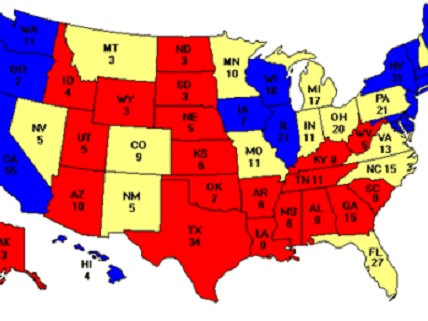
Showing posts sorted by relevance for query electoral college. Sort by date Show all posts

Saturday, November 19, 2016

Electoral College: even under a parliamentary democracy, Hillary Clinton would still have lost, as Republicans have built a huge majority in the House of Representatives


Now the losers of the 2016 election are turning their fire upon the Constitution
writes John Yoo.
Clinton will win by a slight majority of the vote nationwide, but will not take the oath in January because of the Electoral College. Trump won a significant share of the electors, with more than 300 votes of the 538 at stake.

As they did after losing George W. Bush’s 2000 election by a majority of the Electoral College but not the popular vote, Democrats attack the Constitution’s method for selecting the president as fundamentally undemocratic.

Former Obama Attorney General Eric Holder went on a talk show to demand that the United States elect the president by simple nationwide majority vote, while failed 1988 Democratic candidate Mike Dukakis declared that the nation should have thrown out the Electoral College “150 years ago.”
 
These liberal officials have a point. The Electoral College is not democratic, if by democratic they mean rule by simple majority.
  
 … The Electoral College further encourages candidates to campaign state by state, particularly in the large “battleground” states that Clinton ultimately lost, such as Florida, Ohio, Pennsylvania, Michigan, and Wisconsin. If Democrats had their way, candidates would ignore the states and campaign solely in the population centers that Clinton easily won, such as New York, Los Angeles, and Chicago.

But the Electoral College’s exaggeration of the power of the states is not some bizarre mistake or a constitutional version of the appendix.

The Framers specifically designed the Electoral College to dilute democracy and favor the states. Democrats who disagree are at war with the federalism that the Framers hardwired throughout the Constitution itself.
 
They forget that fundamental features of the Constitution are even more anti-democratic than the Electoral College.

 … If Democrats oppose the undemocratic nature of the Electoral College, they should seek to uproot other restraints on democracy.

They should start with judicial review, which gives nine federal judges, appointed for life, the power to strike down legislation. They could continue with the Bill of Rights, which exists solely to prevent the majority from infringing on the rights of individuals, no matter how great the benefit to society. They could finish with the administrative state, where unelected bureaucrats exercise most nation regulatory power.

Liberals, of course, would never oppose these undemocratic aspects of our government, because they more often than not advance their agenda.

The Electoral College has other positive features, despite its complicated process.

 … If Democrats oppose the Electoral College, it only is in keeping with their broad hostility to the Constitution’s founding of a republican government, not a democratic one.

They are also only arguing to benefit themselves now, not to defend principle. For if they were serious, they should argue that the United States adopt a parliamentary democracy — indeed, the very goal of Woodrow Wilson, the intellectual father of progressivism.

In most of our democratic allies, such as Great Britain, Germany, and Japan, the majority party in the legislature selects a prime minister, who becomes head of the executive branch as well. But even under that system, Hillary Clinton would still have lost, as Republicans have built a huge majority in the House of Representatives over the last three elections.

Nothing better shows how liberal attacks on the Electoral College amount to nothing more than sour grapes and constitutional cherry-picking.

Saturday, April 22, 2017

Had the Founders selected direct popular vote as the means for electing a President, the residents of one state (California) would have dictated the choice to the other 49

In the third of twenty-five weekly articles in The Tennessee Star’s Constitution Series (thanks to Instapundit), the Tennessee Star addresses The Electoral College and the Selection of the President.
In recent years, a number of political figures and commentators have criticized the Electoral College and want the President selected by direct popular vote.

Four times since 1868, the first year in which all states selected Electors by some form of popular vote, the candidate who received the most popular vote did not win the Electoral College, and therefore was not elected President.

 … In our most recent Presidential Election of 2016, Democrat Hillary Clinton received 48 percent of the popular vote to Republican Donald Trump’s 46 percent. But Trump was elected President because he won the majority of the Electoral College votes, 304 to 227 (7 Electoral College votes were split between other candidates).

Clinton’s popular vote margin of 2.8 million was the highest of any Presidential candidate who won the popular vote but lost the Electoral College vote (though her 2 percent margin was less than Samuel Tilden’s 3 percent margin in 1876), and therefore the Presidency.

A closer look at the state by state breakdown of the 2016 Presidential Election results reveals the wisdom of the Founding Fathers in establishing an Electoral College method for selecting a President.

Hillary Clinton won the state of California resoundingly, beating Donald Trump there by more than 4.2 million votes – a 61 percent to 31 percent thumping.

Had the Founders selected direct popular vote as the means for electing a President, the residents of California would have dictated to the other 49 states who would have served as our President.

Looking at the total combined vote in the other 49 states, Donald Trump won 1.4 more million votes than Hillary Clinton, taking 58.5 million votes to her 57.1 million votes.

But because of the Electoral College, Hillary Clinton’s huge vote margin in California earned her the state’s 55 Electoral College votes, and no more.

The Founding Fathers had an idea that the Electors would be of a high personal character, wisdom, and intelligence, and would exercise those qualities in their selection.

They also hoped against the development of factions and competing political powers, a hope in retrospect was inevitably bound to be disappointed, given the foibles of human nature.
Related to the Electoral College: The 2016 Vote and the Electoral College System Explained — With Help from the European Union

Monday, November 28, 2016

The Electoral College remains an essential constitutional safeguard of American liberty


In addition to The Daily Signal's Jarrett Stepman and his "pre-election explanation of how the Electoral College works and why the Founding Fathers created it" (Why We Use Electoral College, Not Popular Vote), the American Thinker's Robert Curry takes on the attacks on the Electoral College as well as on the Constitution itself:
The progressives are determined to get rid of the Electoral College. Of course they are. Abolishing the Electoral College would complete their project of overthrowing America's unique federal system, begun about one hundred years ago.

The direct election of senators was the first and greatest victory of the progressives over the Framers of the Constitution. Made possible by the Seventeenth Amendment in 1913, it mortally wounded the Founders' system. Abolishing the Electoral College will finish the job. And the progressives mean to do just that.

If we want to understand the efforts of the Framers during that hot summer in 1787, we must see them as trying to design self-government with a sober assessment of human nature in mind. When in the next century Lord Acton wrote that "power tends to corrupt, and absolute power corrupts absolutely," he captured in a ringing aphorism the view of the Founders.

This understanding of the effect of political power on human nature explains the Framers' focus on defining and limiting federal power. They did so by distributing power among the executive, legislative, and judicial branches of the federal government; preserving the political independence of the states; and creating a zone of liberty around the individual – even by further dividing the (supreme) legislative power itself, crafting two legislative bodies with separate powers and potentially competing interests.

Jefferson put it this way:
What has destroyed liberty and the rights of man in every government which has ever existed under the sun? The generalizing and concentrating all cares and powers into one body.
And Lord Acton put it this way:
Liberty consists in the division of power. Absolutism, in concentration of power.
The Framers of the Constitution aimed to preserve your unalienable rights and mine by preventing the concentration of political power in the central government.

They began with "the Virginia Plan," the original proposal written by James Madison and presented by Edmund Randolph at the Constitutional Convention. This initial proposal opened the discussion and became the basis of the debate. David O. Stewart in his book The Summer of 1787 describes the Virginia Plan like this:
The people would elect the "first Branch" of the legislature[.] … That "first branch" (the future House of Representatives) would choose the "second branch" (the future Senate). Together, those two houses would select the president and appoint all the judges.
Self-government meant that in America, the people and their elected representatives were going to populate the government all the way to the top. But how? The important feature of Madison's plan was that it provided a way to accomplish that. To do so, Madison made a decisive break with England's parliamentary system. The problem with the English model was that the House of Lords was in the hands of the hereditary nobility, and the executive was in the hands of the hereditary monarch. Since America was not going to have a king or a House of Lords, there was no way to make the English model fit America's needs.

It is all too easy for us today to fail to recognize how much of Madison's proposed system of representation actually made it into the Constitution of 1787. This is because the original system of federal elections was significantly different from the one we have today. Only the way we now elect the members of the House is according to the original Constitution.

According to Madison's Virginia Plan, the voters would only directly elect the members of the first branch. The Constitution of 1787 preserved that basic feature. Members of the House of Representatives were the only federal officers directly elected by the voters. The indirect election of U.S. senators was also carried over from the Virginia Plan to the Constitution. U.S. senators were elected by each state legislature; the state legislatures did the selecting in place of Madison's first branch. This followed Madison's proposed format of indirect representation for the upper chamber, with the additional advantage of also providing each state with representation within the federal government.

This modification of Madison's original plan by the Framers was brilliant. Having the first branch of the federal legislature choose the second branch would have had the effect of binding the two branches close together. The selection of senators would also have been a collective process by the first branch. By using the state legislatures as many different channels through which the voters populated the Senate, the Constitution's original design dispersed the process of selecting senators over the whole extent of the republic, state by state. In addition, making the selection process for the two chambers separate in this way put their independence of each other on a firm electoral foundation, preventing the concentration of federal legislative power that would have resulted from the Virginia Plan.

Finally, there can be little doubt that the most important benefit of the constitutional system was that it worked to preserve the political independence of the individual states.

That was the electoral system for Congress America once had.

The direct election of U.S. senators, the system we have today, bypasses the state legislatures. Direct election began a process of putting an end to America's unique federal system. The independence of the states and their ability to counter-balance the power of the central government has withered away. The Senate had been a barrier to the passage of laws infringing on the powers reserved to state governments, but the Senate has abandoned that responsibility under the incentives of the new system of election. Because the states no longer have a powerful standing body representing their interests within the central government, the power of the central government has rapidly grown at the expense of the states. The states increasingly are relegated to functioning as administrative units of today's gargantuan central government. The Tenth Amendment has become a dead letter.

Instead of retaining many of their powers and responsibilities, and surrendering only a limited number of their powers to the central government, as the Framers intended, the states are more and more entangled in administering programs of the central government and in carrying out mandates of the central government. As the central government has metastasized and the states have lost their independence, liberty has diminished. Getting rid of the Electoral College would complete this project.

The Electoral College was another brilliant modification by the framers of Madison's plan. Instead of having the two branches of Congress together choose the president, once again, the voters initiated the process at the state and local levels by choosing the presidential electors. The model for this system was the slates of delegates who had represented the people of the individual states at the Constitutional Convention. Leading citizens well known to the voters were to be chosen by the voters for the special purpose of selecting the president. The electors would assemble in the state in which they were selected, deliberate, and then cast the votes allotted to that state.

Though it does not function as the Founders originally intended, the Electoral College remains an essential constitutional safeguard of American liberty. Each state is allotted as many electoral votes as it has senators and members of the House of Representatives. To become president of the United States of America, one must even today win the national election state by state. Eliminating the Electoral College and electing the president by the popular vote, as the progressives are determined to do, would transform the office. Its occupant would in effect become the president of the big cities of America, and the last vestiges of political autonomy guaranteed the individual states by the Constitution's electoral system would be swept away.

We must preserve and protect the Electoral College at any cost. Repealing the Seventeenth Amendment instead would be a great idea, though. It would be victory for the Founders' vision and a defeat for the progressives. It would make possible a return to America's unique, liberty-preserving federal system.

Friday, November 25, 2016

Never designed to be popularity contests: The genius of the Electoral College is that it gives everyone a voice and everyone a stake in the election's outcome


Over at the Investor's Business Daily, John Merline points out that
if California was more like the average Democratic state, Trump would currently have a 400,000 vote lead in the nationwide popular vote.

 … As IBD pointed out in a recent editorial, the Electoral College was specifically designed to prevent candidates from winning the presidency simply by appealing to a few heavily-populated, highly partisan regions of the country. The Electoral College forces candidates to compete nationwide if they want to be president. That's a good thing.

Trump was right to say that, if the election were based on the popular vote, he'd have campaigned differently, particularly in states like California and New York where he had no hope of winning the popular vote but could have cut into Hillary's outsized margins and won more votes than her nationwide.

Yes, the Electoral College occasionally produces the odd outcome where the popular vote winner is the election night loser. But without the Electoral College, abnormally partisan states like California could permanently dominate the nation's politics.

To quote directly from the IBD editorial:
The Electoral College is a unique institution, one that has functioned well to balance our nation's broad demographic and geographic interests. To destroy it would destroy what is special about our presidential elections. It's what has made our presidential successions so smooth and peaceful over more than 200 years, longer than any other comparable system for changing leadership in an orderly, democratic fashion.

To begin with, from the 1787 crafting of our Constitution, our presidential elections were never designed to be popularity contests. They were designed to give the individual states a voice in who would lead them. There would have been no United States of America without this provision, since from the beginning the small states were terrified of being dominated and bullied by the bigger states if they joined the union.

The genius of this system is that it gives everyone a voice and everyone a stake in the election's outcome.
 
Imagine for a moment if there was no electoral college, and we decided our elections based solely on popular vote. California, New York, Florida, Texas and a handful of other heavily populated states would dominate. The smaller states would have no say.
 
A popular mayor or governor in, say, California, might be able to cobble together enough votes to win without even being close to a majority of the votes. Dozens of smaller, less-populated states would have virtually no voice in what happened. They would soon be dominated by the highly populated coastal corridors and their mostly left-wing politics. The anger would soon explode, and you'd have secession movements springing up all over the country.

Such a system would increase the rewards for voter fraud and cheating, and make our system rife with voter and legal challenges. Think 2000 was bad? We'd soon be acting like some of the chaotic, autocratic nations that we now look down upon if we got rid of the Electoral College.

As author Robert Curry argues at the American Thinker, a president elected by popular vote "would in effect become the president of the big cities of America, and the last vestiges of political autonomy guaranteed the individual states by the Constitution's electoral system would be swept away."

With our current system, candidates have to take even small states seriously. They have to run as national candidates, not as "California" or "New York" or "Florida" candidates. They have to learn what issues matter to everyone, not just a regional few. That, arguably, was Hillary Clinton's failure — she didn't listen to the angry middle-class voters in the Midwest and South who were suffering from economic changes, and wanted their voices heard.
 
"Modern candidates have to accommodate farmers in rural states, factory workers in industrial states, and software engineers in tech-dominated states," writes Jarrett Stepman, an editor at the Heritage Foundation's DailySignal. "The president must consider the needs and opinions of people across the country instead of just the views of a few, highly populated urban centers."

Saturday, November 19, 2016

Why the electoral college? So that every part of the nation has some kind of say over the next executive while preventing large swaths of said nation from being bullied


This week, anti-Trump protesters hit the streets in big cities around the country,
notes Reason's David Harsanyi,
chanting "This is what democracy looks like!"

Yes. That's the problem.
That is precisely the problem.
For many Democrats, the greatest political system is the one that instills their party with the most power. Now that it looks like Hillary Clinton will "win" the fictional popular vote over Donald Trump, people—not just young people who've spent their entire lives being told America is a democracy, but people who know better—are getting hysterical about the Electoral College. Not only is it "unfair" and "undemocratic" but like anything else progressives dislike these days it's also a tool of "white supremacy" and "sexism."

If liberals truly believe majoritarianism is the fairest way to run a government, then why shouldn't 50 percent of states be able to repeal constitutional amendments?

Granted, because of our childish propensity to use the word "fair," I understand that the Electoral College must seem like a relic that undercuts the sacramental notion of "one man, one vote." As if a losing vote ever counts anyway. But if you still generally believe the Founding Fathers did a decent job setting up the conditions for material prosperity and individual freedom to guarantee a stable government and dispersed political power, you should be a big fan of the Electoral College.

If it needs repeating, in the United States of America, we have an Electoral College, wherein the president and vice president aren't elected directly by the voters, but rather by electors who are chosen through the popular votes from each state. Your state's portion of electors equals the number of members in its congressional delegation—one for each member in the House of Representatives plus two for your senators. We have 51 separate elections. This is done so that every part of the nation has some kind of say over the next executive. The president, after all, is not a monarch. He does not make laws. Not even President Barack Obama was supposed to do that. Voters need to view the system as a whole to understand why this is "fair."
 
Diffused democracy weakens the ability of politicians to scaremonger and use emotional appeals to take power. It blunts the vagaries of the electorate. So, naturally, the left has been attacking the Electoral College for years—including talk of a national "compact" to circumvent smaller states.

Need it be repeated again, the Electoral College, and other mechanisms that balance democracy, create moderation and compromise—they stop one party from accumulating too much power. It is certainly possible that Obama's unilateral governance over the past eight years had a lot to do with the pushback of three consecutive losses in the Senate and Congress, and the election of Donald Trump.


To some extent, the Electoral College impels presidents and their political parties to consider all Americans in rhetoric and action. By allowing two senators for both Wyoming, with a population of less than 600,000, and California, with a population of more than 38 million, we create more national cohesion. We protect large swaths of the nation from being bullied. We incentivize Washington, D.C.—both the president and the Senate—to craft policy that meets the needs of Colorado as well as New York.

 … It's also worth remembering that the dynamics of this election would be completely different if the popular vote actually mattered. The election is geared toward winning states, not people. There is no guarantee that Hillary Clinton would have won. There are tons of conservatives in blue states, for instance, who do not vote because they understand that the majority around them have a different political outlook. A direct national election would mean focusing on blue-state Republicans and red-state liberals. I'm not sure that setup works out for Democrats exactly as they imagine.

Thursday, December 01, 2016

Electoral College: A Few Choice Remarks

Abraham Lincoln:
I now wish to submit a few remarks on the general proposition of amending the constitution. As a general rule, I think, we would much better let it alone.
 
 … I was once of your opinion … that presidential electors should be dispensed with; but a more thorough knowledge of the causes that first introduced them, has made me doubt.
The New York Post's Mark Cunningham:
[Hillary] Clinton “won” an election we didn’t have. Neither side was focused on a national-popular-vote win, because both knew the rules.

And if the rules were different, the whole campaign would’ve differed, too.

 … The thing is, every one of these features is vital to securing our great democracy, which is actually, in the famous 1787 words of Benjamin Franklin, “a Republic — if you can keep it.”

And the whole anti-democratic package is what has allowed us to keep it these 200-plus years. Let’s go back to “republic”: Democracy is all about majority rule; the word actually means “rule of the people.” A republic is about the self-rule of a nation of free people.
Investor's Business Daily:
 … from the 1787 crafting of our Constitution, our presidential elections were never designed to be popularity contests. They were designed to give the individual states a voice in who would lead them. There would have been no United States of America without this provision, since from the beginning the small states were terrified of being dominated and bullied by the bigger states if they joined the union.

The genius of this system is that it gives everyone a voice and everyone a stake in the election's outcome.

 … With our current system, candidates have to take even small states seriously. They have to run as national candidates, not as "California" or "New York" or "Florida" candidates.
Reason's John Yoo:
Democrats attack the Constitution’s method for selecting the president as fundamentally undemocratic. … These liberal officials have a point. The Electoral College is not democratic, if by democratic they mean rule by simple majority.
  
 … The Electoral College further encourages candidates to campaign state by state, particularly in the large “battleground” states that Clinton ultimately lost, such as Florida, Ohio, Pennsylvania, Michigan, and Wisconsin. If Democrats had their way, candidates would ignore the states and campaign solely in the population centers that Clinton easily won, such as New York, Los Angeles, and Chicago.
But the Electoral College’s exaggeration of the power of the states is not some bizarre mistake or a constitutional version of the appendix.
The Framers specifically designed the Electoral College to dilute democracy and favor the states.
Reason's David Harsanyi: "so that every part of the nation has some kind of say over the next executive while preventing large swaths of the nation from being bullied"
We have 51 separate elections. This is done so that every part of the nation has some kind of say over the next executive. The president, after all, is not a monarch. He does not make laws. Not even President Barack Obama was supposed to do that.
 
 … Diffused democracy weakens the ability of politicians to scaremonger and use emotional appeals to take power. It blunts the vagaries of the electorate.

 … Need it be repeated again, the Electoral College, and other mechanisms that balance democracy, create moderation and compromise—they stop one party from accumulating too much power. It is certainly possible that Obama's unilateral governance over the past eight years had a lot to do with the pushback of three consecutive losses in the Senate and Congress, and the election of Donald Trump.

To some extent, the Electoral College impels presidents and their political parties to consider all Americans in rhetoric and action. By allowing two senators for both Wyoming, with a population of less than 600,000, and California, with a population of more than 38 million, we create more national cohesion. We protect large swaths of the nation from being bullied.
No Pasarán's Erik Svane:
To better understand the 2016 election results in the United States, it is perhaps helpful to make a comparison that brings in the European Union.

 … the United States of America is not a country, not in the same sense as Denmark or France or Columbia is; it is a federation, a union (50 states), somewhat like the European Union (28 nations), but in the final count somewhere in-between a country and the EU.

 … Try to imagine this on a European level. Imagine that in a more unified European Union, a continental vote has one of two EU candidates win the popular vote in, say, 20 nations out of 28, from Denmark and France to Estonia and Greece. But because the 28th nation is the most populous, the candidate who wins in Germany wins the whole game, meaning the seven nations "allied" with it (so to speak) beat out the 20 lesser-populated countries' choice.

How many times would there be elections, how long would the EU endure, before all other nations woke up to the fact that their votes didn't matter, that Germany (like California in the U.S.) was the dominant member, and indeed, that they started growling about getting ready to follow the UK in its Brexit vote?!

 No. The above scenario shows why, if the EU did want to go ahead with "a more closer union", countries like Denmark, Belgium, and Portugal would refuse a system based on the one-man-one-vote, because they would become totally subjugated by the more populous countries — and who could blame them for that?

Countries like France, Germany, and Italy, on the other hand, would counter that a system in which each country has the same amount of votes is ridiculous and unfair, amounting to the loss of rights for tens of millions of people when their nations have five to 10 times the populations of their smaller neighbors — and who could blame them for that?

This is precisely the debate that occurred between the 13 former colonies, the small states (Delaware, Connecticut, South Carolina…) and the large states (Pennsylvania, Virginia,Massachusetts…), in the 1780s. … 
The difference between a democracy and a republic, wrote Harry Jaffa, is that the first is majority rule while the second is majority rule coupled with the defense of minority rights. He also has this choice quote, the best ever that defines the government of a free people:
Those who live under the law have an equal right in the making of the law, and those who make the law have a corresponding duty to live under the law.

Wednesday, December 07, 2016

Ditching Electoral College would allow California to impose imperial rule on a colonial America

Ditching Electoral College would allow California to impose imperial rule on a colonial America
warns Michael Barone in the Washington Examiner (cheers to Instapundit's Stephen Green).
 … for the first time in the nation's history the most populous state was a political outlier, voting at one extreme in the national political spectrum.

 … Well, yeah, you might say. California has been called the Left Coast for quite a while. Just about everyone in Silicon Valley except Peter Thiel and in Hollywood except Pat Sajak supported Clinton. White middle class families have been pretty well priced out of the state by high taxes and housing costs, and the Hispanic and Asian immigrants who have replaced them vote far more Democratic.

 … In the nine elections before that and after California passed New York to become the most populous state in 1963, the average of California's Democratic and Republican percentages was never more than 5 points off the national figures.

 … In this respect it resembles New York, the most populous state in every Census from 1820 to 1960. In elections 1856 to 1960, New York's Democratic and Republican percentages seldom varied more than 5 points from the national average.

 … The fact that New York voted much like the nation as a whole meant there were few elections when the popular vote winner lost in the Electoral College. In the two exceptions, 1876 and 1888, the popular vote winner was a New Yorker.

If California continues to occupy one extreme of the national political spectrum, there may well be more such splits. At least unless and until the Democratic Party figures it needs more to make a case with more appeal beyond California if it wants to win 270 electoral votes.

All of which prompts renewed arguments about the Electoral College. The case for abolishing it is simple: Every American's vote should count the same. But it won't happen. Two-thirds of each house of Congress and 38 of the 50 state legislatures will never go along.

The case against abolition is one suggested by the Framers' fears that voters in one large but highly atypical state could impose their will on a contrary-minded nation. That largest state in 1787 was Virginia, home of four of the first five presidents. New York and California, by remaining closely in line with national opinion up through 1996, made the issue moot.

California's 21st century veer to the left makes it a live issue again. In a popular vote system, the voters of this geographically distant and culturally distinct state, whose contempt for heartland Christians resembles imperial London's disdain for the "lesser breeds" it governed, could impose something like colonial rule over the rest of the nation. Sounds exactly like what the Framers strove to prevent.

Saturday, November 19, 2016

Abraham Lincoln's Thoughts on Plans to Ditch or Reform the Constitution and the Electoral College


Doesn't Honest Abe's June 20, 1848, Speech on Internal Improvements (first para below) and his February 13, 1848, letter to a Josephus Hewett (second para) sound like he is talking to those who wish to ditch or at least reform the Constitution and the Electoral College?
I now wish to submit a few remarks on the general proposition of amending the constitution. As a general rule, I think, we would much better let it alone. No slight occasion should tempt us to touch it. Better not take the first step, which may lead to a habit of altering it. Better, rather, habituate ourselves to think of it, as unalterable. It can scarcely be made better than it is. New provisions, would introduce new difficulties, and thus create, and increase appetite for still further change. No sir, let it stand as it is. New hands have never touched it. The men who made it, have done their work, and have passed away. Who shall improve, on what they did?

 … I was once of your opinion … that presidential electors should be dispensed with; but a more thorough knowledge of the causes that first introduced them, has made me doubt. Those causes were briefly these. The convention that framed the constitution had this difficulty: the small states wished to so frame the government as that they might be equal to the large ones regardless of the inequality of the population; the large ones insisted on equality in proportion to population. They compromised it, by basing the House of Representatives on population, and the Senate on states regardless of population; and the executive on both principles, by electors in each state, equal in numbers to her senators and representatives. Now, throw away the machinery of electors, and the compromise is broken up, and the whole yielded to the principle of large states. … Have you reflected on these things?
Related: • How Come So Much of What Honest Abe Spoke of 150 Years Ago Seems Relevant Today?

• The Electoral College: A Few Choice Remarks

To better understand America's electoral college, it might be helpful to make a comparison that brings in the European Union

Sunday, January 22, 2017

The 2016 Vote and the Electoral College System Explained — With Help from the European Union

To better understand the 2016 election results in the United States,
it is perhaps helpful to make a comparison that brings in 
the European Union.

Below are 5 points regarding the importance (or lack thereof) 
of Hillary Clinton's victory in the popular vote,
and to what extent it is correct to portray 
her election loss as a scandal.

(The following is meant to be a neutral description of the 2016 election 
as well as of the reasons and concepts explaining America's electoral college, 
since, as I never cease to say, no one was more appalled in March 2016 
than I when Donald Trump emerged as the GOP's candidate…)

Let us start by quoting Mark Twain, 
who, if you remember, said that
there are three kinds of lies — 
lies, damned lies, and statistics.

FIRST of all 
— and what I am going to say will sound
like withering criticism of America, but it is in fact

nothing if not an entirely neutral and dispassionate
observation —
the United States is (get ready for it) 

NOT — repeat NOT — A DEMOCRACY. 

Sounds like a shrieking Trotskyite protester 
from the 1970s, right? (Or from any other era,
not least the present.)
Still, it is true.
The U.S. is not a democracy
(just like France is not a democracy).
It is a republic.
(C'est la RF, la Répubique Française,
pas la DF, pas la Démocratie Française…)


What is the difference?
A Democracy is a government of men,
it is rule by the majority (which sounds
pretty good, until the majority becomes a mob);
A Republic is a government of laws,
it is a rule by the majority,
coupled with protection for the minority
(for the political minority).

SECOND
the United States of America is not a country, not in
the same sense as Denmark or France or Columbia is;
it is a federation, a union (50 states), somewhat like
the European Union (28 nations), but in the final count 

somewhere in-between a country and the EU. 
(The same applies to places like Brazil and Mexico
— 26 states in the República Federativa do Brasil,
31 states in the Estados Unidos Mexicanos.)

THIRD

Both the Republican Party and the Democrat Party 
campaigned according to the system in place, not the system 
not in place. Neither was going for the popular majority,
they were going for the victory in the number of states, 
i.e., for victory in  electoral votes.
They knew the goal, that is how they campaigned, and, 
no, there were no unpleasant (or, rather, no unfair) surprises.
You might as well protest that you have calculated that
a hypothetical loser in a specific country's one-man/one-vote 

system would have emerged the victor had that country 
adopted an America-style electoral college system.
(Yeah, very interesting, but… so what?)
But the "Democratic" system is undoubtedly better,
you counter? Not sure — read on:

FOURTH
Because the citizens of one state feel pretty
knowledgeable about how their state will their turn out
(when they don't, and the state is "up for grabs",
that's when it's referred to as a swing state),
many of them will not bother to vote — just as neither party's
candidate will bother to spend much (or any) campaign time
there — knowing the effort is unlikely to change anything. 


Thus, for instance, neither Hillary nor Trump 

made many campaign stops in California. Meanwhile,
conservatives in the Golden State will not bother to 

leave their homes to vote (knowing it is futile), 
which they certainly would do, if the rule-book allowed  
for a one-vote system (thus changing the popular votes 
back, perhaps decisively, perhaps not, towards the right).
This brings us to the fifth and final point:

FIFTH:
Whatever you think about Hillary and/or Trump
— and I have said time and again how horrified
I was when The Donald won the GOP nomination —

the fact remains, whether you like it or not, that
the Republican candidate won the popular vote
in state after state, from East to West and from
North to South, over and over and over again,
in 30 states (i.e., 30/50).

But because California is (by far) the most populous state,
its winning majority turned the simple state majority into
also the national majority.

If you discount California, the victor of the remainder of
the nation's popular vote (the popular vote in the remaining
49 states combined) happens to be… the Republican.

Whomever you favor in this contest, shouldn't the fact 
that one candidate won the national vote by nearly 
3 million votes be (at least slightly) tempered by the fact 
that 4 (!) million votes of that candidate's 65 to 66 million 
result came from 1 state out of 50 (California)?

Shouldn't the fact that the winning candidate lost the popular vote
in 30 states out of 50 — as well as in the remaining 49 combined —
cause you to pause? (Indeed, imagine 
if it were the other way around, and a winning Republican had won
the popular vote, but also only because of one single state
(Texas?) out of 50.)


Possibly you will recover and say, "Erik, all that is very nice, 
but in the end, it's immaterial, isn't it?" and possibly you will
continue insisting, "So what?! The total amount of votes
is still more fair! Hillary still wins!"
Well, as it turns out, this is precisely not fair, not at all; 
indeed, it is precisely the kind of local unfairness that the 
"Founding Fathers" sought to prevent when they invented 
the electoral college for their republic (not for their democracy)
— to prevent one single state, or, more accurately, one section 
of the country (or of the Union), from dominating all the others.

Try to imagine this on a European level.
Imagine that in a more unified European Union,
a continental vote has one of two EU candidates win
the popular vote in, say, 20 nations out of 28,
from Denmark and France to Estonia and Greece.

But because the 28th nation is the most populous, the candidate
who wins in Germany wins the whole game, meaning the
seven nations "allied" with it (so to speak) beat out
the 20 lesser-populated countries' choice.

How many times would there be elections,
how long would the EU endure, before all other nations
woke up to the fact that their votes didn't matter, that Germany
(like California in the U.S.) was the dominant member, and indeed,
that they started growling about getting ready to follow the UK in its Brexit vote?!

No. The above scenario shows why, if 

the EU did want to go ahead with "a more closer union",
countries like Denmark, Belgium, and Portugal would
refuse a system based on the one-man-one-vote, because
they would become totally subjugated by the more populous 
countries — and who could blame them for that?

Countries like France, Germany, and Italy, on the other hand, 

would counter that a system in which each country has the 
same amount of votes is ridiculous and unfair, amounting to 
the loss of rights for tens of millions of people when their 
nations have five to 10 times the populations of their smaller 
neighbors — and who could blame them for that?

This is precisely the debate that occurred
between the 13 former colonies, the small
states (Delaware, Connecticut, South Carolina…)
and the large states (Pennsylvania, Virginia,
Massachusetts…), in the 1780s.

Indeed, let us leave the Old Continent
and head back across the Atlantic:
The result of the debates in the summer
of 1787 is the United States Constitution:

• In America, the compromise between small states and large states
on the legislative level led to the two-chamber legislature,
the Senate and the House of Representatives.

• On the executive level, the compromise is a 

combination of the Senate and the House of Representatives.
It is called … the electoral college.

Thursday, November 24, 2016

Electoral College: Democracy is all about majority rule; A republic is about the self-rule of a nation of free people


Clinton “won” an election we didn’t have
writes Mark Cunningham acidly in his New York Post article on protests concerning the 2016 election:
Neither side was focused on a national-popular-vote win, because both knew the rules.

And if the rules were different, the whole campaign would’ve differed, too.

Just for starters, a lot more Republicans would’ve voted in California. They had no reason to turn out when everyone knew Clinton would carry the state — and the US Senate race was between two Democrats.

It’s also just plain easier to vote in Democrat-dominated states; Oregon is entirely vote-by-mail. That runs up Dems’ national total, too.

 … Mind you, the Electoral College isn’t even remotely the most “anti-democratic” feature of our government: You could make a better case for that being the US Senate, the Supreme Court or even the states. Not to mention the Bill of Rights . . .

Heck, even the House of Representatives — the most “popular” part of the federal setup — is anti-democratic in key ways: The party that wins the most votes in House races nationwide often winds up scoring the minority of actual house seats.

The thing is, every one of these features is vital to securing our great democracy, which is actually, in the famous 1787 words of Benjamin Franklin, “a Republic — if you can keep it.”

And the whole anti-democratic package is what has allowed us to keep it these 200-plus years.
Let’s go back to “republic”: Democracy is all about majority rule; the word actually means “rule of the people.” A republic is about the self-rule of a nation of free people.

The two words yield a lot of insight into the different thinking of Democrats and Republicans — why, one side loves early voting, vote-by-mail and such schemes, for example, while the other is more eager to honor the profound ritual of going out and casting the ballot on Election Day.

This is much of why the “moral outrage” crowd outrages me: Because they generally don’t even recognize the existence of a different way of thinking, let alone understand it.

Or, God forbid, grant it a shred of legitimacy — even though it’s the actual basis of our entire system.

Look: The Founders were deeply worried about the perils of democracy — its historic instability, its record of oppressing the minority and other potential disasters.

It’s not right to let the majority have its way on everything: Hence the Bill of Rights protections for free speech, a free press and so on.
 
And full-on democracy — every citizen voting on every law, for example — just doesn’t work at large scale, or last long even on a small level. So we elect representatives to do the law-making, and break the country into states so that local decisions largely get made by locals.

More, the Founders focused on creating a republic that would be stable (not static) and strong: They’d actually gathered for the Constitutional Convention because the government set up after the Revolution was neither.

Yet not too strong: Small states didn’t want larger ones to call all the shots, so we got the Senate (where New York is equal to New Hampshire, etc.) to even the playing field.

And the Electoral College protects a similar value — pushing candidates to fight it out state by state, rather than relying on what today would be some godawful national advertising war. (One that, incidentally, would make money even more central to our politics.)

But here’s the biggest thing for the “morally outraged” to ponder: The whole system is set up to ensure that no single election decides all that much — particularly a “fluke” election like the one we’ve just had.

Saturday, November 02, 2024

What is so maddening are the lies, the rigging, the political indifference, the intolerance, the hate

"What is so maddening are the lies, the rigging, the political indifference, the intolerance, the hate", complains Damian Bennett. All of which, to top it off, they assign to us — to us, conservatives!

What I can't fathom is the extent to which Leftists are prepared to lie, not only to others but (perhaps above all) to themselves. The afore-mentioned Damian Bennett agrees:

What is so maddening are the lies, the rigging, the political indifference, the intolerance, the hate (if that word still has the force of its actual meaning) -- all of it is in plain sight. It is before our eyes. We are lied to with the facts in evidence, with the facts attested, with the facts bearing  down. 

YET.

Yet we are lied to, ballots rigged, problems go unchecked, discussion and argument are censored. People are stoked to hate, invited to hate, instructed to hate. No surprise that the once cohering 'love thy neighbor' has been supplanted by 'hate your neighbor".

It is hard to believe the real because the real has become unreal. Precepts, custom, institutions, the law -- everything is turned on its head. It is maddening. Or perhaps I have gone mad and the world outside my brainpan is kind and loving and at peace with itself. But I truly experience the world as mad. Being mad has the benefit of reconciling one to a world fitted for the mad.

Damian Bennett has more to add regarding the "Homestretch+4 Hodge-podge":

The wait on November 5 is entering the surreal hurry-up/hold-on stage. Let's go -- but let's rack up a few more positives. [More positives racked.] Go! Go! Go! -- wait, how about just one more? Oh NO! It's DST turnback! Turn your clock back an hour! That's one more hour away from November 5!

Nice.
Nicer.
More Nicer.
Black Swan Joe.
  • "A Breach Of Protocol": White House Overrode Stenographers, Altered "Garbage" Transcript October 31, 2024
    The change was made after the press office “conferred with the president,” according to an internal email from the head of the stenographers’ office that was obtained by The AP. The authenticity of the email was confirmed by two government officials who spoke on condition of anonymity to discuss internal matters.
    The supervisor, in the email, called the press office’s handling of the matter a breach of protocol and spoliation of transcript integrity between the Stenography and Press Offices.”
    The two-person stenography team on duty that evening, a “typer” and a “proofer” said that any edits to the official transcript would have to be approved by their supervisor, the head of the stenographer's office — who was unavailable. Because of this, the White House press office went ahead and published an altered transcript on the White House website and distributed it to the press and social media in a mad scramble.
    The supervisor did not like that: “If there is a difference in interpretation, the Press Office may choose to withhold the transcript but cannot edit it independently. ... Our Stenography Office transcript — released to our distro, which includes the National Archives — is now different than the version edited and released to the public by Press Office staff.”

    [Joe Biden continues to suck the oxygen out of KA-mala's end-days news cycle. Glenn Greenwald speculates that at some level Biden may be exacting revenge for having his doomed run dead-stopped by his pals and overlords. In a presidency where he has been exposed as irrelevant, he has forced his relevance on W-H.] 
  • Elise Stefanik: Biden’s ‘Garbage’ Smear Coverup Is Illegal October 31, 2024
    Rep. Elise Stefanik (NY-R), House Conference Chair: “The American people deserve to know that Joe Biden and the Democrats are so desperate after his disgraceful comment calling 250 million Trump-supporting Americans ‘garbage,’ that the Biden White House illegally edited the transcript violating the Presidential Records Act.”
  • ‘Whatever It Takes’: Political Strategist Says Dems Must Quit Coddling Biden Just To Make Him Feel ‘Included’ October 31, 2024
    Tim Miller, Libertarian Strategist: “It gets me a little angry because it’s like I don’t know why people in the Democratic party and around the Biden administration, even on the Harris campaign...feel like we have to baby the president of the United States and like walk on eggshells and make sure he feels included.”
  • How Many Ways Can The Media Cover For Biden's Garbage Gaffe? October 31, 2024
The Fix.
  • “I don’t think we’re going to learn very much in this last week of the polling. In fact, I kind of trust pollsters less. They all, every time a pollster, ‘Oh, every state is just a plus one. Every single state’s a tie.’ No, you’re fucking herding. You’re cheating. You’re cheating. Your numbers aren’t all going to come out at exactly one-point leads when you’re sampling 800 people over dozens of surveys. You are lying. You’re putting your fucking finger on the scale.” [Full quote here.]
  • 'Something That the Feds Really Need To Look At': Liberal Dark Money Network Sends Inaccurate Election Texts To Voters Across US November 1, 2024
    AllVote, a ['progressive'] low-profile super PAC [funded by anti-Trump billionaire Reid Hoffman et al.] launched this summer, has sent false information via text message to voters in Pennsylvania, Arizona, Georgia, and other states about their voting status, CNN, the Philadelphia Inquirer, and other outlets reported this week. Some messages inform voters who have already gone to the polls that they have yet to cast their ballots. Others have been provided inaccurate information about their polling places or drop-box locations.
They Got Nothing.
H-W continues to twitch and twist like a hooked trout.
Dial Up the Unity. Selling KA-mala.