 It is easier for the world to accept
a simple lie than a complex truth
— Alexis de Tocqueville
One of the hit items on the social media turns out to be the main character's tirade in the opening scene of The Newsroom's Episode 1, sometimes referred to — seemingly with the utmost glee — as "The Most Honest Three Minutes In Television History".
(Incidentally, among the entries in IMDb's
trivia section,
we learn that in the DVD's "Making of" featurette, '
Aaron Sorkin mentions that he asked if
Jeff Daniels
would need cue cards for his long rant during the opening scene.
Apparently,
Daniels said "no" and memorized the entire speech.')
The first thing to notice is that (exactly like
Aaron Sorkin's other TV series,
The West Wing)
HBO's
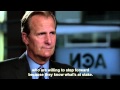
TV show is
fiction, with the entire story and every scene
set up, with a central character (a Democratic idealist) giving
a brilliant speech with unimpeachable arguments that manages to bring out the truth (sorry, to bring out the
Truth with
a capital T, nay, more — to bring out nothing less than
thuh Reh-ve-lay-tion),
shaming his clueless opponents (and everyone else) in the process —
indeed, silencing the whole room — and, in typical Hollywood fashion,
leaving everyone on a higher plane of truth.
Isn't
this a mainstay of the Hollywood dream factory: the wise man (no matter
how young, as it is as often as not a teenager or even a child)
engaging in theatrics and bringing mind-boggling revelations to his
(clueless and uneducated) peers?
"Oh my God
what if the Soviets weren't really our enemies?!
(i.e., what if our only enemies were ourselves?!)
Oh my God
what if the Iranians aren't really our enemies?!
(i.e., what if our only enemies are ourselves?!)
That means Americans opposing Soviets or Islamists can only be bigots; bigots and… paranoids! We are, we must be, better than those clueless and hate-filled Americans!"
This works exceptionally well, provided everybody with a differing opinion (or better yet, with facts) agrees to
refrain from responding.
In the real world, of course, real people have to put up with differing
arguments, with give'n'take, and with opponents providing replies and
counter-arguments (see, for instance,
Larry Elder and
Taleeb Starkes
below); sometimes even brilliant speakers have to listen to what others
(and, no, not just to blindly mindless patriots) have to say, and
sometimes the brilliant speakers' brilliant arguments prove to get the
short end of the the shtick.
That, of course — i.e.,
providing a (dispassionate) examination of "The Most Honest Three
Minutes In Television History", as well as a (fact-based) reply to
Will McAvoy's famous tirade — is what the current post is about.
For the purpose of this extremely long post (the size of a book chapter),
Will McAvoy's
speech has been divided into four sections (with a couple of instances of overlapping here and there).
1) The Extensive List of Countries on Earth with Freedom
2) The Idealist Hero's Irreproachable Statistics
3) The Most Damning Statistics of All
(The
post you are reading right now will be a long, facts-laden,
take-no-prisoners post, as mentioned, the length of a chapter in a book.
If you are short of time and don't have time to read the whole thing,
this third section, specifically 3C, should be the one to focus on…)
4) The Appeal to the Past
Shall we get started?
 1) The Extensive List of Countries on Earth with Freedom
• Will McAvoy: It's not the greatest country in the world, professor, that's my answer. …/… [turns to Lewis]
And  with a straight face, you're going to tell students that America is
so star-spangled awesome that we're the only ones in the world who have
freedom? Canada has freedom, Japan has freedom, the UK, France, Italy,
Germany, Spain, Australia, BELGIUM has freedom! Two hundred and seven
sovereign states in the world, like 180 of them have freedom.
with a straight face, you're going to tell students that America is
so star-spangled awesome that we're the only ones in the world who have
freedom? Canada has freedom, Japan has freedom, the UK, France, Italy,
Germany, Spain, Australia, BELGIUM has freedom! Two hundred and seven
sovereign states in the world, like 180 of them have freedom.
Hm.
Really? Is that so? Doesn't this part of the speech rest entirely on
how exactly we, on how far to go to, define "having freedom"? This is
clear-cut, you say? Maybe you, maybe we, shouldn't be too sure.
The countries that
Will McAvoy
so flippantly mentions have strong central governments. And what
freedoms their citizens have have been bestowed by the central
government. And can be taken away again by the central government.
(This of course is what
leftists
love about these countries, about other countries, in the first place
and are dying to have the USA emulate — the reason behind
Will McAvoy's
entire speech in the first place, not to mention one Barack Obama's
delight in using the White House for the purpose of "fundamentally
transforming the United States of America.")
As
Steven Hayward puts it,
I suspect liberals are envious of Europe not so much for its high taxes
and generous welfare states (which aren’t actually that much more
generous than our own if you add it all up correctly), but for its more
open authoritarianism.
To take
France as an example,
Andrew C. McCarthy writes in the National Review that
Unbound by any First Amendment, the French government exerts
pressure on the media to suppress bad news. We do not hear much about
the steady thrum of insurrection in the banlieues: the thousands of
torched automobiles, the violence against police and other agents of the
state, the pressure in Islamic enclaves to ignore the sovereignty of
the Republic and conform to the rule of sharia.
Right-wing propaganda, you wonder? Let's head over to the New York Times, then: in an article entitled
Where ‘In Bed With Media’ Can Be Taken More Literally,
Scott Sayare adds that
The line between politicians and the news media can be blurry in France,
where the fates of some journalists have long been hitched to those in
the government they pester or please. … in a country
where much of the Paris elite share a common background, attended the
same schools and go to the same parties, the traditional commingling of
journalists and politicians has endured.
Daniel Carton, a former
reporter in France [and an outspoken critic of
conflicts of interest in French journalism], blames the news media for not doing more to resist
such close ties.
… For decades, newspapers have relied heavily on state subsidies. The
public media, which account for perhaps half of mainstream television
and radio news, are still run by political appointees. Private media
outlets belong to companies or investors with demonstrated political
leanings or business connections to the state, undermining journalistic
impartiality.
… Private publications are also beholden to the state, at least
financially. The government provided $1.5 billion in subsidies to them [in 2011].
Have
you heard of the Doctrine of the Lesser Magistrate — whereby "popular
magistrates" acting as guardians of the people's liberty can (lawfully)
"curb the tyranny of kings"? The
author of articles like
It’s Time to Start Teaching Our Kids Disrespect To “Authority”,
Bojidar Marinov, writes (warning: strong religious language at the link):
The Doctrine of the Lesser Magistrate … would be completely useless outside the US, where local “magistrates”  are simply employees of the central government. In the UK, for example,
the resistance of local officials to tyranny would be nothing less than
rebellion no different than the rebellion of private individuals; a
lesser magistrate is simply not a magistrate anymore if he fails to obey
the will of his sovereign, the centralized state. Thus, in its pure
form, the Doctrine of the Lesser Magistrate works as a deterrent to
tyranny only where tyranny has already been pushed back and thus room
for independent action has been legally secured; and in our modern
world, this means only a few polities in the world, limited to the US,
Canada, Australia, Switzerland, and may be South Africa – and these
polities trace their liberties back not to bloodless reforms but to
violent revolutions which forced the central government to agree to
limit its powers.
are simply employees of the central government. In the UK, for example,
the resistance of local officials to tyranny would be nothing less than
rebellion no different than the rebellion of private individuals; a
lesser magistrate is simply not a magistrate anymore if he fails to obey
the will of his sovereign, the centralized state. Thus, in its pure
form, the Doctrine of the Lesser Magistrate works as a deterrent to
tyranny only where tyranny has already been pushed back and thus room
for independent action has been legally secured; and in our modern
world, this means only a few polities in the world, limited to the US,
Canada, Australia, Switzerland, and may be South Africa – and these
polities trace their liberties back not to bloodless reforms but to
violent revolutions which forced the central government to agree to
limit its powers.
In the Washington Post, the Volokh Conspiracy's
Ilya Somin explains Why Most Exercises of Government Power are Non-Consensual (and Why it Matters):

The
Declaration of Independence famously states that governments derive
“their just powers from the consent of the governed.” But, sadly, this
is almost never the case in the real world. If it is indeed true, as
Abraham Lincoln famously put it, that “no man is good enough to govern
another man without that other’s consent,” that principle has more
radical implications than Lincoln probably intended. Few if any of those
who wield government power measure up to that lofty standard.
"The key difference between America and the rest of the world, in regards
to freedom and liberty," adds
Matthew Cina,
is where we believe our freedom comes from. To the rest of the world, even with countries who modeled their
constitution after ours, their freedom comes from the government. … We believe that our rights come from a
place untouched by man and a government, even by consent, can pass any
laws they want and we would still be entitled to our rights. So who is
more free? The people whose rights can be stripped with the stroke of a
pen or the people whose rights can never be taken away?
But, granted, this may all seem a tad theoretical. Shall we, therefore, get a bit more specific?

Although Sweden does not feature among the countries listed by
Will McAvoy, I guess that nation could easily have figured as another
sovereign state with freedom — in view of the fact that the Scandinavian model always features so prominently in
liberals' talking points.
That, however, would be news to
Michael Booth,
a (left-leaning) journalist who has lived in Denmark for 15 years and
whose book "Behind the Myth of the Scandinavian Utopia" (
The Almost Nearly Perfect People)
informs us that "for much of the twentieth century Sweden was
effectively a one-party state." That party was the Social Democrats, and
they "regulated every aspect of their dutiful, acquiescent citizens'
lives, doing their utmost to ensure adherence to the prescribed modern,
progressive social norms." (Again, something that would not be met with
anything but respect from the types of
Aaron Sorkin and
Jeff Daniels.)

(By the way, should this progressive Scandinavian utopia decide not only to exit the EU but also apply to become a U.S. state,
Sweden would rank below 38 other states in wealth based on purchasing-power parity.)
As for the EU's most populous country, writes The Weekly Standard's
Christopher Caldwell,
Since the end of World War II, and largely as a result of it, Germany
has been much more restrictive of speech than other Western democracies.
It is not, strictly speaking, a country of free expression. It long
banned the Communist party, Scientology, and (until last year) Mein Kampf. State investigators regularly use video cameras to watch demonstrations for extremism.

Belgium has freedom? For seven decades — like
in France
and
many other places (not least Sweden) — the élites have hidden the
extent to which collaboration with the (often but not always occupying) Third Reich took place under World War II (in
the 1980s, a graphic novel called
Jaunes faced censorship for evoking King
Leopold III's alleged collaboration with the Nazis during the 1940s occupation).
Japan? From Tokyo, the
New York Times' Norimitsu Onishi has reported on
a press club culture that stifles independent reporting due to
the collusion that exists in Japan between the authorities and the mainstream media (a "structure designed to protect the powerful while ignoring the powerless")…
Mexico? Perhaps few would be surprised that
two-thirds of Mexican journalists admit to censoring themselves, leading to
a media landscape across Mexico for the past 70 years
in which federal and state officials
routinely dictate the news, telling outlets what they should — and should not — report.
But how about Canada? For years,
Mark Steyn
and Maclean's magazine were prosecuted by the quasi-judicial Canadian
Human Rights Commission (or a provincial variant thereof) for exercising his free
speech rights. For what reason? For inciting hate speech, naturally. To hear
Jonah Goldberg tell it,
Canada is barely a functioning democracy at all: Its governmental
structure, if described objectively, is far more similar to what we
would expect 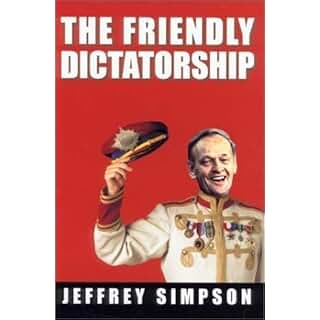 in a corrupt African state with decades of one-party rule. Jeffrey Simpson , who might be called [the] Canadian David Broder, has even
written a book entitled The Friendly Dictatorship, which sports on its
cover a doctored photo of [then-Prime Minister] Jean Chrétien in a Pinochet-style military
tunic. Simpson argues not only that Chrétien is the “Sun King” of
Canada, but that the government itself is designed to be for all intents
and purposes a secular monarchy.
in a corrupt African state with decades of one-party rule. Jeffrey Simpson , who might be called [the] Canadian David Broder, has even
written a book entitled The Friendly Dictatorship, which sports on its
cover a doctored photo of [then-Prime Minister] Jean Chrétien in a Pinochet-style military
tunic. Simpson argues not only that Chrétien is the “Sun King” of
Canada, but that the government itself is designed to be for all intents
and purposes a secular monarchy.
Note to
liberals
and to the makers of "The Most Honest Three Minutes In Television
History": That would be a lot of countries that do not (really) have
freedom.
You are also free (sic) to wonder to what extent Canada is free when

a Québec native is
going to jail for failing to… register his cat! The
Ottawa Sun:
Dan
Smith, 65, is searched against a police cruiser by an officer at the
Gatineau Police Station after refusing to pay a fine and court costs
after being found guilty last summer for not having a license for a cat.
… Smith, using a cane because of arthritis and carrying a plastic bag of
prescription drugs for various maladies, walked to the cruiser outside,
was frisked and asked to hand over the plastic bag before he got into
the back seat.
(Of course, to
leftists like
Aaron Sorkin and
Jeff Daniels,
isn't this little more but a(n unfortunate) glitch in an otherwise
exemplary system where capitalists, common clueless citizens, and other
trouble-makers and assorted enemies of the people can be
stopped in their steps by the politicians and by the authorities and brought to reason—i.e., controlled, and punished?)
But
let us get more specific and proceed with a more wide-ranging example.
(Since this is being written — over several months — in 2016, let that
example have to do with the mass attacks on Western citizens during the
winter of 2015.)
What is striking, in the wake of the
mass sexual assaults and robberies in Cologne on New Year's Eve 2015, is
how many of the governments and how many of
the mainstream media outlets in Europe's "free" countries decided to
refrain from reporting the news — and that that turns out to be something that they have sometimes been doing (or, rather, not doing) for years:
Germany,
Austria,
Sweden,
Denmark,
Finland, and
the Netherlands, not to mention
the EU as a whole, everywhere they did (not report) it.

To quote
Mark Steyn himself:
At New Year Mohammedans targeted infidels — and ZDF said "Nothing to
see here". Even as the Euro-media's cover-up is headline news across the
Continent, in Calgary Mohammedans target infidels — and the Canadian
media do the exact same thing.
As bad as this is,
none of this seems as bad compared to what happened (to what still is
happening?!) in another "free" country, usually considered the freest of
the lot—the
United Kingdom. In the 16 years
between 1997 and 2013 … at least 1,400 girls
from the age of eleven were raped by gangs of men, nearly all of whom
were immigrants (mostly from Pakistan) or sons of immigrants, in just
one English city: Rotherham, population 275,000.
But British authorities kept silent.
In 2014, the reason finally was revealed: the perpetrators were
Muslim, and British authorities were therefore afraid to publicize — or
often even investigate — the crimes. They feared being branded
Islamophobic and racist. Politicians on the Left and Right acknowledged
this fact.
… The British Home Secretary, Theresa May, told Parliament that
“institutionalized political correctness” was responsible for the lack
of attention given to the mass rape.
In other words, faced with the choice of protecting over a thousand
girls from repeated gang rape and protecting Muslims from being
identified as the rapists, British authorities chose to protect
multiculturalism and “diversity.” In the competition between
multiculturalism and one of the most elementary instincts and
obligations of higher civilization — the protection of girls and women
from sexual violence — higher civilization lost.

In
a previous column, the syndicated columnist had written that
Police incompetence was a factor, but not the primary reason.
The primary reason was political correctness. It turns out that the
perpetrators were all, or nearly all, of “Pakistani heritage” and the
girls were all, or nearly all, white.
… The New York Times and other left-wing media have thoroughly
reported this story and the fact that political correctness is to blame
for what was done to these girls. Yet they are oblivious to the fact
that they are the very ones who created the moral monsters known as
political correctness, multiculturalism, and “diversity” — the doctrines
that forbid judging non-whites, Muslims, and others by the same moral
standards by which whites and Christians are judged.
These left-wing doctrines made 16 years of gang rapes of English girls
possible.
Dennis Prager takes us back to the "free" countries on the continent today:
… the mayor of Cologne …
like the British authorities, has opted for multiculturalism over human
and women’s rights; for fighting Islamophobia over fighting to protect
women.
A related example is Ralf Jaeger, the interior minister of North
Rhine-Westphalia, the German state in which Cologne is located. The
left-wing minister said: “What happens on the right-wing platforms and
in chat rooms is at least as awful as the acts of those assaulting the women.”
All the isms of the left — multiculturalism, feminism, environmentalism,
socialism, Marxism, egalitarianism — distort the individual’s and
society’s moral compass. But, as the minister’s comments make clear,
none do so more than the Left’s loathing of conservatives and
conservative values.
As with multiculturalism, the left-wing priority of destroying the Right
has distorted the Left’s moral compass. How could anyone in his right
mind say that right-wing platforms and chat rooms are “at least as
awful” as women being sexually attacked and even raped by gangs of men?
The answer is that you cannot be in your right mind; you have to be in
your left mind.

In this perspective, Breitbart's
Oliver JJ Lane (along with National Review's
Andrew Stuttaford) reports on a brand-new scandal involving Germany's national public service broadcaster:
Zweites Deutsches Fernsehen (ZDF), which was recently forced into a humiliating apology for their silence on migrant violence
and sex assault[,] is being drawn into a fresh scandal after one of their
former bureau chiefs admitted the company takes orders from the
government on what it reports. He said journalists received instructions
to write news that would be “to Ms. Merkel’s liking”.
Former head of ZDF Bonn Dr. Wolfgang Herles [pointed out] that
ordinary Germans were totally losing faith in the media, something he
called a “scandal”. He said:
“We have the problem that – now I’m mainly talking about the public
[state] media – we have a closeness to the government. Not only because
commentary is mainly in line with the grand coalition (CSU, CDU, and
SPD), with the spectrum of opinion, but also because we are completely
taken in by the agenda laid down by the political class”.
Worse than the mainstream, government controlled and poll-tax funded
media in Germany just agreeing with the ruling coalition, the stations
actually took orders on what was and was not to be reported on.
[For instance,] “Today, one is not allowed to say anything negative about the refugees”
said Dr. Herles, concluding: “This is government journalism and that
leads to a situation in which people no longer trust us. This is
a scandal.”
Needless to say, this isn't anything that would bother the makers of
The Newsroom,
to have media echoing what the government is saying (as long as that
government is headed by a non-Republican, such as a good guy leftist
like Barack Obama), and this, indeed, explains their extreme hatred of
sites like Fox News—the likes against which
Will McAvoy's rant is partially directed.
Well. There you have it. Now we can understand that
drama queens like
The Newsroom creators (cast and crew alike) think this is freedom, since that — the freedom to destroy the Right (or at least to make them
shut up), while making the Left's
fairy tales about one victim class after another the prevailing narrative — is exactly the kind of freedom they wish for the United States.
Indeed.
The power of (benevolent) governments to shut up (clueless, racist,
etc) opponents is a highlight of (progressive) governments, according to
the left—as well as of… avant-garde Hollywood dream factories.

As an aside,
Charlie Martin may have put his finger on
what attracts Democrats and Hollywood leftists to Europe when he wrote
about
the lesson that he learned after living for a number of years in southwestern Germany (a country he loves and misses):
The longer I was there, the more I realized that the whole country
thought of themselves as subjects of the government; intrusions I'd
resent were ganz normal. When I'd arrived in Germany, I'd at
first felt it was freer than the U.S., with sex shops in the mall and
Main Street bordellos in small rural towns [in addition to no speed limits on the Autobahn]; the longer I was there, the
more it felt smothering.
2) The Idealist Hero's Irreproachable Statistics
• Will McAvoy:
And yeah, you… sorority girl. Just in case you accidentally wander
into a voting booth one day, there are some things you should know, and
one of them is:
There is absolutely no evidence to support the statement
that we're the greatest country in the world. We're seventh in
literacy, twenty-seventh in math, twenty-second in science, forty-ninth
in life expectancy, 178th in infant mortality, third in median household
income, number four in labor force, and number four in exports.
Most
of us are familiar the adage attributed to Mark Twain, "There are three
kinds of lies: lies, damned lies, and statistics." Fewer of us know
Georges Fischer's saying: "Statistics are like bikinis; they show a lot, but they hide the essential" (
Les statistiques, c'est comme les bikinis : ça montre beaucoup, mais ça cache l'essentiel).
Let the following be a demonstrating why, or in what ways, such sayings are largely truthful.
Before
we do any of that, start by noting that one of the main things we seem
to have established in the previous section is how erroneous — how
(self-servingly) partisan — the statistics (i.e., the news) issued by
the European governments are (such as
Germany,
Austria,
Sweden,
Denmark, and
Finland, not to mention
the EU as a whole) and how erroneous the statistics (i.e., the news) reported by the European press are.
Related: • Misleading Statistics — Would the EU Really
Dominate the Olympics in Medals Won If It Were "United"?
• The Misleading Statistics of Gun Control
• Mass shootings in the U.S. have fallen so much in the past century
that the political left has had to redefine what a mass shooting is
• Facts Which Europeans and American Leftists Conveniently Ignore
In that perspective, let us pause for me to ask you a question:
couldn't this post stop right here?
We
have established that Europe's statistics (i.e., the news) are, at
least to some extent, phony, we have established that, at least to some
extent,
the mainstream media in Europe and elsewhere in the world "takes orders from the
government on what it reports" (this could never happen in America, could it?!).
What
need is there, at this point, to go on debunking "The Three Most Honest
Minutes In Television History"?! Well, I said we would consider the
whole
Jeff Daniels speech (including the parts showing his utter contempt for any person disagreeing with his facts'n'figures — "
Just in case you accidentally wander
into a voting booth one day"), and so we are taking this post to the very end of his rant.
First of all, take a quick look at the first three issues mentioned:
literacy, math, and science. Wherever
Aaron Sorkin gets his statistics from, and whatever the truth behind
Will McAvoy's numbers, the very first thing to mention here is that all these subjects are the result of America's
public education system, supported by
leftists to the core — as taught by union-belonging teachers, supported by
the statists. When your primary goal is to teach social "skills" (with material like
Heather Has Two Mommies), is it any coincidence that factual subjects such as science and the three Rs go down the hill?
As
Matthew Cina asks,
My first question is this: why is a nation whose entire ideals revolve
around private enterprise getting judged for its public services?
In any case, how true do the statistics happen to be?
Let's start with an issue not directly mentioned in
McAvoy's rant: Americans are also accused of being obese. Ergo, there is a strong health problem in the United States
But
think about it: Isn't it true that obesity is not a
health problem (with an H), but
rather a
wealth problem (with a W)? For 5,000 years, the problem for most of the world's inhabitants has not been having too much to
eat, but too little. Now, certainly obesity may be something to
castigate. But at the same time, shouldn't it be noted that it is
more than a step forward that — isn't this thanks to the free market, by the way? — hunger is no
longer the ailment that people in the West are suffering from?
This brings us to
Will McAvoy's
life expectancy
numbers: Again, Americans
are wealthier than people abroad (might we even say that Americans are
freer than people abroad?!), and so have more riches, and more things to
buy, not excluding… food (as we have just seen) and… automobiles.
More cars must necessarily mean more car accidents, which means more
deaths. Again, isn't this less a
health problem — or some sort of
deficiency in society — than simply a side effect (a negative and
unfortunate one, to be sure) of something inherently positive, i.e.,
increased
wealth?
Complaining of the "crappy methodology" by "complete idiots in terms of statistical methods",
Coyote Blog takes this a step further:
The incidence of [the diseases measured] are highly related to diet and
lifestyle. In fact, it is well established that  the US has a
comparatively high incidence rate of these diseases, much higher than
France. This makes it entirely possible that this mortality
difference is entirely due to lifestyle differences and disease
incidence rates rather than the relative merits of health care systems. In fact, this study is close to meaningless.
the US has a
comparatively high incidence rate of these diseases, much higher than
France. This makes it entirely possible that this mortality
difference is entirely due to lifestyle differences and disease
incidence rates rather than the relative merits of health care systems. In fact, this study is close to meaningless.
Coyote Blog goes further, and, as you will see, he will proceed to tackle the origin of
Will McAvoy's
infant mortality numbers in "The Most Honest Three Minutes In Television History":
… you have to be careful. The US has far more surgeries than most other
countries per capita, so we have more surgical deaths. Also, medical
error data is notoriously difficult to compare country to country
because reporting standards and processes are so different.
In
the US,
when the government measures medical errors, it is a neutral third party
to the error. [Well, this was before Barack Obama entered the White
House and introduced Obamacare.] In Europe, the government, as
healthcare provider, is
often the source of the error, calling into question how
aggressive these countries may be in defining "an error."
Infant
mortality data is a good example of such a trap. The US often looks
worse than European nations on infant mortality because it is defined as
infant deaths as a percentage of live births. But the US has the most
advanced neo-natal capabilities in the world. Many pregnancies that would result in a "born dead" in other countries result in a live birth in the US. Since these rescued births are much more problematic, their death rate is much higher.
Indeed, in another post,
Coyote Blog says he is sure that
you have seen various rankings where the US falls way behind
other western nations in terms of infant mortality. This stat is jumped
on by the left as justification for just how cold and heartless America
is, and just how enlightened socialized medicine must be. However, no
one seems to bother to check the statistic itself (certainly the media
is too incompetent to do so, particularly when it fits their
narrative). Statistics like this that are measured across nations are
notoriously unreliable, as individual nations may have different
definitions or methods for gathering the data.
Coyote Blog,
Craig Newmark, and the
American Enterprise Institute's
Mark J Perry go on to quote
a medical doctor:
… in fact, the main factors affecting early infant survival are birth
weight and prematurity. The way that these factors are reported — and
how such babies are treated statistically — tells a different story
than what the numbers reveal.
Low birth weight infants are
not counted against the "live birth" statistics for many countries
reporting low infant mortality rates.
 According to the
way statistics are calculated in Canada, Germany, and Austria, a
premature baby weighing [under] 500g is not considered a living child.
But
in the U.S., such very low birth weight babies are considered live
births. The mortality rate of such babies — considered "unsalvageable"
outside of the U.S. and therefore never alive — is extraordinarily
high; up to 869 per 1,000 in the first month of life alone. This skews
U.S. infant mortality statistics.
According to the
way statistics are calculated in Canada, Germany, and Austria, a
premature baby weighing [under] 500g is not considered a living child.
But
in the U.S., such very low birth weight babies are considered live
births. The mortality rate of such babies — considered "unsalvageable"
outside of the U.S. and therefore never alive — is extraordinarily
high; up to 869 per 1,000 in the first month of life alone. This skews
U.S. infant mortality statistics.
When Canada briefly registered
an increased number of low weight babies previously omitted from
statistical reporting, the infant mortality rose from 6.1 per 1,000 to
6.4 per thousand in just one year.
According to research done by
Canada's Bureau of Reproductive and Child Health, "Comparisons of infant
mortality rates by place and time should be adjusted for the proportion
of such live births, especially if the comparisons involve recent
years."
Norway boasts one of the lowest infant
mortality rates in
the world. But when the main determinant of mortality — weight at birth —
is factored in, Norway has no better survival rates than the United
States.
Comparisons — or, should we say, misleading
comparisons — with Hong Kong, Japan, Belgium, France, and Switzerland
are also mentioned by
Dr Linda Halderman:
Some of the countries reporting infant mortality rates lower
than the U.S. classify babies as "stillborn" if they survive less than
24 hours whether or not such babies breathe, move, or have a beating
heart at birth.
Forty percent of all infant deaths occur in the first 24 hours of life.
In
the United States, all infants who show signs of life at birth (take a
breath, move voluntarily, have a heartbeat) are considered alive.
If
a child in Hong Kong or Japan is born alive but dies within the first
24 hours of birth, he or she is reported as a "miscarriage" and does not
affect the country's reported infant mortality rates.
Shall we let the American Thinker's
Rick Moran have the last word?
Because
we don't have socialized medicine — yet [Infant mortality figures for US are misleading appeared before that great victory called Obamacare] — heroic efforts to save
newborns are common in America while these same infants are considered
"unsalvageable" in other countries and not counted against their
mortality statistics.

No; upon thought, let the last word be about general medicine, and let
all four reports come from articles in France's (left-leaning)
"newspaper of record,"
Le Monde, at least two of which were featured on the front page:
The French have the best health care in the world, yes they do, well, except for
this one flaw here, and that other flaw there, and, oh, that other flaw way over there, flaws which include but are not limited to
extra charges and bribes along with a yoke that fetters
innovation, not to mention
the very costs of the system (y'know, the type that America's
leftists love to quote), which turn out to be incomprehensible to the very members of… the French public.
And while we are on the subject of bikinis — sorry, of statistics — when
one Paris area doctor tried calculating his country's figures — using
the American model — it turned out that
the vaunted French system "only" produced the trifling number of…
10,000 deaths a year!

In the third section of his rant of "The Most Honest Three Minutes In Television History",
Will McAvoy will go on to mention the incarceration rate.
We
will have more on that just below, in the third section, but let us
start with this couple of questions: correct me if I'm wrong, but isn't
it usually
liberals (American or foreign), aka
the drama queens,
who are the champions of punishment and who therefore want more
government intervention as well as an increase in the number of rules
and regulations, thereby lifting the number of people (legitimately or
otherwise) behind bars? Wasn't it Lao Tse who, 2,500 years ago, said
"The more laws and order are made prominent, the more thieves and
robbers there will be"?
Will you forgive me for quoting a
Fox News report?
In April [2016], Hillary Clinton said she was sorry for what she described as
the unintended consequences of the landmark 1994 crime bill signed into
law by her husband. Clinton's past support for the law has come under fire from some African-Americans, who say that it has contributed to mass incarceration of young blacks.
Also, just as
liberals
always assume that the data, such as medical statistics, are the same
in every country, they take it as a given that countries such as China
and Cuba and Russia are
telling the truth
regarding the number of prisoners (political or other) their prisons
hold (or, as we have seen, the number of live babies that are born). How
good, how diligent, and how tenacious, are those countries' one-party
officials, and how likely are their leaders to truthfully report
whatever findings they receive, whether it is to their own people or to
the international community? And — as we saw in section 1 of this post —
the question applies just as much to the "free" countries of Western
Europe.
(This, of course, goes against the liberal
adage, where there are never any lies because all nations are blatantly
honest and always tell the truth, with the singular exception of the
United States provided it is being led by a Republican.)
 3) The Most Damning Statistics of All
• Will McAvoy:
We lead
the world in only three categories: number of incarcerated citizens per
capita, number of adults who believe angels are real, and defense
spending, where we spend more than the next twenty-six countries
combined, twenty-five of whom are allies. None of this is the fault of a
20-year-old college student, but you, nonetheless, are without a doubt a
member of the WORST-period-GENERATION-period-EVER-period, so when you
ask what makes us the greatest country in the world, I don't know what
the fuck you're talking about! Yosemite?
Start
by noting how this third section of the rancorous rant making up "The
Most Honest Three Minutes In Television History" is ended with a piece
of bitter harrumphing and bitter satire meant to shame people
(and—especially?—
silence them?). Just as the second section, above, was started with bitter satire (
Just in case you accidentally wander
into a voting booth one day) meant to shame clueless losers of
little worth. This might be because you could be forgiven for believing
that the entire rant amounts to a (
drama queen's) call for a strongman to take over, or for a strongman in power to take even more radical decisions.
Moreover,
Aaron Sorkin and
Jeff Daniels
are cleverly concealing what are actually far more damning
declarations. What they are actually saying is (and we can sub-divide
the damning statistics into three categories):
A) Americans lead the world in being racist
B) Americans lead the world in being (religious, i.e.) superstitious and
C) Americans lead the world in being warmongers
(in what turns out to be a largely peaceful world).
Come to think of it, isn't that what the man widely praised (in America as well as abroad) as
the most intelligent man ever to accede to the Oval Office, aka
the apologizer-in-chief,
has been saying, over and over again for the past eight years or so?
Whatever the case, let us examine the three categories one by one:
 A) Leading in the Number of Incarcerated Citizens per Capita (i.e., Leading in the Number of Racists)
Let us quickly do away with the incarcerated statistic, which we have mentioned already above. Shall we now address the
racist view, the unforgivable fact that more blacks than whites sit in prison cells?
Hold
on a minute. Isn't what most African American (male)s are in prison for
non-violent drug offenses (which were championed by black leaders
themselves, often liberal-minded ones)? Liberals (black or white) are
always claiming to be in favor of less harsh drug laws, but isn't it
conservatives who, as a general point of view, say "leave me (us) alone"
and "don't tread on me (on us)"? While keeping laws and government to a
minimum?
Remember that, in all cases, statistics can be highly misleading, often but not always, deliberately so. For instance, hardly
anybody (black or white, male or female) ever mentions the scandalous and inexcusably high rates of
sexism
in American jails (and in prisons around the world). Aren't more
than 93% of inmates (black or white) male, while only 7% are (black or
white)
female? Isn't this sexist?! Isn't it about time that we start a
government program to make the figures more "equal", more representative
of Western society (decreasing the number of male convicts while
increasing the number of female prisoners)?!
A number
of readers will probably exclaim "What a ridiculous thing to say" —
which, of course, is my point. Isn't the question they should be asking
themselves, why aren't the black/white incarceration figures approached
with at least some of the same amount of skepticism?
Asking
Is America racist? in a
Prager University video,
Larry Elder replies that
The answer is you cannot have an honest discussion about police conduct without an honest discussion of black crime.
Though blacks are 13% of the population, they commit 50% of the nation’s homicides, and almost always the victim
is another black person, just as most white homicides are against other
whites. In 2012, according to the Center for Disease Control, police
killed 123 blacks, while, by the way, killing over twice that many
whites. But that same year blacks killed over 6,000 people — again,
mostly other blacks.
In another
Prager University video,
Taleeb Starkes adds that as
just
about everyone knows, but too few talk about publicly, in majority
black cities, violent black on black crime is rampant. A Department of
Justice
study from 1980-2008 revealed that blacks accounted for almost half of
the nation’s homicide victims (47.4%) and more than half of the
offenders (52.4%) all while only being 13% of America’s population.
The Tuskegee Institute conducted a study of all known lynchings of
blacks that occurred between 1882-1968. During this 86-year span, which
is essentially the post-Civil War era up to the Civil Rights era, 3,446
Blacks where reportedly lynched. Presently, black-on-black murder
eclipses the number of blacks lynched over the course of 80 years
roughly every six months.
This is part of a
list of
the five biggest problems facing black Americans.

"Where do things like
racism and police brutality rank?" wonders the introduction. The five issues are listed by
Starkes, author of the Amazon bestseller
Black Lies Matter (Why Lies Matter to the Race Grievance Industry), and "They may surprise you." (See also
Larry Elder on
Black Fathers Matter, Chloe Valdary on
Don't Judge Blacks Differently, and
Heather Mac Donald on
Are the police racist?)
More generally,
the Left (and the interventionist government) keeps (conveniently?) forgetting the plights that it is responsible for (see also
Derryck Green on
Who Are the Racists: Conservatives or Liberals?). In
Liberal Fascism,
Jonah Goldberg writes that
In the liberal telling of America's story,
there are only two perpetrators of official misdeeds: conservatives
and "America" writ large. Progressives, or modern liberals, are never
bigots or tyrants, but conservatives often are. For example, one will
virtually never hear that the Palmer Raids, Prohibition, or American
eugenics were thoroughly progressive phenomena. These are sins America
itself must atone for.
For instance,
reformers wanting to "change the mindset" and behavior led the fight against alcohol during Prohibition, which led in turn to
the rise of the American state
and Prohibition's successor, the war on drugs — which has led to the
increased numbers of incarcerated citizens, many of them blacks.
(Remember the Lao Tse quote from 2,500 years ago?) Commenting on
Lisa McGirr's
The War on Alcohol (Prohibition and the Rise of the American State),
Julia Vitullo-Martin writes that
… as anti-alcohol crusaders lost their first war, they turned to
another less controversial one: the war on drugs, which is very much
still with us, contributing to overcrowded prisons, damaged
neighborhoods, and ruined lives.
Remember, these are not conservatives; these are
our trademarked leftists with good (with the best of) intentions who want to create a utopia by changing hearts and minds.
B) Leading in the Number of Adults Who Believe Angels Are Real (i.e., Leading in the Number of Mindless Superstitious Morons)
When
Jeff Daniels later (below)
aspires
to intelligence, not to
belittling
it,
the chances are quite large that he is attacking the bitter clingers
to religion (and guns) of flyover country while saying that we (and that
they—if they had any brains) ought to turn to government, and to its
reasonable and perspicacious bureaucrats, to solve our problems.
So
we are supposed to shake our heads at the backwards Christians while we
laud, and join the numbers of, the ever-growing army of rational
devotees of science.
The only drawback is that there
are a few problems with this: for ain't it true that once you start
going into the details of the
scientific scoops — in an entirely rational, an entirely factual, and an
entirely scientific manner, I might add — a somewhat different picture
starts to emerge? When we start to follow the news
somewhat critically, aren't we surprised to learn how one scientific
"fact", or "truth", after another turns out to be wrong or spurious?
The Weekly Standard's
Andrew Fergyson points to an August 2015 report in the magazine Science

that shows that two thirds of behavioral sciences experiments did not,
could not, replicate the findings of original research teams, meaning
that
"two out of three experiments in behavioral psychology have a fair
chance of being worthless."
Ferguson mentions a Stanford John Ioannidis paper, "Why Most Published Research Findings Are False," along with a
Gina Perry book,
Beyond the Shock Machine, and another by
Stephen T. Ziliak and
Deirdre N. McCloskey,
The Cult of Statistical Significance,
before going on to demonstrate the debunkery of such studies as the one
showing that 75% of Americans are racist and the Stanley Milgram
experiment in which subjects were told to increase electric shocks on a
stranger next door (no, contrary to what we've been told, it turns out
that most people did
not increase the strength of the shock to inflict severe pain).

Richard Smith, who edited the British Medical Journal for more than a decade, told
The Independent
there was no evidence that peer review was a good method of detecting
errors and claimed that
“most of what is published in journals is just
plain wrong or nonsense”.
In January 2017,
the BBC reports that
Most scientists 'can't replicate studies by their peers'
Science is facing a
"reproducibility crisis" where more than two-thirds of researchers have
tried and failed to reproduce another scientist's experiments, research
suggests.
… "It's worrying because replication is supposed to be a hallmark of scientific integrity," says Dr Errington.
Concern over the reliability of the results published in scientific literature has been growing for some time.
According
to a survey published in the journal Nature last summer, more than 70%
of researchers have tried and failed to reproduce another scientist's
experiments.
… The problem [is]
with the way the scientific literature had been "tidied up" to present a
much clearer, more robust outcome.
"What we see in the published literature is a highly curated version of what's actually happened," [says Marcus Munafo].
"The
trouble is that gives you a rose-tinted view of the evidence because
the results that get published tend to be the most interesting, the most
exciting, novel, eye-catching, unexpected results.
"What I think of as high-risk, high-return results."
The reproducibility difficulties are not about fraud, according to
Dame Ottoline Leyser, director of the Sainsbury Laboratory at the
University of Cambridge.
That would be relatively easy to stamp
out. Instead, she says: "It's about a culture that promotes impact over
substance, flashy findings over the dull, confirmatory work that most
of science is about."
She says it's about the funding bodies that
want to secure the biggest bang for their bucks, the peer review
journals that vie to publish the most exciting breakthroughs, the
institutes and universities that measure success in grants won and
papers published and the ambition of the researchers themselves.

All
these scientists, of course, as well as the part of the population
who believe in, and who revere, said scientists, belong to the "culture that promotes impact over
substance" along with "flashy findings" and are the very people laughing
their heads off at the hopeless credulity of religious folk.
Is it any wonder that, among the running tongue-in-cheek memes over at
Instapundit, one of the most popular is
The Science Is Settled?
But it doesn't stop with the (numerous) errors in the science fields.
Indeed, the
Jeff Daniels
outburst is particularly ironic when one considers the numerous New Age
types who invoke stuff such as people's guardian angels.
True, conservatives are religious, concedes
Jonah Goldberg,
no one is denying that, but haven't the (homeopathy-, acupuncture-,
aromatherapy-following) leftists forgotten a couple of minor details?
Democrats
are more likely to believe in paranormal activity. They’re also more
likely to believe in reincarnation and astrology. I have personally
known liberals who think crystals have healing powers who nonetheless
believe that the internal combustion engine doesn’t actually rely on
magical horse power.
… When I hear people talk about
science as if it’s something to “believe in,” particularly people who
reject all sorts of science-y things (vaccines, nuclear power, etc. as
discussed above), I immediately think of one of my favorite lines from
Eric Voegelin:
“When God is invisible behind the
world, the contents of the world will become new gods; when the symbols
of transcendent religiosity are banned, new symbols develop from the
inner-worldly language of science to take their place.”
This will be true, he added, even when “the new apocalyptics insist that the symbols they create are scientific.”
In
other words, the “Don’t you believe in evolution!?!” people don’t
really believe in science qua science, what they’re really after is
dethroning God in favor of their own gods of the material world (though I
suspect many don’t even realize why they’re so obsessed with this one
facet of the disco ball called “science”). “Criticism of religion is the
prerequisite of all criticisms,” quoth Karl Marx, who then proceeded to
create his own secular religion.
Maybe the last word should go to Walter Russell Meade, who, regarding a New York Times article on
Ghost Hunting in Norway, points out, in
When God Goes Away, Superstition Takes His Place,
that people "who think themselves too rational for religious belief end
up believing in 'astral forces', ghosts and other phenomena."
But "these superstitions" can lead to much more harm, he adds:
communist atheists … scoffed at the credulity of religious believers even as they worshipped the infallible insights of Stalin
murdering tens of millions of people in the process.
Similarly, the Nazis presented their faith as an alternative to the 'outgrown superstitions' of historic Christianty.
As you can see, the more we dig, the more unpleasantness we find. The government's
and the politicians' part in the fight for "rational belief" against
religion. As we forget that one function of religion — yes, it too — is
to serve as a part of the checks and balances against total power.
For when religion and the family are weakened, doesn't the welfare state (known by a religious expression in French,
l'État-providence) aka Big Brother (it is not a family expression by accident), take over their functions?

Isn't what is possibly the most ludicrous development of the last couple of years — straight out of
a Monty Python sketch — the idea that men who believe they are women must be treated as women?
How
more anti-science, how
more anti-factual, how
more anti-rational can anyone get than to say
that a man wearing woman's clothing has
effectively become a woman?
If anyone is to be accused of distrusting science or of hating science,
who can be more fit for this position than the person who says a man
wearing woman's clothing
ought to be recognized as a woman? And that, all the while pretending that
this shows the enlightenment, the wisdom, and the avant-garde broadmindedness of those devoted to science!
The topic starts losing its humor when
it turns out that various levels of government are involved in
promoting this, wanting to force you to so say and, effectively, so
think. Otherwise you will run the risk of being subject to various
degrees of punishment, from fines up to six figures (up to a quarter of a
million dollars in the Big Apple) to the ruination of a career due to
being publicized as a "hater".
As
David French writes, we have to ask ourselves if "In the secular faith of the illiberal Left, pronoun mandates have
become the equivalent of blasphemy codes."
For an in-depth and dispassionate study of people of intelligence versus people who believe in angels, go to Devotees of Science Versus Followers of Religion (Are Only the Latter to Be Taken to Task for Their Alleged Superstitions?)
C)
Leading in Defense Spending (i.e, Leading in the Number of Clueless,
Blood-Thirsty, Criminal Warmongers—Instead of Using America's Riches for
Good, Positive Things Such as Foreign Aid, Etc)
Here
we get to two of the most damning and of the most unassailable pieces
of statistics ever used by America's critics: (the vast amount of)
military spending and — or versus, if you prefer — (the tiny percentage
of) foreign aid.
Indeed, in section 4 of his diatribe,
Jeff Daniels will go on to bemoan that we used to "
[wage]
wars on poverty, not [on] poor people".
If this long, long post could and should be boiled down to one short(er) argument, let it be this 3C section.
Before
we go on, let us mention that statistics sound like the unassailable
presentation of a straight-forward figure but that's forgetting that
they are composed of different things, such, as percentages, amounts,
ranks, etc… In an ideal world, we would get
all these pieces of —
together — but that is not the way
leftists
get to become arbiters of dominance and/or achieve positions of
dominance. Whether in politics or in entertainment. And we shall
immediately see why.

We have here two “facts” that, by
themselves, “prove”, or ought to prove, and that behind the shadow of a
doubt, that America is egoistical, that Washington is power-hungry,
that Uncle Sam is war-mongering, that Americans are blind, and that the
rest of the world is in distress because of Uncle Sam's despicable
policies. (Or, that at the very least, its leader — except when he or
she happens to be a Democrat, of course — and/or the leader's policies
are racist, greedy, bellicose, and self-centered.)
First of all,
Matthew Cina puts the high military figures into perspective:
most
European nations, namely France, Germany, and the U.K. are
purposefully downsizing their militaries in favor of relying on the U.S.
to come defend them incase of an incident. Even more to the point, half
the reason the U.S.'s military budget is so expensive, besides the
technology that is literally decades past the competition, is because we
take care of our soldiers. A Chinese soldier is paid one-ninth that of a
U.S. soldier, and even then, the Chinese soldier gets drastically
smaller healthcare or Veteran benefits. If the U.S.'s big military
budget comes from futuristic technology, taking care of our soldiers,
and single-handedly protecting the western world, I think it's worth the
bill.
As for
Megan McArdle, she
adds that
The freeloading countries don’t even send a fruit basket to
Washington to say thanks. In fact, as a rightish American who’s spent a
bit of time abroad, I can personally attest that many of those NATO
members’ citizens feel free to disparage our massive military budget, as
if their smaller budgets were some sort of moral sacrifice rather than
an unearned benefit paid for by U.S. taxpayers.
Which, indeed, is what the usual outrage in
The Newsroom monologue is all about.
But even if we decide to ignore the above, may we be allowed to take a closer look at these facts and figures?
What is the first thing that we notice?
We notice that one “fact” is a percentage figure.
And we notice that the second “fact”
is an amount figure.
More precisely, one puts America (and other
countries) in a list according to a percentage of GNP.
While the other
puts America (and other countries) in a list according to absolute
dollar terms.
Do you want to try something fun?
We have two "facts" about America, right, based upon two different ways of calculating statistics? Correct?
How about this?
How about if, in each category (foreign aid and military budgets), we
try
reversing the way the positions of countries are calculated?
•
Question 1: What happens if
we calculate Uncle Sam's foreign aid according to the process used to compute Uncle Sam's military budget?
What happens when
we calculate foreign aid in absolute terms and what position do the
countries end up in then?
Lo and behold!
While America’s
development assistance as
a percentage its GNP
is indeed smaller than that of other aid nations, "The Most Honest
Three Minutes In Television History" fail to mention that the
net amount that it donates in absolute terms turns out to be — by far — the largest!
At
$31 billion, it is close to double than that
of the next country in the list (the UK, at $18 billion) and until
recently (Germany has inched up over the past couple of years), more
than double than every other country on the list, including all the
Scandinavian countries combined (indeed, with the smaller Northern
European countries mentioned above dropping to four to five times less
than the USA each). As it turns out, for those among you, the
Aarons, the
Wills, the
Jeffs, who love the "combined" comparisons, the
U.S. gives as much as Sweden, the Netherlands, Canada, Norway, Italy,
Switzerland, and Australia combined.
• Question 2: What happens when we calculate Uncle Sam's military budget according to the process used to compute Uncle Sam's foreign aid?
What happens when
we calculate foreign aid in terms of budget percentage and what position do the
countries end up in then?
Lo and behold!
If
we try calculating the dollar figure per GDP, we find that
the figures change drastically. "The Most Honest Three Minutes In
Television History" fail to note that U.S. drops down, not to second
place, not to fourth place, not to 10th or 15th or 20th place, but
almost all the way down to 30th place (it's actually position 29)! This
is according to the
Global Militarization Index
(GMI), which compares a nation's military expenditure with its gross
domestic product (GDP) and which is roughly comparable to… the foreign
aid statistic so widely bandied to scold America for.
"The Most Honest Three Minutes In Television History" fail to mention
North Korea, although it has been reported variably as spending
an astonishing quarter to
a third
of its GDP on its armed forces and should therefore belong in first
place. Indeed, at the NationMaster website, the
10-year-old figures for
military expenditures as an estimated percent of gross domestic product puts the US all the way down in position 27, with North Korea coming up front. (At almost 23%, it is
double the percentage of the next entrant (Oman).)
And what nations follow it?
The next nine countries are all in the Middle East. The first 30
nations are all in the Middle East, in Africa, and in Asia, from Yemen,
Eritrea, and Mauritania to Chad, Angola, and Swaziland. Besides Israel,
Bosnia, Greece, and the United States, along with Turkey, there is not a
democracy and/or a European country among the first 50 or 60 nations.
Does that leave those Western nations off the hook, however? Hardly,
given the very fact that many of them are cosseted by Washington’s
providing for their defense, which — who knows? (
The Newsroom certainly does not) — may go some way
towards explaining why they can afford having both their amounts and
their percentages be so low —
all the while basking in the self-serving statistics of a Will McAvoy monologue.
As for the developing
countries making up the mass of the 50 or 60 top countries, an inordinate amount of money is spent by Third World leaders
on the army, on security forces, and on police battalions, forces that
amount to their leader's (to their leaders') personal bodyguard and
forces which are then often turned loose… on the countries’ own
population.
The money shot:
these are precisely the type of countries which… the smarter-than-thou reporters of The Newsroom and other leftists would have the United States, and the West, provide… more foreign aid to!

For an in-depth and a more detailed account of the figures devoted to foreign aid and military budgets, check out Lilliputian Foreign Aid Percentages Coupled with Gargantuan Military Budget Amounts (What, If Anything, Is Hiding Behind Two Allegedly Damning Statistics About Uncle Sam?)
Here are some additional statistics that
you rarely hear about, statistics that — for some inexplicable reason —
The Newsroom does
not mention in its "Three Most Honest Minutes In Television History":
Americans
make up about 5% of the world's population and give about 35% of the
aid. … At a minimum, in order to discount the largesse of the United
States, one must carefully exclude gigantic categories of aid, such as
military aid, food aid, trade policies, refugee policies, religious aid,
private charities and individual giving.
That's from (the much-hated)
Ann Coulter,
so 5% giving about 35% of the world's aid meme should probably be
dismissed (how convenient), as it doesn't fit into the ensuing rant about America no
longer being a great country.
You do not trust the writer of
Slander (Liberal Lies About the American Right) and you never would?
All right, then; maybe we should head over to
the OECD. As
Daniel J. Mitchell explains,
if you look at rates of “voluntary private social expenditure” among nations, it turns out that Americans are easily the most generous people in the developed world.
Wow, people in the United States are so generous that their voluntary
giving amounts to 10.2 percent of gross domestic product. The only other
nations that even crack 5 percent of GDP are the Netherlands, Canada,
and the United Kingdom.
… It’s also worth noting that these numbers actually understate the
charity gap between Americans and folks from other nations. Economic
output in the United States is about 30 percent higher than it is in the
rest of the developed world, so charitable giving by Americans actually
represents a much bigger slice of a much bigger pie.
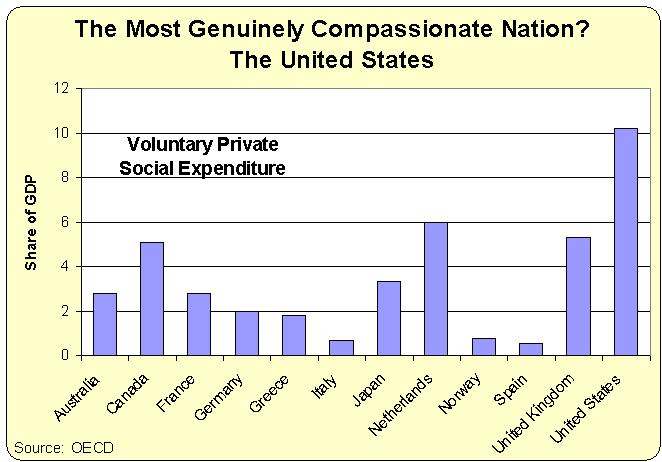
In
fact, adds the senior fellow at the Cato Institute, it even seems like
proponents of small government in the U.S., far from being the greedy
and inhuman(e) egotists they are constantly being described as (not
least in
The Newsroom), are
far more generous than those who favor a big welfare state (not least the creators of
The Newsroom).
Still, as for "That free up money for all the free medical care and cheap train fare that
Europeans
[like] to boast about as a sign of their superiority," writes the
Bookworm,
None would admit that they didn’t have “free” medical care — they had American-funded medical care.
Ann Coulter's figures are confirmed several years later as the
Washington Examiner's Paul Bedard reports that
Americans are world's most charitable, top 1% provide 1/3rd of all donations. The
new
Almanac of American Philanthropy … found that Americans out-donate
Britain and Canada two-to-one and nations like Italy and Germany
20-to-one. What's more, more than half of every single income class
except those earning less than $25,000 donate to charity.
The much maligned top 1 percent in the U.S. economy fork over one third
of all donations made.
Adds the
Philantrophy Roundtable:
A large minority of Americans—45% in total—don’t realize that their
country is all by itself at the front of the pack in the practice of
making voluntary donations to others.
Wouldn't that large minority of Americans include
Aaron Sorkin, and
Jeff Daniels, and the writers of
The Newsroom (and its "Most Honest Three Minutes In Television History" scene) — among (many) other
leftists and Hollywood types?
For the actual hard numbers, see
the last chart in the section that follows this one, Statistics on U.S.
Generosity. You’ll see that the level of charitable offerings in the
U.S. ranges from roughly twice what takes place in lands like Britain
and Canada to almost 20 times the rate of Italians and Germans.
Interestingly, younger Americans ages 18-39 (who often think of
themselves as more globally aware) are actually far less likely than
compatriots 40 and over to appreciate how much their country differs
from others on this front.
Wouldn't those unappreciative Americans include — even if they are older (at least physically) —
Aaron Sorkin and
Jeff Daniels and the writers of
The Newsroom, among (many) other
leftists and Hollywood types? Again, the
Philantrophy Roundtable's numbers are among the (many) statistics that have no place in "The Most Honest Three Minutes In Television History."
Once more, the
Philantrophy Roundtable:
Another area where Americans are distinctive is in attitudes toward
fixing social problems. Our strong preference is to pull the lever of
private aid wherever possible, instead of relying on government.
This is partly just a response to what we see around us: in crucial
areas like medical care, disaster relief, college education, family
life, addiction treatment, sharing the arts, expanding home ownership,
and so forth, the most effective actors are often charitable and
voluntary groups, not state agencies.
Predictably, the biggest split on this question is by political
viewpoint. Overall, men and women alike prefer private aid as their
first choice, as do people of all ages and religions.
But while
Republicans and Independents prefer philanthropy over government by more
than 2:1, Democrats run against the trend by picking government over
philanthropy by 51% to 31%.
Notably in… schooling, the place where children are taught such subjects as…
literacy,
math, and
science (might you remember we mentioned those subjects above? In section 2 of this post?).
In case you are wondering where the charity money comes
from — surely it must come from the generous leftist millionaires —
Jeff Jacoby lays it out for us:
The overwhelming share of that $360 billion is donated by individuals. Not
everyone gives, of course, but in this country those who don’t are
decidedly in the minority. Nearly seven out of 10 American households
donate to at least one charitable cause each year, at an average annual
rate of about $2,600.
in the minority. Nearly seven out of 10 American households
donate to at least one charitable cause each year, at an average annual
rate of about $2,600.
Philanthropic giving is a quintessentially American behavior, and always
has been. It is also a radiant example of American exceptionalism. The
new [“The Almanac of American Philanthropy”] ranks 14 leading industrial countries by the amount of
charity their citizens give yearly (calculated as a percentage of GDP).
Americans were by far the most charitable — roughly twice as generous as
Canadians, Spaniards, and the Irish, for instance, and more than 20
times as apt to give as Germans and Italians.
And with that,
Jeff Jacoby brings us back to defense spending:
As Karl Zinsmeister writes in the Almanac’s lively and
enlightening introduction, “philanthropy is a huge part of what makes
America America.” Huge in its moral and social impact, of course, but
also huge as a matter of economics. The nonprofit sector in the United
States employs 11 percent of the US workforce and supplies 6 percent of
national GDP — and that doesn’t include the economic impact of nearly 8
billion hours of service by 63 million American volunteers,
an impact that last year was worth an estimated $184 billion. America’s
formidable “military-industrial complex,” Zinsmeister notes, isn’t
nearly so formidable when compared with the American philanthropy
complex: Nonprofits surpassed defense as a share of the US economy more
than two decades ago.
… “Indeed, private US philanthropic aid of all sorts sent overseas now
substantially exceeds the official foreign aid of the US government,”
Zinsmeister writes.
… “In the United States I am even more struck by the innumerable
multitude of little undertakings than by the extraordinary size of some
of their industrial enterprises,” marveled Alexis de Tocqueville upon traveling through America in the 1830s.
He wrote of his “daily astonishment” at the “immense works” carried out
by the abundance of voluntary associations Americans formed.
Nearly two centuries later, the vast diversity of private charity in this country is as astonishing and fruitful as ever.
 4) The Appeal to the Past Greatness
• Will McAvoy: [pause]
We sure used to be [the greatest country in the world]. We stood up for what was right. We fought for moral
reasons, we passed laws, struck down laws for moral reasons. We waged
wars on poverty, not poor people. We sacrificed, we cared about our
neighbors, we put our money where our mouths were, and we never beat our
chest.
We built great big things, made ungodly technological advances,
explored the universe, cured diseases, and we cultivated the world's
greatest artists and the world's greatest economy. We reached for the
stars. Acted like men.
We aspired to intelligence; we didn't belittle
it; it didn't make us feel inferior.
We didn't identify ourselves by who
we voted for in the last election, and we didn't scare so easy. We were
able to be all these things and do all these things because we were
informed. By great men, men who were revered. The first step in solving
any problem is recognizing there is one. America is not the greatest
country in the world anymore.
Waging wars on
poverty, not poor people? Haven't we already disposed of that argument
in the previous section? Haven't American citizens always spent more on
charity (both in America and abroad), with the (free-market)
conservatives regularly beating the (statist)
leftists in the amount and the size of the gifts?
As for the time when we
built great big things, made ungodly technological advances, explored
the universe, cured diseases, … we cultivated the world's greatest
artists and the world's greatest economy … reached for the stars,
acted like men,
that was accomplished, more often than not, by private capitalists in the free market

and, often but not always, trusting in a Higher Power. Government and
bureaucrats might have something to do with it, and even a lot,
sometimes (the space program), but didn't said innovations still take
place in the most free-market nation on Earth?
Unsurprisingly (far from it), it would appear that
the geniuses behind
The Newsroom
are enthralled with Barack Obama's "You didn't build that" and with
Elizabeth Warren's "nobody in this country who got rich on his own."
Incidentally, both statements were dispassionately analyzed (much like
the present post purports to be) by
PJ Media.
Progressives critique the fiscal conservative/Tea Party/libertarian
position by purposely misrepresenting it as anarchy. When fiscal
conservatives say "We want smaller government," progressives reply, "Oh, so you want no government?"
… Fiscal conservatives have never called for no government — that's the anarchist position, and contemporary anarchism is actually dominated by extreme leftists, not extreme conservatives. Instead, fiscal conservatives clearly and consistently call for limited government, or for smaller government -- but not for the absence of government altogether.
So when President Obama and his mentor Elizabeth Warren
justify their call for tax hikes by pointing out that all entrepreneurs
benefit from communal infrastructure, they're committing the classic
Straw Man Fallacy by arguing against anarchy — a position that their
opponents do not hold.
Should businesses pay enough taxes to support the nation's basic physical infrastructure? Yes. Of course. And they already do.
But should they pay taxes to fund every progressive social fantasy?
That's open for debate, and that's not the point Obama and Warren were
making. Overtly, at least.
But let us get back to "The Three Most Honest Minutes In Television History":
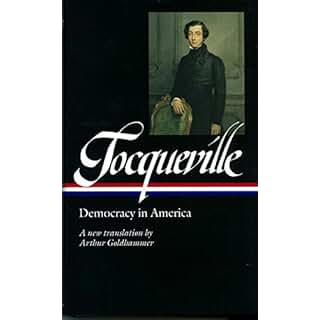
being
informed by
leftists in the mainstream media, even
revered leftists, did not, or did not necessarily seem to, have much to do with it.
Benjamin Duffy jumps in:
When liberals talk about "informed democracy" [and] claim that the press is doing a poor job of informing
the citizenry — which it is — [they are really complaining] that the press isn't
doing a good enough job of disseminating the liberal talking points.
Steven Crowder
has a 13-minute video that takes on "The Three Most Honest Minutes In
Television History" (precisely like this post does, but with a slightly
different argumentation), while Dr
Walter Campbell adds (with more passion and more religious vocabulary than I have so far):
“War on Poor People,” that’s what we have? If so, blame the class
warfare and welfare state created by those that Sorkin supports and
adores as heroes on the left. You want to start a “War on Poverty,” then deregulate, and reduce the
tax burden on those doing the work and those starting the businesses
that employ people. Make a competitive environment for business,
instead of casting them as the enemy, and you will have jobs and
prosperity, and sense of self worth instilled in your citizenry.
You don’t “fight” poverty anyway, you increase prosperity. There’s a
real difference — but the significance of that difference is lost on
left wing idealists who live in Hollywood and DC and have no
comprehension of starting and running a small business, and don’t have
the time in their egocentric lives to even take an academic interest in
the beliefs of those who founded, and made this country great, or who
fight for its greatness still today.

•
Will McAvoy:
[to moderator] Enough?
No,
Will.
Not enough. (Although you obviously would like it to be.) As we have seen, there are serious problems with the numbers
you have (conveniently) chosen in "The Most Honest Three Minutes In Television History" and even more with the statistics
you have (conveniently) chosen to ignore.
Dr
Walter Campbell concludes:
Jeff Daniels is woefully ignorant (or rather Aaron Sorkin who apparently
wrote the monologue) of what Freedom actually means, and is completely
oblivious to things like socialism, government regulation, personal
liberty, etc. and what they mean relative to that word “Freedom.” He
also seems blissfully unaware of immigration statistics and the enormous
number of people still desperate to come to the US …
… If Sorkin really wants to return to American greatness, maybe he
should start at the start, and look at the men and words of its
foundation, and search for the heart of what made us great, in the words
and deeds of the men who fought and died creating and protecting it,
instead of plying leftist propaganda in pseudo-intellectual elitist
centrist wrapping, and calling it a return to the “good old days.”
The “good old days” weren’t always good, but their core values were: a
country that cherished the rights of the individual over the rights of
the state, that trusted God, not Government, as their ultimate arbiter
of morality.

 Speaking about the vice-president's appearance on a Leftist television show, Steven Crowder said that


