
Pancho falls for fake ‘resistance’.

Behind the Façades in France: What expats and the mainstream media (French and American alike) fail to notice (or fail to tell you) about French attitudes, principles, values, and official positions…
Baghdad — June 18, 2006
There are many reasons for the continued violence and tragedy in Iraq, some of which falls on Iraqi and foreign shoulders but much of which lies on our own. There has been a great deal written already about policy errors (too few troops, disbanding of the Iraqi army, etc) to failings in the reconstruction effort (lack of financial controls, poorly written contracts, etc). However, there has also been another significant factor detrimental to success in Iraq, organizational failure on the part of the US government. It is certainly a less simple or sexy explanation for the ongoing tribulations we are putting ourselves through in Iraq but this does not make it any less valid or tragic.
Organizational Confusion and Inter-Agency Rivalry
From the beginning, organizational chaos seemed to plague the mission. Witness the Office for Reconstruction and Humanitarian Assistance (ORHA) set up in early 2003 headed by retired General Jay Garner to manage the affairs of a liberated Iraq. It was subsequently transformed into the Coalition Provisional Authority (CPA), headed by L. Paul Bremer III. Debate still rages today about the perceived failings of ORHA and its transformation into the CPA and the reasons for the change. However, both of these organizations answered to the DOD so this represented largely an in-house rearranging of affairs.
The real organizational test came later when the CPA turned into the US Embassy and the DOD relinquished a great deal of control to the DOS during the granting of sovereignty to Iraq on June 28, 2004. This turnover in organizations required a great deal of transitioning. CPA staff went from being DOD employees to DOS employees overnight. The Project and Contracting Office (PCO), the temporary DOD organization set up to award and supervise infrastructure reconstruction projects then became the Program Management Office (PMO) and answered to the newly created Iraq Reconstruction Management Office (IRMO), a temporary organization set up by DOS, which was set up to manage all of the supplemental funding (about $18.5 billion) allocated by congress for the rebuilding of Iraq.After sovereignty, the Coalition’s Senior Advisors to the Iraqi Ministers under Bremer now became Senior Consultants under IRMO. In theory, each Senior Consultant was to be responsible for overseeing the reconstruction of their designated purview. For instance, the Senior Consultant for Electricity would oversee all projects concerning the generation, transmission, and distribution of electrical power. In practice, there was more confusion for there was another large government agency also involved in reconstruction, the long standing US Agency for International Development (USAID). USAID also had their share of the supplemental budget and their own slate of projects and programs throughout Iraq ranging from work on power generation to water sanitation. In theory, USAID was supposed to answer to IRMO Senior Consultants but in practice they answered to no one despite the fact that they seemed to be working on many of the same types of projects. This kind of organizational rivalry is simple to understand. IRMO, as a temporary creation, was performing a role normally allocated to USAID. The unfortunate result of this rivalry has been a lack of coordination on both a macro and micro scale. For instance, NGOs with contracts under IRMO have received training assistance from USAID but this IRMO only found out via the NGOs themselves. Such work would have been far more effective had both organizations simply communicated.
Other instances involve conflicting messages from different US government representatives. USAID tells the Iraqi government or Iraqi institutions to do one thing when IRMO or DOS tells them to do something else. Naturally, the Iraqis themselves are a bitconfused when different representatives of the US government turn up demanding that they perform conflicting actions. Naturally, the inability of the US government to coordinate its own agencies and organizations has allowed the Iraqi clients to play off US government actors against each other.Mission Confusion
However, the mistakes made from the lack of coordination between IRMO and USAID pale in comparison to other problems. That rivalry is between two organizations charged with the task of reconstruction so it is at least a road to hell paved with good intentions. Although the US mission in Iraq is currently perceived to have as its mission the reconstruction, stabilization, and establishment of freedom, democracy, and the rule of law in Iraq, in actuality the mission has become less focused. DOD, DOS, and USAID are not the only US government agencies represented in Iraq. The Departments of Justice, Commerce, and Homeland Security also have staff in Baghdad nominally serving the overall mission but also serving the goals and objectives of their home departments. One of the more glaring examples of agencies serving at cross purpose is the presence of the USDA. Quite simply, their primary job is to promote American agriculture exports to Iraq. While DOS and DOD are trying to promote the development of the agriculture sector in Iraq, one of Iraq’s most promising avenues for job creation and economic growth, USDA is seeking to promote the sale of American fertilizers, chicken feed, and other products which if successful would hinder the their domestic development and the associated jobs that would be created. Our brave soldiers are not sacrificing their lives so corporate American agro-business can earn higher profits by supplanting local Iraqi producers.
Quality of Personnel
The US Mission faces a devastating lack of talented man power. Since the invasion, it has always been difficult to recruit enough talented people to carry out this massive undertaking. Despite this problem, many talented and driven individuals participated in the US Mission and there are still some outstanding individuals who have continued to serve over here, even a few left over from CPA days. However, for the most part, the quality of personnel has declined significantly since DOS took charge. Under DOD many functions of the CPA were carried out by the military, DOD civilians, and detailees from other agencies including DOS. These civilians were individuals that originally expressed a great interest in coming to Baghdad. However, after DOS took command, many Foreign Service Officers (FSOs) were needed to staff what was now the largest embassy in the world. Sadly, few hastened to come. Most of those who did come came only so that they could hasten on to the next posting of their choosing whether it be Rome, London, or some other nice location. Very few have experience in the Arab world or know even the slightest Arabic. In recognition that not enough FSOs and other government employees were signing up for positions in Iraq, the government recently raised hazard and post differential rates for all government employees in theater essentially giving everyone a 20% raise.
Perhaps one reason for the lack of interest on the part of FSOs is the desire to avoid any sense of failure. The invasion was a DOD affair and DOS inherited many of the problems it created. The future of the US Mission in Iraq is certainly up in the air. Success is not a given. Failure is a strong possibility. Many FSOs have likely stayed away after judging that participation in this endeavor to be a risk to their careers.In IRMO, most of the staff is made up of temporary contractors to DOS otherwise known as 3161s, a special category of personnel created after the launching of the War on Terror when it was realized that DOS did not have the means of fully staffing the reconstruction efforts in Afghanistan and Iraq. 3161s get many of the typical government benefits afforded to government employees but not all. They are not eligible for employment with the DOS beyond theater and they cannot attain tenure unlike the FSOs. In theory, they are supposed to be the best and brightest experts in their field, brought to Iraq to provide specific advice related to their previous professional experience. Almost all of the Senior Consultants with IRMO are 3161s. Unfortunately, all 3161s are subject to pay-caps like other government workers. This effectively hinders the recruitment of private sector experts. However, in some circumstances 3161s have come aboard that have actually sacrificed higher incomes elsewhere in order to serve the cause and their country.
Recruitment is a major problem for IRMO. In most cases, it takes DOS at least 3 months to send out offer letters. This does not include any time for the necessary security clearance. This length of time is not surprising to those who work for the government. It is a shame that the hiring process for Iraq has not been prioritized and streamlined.DOS has also proved ineffective with regard to staffing decisions. IRMO Ministry of Interior has been a particular failure. In 2005, it was determined that the functions of IRMO Ministry of Interior would be handed over largely for the US military to handle. Were these staff members relieved of their largely redundant positions? In fact, they were simply moved over to newly invented positions within the growing IRMO bureaucracy. New deputy positions were created as was the Office of Strategic Planning. IRMO has grown top heavy and layers of bureaucracy have only been added, never taken away. Additionally, these layers are made up largely of dead wood cleared from somewhere else, people who perhaps have no prospects outside of Iraq, people who receive reasonably sized paychecks for sitting at a desk in Baghdad. Worse than simply take up space, they actually provide negative value. A person’s job may be justified by having them “collect and process information” or by “clearing official memos and requests”. The heads of the organization are further removed from the experts advising the Iraqi government.
In short, as the premium talent with the greatest institutional knowledge and Iraq experience has left and have not been replaced, the dead wood and rent seekers have either stayed in place or taken up new levels in the growing administrative bureaucracy.The Big Picture
Taken individually, organizational confusion, inter-agency rivalry, mission confusion, recruitment problems, and suffocating bureaucracy are obstacles to be overcome. Taken together, they can prove deadly to success. Maybe on the face of it, none of this seems so terrible. After all, most of the evidence provided comes largely from a few organizations within the US Mission. However, the organizations covered herein are responsible for a great deal of the US Mission in Iraq. The amount of projects and the allocated funding that falls under IRMO and USAID is truly immense. Their inability to effectively carry out the reconstruction effort is a major threat to the overall mission. Additionally, that these problems are allowed to fester and grow reflects upon the entire Embassy, especially the leadership. If mission leadership cannot bring IRMO, USAID, or DOS to task, what does that say about its ability to do so elsewhere with regard to all the other components of the US Mission?
Fortunately, the Administration has already begun to fix some of the problem by bringing USAID under closer control by DOS. However, this in itself will not be sufficient. Organizational chaos is not the only cause of our problems in Iraq but it is probably the most pervasive. Policy decisions that are deemed to be mistakes can be corrected or their negative effects can at least be partly mitigated later.
Organizational reform, on the other hand, is perhaps more difficult. We can start by remembering what we are really supposed to be accomplishing in Iraq. When the mission is clear, we can begin to address the other problems so commonplace to government organizations elsewhere. Perhaps only then will our brave soldiers and volunteers have not sacrificed in vain.


"It was clear that we could never accept a destabilisation of Lebanon, which could lead to a destabilisation of the region," Douste-Blazy told a news conference in Beirut.
"In the region there is of course a country such as Iran -- a great country, a great people and a great civilization which is respected and which plays a stabilizing role in the region," he told a news conference.
Since when do Lebanese people wear Palestinian Kaffiyas and wave Palestinian and green slaughterhouse sword flags? They weren’t even seen in the lame and thinly attended Hizballah organized pro-Syrian Cedar Revolution counter-demonstrations in 2005. They’re clearly taking their cues from the “peace” movement of the natives.

"At first they said they wanted to create a buffer zone of 20 kilometers to put in an international force. But what does that mean when Hezbollah can fire rockets over your back? Now there is a new formula: the demilitarization of the South."

There is a strong desire for retribution in the Shiite community. Quite a few politicians, including Mr. Jumblatt, have implied that Hezbollah's abduction of two Israelis soldiers was irresponsible, which many of the group's faithful deem to be a stab in the back. This prompted Mr. Nasrallah to declare, ominously, in an Al Jazeera interview last week: "If we succeed in achieving the victory . . . we will never forget all those who supported us. . . . As for those who sinned against us . . . those who let us down, and those who conspired against us . . . this will be left for a day to settle accounts. We might be tolerant with them and we might not."
Hizballah, he says, must be disarmed. These are hard words to say right now. No Arab leader, let alone the Lebanese government held hostage in the grips of Hizballah can openly criticize them in this “resistance” that they’ve initiated at the expense of the population.
What does Mr. Jumblatt think of that threat, obviously directed against him and his political comrades? "Nasrallah was talking in the name of the Syrian regime. He thinks he's a demigod. Like [Iran's President Mahmoud] Ahmadinejad he's waiting for the 12th Imam, the Mehdi. This aspect of Shiite religious mobilization can be frightening."Mr. Jumblatt is dubious. "Rice didn't clarify how the international force would deploy. As I've told the Americans: As long as Syria can send weapons to Hezbollah, there will be no change in the situation. Not with this regime in Damascus. We need a force that can cover all of Lebanon, like in Kosovo. Monitor the Syrian border, then talk."
In it he stands steadfast in the longstanding Druze tradition of finding a way to coexist in a cold peace at the very least, and protecting itself as a minority surrounded by otherwise hostile factions. The first leader of Lebanon prior to the post-Ottoman age, as well as a passionate guarantor of the protection of the Christians was a Druze Emir without who there may not be a notion of a Lebanon that lives to this day.
If Hezbollah refuses to disarm (and it does), "then we enter a phase of all-out war, endless war, with the possibility that this will weaken the Lebanese state. Let us also remember that the Syrians a few days ago promised the Americans they would help them fight al Qaeda. This was, in fact, a backhanded warning that Syria could use al Qaeda to kill innocents in Lebanon."
Having recently both called the men of the south “our brothers” and as we see in an interview with Al-Arabiya Television (20 July) [video courtesy of MEMRI] he walks a tenuous and complicated line in the duplicitous world of Lebanese politics. In it he criticizes Hizballah leader Hassan Nasrallah of the obvious: he committed a nation to war. Jumblatt states clearly that he finds their handler and go-between Syria complicit. It needs to be understood that his relationship with Syria is a bitter and detailed as any in the region. His leadership of the Druze community began with the murder of his own father which was directed by Hafez Assad in 1977.
Unlike virtually every faction in the Lebanese zeitgeist, Jumblatt is certainly no-body’s fool. As for why Hizballah would do this now, one doesn’t need to be a cynic to see that they have to lose when people are free to function without having the rug pulled out from under them.the fuse is lit!

Mr Egeland blasted Hezbollah as "cowards" for operating among civilians.The fuse is lit!
"When I was in Lebanon, in the Hezbollah heartland, I said Hezbollah must stop this cowardly blending in among women and children," he said.

The Melbourne man who smuggled the shots out of Beirut and did not wish to be named said he was less than 400m from the block when it was obliterated.The fuse is lit!
"Hezbollah came in to launch their rockets, then within minutes the area was blasted by Israeli jets," he said.
"Until the Hezbollah fighters arrived, it had not been touched by the Israelis. Then it was totally devastated.


Dressed in civilian clothing so they can quickly disappear, the militants carrying automatic assault rifles and ride in on trucks mounted with cannon.The fuse is lit!
The photographs, from the Christian area of Wadi Chahrour in the east of Beirut, were taken by a visiting journalist and smuggled out by a friend.

Trying to make a religious war out of whole cloth with a weak and delirious US is the culprit, and Christianity the hurtful party when Jihad is at war with the civilized world. I expect nothing less from such a complete dissembler and abject idiot.

... What if we declared once and for all the separation of church and state in the region forever? Beneath a red banner from the salad days of group love behind the iron curtain saying "An Idea Such as This..."
A look at the map, even the ones carried by Le Monde on their web site can’t get their writers to dispose of their illusions that calling and hoping for a fake peace will ease the worried moon-children of the European commune.
UNIFIL’s area of responsibility corresponds exactly to the area of operation Hizballah has control over.
In rehab, they call that enablement. Even if the UN ever did grow enough of a spine to say something the “peace camp” would wish that they nary mention it at all for fear of their precious vision.
Nonetheless, things on the ground seem quite different. There are Lebanese who have no illusion of who’s really oppressing them:The mixed village population on the Israeli units path of advance, Druzes, Shiites, Sunnis and Christians, provides a useful shield for Hizballah fighters. They take full advantage of the directives to Israeli ground forces not to touch Druze and Christian villages. By long Lebanese tradition, the Druzes shut their village doors to Shiites, while the Christians accommodate them because they don’t know how long Israeli forces will be around to protect them against the Hizballah.
Similarly the usual ire the children of the corn have for the Lebanese Christians will be confused by what they see as alliances, and the locals see as a moral issue and one of protection against a jihadist organization intent on killing them based on their religion.The IDF found that certain local elements, which once cooperated with Israel forces during their 24-year occupation of South Lebanon until the May 2000 withdrawal, were still willing to be helpful. Their assistance shortened the Bint Jubeil operation and made its completion possible barring scattered gunfire early Tuesday, July 25.
What I’ve even heard western adult leftist say openly on several occasions is that the fact that there are still Arab Christian alive is hindering “the peace”. After I point out the obvious inhumanity of the though, and the fact that it’s none of their business, and rather sick to want other to die so that they can maintain their narrow and simplistic view of the region, I tell them to go fuck themselves. On one occasion I casually handed a fork to the listener in the bar a fork. As a convenience, of course.
a small pro-Israel rally on the site of old synagogue that was burned down on Kristallnacht, 1938. It was also the assembly point where Jews were gathered before they were sent to Gurs concentration camp in southern France. I'm sure the location of the rally was not coincidental.
A couple of Muslim-looking teenagers were obviously not happy with the rally, althought there wasn't much they could do about it with so many cops standing around.

There was a much larger anti-Israel march through Freiburg about a week ago. Their signs read—big surprise!—Bush #1 terrorist! They were really obnoxious, and they gave me the old Jihad-glare when I booed them and told them to go home. That's when the cops came over and told me that they wanted a peaceful demonstration, and that I should go home. I guess I was "provoking them".
 John Rosenthal has more on Germany (and on the abolition of poverty in Europe, as illustrated by France), Michelle Malkin has more on angry peace activists, Dennis Prager says that the "Middle East conflict is difficult to solve, but it is among the simplest conflicts in history to understand", and Michael Medved points out that it
 should come as no surprise that some of the same angry leftists who stridently deny Israel’s “right to exist” similarly challenge the claims to nationhood of the United States of America.…

No, we aren’t talking about ingénue would-be supermodels, we’re talking “just plain folks” parasitically asking what their country can do for them:For two months the van was parked outside the Packard Bell computer factory in Angers, western France. Inside were three former employees on hunger strike: Tony Berthelot, Bruno Mouillé and Betty Bergeon.
Copycats, alas no. I think we see evidence of the Stockholm syndrome at work here whenever the state or public give in.
The French distinguish themselves, both statistically and anecdotally, ahead of Germans, Britons and even Americans in their obsession with blogs, the personal and public journals of the Internet agewrites Thomas Crampton in the International Herald Tribune.
Just why the French have embraced blogs more than most is anyone's guess, but explanations range from technical to historical and cultural.
Sixty percent of French Internet users visited a blog in May, ahead of Britain with 40 percent and little more than a third in the United States, according to Comscore, an Internet ratings service.
Likewise, French bloggers spent more than an hour in June visiting France's top-rated blog site, far ahead of the 12 minutes spent by Americans doing the same and less than 3 minutes for Germans, according to Nielsen/NetRatings.…
French blogs stands out in other measurable ways. They are noticeably longer, more critical, more negative, more egocentric and more provocative than their U.S. counterparts, said Laurent Florès, the French-born, New York-based chief executive of CRM Metrix, a company that monitors blogs and other online conversations on behalf of companies seeking feedback on their brands.
"Bloggers in the United States listen to each other and incorporate rival ideas in the discussion," he said. "French bloggers never compromise their opinions."

Baghdad Despatch # 22
Baghdad — December 26, 2004Religion and the Iraqi Elections
It is the day after Christmas, this being the second Christmas since Iraq was liberated. Tragically, many Iraqi Christians were afraid to celebrate openly. Almost two years after the US occupation and they are more afraid to celebrate their religion openly then they were under Saddam Hussein.
In fact, one of my friends at work, also an Iraqi Christian, is leaving for Jordan with his family. He is one of many. Clearly, our hopes of a stable country tolerant of all faiths are currently not coming to fruition.As I stated in my previous dispatch, religion and politics are almost totally intertwined in this part of the world. Probably one of our larger mistakes to date is to push too much for the development of a secular regime in Iraq. The religious leaders, especially in the Shia camp, are accorded such a high degree of political power by the Shiite population that to exclude them from politics would be a futile effort. We must incorporate them into the political process but we must also try to inculcate a sense of religious tolerance. From an American perspective, Iraq is an inherently conservative society. Some basic degree of Koranic inspired law that respects all faiths but maintains the essential conservative elements common to all sects and faiths would probably be amenable to the bulk of the population. It will be interesting to see how Islam is referenced in the final constitution. It will be even more interesting to see how the US copes with the election outcome if it does not turn out as desired.
A Grim Reminder
The bombing of the mess hall in Mosul served as a grim reminder to our ongoing danger. In response to this incident, all civilians must be frisked when entering the military dining facility. Eating lunch is now like boarding an airplane. Convenience is sacrificed for security. Of course, this in itself is a victory for the insurgency since additional resources and manpower are now required to feed the military and contractors.
Struck by this incident so close to Christmas, I decided to go to the hospital on Christmas Eve to lend my support to the injured troops. After giving away some magazines, I came back down to the lobby to run into a crowd awaiting the arrival of a VIP. It turned out to be Donald Rumsfeld. Upon arrival, he promptly wished us all a Merry Christmas. He was actually kind of short and looked tired from his day spent traversing the country.
Back to wrapping up my adventures traversing the Middle East . . .My Endorsement of Lebanon
In finishing up my adventures in Lebanon from my [previous] dispatch, I wanted to reiterate my great fondness for the country and its people. Despite the shadow of possible war in the future, I think the place has enormous potential, especially to be the next party capital and music scene. I found the Lebanese to be extremely interested in all forms of music from Yugoslavian gypsy bands and classical Lebanese Arabic singing to Trance, House, and Rock’n’Roll. Its anarchic, materialistic, and European flavor lends itself well to weekend getaways from the Continent. Granted, in many respects, it would simply be reclaiming its lost glory from before the war, but it could also serve as an alternate window into the Middle East, especially if Syria experiences “Regime Change” or opens up politically and economically.
A simple analogy might be that if Dubai is the Las Vegas of the Middle East, then Beirut is the New Orleans.Lessons from the West Bank
Our travels next took us to the Holy Land. Ryan and I flew from Amman, Jordan to Tel Aviv. This had to be one of the shortest but most interesting flights I have ever taken. We flew right over the Jordan River Valley and the West Bank. From that height, one could pick out the numerous Jewish settlements and Palestinian villages. The settlements tended to top the hills and looked extremely orderly while the Palestinian villages tended to reside in the valleys and looked more haphazard. A few days later, we traveled into the West Bank to go to Bethlehem and the Church of the Nativity. There were no tourists. The Intifada had driven them all away. The locals were clearly hurting. The Church of the Nativity itself was very pretty and they have marked the spot where Christ came into the world and where he lay in the manger.
The following day, we traveled to Ramallah to see Arafat’s compound and tomb (he had died just two weeks previously). The compound was half in ruins and there was a large heap of destroyed cars. Guards stood at his tomb just outside the compound. There were many photographs of the former president. There were also many wreathes. There was even a wreath from UNICEF. We thanked the guards as we left and they seemed happy that we made it to pay our respects. Despite his obvious failings, one must certainly give him credit for instilling a sense of nationhood and unity among the Palestinians. One of the more interesting rumors we heard about his death is that he may have converted to Christianity before the end. Imagine the monkey wrench that would throw into regional politics should it turn out to be true and publicized!
The general feeling now, at least among the Palestinians that we spoke to, is that peace with the Israelis is now more possible since his death. It seems that perhaps a degree of optimism is present.Our guide during these travels was a Christian Palestinian. He was quite proud to take us to Ramallah and even treated us to tea and baklava at one of the nicest restaurants in town. Ramallah is actually pretty pleasant for it is apparently the wealthiest Palestinian town. We were told the poorest Palestinian areas are in Gaza. One of the more interesting sights occurred at night as we drove back through the West Bank toward Jerusalem. The Jewish settlements were all extremely well lit and with ample sources of power. The Palestinian villages, on the other hand, were barely any lit at all.
I also want to point out that despite the obvious failings of the peace process to date, there is an ongoing drive on the part of religious leaders from both sides to bridge the gap. They are trying to succeed where the politicians have failed. We had the opportunity to meet one of the prominent Palestinian politicians involved in this process. However, one of the problems is finding the necessary funding. The Great Powers who proclaim to have an interest in solving this conflict should take note and perhaps diversify their strategies. Despite the challenges, I think this informal religious approach can also be used in Iraq.
Where the secular Iraqi politicians fail, we must succeed elsewhere. This is especially important considering that the Iraqi elections may not prove decisive in legitimizing the government and restoring stability.
Lefty Britain: their lives have become a never ending contest to apologize, a stampede to be first at the tut-tut stone. The soft bigotry of low expectations has mutated into an overt bigotry of expecting skin color or origin to establish the behavior of the new gangmasters: the gutmenschen of the culture of concern.
Of flawed attempts at social engineering:
Indeed she doesn’t. These “betters” making one pronouncement or another about public life don’t seem to realize their own tyranny. Moreover, decades of their “moral leadership” have reduced their admirers to a state of stupidity as we can see in this question:
Is it better to memorialise the dead - or to get on with living our own lives?
Connoisseurs of human life and being are otherwise uniformly aware that this is how we say goodbye to those we love, miss, and admire. It’s how we go on.
The author should note that we will not be memorials to the depth of their reasoning.
They’re trying to look like they’re preaching “dialog” with the U.S., but beyond the peddling of business ventures, all there really is that constitutes a “bridge” is what it usually is. The disinct pattern can be easily detect here on their rather lame blog that has a overdesigned “professionally” look, and a theme.
Not enough clues? It has nearly nothing to do with the EU when you consider the author’s interest. When being Europeans amounts to so little that it only amounts to “not being American”, then there really is an existential identity vacuum that they have to attend to before they show so much “concern” for the U.S.
Oddly enough, the author’s own blog is hosted at Rice University in Texas.
U.S.A.
“Concern”. They always like to use the word “concern”.
Thanks.
>
Such “dialogue” with Islamists of all stripes, representatives of Arab dictatorships and all sorts of self-appointed spokespersons for the Arab and Islamic world has been underway for over ten years now. Astonishingly, it is seldom asked what results it has in fact produced. Two years of “dialogue” with Iran over its nuclear program has, for example, brought no results whatsoever. Unperturbed, the Iranian Mullah Regime is sticking to its plans to build a bomb, just as if all the many positive rounds of discussion had never taken place. ”Dialog” even when you’re being suckered. Why then?
 What, then, is driving the “old” Europeans? Is it cowardice, as Matthias Doepfner recently suggested, a preemptive capitulation to Islamism, as Bernard Lewis suspects, appeasement as Henryk M. Broder (“Europe – appeasement is your middle name”) has insisted, or a mix of stupidity and arrogance coupled with a large dose of anti-American and anti-Semitic resentments? Can it really be the case, as Nikolaus Blome recently put it in the pages of Die Welt, that a German Chancellor seriously defends the view that although Iran does indeed want the bomb, “this does not [threaten] world peace as much as that American President manically fixated on going to war”? Even the most experienced observers of the so-called dialogue with Islam and the Arab world are left looking for answers.
Denis Boyle: Not on the Left. At the the Independent, where confusion reigns in effusive style, the editors were so perplexed by the world around them that they had nothing but questions for their readers, including one on the front page — “Middle East: Who backs immediate ceasefire?” (Correct answer: “I do, sir!”) — and another over a main news story: “Why is there not a murmur of protest from Washington?”  Normally, for example, one reads newspapers for answers.
As if what Hizballah is up to is so simple, that it’s just about the Shiites anyway. When you’re a simpleton like Pancho, it HAS to be. It couldn’t possibly be about Jihad fueled by Mommy-Dearest-Syrian injecting that charm that can only come from a control-freak.

« We can’t stop the fighting! Lebanon is full of Shiites! »
« But the Shiites are our friends in Iraq! »


We've received e-mails from him a few days ago and he described the fact that he was taking within - in one case - three meters of his position "for tactical necessity - not being targeted". Now that's veiled speech in the military and what he was telling us was Hizbullah fighters were all over his position and the IDF were (sic) targeting them and that's a favorite trick by people who don't have representation in the UN. They use the UN as shields knowing that they can't be punished for it."
G-Mailers: ever notice that line at the top that seems like a cross between fortune cookie wisdom and a NYT ticker tape? Click the image to see one of their recycling tips.

The commo-trotsko-aracho-fantacist daily L’Humanité’s latest headline: ”Only peaceful negotiations permit the ending of crises”
As if they ever have - since negotiation almost always occurs either at a stalemate or immediately following the vanquishment of one side.
Wrong, bunky. The only reason to call for a halt right now is to make sure the Iranians and Syrians can make sure that no political equilibrium develops, and therefore no real prospect of peace (cold or otherwise.)That being, the situation which prevails in Lebanon is different from that in Palestine, even if the Israeli war machine strikes in both countries. We are people under occupation, Israel exerts a control on our ground, sea, and air borders, whereas Lebanon is an independent State.
The article, an interview with Mahmoud Abbas leaves the impression that he’s feeling forgotten by the nit-wit press this week, and perhaps relieved by that too. But the line of questioning makes attempts at linkage of the Hamas and Hizballah issues, which Abbas distances himself from.
L’Humanité need not ask anyway since any sane Lebanese person wouldn’t want their fate tied to that of the Palestinians anyway, regardless of the special love they have for them.
Abbas went on to try to disown the problems in Gaza with the south of Lebanon answering perfunctually the entirely expected perfunctual questions, in spite of what must have felt like a great moment of intellectual convergence to L’Humanité’s moron-on-the-spot. Maybe he, she, or he/she felt a great wallop of pyramid power hitting them right in the bong, and gave them plenty of that good juju that lets one connect things no-one ever has before, and for reasons completely unknown.
Has anyone suggested a “two state solution” for Lebanon yet? It is, after all, a big part of the Euro-leftie vocabulary at this point...


Hi Joe –
On Saturday I drove up north with a friend. These pictures were taken in Nahariya, which seemed mostly deserted. The Katyusha had landed about an hour before we got there. you can see the hole it made (actually, it dug about a meter deep under the asphalt. The cars and office building you see are between 10 and 20 meters from the impact. While we were there, we heard a Katyusha land. I can only guess that it was within a kilometer from where we were.

“Pepsi stands for “Pay Each Penny to Save Israel”, viewers in the Islamic republic have been warned in an oft-repeated three-minute infomercial on state television, prompted by Israel’s ongoing assault against the Palestinian territories and Lebanon.
“Zionists are the biggest shareholders in the soft drinks industry, and each year they make billions of dollars for their colonialist aims,” consumers with a thirst for fizz have been told.
No matter to our “peace loving friends” in medieval-stan who need to realize that one is a Zionist when one moves to Israel to find fellowship with Israelis – a difficult task to accomplish outside of Israel or in New Bern, North Carolina for that matter.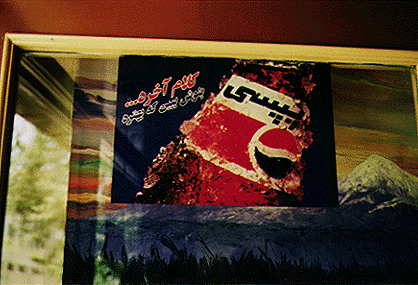
Foreign occupation in Lebanon ending, little by little.
The fuse is lit!
With his usual élan, he seems to be beginning to face up to the repugnance of the action Hizballah’s militia. The state’s official tip-toeing around the immoral nature of this rogue guerrilla gang is a misguided attempt to maintain a DMZ around the suburban ghettos and the fragile delusions of the 68’ers. Since it hasn't yielded much, it may have finally sunk in that it was a crappy idea to begin with. All it does is tacitly affirm their dearly held chickendove twitching coupled with popular chickenhawk-like dreams of revolution.
A French embassy spokeswoman said Douste-Blazy was in a convoy of vehicles about to leave the northern city when the sirens went off.
Appeasment for the popularity of chic fist-pumping aside, the Douste-ster mananged to swing this much without embarassing himself:"We believe the spiral of violence will not lead to anything durable. Only political dialogue can lead to a durable solution," Douste-Blazy said.
If they had only thought of that earlier, like, before Hizballah started all of this, and after the U.N. passed 1559 in February of 2004.
He also called for the implementation of U.N. Security Council Resolution 1559 which demands the disarmament of militias in Lebanon and the deployment of the Lebanese army along the border with Israel, which has been under the control of Hizbullah.
“The only tragedy is that the ploy worked” writes FDI Magazine Editor Courtney Fingar of the recent hunger strike by UDF party deputy Jean Lassalle. The goal of the stunt was to gilt-trip a manufacturer into keeping a low-yielding plant open.
Foreign Direct Investment Magazine is a part of the Financial Times group, and as a journal with a specific focus is rarely given to comic flights – in other words, Ms Fingar is dead serious when she asks what a politician is doing to his own country, and why he would ever want to encourage a non-productive operation to drag his constituency down.
parliamentary representative for the Pyrenees went on a 39-day hunger strike to force a Japanese company to reinvest in his constituency. The only tragedy is that the ploy worked.
Toyal, a subsidiary of Osaka-based Toyo Aluminium, had not attempted to close its Accous plant; it merely announced plans to build a second factory in a nearby town. For Jean Lassalle, a deputy in the UDF party, this smacked of betrayal. He ensconced himself in the National Assembly building in Paris, where he received such visitors as prime minister Dominique de Villepin and shed nearly 50lbs. He ended up in hospital, and the French government ended up agreeing to compensate Toyo for the money it wasted on its new plant site.
[ . . . ]
And why any company would consider setting up a plant on Mr Lassalle’s turf, knowing that it could face similar emotional blackmail if it dared to pull out, is beyond imagining.
[ . . . ]
…A hunger strike would not be nearly as effective in convincing investors to come as it was in forcing them to stay.
As Japan’s ambassador to France remarked: “Japanese investors will hesitate to settle here, for fear of being
held hostage.” Of course the economics resulting from such emotionalism has another side to it. It fails miserably to create an environment where the supply of jobs created can match demand. The successful are following France’s most famous Elvis impersonator off to the borders."They were asking me to pay taxes on money I didn't have," Payre said. "I had no choice but to leave the country."
True to form as it is with any socialistic arrangement, the only things left to take away are those things that come with the promise of a nanny state. The man who runs this artful blog has seen his share of it. He was building a small business in coding and made the mistake of taking a vacation and leaving his only employee to work on a project for his only client. Needless to say, like anyone sold on Nanny’s notion that no one is ever truly responsible for their fate, he caused the client to dump the project.
What do you end up with? A business environment that can barely create clients, and employment environment that will scare even the most promising concept into obscurity, and the final outcome: able bodied people with little to do, and in a position to do even less for others.
Don’t forget that Nanny loves you, and that she only hurts the one she loves.
Leslie inadvertently explains the garden variety European leftist:« In other words, what happens if an organism is set so that changing one little part will make it useless? Like a house of cards it crumbles with the slightest shift. How can that evolve? »
the fuse is lit!
The emptiness of the soul and mind of the selectively "pacifist" European left is astonishing.
In the meantime, the WaPo Outlook section is doing by omission what the BBC's (Dont) Have Your Say filter through by commission: an articulate-sounding Lebanese caller who simply refused to address the chronological matter of who started the present war between the IDF and Hizballah, and caller after caller unable to make a distinction between Hizballah the militia and Hizballah the political entity, much as they were unwilling to dope out the same with Hamas.
They both made their own fig-leaf for the dimwitted to defend them with.

Writes Fouad Ajami: A cleric by the name of Hassan Nasrallah, at the helm of the Hezbollah movement, handed Lebanon a calamity right as the summer tourist season had begun. Beirut had dug its way out of the rubble of a long war: Nasrallah plunged it into a new season of loss and ruin. He presented the country with a fait accompli: the "gift" of two Israeli soldiers kidnapped across an international frontier. Nasrallah never let the Lebanese government in on his venture. He was giddy with triumphalism and defiance when this crisis began. And men and women cooped up in the destitution of the Shiite districts of Beirut were sent out into the streets to celebrate Hezbollah's latest deed.
And what he was actually trying to accomplish with the artillery barrage into northern Israel, and the nabbing of border soldiers is beyond me. Nasrallah's brazen deed was, in the man's calculus, an invitation to an exchange of prisoners. Now, the man who triggered this crisis stands exposed as an Iranian proxy, doing the bidding of Tehran and Damascus. He had confidently asserted that "sources" in Israel had confided to Hezbollah that Israel's government would not strike into Lebanon because Hezbollah held northern Israel hostage to its rockets, and that the demand within Israel for an exchange of prisoners would force Ehud Olmert's hand.
What people in Europe and America who enamored with “resistance” for it’s own sake need to watch closely right now: people don’t like you. You don’t understand anyone but your own kind. The type just as enamored with your fake subversion who surn children into soldiers and start wars with morally dubious reasons, and whose goals are as transparently repugnant as what terrorist openly state. In his cocoon, Nasrallah did not accurately judge the temper of his own country to begin with. No less a figure than the hereditary leader of the Druze community, Walid Jumblatt, was quick to break with Hezbollah, and to read this crisis as it really is. "We had been trying for months," he said, "to spring our country out of the Syrian-Iranian trap, and here we are forcibly pushed into that trap again." In this two-front war--Hamas's in the Palestinian territories and Hezbollah's in Lebanon--Mr. Jumblatt saw the fine hand of the Syrian regime attempting to retrieve its dominion in Lebanon, and to forestall the international investigations of its reign of terror in that country.
A terror engineered to control through chaos - it's a familiar pattern. But Nasrallah was in the end just the Lebanese face of Hezbollah. Those who know the workings of the movement with intimacy believe that operational control is in the hands of Iranian agents, that Hezbollah is fully subservient to the Iranian Revolutionary Guard. The hope that Hezbollah would "go Lebanese," and "go local," was thus set aside. At any rate, Nasrallah and his lieutenants did not trust the new Lebanon to make the ample room that a country at war--and within the orbit of Syria--had hitherto made for them in the time of disorder.
Pity Lebanon and hope that someone out there can Make Hizballah History.
Newsflash to the wooly-headed: anyone proposing negotiation with Hizballah needs to realize that it would just undermine the Lebanese government.
Even the Arabs think it idiotic and are keeping their eye on the man behind the curtain.
Speaking of wooly don’t these clown who are incapable of seeing anything other war crimes and racism in everything need to realize that they virtually all the foreign evacuees should be called Lebanese holders of foreign passports?
With a stunning lack of self-awareness, they can’t quite imagine that Hizballah’s killing of civilians also constitutes a war-crime.the fuse is lit!


