
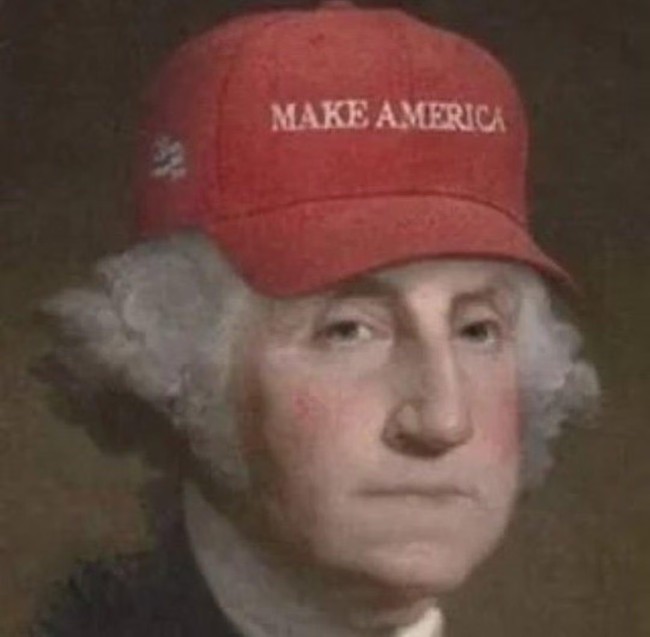
Have you ever asked yourself if there are any parallels between POTUS1 and POTUS47 (aka POTUS45)? You should, because it turns out that there are quite a number, as I mentioned on a French radio station last summer as it celebrated America's 250th birthday, and pretty profound ones at that.
As the nation reacts to the "disgustingly violent" call by Hakeem Jeffries for "maximum warfare" against members of the GOP (and, more specifically, of Donald Trump's MAGA movement) and for Dems to "break their spirit", I think back to last summer.
• To read my post summarizing Chernow's Grant book — including what I call the single best sentence amongst its entire 958 pages — click here: "Break Their Spirit" with "Maximum Warfare": What Nobody Tells You About Reconstruction in the South After the American Civil War.

• First, comparing Donald Trump's war tactics and strategy with those of General Washington during the revolutionary war (although this might perhaps simply be an American way of waging war) — just like Trump's bombings focused on taking out Iran's leadership (not to mention his Caracas raid taking out Venezuela's lider maximo), the men in George Washington's Continental Army would deliberately aim for enemy officers; something which was deplored as scandalous by George III's Royal Army as that was not how wars were fought between "gentleman" in those times. Moreover, writes Chernow later of Washington, by then POTUS1: "As always, he touted military preparedness as the best way to prevent war" .
• As president, Chernow reports,
Washington's catalog of accomplishments was simply breathtaking
• Regarding Trump's relations with NATO and Europe:
Washington hoped to win respectability from foreign powers, but he also wanted to stay free of foreign entanglements so the young nation could prosper. He gave Gouverneur Morris a succinct formulation of his credo:
"My primary objects … have been to preserve the country in peace, if I can, and to be prepared for war, if I cannot."
In general, he favored economic rather than political involvement with the outside world. This neutrality policy was practical in that the United States was too small to exert significant leverage among the great powers and high-minded enough to shy away from European balance-of-power politics. Washington had no desire to exploit wrangling among foreign states, telling Morris that
"this country is not guided by such narrow and mistaken policy as will lead it to wish the destruction of any nation under an idea that our importance will be increased in proportion as that of others is lessened."
As war convulsed Europe, Washington, a former war hero, might have been tempted to become a warlike president, but he wisely abjured the use of force at this first serious threat.
• Related to Washington's emphasis on prosperity which does seem to echo Trump's decision to focus on trade and economic relations: As president, George Washington had
a powerful message:
"The promotion of domestic manufactures will, in my conception, be among the first consequences which may naturally be expected to flow from an energetic government."
According to Ron Chernow, George Washington
believed that "commercial connections, of all others, are the most difficult to dissolve," which foreshadowed his faith as president in enduring commercial rather than political ties with other countries.
• Indeed (in a passage forecasting the Civil War), the Southern planter that Washington was would eventually decide that because of the North's commitment to "finance, commerce, and even abolitionism", that was the path to follow.
[In 1795] Washington told Edmund Randolph that, if the Union were to break up into North and South,
"he had made up his mind to remove and be of the northern."That [the Virginia planter] now identified with northern finance, commerce, and even abolitionism would have major consequences for American history. Had he sided with Jefferson and Madison, it might have deepened irrevocably the cleavage between North and South and opened an unbridgeable chasm seventy years before the Civil War
• Regarding how outraged allies feel scandalized by Trump: they don't realize to what extent that Trump feels — utterly — betrayed by them? Well, in order to see how Washington felt about his country's erstwhile allies during the Revolutionm let us turn the dial back 230 years or so:
On June 13 [1797 (p 782)] Washington sat under the portico of Mount Vernon with Polish nobleman Julian Niemcewicz and talked politics. As they savored breezes coming from the Potomac, Washington upbraided the French government with such "passionate wrath" that Niemcewicz was taken aback. The ex-president, protesting the plunder of American shipping and the unforgivable insults to American envoys, sounded warlike. "Submission is vile," Washington thundered, saying than rather see
"freedom and independence trodden under foot, [he would] pour out the last drop of blood which is yet in my veins."
[former president George Washington] observed that resident aliens had entered the country "for the express purpose of poisoning the minds of our people," thereby estranging"their affections from the government of their choice" and "endeavoring to dissolve the Union"
• Have you heard about all the anger in the MAGA crowds against the Democrats — regularly accused of hatred for America and all things American, of unscupulous tactics, and of treason? Well, listen to what George Washington thought of Thomas Jefferson's party (then called the Democratic-Republican Party — as opposed to Washington's Federalists — and shortened to the Republicans):
Fiercely opinionated, even strident, Washington was now avowedly partisan in private, fulminating against the Republicans as pawns of the French in their attempt to manipulate American politics. As he told Thomas Pinckney, time would show the difference between those
"who are true Americans [and] those who are simulating a foreign nation to unfriendly acts, repugnant to our rights and dignity."
In a paean to unity, he warned that national identity must trump local attachments."The name of AMERICAN, which belongs to you, in your national capacity, must always exalt the just pride of patriotism, more than any appellation derived from local discrimnations."This continued perspective had informed his work ever since the Revolution. Washington stressed the need to safeguard western territories from foreign encroachments, and without mentioning the Whiskey Rebellion by name, he enunciated the need for law and order:"The very idea of the power and the right of the people to establish government presupposes the duty of every individual to obey the established government."Instead of flattering the people, Washington challenged them to improve their performance as citizens. Most of all, he appealed to the Americans to cling to the Union, with the federal government as the true guarantor of liberty and independence. As Joseph Ellis has written, "In the Farewell Address, Washington reiterated his conviction that the centralizing impulses of the American Revolution were not violations but fulfillments of its original ethos."


No comments:
Post a Comment