Showing posts sorted by relevance for query obama doctrine. Sort by date Show all posts

Tuesday, April 20, 2010

The Obama Doctrine: Ignore the great threats and cloak the lesser threats in faux unity, pomp, and circumstance

Assemble all these pieces and an Obama Doctrine begins to take shape
concludes Cliff May.
Assemble all these pieces and an Obama Doctrine begins to take shape. It might be summed up this way: Ignore the great threats and cloak the lesser threats in faux unity, pomp and circumstance; talk incessantly and carry a shrinking stick. Somehow, I doubt that's the change most Americans have been hoping for.
Compare with Frank Gaffney's definition of the Obama Doctrine…

Monday, August 31, 2009

The Obama Doctrine: Abandoning our allies, emboldening our enemies, and diminishing our country

Yes, indeed, there is an Obama Doctrine, and it is clear to the naked eye what it is in the eyes of the Apologizer-in-Chief.
Should the United States indeed go that route [appeasement of Vladimir Putin's Russia], it will make plain to all the emerging "Obama Doctrine" with its three ominous characteristics
says Frank Gaffney:
abandoning our allies, emboldening our enemies and diminishing our country.

Thursday, September 17, 2009

“The East European countries went out on a limb for America during the war in Iraq and Afghanistan; Now they feel they are getting whacked”

With the Apologizer-in-Chief — courageously — deciding against the deployment of missiles in Poland and Czechoslovakia, we are once again witnessing the Obama Doctrine at work:
  • Abandoning our allies,
  • emboldening our enemies,
  • and diminishing our country
Earlier, Judy Dempsey had come with this:
…with Barack Obama in the White House, the deployment of the missile shield in Eastern Europe is no longer a given, as defense experts question its costs, its effectiveness and even its location. As a result, the certainties of the Bush era have given way to a sense of betrayal — but maybe also realism [yeah; realism in the Jimmy Carter/Munich-type mold] — on the part of the East Europeans.

Throughout the Bush administration, the East Europeans had supported the U.S. war on terrorism. They had broken ranks with many other European Union countries in supporting the invasion of Iraq by sending troops. They had turned a blind eye to renditions and interrogation centers (though there were also West European countries that did that).

“The East European countries went out on a limb for America during the war in Iraq and Afghanistan,” said Ron Asmus, director of the Brussels office of the German Marshall Fund of the United States. “Now they feel they are getting whacked.”

Indeed, Washington’s special relationship with Eastern Europe seems to be over. Mr. Obama’s dithering over whom to send to Poland last month to commemorate the 60th anniversary of the beginning of World War II confirmed that.

Much more important for the administration is its goal of “resetting” its relationship with Russia after years of neglect by Mr. Bush. Russia, whose support is needed for issues like Iran, nuclear proliferation and the Middle East, dwarfs the importance of any East European country for Washington.

As it turns out, the announcement
made for unfortunate timing, as Thursday is the 70th anniversary of the Soviet invasion of Poland at the start of World War II, a date fraught with sensitivity for Poles who viewed the Bush missile defense system as a political security blanket against Russia. Poland, along with many other countries in the former Soviet sphere, worry that Mr. Obama is less willing to stand up to Russia.
Like we said, the Obama Doctrine at work:
  • Abandoning our allies,
  • emboldening our enemies,
  • and diminishing our country
Update: Tony Blankley adds (regarding Iran's Mahmoud Ahmadinejad):
For the greatest nation on earth to accept such impertinent treatment by so vile a despot is a profound lesson in humility.
In France, Le Monde's Munich readers are already reacting in typical Munich fashion:
BRAVO

Excellente nouvelle! Obama comprend parfaitement qu'il s'agissait d'un projet agressif et impérialiste detiné, non pas à contrer l'Iran mais à menacer la Russie. Il faut dialoguer et non pas menacer…

Le principe de ce bouclier est une ineptie … La volonté d'installer le "bouclier" doit être cherché ailleurs [i.e., some sort of treacherous plot hatched — needless to to say — by (conservative) Americans].

Wednesday, December 16, 2015

Obama has become European: The less he wants to get involved abroad, the more he dials up his rhetoric

I have long been a critic of the German foreign policy debate
writes Clemens Wergin, predicting America's current mess (in the New York Times, of all places) already a year and a half ago
— of its freeloading on the American security umbrella, coupled with moral grandstanding whenever the Americans did things their way; of too much analysis of past events and not enough thinking about how to get things right in the future; of its tendency to take words as a substitute for deeds. That’s why I have usually given the Americans the benefit of the doubt: At least they took on problems nobody else was willing to tackle.

But then, at the height of the Syria conflict and just after yet another of Barack Obama’s speeches, I suddenly understood the problem with this American president and his foreign policy. He sounded just like a German politician: all moral outrage, but little else to help end one of the most devastating civil wars of our age. President Obama, I thought with a sigh, has become European.
 
Indeed, the less this president wants to get involved in something abroad, the more he dials up his rhetoric. That the American president finds things “unacceptable,” one of his administration’s favorite words, doesn’t carry any real meaning anymore; it certainly doesn’t mean that America will try to change what it deems “unacceptable.”

 … Polls suggest that Americans are not happy with the results of Mr. Obama’s foreign policy, though they still shy away from the costs that more engagement around the globe would entail. Welcome to my world. It sounds awfully European to want to have one’s cake and eat it at the same time.

There is a certain irony in the fact that President Obama’s foreign policy finds its Waterloo in the same country that shipwrecked the Bush doctrine: Iraq. It is true that the Bush administration seriously mishandled the war in Iraq. But it is also true that after the surge, George W. Bush handed Mr. Obama an Iraq that was in much better shape than it is today.

By rushing to the exit and teaming up with the Iranians to reinstall Prime Minister Nuri Kamal al-Maliki after he lost the elections in 2010 — and by not confronting him forcefully on his anti-Sunni policies — the Obama administration undermined the progress American troops had paid for very dearly.

Then came another deed of omission in Syria. For years Middle East experts had warned that the civil war in Syria would not be confined to that country, but would spill over into neighboring countries. But Mr. Obama stood back, using rhetoric and admonitions while ignoring the experts. Yet they were right: The crisis in Iraq is a direct result of Mr. Obama’s nonconfrontational strategy in Syria.

When he was first elected in 2008, Barack Obama was hailed on the old Continent as a president with almost European sensitivities and worldviews. But the compliment was unintentionally double-edged. For more than two decades now, Europeans have assumed that the world would remain comparatively stable and wouldn’t need much hard power to be maintained (at least European hard power, that is). So too, it seems, does Mr. Obama.

While Mr. Obama’s new style of diplomacy — soft power and nonintervention — was at first seen as a welcome break with the Bush years, five years later a dismal realization has set in. It turns out that soft power cannot replace hard power. On the contrary, soft power is merely a complementary foreign policy tool that can yield results only when it is backed up by real might and the political will to employ it if necessary.

Ultimately, the measuring stick for a successful foreign policy is not how many nice and convincing speeches a leader makes, but whether he succeeds in getting things to go his way. … the list of actors and countries that are actively pushing against European and American interests, and getting away with it, grows ever longer.

Barack Obama wanted America to learn from Europe’s soft-power approach. But while Europeans are loath to admit it, they know that European soft power often doesn’t work either — and that it is a luxury that they could afford only because America’s hard power always loomed in the background. And when they dropped the ball, America would pick it up.

And therein lies the lesson to our American friends who seemingly want to become less involved and more European: There is no second America to back you up when you drop the ball.

Friday, May 07, 2010

Neglected European Allies to Barack Obama: "We want to be heard, listened to, allowed to reflect together!"

"We want to be heard, listened to, allowed to reflect together!" Those words, declaimed by Nicolas Sarkozy before Columbia University's students in New York in late March on the eve of his dinner with Barack Obama, said aloud what a good number of European leaders are thinking to themselves regarding the first U.S. leader to describe himself as "America's first Pacific president." … In the American president's world vision, there is little affection for Europe.
European allies feel neglected by Barack Obama, writes Natalie Nougayrède in a Le Monde. article in which she goes over some of the Obama's snubs to the Europeans, intended or otherwise (sending the Churchill bust back to Britain, the unilateral retreat of Eastern Europe's missile defense shield, the refusal to attend the 20th anniversary of the fall of the Berlin Wall, etc), as well as conservative criticism of the Apologizer-in-Chief's be-snotty-to-our-allies-be-kind-to-our-enemies doctrine.
Les causes, petites et grandes, de désenchantement, se sont accumulées, en un an, entre M. Obama et les Européens. En arrivant dans le bureau Ovale de la Maison Blanche, M. Obama en a retiré le buste de Winston Churchill placé là par George W. Bush, un cadeau de Tony Blair. Les Britanniques ont compris que la "relation spéciale" s'estompait. Les Européens de l'Est ont eu leurs déceptions avec la refonte, unilatérale, du projet de bouclier antimissile.

En novembre 2009, M. Obama a fait l'impasse sur la cérémonie des vingt ans de la chute du mur de Berlin, après avoir jugé qu'en revanche sa présence était indispensable pour défendre à Copenhague la candidature de Chicago aux Jeux olympiques. Le mois suivant, à Copenhague, il discutait avec les "émergents" du climat, sans que les Européens soient présents dans la salle.

…Les détracteurs de M. Obama affirment toujours qu'il dialogue plus volontiers avec les ennemis de l'Amérique qu'avec ses amis. "Cette administration voit les Etats-Unis comme une puissance en recul dans le monde, commente Eric Edelman, l'ancien numéro trois du Pentagone sous George W. Bush, et elle semble penser que le seul pôle qui décline plus vite encore est l'Europe."
• See also: Europeans "Shattered" by Obama's Indifference: "Bush Was Not the Problem, Obama Is Not the Solution"

Update: Barack Obama reaches out to …France's Muslims, in France's ghettos (!), writes Corine Lesnes.

Uh oh — according to Le Monde's readers, America is still racist: Americans only voted for a half-breed (un métis), they write; "a black man of [Mike] Tyson's color would have no chance"; "a black man, a real black, would never have been elected … behind the Obama window there is a reality that is not beguiling" (sigh…)

Of course, if (or on the day when) Americans vote for a "real" black man (Allen West?), we will just hear a new narrative in which blacks are not re-elected president, or are not elected president often enough, or… etc… etc… etc… (sigh again…)

Monday, October 22, 2012

IdeOlogy Masquerading as Foreign Policy: What Romney Must Point Out in the Third Debate


I think Romney did as well as could be expected in the second debate — although I keep wanting him to bring up the Russian microphone episode, along with Barack Obama's dissing of Russia and China's foes, Lech Walesa and the Dalai Lama — both of whom happen to be fellow Nobel Peace Prize recipients. (I mentioned all of the above several weeks ago during my televised debate with a member of the mainstream media — Newsweek's Paris Bureau Chief, no less.)

Indeed, what I really want the governor to do is tie the individual in with the general, and that means not only emphasizing the Benghazi debacle for the catastrophe it truly is, but tying an individual event like the Libyan attack in with Obama's foreign policy in general — to show it is not an isolated event but inherent in Obama's world view — as well as tying foreign policy (in general) in with economic policy. In other words, a winning strategy for Mitt Romney and Paul Ryan would not simply be attacking specifics, but also pointing out the underlying patterns.

From bumps on the road on the issue of economic recovery to bumps in the road in America's Mideast policy through four Americans getting killed being not optimal and blocking out any noise regarding Israel and Iran: All those quotes — especially the first two — ought to be put together in one nation-wide ad. And how about America being able to “absorb” another 9/11-sized attack? (See also Dick Durbin.) That choice of phrases show how unconcerned the Chicago politician really is about anything not linked to himself and to his leftist ideology and, indeed, how cold-hearted, as Ed Driscoll puts it, Barack Hussein Obama turns out to be.

You would not know it if you read the mainstream media, but far from rescuing the United States (or its reputation) from George W Bush's "disastrous" foreign policy and thus being the embodiment of Smart Diplomacy, Barack Obama's antics (or refraining from acting), have managed to snub one ally after another, time and again, from the British to the French, from the Poles to the East Europeans in general, and even from the Scandinavians to America's immediate neighbors, Canada and Mexico.

This goes from the dramatic (Fast and Furious or switching support from Britain on the Falklands issue in favor of Argentina (while erroneously calling the Malvinas the Maldives)) to (what would seem to be) the trivial, such as petty refusals to make any kind of effort to be original (and thus respectful) when dealing with foreign leaders; petty refusals to offer gifts of any consequence to such dignitaries as Britain's prime minister or to the country's Queen; and petty refusals, while on official (!) visits in foreign capitals, to even attend dinners with the countries' respective leaders, such as the President of France and the King of Norway. Needless to say, we all remember that Obama also refrained from meeting with a single world leader — going on The View and on Letterman was more important — during the September United Nations conference.
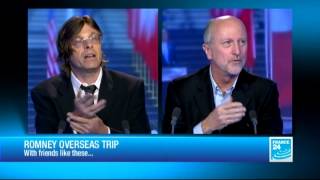
What all this amounts to is obvious egotism while refusing to take the office of president of the United States seriously (beyond the left's own ideas of how to use it) and refusing to do the very basics (and not even unpleasant basics at that (double-date dinner in Paree with Carla Bruni and her husband?)) of one's duty as leader of the free world.

Of course, this all puts the left's world view on display (something Mitt Romney must pound home during the next debate and over the next couple of weeks): Obama and the left must not submit to reality (yes, America has enemies, yes, diplomacy requires treating foreign dignitaries with basic courtesy, and no, you are deferential to noone — certainly not monarchs and autocrats and foes); reality must submit to Obama's leftist (and self-serving) view.

Because, in addition to all the above snubs (to America's friends), Smart Diplomacy means that Obama has sucked up to Moscow and Beijing, along with régimes like Tehran's and that of Caracas. The Apologizer-in-Chief has been deferential — whether to autocrats like Saudi kings or to America's enemies. Because it turns out that in the leftists' fairy tale world, there are no enemies. At least, not as foreign nations; a criminal band like Al Qaeda, perhaps… But the Soviets, sorry the Russians, are not enemies — never have been, really — nor are the Chinese; after all, all of us on this planet are brothers under the skin. As are Iran's mullahs. And Hugo Chávez. Who can all live together, quite diplomatically — just like we all do among suit-wearing dipomats in the hallowed halls inside the United Nations…

With the much-vaunted Reset touted so much, (pacifist) ideology has been triumphant to the detriment of reality, with Obama making showing "space" and "flexibility" for concessions to Putin and Medvedev, showing little interest in the human rights situation in Russia and basically ignoring such things as the Russian spy scandal and the Viktor Bout case as well as a NATO member selling sensitive military technology to the Kremlin — never mind arms sales to China.

We have seen many comparisons to America's 39th president. Indeed, Jimmy Carter similarly ignored the misdeeds of the West's traditional enemies, like the Soviets — who in fact, he (Carter) told us, were not our enemies (and whose misdeeds, if indeed they could so be called, were exaggerated) — in favor of weeding out horrific human rights offenders (real or alleged) among our allies (who in turn were not really our friends). Thirty years later, we — America, the world, and Iran's citizens — are still living with the results — which needless to say includes an Islamic Republic that is hostile to America and the West, a régime that sponsors terrorism while seeking nuclear warheads, and a government in Tehran that is more oppressive towards the Iranian people than the Shah ever was. (Sounds like something Obama may have duplicated in Egypt and perhaps in Libya…)

This is the leftist fairy tale: we are all friends and brothers under the skin, and given that "fact", if we (or if any of us) fail to see this in a fellow nation, the fault must lie not with their leaders but with us — or with those of us who see them as enemies, i.e., with conservatives. (Note: try taking the left's talking points to their logical conclusion…)

Thus, there is no real problem with Russia, China, Iran, or countries such as Venezuela, at least none that cannot be worked out by ever-deeper soul-searching — soul-searching on the American side, needless to say. This has led to what Frank Gaffney called the Obama doctrine:
• Abandoning our allies,
• emboldening our enemies,
• and diminishing our country

The only victories the Apologizer-in-Chief is concerned with is over America conservatives, over American military funds, and over the American Way of Life. In the Obama fairy tale (or, as even John Edwards (!) said in 2007, in his Never-Never Land), allies don't need defending and don't even need to be called allies, as we (and they) don't really have enemies (no one does); therefore enemies aren't really being emboldened (as there are no enemies for the Apologizer-in-Chief — who is therefore, and who as senator was in 2007, more than willing to meet with said (non-)enemies "without preconditions"), just encouraged to see us and everybody else in the avant-garde way that we now see them; and we aren't in need of standing out, before (non-existent) foes and friends, in view of the fact that in Obama's brave new world, "there are no senior or junior partners — we are simply partners."

And so a major French party's anti-Americanism is ignored, by the administration as well as by the mainstream media (!), as is the open letter to the administration of President Barack Obama from Central and Eastern Europe, signed by 22 intellectuals and former leaders from the region, including Vaclav Havel and Lech Walesa, who are feeling "they are getting whacked".

The pretense of this fairy tale reality has gone to such lengths as hastily sending Russian spies to Moscow without garnering information about the Kremlin's spy ring beforehand and hastily announcing the death of Osama Bin Laden on the same day he was gunned down, before the documents discovered at his Pakistan home could be studied, and acted upon, by intelligence officers — never mind the Russian mike episode. Apologies have gone out to the Arab world, as we all know, but how many people realize that they even went out, before the Arab Spring, to Libya's Muhammar Gaddafi?

And then we get Benghazi: there are no enemies — unless it is us, ergo the murder of the ambassador must be due to the Mohammed-insulting videotape. Any other interpretation, unless of course it is due to Western hatred of and bigotry towards Muslims, can only amount to shameful politicizing.

To conclude: Mitt Romney must base his arguments on simple descriptions on the underlying premises and patterns of the Barack Obama administration and the leftists who embody them.
• A set of policies — foreign, domestic, and economic — based on leftist ideology, in other words, imaginary fairly tales
• Imagining that no country, large or small, is in the final analysis a foe, to America or to any of its allies — who aren't really that close friends anyway — and no disaster during the term of a leftists is really that big of a disaster anyway
• Anything going wrong in the world must somehow be the fault of America (or the West)
• A refusal by Obama to take his office seriously
• A lack of concern for anyone who doesn't support, directly or indirectly, his position and his (self-serving) world view or who can't be persuaded to jump on the bandwagon of supporters — for they can of course only be vile bigots and racists and other hatemongers.

Oh. And by the way — go see Dinesh D'Souza's Obama's America 2016.

Update — Also check out: Three crucial points that Mitt Romney must make

Update 2 — Five Things I Wish Mitt Romney Would Say in the Debate

Friday, October 24, 2008

Obama on the Subject of Fox News: A Complaint or a Threat?

There are several sinister things concerning Barack Obama's complaints about Fox News, the full extent of which does not seem to have been noted. You remember the words:
"I am convinced that if there were no Fox News, I might be two or three points higher in the polls,” Obama told [Matt Bai]. “If I were watching Fox News, I wouldn’t vote for me, right? Because the way I’m portrayed 24/7 is as a freak! I am the latte-sipping, New York Times-reading, Volvo-driving, no-gun-owning, effete, politically correct, arrogant liberal. Who wants somebody like that?

"I guess the point I’m making,” he went on, “is that there is an entire industry now, an entire apparatus, designed to perpetuate this cultural schism, and it’s powerful. People want to know that you’re fighting for them, that you get them. And I actually think I do. But you know, if people are just seeing me in sound bites, they’re not going to discover that. That’s why I say that some of that may have to happen after the election, when they get to know you."
The first sinister thing about this comment of Obama's are the man's double standards. Like the rest of the leftists — as well as the (Fox-hating) mainstream media — the man has obviously no problems with ABC, with CBS, with NBC, with CNN. He has no problems with the New York Times, the Los Angeles Times, the Boston Globe, and the Washington Post. He has no problem with the fact that if there were no ABC, no CBS, no NBC, no CNN, and no New York Times, no Los Angeles Times, no Boston Globe, and no Washington Post, John McCain might be two or three points higher (probably even more) in the polls; he has no problems with the fact that if there were no ABC, no CBS, no NBC, no CNN, no New York Times, no Los Angeles Times, no Boston Globe, and no Washington Post, Obama might be many points (hardly "just" two or three) lower in the polls. Never mind that: the only thing that irks him is that there is a media outlet — one! — that ensures that instead of being, say, 5 to 10 points ahead (that ain't enough), he isn't 8 to 13 points ahead.

The second sinister thing about the comment — obviously related to the first — is that it may not be be a complaint (whining or otherwise) at all: it may be a threat. It may be a warning to Rupert Murdoch to rein in his TV station (heck, all of his news outlets) if (when, in Obama's mind) the Illinois senator wins the 2008 election. Or else… Leftists cannot stand any criticism of their nigh-heroic measures. Fox News must be isolated, bloggers must be castigated, talk radio must be silenced with the Fairness Doctrine.

Jonah Goldberg hits the nail on the head:
Now, let us actually transcend race for a moment. Apparently for Obama, "transcend" isn't a racial term so much as a euphemism for declaring victory. He says he wants to "turn the page" on the arguments of the '80s and '90s, by which he means conservatives should stop clinging to their guns and antiquated Sky God and join his cause.

He told Planned Parenthood he wants to stop "arguing about the same ole stuff," by which he means he wants people who disagree with his absolute support for government-funded abortion on demand to shut up already.

He doesn't want to argue about his pals from the Weather Underground who murdered or celebrated the murder of policemen and other Americans, he just wants everyone to agree no one should care.

In short, Obama and his disciples only demand one kind of transcendence from all Americans. We must, as Obama likes to say, unite as one people, one nation, one American family and transcend all of our misgivings about Barack Obama. Then, and only then, will The One fulfill his wife's pledge and fix our broken souls.

Only a racist could possibly disagree.
Update: Obama camp lashes out at Fox News again (thanks, Duncan)

Monday, January 09, 2017

We Americans are ruled by a non-religious elite and we seem unbothered by it—and not just in politics but in culture and education as well


News flash from National Public Radio: There aren’t enough atheists in Congress! This is really a problem and NPR wants to rally the electorate to remedy it. In an article entitled “Non-Religious Americans Remain Far Under-Represented in Congress” NPR bemoaned the lack of unbelievers serving on Capitol Hill.

Thus does Benny Huang start another outstanding column.
I’ve got news for NPR—there are plenty of godless heathens in politics. Very few elected officials publicly claim atheism or agnosticism but their actions betray what’s in their hearts. For all of the talk about how rabidly religious Americans are we continue to vote for people who are very secular in their outlooks and in their voting records. There is no pandemic of religious fervor in the United States. We’re ruled by a non-religious elite and we seem unbothered by it—and not just in politics but in culture and education as well. Among those non-religious elite I would certainly count Donald Trump. Perhaps he has certain qualities that are needed at this moment but he’s not a religious man.

I realize that I am treading on thin ice here. There’s an unwritten rule in politics that an elected official’s professed faith should never be questioned—or at least not if you think the person’s religious deception is a bad thing. Barack Obama is a good example of this. The media have spilled plenty of ink “debunking” the supposed myth that the president is not a Christian.

Here’s one from Timothy Stanley at CNN. His opening sentence: “One of the strangest right-wing conspiracies is that Barack Obama is not really a Christian.” I think he meant to say “conspiracy theories” but whatever. It’s not a conspiracy or a theory, it’s just Barack Obama telling lies which I’ve noticed he does quite a bit. This is a man who once said that “Sin is being out of alignment with my values.” Seriously? Actually, sin is being out of alignment with God’s values. I can only conclude that Barack Obama is his own higher power.

Which leads me to my next question—who are these fools who think Obama is a Muslim? That’s ridiculous. Barack Obama is a secular humanist just like the mother who raised him and the absent father he idolized. He joined a church that teaches black victimology while calling it Christianity—and he likely only did that because he had political aspirations.

But the late Christopher Hitchens speculated with some certainty that Barack Obama is an atheist and I don’t recall him being chastised for it. Why? Because Christopher Hitchens was also an atheist and therefore considered Obama’s atheism a plus. Hitchens’s doubts about Obama’s purported religion were somehow acceptable but if you happen to be a Christian who’s sick of seeing President Obama fraudulently sporting your religion on his sleeve, you’re a conspiracy theorist.

So there are actually plenty of non-religious people in politics. Why don’t they identify themselves? There are several reasons, I think. The first is prejudice, which I gather from the NPR article is their preferred explanation.

 … But there are other reasons why more atheist politicians don’t just fess up. One reason is that it inoculates them from accusations of anti-Christian bigotry which is rampant in the jackass party. Take Nancy Pelosi, for example. I consider Pelosi to be an anti-Christian bigot but she’s able to parry the accusation by claiming to be just as Catholic as Catholic can be. This is a woman who never misses an opportunity to mention her Catholicism, sometimes misrepresenting Catholic doctrine to justify her Left Coast policy positions. Nancy Pelosi may have a baptismal certificate but she really worships at the altar of statist liberalism. She should probably just admit it and stop making a mockery of her (and my) religion.

But why would she do that? Then she couldn’t smother criticisms that she despises Christianity. That’s the real reason why she misrepresents herself. It’s not as if San Francisco voters would send her packing if they thought she was an apostate. A 2015 study from the Public Religion Research Institute found San Francisco to be the third least religious city in the country. Only Portland and Seattle had higher proportions of non-believers. Pelosi’s constituents are comfortable with atheism, just as they are comfortable with sodomy on parade down Castro Street. It’s Catholicism that make them squirm—especially its teachings on butt sex. She would pay no penalty at the polls for admitting the obvious fact that she isn’t really Catholic after all. Still she persists with her lies.

The NPR article left me wondering just what’s wrong with too few atheists or, as I think they really meant to say, too many of those darn Christians serving in Congress.

 … Maybe NPR should start looking more like America and give a show to someone who isn’t a coastal liberal elitist for a change. Might I suggest Larry the Cable Guy?

Wednesday, February 20, 2013

The NeoComs: The final ‘coming out’ of the communist left in the illiterate society of useful idiots that is America


In the book, “1984,” George Orwell wrote that “the most effective way to destroy people is to deny and obliterate their own understanding of their history” 
writes Tom Tillison in the BizPack Review.
Even more compelling, Orwell said of the future:
“Those who control the present, control the past and those who control the past control the future.”
It is hard to dispute that the progressive left has a stranglehold on pop culture in America. Firmly entrenched in media, academia and the entertainment industry, and more emboldened than ever, it controls the present.

Our history has long been under assault, particularly in universities, but never as aggressively as we see in a 10-part Showtime documentary produced by Oliver Stone, “Untold History of the United States.”

Commenting on Stone’s latest work in a FrontPage column, David Horowitz calls it “a ludicrous encapsulation of the Kremlin’s view of the Cold War, amplified by the Castro, Ho Chi Minh, Daniel Ortega, Hugo Chavez, Hamas version of the post-Communist decades.”

 … Stone’s rewriting of history is being widely embraced by far-left zealots who have nothing but contempt for this country and by the progressive culture in general.

Such rewriting is not just relegated to Hollywood. A professor at Montclair State, a public university in New Jersey, can be seen in a YouTube video denying that Soviet Union leader Joseph Stalin was responsible for the murder of millions, saying he has “yet to find one crime – one crime that Stalin committed.”

More importantly, and this matters because it’s coming from someone who grew up in that culture — the very same culture that Barack Obama cut his teeth on — Horowitz suggests “Untold History” is the coming out of the communist left.

“I consider the reception of this latest Stone travesty to be a significant cultural event signifying a final coming out of the closet of what can only be termed the Communist left,” Horowitz wrote.
Over at the Patriot Post, Mark Alexander adds a quote by Britain's greatest prime minister and finishes with a quote from Pravda that syncs with Tom Tillison's opening thought.
"The inherent vice of capitalism is the unequal sharing of blessings. The inherent virtue of Socialism is the equal sharing of miseries. ... Socialism is the philosophy of failure, the creed of ignorance and the gospel of envy." --Winston Churchill
Today, I have a new entry for the political lexicon to categorize the latest ideological iteration of Marxists in America: "Neo-Communists" or the abbreviated version, "NeoComs."

 … At the other end of the political spectrum from the Ronald Reagan NeoCons are the NeoComs -- modern-day socialists who have risen, in the last decade, to dominate the once-noble Democrat Party. They have modified old Marxist doctrines and adapted them to current political platforms and policies using leftist propaganda more compatible with contemporary culture. Chief among these is the Democrat Party's tried and true "divide and conquer" disparity rhetoric, which foments discontent and division based on income, race, ethnicity, gender, education, occupation, etc.

However, bull pucky by any other name is still bull pucky. Democrat Socialism, like Nationalist Socialism, is nothing more than Marxist Socialism repackaged.

The objective of today's NeoComs is, as you by now know, "fundamentally transforming the United States of America," in order to "peacefully transition" from our constitutional republic and its free-enterprise economy to a socialist republic with a state-organized and regulated economy.

Ideological adherents of the American Communist Party made few political gains under that banner in the last century because the label "communist" was and remains "distasteful" to most Americans. Thus, NeoComs have infested the once-noble Democrat Party and are using it as cover for socialist policy implementation.

The political genes of the current cadres of NeoComs establish them as the direct descendants of the statist policies of Franklin Delano Roosevelt and the programs he implemented under cover of the Great Depression.

Roosevelt, like most of today's wealthy liberal protagonists, was an "inheritance-welfare liberal" -- raised in a dysfunctional home and dependent on his financial inheritance rather than that essential spirit of self-reliance, which forms the core of American Liberty. Consequently, the "dependence ethos" irrevocably shaped by FDR's privileged upbringing is virtually indistinguishable from the dependence ethos of those who have been raised or inculcated with belief that they are reliant upon welfare handouts from the state.

Though markedly dissimilar in terms of their political power, the underlying difference between inheritance liberals and welfare liberals is, the former depend on investment and trust distributions while the latter depend on government redistributions. But they both support socialist political and economic agendas based on Marxist collectivism.

Endeavoring to transform our Republic into a socialist state, FDR set about to replace our authentic Constitution with the so-called "living constitution" by way of judicial diktat, thereby subordinating the Rule of Law to the will of his administration. Anticipating Supreme Court rulings against many of his patently unconstitutional policies, which he later arrogantly outlined in his "New Bill of Rights," FDR attempted to expand the number of justices on the High Court, thereby allowing him to flood the bench with his nominees in order to win majority rulings.

Despite his failed attempt to pack the High Court, over the course of FDR's three full terms, he infested American politics with socialist programs and policies, and brought the nation perilously close to being ruled by an avowed Marxist, his vice president, Henry Wallace.

Prior to 2008, the closest the U.S. had gotten to an openly socialist president was after FDR's then-vice president, John Garner, broke with Roosevelt over FDR's effort to pack the court. In 1940, Roosevelt tapped his secretary of agriculture, Henry Wallace, to replace Garner as his new running mate. Wallace's allegiance to Marxist doctrine was well established. However, near the end of World War II, Roosevelt feared that he could not get re-elected to a fourth term with an open Communist on the ticket, so he tapped the more moderate Harry Truman and demoted Wallace to Secretary of Commerce -- where he could further his Marxist agenda.

FDR, of course, died in office just a month into his fourth term. But had he retained Wallace instead of opting for Truman, America would have had its first communist president by succession.

 … And a prophetic footnote: FDR also wrote in his Bill of Rights, "People who are hungry and out of a job are the stuff of which dictatorships are made."

Like Roosevelt, Obama was raised in a dysfunctional family, but unlike FDR, Obama inherited a socialist political legacy rather than wealth. However, neither Roosevelt nor Obama "let a serious crisis go to waste."

Obama, the NeoCom-in-Chief and our first openly socialist president, was elected and re-elected on his progressive "fair share" rhetoric, which he often frames as "spreading the wealth around." That, of course, is merely a new riff on an old FDR proclamation: "Here is my principle: Taxes shall be levied according to ability to pay. That is the only American principle." However, that "American principle" is merely a paraphrase of Karl Marx's Communist Manifesto, in which he declared, "From each according to his abilities, to each according to his needs."
Obama's political storm troopers are led by the largest subgroup of congressional Democrats, the 76 declared members of his Congressional Progressive Caucus, who have made "progressive taxation" the top priority of their "redistributive justice" agenda.
Rep. Paul Ryan properly summed up Obama's progressive agenda as "a dull journey from one entitlement to the next, a government-planned life, a country where everything is free but us." 

Obama and his American Communist Party-endorsed NeoComs are crafting their progressive economic policies using the subtle Cloward-Piven model, a socialist strategy that outlines how to overload the national entitlement delivery system, what we call the ObamaNation Plantation, in order to generate a severe economic crisis and ultimately break the back of free enterprise. Obama is using so-called "stimulus and bailout" plans (including his most recent "Fiscal Bluff"), ObamaCare, cap-n-trade, international climate change treaties, and the like, to take our country to the edge of that precipice. 

Sometimes, however, the NeoCom agenda is not so subtle, as was the case this week when Jeffrey Immelt, an ardent Obama supporter who also chairs Obama's Economic Recovery Advisory Board, said of Red China's economy, "The one thing that actually works, state-run communism, may not be your cup of tea, but their government works."
NeoComs outside the U.S. are even less subtle.
In a recent newspaper column in "Pravda," the old Soviet propaganda rag ("The Truth") now published by post-Soviet era conscripts of the Communist Party of the Russian Federation, a popular writer, Xavier Lerma, had this observation on our most recent presidential election: "The Communists have won in America with Obama. ... Obama has been re-elected for a 2nd term by an illiterate society."

Putin said: "We are reducing taxes on production. We are optimizing state expenses. We must avoid excessive interference into the economic life of the country and the absolute faith into the all-mightiness of the state. Unreasonable expansion of the budget deficit and accumulation of the national debt are as destructive as an adventurous stock market game. During the time of the Soviet Union the role of the state in economy was made absolute, which eventually lead to the total non-competitiveness of the economy. That lesson cost us very dearly. I am sure no one would want history to repeat itself. We must seek support in the moral values that have ensured the progress of our civilization. Honesty and hard work, responsibility and faith in our strength are bound to bring us success."
Lerma concluded, "Who could ever [have] imagined anyone so willing to destroy [capitalism] like Obama, much less seeing millions vote for someone like Obama. They read history in America don't they? Alas, the schools in the U.S. were conquered by the Communists long ago and history was revised thus paving the way for their Communist president."
Indeed, who could have imagined?

Tuesday, September 22, 2009

Barack Obama's Dangerously Naïve Foreign Policy

A shortened version of the following text was published in the International Herald Tribune:
Nicholas Kulish and Judy Dempsey write that "staunch East European allies like Poland and the Czech Republic appeared likely to become more realistic and less idealistic about American foreign policy" (No Shock for Poles and Czechs, Sept. 18).

If only Barack Obama's foreign policy would be more realistic and less idealistic. George W. Bush's policies recognized, realistically, the existence of rogue countries and threats from nations like Russia, Iran, and, yes, Saddam Hussein's Iraq, as well as the importance of solidarity — not least the symbolic kind — with the states that feel threatened by same.

Obama's policies are based on the naïve mantra that it is all a matter of "mutual understanding" and that talk can, and will, make everybody come together. In this fairy tale, there are no bad guys in the world (easy to believe if you do not pay too much attention to such things as Saddam's killing fields, the Iranian Mullahs' mass arrests, Kim Jong-Il's starving masses, and the Kremlin's bullying its neighbors) and America (and the West) has no enemies — with the singular exception, of course, of… those pesky, clueless conservative Republicans who don't see the light and who won't keep quiet. The only rogue country in the world (besides perhaps Israel) is America, which — both domestically and globally — needs an outreaching, empathizing pacifist à la Chamberlain at its helm — an Apologizer-in-Chief, if you will — to set America, and thereby the world, right.

We have seen this myopia masking as far-sightedness before, and it didn't work. Back during the 2008 election, several of us suggested that all signs pointed to Obama turning out to be a Jimmy Carter II (Letters, Oct. 10, 2008). If Jimmy Carter's Camp David accords were a success, the 39th president's State Department managed to alienate one faithful (if at times distasteful) ally after another. And two of them — Nicaragua's Somoza and Iran's Shah — were overthrown during his tenure, both of whom were replaced by régimes arguably far more repressive and more hostile to Washington if not the Western world itself. With regards to the 44th president continuing Carter's naïve policies (consciously or otherwise), Frank Gaffney of the Center for Security Policy has suggested a definition for what can be called the Obama Doctrine:
abandoning our allies, emboldening our enemies, and diminishing our country.

Wednesday, May 25, 2011

When Obama wants to make a show of his exquisite diplomatic sensitivity he knows how; And when he wants to show his contempt, he knows how, too

…it isn't often that this or any other U.S. president welcomes a foreign leader by sandbagging him with an adversarial policy speech a day before the visit
notes Bret Stephens of the Apologizer-in-Chief. At a time like this, it's hardly a bad idea to remember Frank Gaffney's definition of the Obama Doctrine…
Remember when the Dalai Lama visited Mr. Obama last year? As a courtesy to Beijing, the president made sure to have the Tibetan spiritual leader exit by the door where the White House trash was piled up. And that was 11 months before Hu Jintao's state visit to the U.S.

When this president wants to make a show of his exquisite diplomatic sensitivity—burgers with Medvedev, bows to Abdullah, New Year's greetings to the mullahs—he knows how. And when he wants to show his contempt, he knows how, too.

The contempt was again on display Sunday, when Mr. Obama spoke to the Aipac policy conference in Washington. The speech was stocked with the perennial bromides about U.S.-Israeli friendship, which brought an anxious crowd to its feet a few times. As for the rest, it was a thin tissue of falsehoods, rhetorical legerdemain, telling omissions and self-contradictions. Let's count the ways.

Monday, June 08, 2009

Obama's stirring words to D-Day veterans ("You could have hid in the hedgerows or waited behind the seawall") come with… (faint) apology for WWII!

I am happy to say that I attended the 65th commemoration of the D-Day landings at Omaha Beach.

Of the four speeches made at the American cemetery near Colleville-sur-Mer in Normandy on June 6, 2009, the speech by Nicolas Sarkozy was by far the most moving (I do not remember hearing any French president lay out the facts of the war and of the nations involved as well as of the landings so precisely before) — I defy anybody to listen to it without tearing up. (Well, at least the first part commemorating the 1940s, which was outstanding and second to none; the second and final part, devoted to today's world, goes on to celebrate the UN, to take on this generation's greatest challenge — global warming — and to seemingly take potshots at the Bush doctrine.)
A quoi pensaient-ils ces jeunes soldats le regard fixé sur la mince bande noire de la côte qui émergeait peu à peu de la brume ?

A leur vie si courte ? Aux baisers que leurs mères déposaient tendrement sur leur front quand ils étaient enfants ? Aux larmes retenues de leurs pères quand ils étaient partis ? A celles qui les attendaient de l’autre côté de la mer ?

A quoi pensaient-ils ces jeunes soldats dont le destin avait mis entre les mains le sort de tant de peuples, sinon qu’à 20 ans il est bien tôt pour mourir ?

Leur silence était comme une prière.
By all means, see the whole discours (at least the part directly devoted to la Seconde Guerre Mondiale).

The best speech was by Prime Minister Stephen Harper, who switched back and forth between French to English and who seemed to be giving a reply to today's pacifists. At Juno, he said:
Never dismiss these things [freedom, democracy, human rights and the rule of law] as mere abstractions. They are the very foundation upon which our lives of peace and prosperity are built. They are the very lives to which all of our fellow human beings aspire. And it is only when these values are in peril, when we have to defend them, that we can truly understand their worth. As our soldiers did here on these beaches 65 years ago.
The speech by Gordon Brown was also rather good (the most notable part of it being malheureusement when Omaha Beach was rechristened (03:55) Obama Beach — you can't hear it in the video (see below, at 0:20), but it was the whispers that started throughout the audience that got the British Prime Minister to realize his mistake.)
So intense was the allied cooperation that when Winston Churchill regularly asked to see strategists planning D-Day he never knew until he arrived at 10 Downing Street whether the officer would be British, Canadian, or American.
The worst speech, I can confirm without undue partisanship, was by the Apologizer-in-Chief, who was flying in from Dresden (where, the Germans tell us — or, rather, where they tell themselves [as it is not something they want publicized abroad] — that Obama did not disappoint).

Echoing Dresden (very faintly), Obama did not seem to apologize for the Allies' strategy and actions in World War II in Normandy, offhand — except that: he found it necessary to mention that the "nations that joined together to defeat Hitler's Reich were not perfect" and that they "had made their share of mistakes". Obama went on to speak of "a battle of competing interests" and "a competing vision of humanity" as well as the "sheer improbability of this victory" and so on, while seemingly (haughtily?) denying anybody the right to call the conflict the "good" war. But the bottom line is that — yes — Obama did manage to apologize — however faintly — to the Germans for the actions of the WWII Allies.

Always putting himself in the middle of things, moreover, he had to mention every single family member who (somehow or other) was involved in the war: there was his "grandfather, Stanley Dunham, who arrived on this beach" (six weeks after D-Day), there was his "great uncle" (who "was part of the first American division to reach and liberate a Nazi concentration camp"), there was his "grand-mother" (who "did her part as an inspector" in Kansas), etc…

This may not seem like a big deal, although notice that none of the other speakers spoke of the parts any of their family members played during the war. Also, if this was a one-time deal it would indeed seem harmless, but the point is that Obama always — in all of his speeches — seems to have to put himself at the center of attention.

Worse was to come: America's most outstanding orator™, the inspirer of hope© and the bringer of change©, went on to address the veterans (does the commander-in-chief have no knowledge of military affairs, of the military way of life, of honor and brotherhood?! does he have no empathy with military men, retired or otherwise?!) saying that — wouldn't you know it? — they could have behaved dishonorably (although that is probably not a word someone like Barack "It's always been up to us" Obama would use…)
You could have done what Hitler believed you would do when you arrived here. In the face of a merciless assault from these cliffs, you could have idled the boats offshore. Amid a barrage of tracer bullets that lit the night sky, you could have stayed in those planes. You could have hid in the hedgerows or waited behind the seawall. You could have done only what was necessary to ensure your own survival. But that's not what you did. That's not the story you told on D-Day.
So, as we see — of course — the orator extraordinaire goes on to conclude (08:45) that — of course — the "veterans of the landing" did not behave dishonorably. Au contraire. But still — even if you don't take offense over language used like this at a ceremony for the dead at a military cemetery and even if you don't find fault with oratory that is less than compelling — you should take notice that the (surprizing?) fact that the troops did not behave dishonorably somehow, seems, for this child of the pacifist 1960s, to be the main reason "why we still remember what happened on D-Day."


Compare Obama's talk with Stephen Harper's (previous) speech, in which the Canadian PM not only spoke of the "iron will of those troops, the careful planning of their commanders, and the unwavering support of their fellow citizens back home" (as well as Europe's other dicatorship, "the tyranny of communism"), but also (nudge, nudge) of the "triumph of good over evil":
The Allied troops from our four great nations who crossed the Channel to launch the liberation of Europe and rescue civilization from the darkness of fascism had no uncertainty about their purpose or duty. In the words of Captain Jack Fawcett of the First Canadian Scottish battalion, Scottish regiment, “We were so intent of getting to the beach that even if the engines had stopped or broken down, sheer willpower would have driven the craft ashore.”
Eschewing references to global warming (as he passed to the present day), Stephen Harper went on to remind us to
think of the courageous men and women of our enduring alliance who serve shoulder to shoulder in Afghanistan to bring light and hope to a people who have long known only darkness and despair. And we remember that our peace and prosperity have come not only with a price but also with an obligation to do what we can to share our good fortune with others, including those elsewhere who to this day endure violence, oppression and privation.

So let us resolve today, on behalf of our honoured veterans, on behalf of those young people so full of hope for a safer, better world, on behalf of the heroic souls who came to liberate these shores to never forget, to never surrender, to never waver in our determination to defend freedom, to advance democracy, and to seek justice for all people.
Compare Obama's talk also with Ronald Reagan's 1984 oration at the Pointe du Hoc (starting at 05:05, merci à Stu):
You were young the day you took these cliffs; some of you were hardly more than boys, with the deepest joys of life before you. Yet you risked everything here. Why? Why did you do it? What impelled you to put aside the instinct for self-preservation and risk your lives to take these cliffs? What inspired all the men of the armies that met here? We look at you, and somehow we know the answer. It was faith and belief. It was loyalty and love.

The men of Normandy had faith that what they were doing was right, faith that they fought for all humanity, faith that a just God would grant them mercy on this beachhead, or on the next. It was the deep knowledge — and pray God we have not lost it — that there is a profound moral difference between the use of force for liberation and the use of force for conquest. You were here to liberate, not to conquer, and so you and those others did not doubt your cause. And you were right not to doubt.

You all knew that some things are worth dying for. One's country is worth dying for, and democracy is worth dying for, because it's the most deeply honorable form of government ever devised by man. All of you loved liberty. All of you were willing to fight tyranny, and you knew the people of your countries were behind you.

…Something else helped the men of D-day; their rock-hard belief that Providence would have a great hand in the events that would unfold here; that God was an ally in this great cause. And so, the night before the invasion, when Colonel Wolverton asked his parachute troops to kneel with him in prayer, he told them: "Do not bow your heads, but look up so you can see God and ask His blessing in what we're about to do."

…Today, as forty years ago, our armies are here for only one purpose: to protect and defend democracy. The only territories we hold are memorials like this one and graveyards where our heroes rest.
But the bottom line, of course, is that — beyond the fact that their orations were more stirring than the One's — neither Harper nor (25 years earlier) Reagan (nor Brown nor Sarkozy) managed to apologize (however faintly) for the actions of those who, during World War II, fought against the Nazi juggernaut.

And what does it tell us about the man — the American leader and the world leader — that he felt it necessary to apologize during a military ceremony?


You cannot see (or feel) it, but the entire ground shook every time a cannon fired one of its salvos in the 21-gun salute… And then there was the flyover…


On the way back to Caen in a convoy of special buses, incidentally, I sat next to two Frenchmen discussing the event, the younger one of them (who looked like a very self-confident graduate of les grandes écoles) saying with a wry smile that France has been trying to take the D-Day commemorations down a notch or two for the past few years, notably this year, and that one (main) reason (if not the main reason) for the entire exercise — you would expect it to be a secondary reason, non? — is to keep America well-anchored as a friend…


It ain't a joke — unfortunately…

Update: WWII hero and D-Day survivor Arthur Seltzer relives his harrowing experience on that tragic day (merci à Arnaud)

Update 2: Smitty says he gets the impression that
Obama didn't really care about D-Day, what it means or what was accomplished. Like it's so boring, it was sixty-five years ago, with all these tottering old white guys in their VFW hats and the whole thing is so European.
Update 3: A reader of NP writes that he was watching a bit of the ceremony on television and has to
admit that I couldn’t make it to the end of Obama’s speech. It was glaringly obvious that he didn’t really have anything to say on the occasion and what he did have to say, as you point out, was all faintly apologetic. I thought it was also bizarre how he spoke of the “sheer improbability” of the victory of the Allies. By June 1944, the victory of the Allies was totally probable and the Normandy invasion made it virtually certain. The guy just knows nothing. Every word that comes out of his mouth falsifies history, even inadvertently.

Friday, November 05, 2010

Change, Mutual Respect, and Russian-EU Relations: When the Obama administration stamps its foot, no one any longer snaps to attention

…“the Russians now have far more leverage in the U.S. relationship [with Europe] than they should”
John Vinocur quotes a former senior State Department official with responsibility for Russia (David J. Kramer) as saying in the conclusion of his International Herald Tribune article.
The United States used to call wayward members of NATO back to the reservation with a whistle or a shout. It decided what was deviation from doctrine, and that decision was pretty much law.

When the Obama administration stamped its foot this time, no one snapped to attention.

Rather, Germany and France, meeting with Russia in Deauville, northern France, last week, signaled that they planned to make such three-cornered get-togethers on international foreign policy and security matters routine, and even extend them to inviting other “partners” — pointing, according to diplomats from two countries, to Turkey becoming a future participant.

That can look like an effort to deal with European security concerns in a manner that keeps NATO, at least in part, at a distance. And it could seem a formula making it easier for Russia to play off — absolutely no novelty here — the European allies against the United States, or NATO and the European Union, against one another.

… As for the Obama administration stamping its foot, what it came down to was a senior U.S. official saying: “Since when, I wonder, is European security no longer an issue of American concern, but something for Europe and Russia to resolve? After being at the center of European security for 70 years, it’s strange to hear that it’s no longer a matter of U.S. concern.”

So, a follow-on burst of European contrition? I asked a German official about it. He spoke of German and French loyalty to NATO. And he said, “I understand there are American suspicions.”

“But,” he added, “the United States must accept that the times are changing. There are examples of it having done this. Why wouldn’t it accept our view in this respect?”

The official did not list them, but there are obvious factors explaining the French and German initiatives.

A major one is President Barack Obama’s perceived lack of interest and engagement in Europe. His failure to attend a Berlin ceremony commemorating the end of the Cold War and his cancellation of a meeting involving the E.U.’s new president has had symbolic weight.

… Consider this irony: the more Russia makes entry into the E.U.’s decision-making processes on security issues a seeming condition for deals the French and/or Germans want (think, for example, of France’s proposed sale to Moscow of Mistral attack vessels), the more the impression takes hold that the administration’s focus for complaint about the situation has been off-loaded onto the Europeans.

… When Mr. Medvedev bestowed Russia’s highest honors at a Kremlin ceremony on a group of sleeper spies who were expelled from the United States last July, a State Department spokesman turned away a reporter’s question with a “no comment.” Washington chooses not to say anything either about Mr. Medvedev’s support, repeated in Deauville, for Mr. Sarkozy’s plan, as next year’s president of the G-20 consultative grouping, to focus its attention on limiting the dollar’s role as the world’s reserve currency.

Prior to John Vinocur's article appeared an IHT editorial page column in which Roger Cohen appraised us that

France is in a quiet sulk. Nicolas Sarkozy is the most pro-American president of the Fifth Republic. He brought France back into NATO’s military command, rejected the de rigueur cynicism of French political discourse on the United States, and reached out to Obama. For all of which he got nothing. He must hear de Gaulle’s ghost at night whispering, “I told you so.”

In London, the British are shaking their heads. … “Beside the E.U., is there another bunch of countries anywhere willing to work as closely and permanently with the U.S. on almost all issues of global and regional concern?” asked Wolfgang Ischinger, a former German ambassador in Washington. “I wish Obama would say just that.”
Somewhat related is Virginie Malingre's interview in Le Monde with Alastair Cameron, who "est chargé des questions européennes au Royal United Services Institute, un think tank londonien spécialisé dans les questions de défense et de sécurité. Ce Franco-Britannique a fait ses études à Londres et à Paris, où il a travaillé quelque temps pour le ministère de la défense."
…on peut penser que la guerre en Irak a mis en évidence le déséquilibre de la relation. On a parlé de la Grande-Bretagne comme du "caniche de Washington"...

William Hague, le ministre des affaires étrangères britannique, et David Cameron, le premier ministre, ont tous deux dit qu'ils étaient les alliés des Etats-Unis mais qu'ils ne seraient pas "son esclave ". C'est une manière d'admettre que les Britanniques, ces dix dernières années, ont eu le sentiment qu'ils étaient trop souvent à la botte de Washington. De ce point de vue-là, la coopération avec la France sera la bienvenue. Mais, sur le fond, rien n'a changé.

Wednesday, October 24, 2012

The EU Stepping In Against Putin’s Russian Bullying Which Flourished Thanks to Lack of Countermeasures From Obama White House?

Hooray for the European Union — in spite of a Nobel Peace Prize awarded largely on the basis of wishful thinking — for taking an important, tough-minded step, avoided by NATO and the United States [i.e., Barack Obama].  
Thus writes John Vinocur, the most conservative commentator working for the New York Times, in the International Herald Tribune.
The bold moment came last month when the European Commission opened an antitrust investigation against Gazprom, the Russian national gas monopoly which furnishes about 25 percent of Europe’s energy imports, for unfair pricing and blocking diversification of supply concerning eight E.U. members from the old Soviet bloc. 

Out of character for an organization once described by Jean-Pierre Jouyet, a former French minister for Europe and France’s former chief financial market supervisor, as dominated by a culture of connivance? I’d like to believe it matters little whether the European Union is being consecrated, even counter-instinctively, as a grand peacemaker, if it is really drawing lines that make clear where its tolerance stops and trouble for transgressors begins. 

The European pursuit of Gazprom as an energy bully has particular resonance because it comes at a time when Vladimir Putin’s Russia is supplying Syria with arms and support in the U.N. Security Council, renouncing a pact with the United States providing nuclear safeguards, ordering the closure of Unicef’s Russian office, and directing the U.S. Agency for International Development to halt its operations in Russia — all without the United States taking countermeasures. 

The E.U. investigation K.O.’s the argument that only born-again cold warriors regard Putin’s actions as serious, strategic problems for the West (starting with a significant measure of Russian control over E.U. and European NATO members’ energy supply). 

The investigation contains an additional message: the European Union’s willingness to challenge Putin’s attempt to play off wealthy Western Europe against poorer Eastern members by offering price flexibility to France and Germany while treating a Poland, a Bulgaria, or an Estonia as if they still fell under the Brezhnev Doctrine. That was the Soviet Union’s notion of its immediate neighbors’ limited sovereignty, reiterated by former president Dmitri Medvedev after Russian troops entered Georgia in 2008. 

Now Moscow, a new member of the World Trade Organization, has issued a decree barring “strategic” enterprises like Gazprom from divulging any information to foreign regulators. 

… just weeks after Barack Obama’s inauguration … NATO was never seriously pressed to pick up the ball. Kurt Volker, the U.S. ambassador to NATO at the time, said the initial American warnings about the energy squeeze involved “smart people who were operating on auto-pilot. Then Obama’s reset kicked in.” 

At its extreme, that meant the United States publicly saying it would not pursue linkage in its Russian policy — telling Putin, in effect, he could do as he pleased, with no price to pay. The E.U. Commission, all the same, has signaled that its limits have been overrun. 

Süddeutsche Zeitung, a leading left-of-center voice, called the investigation a brave strike and “the start of a battle against the power of Russia’s raw materials empire.” And the E.U.’s commissioner for energy, Günther Oettinger, a German conservative, has branded those energy reserves “Putin’s new Red Army,” and criticized Angela Merkel’s announced retreat from atomic energy as increasing Europe’s dependency on Gazprom as a supplier.

… As for Barack Obama, he cannot politically manage a shift in tone on Putin’s Russia with only weeks to go in the U.S. presidential campaign. But with Putin acting aggressively and unrelentingly, the president, if re-elected, could well find it necessary to speak out on the significant deterioration of Russia’s sense of responsibility, and stand up with protesting Russians the next time they fill Moscow’s streets.
Related: Moscow's current tone is "reminiscent of Soviet days"; If anyone is stuck in the Cold War mentality, it is the Russians