| Dhimmi Burger |
| What's in the special sauce? |

Behind the Façades in France: What expats and the mainstream media (French and American alike) fail to notice (or fail to tell you) about French attitudes, principles, values, and official positions…
Saturday, August 06, 2005


Castro’s Flunkies
From the magazine Human Events: «In early 1957, when the only thing he commanded was a half-starved band of a dozen "rebels" in Cuba's Sierra Maestra mountains, Fidel Castro was approached by some of his rebel group's wealthy urban backers.
Fast forward to the present:
"What can we do?" They asked. "How can we help the glorious rebellion? We can write you some checks. We can buy you some arms. We can recruit more men. Tell us, Fidel, what can we do to help?"
"For now," answered Castro, "get me a New York Times reporter up here."
Bingo! The rest is history. They quickly complied and The New York Times' ranking Latin American expert, Herbert Matthews, was escorted to the rebel camp with his notepad, tape recorder and cameras. Within weeks Castro was being hailed as the Robin Hood of latin America on the front page of the world's most prestigious papers.
Within two years he was dictator of Cuba, executing hundreds of political prisoners per week, jailing thousands more -- all the while being hailed as "the George Washington of Cuba!".» «This April in front of "the Union of Young Communist Leaders, the Officers the Revolutionary Armed Forces and Relatives and Surviving Victims of the Empire’s Terrorist Attacks on our Country," Castro gave one of his famous "speeches." This one blasted John Bolton's nomination as U.N. ambassador.
"The longer John Bolton’s Senate hearing for the post of United Nations representative went on," Castro raved to the suffering crowd, "the more outrageous it seemed that President Bush could have nominated this man!"
Much applause erupted here (his honored guests knew they were being watched. They wanted their starvation rations that week.)
Castro was simply reading from a (translated) New York Times article dated April 13th titled "Questioning Mr Bolton." Castro spent three-fourths of his time at the lectern reading from the article verbatim, spicing it up with exclamation marks and a few quips of his own. "See what kind of man this Mr. Bolton is?" He asked while poking his finger skyward and arching his eyebrows.
The rest of Castro's speech came mostly from Newsweek and The Washington Post. And who could blame him? Why put Cuba's propaganda ministers to work fashioning anti-Yankee diatribes and puff pieces on himself when he can simply pick up America's Mainstream media?»
They’re still at it. The western left still doesn’t understand the wrongness that holds people down, diminishes their lives, and keeps them miserable and manageable by dictators large and small, their industries, and their contrived ideologies.

The Blackest of Lies…
 It does not seem unfitting that today is the birthday of Alfred Tennyson (1809-1892), the English poet who wrote
 A lie which is half a truth is ever the blackest of lies.

More discussion of Hiroshima…
Friday, August 05, 2005

Hiroshima, 60 Years Later
Discussing the means that brought the War in the Pacific to an end:
Erik Svane: Unlike the endgames of the majority of wars, World War II in the Pacific grew increasingly bloody as U.S. forces approached the Japanese homeland (read more)…
Thomas Sowell: the atomic bomb spared us (and the Japanese) a bloodbath that would have dwarfed the death toll from Hiroshima and Nagasaki (read more)…
Charles de Gaulle: Les trois cent mille morts d'Hiroshima ont épargné bien davantage de Japonais, qui auraient été écrasés sous des bombes ordinaires (read more)…
The Wall Street Journal: The Japanese army was expected to fight to the last man, as it had during the battles of Iwo Jima and Okinawa. Since the ratio of Japanese to American combat fatalities ran about four to one, a mainland invasion could have resulted in millions of Japanese deaths—and that's not counting civilians (read more)…
A Japanese-American: Lance or spear practice was a regular women's exercise to practice for the anticipated U.S. landing (read more)…
Bret Stephens: Whatever side one takes here, the important point is that the debate fundamentally is about results. … In other words, the question here isn't about the intrinsic morality of the bombing. It's about whether the good that flowed from the bombing outweighed the unmistakable evil of the act itself (read more)…
Victor Davis Hanson: Post-facto critics never tell us what they would have done instead — lay off the German cities and send more ground troops into a pristine Third Reich; don’t bomb, but invade, an untouched Japan in 1946; keep out of WWII entirely; or in its aftermath invade the Soviet Union? (read more)…
Robert Maddox: the veteran historian ("I regard Hiroshima [revisionism] as the greatest hoax in American history") is interviewed by Victor Fic on every Atomic bombing subject imaginable (read more)…
In addition, check out the information below the subhead "Watching for the 'Fool-Proof' Cards", about two thirds to three fourths down the drag zone of the AA page…
Examining the Issues Surrounding the Dropping of Atomic Bombs on Japan
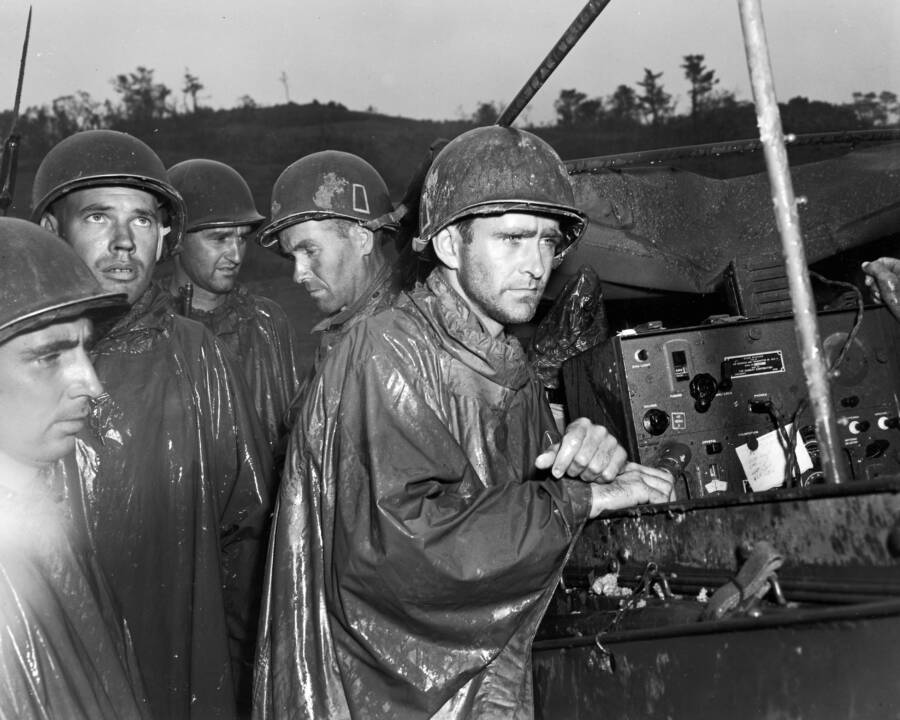 |
| American soldiers on Okinawa in Japan
listening to the radio broadcast announcing the German surrender and the official end of World War II in Europe. The Battle of Okinawa began in April 1945 and lasted until June, and Japan would not officially surrender until September. (All That's Interesting) |
A critical examination of some common charges against the Americans regarding the dropping of atomic bombs on Hiroshima and Nagasaki.
Racism
Americans may have felt hatred for the Japanese during WWII, but it was not for what race the Japanese belonged to and it was certainly not a hatred that allowed them to murder on sight (what did the so-called American racists hate, and fight, the Nazis for, then ; for being blond, blue-eyed Aryans?!). It was for what they had done, the treachery in Hawaii (remember Pearl Harbor?), the murders of POWs on the Bataan death march, and the numerous other atrocities committed throughout the Pacific, of which the rape of Nanking is only the most repellent. Still, that anger alone was not what led U.S. authorities to drop atom bombs on Hiroshima and Nagasaki. It was the Japanese refusal to surrender, backed by the prospect that the blood-letting would continue and that the fighting would, in fact, intensify.
The Americans' Uncalled-for
Intensification of the War
Many more Japanese died in the hell-hole of Okinawa than in the nuclear blast of Hiroshima. More were killed in the battle of Leyte Gulf than in the explosion at Nagasaki. Based on America's 35% casualties on Okinawa, if 767,000 Americans were to attack Kyushu, one prediction said the dead and wounded would number 268,000, as many as the number of battle deaths that the U.S. had experienced in the war so far. As for Japanese battle death figures, they inevitably dwarfed those of the U.S. (On average, the ratio of combat fatalities was 4:1; on Iwo Jima, three Japanese died for every American; on Okinawa, that figure was 15:1; at Leyte Gulf, 20:1; on Attu, in the Aleutians, 50:1.) Japanese casualties on the battlefield by summer 1945 numbered 1.2 million total. Intensification of the War
Nobody suggests that the Japanese be grateful for being the target of at atomic bombs — but, bearing those figures in mind, who can doubt that far more lives — as millions of soldiers and civilians rushed to the defence of their homeland — would have been lost in conventional warfare than actually were at Hiroshima and Nagasaki?
War on Civilians
Those who criticize the Americans for waging war, nuclear or otherwise, on civilians forget that the Japanese armed forces were arming every person available in Japan, from women and children to the elderly, and with everything from advanced firearms to primitive pointed bamboo sticks, to fight the Yankee invaders to the death. Incidentally, this was not as fanatical as it may sound at first, given their own behaviour on enemy soil. The Empire of the Sun expected American soldiers to submit the Japanese people to the same atrocities — in fact, it expected the "foreign devils" to treat them worse — that its soldiers had hoisted upon foreign civilians such as those at Nanking or Manila. Japan's coming victims might as well avoid dishonour and at the same time contribute to holding back the U.S. onslaught by, if possible, taking a few enemy soldiers with them to their death. Fight to the last had been the Japanese motto throughout the war.
Thus, the war promised to become even more bloody, as it indeed already had.
Still, the atomic targets were not chosen out of the blue. The Honshu island city was (correctly) referred to as an "important naval base" by Le Monde back in August 1945, although it is typical that in a retrospective 60 years later (scroll to bottom), the independent daily omitted all types of strategic information and all types of context, for expressions such as "martyrdom", "crimes against humanity", "a haughty indifference of the laws created by men to check barbarism", and "a graduation as useless as indecent into horror". (Needless to say, Japanese actions at Nanking and the Bataan Death March did not figure into this kind of rants.)
Peace Feelers Ignored
It has become common for some to say that the Japanese were ready to sue for peace, and that the treacherous and demagogic Americans (or their leaders, if you want to be cute) ignored the peace feelers. There's so much to say to this charge one hardly knows where to begin. First of all, we are told the peace feelers were secret. If it was so obvious as we are told that the Japanese (or, at least, their government) as a whole were desirous to establish an era of peace and goodwill (unlike the murderous Yankees), why didn't they simply make the call for peace public (and thereby stigmatize the leaders in Washington, had the latter refused to take them up on it)? If asked the question, we will be told that it wasn't that easy and that Japanese pride was involved.Well… exactly! If pride is involved, to what extent can you be sure the peace offer — or any message — is sincere, and especially, how much power does the individual (or the band of individuals) have in proffering it if he or they are surrounded by sizable parties of prideful leaders, soldiers, and other individuals?
As it happens, if and when you get a message (be it a peace proposal or anything else) from a mortal enemy — or even from a traditional friend (think Chirac and Villepin at the UN in early 2003), how are you to know they are sincere? Is disinformation of some kind involved? How do you know they're not stalling for time? Time for what? To prepare their fellow leaders, and the population, for surrender? (In that case, how do you know what the chances are they will be successful in the task?) Or to build more weaponry, arm more combattants, launch more attacks, and/or kill more of your own nationals?
And who would the peace feeler have been from? From the entire government (in which case they could have made it public, supposedly)? From a clique in the government? And if, so, how much power did its members actually have — and were the latter sincere, were they wishful thinkers, or might they the victims of manipulation (from those who wanted to stall for time for military reasons)?
To use a surreal example of a peace feeler (from the same conflict), in May 1941 Rudolf Hess asked for peace between Britain and Germany (after flying a Messerschmitt solo to Scotland), only to be immediately disowned by Adolf Hitler. For months — years, really — British citizens, commoners and responsible leaders alike (not to mention nervous foreigners, and their governments), wondered what secret intentions, if any, might have laid behind the feat.
Also, to what extent should we go in trusting today's Japanese accounts of their willing and innocent peace-seeking forebears?
In any case, here are some things to ponder: it is well-known that the Imperial Army was full of officers and men of the type as those who, when they learned that Japan would eventually surrender, tried to prevent Hirohito's message to that effect from being broadcast. It is also known (not least to the Navy personnel at the time!) that while the Japanese were supposedly desiring peace, kamikaze pilots were crashing their Zeros into U.S. Navy warships. What is less known is that over 400 people were arrested in Japan in 1945 on the mere suspicion of favoring negotiation.
In conclusion: the Americans were aware of the propensity of the Japanese to fight to the very end, and untold thousands had bled, suffered, and died in so learning. And for very good reasons, Americans were not very trustful of the Japanese; indeed, the formers' tendency to regard the latter as duplicitous cannot be ascribed only to racism, far from it (remember Pearl Harbor?).
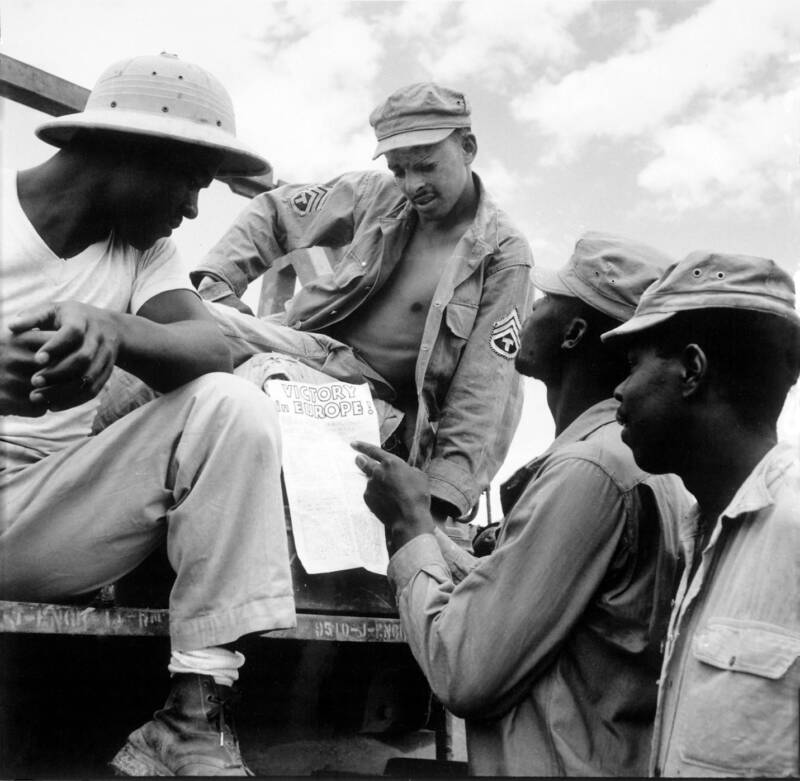 |
| American troops in Burma (now Myanmar) taking a break to read about the Allied victory over Nazi Germany. (All That's Interesting) |


Starved by Socialism

«The director of the World Food Program, James Morris, says one-third of Burma's children are chronically malnourished, and, in some areas, the proportion is as high as two-thirds. And, noting that many mothers are also malnourished, he said the humanitarian cost is enormous.»
Burma, an authoritarian socialist proves what the erasure of free enterprise and the decapitation of capitalism can accomplish, just as they have in Cuba and South Korea, and may inflict itself on Venezuela.«"When numbers this large of children are at risk, to say nothing of the anemia condition of so many women in the country, the country's future is severely at risk," he said.
Burma has lush and productive land. Unlike corrupt states, or ones that cannot live with their land and weather events, what’s killing people in Burma, and holding them back is distinctly ideological.
Mr. Morris, talking to reporters in Bangkok after a trip through Burma, said Burmese government policies on agriculture, marketing and the movement of people make it difficult for many Burmese to subsist.
He said the WFP is allowed to operate in Burma with relatively few restrictions. But he said many humanitarian workers are hampered by complex bureaucratic procedures, taxes and market restrictions on staples, such as rice.
"The government needs to be much more thoughtful and committed to addressing these tough issues that I have described," he said.»
The agitators can complain all they like. The leftist view of the world comes down to the illiberal behavior of the control freak within.
Media note: We’re linking to an article by the Voice of America on this item, but huzzah and bravo to the BBC for not holding the statement back or maligning it with the Radio 4 politburo “chat panel” treatment (yet).
Malatsia’s Star masks the attribution to severe market controls, and alludes to “Army rule”, as does Reuters, which rather improbably throws HIV/AIDS in there as an implied side effect. Through droning repetition and advocacy, in lieu of disciplined reportage might have brought this bubbling up with the usual Reuters pedantic bubbling of teenage angst.
Unlike the ends of the majority of wars, World War II in the Pacific grew increasingly bloody as U.S. forces approached the Japanese homeland
|
| American soldiers on Okinawa in Japan
listening to the radio broadcast announcing the German surrender and the official end of World War II in Europe. The Battle of Okinawa began in April 1945 and lasted until June, and Japan would not officially surrender until September. (All That's Interesting) |
A shortened version of the following text appeared in the International Herald Tribune of January 9, 1998.
In what is perhaps a laudable attempt to declare that underneath the skin, all humans are basically the same (i.e., equally racist), one of your readers compares the World War II ravages of the Japanese and German armies to the massacre at My Lai. Widespread references to "gooks" notwithstanding, the revelation that more than 300 villagers had been killed in one day in Vietnam by fellow Americans immediately brought about uproar, self-questioning, and opposition in U.S. society, not least in military circles which soundly condemned the massacre. In comparison, the few attempts in the past 60 years to simply present the Japanese nation with a straightforward account of its army's involvement in the slaughter of 300,000 civilians at Nanking and other atrocities have been met with wholesale resistance.Another reader coyly suggests that because they produced the same number of dead, the rape of Nanking is no less racist than the atom bombing of Hiroshima and Nagasaki. He overlooks a fundamental difference. The atom bombs did not appear out of the blue, but after years of gruelling fighting, suffering, and dying at the hands of the fanatical armies of the society which passively allowed its soldiers to slaughter civilians, work prisoners of war to death, and otherwise inflict the most cruel atrocities known to modern man.
Unlike the majority of wars which flicker out when the outcome becomes obvious, World War II in the Pacific grew increasingly bloody as U.S. forces approached the Japanese homeland. For instance, the battle for Okinawa, the costliest battle for the Americans — and one of the costliest as well for the Japanese — did not end until June 21, 1945, i.e., after the Germans' surrender in the European theater. The prospect of ever-increasing numbers of dead soldiers, and not racism, was the decisive element in deciding the use of the atomic bombs six weeks later.
In comparison, the Japanese had encountered little effective resistance and few losses in their 1930s occupation of China, and again, at any point during the two-week rape of Nanking, some commander (not least the Emperor) could have stepped in and said "Enough".
More discussion of Hiroshima…
|
| American troops in Burma (now Myanmar) taking a break to read about the Allied victory over Nazi Germany. (All That's Interesting) |
Is Some Kind of "Peace Process" What Causes Wars to End?
…what causes wars to end?asks Victor Davis Hanson.
We hear a lot about the peace process — the quartet, the U.N. peacekeepers, and so on. I can’t think of one war that the U.N. has stopped or ended to bring lasting peace. I really can’t. I wish I could, because I don’t like necessarily to accept the bitter wisdom of the Greeks that is so often depressing given its pessimistic appraisal of human nature. In short, wars end when one side wins and one side loses — and thus the condition for which they went to war no longer exists. Let’s see if that makes sense. What made the Falkland war end? Did the U.N. send down peacekeepers? Is there a green line there today? No, the U.N. didn’t do anything. Britain didn’t even go to the U.N. on that issue. That conflict ended when the British forces physically removed Argentine forces from the Falklands and the government that sent them there fell in humiliation. Now there’s apparently not a problem and surely not a UK East Falklands and an Argentine West Falklands with sniping in between.
Why is there an axis of evil that includes Iran, Iraq and North Korea? Whatever you think about the nomenclature or the rhetoric of that provocative phrase, it is interesting that we have these problems with Iran, that started with the Iranian hostage crisis, that were never resolved. Our sovereign territory inside an embassy was attacked and hostages taken. We didn’t really respond to it successfully, and as a result have been in a de facto state of hostility with the mullacracy ever since.
Again, wars usually end when one side wins and one side loses. Look at World War I and World War II. At first glance their outcomes would seem to refute that thesis. Didn’t we defeat Germany in 1918? Yet if you look at the Versailles peace treaty, it combined the worst aspects of diplomacy, a harsh peace on an enemy that does not feel defeated, but rather cheated. It doesn’t matter what the winner thinks; it has to be the defeated who accepts defeat. If you look what people were writing in Germany in 1918 and 1919, it was exactly opposite of what Woodrow Wilson said they felt.
The German army was a magnificent, frightening machine; and although we thought it was beaten badly, and I think it was beaten, it didn’t always think it was so defeated. When Pershing suggested that he should march a million men — French, English and American — into Berlin and physically take that government and expel the Prussian autocrats, Wilson said that would be too costly. Well the problem is that when we didn’t do that, the German army surrendered in Belgium and France, not in Germany. It claimed that it still was on the move. It was stabbed in the back by Jews; it was stabbed in the back by Marxists; it was stabbed in the back by traitors. And so the legend grew that the German army was invincible, and the enemy could only stymie but not defeat it — and, worse still, perhaps even didn’t have the guts or the power to defeat it. World War II came along and the Allies did not make that mistake twice.
So when you look at the axis of evil, look what’s not there: Germany and I might add Japan for obvious reasons as well. I would add that Vietnam is not there either, because I think that although we could argue, if we had time, that the United States military really did win the war, it lost the peace: the country was unified under a communist government, and the issues for which we went to war were settled. We were defeated, we left, the communists got their wish (beware what you wish for). So Vietnam is not any longer in the Axis of Evil because that issue is resolved — one way or the other. Whether we like it or not, defeat or victory seem to be the arbiters that close wars.
Why, in conclusion, do we find all of this sort of bone-chilling? Why, when we mention the name William Tecumseh Sherman, do we all sort of shudder? I think I don’t need to tell you that people from this state of Ohio went down with Sherman in his thirty-seven day romp through Georgia and his two month swing through the Carolinas. Yet they killed only 600 Confederates in Georgia while that prior summer ten thousand were being killed in northern Virginia. They freed 40 thousand slaves; they lost about one hundred men. Yet to paraphrase what Machiavelli said, "A man can forgive you if you kill his father, but not if you damage his patrimony." And in Mr. Sherman’s way of thinking, the people who started the war were precisely the plantation class who were sending eighteen year olds who did not own slaves to their deaths; and he wanted to reverse that moral calculus by bringing humiliation to those reckless instigators who put such a high premium on honor.
In other words, the use massive force in a moral cause is in fact humane, and saves lives in the long run as it disabuses the enemy of its many false conceptions. What’s inhumane are long drawn out wars — often over entire decades — where people decide for political or ideological or religious reasons that they don’t want to seek victory and instead turn to processes that only prolong the killing. Then the corpses start to pile up.
Again, why do we find this so disturbing? I’ll just leave you with some propensities common in Western civilization that people have remarked upon from Plato to Hobbes to the German nihilists like Nietzsche and Hegel and Spengler.
The combination of values in Western culture that makes us fight so well also are responsible for enormous affluence and security, what the Romans called luxus —almost a sort of license. In this way of thinking, for a post-heroic, post-enlightened society, war can be passé, or war is fought among ignorant people in need of education or money, or war is an innate part of our distant and embarrassing Neanderthal past. Then usually affluent and very educated people in the West in their smugness — we see that in Europe to an astonishing degree today — believe that they are beyond the reach of war or, worse still, that the entire human community is at the end of history and thus has evolved to a higher state of peace. Then innocent people — whether they be in Bosnia or Rwanda or in Iraq or in Manhattan — will get killed. And this tragedy un-folds precisely because of the intellectual or moral or even religious arrogance of an elite few in positions of leadership and influence who don’t understand, whether we like it or not, that evil is always with us, and it is our duty on our watch and according to our station to combat it wherever we see that it poses a threat to civilization itself.
Another Vindication of Ronald Reagan's Ridiculed Views
Once again, we see another vindication of Ronald Reagan’s much ridiculed view that there were lots of natural (or non-human) sources of smogmuses Ashbrook's Steven Hayward, while Peter W Schramm points out to this map of the growth of the United States.
Stick em up!
The leftist reaction to the London bombings are worthy of Pavlovs dog:
Grab your ankles, and hope for nicer terrorists, next time.
Unaware that they're being mugged by reality, they surrender immediately and turn out their pockets.

And each day seems to brings us yet another Jane Fonda story to enjoy.
Thursday, August 04, 2005
Lefty Makes a Date With His Future Beheader

http://www.timesonline.co.uk/article/0,,1072-1716156,00.html
Antony Brown, in the Times (UK):
«"They may not want a global theocracy, but they are like the West’s apologists for the Soviet Union — useful idiots. … The support of Islamic fascism spans Britain’s Left. The wacko Socialist Workers Party joined forces with the Muslim Association of Britain, the democracy-despising, Shariah-law-wanting group, to form the Stop the War Coalition. The former Labour MP George Galloway created the Respect Party with the support of the MAB, and won a seat in Parliament by cultivating Muslim resentment.
"The BBC and The Guardian regularly give space to MAB to promote sanitised versions of its Islamist views. John Ware, one of the BBC’s most-respected reporters, spent years trying to make a programme on Islamic fundamentalism in Britain, but was repeatedly blocked by senior editors who feared it was too sensitive. Last month it emerged that The Guardian employed a journalist, Dilpazier Aslam, who is a member of the Hizb ut-Tahrir, an Islamist group that wants a global theocracy… The Guardian used Dilpazier Aslam to report not just on the London bombings, but on Shabina Begum, the Luton schoolgirl who, advised by Hizb ut-Tahrir, won a court case allowing her to wear head-to-toe fundamentalist Islamic clothes.»
Even the house organ of the “World Socialists” finds the über-moonbats in their midst a wee smidge creepy:
«Instead of combating such a negative development [the turning of public scrutiny on Near Eastern and Asian immigrants in Britain], the SWP and its Respect vehicle lend it a pseudo-socialist cover. In doing so, they champion a perspective that represents a betrayal of the democratic interests of Muslim workers, and is bound to alienate and disorient other sections of the working class.
To cite one example, spokespersons for Respect have repeatedly glorified the wearing of the Muslim headscarf, or hijab, and other more concealing clothing for women, as being somehow progressive. It should be recalled that on the occasion of Respect’s founding, SWP leader Lindsey German spoke of her pride at addressing an audience where so many young women were wearing the hijab.
A recent Respect Newsletter article by Summer Khan claims, “Women are often judged by their looks or bodies. Hijab forces society to judge women for their value as human beings. A woman in a Hijab sends a message: ‘Deal with my brain, not my body!’ “ He continues, “For British Muslims facing the fear of losing their identity, RESPECT is THE only party.”
Khan’s argument is a ludicrous defence of the oppression faced by Muslim women. In a more extreme form, it could be advanced by the Taliban to justify the segregation of men and women and the wearing of the Burka. Would not the complete removal of women from the lustful gaze of men be an even better safeguard against sexism?»
Even a narrow-focus collection of
Amazing.
An Inexcusable and Terrible Disservice to Millions of Iraqis
I was saddened to read of the murder of Steven Vincent in Basra, not only because the independent journalist wrote one of the best books to emerge from post-Saddam Iraq.
Among other pertinent insights on his four months' worth of solo expeditions through the country, Vincent takes the mainstream media to task in In the Red Zone, saying "words matter":
Vincent used to point out that when the mainstream media reported on similar groups of masked reactionary killers operating in Latin American countries, they use the phrase "paramilitary death squads." This is not semantics, he would note: Same murderers, different designations.Once, in a Baghdad restaurant, I overheard some Westerners and Iraqis discussing the conflict — when the Westerners asked what they thought of the "occupation", one Iraqi retorted, "What 'occupation'? This is a liberation."
…How, then, should we describe this war? What words and concepts define the situation more accurately? Since Iraq is now liberated, we might replace "occupation" with a word taken from the post-Civil War era: "Reconstruction," as in, "the Coalition is reconstructing Iraq." We might then exchange the term "guerilla fighters" for the more precise term "paramilitaries." Rather than noble warriors fighting to liberate their people, "paramilitaries" evoke images of anonymous right-wing killers terrorizing a populace in the name of a repressive regime — which is exactly what the fedayeen and jihadists are doing. Or we could simple dust off the venerable term "fascists."
I repeat: words matter. Terms like "paramilitaries," "death squads", and "fascists" clarify the nature of the enemy and underscore a fundamental point that the American media has inexcusably ignored. it is the Iraqi people who are under attack. They are the victims, their future is threatened, they are bleeding from wounds inflicted by pan-Arab Baathists and pan-Islamic jihadists. By calling these neo-fascists the "Resistance" the media reverses the relationship of assailant and defender and renders a terrible disservice to the millions of Iraqis who oppose, in ways large and small, these totalitarian forces. …
How did this happen? How did the media confuse the real forces of resistance — police officers, administrative workers, translators, truck drivers, judges, politicians and thousands of others — with men who plan car bombings, assassinate government officials, and rampage through religious shrines in their quest to reinstate tyranny? Part of the reason is the anti-American bent of the international media: many reporters will sacrifice anything — including journalistic integrity — to defame the U.S. effort in Iraq.
Read Leo Buchignani's book review and
check out the Cox and Forkum homage…
Wednesday, August 03, 2005
Highly Recommended


Steven Vincent was prominently featured in one of the first articles I wrote on my blog…
Update: Read why words matter
The sick man among the world's developed democracies
This will be the year that the decline of France came home to the Frenchwrites Nicolas Baverez (merci à RV).
After the collapse of the giant strikes of 1995, after the civic crash of 2002 that saw the far-right leader Jean-Marie Le Pen get through to the second round of the presidential elections, the failure of the May 29 referendum on the EU constitution and of Paris's bid last month for the 2012 Olympic Games finally tore the last shreds of an illusion and revealed France as the sick man among the world's developed democracies.
The Angry Reaction to Socialist Decadence
From the journal "Foreign Affairs" - Europe's Angry Muslims«A Nixon Center study of 373 mujahideen in western Europe and North America between 1993 and 2004 found more than twice as many Frenchmen as Saudis and more Britons than Sudanese, Yemenites, Emiratis, Lebanese, or Libyans. Fully a quarter of the jihadists it listed were western European nationals -- eligible to travel visa-free to the United States.»
And what is it that they seem to be reacting to? At least in part:«The footprint of Muslim immigrants in Europe is already more visible than that of the Hispanic population in the United States. Unlike the jumble of nationalities that make up the American Latino community, the Muslims of western Europe are likely to be distinct, cohesive, and bitter. In Europe, host countries that never learned to integrate newcomers collide with immigrants exceptionally retentive of their ways, producing a variant of what the French scholar Olivier Roy calls "globalized Islam": militant Islamic resentment at Western dominance, anti-imperialism exalted by revivalism.
- Remerci, RV...
In Europe, host countries that never learned to integrate newcomers collide with immigrants exceptionally retentive of their ways, producing a variant of what the French scholar Olivier Roy calls "globalized Islam": militant Islamic resentment at Western dominance, anti-imperialism exalted by revivalism.»
Ze Tittle, Messieurs Dames, Ze Tittle! Do Not Be Forgetting Your Tittle!

Mais pourquoi i' comprennent pas ce qu'on leur dit?!
Subscribe to:
Posts (Atom)