
As you can't avoid having heard, the Republican Party is often demonized for being predominant in the states that used to have slavery and Jim Crow. Actually, once the Southern states stopped being socialist and discriminatory, they naturally turned towards the free market. And so the Democrat party was left behind, along with and in the wake of Jim Crow and slavery. (Dankie aan Sarah vir die InstaHiperskakel.)
The 20th-century policies of South Africa and America's southern states were leftist policies, typical leftist policies, as it were, designed against capitalism and the free market. Indeed, as David R Henderson writes,
"The socialist roots of Apartheid are a secret in plain sight."
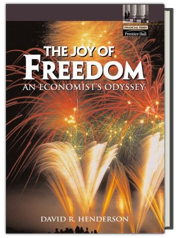 I will never be able to thank David R Henderson enough for his eye-opening Joy of Freedom (one of my very earliest internet and Amazon purchases), which, during the year 2003, pivoted me once and for all to conservatism and contributed to starting me on my blogging career (which has now lasted for over 21 years). As I wrote in 2003 or 2004, after I opened my first website/weblog, the book
is one of the biggest literary discoveries (philosophically speaking) in my life. … Although its subject is the "dismal science" — economics (its subtitle is "An Economist's Odyssey") — David R Henderson's book is a breath of fresh air. Directly or indirectly, it gives in-depth insight about subjects such as racism, segregation, unions, war, communism, fascism, anti-Americanism, education, ecology, and even the fourth movement of Beethoven's Ninth Symphony.
The chapter on South Africa's apartheid era is especially eye-opening, and excerpts from said chapter are below, followed by Henderson's comments of America's slavery and Jim Crow era. (If you read this, David, please have the book republished — I bought a dozen copies during and after the Iraq War to hand out as gifts — or at least have it issued as an e-book.)
The main opponents of Apartheid were not just the black people who wanted better jobs, but also the white employers who wanted to hire them.Before we go into the main subject of today's post, here are a couple of posts throughout the years featuring the writings of David R Henderson — who is a blogger at the EconLib blog and whose "specialty is in making economics understandable to non-economists" — both from my first couple of years of blogging, i.e., both 20 years old or more:
• "Income Is Determined Not by Society Distributing, But by Individuals Earning"
• Poverty and How to Reduce It

• Did you know? The word "USA" stands, or used to stand, for two countries: the United States of America, obviously, of course, as well as the Union of South Africa (before the Unie van Suid-Afrika was renamed the Republic of South Africa).
• Did you know? One of the most amazing things I remember learning in college, and that I will never forget, was that the worst animosity between communities in South Africa was in fact not between whites and blacks, but between blacks and blacks (the Xhosa versus the Zulus) on the one hand and between whites and whites (the farming descendants of the Dutch versus the business-oriented descendants of the British) on the other.
More: • Mandela and the ANC: A Look Back
• Fans of Mandela Like to Forget That One of the ANC's Biggest Supporters Was Muammar Gaddafi
Without further ado: here are excerpts from The Joy of Freedom's Chapter 7, which starts out by describing South Africa and segues into America's slavery and Jim Crow eras. (I have avoided using ellipses [i.e., "…"s], but each paragraph below is from a different part of the chapter between pages 102 and 131…)
Free Markets Versus DiscriminationBy far the most common, vicious, and destructive use of force against racial and ethnic groups is by governments themselves.
Government use of force against ethnic groups is far more effective than private use of force.
Interestingly, Apartheid and its precursor, the Colour Bar, resulted from the South African government's desire to help white workers avoid having to compete with black workers. Apartheid was, in essence, an extreme form of affirmative action for whites. "Workers of the world unite, and fight for a white South Africa."
Apartheid was, in the words of socialist Thomas Hazlett (in Henderson's "The Fortune Encyclopoedia of Economics"), "socialism with a racist face". The socialist roots of Apartheid are a secret in plain sight. Although these roots are well-known to scholars who have studied Apartheid, they have received little publicity in the West. That so few Western intellectuals have been unwilling to look seriously at Apartheid's socialist roots is not surprising. After all, a serious examination of those roots could easily lead to doubts about the goodness of socialism. And, as most of us know, questioning the strongly held beliefs in which we have a lot invested is usually painful.
But avoiding pain is never a good enough reason to avoid thinking and understanding, especially when the issue is so crucial.
Let's examine the roots of Apartheid.
Who pushed for the Colour Bar? Not employers. Indeed, employers wanted the many black workers who were as qualified as the white workers and who were often willing to work for lower wages. The main people who pushed for laws enforcing racial discrimination in workplaces were the white union workers. Their reason was simple: they did not want to compete with black workers. By passing laws that to make work by blacks illegal, the white union workers could restrict the supply of labor and drive up their own wages.
Hazlett: "Industrialists, eyeing low-wage blacks anywhere in their neighborhoods, found them irresistible." That, from the viewpoint of many whites, was the problem. The employers' profit motive and the black workers' desire for better-paying jobs created constant pressure for racial discrimination to break down. Moreover, blacks working alongside whites led to social integration, and social integration led to further economic cooperation, thus breaking down the Colour Bar even more.
So there you have it. Apartheid did not come about simply because South African whites didn't like South African blacks or because whites considered blacks inferior. Those factors were necessary and were present, but the impetus for Apartheid came almost solely from white workers who used government regulation to prevent blacks from competing with them. Without government as the enforcer, the believers in Apartheid would have been seen as a bunch of cranks and would have had their own little racist sects, but would not have been able to able to determine where blacks and whites worked and lived for 40 years. The main opponents of Apartheid were not just the black people who wanted better jobs, but also the white employers who wanted to hire them.
Slavery … is essentially legalized kidnapping.
The U.S. government helped maintain slavery in three main ways.
Government discrimination against black people continued well into the 20th century. Laws in the South required discrimination in restaurants and other privately owned facilities, whether or not the owners desired it. These segregation laws were thus a direct attack on the property rights of the owners.
Small wonder that early 20th-century black leaders Booker T Washington and W.E.B. Dubois, whose disagreements with each other are legendary, agreed on unions.
DuBois: "[Unions are] the greatest enemy of the black working man."
How did unions become so powerful? That can be answered in one word: Government.
F Ray Marshall points out that the craft unions (for example, the plumbers union) could discriminate more than the industrial unions (the auto workers) because the craft unions could determine literally who could join and who could not.
By contrast, employers of workers in industrial unions usually make the hiring decisions.
"look for the union label" 1880s ad campaign
Unions also were strong supporters of the Chinese Exclusion Act of 1882
They also supported the Immigration Act of 1924, which restricted Japanese people from immigrating.The loss in jobs caused by the minimum wage is not an accidental byproduct of the higher minimum wages. It is the consequence intended by those who most avidly support increasing minimum wages. Unions don't support minimum wage increases because their own members are working at the minimum wage. Virtually all union employees — I've never heard of an exception — work at wages above the minimum.
Although probably no one today would dare admit it, many who vote for increases in the minimum wage understand that one consequence will be to destroy jobs for the least skilled workers, a disproportionate number of whom are black.
Why were buses and streetcars segregated in the first place? It wasn't because the streetcar companies wanted it that way, but because local government required it. In fact, owners and managers of private streetcars strongly opposed segregation. Before the law required segregation, most streetcar companies voluntarily segregated tobacco users, not blacks. Nonsmokers of either race were allowed to ride where they wished, but smokers were relegated to the back or the outside platform. Even after segregation laws were passed early in the 20th century, streetcar companies dragged their heels for as long as they could before complying. Their objection was very simple: Racial discrimination cost them money.
In Augusta, Savannah, Atlanta, Mobile, and Jacksonville, streetcar companies refused to enforce segregation laws for as long as 15 years after the laws' passage. But as the government stepped up the legal pressure, the streetcar companies finally had to comply with the law, and the United States stumbled further into government-enforced segregation.
This is how markets work. Employers care mainly about people's productivity relative to their compensation package. Employers who want to discriminate on grounds other than productivity may do so, but they pay a price — they pass up the opportunity to hire people whose productivity exceeds their wage rate. [Schindler's List]
Throughout history, governments have generally been much less tolerant of racial differences than private employers have been. This is because the government officials who discriminate incur no cost for doing so, as long as discrimination is politically acceptable, which it often has been.
The free market helps break down discrimination in all economic transactions
Markets are especially good at breaking down discrimination when what is exchanged is goods rather than just labor.
When it comes to saving their economic lives, even otherwise prejudiced people are downright tolerant.
As economist and Nobel prize-winner Gary Becker makes clear in his book "The Economics of Discrimination", free markets make discriminators pay for discriminating.
The bottom line is that in a free market, any employer who discriminates on grounds that have nothing to do with productivity will pay a cost for doing so. The economic system that removes the props from racism is free markets.
That freedom breaks down racial and other kinds of discrimination is one reason many people don't like free markets. [Including the independence-minded leaders of decolonization!]
In the vast majority of cases, the result of freedom will be racial tolerance and tolerance of differences generally.
Freedom of association means that people should be free to hire or not hire, or to work for or not work for, whom they please.
Moreover, laws against discrimination seem invariably to get out of control in two ways. First, the government often starts to require discrimination.
Second, they make even sensible discrimination illegal.
Laws beginning as modest antidiscrimination measures inevitably evolve into laws that require discrimination or ban reasonable discrimination.
In a government-run society, unpopular groups are often discriminated against, often as a matter of government policy. In a free society, on the other hand, freedom removes the props from discrimination. Government policies against discrimination by business makes headlines. Yet market penalties against discrimination are much more forceful and consistent than government penalties. These market penalties almost never make headlines, and few people know about them. But a free-market economy exacts a stiff penalty from employers who discriminate against people on any basis other than productivity. For all their holier-than-thou talk about the evils of racial and other discrimination, government officials have been the main enemies of unpopular groups, and profit-maximizing businessmen have been their main saviors. Indeed, the market penalty for discrimination has been so strong that businessmen are often tenacious champions of fair treatment, even when doing so is unpopular and even when the businessmen would themselves prefer to discriminate.
"Why did men die of hunger, for six thousand years? Why did they walk, and carry goods and other men on their backs, for six thousand years, and suddenly, in one century, only on a sixth of the earth's surface, they make steamships, railroads, motors, and are now flying around the earth in its utmost heights of air? Why did families live thousands of years in floorless hovels, without windows and chimneys, then, in eighty years and only in the United States, they are taking floors, chimneys, glass windows for granted, and regarding electric lights, porcelain toilets, and windowless screens as minimum necessities?"
(Rose Wilder Lane, The Discovery of Freedom: Man's Struggle Against Authority)
Related: More entries in NP's What Nobody Tells You About… series:
• What Nobody Tells You About Indians and Other Native Americans
• What Nobody Tells You About the Alamo and the Texas Revolution of the 1830s
• What Nobody Tells You About the Israeli Rave of October 7, 2023


