Showing posts sorted by date for query peace for oil. Sort by relevance Show all posts

Friday, May 29, 2026

Spain's Zapatero: Another Compassionate Leftist's Welfare Heroics Prove to Hide a World of Scamming, One of Hardly Believable Magnitude

It turns out that another one of Europe's patented humanists, a compassionate leftist who doubled as a valiant foe of ths United States, proves to be little more than a scammer, one of hardly believable (i.e., of criminal) magnitude (gracias a la Señora Sarah Hoyt de Instapundit). Washington Examiner's Jose Lev Alvarez breaks the story:
Spain’s National Court made history last week by placing former Socialist Prime Minister Jose Luis Rodriguez Zapatero under investigation for allegedly leading a criminal network engaged in influence peddling, money laundering, document forgery, and related offenses. 
(Filed in the Rules for thee, but not for me department.) Do you remember how Zapatero won his (dubious) victory as prime minister in the first place? Besides a horrific terrorist action that killed or injured 2600 people, anti-Americanism — and betrayal of the White House (in time of war) — was central to the socialist's victory (details below).
 … Investigators are also examining alleged links to Venezuelan regime money tied to PDVSA oil schemes and the CLAP food program, whose corruption devastated ordinary Venezuelans. … This scandal reveals Zapatero as one of former Venezuelan dictator Nicolas Maduro’s most valuable international assets. 
 
 … Zapatero’s alleged ownership [of the Orinoco Mining Arc gold mine] implicates him in [an] ecological and humanitarian catastrophe. 
 
 … As prime minister, Zapatero supplied Iran with dual-use technology and authorized Spain’s largest-ever arms export 
 
 … The scandal indicts Spain’s Socialist establishment. As Prime Minister Pedro Sanchez’s government faces its own corruption controversies, Zapatero’s exposure underscores how “dialogue” and “progressive” internationalism [not to mention heroic anti-Americanism] can conceal both personal enrichment and willful blindness to dictatorship. 
I often say that the dream of the world's leftists is to make a world where all citizens are de facto welfare recipients (an update from the serfs and the peasants that they used to be during feudalism and in prior eras). 
 
This, far from incidentally, in turn explains why there is so much anti-Americanism in the world, since statists in the United States as well as in the rest of the world are enraged that Americans (i.e., common citizens) made a rich and successful country with the minimal involvement of politicians and bureaucrats — and not only that but indeed made it the richest and the most successful country on the planet.
 
Spain — and "the mafia that governs" the country  — provides one heck of a perfect example of that. Recall how Zapatero became Spain's prime minister in the first place. In August 2004 (most 2004 hyperlinks now broken), the International Herald Tribune's John Vinocur went back over his (dubious) victory while characterizing the mindset of the European press perfectly: "its logic running that since intelligent Europe hates [George W Bush] so, how could any decent, non-fascistic American contemplate voting Republican?"

José Luis Rodríguez Zapatero, Spain's prime minister, says he does not want to talk about Islamic terrorism. … "I never talk about Islamic terrorism, but international terrorism," Zapatero told Le Monde in an interview marking his first 100 days in office.

A couple of background details enter here. Zapatero's Socialists got elected in March after a murderous Madrid railway station bombing that was undoubtedly planned by Islamic terrorists to affect the election's outcome. An extreme long shot before the attack, the Socialists had campaigned on the theme that Spain would pay for José María Aznar's backing of the United States in Iraq. …

A bit like newspapers that avoid the word "cancer" in obituaries with the explanation that they are sparing sensitive readers, [the secularist] Zapatero is keeping Islamic fundamentalists out of the discussion of terrorism because, he says, Islam is a religion with hundreds of millions of followers "which, like all the religions in the history of humanity, involves an element of religious fanaticism."

The IHT's John Vinocur went on to describe Zapatero's first actions when the new PM reached La Moncloa, Spain's government house.
The detoxed Spain of José Luis Rodríguez Zapatero, it was pledged, was going to rush back into the family-like warmth of the European Union, and rush home its troops from Iraq. In a whoosh, it would rejoin the community of the just, and end what the new Socialist government called the country's miscast role as superpower-adjunct of the Americans.

Promise keepers, the new guys did what they said they would in their first full week on the job. For which they got something short of an international standing ovation.
Four years after his defeat, the incumbent José Maria Aznar, a vibrant supporter of Bush, had the following to say about the 2004 elections:
Frankly, the left exploited this tragedy. … All the polls were clear: without these attacks, which the left capitalized on, we would have won the elections. What's terrible is that instead of blaming the terrorists, they blamed the government! 
 
 … every day, it becomes clearer that the terrorists achieved their objective: to manipulate the electoral process. This is a crucial point for all democracies to consider—insofar as this phenomenon risks recurring. The decision to withdraw Spanish troops from Iraq, which was made in violation of Spain's international commitments and the promises Mr. Zapatero himself had made during the election campaign, was considered by the terrorists to be a significant victory. And when terrorists achieve a victory, they become stronger… 
 
If you ask me if Chamberlain resembles Zapatero, I would answer… that Chamberlain had more depth and even more courage than Zapatero! Indeed, after having collaborated with the Nazis, Chamberlain, at least, had the courage to leave with dignity. 
By standing up to the accursed Republican in the White House, Zapo, also known as Bambi and (on this blog) as El Zap and el caniche de Chiraque, was described as a totemic figure for the Spanish left, who, like his successor Pedro Sánchez, was/is hailed as a humanist champion, another paladin in Europe's pantheon of heroes giving lessons on civility and compassion and peace-making and humanity to America's neanderthals.
 
But also to Europe's neanderthals, it turns out: Likewise blinded to any problematics associated with Islam, Pedro Sánchez (following in the footsteps of Tony Blair and duly lionized in the New York Times for being "Trump's nemesis") has allowed half a million illegal aliens in Spain, many of them Muslims, to become regularized. At a Podemos party rally in Zaragoza, to "chilling" applause, a drama queen like Irene Montero bellowed at the top of her lungs: 
“We have obtained papers and regularization. And now we are going to go for citizenship or change the law so that they can vote, of course. Hopefully, replacement theory, hopefully we can rid this country of fascists and racists with migrants, with working people.”  
Cross the Atlantic: As California and other states seem to be heading in the direction of fraud-soaked Minnesota (the home for many Scandinavian immigrants in the 19th century), it appears that the various welfare systems throughout the American nation might be little more than a scam.

But for the statists, American and foreign alike — whether they turn out to be true believers or hypocritical conspirators — the international situation is far worse than that.

In view of the fact that the global left's major talking point — that leftists like the Democrats and all the Socialist-leaning Europeans — are far more tolerant and compassionate than the egotistical brutes in the capitalistic United States (or, at least, then the neanderthals of America's Republican Party), it would be highly problematic if the welfare systems throughout the rest of the West — and the rest of the world — proved to be a scam as well.

That is what might be happening in the region — Scandinavia — whose countries are often lauded as the very top model of a healthy government and a healthy nation. Certainly, Norway's reputation for honesty and humility, for good governance, and for “least corrupt in the world” rankings has been taking broadside after broadside in the wake of the Epstein Scandal.

And if Norway turns out to be so filled with (for want of a better word) corruption, can Sweden and Denmark be far behind?
 
At this point, a final question that comes to mind is: What is the international left (not excluding America's Democratic Party) if not a cult of irresponsibility filled with drama queens, Sophomoric Teens, Intrepid Cosplayers, and Would-Be Heroes?
 

Monday, May 12, 2025

The 100-day-period that has changed America the most in the past 100 years: Trump's Counter-Revolution Is a Blitzkrieg, Acting on All Fronts Simultaneously


In his first hundred days, Franklin Roosevelt established the foundations for what would become the  welfate state, writes GÉRALD OLIVIER in La Contre-Révolution Trump après cent jours (1ere partie), that is, an ever-increasing involvement of the government in all aspects of citizens' lives

What Trump has accomplished in his first hundred days almost a century later — in an article where GÉRALD OLIVIER gives a "survey of what was, if not accomplished, at least initiated, during the hundred day-period that has changed America the most in the past 100 years" — is similar to FDR's, but in the opposite direction.

In three months, he has launched the most ambitious counter-revolution ever envisioned in the United States. The term is not too strong. It is indeed a "counter-revolution." Donald Trump's ambition is to unravel the immense web woven by the government since 1945 and unleash the creative and entrepreneurial energy of the American people. At the same time, he aims to rebalance the international trade system as it has existed since that same date, in order to consolidate the United States' position as the world's leading power while restoring its aura in the world.

This counter-revolution has been conducted at a rapid pace, primarily through presidential decrees (Executive Orders or EOs). He signed 142 of them. A record. FDR signed 99 in his first three months.

Neither the form nor the substance of this counter-revolution were surprising.

Trump is known for wanting to move quickly and favoring a form of chaos to surprise and destabilize his adversaries. He learned this in business. To change things, "you have to move fast and cause havoc," as a popular expression in Silicon Valley goes. He therefore launched a furious "blitzkrieg," acting on all fronts simultaneously.

Donald Trump also announced and detailed the actions of his future administration during his presidential campaign. In dozens of tirelessly repeated remarks and speeches. His slogans "America First" and "Make America Great Again" (MAGA) foreshadowed everything he has undertaken since January 20: fighting illegal immigration, fighting inflation, reviving fossil fuels, reducing bureaucracy, eliminating wokeness, returning to common sense, reindustrializing the United States, and rebalancing international trade.

The only surprises came from his foreign policy. Trump restored the Monroe Doctrine and proclaimed a new American imperialism, something he had hardly elaborated on before his election. He also clashed with geopolitical realities, and his hopes of achieving peace in Ukraine were dashed by the intransigence of the parties to the conflict. However, his commitment to Israel in the Middle East was exemplary.

An overview of what was, if not accomplished, at least begun during the 100-day period that changed America the most in a century.

Illegal Immigration

The fight against illegal immigration is the most convincing success of the American administration since January. Donald Trump managed to close the country's southern border. What his predecessors said was impossible without a new law from Congress, he accomplished single-handedly in just a few weeks. The border with Mexico, which was crossed by an average of 5,000 people every day from 2021 to 2024, and sometimes as many as 12,000, is now seeing fewer than 200 daily crossings. 178 to be precise at the end of April. The flow has stopped. Overnight. There is no longer a massive influx of illegal immigrants into the United States. This has had an immediate impact on criminal risk, terrorism risk, and drug trafficking.

At the same time, the Trump administration has launched the most massive deportation operation of all time. Every day, approximately 1,000 illegal immigrants, accused of crimes in the United States and sometimes already convicted, are apprehended and returned to their countries of origin or held in pretrial detention on American soil. This is particularly the case for members of the MS-13 gangs in El Salvador and the Tren de Aragua gang in Venezuela, who are sent to the CECOT terrorist detention center in El Salvador.

The administration's swift execution, particularly that of the border police (ICE, Immigration and Customs Enforcement), has provoked the ire of Democrats and several judges who have attempted to block the deportations, arguing that they are unconstitutional and deprive the victims of their rights. Trump and his administration have appealed these orders, and these disputes will inevitably end up before the Supreme Court, which will be called upon to rule in the coming months, or even weeks. This will be an opportunity to clearly redefine the scope of presidential powers regarding illegal immigration, as well as the limits to judicial obstructionism.

As a reminder, interference by federal judges to block executive branch decisions at the national level has been steadily increasing recently, constituting a means of blocking government action, completely contrary to the popular will expressed through the electoral process. During George W. Bush's two eight-year terms in office, there were a total of six judicial injunctions against his decisions. Then, twelve during the eight years of the Obama presidency. And sixty-four during Trump's first term alone. Under Biden, the total had fallen to fourteen. It has reached thirty-five during the first three months of Trump's new term, for a total of 99. Clearly, the local judicial system has become the new recourse for the Democratic opposition to halt executive action and interfere with the democratic process when the Republicans are in power.

Fighting Inflation

On the inflation front, the price of key commodities, including eggs—a staple of the traditional American breakfast—and especially gasoline, have fallen considerably. It cost $6.50 to buy a dozen eggs on January 21st; now, the price is $3.20. A 50% drop. A barrel of crude oil, which was $73 on January 20th, fell to $58 on April 8th. It has since risen to $63. This represents a drop of 15 to 20%, which was immediately felt at the pump by American drivers (and European drivers, but with less impact given the weight of taxes on gasoline prices in Europe).

In Georgia, gasoline has fallen below $2 per gallon (akin to 4 liters) in some places. The national average price remains at $3.15, whereas it had hovered near $5 in July 2022.

The United States is currently experiencing no domestic inflationary pressure. This does not prevent the media from denouncing a "potential risk of imported inflation" presented by the widespread increase in tariffs that Trump introduced on April 2. However, this is only a "risk," not a proven reality, and this risk is uncertain because the level of the tariffs in question is currently subject to multiple negotiations, and the impact of a tariff on a product's selling price is a matter of debate.

Energy Revival

Regarding energy, the Green New Deal, beloved by the tree huggers, is dead, and the United States has once again withdrawn from the 2015 Paris Agreement. Donald Trump has reauthorized the exploitation of fossil fuel deposits, authorized liquefied gas exports, issued new exploration permits, notably in Alaska, a vast territory containing equally vast hydrocarbon reserves, restarted the production of "clean coal," and suspended permits for the installation of new "wind farms." In short, fossil fuels, which abound in the United States' subsoil, are once again popular, and renewable energies are being restored to their historic place as backup energy sources.

Trump established a "National Energy Dominance Council" whose task is to work not simply toward US energy independence, which was achieved during his first term, but also toward its dominance in the global market.

Trump also ended the ban on internal combustion vehicles in 2035. The Biden administration had decreed that electric vehicles should account for 67% of car sales by 2032, and 100% three years later. This decision was made without any public consultation or parliamentary debate by the un-elected bureaucrats of the Environmental Protection Agency. Trump put an end to this ambition, which was nothing more than wishful thinking and would spell the end of the American auto industry.

Conversely, he encouraged the production of all types of vehicles—internal combustion, hybrid, and electric—on American soil. This was to revive the struggling industry and support the re-industrialization of the United States. Many manufacturers, including Toyota, Honda, Mercedes, Hyundai, and Audi, have responded to this call, motivated by the desire to avoid the tariffs that President Trump has begun imposing on imported vehicles and auto parts.

Government Reform and the Fight Against the Deep State

The DOGE (Department of Government Efficiency) is the most spectacular creation of the Trump 2.0 administration. And the opposition it has generated is both a reflection of its success and an illustration of the true mood prevailing in Washington.

For decades, American presidents, both Republican and Democratic, have complained about a sprawling, costly, and paralyzing bureaucracy. Ronald Reagan complained about it as early as 1981, Bill Clinton in the 1990s, and Barack Obama in 2012. All vowed to take action to reduce this bureaucracy.

At the time, this ambition was unanimously supported by public opinion. But all these presidents have, in truth, done nothing. A speech full of melodrama, and nothing beneath it. Donald Trump, on the other hand, who had promised to act quickly and decisively to reduce the power and influence of un-elected bureaucrats during his campaign, set about drastically reducing bureaucracy upon his return to the White House. First with a simple rule: a new regulation can only be instituted if ten existing rules are eliminated. Then with the creation of DOGE, which he entrusted to Elon Musk.

The task specified to Musk is to identify all "abuses, fraud, and waste" existing in government agencies and services, in order to inform directors so that they can take the necessary measures. In just three months, Musk has exposed tens of billions of dollars of waste, often bordering on negligence, sometimes incompetence, as well as outright embezzlement and a form of corruption. In short, Musk has revealed the use of billions of dollars of public funds to finance opaque progressive propaganda outlets in the United States and abroad.

Musk should have been celebrated as a hero. He should have been praised, thanked, and rewarded. Because, without asking for any compensation, he launched a fight on behalf of American taxpayers, to ensure that their hard-earned dollars were spent wisely and for causes that served the United States' interests. But he was vilified, denounced, threatened, and attacked. His companies' products were vandalized and boycotted. Why? Because by attacking the bureaucracy—that is, the deep state—with a chainsaw, Elon Musk has shaken the Democratic political machine and endangered the radical nebula that has thrived for years on hidden government subsidies. The violence of the attacks he continues to face is, moreover, the true measure of the success of his actions.

So far, DOGE has saved $160 billion. That's 10% of the budget deficit. One hundred and twenty thousand civil service jobs have been eliminated. That sounds like a lot, but it only represents 6% of the workforce, or $12 billion in savings per year. Dozens of agencies have nevertheless seen their missions redefined or suspended, indicating that DOGE's impact is not just economic but political.


Dans La Contre-Révolution Trump après cent jours (1ere partie), GÉRALD OLIVIER nous donne un "Tour d’horizon de ce qui a été, sinon accompli, du moins commencé, au cours des cent premiers jours qui ont le plus changé l'Amérique en un siècle."

Le 30 avril a clos les premiers cent jours du second mandat de Donald Trump à la Maison Blanche. C’est une date symbolique. Non pas en référence aux cent jours de Napoléon en 1815, mais aux cent jours de Franklin Delano Roosevelt (FDR) en 1933. 

Devenu président après deux ans d’une crise économique sans précédent, Roosevelt avait réussi à stopper la spirale dépressive et redonner espoir à ses concitoyens, grâce à une série de réformes votées durant ses cent premiers jours. Ce faisant, il avait révolutionné le gouvernement, la politique et l’économie américaines plus qu’aucun de ses prédécesseurs. Ses premiers jours avaient établi les fondations de ce qui allait devenir « l’Etat providence »,  soit une implication toujours plus étendue du gouvernement dans tous les aspects de la vie des citoyens.

Près d’un siècle plus tard, Donald Trump est engagé dans une œuvre comparable, mais en sens inverse. En trois mois, il a lancé la plus ambitieuse contre-révolution jamais envisagée aux Etats-Unis. Le terme n’est pas trop fort. Il s’agit bien d’une « contre-révolution ». Donald Trump a pour ambition de détricoter l’immense toile tissée par le gouvernement depuis 1945 et de libérer l’énergie créative et entrepreneuriale du peuple américain. Dans le même temps, il ambitionne de rééquilibrer le système du commerce international tel qu’il existe depuis cette même date, afin de conforter la place des Etats-Unis comme première puissance mondiale et de restaurer son aura sur le monde. 

Cette contre-révolution a été conduite à cent à l’heure principalement à coups de décrets présidentiels (Exexutive Orders ou EOs). Il en a signé cent quarante-deux. Un record. FDR en avait signé 99 sur ses trois premiers mois.

Immigration clandestine

Pour rappel les interférences de juges fédéraux pour bloquer au niveau national les décisions de l’exécutif n’ont cessé de se multiplier récemment constituant un moyen, totalement contraire au vœux populaire exprimé via la processus électoral, de bloquer l’action du gouvernement. … l’appareil judiciaire local est devenu le nouveau recours de l’opposition démocrate pour stopper l’action de l’exécutif et interférer avec le processus démocratique lorsque les Républicains sont au pouvoir.


Friday, June 02, 2023

The Democratic administration has declared America, Americanism, and a majority of Americans, as its enemy; ergo, it seeks war with Russia and/or China not to win, but, perversely, to lose


Regarding the Ukraine conflict, one thing is fairly obvious, writes Matthew G. Andersson (thanks to Sarah Hoyt) as he explains Why the White House Wants War

the United States is not interested in pursuing, or trying to broker, a peace deal

 … Former Undersecretary of State and arms negotiator Eugene V. Rostow, in his Toward Managed Peace, correctly argued that the United States cannot avoid its leadership role in global affairs, and moreover, its highest national security interest involves deploying its government system as a mechanism of peace.  Instead, the Biden administration is following precisely the opposite strategy, and has through its own incompetence and incapacity, also left leadership open to other countries. It is a strategy that creates economic and industrial disruption, perhaps even deliberate destruction, including of American government itself.

Why would this be?

I suggest that there are six reasons that directly serve the “Biden” administration by this foreign policy of war escalation:

  1. The current administration’s domestic social policies are so radical that they cannot be implemented (or disclosed) within a normal spectrum of law and government.  Its plans require extra-constitutional authority.  War provides that authority.
  2. A formalized war footing with Russia is presumed an essential path to oil and gas supply disruption, both physical (exploration, production, and refinement, including Arctic claims) and price stability disruption, which presumably will accelerate green energy switching behavior (problem: there is nothing to switch to). In reality, war merely enriches oil and gas, and further consolidates its central energy role.
  3. Financial flows, commercial/central banking, and U.S. dollar stability would all be subject to war-time emergency manipulation. The U.S. is not able to absorb over $30 Trillion in national debt obligations under normal economic arrangements and methods. 
  4. War is also an ideal platform to fully effect political persecution, and the marginalization or complete removal of competitive political parties.  The U.S. is already well on its way to a single-party consolidation. A civil or world war “seals the deal” just as it did in wartime Germany, the Soviet Union, North Korea, and eventually in Cuba and China.  The Biden administration has numerous “blueprints” it can follow from other countries, as the administration is saturated with inexperienced ideologues who both naively admire “revolutionaries” and at the same time are intellectually incapable of imagining and carrying out actual economic development policy.
  5. A fifth reason involves traditional Pentagon motivations in defense spending.  Most of the public (and even political class) doesn’t acknowledge that the GWOT (Global War on Terror) is still fully operational, but more, its legal infrastructure, formed after 2001 through the Patriot Act, among other legislation and executive orders (hundreds that remain undisclosed or unexamined) can be activated at-will under emergency pretext.  Moreover, the GWOT has been turned inward toward America’s own citizens.  All that was required was a structured program of terror accusations against a manufactured target: Trump provided that, and now Russia does in a war context.
  6. Finally, war unleashes massive disruptions in population, demographics and health risk.  The current administration and its supporters, above all else, are ideologues devoted to population control because it is the “root cause” of global warming.  And global warming is the fundamental organizing policy of the Left, even though it has nothing to do with climate, but rather with absolute social control.

An unsettling aspect of the Biden administration’s foreign policy is that, while it seeks war, it isn’t prepared to fight one (especially with a putative civilian commander qualified for 25th Amendment removal): it invites a confrontation with Russia (and to some extent with China) not to win, but in an unprecedented perversion of U.S. national security interests, to lose: it has declared America, Americanism, and a majority of Americans, as its enemy.  It will use Russia as a tool for its own domestic “transformation” which means the attempted dismantling of U.S. constitutional law. The White House wants war, but an effective internal civil war that results in a reconstructed government, legal system, and political order. …

Remember the giddiness of the 1970s Democrats as they did the necessary so that the United States would lose the war in Vietnam… 

One has to wonder… Haven't the Democrats been Republican Party haters and America haters since at least… the Civil War era, when, to let Lincoln describe the situation,

one of [the parties] would make war rather than let the nation survive, and the other would accept war rather than let it perish.

Thursday, October 20, 2016

Lilliputian Foreign Aid Percentages Coupled with Gargantuan Military Budget Amounts: What, If Anything, Is Hiding Behind Two Allegedly Damning Statistics About Uncle Sam?

    Most of us are familiar the adage attributed to Mark Twain, "There are three kinds of lies: lies, damned lies, and statistics." Fewer of us know Georges Fischer's saying: "Statistics are like bikinis; they show a lot, but they hide the essential" (Les statistiques, c'est comme les bikinis : ça montre beaucoup, mais ça cache l'essentiel).

    Let the following be a demonstrating why, or in what ways, such sayings are largely truthful.

    You have probably heard and read — not once but many times — that America’s aid to the developing countries of the Third World is nothing short of disgraceful, as it amounts to nothing but a much smaller percentage of that of many other Western nations.  For example, in 2013, the official development assistance by country as a percentage of Gross National Income was at about 1% or above for Sweden, Norway, and Luxembourg, with the United States arriving a dismal 20th, at "only" 0.17%.

    But wait!  There is a second statistic, one that is just as, if not more, damaging:  you have also probably heard or read that the amount of money that America uses on its military is far larger than that that other nations use, and indeed, you have probably heard broadsides to the effect that America's defense budget is larger than that of the next 20-25 or so nations combined.

    Paired, this pair of statistics, this couple of “facts”, seems to give nothing but a damning image of Uncle Sam.

    Both of these “facts”, incidentally, are mentioned in the famous rant that is often called "The Most Honest Three Minutes In Television History".  (In the opening scene of The Newsroom's Episode 1, Aaron Sorkin has his Will McAvoy character (Jeff Daniels) spit out: "we spend more than the next twenty-six countries combined, twenty-five of whom are allies … We [used to wage] wars on poverty, not poor people").

    So we have here two “facts” that, by themselves, “prove”, or ought to prove, and that behind the shadow of a doubt, that America is egoistical, that Washington is power-hungry, that Uncle Sam is war-mongering, that Americans are blind, and that the rest of the world is in distress because of Uncle Sam's despicable policies.  (Or, that at the very least, its leader — except when he or she happens to be a Democrat, of course — and/or the leader's policies are racist, greedy, bellicose, and self-centered.)

    First of all, Matthew Cina puts the high military figures into perspective:
most European nations, namely France, Germany, and the U.K. are purposefully downsizing their militaries in favor of relying on the U.S. to come defend them in case of an incident. Even more to the point, half the reason the U.S.'s military budget is so expensive, besides the technology that is literally decades past the competition, is because we take care of our soldiers. A Chinese soldier is paid one-ninth that of a U.S. soldier, and even then, the Chinese soldier gets drastically smaller healthcare or Veteran benefits. If the U.S.'s big military budget comes from futuristic technology, taking care of our soldiers, and single-handedly protecting the western world, I think it's worth the bill. 
    As for Megan McArdle, she adds that
The freeloading countries don’t even send a fruit basket to Washington to say thanks. In fact, as a rightish American who’s spent a bit of time abroad, I can personally attest that many of those NATO members’ citizens feel free to disparage our massive military budget, as if their smaller budgets were some sort of moral sacrifice rather than an unearned benefit paid for by U.S. taxpayers.
    Which, indeed, is what the usual popular outrage discussed in this post is all about.

    Indeed, Loren Thompson points out in Forbes some salient facts about the "military-industrial complex":
most of the defense budget is not spent on weapons, it is spent on items like military pay and benefits, training, maintenance and the like. The amount of money set aside for developing and procuring military equipment in the budget agreement Congress reached [in May 2017] is $197 billion — a third of the $593 billion defense budget, and barely 1% of GDP (which stands at $19 trillion). … how much of a problem can the "military-industrial complex" be when it only represents 1% of the economy? Healthcare is 17%, but nobody refers the "healthcare-industrial complex." … As I often point out, the amount of money the Army gets for weapons each year is a fraction of what Americans spend on beer or cigarettes.

    But even if we decide to ignore the above, may we be allowed to take a closer look at these facts and figures?

    What is the first thing that we notice?

    We notice that one “fact” is a percentage figure. And we notice that the other “fact” is an amount figure.

    More precisely, one puts America (and other countries) in a list according to a percentage of GNP.  While the other puts America (and other countries) in a list according to absolute dollar terms.

    Does this signify anything?  At all?

    As a matter of fact, yes.

    It signifies a great deal.

    Both ways of making comparisons are valid and, in an ideal world — in a world where the reader, the student, the citizen, is given all necessary data — all figures, all facts, and all relevant statistics would be supplied — would be set forward for him to make up his own mind.

    How about if we provided all necessary data on these two subjects?  Wouldn't that be something?

    (For instance, changing the dollar figure of military expenditures to the dollar figure of military expenditures per capita used to drop the U.S. to third place a few years ago (with $936 per person, in third position following Israel and Singapore, with respectively $1,429 and $1,010 per person) and today to fourth place.)

    In the meantime, how would you like to try a fun experiment?  We have two "facts" about America, right, based upon two different types of calculating statistics.

    How about this?

    How about if, in each category (foreign aid and military budgets), we tried reversing the way the positions of countries are calculated?

1) What Happens If We Calculate Uncle Sam's Foreign Aid According to the Process Used to Compute Uncle Sam's Military Budget?

    Shall we try the foreign aid list first?  Let us see what happens when we calculate foreign aid in absolute terms and what position the countries end up in then.

    Lo and behold!

    While America’s development assistance as a percentage its GNP is indeed smaller than that of other aid nations, the net amount that it donates in absolute terms turns out to be — by far — the largest!

    At $31 billion, it is close to double that of the next country in the list (the UK, at $18 billion) and until recently (Germany has inched up over the past couple of years), more than double than every other country on the list, including all the Scandinavian countries combined (indeed, with the smaller Northern European countries mentioned above dropping to four to five times less than the USA each). As it turns out, for those among you who love the "combined" comparisons, the U.S. gives as much as Sweden, the Netherlands, Canada, Norway, Italy, Switzerland, and Australia combined.

    Obviously, it turns out that because the US is the superpower, in economics as well as everything else, the (far) lower percentage turns out to be an amount (far) superior to any amount offered by less rich countries.  (Now, think about this:  Does a farmer in central Africa, in southeast Asia, or elsewhere have a chance of profiting more from a donation of millions of dollars or from a donation of 1.40%?  The question doesn't make much sense, does it?)

    Now, you may well reply : Yes, you may agree …somewhat, but still, think about the following:  if Washington were to raise its percentage to the same level as, say, Japan and and the Europeans, wouldn't the amount of aid be that much larger?

    Alright, let us keep this in mind, we will get back to it (in the third part of this post), but first we must address the second “fact” discussed above.

    For the moment, notice that many people who reacted as mentioned above have not been willing to even entertain the thought that the Washington critics were even slightly wrong, not to say misleading.

    Indeed, those critics do not advertise the “amount” aspect of the aid matter, for one simple reason:  it does not go far in nourishing their (self-serving) message, which is that Americans, or their leaders, are inherently greedy, simple-minded, self-centered, short-sighted, etc.

    That is why we do not learn that, in real terms, the U.S. is
• top donor at the office of the UN High Commissioner for Refugees
(its $157 million is three times as large as the next country (Holland)),
• top donor at UNICEF (along with the UK and Japan),
• top donor at the UN's fund in the fight against AIDS (half a billion dollars),
• and of course top donor at the United Nations itself.
Related: • Misleading Statistics — Would the EU Really
Dominate the Olympics in Medals Won If It Were "United"?

• The Misleading Statistics of Gun Control
• Mass shootings in the U.S. have fallen so much in the past century
that the political left has had to redefine what a mass shooting is
• Facts Which Europeans and American Leftists Conveniently Ignore

2) What Happens If We Calculate Uncle Sam's Military Budget According to the Process Used to Compute Uncle Sam's Foreign Aid?

    What do we notice with the military budget “fact” mentioned above?

    Lo and behold!

    Yes, this description of a problem with America turns out to be exactly the opposite of what was criticized in the foreign aid field.

    (Needless to say, one problem with statistics is that, as we have seen, there is more than one way of calculating sums, ratios, and other types of proportions)

    If we calculate military budgets as a percentage of GDP, we find that the figures change drastically.  We find that the USA falls to fourth place (3.5%) in one report, below Israel (5.2%) and Russia (4.5%).  First place?  That belongs to Saudi Arabia with almost three times as large a percentage (10.4%) as America. By capita, Riyadh also spends as much as three times the amount as the next country (as mentioned, not the United States) on the list.

    In early 2017, The Wall Street Journal summarized America's defense budget over the past 30+ years:
The U.S. spends barely 3% of gross domestic product on defense—about 16% of the federal budget—down from 4.7% in 2010 and a modern high of 6% in 1986.
    If we calculate military expenditures as a percent of GDP, the U.S. drops even further, falling to 9th place in one study and to 11th place in another, below eight or nine countries in or close to the Middle East (including Israel) as well as Russia.

    And if we try calculating the dollar figure per GDP, we find that the figures change drastically.  The U.S. drops down, not to second place, not to fourth place, not to 10th or 15th or 20th place, but almost all the way down to 30th place (it's actually position 29)!  This is according to the Global Militarization Index (GMI), which compares a nation's military expenditure with its gross domestic product (GDP) and which is roughly comparable to… the foreign aid statistic so widely bandied to scold America for.

    In some earlier studies, America has appeared at or near the 50th mark (#47, to be exact)!

    But hold on — what many of the above studies seem to fail to do is mention North Korea, although it has been reported variably as spending an astonishing quarter to a third of its GDP on its armed forces and should therefore belong in first place.  Indeed, let's go to the NationMaster website, where the 10-year-old figures for military expenditures as an estimated percent of gross domestic product already then put the US all the way down in position 27.  This makes more sense, with North Korea coming up front. (At almost 23%, it is double the percentage of the next entrant (not the United States but Oman).)

    And what nations follow it?

    The next nine countries are all in the Middle East. The first 30 nations are all in the Middle East, in Africa, and in Asia, from Yemen, Eritrea, and Mauritania to Chad, Angola, and Swaziland. Besides Israel, Bosnia, Greece, and the United States, along with Turkey, there is not a democracy and/or a European country among the first 50 or 60 nations.

    Does that leave those Western nations off the hook, however? Hardly, given the very fact that many of them are cosseted by Washington’s providing for their defense, which — who knows? — may go some way towards explaining why they can afford having both their amounts and their percentages be so low — all the while basking in the self-serving statistics of a Newsroom monologue.

    As for the developing countries, an inordinate amount of money is spent by Third World leaders on the army, on security forces, and on police battalions, forces that amount to their leader's (to their leaders') personal bodyguard and forces which are then often turned loose… on the countries’ own population.


3) How Do We Tie Points 1 and 2 Together and Which Fundamental Factors Are Being Overlooked?

    Now we're getting to the gist of things.

    Because what you are saying now is:  Hold on for a second:  Back in section 1, you said that we would tie this second “fact” in with the first “fact” mentioned above.  How so?  Well, it so happens that this — any number of countries run by an autocrat using the country's military as his personal bodyguard — is the… type of country that… many of Washington’s critics would have America provide… a larger percentage (or a larger amount, whichever) of aid to!

    Of course, the critics will say, rubbish, they in no way want to provide aid to régimes that are oppressive and murdering their own people.

    I think it would be quite easy to come up with a number of examples disputing their claims.  (Leftists' support for and their aid to Saddam Hussein's Iraq — including peace-for-oil — comes to mind, for I don’t know which reason.)  But if it is true that a number of these countries are not having their personal bodyguard forces machine-gun their unarmed civilian populations (or otherwise disposing of internal enemies, imaginary or other), they are using quite an amount of moolah to buy luxury vehicles for their government ministers, and putting their friends in high places, and engaging in other types of corruption.

    Corruption, inefficiency (except in repression), wasted money:  this is a seemingly integral part of a number of the countries that would supposedly benefit from increased American (and Western) aid.

    Have you ever heard the old joke told inside the NGO community:  How can you predict when a famine is about to threaten an African nation?  Give up?  It's when the country's president needs a new Mercedes.

    Enter Kenyan economist James Shikwati.
If [Westerners] really want to fight poverty, they should completely halt development aid and give Africa the opportunity to ensure its own survival. Currently, Africa is like a child that immediately cries for its babysitter when something goes wrong. Africa should stand on its own two feet.
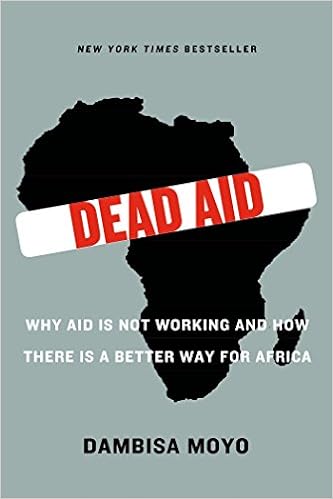
    Thus spoke James Shikwati to Der Spiegel's Thilo Thielke in July 2005 as the Kenyan economics expert pleaded, For God's Sake, Please Stop the Aid! (See also Dambisa Moyo's Dead Aid (Why Aid Is Not Working and How There Is a Better Way for Africa).)

    Good intentions such as eliminating hunger and poverty
have been damaging our continent for the past 40 years. If the industrial nations really want to help the Africans, they should finally terminate this awful aid. The countries that have collected the most development aid are also the ones that are in the worst shape. Despite the billions that have poured in to Africa, the continent remains poor.

 … Huge bureaucracies are financed [with the aid money], corruption and complacency are promoted, Africans are taught to be beggars and not to be independent. In addition, development aid weakens the local markets everywhere and dampens the spirit of entrepreneurship that we so desperately need. As absurd as it may sound: Development aid is one of the reasons for Africa's problems. If the West were to cancel these payments, normal Africans wouldn't even notice. Only the functionaries would be hard hit. Which is why they maintain that the world would stop turning without this development aid.

 … Africa is always only portrayed as a continent of suffering, but most figures are vastly exaggerated. In the industrial nations, there's a sense that Africa would go under without development aid. But believe me, Africa existed before you Europeans came along. And we didn't do all that poorly either.

 … Millions of dollars earmarked for the fight against AIDS are still stashed away in Kenyan bank accounts and have not been spent. Our politicians were overwhelmed with money, and they try to siphon off as much as possible. The late tyrant of the Central African Republic, Jean Bedel Bokassa, cynically summed it up by saying: 'The French government pays for everything in our country. We ask the French for money. We get it, and then we waste it.'

 … There must be a change in mentality. We have to stop perceiving ourselves as beggars. These days, Africans only perceive themselves as victims. On the other hand, no one can really picture an African as a businessman. In order to change the current situation, it would be helpful if the aid organizations were to pull out.
    Case in point.  Tanzania was supposed to be Sweden’s showcase in the aid “industry.”  A couple of decades ago, it was said that there was as much chance of seeing a blond head behind the wheel of a vehicle in Dar es Salaam as a black one.  Now, I have a question for you:  How often do you hear the government in Stockholm bragging about the wonderful advances it has made in Tanzania?  Not often, do you?  As a matter of fact — and I write this perhaps primarily for those who love to dish out statistics — the per capita income in that Western African country has decreased since Sweden’s millions of kronor started flowing in.

    So: must we do nothing, ask Washington’s critics?

    I will try to answer that in the a later post.  For now, just notice that the question doesn’t, as before, even start to cast doubt, be it a single iota thereof or otherwise, on the claims, implied or otherwise, that foreign aid is working, that aid in general is undoubtedly a proof of generosity, that Uncle Sam's military budget is a monstrosity, that Washington is greedy and evil, and that Americans are devious and mean.

    In fact, isn't the (pressing) question meant to change the subject as quickly as possible?  Change it back to the old we-are-still-the-most-compassionate-most-intelligent-most-humane-people-to-ever-tread-the-face-of-Earth mantra?

    To sum up: 

    What is the reason that all of us are not more familiar with the net amount figures in the matter of foreign aid?  Because it would be much harder for the critics to depict America capitalists as greedy, clueless, heartless clods.

    And what is the reason that we are not more familiar with the percentage figures on the question of military budgets?  Because it would be much harder for the critics to demonize Americans as bellicose imperialist warmongers.

    By the same token, it would be much harder for America's critics — U.S. leftists and Europeans foremost amongst them — to laud themselves as the most compassionate people in the world, as the most intelligent people in the world, as the most tolerant people in the world, and as the most humane beings in history ever to walk the face of the Earth.

Wednesday, January 27, 2016

Regarding Iraq, Saddam, and WMD, Where Did the Lies Originate? In the Bush White House? Or Elsewhere?

Thanks to Sarah Hoyt for linking the Wall Street Journal piece, The Dangerous Lie That ‘Bush Lied’.

As someone who served as co-chairman of the Commission on the Intelligence Capabilities of the United States Regarding Weapons of Mass Destruction—a bipartisan body, sometimes referred to as the Robb-Silberman Commission — Laurence H. Silberman finds it
astonishing to see the “Bush lied” allegation evolve from antiwar slogan to journalistic fact.

 … it is one thing to assert, then or now, that the Iraq war was ill-advised. It is quite another to make the horrendous charge that President Bush lied to or deceived the American people about the threat from Saddam.

 … It is … certainly possible to criticize President Bush for having believed what the CIA told him, although it seems to me that any president would have credited such confident assertions by the intelligence community. But to accuse the president of lying us into war must be seen as not only false, but as dangerously defamatory.

The charge is dangerous because it can take on the air of historical fact—with potentially dire consequences. I am reminded of a similarly baseless accusation that helped the Nazis come to power in Germany: that the German army had not really lost World War I, that the soldiers instead had been “stabbed in the back” by politicians.
Indeed, if anybody can be accused of lying in this matter, it is the very people — in America as well as abroad — who are not only accusing George W Bush of lying but who are simply presenting that as an incontrovertible (an almost ho-hum) fact. As I wrote in 2008,
his opponents, his accusers (both American and foreign!), did lie (in the very fact that they charged him with lying), and that they were lying all the time. (And if you think lying is too strong a term, and want to say that they "were mistaken", that would be fine with me — except for one thing: that was/is an alternative explanation that they never allowed for Bush and/or the neocons!)
Isn't one of the lies ignoring what was the one of the really most pressing reason for sending U.S. troops to Iraq?
Rudolph Giuliani:
President Bush will make certain that we are combating terrorism at the source, beyond our shores, so we don't have to confront it, or we reduce [the chance] of confronting it here in New York City, or in Chicago or in Los Angeles or in Miami [or in San Bernardino] or in the rural areas of America.
That's what it means to play offense with terrorism, and not just defense.
 Furthermore, Mr. Watergate scandal himself, aka Bob Woodward, has stated that
there was no lying in this that I could find.

Above is a video that Glenn Reynolds runs regularly to remind people, American and foreign (go to GR's link to see Instapundit's preponderance of evidence), what Democrats had been saying about Saddam's WMD before the invasion (my only beef with the video is it doesn't show foreign leaders, such as Jacques Chirac and Gerhard Schröder, when they were making the exact same type of remarks and/or speeches).

As I wrote 11 years ago, on the eve of the 2004 election:

Is Bush the World's Worst Leader?

When confronted by a militant leftist many years ago who was ticking off all the sins and failures of capitalist democracy, Winston Churchill finally indicated that he agreed with the man. "Democracy is the worst form of government", nodded the Old Lion. He marked a pause, before adding, "…with the exception of all the rest."

That is what I think about when I am confronted by angry people, American or foreign, who proceed to tell me what a "disaster" George W Bush has been and who can tick off his every sin and bewail the sorry record of his administration. (Not to mention every sin linked to America and capitalist society.)

Bush, I agree with them, is the worst leader in the world, and the worst politician, and the worst liar, and the man with the worst record… with the exception of… all the rest. (And the same can be said of capitalism compared to the rest of the world's economic systems…)

Foremost among the liars worse than Bush is Saddam Hussein, of course. The tyrant was a known fibber, doubling as a psychopath and — last but not least — a man repeatedly seeking war-making capabilities, and if Dubya mentioned WMD as a reason to oust the dictator, it's not because he (Dubya) was lying, but because Saddam had built the reputation he had.

Take the members of the "peace camp". Their foremost lie lay in their eagerness to castigate Bush and his administration, in the process conveniently forgetting that Saddam was the liar with the reputation just mentioned and that their secret services, as much as the CIA and MI6, had concluded that Saddam was hiding WMD.

In addition, they gave credence to the pretense that with just a bit of goodwill, the United Nations could, and would, solve the entire problem and entice the murderer of hundreds of thousands of his countrymen, if not to share power, at least to tone down on his killing… This being the same organization that threw a democracy out of its seat in the UN human rights committee (it happened to be Uncle Sam, but it could just as well have been any other Western-type democracy) while elevating countries like Libya or Syria to its chairmanship. It was also the organization that, when subsequently faced with genocide in Sudan, proceeded to do little else but issue communiqués deploring the situation and calling upon the murderers to ease up on their killing.

Take the United Nations as a whole, which, in unison with the "peace camp" members, pretended to be objective, detached, and holier than thou, when its members, in fact, were involved in the largest scam in human history. This, of course, brings us back to the Peace Camp, which pretended that their only, or their foremost, concern was a just and lasting peace, in contrast to Bush's "war for oil" when, in fact, it would have been more appropriate to have the pre-conflict situation termed as their "tyranny for oil" gambit.

Then there are the pacifists, both private citizens and government bigwigs, who marched through the streets and/or made rousing speeches, pretending that the largest threat to the world today was Uncle Sam.

Then there are the media outlets, both within the United States and abroad, which echoed those sentiments, while making much out of the fact that Iraq now is supposedly in chaos and insecurity — as if having the thuggish members of Saddam's secret police enter into your home with impunity, take away your parents, spouse, and/or children, and torture and murder them, can in any way be likened to an environment of public safety and to the absence of chaos.

To be totally honest, I liken the accusations concerning Bush and Blair's claims about Saddam's WMD to accusing Churchill, Roosevelt, Eisenhower, or Montgomery of lying to the Rangers when they ordered them to storm the cliffs of the Pointe du Hoc on June 6, 1944, to neutralize some long-range cannons (weapons of mass destruction, one could call them); after sustaining heavy losses, the Rangers found that the cannons were nowhere to be found, the Germans having removed them from the Normandy coast not long before.

History has a long flow of evidence showing that when Uncle Sam is being attacked, castigated, or mocked, it is usually the people, institutions, and countries doing the berating who are the worse sinners. And who have something to hide, as much from the rest of the world as from themselves.
To quote Sir Winston again, 
a fanatic is one who can't change his mind and won't change the subject.
Read the three-and-a-half-years-later (!) update
Shall we let the last word go to Dennis Prager?
Few liberal activist groups tell the truth. Not because their members are liars -- in private life they may well be as honest as anyone else -- but because whatever the left advocates it deems more important than truth.
  … when the left ceaselessly repeats the mantra "Bush lied," it may simply be projecting onto George W. Bush what comes quite naturally to the left — when it offers false Iraqi death statistics, false homeless data, false rape statistics, false secondhand smoke statistics, false claims about the percentage of gays in the population, and false claims of just about everything else the left cares about.
Related: So Long As We Are Hunting for Liars in the Iraq Controversy…

Monday, August 20, 2012

Plantu on Putin and Pussy Riot


Pussy Riot girls: [singing]

• Putin: Hey, girls, not so loud!! We can no longer hear the Syrian melody!

When a Democrat is in the White House, and the American superpower is not involved in a given conflict, Europeans like Plantu can finally soar and give us fabulous cartoons…

Below is one of his very rare Iraq war cartoons which did not demonize the Bush-Blair coalition as a band of marauding mass murderers, taking on, for once (for one rare time), a member of the alleged peace camp… (Then again, of course, it was a politician from the far right…)

Rot for Oil

Saturday, April 17, 2010

What’s Old is Old Again

EUOBSERVER / BRUSSELS - The number of antisemitic incidents mushroomed in many western EU countries in 2009 due to an organised anti-Gaza war campaign, a new study says.
Alas, further furry fables from EUtopia, land of love, tolerance and world peace:
Looking at the number of violent incidents in absolute terms, the UK and France lead the EU league table, followed by Germany, Belgium and Austria. Relatively high numbers are also seen in the Czech Republic, Denmark, Hungary, Italy, Lithuania, the Netherlands, Poland and Sweden.
You’ll note that what triggers the attackers is not what any of the victims does, but what their identities are believed to represent to the attackers. In other words: the same old small-minded continental rubbish that they know “classically European” people can no longer do to one another in the same way they permit themselves to say and do to others, even to whole classes of people that they have always made straw-men of, and imaginary sources of their struggles of.

It’s only a matter of time until someone prominent starts to blame Greece’s economic problems on some generic concept they have of Jews. It will surely go unquestioned by Europeans who have likely never met a Jew too.
The institute said the rise was due to an organised campaign by far-left parties and Muslim communities, funded by "oil money" rather than due to a spontaneous reaction, although the report does not provide evidence for this accusation.

"The intensity and nature of the wave that began in January 2009 testified to pre-planned mobilisation among radicals from the left and among Muslim immigrant communities," it said.
The “oil money” part sounds a little sketchy, but isn’t that far fetched when you consider some of the opinions overheard made by near-Eastern business people. In fact one of the ttraits one finds with the younger ones, is a desire to be liked by the aboriginal Europeans, which frequently amounts to young, politically active and fairly extreme college students who coddle the old racial arguments out of mere ignorance of the past, being morally bereft when it comes to anyone other than their friends and families, and a youthful lack of life experience.

To single THEM out and characterize them, they are frequently seen wearing contrived looking whispy scarves, sweaters, no jackets (except for fake “army surplus” style jackets in the dead of winter,) and go strategically unkempt. Absent any air of dignity it’s just another uniform pulled out of history like so many others in their self-immolating continent’s past.

Remember, they’re better than you and I are. More smarter too!