Showing posts sorted by relevance for query international herald tribune. Sort by date Show all posts

Tuesday, October 15, 2013

The International Herald Tribune Is Gone, Off the Newsstands for Good

(Well, Not Really) Today, the International Herald Tribune is gone:
On Tuesday, The International Herald Tribune, the global edition of The New York Times, becomes The International New York Times. The paper has changed names a number of times since its founding 126 years ago, but its mission has always remained the same: to provide a global perspective on events and ideas shaping the world. This is a look at its journey so far.

What follows at the link is a retrospective of news and editorials, from the 1890s to the 2000s, but if you really want a good time, read Art Buchwald's 1956 report of the Monaco wedding between Prince Rainier and Grace Kelly. A couple of years earlier, the humorist had written Tax Deductions Made Easy…
My take:
I've been a devoted reader of the International Herald Tribune since the tender age of 8.

(Okay, at that time I only read the comics page, but still…)

I had a number of letters to the editor in the paper since then, although only about boring international happenings and tedious issues of liberty and freedom (they never published my missives complaining every time they got rid of another comic strip — Buzz Sawyer, Beetle Bailey, Blondie, etc; I never understood why Dennis the Menace was less important than Dilbert).

Maybe soon the NYT will take the next logical step, and follow the NYT's example, getting rid of if its comics page altogether (no, seriously, folks, the Big Apple-based editors pride themselves on the NYT being without a comics page)!

Leave the comics page alone, New Yorkahs.
And leave the IHT's name alone, as well!

If you must change anything at all, do as follows:
change the name of the New York Times to
the "New York International Herald Tribune"!

Saturday, November 02, 2013

A Turning of the Page for the IHT (the INYT), Yes, But a Turning Back


IHT readers complain about the International Herald Tribune's name change (to the International New York Times):
To realize what the name IHT meant, read Roger Cohen’s column, “Adieu IHT, bonjour INYT” (Oct. 15). Will the new name inspire the same romance? If loyalty to the IHT brand was as immense as Mr. Cohen describes, why change the name in the first place?
Renaat Horemans, Mol, Belgium
 
I remember reading my first European edition of the New York Herald Tribune on Tuesday, Aug. 1, 1961, upon arrival in London. Since then, except for two short stays in the United States, I have read it virtually every day. I was delighted in 1967 when the paper took a step away from New York exceptionalism by dropping the geographical reference in the masthead. The International Herald Tribune now sounded like a true international paper rather than an international edition of a U.S. paper, and year by year it seemed to grow more and more into that role. 
Yes, the resurrection of “New York” in the title is a “turning of the page,” but in my view it is a turning back of the page, which is a pity.
Joel McClellan, Geneva

Thursday, April 16, 2015

The Other International Brigade of the 1930s/1940s; The One That Your History Teacher Knows a Whole Lot Less About…


The title of this blog is a takeoff of the cry immortalized during the Spanish Civil War when the Republican camp tried to fight against the fascist totalitarians of General Franco — "They shall not pass!" — and when thousands upon thousands of foreign volunteers came to the Spaniards' aid in the 1930s in the form of an International Brigade.

This has been glorified by everyone in the West, from Picasso to Ken Loach, and the David/Goliath fight figures prominently in most history books from one part of the West to the other.

So if you know that, you know your basic history.

Or… do you?

There seems to have been another international brigade that we have heard about far less — far, far less…

Listen to the New York Herald Tribune at the turn of the decade:
WITH THE INTERNATIONAL BRIGADE IN THE FINNISH ARMY — Another group of Americans and even more Swedes, Norwegians and Danes reached the training center for volunteers late last night [Jan. 15, 1940] and early today to swell the number of fighting men in the International Brigade being formed in Finland. They have been coming in here every day now for four or five weeks, at first in groups of twenty to thirty, and then by hundreds. It is beginning to look as if the greatest International Column of all time will be fighting for Finland by spring. The backbone of this International Brigade will be the Swedish corps under General Eric Linder, a powerful force trained and equipped and paid for by Swedes. It will operate under the supreme command of the Finnish General Staff. Otherwise, it will resemble a private army. They are here to fight for a small country with a population about half that of the City of New York, into which a powerful neighbor has sent its armies and air force. — New York Herald Tribune, European Edition, Jan. 17, 1940 
So there was another international brigade come to the aid of a European people under attack by a totalitarian entity in the 1930s/1940s. And indeed, it seems to have become no less than "the greatest International Column of all time"—i.e., outweighing its Spanish counterpart!

Except this totalitarian entity it fought against was Stalin's communist Soviet Union (who, also, by the way, was instrumental in the fight besides Spain's Republicans (or shall, we call them Spain's "Republicans" with quotation marks?)).

So now we understand the reason why we have heard so little about this Finnish international brigade:

Rightist dictator(ship)s, bad.

Leftist dictator(ship)s, good.
(Or: at least, we have to try to make an effort to understand them…)

Sunday, October 04, 2015

RIP Adrian Frutiger, the Font Designer I Had a Spat With 20 Years Ago


For more than 50 years, Adrian Frutiger made the world legible
writes Margalit Fox in her New York Times obituary. Twenty years ago, I had a verbal run-in with the Swiss type designer, through the pages of the International Herald Tribune, in which I appealed to the bible of the advertising industry.
    Anyone who has had to strain his eyes to make out a street sign or a highway direction at night, read arduously through a monument inscription, or decipher a direction from the far side of
a Paris Métro platform would tell typographer Adrian Frutiger that the idea is not to "recognize letters one by one" (back page, Sept. 18 [1995]), but words!

    Thus, a text, whatever it is (even a headline or a brief pair of terms), should never be in capitals.  As David Ogilvy of Ogilvy & Mather writes in "Ogilvy on Advertising" — the definitive book on the ad world — "The eye is a creature of habit.  People are accustomed to reading books, magazines and newspapers in lower case."  It has been established that "Capital letters are extremely difficult to read" and "retard reading.  They have no ascenders or descenders to help you recognize words, and tend to be read letter by letter."
It was printed, shortened, in the International Herald Tribune (issue # 35,023) on October 5, 1995, as "Signs of the Times."

Back to the Margalit Fox's obituary:
A type designer who died on Sept. 10 at 87 in his native Switzerland, Mr. Frutiger created some of the most widely used fonts of the 20th century, seen daily in airports, on street signs and in subway stations around the world.

Mr. Frutiger, whose career spanned the era of hot lead and the age of silicon, created some 40 fonts, a vast number for one lifetime. Praised for an elegant readability that belied their rigorous engineering, his typefaces over the years have graced signs in the Paris Métro and many international airports, and on Swiss highways and some London streets.

His best-known fonts include Univers, employed throughout the design of the 1972 Olympic Games in Munich, and Frutiger, ubiquitous on airport signage, including that of John F. Kennedy International Airport in New York and Charles de Gaulle Airport in Paris.

“Frutiger is basically the best signage type in the world because there’s not too much ‘noise’ in it, so it doesn’t call attention to itself,” Erik Spiekermann, a prominent German type designer and friend of Mr. Frutiger, said by telephone on Wednesday. “It makes itself invisible, but physically it’s actually incredibly legible.”

 … in the early 1960s he founded his own studio in Paris.

Commissioned to create signage for airports and subway systems, Mr. Frutiger soon realized that fonts that looked good in books did not work well on signs: The characters lacked enough air to be readable at a distance. The result, over time, was Frutiger, a sans serif font designed to be legible at many paces, and from many angles.

One of Frutiger’s hallmarks is the square dot over the lowercase “i.” The dot’s crisp, angled corners keep it from resolving into a nebulous flyspeck that appears to merge with its stem, making “i” look little different from “l” or “I.” (For designers of sans serif fonts, the gold standard is to make a far-off “Illinois” instantly readable.)

  … His other fonts include Avenir, Centennial, Egyptienne, Herculanum, Iridium, Serifa, Vectora and Versailles.

As conspicuous as Mr. Frutiger’s work became, it was for its inconspicuousness, he said, that he hoped it would be known.

“The whole point with type is for you not to be aware it is there,” he said in an interview on the Linotype company’s website. “If you remember the shape of a spoon with which you just ate some soup, then the spoon had a poor shape.” He added:

“Spoons and letters are tools. The first we need to ingest bodily nourishment from a bowl, the latter we need to ingest mental nourishment from a piece of paper.”


Saturday, February 19, 2022

One Exception Was John Vinocur, Who Was a Breed Apart: “Journalists used to act like cynics but at heart we were idealists; Now we’re often cynics masquerading as idealists”

The title of When Did ‘Me,’ ‘We’ and ‘Us’ Become the Media’s Preferred Pronouns?

But on the front page of its global edition (the International New York Times is the successor paper of John Vinocur's beloved International Herald Tribune), the title is a more sober Honoring old-school journalism.

In Honoring old-school journalism, discusses the present state of the craft, and mentions his friend, the late John Vinocur, as the antidote.

The IHT pundit, almost all of whose final decade of weekly opinion pieces were linked to by No Pasarán, died at 81 on February 13.

I feel exactly like , when he says that Vinocur's 

column in The I.H.T. was the one thing I would never miss 

when he (Stephens) was a graduate student in England and later when he worked as a journalist.

Over drinks not long ago, a friend summed up the way journalism had changed over the course of his career. “Journalists used to act like cynics but at heart we were idealists,” he said. “Now we’re often cynics masquerading as idealists.”

I thought of that line twice last week. The first time was on Wednesday, while reading, against my better judgment, about the abrupt resignation of Jeff Zucker as president of CNN. The second was on Sunday, after learning that my friend John Vinocur, the former executive editor of The International Herald Tribune, had died in Amsterdam at 81.

In these two stories lies the difference between the kind of journalism Americans used to venerate and the kind we have today.

 … When did “me,” “we” and “us” become the news media’s preferred pronouns?

One journalist who was not much for navel gazing was Vinocur, whose column in The I.H.T. was the one thing I would never miss when I was a graduate student in England and later when I worked as a journalist in Brussels and as an editor in Jerusalem.

From reading him over the years, I gleaned that Vinocur had covered, so it seemed, everything. The Biafran war. The Munich massacre. The Rumble in the Jungle. The Stroessner regime in Paraguay. Spy games in Germany. The Mitterrand monarchy in France. He was almost absurdly well sourced, thanks to years spent as The Times’s bureau chief in Paris and Bonn. And his prose — confident and confiding, energetic and endearing, intimate in detail and Olympian in scope — was, by far, the best in the paper.

 … [His lines from a vintage Vinocur lede] … made the morning paper a joy to read. And they gave a young journalist a sense of what his vocation might be like when practiced at its best: adventurous, literary, significant. As I read John in my 20s, I figured out what I wanted for my own career: to see the world without illusions — but without losing the ballast of personal ideals.

About 10 years ago, I got an unexpected visit from John in my office at The Wall Street Journal. Would I, he asked, give him a job? He was retired from The Times. But he still knew everyone, he had plenty to say, his skills were intact. In this way I became his editor, he became my mentor, and we became friends.

For the next several years he delivered a string of columns that look only better with the passage of time. From a 2015 column on the Minsk agreement, which helped set the stage for the present crisis in Ukraine: Its holes, he wrote, were “so gaping as to allow Russia to drive tanks unhampered through an open Ukrainian border for next to forever.” From a 2017 column raising alarms about Berlin’s increasingly neutralist foreign policy: “Is there a kind of German complicity or reflexive softness involving Russia that permits Moscow’s blatant (and strategic) lying without anything resembling serious retaliation?”

For many readers, these topics may have seemed distant. They didn’t trend on Twitter. They didn’t have the gossipy salaciousness of a newsroom scandale.

But they mattered. They looked outward. They dwelt heavily on the inner mechanics of politics and diplomacy. But they did so not for the sake of the game itself, but for the large things at stake.

I last saw John in Florida, shortly before the pandemic began. We had a gloomy conversation about the state of journalism. But when we parted, he said, “It’s a noble profession.”

It is. We should do more to live up to his example.

Thursday, February 21, 2013

“Incendiary!” “Insulting!” “Scathing!” French Vow to Retaliate Against Taylor's Titan International

Following the eruption of a furor in France after the blunt letter of a Yankee capitalist to a Socialist government minister — it made the front pages of, among others, Le Monde and the International Herald Tribune — the French vow to fight back. The fight was described in a previous NP post, as well as in Harvey Morris's New York Times blog:
Many in France are bristling over a letter from Maurice M. Taylor, the American tire tycoon, describing French employees as underworked and overpaid.

Writing to a government minister to explain why he would not step in to save a tire factory threatened with closure in northern France, Mr. Taylor, the chief executive of Illinois-based Titan International, recalled visiting the factory: “The French workforce gets paid high wages but works only three hours.

“They get one hour for breaks and lunch, talk for three, and work for three. I told this to the French union workers to their faces. They told me that’s the French way!”

Mr. Taylor, who glories in a Wall Street nickname — The Grizz — that reflects his tough negotiating style, was writing to Arnaud Montebourg, France’s minister for industrial renewal, to explain why he would not be stepping in to save the doomed Goodyear plant in the northern town of Amiens.

“How stupid do you think we are?” he asked the minister in the Feb. 8 letter, a facsimile of which was published on Tuesday by Les Echos, the French business daily.

His blast touched a raw nerve in France, where both politicians and the press are sensitive to Anglo-Saxon lectures about the country’s alleged anti-business culture.

“Virulent,” “unbelievable” and “incendiary” were among the adjectives used by the French press to describe Mr. Taylor’s missive in which he told Mr. Montebourg:

“You’re a politician so you don’t want to rock the boat. The Chinese are shipping tires into France – really all over Europe – and yet you do nothing.”

Mr. Taylor, a former welder who made a self-financed bid for the Republican presidential nomination in 1996, had already ruffled French feathers back in December when he said he was pulling out of a possible Amiens deal.

Referring to the regulatory barriers Titan had faced, he attacked France’s business practices as “screwed up” and said “only a non-business person would understand the French labor rules.”
An article on the front page of the International Herald Tribune (top left) by Liz Alderman also provides the back story along with the retaliation measures promised by the government as well as the communist CGT union — which wants to take Taylor to court.
Mr. Montebourg released a letter to Mr. Taylor, calling the [Titan International] executive’s comments “extreme” and “insulting,” adding that they pointed to a “perfect ignorance” about France and its strengths, which continue to attract international investors.

French media outlets minced no words. “Incendiary!” “Insulting!” and “Scathing!” were just a few of the terms replayed on French newspaper Web sites and on the airwaves throughout the day. The French blogosphere lit up with hundreds of remarks condemning the “predatory” American corporate culture that Mr. Taylor seemed to represent; other commentators who ventured to admit that there might be something to Mr. Taylor’s observations were promptly bashed.

And France’s main labor union wasted no time in weighing in. 

Mickaël Wamen, the head of the Confédération Générale du Travail union at the Goodyear plant, in Amiens, said Mr. Taylor belonged in a “psychiatric ward.” 

A spokesman for Mr. Taylor did not immediately respond to calls for comment. France’s 35-hour workweek, its rigid labor market and the influence that labor unions hold over the workplace have long been a source of aggravation for businesses. 

… In his response, Mr. Montebourg reacted strongly to what he called Mr. Taylor’s “condemnable calculation” and noted that France and its European partners were working to stop illegal dumping of imports. 
“In the meantime,” he added, “rest assured that you can count on me to have the competent government agencies survey your imported tires with a redoubled zeal.”

But is it unfair to give the last word to the Frenchman also providing the concluding words to Harvey Morris's New York Times blog?
… Daniel Schneidermann, a columnist for the @rrêt sur images Web site, said on Wednesday, “The Grizz doesn’t care whether he’s loved or hated. He reveals globalization in its true colors. He does it a thousand times better than all Michael Moore’s movies. Thank you, the Grizz.”
Indeed, Le Monde itself admits there is quite a problem with France. Denis Cosnard and Anne Eveno mention polls that show that 40% of directors of American company affiliates in France say that the country is a bad place to invest in, a huge increase from the 2011 figure of 15% and from that of 10% two years earlier.
"MAUVAISE" DESTINATION D'INVESTISSEMENT

Faut-il être "stupide" pour s'implanter en France, comme le clame M. Taylor ? Dans sa réponse, le ministre insiste sur le fait que la France reste une terre d'accueil privilégiée des investissements étrangers. "Plus de 20 000 entreprises étrangères représentant près de deux millions d'emplois" y sont installées, note-t-il, les sociétés américaines en tête. Chaque année, "on compte 700 décisions de localisation d'investissements étrangers (...) en France. Et cette solide attractivité ne s'affaiblit pas, tout au contraire, d'année en année, elle se renforce", assure le ministre.

L'image de l'Hexagone auprès des investisseurs étrangers – américains particulièrement – s'est néanmoins dégradée fortement depuis quelques mois. Un sondage effectué en octobre-novembre 2012 auprès des dirigeants de 52 filiales d'entreprises américaines le montrait clairement.

"Comment votre maison mère perçoit-elle la France ?", leur avaient demandé la chambre de commerce américaine en France et le cabinet de conseil Bain & Company. Comme une "mauvaise" destination d'investissement, indiquaient 40 % d'entre eux. Ils n'étaient que 15 % à donner la même réponse en 2011, et à peine 10 % les deux années précédentes. Seuls 22 % des responsables interrogés voyaient la France comme une bonne terre d'accueil, deux à trois fois moins qu'auparavant.

Et convaincre une maison-mère américaine, allemande ou finlandaise de choisir la France se révèle de plus en plus ardu, reconnaissent en privé bien des patrons de filiales françaises.

Thursday, April 07, 2011

The war in Libya can create "a new Iraq on the Mediterranean coasts"

(See Update below…) In response to the International Herald Tribune article on Bernard-Henri Lévy's view on and role in the conflict against Muammar el-Qaddafi, Umberto Eco (who was recently in Paris for the Salon du Livre) responds from Milan:
I totally disagree with the French writer Bernard-Henri Lévy. The war in Libya is a terrible mistake.

The situation in Libya now is catastrophic and the war is a real danger for the European economy and can increase the risk of terrorist attacks in Western countries. This war can create a new Iraq on the Mediterranean coasts. This war is stupid and dangerous for all.

Note that each writer happens to be reflecting the attitude of his respective government (or vice-versa)…

Update: Turns out that the Umberto Eco letter is a hoax:

In the newspaper of April 6, the International Herald Tribune published a letter over the name of the writer Umberto Eco, criticizing the military actions in Libya. This letter was a hoax and should not have been published. We take efforts to verify the authenticity of every letter we publish. In this case, however, we failed to contact Mr. Eco for confirmation. We have expressed our regret to him, and we apologize to our readers.

Tuesday, September 06, 2005

"Look, Lance, the French don't like winners"

Samuel Abt has an interesting article about Lance Armstrong in the International Herald Tribune.

Quite different from an article in Le Figaro, which turns out to be a diatribe against the the United States and its oafish inhabitants. Here's the kicker: the "anti-American tripe" (merci à Michael Dundon) comes from an American journalist based in Paris.

I know Ted Stanger. I met him after the former Newsweek correspondent wrote a very funny book called Sacrés Français, and a bunch of like-minded expats and Frenchmen celebrated its publication together.

Many months later, I met a fellow admirer of his again (the same who had invited him to the dinner party on the Seine péniche) and when his name was mentioned, her eyes turned sad. With disappointment in her voice, she said that he had sold out. Indeed, his editor had "made" him write Sacrés Américains.

Offhand, you might think, where's the problem, it's simply writing a funny book about one nation followed by another book about another (about the rival) nation. That's not taking into consideration the differences in tone: while the first book was filled with light-hearted and sympathetic observations of a (single) foreign observer, the second basically revisited the (community-wide) judgmental scorn and self-serving prejudices applied to clueless Americans by the far superior French, taking that scorn (and the accompanying prejudices) for granted.

Although I can't say for sure, of course, I can imagine the author as well as the editor(s) having been subjected to a barrage of pressure from friends, colleagues, co-workers, and family members. That pressure amounting to what? To deciding that in the final analysis, France (or Europe) and its system come out on top (as more lucid, more generous, more tolerant, etc, etc, etc…)

I have seen this happen again and again, among expats I hardly know as among loved ones, and at times, truth to tell, it is not a little disheartening.

John Vinocur mentioned a famous example in the International Herald Tribune.

Faced with the constant barrage of news proving Americans' backwardness in all things worthwhile, along with constant pressure from their French friends, co-workers, and acquaintances (snorts, snickers, guffaws, tch-tchs, nose curls, head shakes, and dirty looks accompanied by "mais certainement vous pouvez admettre que Bush a commis des erreurs/a raconté des mensonges", "pourquoi vous êtes en France si vous pensez ainsi?"), foreigners and other American friends (whether consciously or otherwise) cave in, not wanting to face the heat and not wanting to rock the boat…

Incidentally, the journalist, whose Sacrés Français: le roman is to be published this week, has been mentioned on this blog before, with Douglas wondering, did you know that at points he was even more anti-American than the average Le Monde Web reader?

Tuesday, May 25, 2004

For EU Deputies, the Gravy Train Can Add 100,000 Euros a Year

In a front-page article in the International Herald Tribune concerning perks at the EU Parliament, Doreen Carvajal and Martin Gottlieb ask whether it is a system out of control.
…the legislature's well-oiled system of perks and privileges … might make a corporate president smile in recognition: chauffeured cars; daily and monthly stipends that can add tens of thousands of euros to basic salaries; jobs for relatives paid out of a E150,000 (about $180,000) a year secretarial allowance; free health care; pensions that, as one legislator put it, can put "gin on the terrace"; and, most stunningly, a travel expense procedure that reimburses legislators for as much as 10 times the amount of their airfare ticket prices.

According to payroll and expense records obtained by the International Herald Tribune and The New York Times, a legislator can add well over E100,000 to a base salary when all the tax-free benefits are calculated. …

"I have been accused of boarding the gravy train," said Bill Miller, a Scottish member who argued for reforms. "I have been accused of being dishonest. I've been accused of being greedy. I've been accused of being a parasite. I've been accused of being a leech. And that's just by members of my own political party."…

Whether the legislators will be crucified remains unclear. Europeans will engage in sweeping elections June 10 to 13, sending 732 delegates from the 25 countries of the newly expanded European Union to a legislature whose laws will govern life from western Ireland to the borders of Ukraine.

Substantial issues involving trade, immigration and integration of the 10 new, mostly Eastern European members are certainly campaign trail topics. But so, in many places, are the legislature's grab bag of goodies, with items like the E262 daily expense allowance legislators receive when they register for work in the Parliament's seats in Brussels or Strasbourg, a delicate election problem for some who have been seen signing in at 8 a.m. and then bolting for planes home.

Michiel van Hulten, a Dutch Democratic Socialist member who has campaigned for reform, said the issue was basic for the EU because to win popular acceptance it needed "institutions that citizens have faith in." …

Budgeted at nearly E100 million in the aggregate, European deputies' benefits easily top those for members of any EU-member national parliament. (The U.S. Congress, in which members of the House receive million-dollar budgets to finance sizable staffs is another story, but nepotism in hiring is barred there and reimbursement is generally tied to actual costs incurred.) …

The system of pay and perks has evolved like new generations of computers, each more efficient and faster than the last.

When members complained that they couldn't sign for their daily expense money at 8 a.m. without risking missing their flights, registration hours were pushed back to 7 a.m.
Read the entire article, notably how one slightly disheveled Austrian legislator (Hans-Peter Martin) assembled some of the most revealing information about the perk system with "a hidden minicam the size of a big sponge".

Friday, October 11, 2013

Did You Know That in France, People Also Use Guns in Self-Defense? And That the New York Times Would Present the Shooting of a Criminal in as Biased a Way as Possible?


Members of the French élite and its political class may preen about how their country is in favor of gun control as well as poised against the death penalty — thus showing themselves far above the Wild West mentality of those clueless Yanks — but average French citizens apparently think differently when one of theirs comes face-to-face with crime in the streets — something you would have trouble seeing sometimes in Dan Bilefsky's New York Times article.
Early on the morning of Sept. 11, a 67-year-old jeweler in Nice, France, raised his unlicensed semiautomatic pistol and shot a teenager in the back as he and an accomplice sped away on a motor scooter with gems they had stolen at gunpoint … the jeweler, Stephan Turk, was arrested last week and charged with murder. 
So a vigilante shoots a "teenager" in the back, we learn. Why don't we hear that the jeweler was "punched and kicked" by both the "youth" and his accomplice, as they forced their way into his jewelry shop? Doesn't the NY feel the need to report that?! Sure it does! But only 11 paragraphs into the story…
The case has set off a national debate in France about how to define self-defense, and about the decision to charge Mr. Turk. Many have rallied behind the jeweler, lauding him as a hero who was protecting his life and property, while others have accused him of being a reckless and unfeeling vigilante. 

  … a Facebook page created to support Mr. Turk by an anonymous author has attracted about 1.6 million “likes” — a figure so high that some social-network experts have challenged its veracity. 
Well — but of course. High figures are always — and only — challenged when they seem to support the right…
At first Mr. Turk was held in police custody, but after a public outcry, he was moved to an undisclosed location under house arrest, wearing an ankle monitor
At this point the International Herald Tribune added a tongue-in-cheek comment (not on the website) — although it made sure to disguise it under unnamed "critics" of the jeweler's:
—a show of empathy that his critics say he did not show his victim.
Notice who is, who it is who has become, a "victim". Notice who has become "the" (i.e., the only) victim.

Yes, it is Anthony Asli, a "onetime horticulture student" with — to be sure — "a string of previous convictions for assault, theft and driving offenses". The victim of "Mr. Turk, a prosperous business owner" in a city where, the New York Times has no choice but to note, "400 jewelry robberies occurred last year."

Now let's pick up on the evil and fearful far right forces, including the awful capitalists, the true enemy of the country:
After the left-wing newspaper Libération lamented on Monday that the support on Facebook for Mr. Turk was “worrying” and “unprecedented,” a reader using the name Rantamplan insisted that the wellspring of admiration for Mr. Turk showed that France was dominated by reactionary right-wingers. “Some people feel that property is worth more than a life,” the reader wrote online in the comments section.  
Only after all that do we get to the 11th paragraph:
Eric Bedos, a Nice prosecutor, told reporters that Mr. Turk was held up at gunpoint by two young men as he opened for business on Sept. 11, and that security-camera video showed him being punched and kicked, and then opening his safe. 
It's not even Stephan Turk being "punched and kicked", it's not even a "security-camera video [showing] him being punched and kicked", it's as follows; it's "a Nice prosecutor [reporting] that security-camera video showed him being punched and kicked"! How far away from simple factual reporting can you get, disguising it under emotion-lacking "he said, she said, it showed"?!
President François Hollande said in an interview on the French channel TF1 … that he recognized the “exasperation and anger” in the case, but that “it’s up to the justice system to do justice, and no one else.” 
Well, that's just the problem, ain't it, Monsieur le Président? When police acting as tax inspectors, i.e., are busy raising money for the French state by ticketing car drivers right and left instead of patrolling (say) the streets of (say) Nice.

The International Herald Tribune decided to change paragraphs around, in order to end the story full of emotion, adding a claim that "a" girlfriend "told Le Monde that she was pregnant at the time of his death" ("a" girlfriend? How many did he have? How many are expecting?) and with a quote from Anthony's dad:
  … the father of Mr. Asli said, he did not deserve what happened to him, the newspaper Nice-Matin reported. “He was a little delinquent, a scooter thief,” the newspaper quoted the father as saying. “But he had the face of a child, and no child should have to die like that.” 
No quotes from Stephan Turk's wife, mistress(es) — if he has any — parents, children, or 3rd cousins…

Related: 
• For a Nation Used to Giving Americans Lessons on Firearms and Police Trust, France Has Been Amassing Quite a Collection of Bullet-Ridden Bodies

• For a Country Always Giving Yanks Lessons on Civility and Gun Control, There Has Been an Amazing Amount of Kalashnikov-Related Killings

• "Unlike the U.S., guns are tightly regulated in Europe, but the French gangs have armed themselves with weapons obtained on the black market"

• In a Country with Gun Controls Like France, the Kalashnikov Has Become the Thug's Rolex of Choice

• PLUS: this lengthy, dispassionate, in-depth discussion on the issue of gun control:
What Is to Blame for the Connecticut Shooting? Does the Blame Lie with the Right to Bear Arms Or Can It Be Found Elsewhere?

Sunday, March 20, 2022

18th Anniversary of My First Post for No Pasarán

A few weeks after the founding of No Pasarán, 18 years ago, I was invited to join as the blog's fourth blogger (after Douglas, Jonathan, and Liminal aka U*2, and prior to N Joe).

The blog's inaugural pledge was that we

 "will commentate on current events with all the psychotic calm and serenity of a Palestinian father who explains that he can't wait for his 2 surviving sons to become martyrs"
Of the more than 13,000 posts that have been written since 2004 (13,687, to be exact, as of today), I consider the following couple of posts to be two of the most important:
• The Era of the Drama Queens: Every Crisis Is a Triumph
• The Leftist Worldview in a Nutshell: A world of Deserving Dreamers Vs. Despicable Deplorables
Today is the anniversary of my first contribution, which related how I attended a conference in Normandy (at a museum linked to the D-Day landings, no less!) with some of France's best-known journalist VIPs and how I rose to challenge the group on the French media's coverage of the Iraq conflict.

Wednesday, March 24, 2004


Growling for Colombani

Any of you who have seen me over the past 10 days knows how furious I get anytime I read or hear the French media trying to stuff down our throats their self-serving lying charges (those against Aznar, Bush, and Blair, i.e., anybody whom they don't feel any sympathy with).

So when I read that the Mémorial de Caen was organizing a conference with Jean-Marie Colombani, among others ("QUELLE LIBERTÉ POUR L'INFORMATION DANS UN MONDE INQUIÉTANT ?" [What freedom for information in a distressing world?], organized in tandem with Les Amis de l'hebdomadaire La Vie and Reporters sans Frontières), I knew I had to attend. I wanted to give Le Monde's director a piece of my mind (in a diplomatic manner, natch). Three hours before it started at 7 pm on March 23, 2004, I jumped into my trusty jalopy, and drove the 260 km to Caen, arriving just in the nick of time.

And sure enough, the first thing any of the five intervenants did (with a constant wry smile on his face) was to attack the lies of politicians, ridicule the partisanship of the media, and bemoan the jingoism of the population (meaning those of the US, the UK, and Aznar's Spain exclusively, bien sûr). It was Jean-Marie Charon, "Sociologue des médias" (whatever that means), who opened the débat — the others being (left to right on the admittedly unclear photo) Colombani, Walter Wells, Directeur de l'International Herald Tribune (beard), Jean-Jacques Lerosier, Grand reporter à Ouest-France, and Jacqueline Papet, Rédactrice-en-chef de RFI, with the moderators answering to the names of Daniel Junqua, Journaliste et Vice-président de RSF, and Jean-Claude Escaffit, Journaliste à La Vie et Directeur des Amis de La Vie.

Before I left Paris, I'd reviewed and written down (in telegraph-style) a handful of arguments: these ranged from the Iraqis quoted in Reason, on Iraq the Model, and in Le Monde itself, to Doug's post on Le Monde's partisan mistranslation of Michael Ignatieff's piece in the New York Times.

The only problem was a rather big one, I learned as a I headed for my seat: questions would not be permitted, except in written form on small pieces of paper handed over to one of the animators. So I knew I had to pay close attention if I wanted to find an appropriate moment when to jump in. And I would obviously not have time to develop any of the arguments (especially since Eskaffit seemed to be a control freak).

It happened towards the end. There was a brief lull as Wells was about to make his last extensive remarks. Suddenly everybody turned to me as I let out : "Je pense que nous devons tous remercier les médias français pour leur admirable abilité à détecter les mensonges. Mais je ne comprends pas pourquoi ces spécialistes en la matière ignorent des sujets qui ont été traités dans le Herald Tribune, par exemple." (This was punctuated by Eskaffit's protests on his mike, you realize.) "Nous avons pu y lire des articles détaillant ce qu'on pourrait taxer de mensonges dans le camp de la paix, comme le fait que les Allemands, les Russes, et les Français avaient pas mal d'affaires avec les autorités baasistes, et que Total devait avoir un contrat exclusif avec Saddam Hussein. Pourquoi les médias français n'en font-ils pas autant état que de ce qui concerne les Ricains, les Rosbifs, et les Espagnols?"
[Translation: "I think we should all be grateful to the French media for their admirable ability to detect lies. But I do not understand why these experts in the field are ignorant of topics that have been covered in the Herald Tribune, for example." (This was punctuated by Eskaffit's protests on his mike, you realize.) "We have read articles detailing what could be taxed as lies from the peace camp, such as the fact that the Germans, the Russians, and the French had quite a lot of business dealings with the Baathist authorities, and that Total had an exclusive contract with Saddam Hussein. Why don't the French media make as much fuss about that as about the Yanks, the Limeys, and the Spaniards?"]
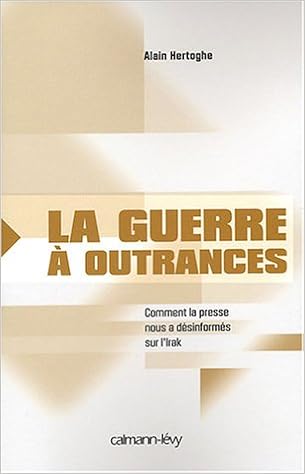
Eskaffit was growing increasingly more vocal in asking/telling me to keep quiet (shades of Chirac?) — he claimed that "de toutes façons", nobody could hear me — so seeing the end approaching (and having a hard time competing against a microphone), I pulled out my final ace — the final ace being a book, which I held above my head. (Yes, there did seem to be a somewhat theatrical element to this scene; why do you ask?) "Et en matière de mensonges, il y a ce livre d'un rédacteur de La Croix, qui a été licencié pour l'avoir publié, qui s'appelle Comment la presse nous a désinformés sur l'Irak. Et qui raconte les partis pris des Français pour diaboliser Bush, pour sanctifier Chirac, et pour communier avec les partis de la 'paix'."
[Translation: "And in terms of lies, there is this book by an editor of La Croix, which is called How the Press Disinformed Us on Iraq, and who indeed was fired for publishing it. And who details the bias of the French to demonize Bush, to sanctify Chirac, and to commune with the 'peace' parties."]
Even a few audience members had by now started to tell me to keep quiet, but that seemed an appropriate place to end anyway, so with that I sat down.

As for Eskaffit, he went on talking to the intervenants… ignoring completely what I had said. (While a couple of people behind me asked to see the book.) Well, I felt I had done my blogger's duty, so to speak, so I sat back, pretty content with myself.

Then, as Junqua made his last remarks, I understood that some people had heard me; the RSF moderator surprised me by pulling out his own copy of Alain Hertoghe's book (which he had in his briefcase), and explained that it provided a negative view of the French media during the Iraq war. But then he added that there was another book, detailing the French press's doings during the first Gulf war, with a positive slant, and that one could not read the first book without comparing it to the second. He tried to conclude that Hertoghe's book was a partisan "brûlot" that was not very friendly to his colleagues. (This from a colloque which had just declared that, happily, the old tradition in the press of refusing to criticize one's colleagues had now become "caduc"!)

I wasn't going to let him get away with that as the final word, so I let out another comment: "Les médias ont complètement censuré ce livre!" (But Eskaffit immediately started interrupting again.)
 [Translation: "The media thoroughly censored this book!"]
Afterwards, I went up to speak to some of the intervenants. Wells asked to see Hertoghe's book, which he wanted to check out. As for Junqua, he admitted it was news to him that the La Croix editor had been fired as a result of the book's publication.

So, all in all, a satisfying 10 minutes. (But hardly worth doing again, not at that distance. At least not without a couple of chums to have a drink with, afterwards.)

P.S. This is my first post for ¡No Pasarán! Muchas gracias, amigos, for inviting me to participar.

Sunday, March 24, 2019

15th Anniversary of My First Post for No Pasarán

A few weeks after the founding of No Pasarán, 15 years ago, I was invited to join as the blog's fourth blogger (after Douglas, Jonathan, and Liminal aka U*2, and prior to N Joe).

The blog's inaugural pledge was that we
 "will commentate on current events with all the psychotic calm and serenity of a Palestinian father who explains that he can't wait for his 2 surviving sons to become martyrs"
Of the more than 13,000 posts that have been written since 2004 (13,362, to be exact, as of today), I consider the following couple of posts to be two of the most important:
• The Era of the Drama Queens: Every Crisis Is a Triumph
• The Leftist Worldview in a Nutshell: A world of Deserving Dreamers Vs. Despicable Deplorables
Today is the anniversary of my first contribution (thanks to Ed for the Instapundit link), which related how I attended a conference in Normandy (at a museum linked to the D-Day landings, no less!) with some of France's best-known journalist VIPs and how I rose to challenge the group on the French media's coverage of the Iraq conflict.

Wednesday, March 24, 2004


Growling for Colombani

Any of you who have seen me over the past 10 days knows how furious I get anytime I read or hear the French media trying to stuff down our throats their self-serving lying charges (those against Aznar, Bush, and Blair, i.e., anybody whom they don't feel any sympathy with).

So when I read that the Mémorial de Caen was organizing a conference with Jean-Marie Colombani, among others ("QUELLE LIBERTÉ POUR L'INFORMATION DANS UN MONDE INQUIÉTANT ?" [What freedom for information in a distressing world?], organized in tandem with Les Amis de l'hebdomadaire La Vie and Reporters sans Frontières), I knew I had to attend. I wanted to give Le Monde's director a piece of my mind (in a diplomatic manner, natch). Three hours before it started at 7 pm on March 23, 2004, I jumped into my trusty jalopy, and drove the 260 km to Caen, arriving just in the nick of time.

And sure enough, the first thing any of the five intervenants did (with a constant wry smile on his face) was to attack the lies of politicians, ridicule the partisanship of the media, and bemoan the jingoism of the population (meaning those of the US, the UK, and Aznar's Spain exclusively, bien sûr). It was Jean-Marie Charon, "Sociologue des médias" (whatever that means), who opened the débat — the others being (left to right on the admittedly unclear photo) Colombani, Walter Wells, Directeur de l'International Herald Tribune (beard), Jean-Jacques Lerosier, Grand reporter à Ouest-France, and Jacqueline Papet, Rédactrice-en-chef de RFI, with the moderators answering to the names of Daniel Junqua, Journaliste et Vice-président de RSF, and Jean-Claude Escaffit, Journaliste à La Vie et Directeur des Amis de La Vie.

Before I left Paris, I'd reviewed and written down (in telegraph-style) a handful of arguments: these ranged from the Iraqis quoted in Reason, on Iraq the Model, and in Le Monde itself, to Doug's post on Le Monde's partisan mistranslation of Michael Ignatieff's piece in the New York Times.

The only problem was a rather big one, I learned as a I headed for my seat: questions would not be permitted, except in written form on small pieces of paper handed over to one of the animators. So I knew I had to pay close attention if I wanted to find an appropriate moment when to jump in. And I would obviously not have time to develop any of the arguments (especially since Eskaffit seemed to be a control freak).

It happened towards the end. There was a brief lull as Wells was about to make his last extensive remarks. Suddenly everybody turned to me as I let out : "Je pense que nous devons tous remercier les médias français pour leur admirable abilité à détecter les mensonges. Mais je ne comprends pas pourquoi ces spécialistes en la matière ignorent des sujets qui ont été traités dans le Herald Tribune, par exemple." (This was punctuated by Eskaffit's protests on his mike, you realize.) "Nous avons pu y lire des articles détaillant ce qu'on pourrait taxer de mensonges dans le camp de la paix, comme le fait que les Allemands, les Russes, et les Français avaient pas mal d'affaires avec les autorités baasistes, et que Total devait avoir un contrat exclusif avec Saddam Hussein. Pourquoi les médias français n'en font-ils pas autant état que de ce qui concerne les Ricains, les Rosbifs, et les Espagnols?"
[Translation: "I think we should all be grateful to the French media for their admirable ability to detect lies. But I do not understand why these experts in the field are ignorant of topics that have been covered in the Herald Tribune, for example." (This was punctuated by Eskaffit's protests on his mike, you realize.) "We have read articles detailing what could be taxed as lies from the peace camp, such as the fact that the Germans, the Russians, and the French had quite a lot of business dealings with the Baathist authorities, and that Total had an exclusive contract with Saddam Hussein. Why don't the French media make as much fuss about that as about the Yanks, the Limeys, and the Spaniards?"]
Eskaffit was growing increasingly more vocal in asking/telling me to keep quiet (shades of Chirac?) — he claimed that "de toutes façons", nobody could hear me — so seeing the end approaching (and having a hard time competing against a microphone), I pulled out my final ace — the final ace being a book, which I held above my head. (Yes, there did seem to be a somewhat theatrical element to this scene; why do you ask?) "Et en matière de mensonges, il y a ce livre d'un rédacteur de La Croix, qui a été licencié pour l'avoir publié, qui s'appelle Comment la presse nous a désinformés sur l'Irak. Et qui raconte les partis pris des Français pour diaboliser Bush, pour sanctifier Chirac, et pour communier avec les partis de la 'paix'."
[Translation: "And in terms of lies, there is this book by an editor of La Croix, which is called How the Press Disinformed Us on Iraq, and who indeed was fired for publishing it. And who details the bias of the French to demonize Bush, to sanctify Chirac, and to commune with the 'peace' parties."]
Even a few audience members had by now started to tell me to keep quiet, but that seemed an appropriate place to end anyway, so with that I sat down.

As for Eskaffit, he went on talking to the intervenants… ignoring completely what I had said. (While a couple of people behind me asked to see the book.) Well, I felt I had done my blogger's duty, so to speak, so I sat back, pretty content with myself.

Then, as Junqua made his last remarks, I understood that some people had heard me; the RSF moderator surprised me by pulling out his own copy of Alain Hertoghe's book (which he had in his briefcase), and explained that it provided a negative view of the French media during the Iraq war. But then he added that there was another book, detailing the French press's doings during the first Gulf war, with a positive slant, and that one could not read the first book without comparing it to the second. He tried to conclude that Hertoghe's book was a partisan "brûlot" that was not very friendly to his colleagues. (This from a colloque which had just declared that, happily, the old tradition in the press of refusing to criticize one's colleagues had now become "caduc"!)

I wasn't going to let him get away with that as the final word, so I let out another comment: "Les médias ont complètement censuré ce livre!" (But Eskaffit immediately started interrupting again.)
 [Translation: "The media thoroughly censored this book!"]
Afterwards, I went up to speak to some of the intervenants. Wells asked to see Hertoghe's book, which he wanted to check out. As for Junqua, he admitted it was news to him that the La Croix editor had been fired as a result of the book's publication.

So, all in all, a satisfying 10 minutes. (But hardly worth doing again, not at that distance. At least not without a couple of chums to have a drink with, afterwards.)

P.S. This is my first post for ¡No Pasarán! Muchas gracias, amigos, for inviting me to participar.

Saturday, December 28, 2024

Food for Thought About Canada: Should America Have a 51st State? 52 States? Or a Total of 60? How About Just the Current 50?


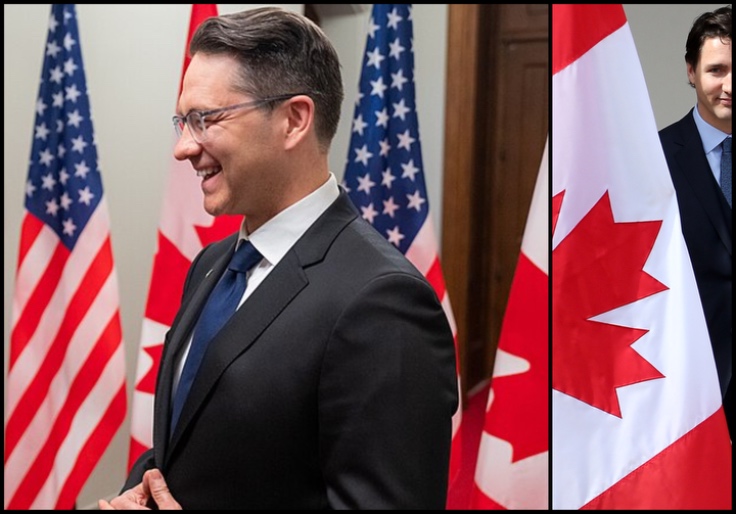
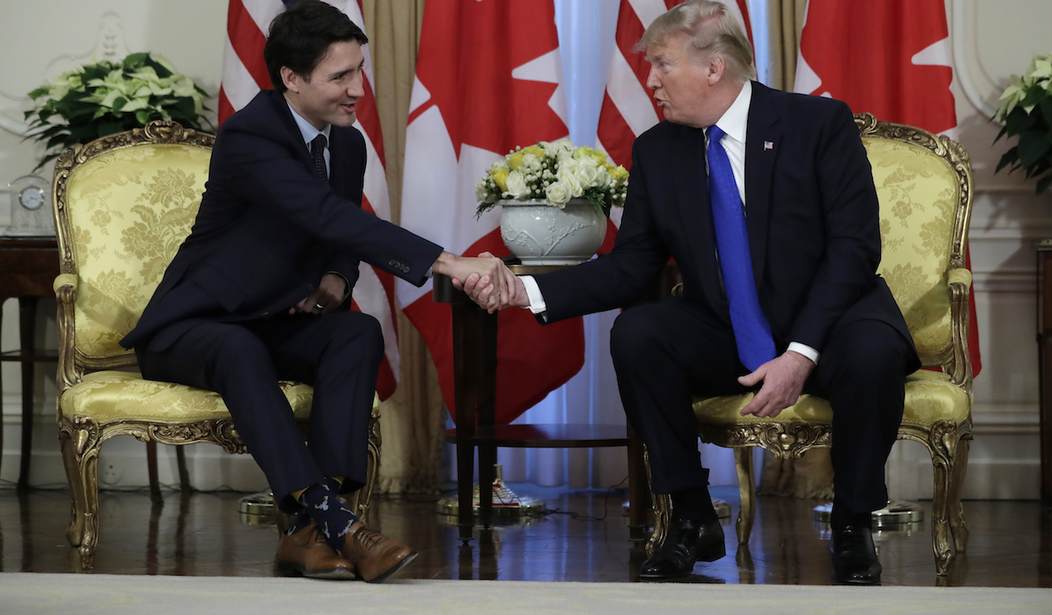
So Donald Trump has trolled Justin Trudeau, suggesting to the Canadian PM that his country become America's 51st state, one which he in turn could become the governor of.

Excluding more expansionist rhetoric, regarding Greenland and the Panama Canal (and as the Washington Free Beacon declares its 2024 Man of the year to be the Conservative Party's Pierre Poilievre (thanks to Instapundit's Ed Driscoll, eh?)), the thing about Canada is that it is a (con)federation of 10 sub-units (called provinces) in the same way that the U.S.A. is a (con)federation of 50 sub-units (called states).  

An Old Glory with extra stars
— via AI Magic Media
If Canada should be annexed, should it be as a single state/province, leading to an American total of 51, or as 10 states/provinces, leading to a total of 60 states in the newly enlarged nation?

There is much thought to be given to the matter. 

I actually gave it some thought decades ago, right after college, when I tried imagining what the new American flag might look like: should the Stars and Stripes be 60 stars or — what follows I knew was far-fetched — 50 stars plus 10 star-sized maple leafs on the bottom line of the canton?

It has been common throughout history to talk about Britain's 13 colonies in America, and all of said colonies uniting to become independent. This ignores that George III actually had 15 colonies in all, the 13 below the Saint Lawrence River, plus two above, then called Upper Canada and Lower Canada. The latter admittedly had a very different history, the former Nouvelle France being a conquered territory (and a conquered foreign people with a different language) by Britain a decade prior to the unrest further South. Being former subjects of the French Crown, why did Québec not join the 13, then? Should they not have the most fervent of les Américains resisting the hated roi des Anglais?

Many history scholars and teachers whom I asked this question to hummed and hawed. appearing to never have given a thought to the matter. The answer, I eventually fount out, were that the Québecois were Catholics and apparently, they trusted more in their British overlords than in the mainly Protestant radicals and hotheads of the lower colonies.

I wondered how history had been different had the 1775 invasion of Québec been successful, or had Britain's 14th and 15th colonies agreed to join the continental congresses in the early 1770s and agreed to provide a single united North American continent (down to Spain's Mexico border, anyway). How would the first half of the 19th century been different? Would the Civil War "four score and [about] seven years" years later — had it erupted at all — have been shorter, had the president (Abraham Lincoln or another commander-in-chief?) not needed to worry about an invasion from Queen Victoria's British America?

(An aside from down South: after the Mexican War, the U.S. annexed more than half of Mexico; however, there were plans in 1847 and 1848 to annex even more territory, with not the Rio Grande river serving as the U.S./(rump) Mexican border but the Sierra Madre mountain range. Anyway, the full name of the country is the Estados Unidos Mexicanos and if the 31 United Mexican States (plus the DF equivalent of DC) were also to join the US of A, it might lead to 81 stars on Old Glory, or along with Canada's provinces, 91.)

Population & Area

If Canada were to join as a single state, it would be far from a pushover; its 41 million inhabitants would surpass California's 38,000,000 as the most populous state of the (enlarged) Union. It would also — easily — become the largest state by area. Indeed, as the second-largest country on the planet by total area, the Great White North joining the U.S. would make the enlarged union jump to largest country on Earth, with its total 7.39 million square miles (19.3 million square km) surpassing Russia's 6.6 million square miles (17,000,000 square km).

Reminder: back in 1960, when Alaska became the largest state in the Union, some of The Last Frontier's inhabitants enjoyed provoking the previous largest state, Texas, telling its (very) proud citizens that their state (Alaska) was so much larger that they could split it it in two, making the Lone Star State only the third largest in the Union. By comparison, Canada might split into five, making Alaska the sixth-largest state and putting the proud Texans into (a humiliating?) 7th place.

But the fantasy of splitting Canada into five does not take into consideration that — as mentioned — the country is already split into 10 provinces — not to mention three territories.

Danger: Leftists Galore

The danger of having/asking/requesting (?) the 10 provinces join is that the second-most populous province (among others?) might not want to join at all. There are fewer more anti-American people on this planet than the Quebécois, proud to the Heavens of their French language and heritage, going so far as regularly lecturing the French population on the matter. 

Having worked for the Québec government in a Dallas office as my first summer job — it was a standing requirement that the name of the province always be written with its French accent, whatever the language (English or other) it was written in (as you can see in this very post).  With support from France, sometimes — notably when Charles de Gaulle shouted "Vive le Québec libre!" during his 1967 tour, leading him to cut his state visit short — the Québecois regularly hold referendums about splitting from the rest of English-speaking Canada and becoming independent.

The last time Quebec (no accent here for Search Result purposes) tried this, in 1995, I wrote about it in The Globe and Mail (an upgrade of a 1992 text in the International Herald Tribune), which got me a trans-Atlantic call from a Canadian radio station (since they would be interviewing a foreign observer in Paris), where they had trouble believing my view that the French population did not seem that interested in the issue at all.

The danger of having Canada join at all, whether as one or as 10 (9?) sub-units, is the leftist mentality that dominates (the media being worse than America's, as observed, say, during the truckers' Covid revolt).

Twenty years ago, indeed, the Canadian sanctimocracy ("rule by the holier-than-thou") was described during the Iraq War as a nation crippled by a dishonest pacifism, while No Pasarán quoted the International Herald Tribune as saying that Because Canadian Mentality Is Closer to That in Europe, They Are More Generous and More Security-Conscious than Dollar-Hungry American Capitalists Are.

The following year, in March 2005, one Michael Coren wrote in the Toronto Sun that it pained him to say it, but

I'm so very tired of the way … that we Canadians have come to define ourselves not by who we are but by who we are not. … With a malodorous stew of ignorance and malice, [publicly funded mediocrities screaming abuse at a great and noble nation] pump Canada at the expense of deflating the United States" 

The writer's mailbox was soon overflowing, with 1,000 letters from Canadians of all backgrounds and ages. To Coren's delight, over 90% "wrote to say that I had spoken for them."

Unsurprisingly, the remainder, filled with insults such as "collaborationist, double-crossing fifth columnist, fraternizer, quisling, saboteur, security risk, subversive traitor, treasonous turncoat, two-timing quisling", only served to prove… exactly what Coren had written the previous week, "deliciously [illustrating] Canadian hypocrisy and self-delusion": 

We flatter ourselves into a false sense of grandeur by flippant assumptions of our own tolerance and liberalism. 

 … Goodness me, I'm as bad as the Norwegian fascist who sold his country to the Nazis because I wrote that the United States is not the ugly bully so many Canadians make it out to be.

 … Conclusion? The chauvinistic neurosis of the Canadian liberal is in many ways even more repugnant than the insularity of some Americans. 

Back to the 2024 meeting at Mar-a-Largo: PJMedia's Robert Spencer mentions that

Someone at the meeting, according to Fox News, then warned Trump that as a state, Canada would be deep blue, whereupon Trump suggested it become two states, a leftist one and a patriotic one.

So, according to Donald Trump, that makes neither 51 nor 60 (59?), but a total of 52.