Showing posts sorted by date for query New York Times. Sort by relevance Show all posts

Wednesday, July 22, 2026

I Hate Being the One to Ask This, But… Where Are the Pictures of Gaza's Dead Palestinians?


I'm probably going to get in trouble for this — another Google ban? — but… I'm sorry, the question needs to be asked, and somebody needs to ask it: Where are the photographs of Gaza's dead Palestinians?

Remember the Gaza kid who was allegedly malnourished and starving "because of" Israel's inhumane policies? Didn't Mohammed Zakaria al-Mutawaq's photo and story immediately show up in the New York Times and everywhere else?

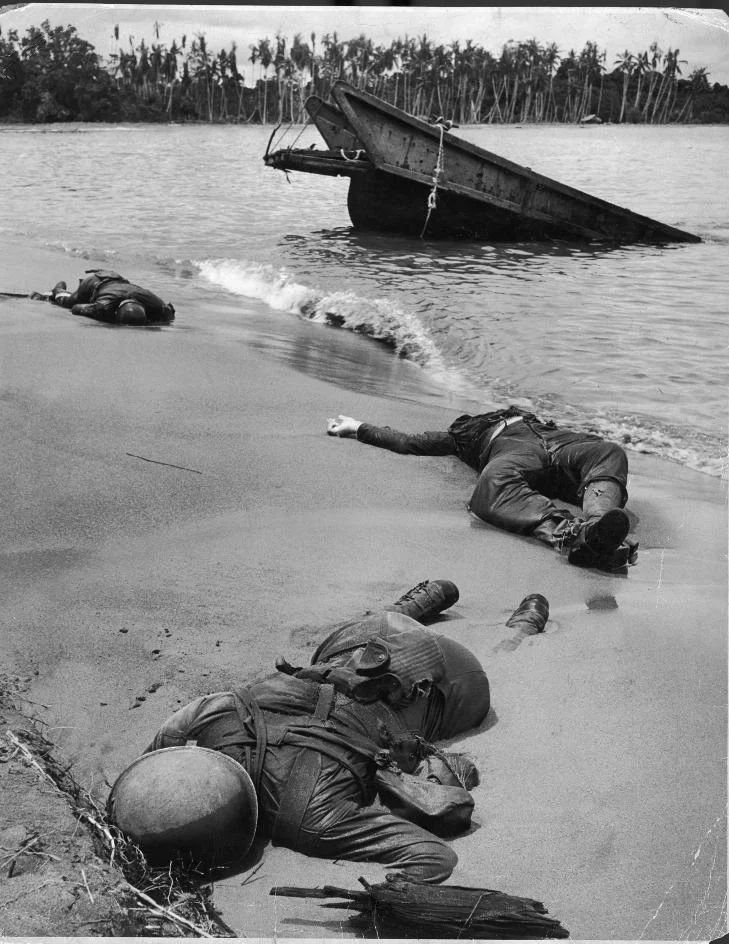
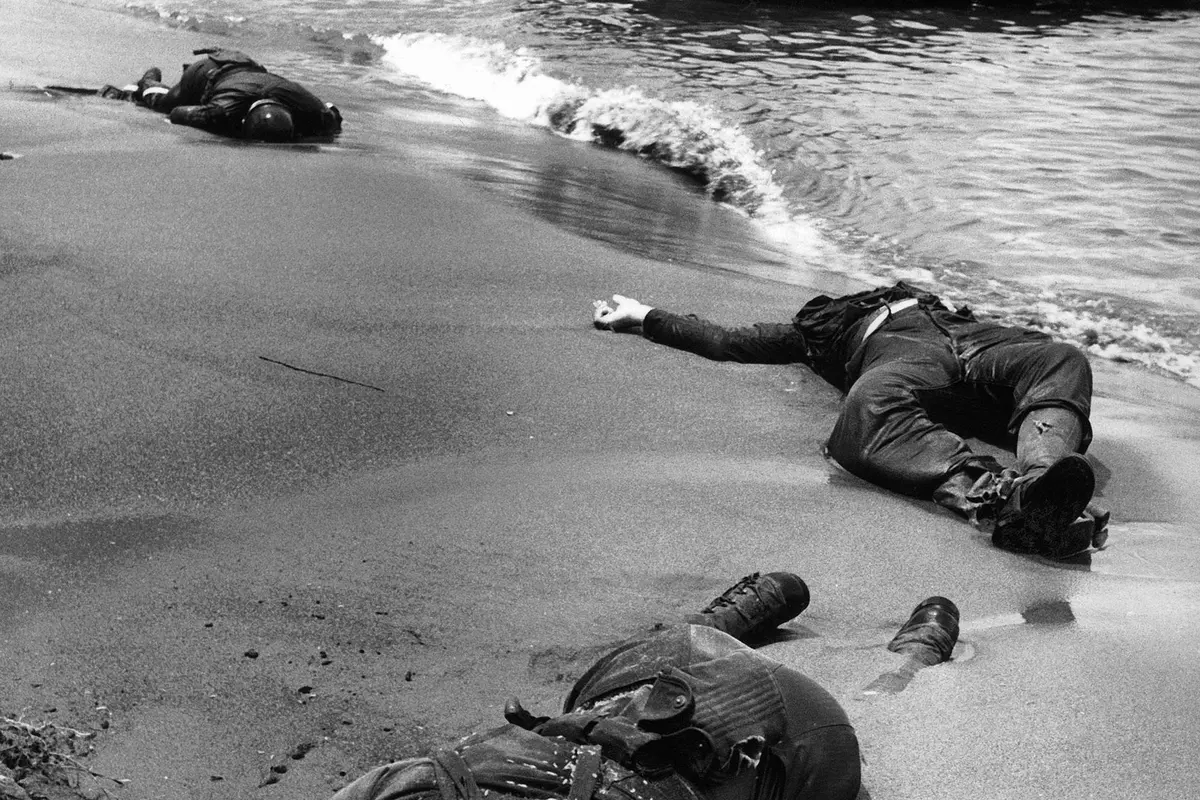
Above is the first photo of American dead to appear in America during World War II — a conflict in which the USA participated without much controversy, i.e., without protestors, hysterical radicals or other types, clamoring one way or another.

If, in Zohran Mamdani's words, it is true that 

Benjamin Netanyahu is a war criminal, the architect of a horrific genocide against the Palestinian people. He is responsible for the killing of more than 73,000 people, for the maiming of tens of thousands of children 

— then you don't have to be a hysterical propagandist in Palestine or even a dishonest one, to think as follows: "Why not set up, say, 20 of the myriad of corpses, or 50, or 100, either in a morgue or among the ruins of the city, and invite in the international press corps? Let the world see the war crimes of the Israelis!"

In fact, if in the New York mayor's words, "the UN confirmed that Palestinian children continue to be deliberately targeted and killed by Israeli armed forces", why not up the ante and have the 20/50/100 corpses be exclusively of… Palestinian kids?! (Certainly, in all cases — dead adults and/or dead children — the photos should be blurred — especially if the cadavers display horrific wounds — but the question remains.)

When Zohran Mamdani mentions "the devastation he [Netanyahu] has wrought", what we see are ruined buildings — indeed, smoldering cityscapes — which remind people, whatever their leanings, of World War II — here we go back to the 1940s again — when carpet bombings led to thousands of dead civilians.

But as far as Gaza is concerned, do we ever seem to see a single corpse? 

The prime minister's office in Jerusalem states that

Under Prime Minister Netanyahu's leadership, Israel has taken unprecedented wartime measures to minimize harm to civilians while confronting Hamas, a genocidal terrorist organization that uses Palestinians as human shields and deliberately targets innocent Israeli civilians  

Could it be that the IDF's boast to keep the casualties down as best as possible is not propaganda but explains the dearth of bodies? 

Tuesday, July 07, 2026

NYT: How to Celebrate America’s 250th Birthday in the Country It Broke Up With


 … remnants of the American Revolution can be found all over London, including Benjamin Franklin’s living room and an original 1776 print of the Declaration of Independence

writes  from 21st century London in a historical tourism piece for the New York Times, with on, on "the topic of the American Revolution — or, as it is often called on the other side of the ocean, the U.S. War of Independence": How to Celebrate America’s 250th Birthday in the Country It Broke Up With. (Stateside, provides A Summer Travel Checklist for America’s 250th Birthday.)

Here’s how you can follow the footsteps of some of America’s notable founders and celebrate the country’s 250th birthday this summer in London. …

It was in London that Benjamin Franklin, one of America’s most famous founders, turned into a revolutionary. From 1757 to 1775, he lived in a terraced Georgian house at 36 Craven Street, near Trafalgar Square.

He came to London as an unofficial diplomat to resolve a tax issue between the provincial government and the Penn family, who governed Pennsylvania, but soon turned into a popular figure around town.

“He really valued being at the heart of the British Empire,” said Megan King, a historian at Benjamin Franklin House, now a museum. “Franklin came as a royalist and left a revolutionary.”

 … If you find yourself in London around the Fourth of July, there are multiple ways to celebrate America’s 250th birthday. You can listen to a Great American Songbook concert in a church in southeast London, learn about the science of fireworks by an American chemist or hear historians at the British Library discuss how the world made the American Revolution. And for an even bigger party: London’s annual Pride Parade in Central London falls on July 4 this year. 

The war was a divisive issue in 18th-century London, according to Jerry White, a British historian. Merchants wanted to “avoid the war at all cost,” he said.

“It was a very disruptive moment for London’s trade,” he added. “And London was a commercial city.”

 … Among other notable opponents of the war was William Pitt, the Elder, a statesman who served as prime minister. He was so staunchly against the war that he proposed an act in the House of Lords in 1775 that was supposed to reconcile Britain and the colonies. He was convinced that a British military victory in America was impossible. (Fun fact: Pittsburgh is named after him.) 

The parlor in the house near Trafalgar Square where Benjamin Franklin lived 
from 1757 to 1775
. He was better known as a scientist than as a diplomat in London.


Monday, June 22, 2026

James Fenimore Cooper, 2 Centuries Ago: “the American press is the pest of society, the bane of decency, the perverter of truth, and the pander of crime”

As the 1826 novel The Last of the Mohicans turns 200 this year, it is worth our salt to head to the New York Times in order to check out the  book review of Alex Wright's EMPIRE OF INK: The Printers, Rogues, and Radicals Who Invented the American Newspaper. (Thanks for the Instalink, Sarah.)

Empire of Ink

Her New York Times review, titled A Spunky History of Newspapers Adds Color to the Black and White, of this "unsentimental history of the American newspaper from the Revolutionary War to the beginning of the 20th century" shows how, already two to three centuries ago, "newspapermen were held in low repute" (and how!) 

Besides Samuel Clemens, a.k.a. Mark Twain, a number of classic authors are mentioned in the review as well as in the book. What they thought about the press and how they fought back, in writing as in deed, can be described as far stronger than any railings and any comebacks Donald Trump has undertaken against "fake news." 

Charles Dickens, a former reporter … whose books were hugely successful in serial, found the American penny papers “so filthy and so bestial that no honest man would admit one into his house, for a water-closet door-mat.” The hero of his “Life and Adventures of Martin Chuzzlewit” is confronted with self-important scandal sheets like The New York Sewer and The New York Rowdy Journal.

James Fenimore Cooper filed 14 libel suits against various newspapers, all of which he won, and declared that “the American press is the pest of society, the bane of decency, the perverter of truth and the pander of crime.” (He would fit right in on Threads.)

Edgar Allan Poe once challenged the editor of The Richmond Examiner, a defender of slavery who’d written about Poe’s rumored affair with a local widow, to a duel. The poet showed up too drunk to fight; they repaired to a tavern and became lifelong friends.

 
The "water-closet" that Dickens mentions is of course a toilet (WC). As far as Poe is concerned, who can deny they wouldn't love to see a duel between Donald Trump and George Stephanopoulos? (Pistols or sabers?) 

If the internet is to be believed (and I'm sorry, I don't remember exactly where I got this particular meme from), Hunter Thompson said something quite similar in the 20th century…

Friday, May 29, 2026

Spain's Zapatero: Another Compassionate Leftist's Welfare Heroics Prove to Hide a World of Scamming, One of Hardly Believable Magnitude

It turns out that another one of Europe's patented humanists, a compassionate leftist who doubled as a valiant foe of ths United States, proves to be little more than a scammer, one of hardly believable (i.e., of criminal) magnitude (gracias a la Señora Sarah Hoyt de Instapundit). Washington Examiner's Jose Lev Alvarez breaks the story:
Spain’s National Court made history last week by placing former Socialist Prime Minister Jose Luis Rodriguez Zapatero under investigation for allegedly leading a criminal network engaged in influence peddling, money laundering, document forgery, and related offenses. 
(Filed in the Rules for thee, but not for me department.) Do you remember how Zapatero won his (dubious) victory as prime minister in the first place? Besides a horrific terrorist action that killed or injured 2600 people, anti-Americanism — and betrayal of the White House (in time of war) — was central to the socialist's victory (details below).
 … Investigators are also examining alleged links to Venezuelan regime money tied to PDVSA oil schemes and the CLAP food program, whose corruption devastated ordinary Venezuelans. … This scandal reveals Zapatero as one of former Venezuelan dictator Nicolas Maduro’s most valuable international assets. 
 
 … Zapatero’s alleged ownership [of the Orinoco Mining Arc gold mine] implicates him in [an] ecological and humanitarian catastrophe. 
 
 … As prime minister, Zapatero supplied Iran with dual-use technology and authorized Spain’s largest-ever arms export 
 
 … The scandal indicts Spain’s Socialist establishment. As Prime Minister Pedro Sanchez’s government faces its own corruption controversies, Zapatero’s exposure underscores how “dialogue” and “progressive” internationalism [not to mention heroic anti-Americanism] can conceal both personal enrichment and willful blindness to dictatorship. 
I often say that the dream of the world's leftists is to make a world where all citizens are de facto welfare recipients (an update from the serfs and the peasants that they used to be during feudalism and in prior eras). 
 
This, far from incidentally, in turn explains why there is so much anti-Americanism in the world, since statists in the United States as well as in the rest of the world are enraged that Americans (i.e., common citizens) made a rich and successful country with the minimal involvement of politicians and bureaucrats — and not only that but indeed made it the richest and the most successful country on the planet.
 
Spain — and "the mafia that governs" the country  — provides one heck of a perfect example of that. Recall how Zapatero became Spain's prime minister in the first place. In August 2004 (most 2004 hyperlinks now broken), the International Herald Tribune's John Vinocur went back over his (dubious) victory while characterizing the mindset of the European press perfectly: "its logic running that since intelligent Europe hates [George W Bush] so, how could any decent, non-fascistic American contemplate voting Republican?"

José Luis Rodríguez Zapatero, Spain's prime minister, says he does not want to talk about Islamic terrorism. … "I never talk about Islamic terrorism, but international terrorism," Zapatero told Le Monde in an interview marking his first 100 days in office.

A couple of background details enter here. Zapatero's Socialists got elected in March after a murderous Madrid railway station bombing that was undoubtedly planned by Islamic terrorists to affect the election's outcome. An extreme long shot before the attack, the Socialists had campaigned on the theme that Spain would pay for José María Aznar's backing of the United States in Iraq. …

A bit like newspapers that avoid the word "cancer" in obituaries with the explanation that they are sparing sensitive readers, [the secularist] Zapatero is keeping Islamic fundamentalists out of the discussion of terrorism because, he says, Islam is a religion with hundreds of millions of followers "which, like all the religions in the history of humanity, involves an element of religious fanaticism."

The IHT's John Vinocur went on to describe Zapatero's first actions when the new PM reached La Moncloa, Spain's government house.
The detoxed Spain of José Luis Rodríguez Zapatero, it was pledged, was going to rush back into the family-like warmth of the European Union, and rush home its troops from Iraq. In a whoosh, it would rejoin the community of the just, and end what the new Socialist government called the country's miscast role as superpower-adjunct of the Americans.

Promise keepers, the new guys did what they said they would in their first full week on the job. For which they got something short of an international standing ovation.
Four years after his defeat, the incumbent José Maria Aznar, a vibrant supporter of Bush, had the following to say about the 2004 elections:
Frankly, the left exploited this tragedy. … All the polls were clear: without these attacks, which the left capitalized on, we would have won the elections. What's terrible is that instead of blaming the terrorists, they blamed the government! 
 
 … every day, it becomes clearer that the terrorists achieved their objective: to manipulate the electoral process. This is a crucial point for all democracies to consider—insofar as this phenomenon risks recurring. The decision to withdraw Spanish troops from Iraq, which was made in violation of Spain's international commitments and the promises Mr. Zapatero himself had made during the election campaign, was considered by the terrorists to be a significant victory. And when terrorists achieve a victory, they become stronger… 
 
If you ask me if Chamberlain resembles Zapatero, I would answer… that Chamberlain had more depth and even more courage than Zapatero! Indeed, after having collaborated with the Nazis, Chamberlain, at least, had the courage to leave with dignity. 

By standing up to the accursed Republican in the White House, Zapo, also known as Bambi and (on this blog) as El Zap and el caniche de Chiraque, was described as a totemic figure for the Spanish left, who, like his successor Pedro Sánchez, was/is hailed as a humanist champion, another paladin in Europe's pantheon of heroes giving lessons on civility and compassion and peace-making and humanity to America's neanderthals.
 
But also to Europe's neanderthals, it turns out: Likewise blinded to any problematics associated with Islam, Pedro Sánchez (following in the footsteps of Tony Blair and duly lionized in the New York Times for being "Trump's nemesis") has allowed half a million illegal aliens in Spain, many of them Muslims, to become regularized. At a Podemos party rally in Zaragoza, to "chilling" applause, a drama queen like Irene Montero bellowed at the top of her lungs: 
“We have obtained papers and regularization. And now we are going to go for citizenship or change the law so that they can vote, of course. Hopefully, replacement theory, hopefully we can rid this country of fascists and racists with migrants, with working people.”  
Cross the Atlantic: As California and other states seem to be heading in the direction of fraud-soaked Minnesota (the home for many Scandinavian immigrants in the 19th century), it appears that the various welfare systems throughout the American nation might be little more than a scam.

But for the statists, American and foreign alike — whether they turn out to be true believers or hypocritical conspirators — the international situation is far worse than that.

In view of the fact that the global left's major talking point — that leftists like the Democrats and all the Socialist-leaning Europeans — are far more tolerant and compassionate than the egotistical brutes in the capitalistic United States (or, at least, then the neanderthals of America's Republican Party), it would be highly problematic if the welfare systems throughout the rest of the West — and the rest of the world — proved to be a scam as well.

That is what might be happening in the region — Scandinavia — whose countries are often lauded as the very top model of a healthy government and a healthy nation. Certainly, Norway's reputation for honesty and humility, for good governance, and for “least corrupt in the world” rankings has been taking broadside after broadside in the wake of the Epstein Scandal.

And if Norway turns out to be so filled with (for want of a better word) corruption, can Sweden and Denmark be far behind?
 
At this point, a final question that comes to mind is: What is the international left (not excluding America's Democratic Party) if not a cult of irresponsibility filled with drama queens, Sophomoric Teens, Intrepid Cosplayers, and Would-Be Heroes?
 

Monday, May 18, 2026

A 1930s MSM Myth About Clark Gable; + Mysteries You Never Asked Questions About Dept.: The History of the Undershirt


According to legend, when Clark Gable removed his shirt in Frank Capra's It Happened One Night (the film that would relaunch the star's career and the first to win all five main Academy Awards at the Oscar ceremony), revealing no undershirt but a bare chest, it led to a precipitous fall in sales for the undershirt industry. Except for one thing: according to Cliff Aliperti, it seems to be another drama queen myth:

 … the legend has never been verified … The disappearance of the undershirt is never reported in the business columns, just on the entertainment pages. 

Now, here is one mystery you probably never asked a single question about: To the question of a reader who did do so, wondering "why the ribbed undershirt has become the ubiquitous garment of the moment" and asking Why Are So Many Men Wearing Tank Tops?,  proceeds to provide an answer in the New York Times regarding the garment's birth: 

a brief history of the undershirt is in order.

The “marcel undershirt,” as it was originally known, was born in the 1860s when French dockworkers decided to cut the sleeves off their sweaters for relief from the heat. Les Établissements Marcel, a knitwear company, took note and began selling ready-made versions of the style.

Those styles made their way into the American wardrobe in World War I, when U.S. troops in Europe encountered the tank top and realized its potential as a garment to wear under their wool uniforms, and it was officially adopted by the Navy. By World War II, it was a ubiquitous part of military garb.

While the Army was embracing the tank top, so too was the athletic world. Indeed, the “tank” part of tank top is a reference to early-20th-century swimming pools, which were called swimming tanks, and the tank top made its debut as part of the swimming costume of female athletes from Australia, Britain and Sweden in the 1912 Stockholm Olympics.

From there, the shirt made its way into the mainstream, imbued with associations of physicality, strength and a certain gritty reality. By the time Marlon Brando and James Dean were plastered all over the silver screen smoldering rebelliously in their white tanks, it had reached iconic status — and its cartoonish masculinity was ripe for subversion and appropriation. (That aspect of the tank top never went away. See Bruce Willis in “Die Hard,” Hugh Jackman in “Wolverine” and Angelina Jolie in “Lara Croft: Tomb Raider.”) 

But not Clark Gable in “It Happened One Night.”

Sunday, May 03, 2026

The CIA's Anti-Democratic 1953 Coup in Iran? What Nobody Tells You About America's Alleged Overthrow of the Shah's "Democratically-Elected" Prime Minister Mossadegh

The Iranian tragedy did not begin in 1953. It began in 1979 

Well, what do you know? Another "well-known historical fact" turns out to be nothing but fake news or, if you prefer, leftist re-writing of history. Over on X Twitter, Ole @DerCheapi has penned the post The Mossadegh-Myth: A coup that never happened. The original title in German ("Die Mossadegh-Lüge: Ein Putsch, der keiner war") calls it The Mossadegh Lie.

Some stories have been told so often that nobody asks anymore whether they are true. The story of the CIA coup against Mohammad Mossadegh is one of them.
It goes roughly like this: In August 1953, the CIA and MI6, acting on behalf of American and British interests, overthrew Iran's democratically elected prime minister. They installed the Shah as a puppet. In doing so, they destroyed Iran's democratic future and laid the groundwork for the Islamic Revolution of 1979, for anti-Americanism, for the mullahs, for everything that has gone wrong since.
Over the past few decades, this narrative has hardened into a Western dogma. It appears in school textbooks, in mainstream American journalism, and in the memoirs of those who shaped U.S. policy. The New York Times, CNN, and the BBC (well well well) have canonized it as the original sin of Western Middle East policy. Hollywood took up the same script: Ben Affleck's Argo (2012), winner of the Academy Award for Best Picture, opens with a three-minute animated prologue walking the audience through 1953 as the inciting cause of everything that followed.

 … Here in Germany, the chorus is no quieter: Olaf Scholz recently declared that the entire Iranian dilemma traces back to the British and American overthrow of Iran's democratic government, without which Iran would today be "a very successful Western country." … Even the German "Federal Agency for Civic Education "calls 1953 Iran's "primal catastrophe."

The only problem is: the story isn't true.
Not partially untrue. It isn't a matter of "needing nuance." It simply isn't true.

What Mossadegh Was Not

Let's start with the label that carries the whole thing: "democratically elected."
Mossadegh was not elected by the people. The Iranian Constitution of 1906 made no provision for the direct election of the head of government. Article 46 of the Supplementary Fundamental Laws expressly assigned the appointment and dismissal of the prime minister to the Shah. (1) Mossadegh came into office in 1951 because the Shah appointed him, following a non-binding expression of preference by parliament, in the expectation that the 69-year-old aristocrat would gracefully decline. To the Shah's surprise, he accepted.
This is the precise process that the myth sells as a "democratic election." … Mossadegh was no man of the people. He was a Qajar prince, a descendant of the dynasty that had ruled Iran into a state of chronic weakness for more than a century. Under the Qajars, Iran was not a sovereign state but an object of plunder. In 1907, the Russians and British divided the country contractually into spheres of influence; the economy had been sold off through foreign concessions; the hinterland disintegrated into the hands of local tribal chiefs and warlords; and the central government in Tehran often controlled little more than its own capital. It was precisely this disintegration that produced the Constitutional Revolution of 1906. And it was precisely those constitutionalists who, two decades later, together with Reza Khan, the future Reza Shah Pahlavi, finally toppled the Qajar dynasty in 1925. The Pahlavis, in other words, did not come to power against Iran's constitutional movement but with it, as a response to the failure of the very aristocracy from which Mossadegh hailed. His title Mossadegh ol-Saltaneh, "the one belonging to the monarch," was no nickname but a noble designation from that very order which had been overthrown.

Anyone who declares Mossadegh the hero of Iranian democracy overlooks the irony: the man who fought the Pahlavis was a representative of precisely that old order whose removal had created the precondition for Iran ever to become a modern state at all.

What Mossadegh Did

But surely he was at least a democrat in spirit, right? A man who protected the constitution, respected parliament, preserved the institutions?
No.
In 1952, Mossadegh halted the parliamentary elections for the 17th Majles at the very moment when the number of deputies already elected was just sufficient to make parliament quorate. … he had the Majles grant him emergency powers that gave him the right to govern by decree, initially for six months and then extended by another year. He stripped the Supreme Court of its powers. He took over the Ministry of Defense personally, cut its budget by fifteen percent, dismissed 136 officers, and appointed his own nephew as deputy. …

What the CIA Did (and Didn't Do)

Now to the actual heart of the matter: did the CIA overthrow Mossadegh?
The honest answer is: no. But not because the CIA didn't try. It's because the attempt failed.
Operation TPAJAX was set in motion on August 15, 1953. Colonel Nassiri, commander of the imperial guard, brought Mossadegh the dismissal decree signed by the Shah. Mossadegh, forewarned by Tudeh contacts within the army, had Nassiri arrested. The Shah fled the country. The operation collapsed.

… Ayatollah Kashani, humiliated by Mossadegh, supplied the religious legitimation. The Tudeh Party tore down statues of the Shah, alarming the clergy, who feared a communist takeover. The bazaar shut down. The military marched. …

What Happened with the Oil

The economic argument with which the coup thesis is typically rounded out also doesn't stand up to scrutiny. The usual narrative is that the West overthrew Mossadegh in order to return nationalized Iranian oil to private, Anglo-American hands. In fact, the opposite happened. The nationalization of the Iranian oil industry was not reversed after 1953. The National Iranian Oil Company (NIOC), founded in 1951 under Mossadegh, remained the owner of the reserves, the facilities, and the refinery at Abadan. What changed was the form of utilization.
 … The nationalization for which Mossadegh is venerated as a martyr was thus completed not in spite of, but after, his overthrow.

Who Benefits from the Lie?

That leaves the uncomfortable question: why does this story persist so stubbornly?
Because it offers too much to too many actors to disappear.
It serves the Western left, which after Vietnam needed a vocabulary of American guilt. Iran became the canvas on which "imperialism" could be demonstrated beyond the Southeast Asian defeat. Stephen Kinzer's All the Shah's Men (2003) even derived 9/11 from 1953, a chain of causation so absurd that it works only if no one asks any questions.
The CIA itself also profited massively from this narrative. The events surrounding 1953 were a complete success for both the West and Iran: communist influence was pushed back, looming chaos was averted, and in the following decades up to 1979, Iran experienced one of the most impressive economic developments in its history …

It serves Western politicians who want to stage diplomacy and appeasement with Tehran as atonement for past guilt. Madeleine Albright apologized in 2000. Barack Obama repeated the legend in Cairo in 2009 and in his memoirs. John Kerry negotiated the nuclear deal with diplomats who, schooled in the language of Western self-accusation, played the Mossadegh card routinely whenever the pressure at the negotiating table grew too great.

But no one benefits from it more than the regime in Tehran itself.

Ali Khamenei is dead. The system he embodied for decades lives on, for now, as of the time of this article, and with it the function the Mossadegh myth serves for that system. As long as the world is talking about 1953, it isn't talking about 1979. As long as the supposed CIA coup is being debated, the mass executions of 1988, in which thousands of political prisoners were murdered on Khomeini's orders, are not. As long as Mohammad Reza Shah appears as an "American puppet," the Revolutionary Guards, who since 1979 have been financing terror in dozens of countries, don't have to explain themselves. As long as the West accuses itself, the regime in Tehran doesn't have to face accusation.

The legend of the coup is the most important weapon of the Islamic Republic. Not its missiles. Not its proxy militias. Not even its nuclear program.
But a story the West tells itself, and which the regime listens to, comfortably leaning back.

What This Means for Us

In January 2026, an estimated tens of thousands of Iranian demonstrators died under the gunfire of their own security forces. Eyewitnesses reported hundreds of corpses in the streets. The regime shut down the internet so that the world could not watch.
In that very moment, German politicians, talk-show intellectuals, and public broadcasting correspondents were declaring that the real key to understanding Iran lay in a 73-year-old event that, in truth, did not happen the way they retell it. They did so in the conviction that they were saying something enlightened.
That is the real scandal. Not that the story is told incorrectly. But that it is told incorrectly at the very moment when the victims of this regime are dying in the streets, and that the lie covers, of all people, those who pulled the triggers.

Not merely that, but because every repetition of this lie is a slap in the face of those Iranians who, since 1979, have been tortured, hanged, and shot so that the regime can keep ruling. The Iranian tragedy did not begin in 1953. It began in 1979. 

No need to comment beyond what can be read on X. Still, what stands out for me is this sentence:

[Mossadegh's] Tudeh Party tore down statues of the Shah, alarming the clergy, who feared a communist takeover
In other words, Iranians feared, rightly or wrongly, that the "democratically-elected" PM was (like Fidel Castro six years later) a secret communist and/or, at the very least, a Moscow plant, ally, or useful idiot (if not all three). 

No matter how obscure the paths to power of people like Fidel Castro in 1959 (how about Barack Obama in 2008 and Joe Biden in 2020?!), the Left is always claiming that (neo-)communists in power is the result of invariably democratic decisions made of, by, and for the people. 

But like in Russia in 1917 and like in all the countries of Eastern European countries — not to mention China — in the eight years prior to 1953, the election of a communist was, or was supposed to be, the very last time there were elections in the respective nation — before a campaign of persecution set in.

Once again, the Left's insistence on American guilt (and the attendant need for its citizens to feel the deepest shame possible) is based on exaggerated or on (outright) fake news…

Saturday, April 18, 2026

A Historic Power Imbalance? The Left's use of the word “problematic” does not explicitly state the problem; We are to intuit it — There is a kind of délicatesse involved…

When my fellow academics refer — as they started doing a great deal toward the end of the last century — to the problematics of a topic, they are listing not annoying things that need to be fixed but intriguing twists that deserve extended consideration. 
Investigating the origins of the word "problem(atic/al)" — the adjective of which has recently enjoyed quite a renaissance among the Left — in the New York Times, the Columbia University linguist  asks the question, What’s So Problematic About ‘Problematic’? 

These days, the plural “problematics,” as wrinkle-browed exegesis of complex academic issues, is a marginal term. So is the straightforward sense of “problematic” meaning “full of problems,” as in “Sunflowers are problematic as a large-scale crop.” The word is in wide circulation, but its current incarnation is as a euphemism for a very specific kind of problem or a very specific kind of person.

Its newest usage is a way to say, without saying, that something is perpetuating a historic power imbalance — especially when it comes to race. An example is “Your fave is problematic,” a catchphrase that got around for a while starting in the 2010s as a way to call out fandom for people whose values are deemed to be incorrect. Fandom for the television host Trevor Noah earned this designation when a series of his old tweets, including coarse jokes about subjects such as “fat chicks,” surfaced in 2015. The most recent star deemed to be problematic was Patti LuPone, who in a recent New Yorker article referred with rather acrid dismissal to two Black stage stars.

It’s significant that this use of the word “problematic” does not explicitly state the problem. We are to intuit it. There is a kind of délicatesse in this, a way to circumvent the thorny national conversation about concepts such as intersectionality, wokeness and cancel culture. That impulse toward euphemism, too, is a natural part of language. And it is no less clear as a result.

In other words, what is problematic is something to feel ashamed about. I.e., it has something to do with "racism" and (what is preposterously called) America's "original sin." Typical leftist mentality…

Note to leftists: all societies throughout history have had historic power imbalances (although rarely racial). Nothing did more to correct these than America's capitalism — a synonym for the free market.

 … As for the ancient Greeks, the transformation of a word that meant to propose something would surely have struck them as otherworldly. But then again, “nice” started out meaning “ignorant.” In any language, plus ça change … well, the more they change.

One last problem for consideration: You might imagine someone of Harding’s era would recognize the expression “no problem,” but it didn’t really come into circulation until the 1960s. Sometimes what seem like very ordinary words or expressions are recent coinages. My favorite example is “oink.” The first written “oink” is in 1910. Before that, a child who was asked what pigs say would probably answer either “squeak” or “wee-wee,” as in the little piggy that went “wee-wee-wee all the way home.” And if you think about it, “wee-wee” is closer to the sound of pigs than “oink.” Bring back “wee-wee”!

Monday, April 13, 2026

Regarding the Islamic World's History of Slavery, a NYT Book Review Tries to Be Nice and Understanding

As The New York Times reviews Justin Marozzi's CAPTIVES AND COMPANIONS: A History of Slavery and the Slave Trade in the Islamic World, America's "paper of record" in no way resorts to the same kind of common depictions reserved for slavery in the United States as a country or region flagrantly condemnable (what am I saying? Damnable!) and abhorrent while ranting about the (ridiculous) concept of America's "original sin." 

No, it turns out that NYT reviewer Thomas Meaney wants to be tolerant, contextualize, and put things into perspective, condemning Western "myths" and "lazy generalizations" while drawing comparisons (or contrasts) with abominable Westerners such as George W Bush and Belgium's King Leopold II (his case can hardly be denied), not to mention… the patriarch Abraham. 

Nothing in his review about the generalized castration of the Muslims' male slaves or the fact that the Transatlantic slave trade pales in comparison to the fate of Africans forced to reach their Arab masters' regions, given that the "brutal" Middle Passage, however horrific, consisted, after all, of lying still in a ship (certainly, inhumanely, like sardines and in their own filth), which is still hardly comparable with the fate of Africans forced to spend weeks walking the entire way to their Arab destinations and that, indeed, across one of the hottest regions in the world, i.e., the Sahara desert (which, needless to say, allowed for more — for far more — deaths).

As it happens, the history about the Muslims' slavery in the Arab regions never seems to be condemned outright in the NYT's book review, but boils down to asking a simple question: How Should We View the Middle East’s Legacy of Slavery?

As … the British journalist Justin Marozzi … showcases the many types of enslaved people — eunuchs, harem women, mercenaries, unpaid laborers — who populated a region that stretches across modern-day Libya, Turkey, Iraq, Iran, Yemen, Oman and Saudi Arabia, all the while demonstrating how the realities of bondage in these places differed from the more familiar chattel slavery of the West.

Until the late 19th century, slavery was a near universal institution, though it was practiced in so many varieties that the word could hardly encompass them all. Marozzi’s account begins in 632 with a “free-spirited woman” in the first caliphate who took a slave to bed, assuming it was her right as set forth in the Quran.

 … Marozzi refers to his scope of interest as the “Islamic world,” apparently because slavery, like so many other iniquities, was justified by the existence of rules found in religious codes. The Prophet Muhammad, like Abraham, was an untroubled owner of slaves, and “the legitimacy of the slavery, as pronounced upon by the Quran, is not up for debate,” Marozzi writes.

 … Most enslaved people over the span of the centuries were held in bondage for life, and treated inhumanely by their owners.

How significant was racism in the practice of slavery by Muslims? Marozzi suggests that the advent of racial prejudice in the Middle East might have preceded the rise of modern European racism by several centuries.

 … Marozzi … appears to know how easy it is to descend into lazy generalizations about Islamic culture, and, in doing so, to prop up Western self-regard. Nevertheless, Marozzi appears reluctant to wriggle free from some of the most robust myths of the Victorian age.