
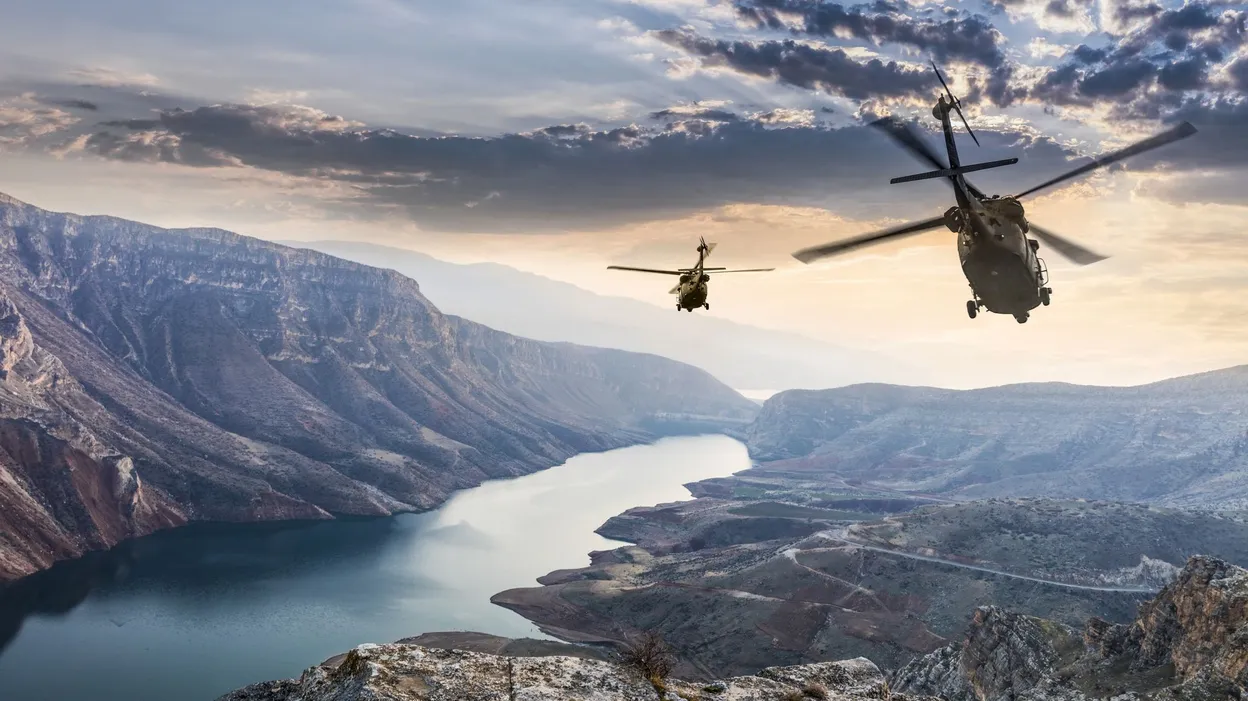
Belgium's RTBF has an article explaining exactly how a CSAR operation, divided into three mission components, is carried out.
It can be likened to Sarah Hoyt's link to Behind the Black's Robert Zimmerman post, where one Cap'n Steeve proceeds to give what is probably the best explanations of the history of the missions (and SERE) since Vietnam, as the 25-minute video is recounted by a former military pilot (and current civilian pilot) himself. (“Will you be worth the trip?”: If you can get to the end without tearing up — as the captain does — then you are more stoic than I am…) As for the RTBF link, it is in French, but do go there for plenty of dramatic photos and videos from Iran's Zagros mountain range.
… Combat SAR (or CSAR), for Combat Search and Rescue … is a distinct mission within the art of warfare, for it seamlessly blends aviation, special forces, intelligence, air command, electronic warfare, and emergency medicine into a single, unified operation. …Code Sandy
… A legacy of the rescue missions of the Vietnam War, "Sandy" designates the escort and coordination aircraft that provide protection during recovery operations. Historically, this role was first filled by the A-1 Skyraider, and later—in the more recent tradition of the U.S. Air Force—most often by the A-10 Thunderbolt II, with F-15s and other MQ-9 drones also providing support.
Their mission: to locate targets, keep the enemy at bay, coordinate the scene, conduct route reconnaissance, escort rescue helicopters, and—if necessary—deliver immediate fire support. U.S. Air Force manuals continue to explicitly associate the A-10 with "Sandy"-type missions and rescue escort duties. Sandy serves, in a sense, as both the sword and the forward-deployed "eye" of the mission. It does not perform the extraction itself, but rather makes that extraction possible—most notably by establishing the "Sandbox" security perimeter.Code King
Thereafter comes the "King," referring to the HC-130J Combat King II—the aircraft specifically designed for personnel recovery missions (though the MC-130J Commando II may also be utilized). It serves as a command and control platform, extends the operational radius of the recovery force, and—most importantly—is capable of mid-air refueling for rescue helicopters; this capability is essential when an extraction must be executed over long distances, at night, at low altitudes, and without a second chance. The U.S. Air Force specifically defines it as a platform dedicated to personnel recovery missions, command and control, and helicopter refueling. King constitutes the logistical and tactical backbone of the operation; it is its central element.Code Jolly
Finally, "Jolly" refers to the rescue helicopter itself. Today, the name is borne by the HH-60W Jolly Green II, the successor to the Pave Hawk. It is the aircraft designed to enter contested zones—by day or by night—to recover an isolated pilot or commando, pick up a rescue team, and make a rapid exit. The U.S. Air Force explicitly positions the HH-60W as its dedicated Combat Search and Rescue helicopter, engineered to recover isolated personnel in hostile or denied territory. To this end, it is equipped with a FLIR (Forward-Looking Infrared) system—an advanced thermal imaging system that enables the crew to detect and identify targets or individuals, even in total darkness, through smoke, or in adverse weather conditions.Aboard the Jollys, one also finds the mission’s other—human—heart: the the Pararescuemen—the famous PJs—nicknamed Guardian Angels. Their role extends far beyond the image of a rescuer dangling from a hoist. The Guardian Angel structure is dedicated to Personnel Recovery across the entire spectrum of operations, and PJs are trained to conduct rescues under fire, stabilize the wounded, infiltrate, exfiltrate, survive, and improvise in degraded environments. It is they who transform a technical recovery into a safe return.

Experts say a rescue mission of this nature is likely to require 24 “pararescue” operatives and two Black Hawk helicopters, assisted by in-air refuelling aircraft to extend their reach over Iran.US pararescue operatives receive training in combat medical care, evacuation, air-dive physiology, and additional skills to survive in chemical or nuclear environments.
On finding a casualty, they may need to provide him with medical treatment in place to ensure he survives the journey to safety.
“Harrowing and massively dangerous is an understatement,” one former pararescue commander told CBS News.

Lorsqu'un pilote américain tombe derrière les lignes ennemies, l’armée ne lance pas seulement un sauvetage, elle déclenche une mécanique complexe mêlant repérage, commandement aérien, hélicoptères de récupération, avions d’escorte et forces spécialisées. C’est ce que l’on appelle une mission CSAR, pour Combat Search and Rescue. L’opération menée pour récupérer le pilote tombé en Iran en a rappelé la logique implacable : aller chercher un homme isolé avant que l’ennemi ne mette la main dessus.


5 comments:
I am quite sure I'll learn lots of new stuff right here! Good luck for the next!
Important and Valuable information with us. This will be very helpful for me and others
Your blog provided us with valuable information to work with. Keep blogging.
Its so informative and the content make post more interesting. really appreciated
Helpful post this is. I really really love it. It's so good and so awesome. I am just amazed
Post a Comment