
Kabul gave us Ukraine, and all the death that ensued
Fifty years after Saigon, Rod D. Martin asks us to Remember the Nobility of a Betrayed Cause (cảm ơn to Mark Tapscott).
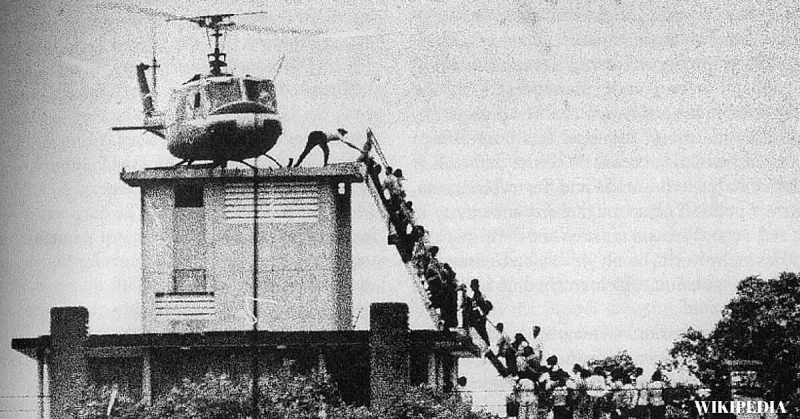
Fifty years ago, April 30, 1975, the world watched in horror and disbelief as the last American helicopter lifted off from the rooftop of our embassy in Saigon. South Vietnam had fallen in the manner of Ernest Hemingway, “first gradually, then suddenly”: a decades-long war, a relative peace, and then a mad dash by the North Vietnamese Army that consumed the country in less than a month.
The tragedy was simply breathtaking. And horribly, horribly unnecessary.
What followed was not peace, but darkness. The swift collapse of South Vietnam, Cambodia, and Laos (turns out the Domino Theory was true) brought the subjugation of millions, and the opening act of a Communist bloodbath across Southeast Asia. At least a million were sent to the “re-education camps” in Vietnam alone. Half a million were murdered. Another two million fled this brutal night by sea, on rafts wholly unsuited for the tumultuous ocean, in wild hope that an American aircraft carrier might happen upon them. Close to half a million died in the water.
None of that counts the genocide of Pol Pot — whom the American left had dubbed “the George Washington of Cambodia”. Over the next three years he murdered between a quarter and a third of his entire population. He would have gone right on had not even the Communists in Moscow and Hanoi been horrified (though Beijing gave him their unqualified support both before and after the massacre).
None of this had to happen. This was not the end of a war, but the culmination of betrayal — a betrayal of an ally, of a cause, and of the very principles America had defended with precious blood and treasure for eight long years.
The received wisdom is that Vietnam was a mistake, a misguided war fought in the wrong place at the wrong time. That narrative is false. The Vietnam War was part of a noble, epic struggle — the same struggle that won the Cold War and saved the whole world from a similar fate. It was a just effort to stop Communist totalitarianism and genocide from consuming yet another corner of the globe. South Vietnam was not a hopeless case. It was a fledgling republic, striving to build a free society in the shadow of Marxist tyranny and under constant assault from within and without. Its people fought with courage and resolve for more than two decades, first with our help and then — fatally — with almost none.
In many ways, the fall of Vietnam mirrored the loss of China in 1949: a long American effort thrown away at the very last through perfidy in Washington — begun and betrayed by Democrats in both cases — with ghastly, ongoing consequences. The two were even similar in this: a Christian President of China (Chiang Kai-shek) betrayed by Truman, a Christian President of South Vietnam (Ngo Dinh Diem) assassinated on orders from JFK, after both of which came the deluge.
By 1973, we had won. No, really. Richard Nixon and Henry Kissinger negotiated the Paris Peace Accords, forcing North Vietnam to accept South Vietnam’s sovereignty and halting hostilities.
… Nixon called it “peace with honor” because it represented more than withdrawal — it was a commitment, a guarantee that America would not desert its friends or allow 58,000 of its sons to have died in vain.
But with Nixon forced from office, Congress fell into the hands of men more concerned with leftist politics than principle. … Deprived of ammunition, fuel, and the will of its ally, South Vietnam collapsed — not because it lacked heart, but because it was abandoned, by the same Democrat Party that had sent America’s sons to die there just ten years before.
This is the reality the left refuses to confront even half a century later. The fall of Saigon was not inevitable. It was engineered in Washington more than Hanoi. It was not a military defeat — it was a political surrender, the first of many. Over the next five years, Democrats handed 26 countries to the Communists. That’s on top of Carter’s betrayal of the Shah of Iran.
Richard Nixon understood this. Years after, in No More Vietnams, he laid out the real lessons of that conflict, lessons we ignore at our peril. … He rightly condemned the gradual escalation that defined the Kennedy and Johnson years, insisting that decisive action at the outset would have saved countless lives.
The same could be said for China, where decisive Soviet action in 1945 in Manchuria, fecklessly answered by Truman, set the tone for the rest of the war.
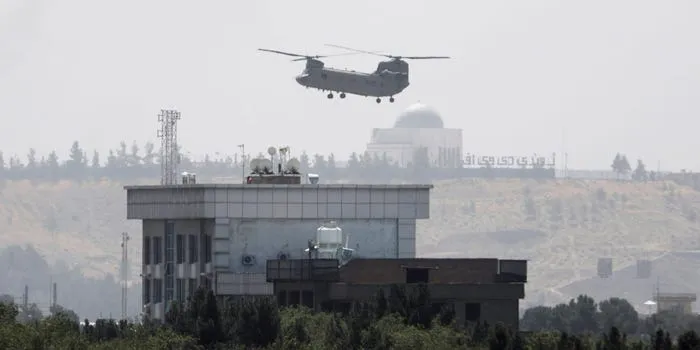
… These lessons, learned at tragic cost, should have guided us forward. But they were forgotten. In 2021, Joe Biden gave us a second Saigon, this time in Kabul.
Once again, a Democrat President abandoned our allies, violated our commitments, and handed victory to the forces of barbarism. Once again, desperate people clung to departing American aircraft, hoping in vain that the land of the free would not forget them. Once again, we left billions of dollars worth of weapons for our enemies and consigned countless friends to death.
It’s a very dangerous thing to be an American ally when Democrats are in power.
Biden’s withdrawal from Afghanistan was not a tragedy born of necessity. It was a choice — a deliberate reversion to the very perfidy that doomed South Vietnam. And just as in Vietnam, the consequences were immediate: a resurgent Taliban, women and girls booted from schools and reduced to chattel, jihadists emboldened, and American credibility in tatters. Kabul gave us Ukraine, and all the death that ensued.
Related: Il y a 50 ans, tout le Vietnam devenait un pays totalitaire communiste
La chute de Saigon, le 30 avril 1975, acte toujours, dans l’imaginaire collectif, la défaite des Etats-Unis dans la guerre du Vietnam. Or, la réalité historique est différente. Ce qui s’est passé au Vietnam après cette date est tout aussi marquant, sinon plus. … c’est bien l’armée sud-vietnamienne qui a été défaite, les troupes américaines ayant quitté le pays deux ans avant. Les derniers soldats américains étaient partis le 29 mars 1973 et la situation militaire n’était pas très bonne côté communiste.
… Les 140 000 personnes évacuées en avril 1975, quand Saïgon est tombé, étaient presque exclusivement des civils et des militaires vietnamiens, pas des militaires américains en fuite. L’Amérique avait perdu la guerre… chez elle, dans les médias et l’opinion publique. Une guerre qui n’avait plus de soutien, menée par une administration en proie à des graves affaires intérieures. C’était pourtant, malgré ses horreurs, une guerre juste contre le communisme qui allait transformer de nombreux pays de l’Asie du Sud-Est en dictatures criminelles. … Ce sont les « boat people » sur lesquels se réfugient, au risque de leur vie, des milliers de Vietnamiens fuyant leur propre pays, qui ouvriront enfin les yeux sur la terrible situation du Vietnam.
Ironie de l’Histoire, 50 ans après, le Vietnam, même s’il reste une dictature, a choisi d’adopter l’économie capitaliste et le style de vie occidental. C’est aussi une victoire de l’Amérique.


No comments:
Post a Comment