Friday, April 01, 2022

Notre Dame on Fire: One of the Best Films of the Past 10 Years Is French

One of the best films of the past ten years came out in March, and it is French.

It's called Notre Dame Brûle. 

Needless to say, I was expecting to be half bored during the reenactment of the 2019 fire in Paris's central cathedral, most of which (I thought that) I knew already. 

Instead, Jean-Jacques Annaud's film (which is not a documentary but a minute-to-minute reconstruction of the fateful hours that day) is gripping from beginning to end. And I do mean that, from the first seconds to the very last…

Not only does it not poke fun at the priests and deacons of the cathedral, it is not anti-religious (contrary to some of the director's previous efforts). 

Au contraire: a great part of the film concerns the fight to save the various religious artifacts. That is almost the best part, as it is so unlike other cinema fare…

It is also an action film, needless to say — it turns out that at one point, most of the firefighters were pessimistic and dejected and agreed that there was no choice but to give up on saving the building, whose walls they expected to completely collapse.

That's when a lone hero speaks up, points out some facts about the church, and asks for volunteers.

Lots of (black?) humor: such as the deacon with the key to the artifacts trying to rush to the Île de la Cité from a (very) badly-timed trip to Versailles. Or the numerous firefighters unable to get through the traffic jams of the French capital and sitting, idle and powerless, in their immobile vehicles.

There is a smattering of romance: At the end, after the flames are out, a couple of rookies for whom this was their first blaze are conversing — for some reason, the young girl tells the young guy (both of whom almost died in the flames) that she doesn't think their next fire will come anywhere close to being as exciting…

Extra benefit: Donald Trump appears for a few seconds, while in the White House writing his famous tweet on using "flying water tankers" (Canadair planes) to put out the blaze, and like the rest of the movie, it is reported matter-of-factly, without any judgment. 

For much of the movie, my cheeks were wet with tears.

At the end of the film, I and the (pro-American) Frenchwoman who had invited me started clapping, américain-wise, something that is totally outside the experience of European moviegoers (whatever part of the continent they're from). Well, after a few seconds, just about the entire audience joined in the applause.

Saturday, March 26, 2022

Russian Revanchism and Revisionism: given their histories with Russia, it’s not hard to understand why the newly independent countries of Central and Eastern Europe all desperately wanted to join NATO


The roots of Russian aggression lay in neither NATO enlargement nor ‘hawkish’ US foreign policy, but in Russian revanchism, Brookings analyst Jamie Kirchick writes for the National Review. Insightful weekend reading from a former Penn Kemble fellow at the National Endowment for Democracy.

Thus wrote four years ago on the website of the same name, echoing (years before 2022) The New Russian Cult of War and Mikhail Khodorkovsky branding Vladimir Putin a bandit at the head of a gang of thugs. Likewise, see the post For decades, the Kremlin has accused NATO of encircling, threatening, oppressing Russia… accusing the West of exactly what Putin is doing to his neighbors, who are not his vassals but countries liberated from centuries of Russian yoke. (Spasiba for the link, Maggie's Farm).

A number of articles from 2018 go by the title of The Roots of Russian Aggression, but let's take a closer look at the one in National Review by :

As U.S.–Russian relations reach a post–Cold War low, a growing number of observers have concluded that Western behavior, not Russian belligerence, ultimately lies at fault. According to this analysis, the United States and its European allies “humiliated” Russia by enlarging NATO, undertaking military action in the Balkans, extending trade and other forms of soft power to the former Eastern Bloc, and generally not affording Moscow the respect it supposedly deserved as a great (albeit territorially smaller and militarily weaker than it once was) power. 

 … So stubbornly is this historical narrative of Western arrogance and Russian innocence asserted that it has become impervious to all manner of Russian mischief, no matter how morally egregious or physically destructive. In 2014, after Russian president Vladimir Putin annexed the Crimean peninsula in the first armed seizure of territory on the European continent since World War II, former Soviet premier Mikhail Gorbachev denounced NATO “triumphalism” as the culprit, though the military alliance had expressly chosen not to offer Ukraine a pathway to membership at its 2008 Bucharest summit. 

 … the Soviets and their allies taken by surprise when national independence movements referenced the [the Helsinki Final Act's] sovereignty provisions to expose the fundamental illegitimacy of the Warsaw Pact, all along a façade for Russian colonialism …

 … The subject of NATO’s post–Cold War enlargement, and more specifically the false claim that Western leaders promised their Soviet counterparts that NATO would refrain from incorporating new members, has won credibility of late. Particularly after the Ukraine crisis, Russia’s Western sycophants, seeking to justify Putin’s aggression, trotted out the claim that NATO’s “encircling” of Russia had somehow forced Putin into invading his neighbors. It is remarkable how pervasive this narrative has become. 

  … As is already known, James Baker, then the secretary of state, promised Gorbachev that NATO would not expand “one inch eastward.” The [left-wing National Security Archive at George Washington University] attempts to embellish this statement by releasing some extraneous once-classified documents. But Baker made that pledge solely in the context of East Germany, a country that, like the Soviet Union, would soon cease to exist. At the time, it was inconceivable that places such as Poland or Czechoslovakia (another state not long for this world), never mind the soon-to-be independent Soviet Baltic republics of Estonia, Latvia, and Lithuania, might one day join NATO.

Russia and its Western apologists can offer no evidence of a promise not to enlarge NATO, because such a promise was never made. Gorbachev should have the final word on this matter: “The topic of ‘NATO expansion’ was not discussed at all, and it wasn’t brought up in those years,” he said in October 2014. “I say this with full responsibility. Not a single Eastern European country raised the issue, not even after the Warsaw Pact ceased to exist in 1991.” Only years later would the prospect of former Warsaw Pact states’ joining NATO become a subject of more than academic discussion, when the alliance offered membership to Hungary, Poland, and the Czech Republic. In 1997, all three joined.

  … The newly independent countries of Central and Eastern Europe all desperately wanted to join NATO, and given their histories with Russia [as its former satrapies], it’s not hard to understand why. The practice of invading European neighbors because they stray from the true socialist path — employed by the Russians in Hungary and Czechoslovakia in 1956 and 1968, respectively — is a model of interstate behavior that was supposed to have been forever discredited with the collapse of the Soviet Union. (As events in Georgia in 2008 and Ukraine six years later demonstrate, however, it has unfortunately been revived.) 

 … As with practically every understanding it signed in the post–Cold War period, Russia later violated this pledge [the Budapest Memorandum with Ukraine, Great Britain, and the United States, which saw Kiev surrender its ample nuclear-weapons stockpile to Moscow in exchange for guarantees of its territorial integrity]. 

Throughout the 1990s and well into the reign of Vladimir Putin, the United States and its allies went out of their way to draw Russia closer and assuage any fears its government might have had, genuine or contrived, that the Western alliance harbored aggressive designs. 

… What provoked the deterioration in relations between Russia and the West, then, was neither NATO enlargement, nor American foreign policy, nor anything else that the West did, but Russian revanchism and revisionism. In 2007, Putin delivered an anti-American tirade at the Munich Security Conference, shocking attendees. Shortly thereafter, Russia launched a cyberattack on tiny Estonia, and the following year it invaded Georgia. The French writer Michel Gurfunkiel identifies Putin’s four major strategic goals as reuniting “all the Russian-speaking peoples under a single nation-state,” reestablishing Russia as “the first among equals” in the “Eurasian community,” weakening Europe and the transatlantic alliance, and restoring Russia as a global power.  

 … Unlike post-war Germany, which made full amends for its past militarism and atrocities and committed itself to multilateralism and nonviolent approaches to resolving international conflict, Russia never went through a process of Vergangenheitsbewältigung, or “coming to terms with the past.” Perhaps this was an unavoidable consequence of the Cold War’s peaceful end — the Soviet Union, unlike the Third Reich, was not subjected to a traumatic military defeat and occupation by its adversaries. But the consequences of Russia’s not engaging in the sort of critical appraisal of its own history so admirably pursued by post-Holocaust Germany are visible all around us in the modern-day cult of Josef Stalin, the veil of silence surrounding Communist-era crimes, and the popular support among the Russian people for Putin’s military adventures abroad.

 … Deprived of the argument that it was nonexistent NATO expansion to Ukraine that “provoked” Russia to invade it, some realists cite the EU’s 2013 offer of a trade-and-aid package to Kiev as having justified the aggression. What this excuse neglects to acknowledge is Putin’s 2004 statement “If Ukraine wants to join the EU and is welcome there, we can only welcome that.” Ten years later, he waged war against the country for trying to do precisely what he had encouraged. 

 … German chancellor Angela Merkel was said to have remarked that Putin lives in “another world.” He does. It’s a dangerous world where might makes right, one that successive generations of Western statesmen, along with courageous Poles, Czechs, Romanians, and countless others, fought to overcome. The post–Cold War “ideas and assumptions” of America and its allies were not “triumphalist” diktats meant to humiliate or “encircle” Russia by “rubbing its nose” in defeat, but fundamental principles of sovereignty and national self-determination established to avert war on a continent repeatedly plagued by it. Far from being too “triumphalist” in its dealings with Russia, if anything, the West was not triumphalist enough.

Friday, March 25, 2022

Russian Exile Khodorkovsky: "You have to understand that Mr Putin, in his head, has long been at war not with Ukraine, but with America"

A former oil mogul and political prisoner warns the West it must face down Vladimir Putin now or prepare for something worse

writes The Economist (see also The New Russian Cult of War and While Ukraine Agonizes…) as it gives the word to Mikhail Khodorkovsky. Update: Welcome, Instapundit readers

I HAVE BEEN fighting a personal war with Vladimir Putin for nearly 20 years. It led to my being jailed in Russia for ten years and then expelled, with a warning that life imprisonment awaited me if I ever returned. Do I know the man who did all this to me? I think I do. That is why I look with despair at the defeatist approach of Western leaders, such as Joe Biden, Emmanuel Macron and Naftali Bennett.

It is difficult for me to judge how their actions are seen by their electorates. However, I know well how they are perceived by Mr Putin, sitting at the end of his long table. They fly to Moscow, call him, ask him to stop, but assure him that they will not interfere and do not want him to perceive certain movements as a provocation. The president sees all of this as weakness, and that is extremely dangerous.

Part of the problem is that the current leaders of Western countries have never dealt with thugs. Their experience and education relate to interactions between statesmen. The principle of these people’s behaviour is that both sides concede to each other in the interests of their electorate or subjects. War is evil to them, and the use of force is a last resort.

This is not the case with Vladimir Putin. He was raised in the KGB, an organisation that relied on force and disregard for the law. While working at St Petersburg City Hall in the early 1990s, he was responsible for the informal interaction of the law-enforcement agencies with gangsters. St Petersburg at that time was perceived in Russia just as Chicago was seen during prohibition. Instead of smuggled whisky, the gangsters were selling drugs and oil.

Times changed but his ways of solving issues remained. Some of the conversations between his confidants and known criminals, made public after an investigation by Spanish prosecutors, help us to understand how the murder of Alexander Litvinenko and the poisoning of Alexey Navalny and the Skripals came at the nod of the ringleader. Such acts are the norm within the president’s circles, because he is a thug by nature.

Even after more than 20 years in power, having acquired a strongman image and self-confidence, a bandit will always remain a bandit in terms of his perception among those around him. It is a drastic mistake when he is seen as a normal statesman. Russia’s foreign partners fail to understand who he really is.

I have plenty of experience of dealing with bandits. After spending ten years in Russian prisons, I can say that the most dangerous thing is to show them any weakness or uncertainty. Any step towards their demands, without a clear demonstration of strength, will be perceived as weakness. Following their logic, if Western countries say they will not give up Ukraine and yet they do exactly that, it means that they are weak. And that makes it likely that Mr Putin will look towards other neighbours, such as Estonia, Latvia, Lithuania and Poland, who were also previously part of the Russian Empire.

You have to understand that Mr Putin, in his head, has long been at war not with Ukraine, but with America. And now America and NATO look to be retreating. He is not the only thug who perceives the situation that way. Other bandits are also watching and waiting their turn, as America’s humiliation echoes around the world. Transnistria is stirring, the Balkans are restless again, Iran is attacking American bases. At some point, America and NATO will retaliate, but by that point, they will be tormented by crows and vultures in various parts of the world, and Mr Putin will not immediately realise that the pushback is serious. The habit of impunity among thugs does not subside so quickly. And that means a worse war, an even bigger one, is likely.

Perhaps you do not believe it. But consider this: Mr Putin managed to increase his ratings when he came to office, in 1999, with the war in Chechnya. He solved the problem of controlling his “interim president”, Dmitry Medvedev, by going to war with Georgia in 2008. Having gone to war on Mr Putin’s orders, Mr Medvedev was forced to abandon his own agenda of modernisation. Mr Putin solved the problem of his ratings plunge in 2013-14 by seizing Crimea.

Now, the war in Ukraine dwarfs any gripes about a decade of economic decline. If he is allowed to take over Ukraine, the economy will continue to collapse, as a result of corruption and sanctions. A flood of coffins will return home to Russia, for the guerrilla war cannot be stopped. The mood of the population will continue to deteriorate. And in 2024, there will be elections.

What is likely to be Mr Putin’s solution? It will be another “special operation”. Moldova is too small, so it is likely to be in the Baltic states or Poland. Unless Mr Putin is stopped in the air over Ukraine, NATO will have to fight him on the ground.

As for nuclear weapons, the Russian president has a manic psychosis. He is obsessed with being a historical figure like Stalin. He has placed a huge statue of Prince Vladimir, the creator of Russia, at his Kremlin gate. But he is not suicidal or he would not be sitting at the other end of a 20-foot table from his cronies. He will only use nuclear weapons if he believes there will be no response. But every day NATO rejects the no-fly zone over Ukraine, his self-confidence grows.

I do not want my country to face NATO in a global conflict, but trying to talk to a thug without showing him your strength leads exactly to that point.

Kirill, the patriarch of the Russian Orthodox church, calls Putin's presidency “a miracle of God”; while one priest said the Russian army “was cleaning the world of a diabolic infection”


This crusade against a liberal European future is being fought in the name of Russkiy mir—“the Russian world”, a previously obscure historical term for a Slavic civilisation based on shared ethnicity, religion and heritage.

Thus writes The Economist in The New Russian Cult of War. While reading the article, remember that the word "Russia" does not appear in any Christian (or Jewish) Bible (nor does "America" or any other nation besides Israel and the Egypt of the Pharaohs). See also the take of a famed Russian political prisoner and exile.

Thanks to Evelyne Joslain, most recently the author of a post that declared that For decades, the Kremlin has accused NATO of encircling, threatening, oppressing Russia… accusing the West of exactly what Putin is doing to his neighbors, who are not his vassals but countries liberated from centuries of Russian yoke.

The Putin regime has revived, promulgated and debased this idea into an obscurantist anti-Western mixture of Orthodox dogma, nationalism, conspiracy theory and security-state Stalinism.The war is the latest and most striking manifestation of this revanchist ideological movement. And it has brought to the fore a dark and mystical component within it, one a bit in love with death. As Andrei Kurilkin, a publisher, puts it, “The substance of the myth is less important than its sacred nature…The legitimacy of the state is now grounded not in its public good, but in a quasi-religious cult.”

The cult was on proud display at Mr Putin’s first public appearance since the invasion—a rally at the Luzhniki stadium packed with 95,000 flag-waving people, mostly young, some bused in, many, presumably, there of their own volition. An open octagonal structure set up in the middle of the stadium served as an altar. Standing at it Mr Putin praised Russia’s army with words from St John’s gospel: “Greater love hath no man than this, that a man lay down his life for his friends.”

His oration, delivered in a $14,000 Loro Piana coat, made much of Fyodor Ushakov, a deeply religious admiral who, in the 18th century, helped win Crimea back from the Ottomans. In 2001 he was canonised by the Orthodox church; he later became the patron saint of nuclear-armed long-distance bombers. “He once said that the storms of war would glorify Russia,” Mr Putin told the crowd. “That is how it was in his time; that is how it is today and will always be!”

… Links between the church and the security forces, first fostered under Stalin, grew stronger after the fall of Communism. Whereas various western European churches repented and reflected after providing support for Hitler, the Moscow Patriarchate has never repented for its collusion with Stalin in such matters as the repression of Ukrainian Catholics after 1945.

 … The allegiance of its leaders, if not of all its clergy, has now been transferred to Mr Putin. Kirill, the patriarch of the Russian Orthodox church, has called his presidency “a miracle of God”; he and others have become willing supporters of the cult of war.

  … Its garish culmination can be seen in the Main Cathedral of the Russian Armed Forces in Kubinka, 70km west of Moscow, which was inaugurated on June 22nd (the day Hitler launched his invasion) in 2020 (the 75th anniversary of the war’s end) with Mr Putin and Kirill in attendance.The cathedral is a Byzantine monstrosity in khaki

 … More zealous churchmen have gone further. Elizbar Orlov, a priest in Rostov, a city close to the border with Ukraine, said the Russian army “was cleaning the world of a diabolic infection”. As the cathedral shows, the Russian people’s sacrifice and victories in the great patriotic war, which saw both the loss of 20m Soviet citizens and the creation of an empire greater in extent than any of the Tsars’, are central to Mr Putin’s new ideology of the Russian world. Today, though, the foes and allies of the 1940s have been shuffled around, allowing the war to be reframed as part of an assault on Russia’s civilisation in which the West has been engaged for centuries. The main culprits in this aggression are Britain and America—no longer remembered as allies in the fight against Nazis, but cast instead as backers of the imaginary Nazis from which Ukraine must be saved.

Project Russia

More important to the cult even than the priests are the siloviki of the security services, from whose ranks Mr Putin himself emerged. Officers of the FSB, one of the successors to the KGB, have been at the heart of Russian politics for 20 years. Like many inhabitants of closed, tightly knit and powerful organisations, they have a tendency to see themselves as members of a secret order with access to revealed truths denied to lesser folk. Anti-Westernism and a siege mentality are central to their beliefs. Mr Putin relies on the briefs with which they supply him, always contained in distinctive red folders, for his information about the world

In this realm, too, a turn towards the ideology now being promulgated was first seen in 2005, when a faction within the FSB produced an anonymous book called “Project Russia”. It was delivered by courier services to various ministries dealing with security and Russia’s relationship with the world, warning them that democracy was a threat and the West an enemy.

 … In his Munich speech in 2007 Mr Putin formally rejected the idea of Russia’s integration into the West. In the same year he told a press conference in Moscow that nuclear weapons and Orthodox Christianity were the two pillars of Russian society, the one guaranteeing the country’s external security, the other its moral health.

 … One of the few people he appears to have spent time with is Yuri Kovalchuk, a close friend who controls a vast media group. According to Russian journalists they discussed Mr Putin’s mission to restore unity between Russia and Ukraine.Hence a war against Ukraine which is also a war against Russia’s future—or at least the future as it has been conceived of by Russia’s sometimes small but frequently dominant Westernising faction for the past 350 years. As in Ukraine, the war is intended to wipe out the possibility of any future that looks towards Europe and some form of liberating modernity. In Ukraine there would be no coherent future left in its place. In Russia the modernisers would leave as their already diminished world was replaced by something fiercely reactionary and inward looking.The Russian-backed “republics” in Donetsk and Luhansk may be a model. There, crooks and thugs were elevated to unaccustomed status, armed with new weapons and fitted with allegedly glorious purpose: to fight against Ukraine’s European dream. In Russia they would be tasked with keeping any such dream from returning, whether from abroad, or from a cell.

Tuesday, March 22, 2022

At CPAC, an Interview with Defenders of American Exceptionalism Podcast


During CPAC 2022, I was interviewed by Steven Airey and Dylan Liles for Defenders LIVE Episode 824: LIVE at CPAC Day 2, between minutes 1:02:44 and 1:27:44.

But by all means, check out the other interviewees, before and after… 

We ran the gamut of subjects, from Ukraine to January 6; one of the main issues we touched upon, however, was education in America. 

As I wrote in one of my most important posts on the 1619 Project two and a half years ago, Americans don't realize enough (American conservatives and American liberals alike, blacks and whites alike) to what extent the United States has imported the European curriculum (the Frankfurt School must certainly be among the originators of this), a great part of which concerns, overtly or not, the demonization if not of America, then certainly of the government-free/free market model… 

Do not think that Europe's role in this is secondary or passive. Au contraire:  Europe's influence in these teachings is paramount and must not be minimized.

From the Europeans' school benches in the 19th century to the establishment in the United States of the Frankfurt School — certainly the European élites' most successful gambit has been to take over at least parts of American education over the course of the 20th century — with the more or less willing aid of the Democrat Party.

I am the son of diplomats who, every three years, would be posted in the embassy of a different national capital — among the places I lived in through my childhood were Denmark, the United States, France, and Belgium:
In Scandinavia I learned about slavery in America along with the treatment of the Indians.

In France I learned about slavery in America along with the treatment of the Indians.

In Belgium I learned about slavery in America along with the treatment of the Indians.

In Scandinavia we did not learn much about the Sámi people — a people, and a word, even most Scandinavians would barely recognize (they are better known as Lapps or Laplanders, but with no Swedish blood-letting attached to their names, only romantic folklore).

In France we did not learn much about Napoleon's conquest of Haiti and the horrors perpetrated on the blacks of that island, along with the reenslavement (!) of the former slaves liberated during the French Revolution.

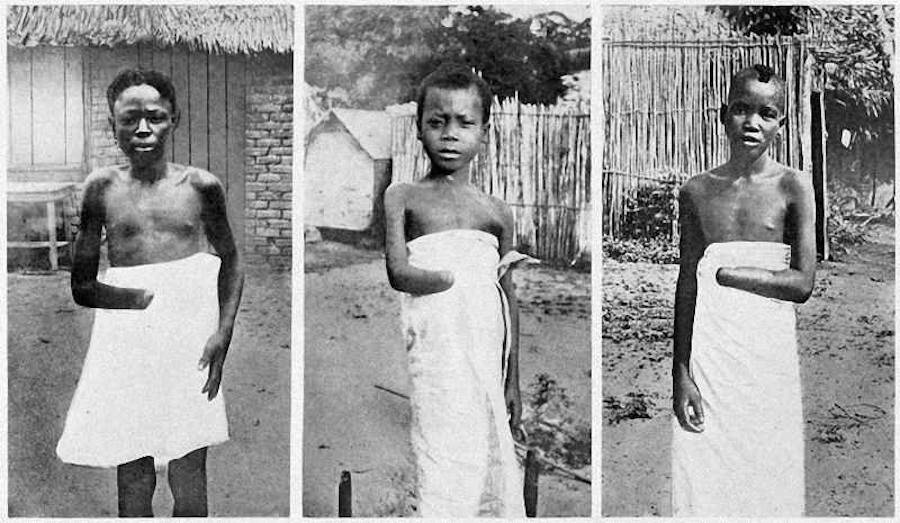
In Belgium we did not learn much about the kingdom's Congo colony — where, 20 to 40 years after Appomattox, indeed all the way into the early 20th century, blacks were not only the equivalents of slaves, but the terror and brutality meted upon them dwarfed any punishment seen on a Southern plantation, the most terrifying being the most horrific instances of maiming (having hands and/or feet chopped off) if they did not meet their masters' expectations. Marco Margaritoff:

Through the enslavement of locals who worked or starved to death, Belgium made a fortune. Hundreds of thousands of Congolese fled, while tens of thousands were killed or had their arms cut off for rebelling. Between 1880 and 1920, the population plummeted from 20 million to 10 million.

Nor, needless to say, does any American schoolchild learn much, if anything, about the Sami, Haiti, or King Leopold's Congo Free State.

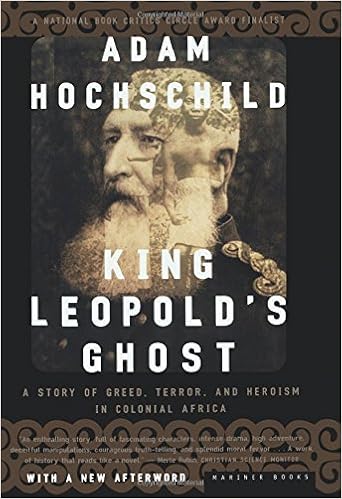
When King Leopold's Ghost (A Story of Greed, Terror, and Heroism in Colonial Africa) was translated into French and Dutch, writes Adam Hochschild,
The Belgian prime minister clearly wanted the row to end. "The colonial past is completely past," he told the [Guardian]. "There is really no strong emotional link any more. . . . It's history."
That's it. The only country where the "past" — if and when leaning towards the negative — is never "completely past" is the United States. The only sins, real or alleged, that there is a strong emotional link to is America's.

As Walt Whitman wrote in the midst of civil war, around 1863 or 1864,
The Democratic Republic has paid her to-day the terrible and resplendent compliment of the united wish of all the nations of the world that her Union should be broken, her future cut off, and that she should be compell’d to descend to the level of kingdoms and empires ordinarily great! There is certainly not one government in Europe but is now watching the war in this country, with the ardent prayer that the united States may be effectually split, crippled, and dismember’d by it. There is not one but would help toward that dismemberment, if it dared. I say such is the ardent wish to-day of England and of France, as governments, and of all the nations of Europe, as governments. I think indeed it is to-day the real, heart-felt wish of all the nations of the world …

 … We need this hot lesson of general hatred, and henceforth must never forget it. Never again will we trust the moral sense nor abstract friendliness of a single government of the world.

The reason is very simple: the hatred for America started in the 1780s, when George Washington …

Do read the whole thing™…

Monday, March 21, 2022

For decades, the Kremlin has accused NATO of encircling, threatening, oppressing Russia… accusing the West of exactly what Putin is doing to his neighbors, who are not his vassals but countries liberated from centuries of Russian yoke


On the Dreuz website, Evelyne Joslain comments on the Russian invasion of 2022: Tandis que l’Ukraine agonise. A radio host at the Libre journal du Nouveau Monde on Radio Courtoisie, Evelyne Joslain is the author of a handful of French books on the United States. (See also The Economist's The New Russian Cult of War and the take of a famed Russian political prisoner and exile…)

The West is united behind Zelinsky, at least as far as fine words are concerned. We are overwhelmed by emotions, but as for the determination to defend the West, it is non-existent. Only volunteer fighters from all our democracies, who have spontaneously committed themselves to defending Ukraine and our civilization, are saving our honor. For, make no mistake about it, Putin is not going to stop at the borders of Ukraine. This Third World War that we so much want to avoid has already begun.

Even if the Kremlin were stopped, China and Iran would miraculously remain, since we are faced with a new Axis of Evil which has patiently built itself up and is not hiding its aspirations to destroy not only the EU (which would hardly be a drama) but also NATO and the USA as the world's foremost power. The Axis wants a New World Order, with its currency, its international banking system, its laws... Would that suit all those, American as well as foreign, who have railed against "American imperialism" for decades?

Recall that Beijing and Moscow both have veto power at the UN (a resolutely anti-West body that serves no purpose except to comfort dictators), where both enjoy an absurd commercially-protected nation status. True enough, the Russian and Chinese countrysides belong fully in the Third World, but we are not supposed to know that. As for the third Axis, Tehran, the same Westerners who scold Putin in front of the television cameras are, behind Vienna's closed doors, busy with the Russians and the CCP polishing Obama's resurrected Iran Deal. Obama had wanted this agreement out of sheer infatuation for the Islamists. Biden desperately wants it back (and to hell with Congress, a presidential order will do) because it is fine to take oil from dictators and enemies of the United States (all of them) but in no case, Heaven forbid, from American producers.

There is no more anti-American and traitorous to their country than the current American left, and nothing more hypocritical and absurd than state environmentalism, the primary concern of Western leaders. As for the ayatollahs, they demanded and obtained from the squatter of the White House that it be a Russian, Mikhail Ulyanov, who does the negotiating for the United States! This shows the seriousness that Biden gives to martyred Ukraine: the "Ukrainian crisis", as he calls it, is an annoying setback (for leftists, everything is "crisis" and therefore good for exploitation, which he does).

Note also that, just like for the first Iran Deal, no regional power is invited to participate: this takes place only between China, Russia, France, the United Kingdom, and Germany. This agreement is essentially for the benefit of Iran: to pull it out of the isolation where its unacceptable methods have placed it. No advantage for Westerners, except for politicians and for a few big companies, therefore very special interests — "one hell of a bonanza to rake in"… As for the nuclear bomb, given the time that they've been fooling the IAEA's inspectors, the Iranians probably already have it.

We are also confounded by the treachery of Macron and Johnson, bound like Biden, to respect the Budapest Memorandum solemnly signed by their respective countries in 1994, that is to say to ensure the territorial integrity of Ukraine in exchange for the docile surrender of its nuclear weapons. Instead, our leaders are in a rush to get back to business and deepen our dependence on hostile powers. The sanctions only affect 2/3 of the Russian economy. Above all, NATO's military force depends on the occupant of the White House (through the blame lies on the shoulders of the Europeans who have done nothing to acquire within the Alliance armies worthy of the name, with the exception of France, Turkey, and Great Britain). But above all, Biden is anything but a leader: corrupt to the core, he is involved in Mafia affairs with Ukrainians, Russians, and Chinese, so he's in their pockets. All being show biz, the media conceals these inconvenient truths and focus on the tragedy of Ukraine which is dying.

Putin probes the softness of a largely decadent, de-virilized, and pathetic West, which finds all the technical excuses not to get involved. After 25 days of aggression-invasion, money is flowing into Ukraine but not the really “offensive” weapons it demands, only “defensive” weapons. We therefore limply support a war that we believe to be lost in advance because we fear that a Putin who cannot afford to back down will use a missile to settle the seizure of Ukraine. We give in to Putin's nuclear blackmail without realizing that he is playing games with us. He made it clear that balancing by mutual deterrence was obsolete by 2020.

We are therefore terrified for reasons for which we are completely responsible: the West has unilaterally disarmed, both with regards to conventional and nuclear forces, the United States and the European Union (thanks to the idol, Obama, Russia has 1,500 nuclear warheads, twice that of the USA). And they have also unilaterally dispossessed themselves of their fossil fuels, preferring to give them all 1 billion dollars a day for Russian gas, obeying the dictates of frenzied ecologists.

For Putin, the situation was ideal: in the United States, the coming to power by fraud of a particularly shabby and destructive trio: Biden, Harris, Pelosi, the top three honchos in the nation, amply proved to what degree they are unworthy of their functions. Another major figure of the West and NATO are Canada's Trudeau who, like Biden, has shown his totalitarian streak, one against his own people; Britain's Boris Johnson, often more buffoonish than Prime Minister; and France's Macron who supports Ukraine by disguising himself as Zelinsky. And none of the above have denied their involvement in environmental fraud, quite the contrary: any "way out of the crisis" goes through the "green transition", they say, first Covid later the "Ukrainian crisis".

Who dares to counter them? Half of America is willing, but hardly any of the deeply indoctrinated Europeans. In polls, environmentalism is the third concern of the French just after their purchasing power and their health. Not a presidential candidate in France (which has become a non-event) who does not sacrifice to this heresy! They even all have a specific green program, even if it is obviously the left that leads the way since environmentalism is nothing but re-distributionist Marxism. Ignoring the most basic decency, environmentalists even organized demonstrations all over France on Saturday March 12, to protest the "appalling" fact that Ukraine was capturing all the media attention to the alleged detriment of the planet...

Environmentalism, that suicidal madness, a sad Western exception that amazes all the other countries on the planet that cannot be blamed for profiting from so much stupidity. The truth emerges about Putin: if Ukraine has a level of corruption equal to that of Russia, Putin is nevertheless the aggressor and demonstrates how he is nothing European. He is completely penetrated by the Eurasian theses of Alexandr Dugin, theses which adapt very well to all Asian and Muslim elements, uniting them in the same hatred of the West and in the same Neo-Eurasianist supremacy.

Moreover, "Mad Vlad" reveals his medieval mentality and his Asian fiber: he is both Attila the Hun and Yvan the Terrible. And he hasn't changed as his last defenders would like to believe, he finally lets himself be seen as he is, perhaps because he is about to celebrate his 70th birthday and wants to ensure his legacy, perhaps because he is sick (his swollen figure suggests heavy treatments), or simply because he will not always have the windfall of a Biden in front of him.

If the West can come to its senses in time, nothing should be given to Putin. He must give back everything he has wrongfully acquired — Crimea, the seas, the provinces — and be condemned to reparations for the approximately 200 billion dollars of damage he and his armies have caused. For human suffering and his crimes, he must be tried by a special tribunal. For decades, the Kremlin has accused NATO of encircling, threatening, oppressing Russia… accusing the West of exactly what Putin himself is doing to his neighbors, who are not his vassals but countries liberated from centuries of Russian yoke. 

It is about time for NATO to give some push-back, with teeth, to this tiresome neo-Soviet propaganda.

Sunday, March 20, 2022

18th Anniversary of My First Post for No Pasarán

A few weeks after the founding of No Pasarán, 18 years ago, I was invited to join as the blog's fourth blogger (after Douglas, Jonathan, and Liminal aka U*2, and prior to N Joe).

The blog's inaugural pledge was that we

 "will commentate on current events with all the psychotic calm and serenity of a Palestinian father who explains that he can't wait for his 2 surviving sons to become martyrs"
Of the more than 13,000 posts that have been written since 2004 (13,687, to be exact, as of today), I consider the following couple of posts to be two of the most important:
• The Era of the Drama Queens: Every Crisis Is a Triumph
• The Leftist Worldview in a Nutshell: A world of Deserving Dreamers Vs. Despicable Deplorables
Today is the anniversary of my first contribution, which related how I attended a conference in Normandy (at a museum linked to the D-Day landings, no less!) with some of France's best-known journalist VIPs and how I rose to challenge the group on the French media's coverage of the Iraq conflict.

Wednesday, March 24, 2004


Growling for Colombani

Any of you who have seen me over the past 10 days knows how furious I get anytime I read or hear the French media trying to stuff down our throats their self-serving lying charges (those against Aznar, Bush, and Blair, i.e., anybody whom they don't feel any sympathy with).

So when I read that the Mémorial de Caen was organizing a conference with Jean-Marie Colombani, among others ("QUELLE LIBERTÉ POUR L'INFORMATION DANS UN MONDE INQUIÉTANT ?" [What freedom for information in a distressing world?], organized in tandem with Les Amis de l'hebdomadaire La Vie and Reporters sans Frontières), I knew I had to attend. I wanted to give Le Monde's director a piece of my mind (in a diplomatic manner, natch). Three hours before it started at 7 pm on March 23, 2004, I jumped into my trusty jalopy, and drove the 260 km to Caen, arriving just in the nick of time.

And sure enough, the first thing any of the five intervenants did (with a constant wry smile on his face) was to attack the lies of politicians, ridicule the partisanship of the media, and bemoan the jingoism of the population (meaning those of the US, the UK, and Aznar's Spain exclusively, bien sûr). It was Jean-Marie Charon, "Sociologue des médias" (whatever that means), who opened the débat — the others being (left to right on the admittedly unclear photo) Colombani, Walter Wells, Directeur de l'International Herald Tribune (beard), Jean-Jacques Lerosier, Grand reporter à Ouest-France, and Jacqueline Papet, Rédactrice-en-chef de RFI, with the moderators answering to the names of Daniel Junqua, Journaliste et Vice-président de RSF, and Jean-Claude Escaffit, Journaliste à La Vie et Directeur des Amis de La Vie.

Before I left Paris, I'd reviewed and written down (in telegraph-style) a handful of arguments: these ranged from the Iraqis quoted in Reason, on Iraq the Model, and in Le Monde itself, to Doug's post on Le Monde's partisan mistranslation of Michael Ignatieff's piece in the New York Times.

The only problem was a rather big one, I learned as a I headed for my seat: questions would not be permitted, except in written form on small pieces of paper handed over to one of the animators. So I knew I had to pay close attention if I wanted to find an appropriate moment when to jump in. And I would obviously not have time to develop any of the arguments (especially since Eskaffit seemed to be a control freak).

It happened towards the end. There was a brief lull as Wells was about to make his last extensive remarks. Suddenly everybody turned to me as I let out : "Je pense que nous devons tous remercier les médias français pour leur admirable abilité à détecter les mensonges. Mais je ne comprends pas pourquoi ces spécialistes en la matière ignorent des sujets qui ont été traités dans le Herald Tribune, par exemple." (This was punctuated by Eskaffit's protests on his mike, you realize.) "Nous avons pu y lire des articles détaillant ce qu'on pourrait taxer de mensonges dans le camp de la paix, comme le fait que les Allemands, les Russes, et les Français avaient pas mal d'affaires avec les autorités baasistes, et que Total devait avoir un contrat exclusif avec Saddam Hussein. Pourquoi les médias français n'en font-ils pas autant état que de ce qui concerne les Ricains, les Rosbifs, et les Espagnols?"
[Translation: "I think we should all be grateful to the French media for their admirable ability to detect lies. But I do not understand why these experts in the field are ignorant of topics that have been covered in the Herald Tribune, for example." (This was punctuated by Eskaffit's protests on his mike, you realize.) "We have read articles detailing what could be taxed as lies from the peace camp, such as the fact that the Germans, the Russians, and the French had quite a lot of business dealings with the Baathist authorities, and that Total had an exclusive contract with Saddam Hussein. Why don't the French media make as much fuss about that as about the Yanks, the Limeys, and the Spaniards?"]
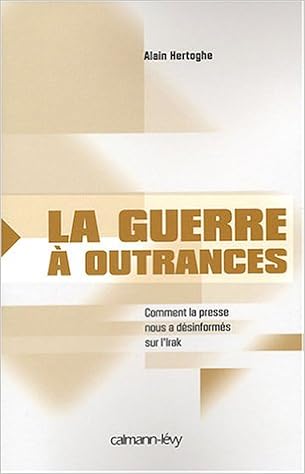
Eskaffit was growing increasingly more vocal in asking/telling me to keep quiet (shades of Chirac?) — he claimed that "de toutes façons", nobody could hear me — so seeing the end approaching (and having a hard time competing against a microphone), I pulled out my final ace — the final ace being a book, which I held above my head. (Yes, there did seem to be a somewhat theatrical element to this scene; why do you ask?) "Et en matière de mensonges, il y a ce livre d'un rédacteur de La Croix, qui a été licencié pour l'avoir publié, qui s'appelle Comment la presse nous a désinformés sur l'Irak. Et qui raconte les partis pris des Français pour diaboliser Bush, pour sanctifier Chirac, et pour communier avec les partis de la 'paix'."
[Translation: "And in terms of lies, there is this book by an editor of La Croix, which is called How the Press Disinformed Us on Iraq, and who indeed was fired for publishing it. And who details the bias of the French to demonize Bush, to sanctify Chirac, and to commune with the 'peace' parties."]
Even a few audience members had by now started to tell me to keep quiet, but that seemed an appropriate place to end anyway, so with that I sat down.

As for Eskaffit, he went on talking to the intervenants… ignoring completely what I had said. (While a couple of people behind me asked to see the book.) Well, I felt I had done my blogger's duty, so to speak, so I sat back, pretty content with myself.

Then, as Junqua made his last remarks, I understood that some people had heard me; the RSF moderator surprised me by pulling out his own copy of Alain Hertoghe's book (which he had in his briefcase), and explained that it provided a negative view of the French media during the Iraq war. But then he added that there was another book, detailing the French press's doings during the first Gulf war, with a positive slant, and that one could not read the first book without comparing it to the second. He tried to conclude that Hertoghe's book was a partisan "brûlot" that was not very friendly to his colleagues. (This from a colloque which had just declared that, happily, the old tradition in the press of refusing to criticize one's colleagues had now become "caduc"!)

I wasn't going to let him get away with that as the final word, so I let out another comment: "Les médias ont complètement censuré ce livre!" (But Eskaffit immediately started interrupting again.)
 [Translation: "The media thoroughly censored this book!"]
Afterwards, I went up to speak to some of the intervenants. Wells asked to see Hertoghe's book, which he wanted to check out. As for Junqua, he admitted it was news to him that the La Croix editor had been fired as a result of the book's publication.

So, all in all, a satisfying 10 minutes. (But hardly worth doing again, not at that distance. At least not without a couple of chums to have a drink with, afterwards.)

P.S. This is my first post for ¡No Pasarán! Muchas gracias, amigos, for inviting me to participar.

Monday, February 28, 2022

No Pasarán at 18: We "will commentate on current events with all the psychotic calm and serenity of a Palestinian father who explains that he can't wait for his 2 surviving sons to become martyrs"

Eighteen years ago, after enduring months of unceasing tirades of criticism and venom from Europe (and especially France) linked to George W Bush's 2003 invasion of Saddam Hussein's Iraq, a handful of independent bloggers (Douglas, Jonathan, and Liminal aka U*2) made good on their vow to unite their efforts and create a single, common weblog, one by the name of No Pasarán! (I would join five weeks later, and N Joe a year or two later.)


Of the more than 13,650 posts that have been written since 2004, I consider the following couple of posts to be two of the most important:

• The Era of the Drama Queens: Every Crisis Is a Triumph
• The Leftist Worldview in a Nutshell: A world of Deserving Dreamers Vs. Despicable Deplorables

Below are the first two days of No Pasarán!

Update: Many thanks for the greetings, Ed Driscoll; we couldn't have survived as a blog this long had it not been for you and your fellow bloggers' daily endeavors at Instapundit…

Friday, February 20, 2004


Let's cool off Il faut décompresser
Being a tad worried about my reputation [over at the blog Merde in France] I have decided to not write any controversial posts on this blog. Therefore, I will commentate on France's current events with all the psychotic calm and serenity of a Palestinian father who explains that he can't wait for his two surviving sons to become martyrs. How's that? Etant un tant soit peu soucieux de ma réputation, je tâcherai de me limiter à des postes qui ne provoquent point de polémiques sur ce blog. Donc, je vous relaterai la situation en Fwance avec tout le calme et toute la sérenité psychotiques normalement employés par un père palestinien qui vous explique qu'il a hâte de voir ses deux fils survivants se transformer en martyres. Ça vous va?


United States

Le Monde's website is advertising a "lexicon for better understanding the United States" on the right-hand side of its front page. Although you have to pay in order to access the dictionary that contains over 400 "words of America," the advertisement is telling. If you click on the ad, a slide show opens with the following definitions:

(1) Sex: Sodomy remains illegal in a number of American states, and Bush promotes abstinence.
(2) Botox: 7.4 million Americans spent 7.7 billion euros on plastic surgery in 2000.
(3) Televangelists: The successors of nineteenth century traveling preachers, televangelists are television stars.

It's comforting to know that Le Monde is doing its part to break down misunderstandings and stereotypes between French and Americans. Now we just need Conan O'Brien to come up with a dictionary for Americans to understand France.

International Law:

Last month, the ship, Bugaled Breizh, sunk off of southern England. Five Frenchmen died. The culprit was allegedly a Philippine-registered vessel called the Seattle Trader, which may have collided with the Bugaled Breizh. Although the UN Convention on the Law of the Sea indicates that vessels are under the jurisdiction of the country in which they are registered and therefore any action with respect to the Seattle Trader should be authorized by the Philippine government, France is bringing justice to the alleged culprits and is hunting them down. Philippine President Gloria Macapagal-Arroyo has denounced France's actions as "gun-boat diplomacy."

International Law:

Three years after the Convention was created, France has ratified the Stockholm Convention on Persistent Organic Pollutants, which restricts production of certain pesticides, industrial chemicals and unintended byproducts of combustion such as DDT, PCBs and dioxin. France was the fiftieth country to ratify the Convention, and "fifty" was the number required for the Convention to enter into force.

The United States is a signatory to the treaty, and President Bush submitted the Convention for ratification to the Senate back in 2002.
And here is the second day of the blog: 

Saturday, February 21, 2004


We have no bananas to-day!

Let's check in on our friend Dieudonné. Where do we find his career?


The stunt he pulled seems to be costing him dearly, according to Le Monde. The paper writes that the show he was supposed to have yesterday at L'Olympia was canceled. The venue's directors issued a press release stating that, after receiving anonymous threats, they were canceling the show due to the "climate of extreme tension we have observed over several days." They say that Olympia would "not have the means to guarantee the security of its audience and employees." Indeed, Olympia claim that on Tuesday they received a letter from police headquarters that "reminded [the director] of his responsibilities" and pointed out "that the staff in private establishments are responsible for safety and security on their premises." Contacted by the AFP, Dieudo's agent said the "funny man" didn't want to "react in anger."

So much for that. Dieudonné decided to hold his show in the street outside the theater.
They came by the hundred to chant the slogan "freedom of speech" and to support Dieudonné, who decided to have his show on a platform erected on the sidewalk opposite Olympia, the venue where he was supposed to have performed on Friday and which canceled this.

The humorist raised his arms, greeted his fans, the "descendants of slaves," the "Arabs," the "blacks" and also the whites of all ages who had massed on the boulevard des Capucines in Paris, surrounded by anti-riot police. "We love you," shouted young girls, waving their cameras.
Libération is writing derisively that now Diedonné "takes himself for a defender of the black cause" and reports that the "comedian" said "400 years of slavery and we don't have the right to speak!"

Alain Finkielkraut is criticizing those who leveled threats against l'Olympia (causing the venue to fear for its safety), as he thinks they are "transforming [Dieudonné] into a martyr for human rights and freedom of speech."

Dieudonné is now claiming that he's been banned from French public television. "I've been banned from the TV... just like Coluche and Bedos once were." This was categorically denied however by France 2. Do you imagine they have any interest in seeing him ever again? Do you think many other venues will want to book him now? Can we now ask, as W. once did, "Dis donc Dieudo, les recettes de ton dernier spectacle, ça achète beaucoup de bananes?"

reconnaissance

Le Monde is also offering a slide show of reconnaissance photos (note that in French reconnaissance means "gratitude") from World War II. Some are from the Imperial War Museum, some from the Aerial Reconnaissance Achives and some from the Public Record Office. They include that now famous photo of Auschwitz-Birkenau ("at its criminal apex") and of Omaha Beach (on D-day).

On décompresse...


Ça se fait comme ça... con nosotros

Saturday, February 26, 2022

Blurring the Faces of People Who Are Already Wearing Masks: Is CNN a Serious Network?

CNN Blurs Image of People (Kids, in This Case, to Be Sure) Who Are Already Masked

CNN finally had to give in and allow a scandal involving a beloved Democrat to come forward: namely, the (in)famous picture of Stacey Abrams maskless among schoolchildren.

Apart from the obvious hypocrisy involving the Georgia "Governor" which has been dissected again and again (and rightly so), CNN decided to blur the faces of all the kids. There is only one problem:  the kids are… already wearing masks. (Which, indeed, is the whole point of the news story.)

So, CNN did not actually blur the faces of the kids, just their eyes and the top of their faces.

What's the point?! Nobody (apart, perhaps, from each kid's mommy and daddy) can recognize any of them anyhow.

It has probably been a rule that everybody in the past 5,000 to 10,000 years who wears a mask cannot be recognized. This is the reason why — this is precisely the reason why — outlaws and robbers from time immemorial, when committing a crime, hide their facial features behind… masks.

To be fair, CNN is not alone in this; everybody does it, not excluding Fox News, which was the only channel, as far as I know, which decided to blur the entire video (see below) of the recent news report featuring schoolkids erupting in applause as they were told that masks were gotten rid of.

Yes, here we can see the faces of the kids tearing off their masks. But so what?

I find the whole blurring thing annoying — even though I want to be of an understanding nature.

It seems to me that it started about two decades ago. First, it was T-shirts and signs in the background. We weren't supposed to see an (unpaid) ad for Coca-Cola, i guess. Then it became faces.

People have been blurred. Kids. Babies. Newborns. What is the point?!

I hate to say this, I hate to sound "hateful," but nothing looks more like a baby than another baby. Not to you, the parent, granted, but to everybody else (especially strangers).

I recently watched a(n Italian?) documentary on the Costa Concordia disaster showing personal videos inside the ballroom in which everybody starts reacting to the sound of the ship striking a rock off Isola del Giglio. Needless to say, their faces are blurred.

What's the point?!

There are probably good legal reasons involved.

But it shouldn't go this far.

When I worked on a feature on the Lego company for the Reader's Digest at the beginning of my career, the company kept the ages of the CEO's three children a secret (the CEO was the son or grand-son of founder Ole Kirk Christiansen, I believe), in case kidnappers read the story. The dead-tree editors blurred the kids, or their ages, one could say. And since the threats were real, for good reason.

But let's not go too far. Must it be a automatic reaction, at this point?!

It doesn't excuse CNN's producers for not being professional and not noticing the obvious, that telling their professional face-blurrerers (is that an actual full-time job?) to blur the (tops of) faces of people (even kids) who are unrecognizable in the first place is going beyond the call of duty…

Saturday, February 19, 2022

One Exception Was John Vinocur, Who Was a Breed Apart: “Journalists used to act like cynics but at heart we were idealists; Now we’re often cynics masquerading as idealists”

The title of When Did ‘Me,’ ‘We’ and ‘Us’ Become the Media’s Preferred Pronouns?

But on the front page of its global edition (the International New York Times is the successor paper of John Vinocur's beloved International Herald Tribune), the title is a more sober Honoring old-school journalism.

In Honoring old-school journalism, discusses the present state of the craft, and mentions his friend, the late John Vinocur, as the antidote.

The IHT pundit, almost all of whose final decade of weekly opinion pieces were linked to by No Pasarán, died at 81 on February 13.

I feel exactly like , when he says that Vinocur's 

column in The I.H.T. was the one thing I would never miss 

when he (Stephens) was a graduate student in England and later when he worked as a journalist.

Over drinks not long ago, a friend summed up the way journalism had changed over the course of his career. “Journalists used to act like cynics but at heart we were idealists,” he said. “Now we’re often cynics masquerading as idealists.”

I thought of that line twice last week. The first time was on Wednesday, while reading, against my better judgment, about the abrupt resignation of Jeff Zucker as president of CNN. The second was on Sunday, after learning that my friend John Vinocur, the former executive editor of The International Herald Tribune, had died in Amsterdam at 81.

In these two stories lies the difference between the kind of journalism Americans used to venerate and the kind we have today.

 … When did “me,” “we” and “us” become the news media’s preferred pronouns?

One journalist who was not much for navel gazing was Vinocur, whose column in The I.H.T. was the one thing I would never miss when I was a graduate student in England and later when I worked as a journalist in Brussels and as an editor in Jerusalem.

From reading him over the years, I gleaned that Vinocur had covered, so it seemed, everything. The Biafran war. The Munich massacre. The Rumble in the Jungle. The Stroessner regime in Paraguay. Spy games in Germany. The Mitterrand monarchy in France. He was almost absurdly well sourced, thanks to years spent as The Times’s bureau chief in Paris and Bonn. And his prose — confident and confiding, energetic and endearing, intimate in detail and Olympian in scope — was, by far, the best in the paper.

 … [His lines from a vintage Vinocur lede] … made the morning paper a joy to read. And they gave a young journalist a sense of what his vocation might be like when practiced at its best: adventurous, literary, significant. As I read John in my 20s, I figured out what I wanted for my own career: to see the world without illusions — but without losing the ballast of personal ideals.

About 10 years ago, I got an unexpected visit from John in my office at The Wall Street Journal. Would I, he asked, give him a job? He was retired from The Times. But he still knew everyone, he had plenty to say, his skills were intact. In this way I became his editor, he became my mentor, and we became friends.

For the next several years he delivered a string of columns that look only better with the passage of time. From a 2015 column on the Minsk agreement, which helped set the stage for the present crisis in Ukraine: Its holes, he wrote, were “so gaping as to allow Russia to drive tanks unhampered through an open Ukrainian border for next to forever.” From a 2017 column raising alarms about Berlin’s increasingly neutralist foreign policy: “Is there a kind of German complicity or reflexive softness involving Russia that permits Moscow’s blatant (and strategic) lying without anything resembling serious retaliation?”

For many readers, these topics may have seemed distant. They didn’t trend on Twitter. They didn’t have the gossipy salaciousness of a newsroom scandale.

But they mattered. They looked outward. They dwelt heavily on the inner mechanics of politics and diplomacy. But they did so not for the sake of the game itself, but for the large things at stake.

I last saw John in Florida, shortly before the pandemic began. We had a gloomy conversation about the state of journalism. But when we parted, he said, “It’s a noble profession.”

It is. We should do more to live up to his example.