| Retarded being of a sub-culture | Être arriéré appartenant à une sous-culture |
| Ex-education minister, Claude Allègre, who looks like a retarded ape, says a vote against the Zeropean Constitution is a vote for Bush. Wha?!?
| Claude Allègre, ancien Ministre de l'Education, qui ressemble à un macaque débile, déclare qu'un vote contre la Constitution zéropéenne est un vote pour Bush. Quoi?!?
|

| |

Behind the Façades in France: What expats and the mainstream media (French and American alike) fail to notice (or fail to tell you) about French attitudes, principles, values, and official positions…
Tuesday, October 12, 2004


Monday, October 11, 2004
Film Reviews Allow Le Monde Another Opportunity to Blast America, Its Leaders, Its People, and Its Society
The gist of this weblog, and its sister weblogs, is to demonstrate that in France and Europe there is a deep newspond of what, in spite of claims to the contrary, can best be described as anti-Americanism, and this is something which pervades every facet of life. Some people think we must be exaggerating when we say this, but it can be found in the strangest places.
Since it is Le Monde's 60th anniversary this year, let us take a look at the independent newspaper's film reviews. It would seem that whenever the reviewers get an opportunity (whether with Hollywood movies or non-American ones), they take a potshot at America (or her leaders and their policies, if you prefer), even if the reviewers' speechifying has little, not to say nothing, to do with the director and/or the writer's intentions.
In that perspective, you may remember Samuel Blumenfeld gratuitously describing The Ladykillers as taking place in "a country being eaten away by corruption and bigotry, by finance and religion, a perfect metaphor for George W. Bush's America". This, in spite of the facts that the picture is a remake of a British comedy from… 1955, and that not once in the three pages of Blumenfeld's interview do the directors make any comments whatsoever about American society or any of their leaders.
Some reviewers spend a lot of ink on finding (sometimes obscure) links to the 9/11 attacks, something that is not all that unusual, perhaps, but notice how this always seems to be said in a condescending tone. As you read the following reviews from the newspaper of reference, please notice how simplistic assessments of American guilt is taken for granted, how condescending they are of Americans or their leaders, and how it is assumed that all of America's society, together, is supposed to make some sort of collective mea culpa.
"'Shot in Iraq on the eve of the American offensive' the press release proclaims proudly", purrs Florence Colombani in her film review of Zaman: The Man from the Reeds, apparently finding it chillingly exotic that Amer Alwan's Iraqi TV movie was made during the reign of the Rais. She ends by saying that "beyond the documentary interest, the film … doesn't have much to offer, due to the lack of a filmmaker who could impose a true viewpoint on the reality that he is contemplating." Well, what can you say, it's true that the régime at the time wasn't too inclined to let filmmakers (or anybody else) impose (or even have) any viewpoints at all. Still, Ms Colombani tells us, the film — which concerns the travails of Zaman seeking medicine to help his sick wife — managed to capture "the consequences of the [U.S.] embargo on daily life."
In the same paper (and on the same URL page), a review of Brooklyn Babylon notes that "love wins" in Marc Levin's Romeo and Juliet parable (between a black rapper and an Orthodox Jew) that is an "ode to freedom and […drumbeat…] peace between peoples", that perennial of European grandiloquent statements. When 13 Going On 30 was released, JFR (Jean-François Rauger?) wagged his finger at Gary Winick (and ultimately, at American society) for not letting his heroine go all the way (with her sexual experience), meaning the film lost all interest. Either because the director was sexually repressed, or because America is, or because the studio was, the film had not shown sexual freedom as it should have, and it could only be called a failure:
The scriptwriters manage to avoid in a cowardly and lazy way situations that are too sexual. She has a boyfriend but doesn't sleep with him! There is, behind the premise of the film and the way the story is carried forward, the very contemporary phantasm of a general infantilization of society. May we be preserved from that!As for El Cid: The Legend, the "depressingly trivial script" of José Pozo's Spanish animated movie is castigated by a reviewer identified only by his initials. (Is "I.R." Ignacio Ramonet of Le Monde Diplomatique? It sure would seem so, judging from his wording.) "Blood-thirsty, devoid of any moral code, [the Moorish] warriors are dominated by a cruel and bearded chieftain, wearing a long black headdress, who is strangely reminiscent of another great Satan, much more contemporary. Might it be that the post-September-11-2001 context has again made fashionable the figure of the Moor as the enemy to kill? For a film that has won the Goya of the best animated movie in Spain, it is a question that needs to be asked." Let's just hope I.R.'s sneers and snorts during the projection weren't loud enough to disturb the enjoyment of the movie by los niños.
Oh, and then there is The Village. Thomas Sotinel informs us that the film is a "political film disguised as a fantasy film": "What with clear-cut elements, one might support the current idea: The Village, born in the torment unleashed by the attacks of September 11, has attained a universal dimension. The metaphor is crystal clear, sometimes extremely precise: the fear of the village's inhabitants focuses on one single threat, accepting that it conditions an important part of their existence. In the New York Times, A. O. Scott remarked that the orange banners planted at the outskirts of the village to keep the creatures away and the red marks that the latter leave behind during their incursions correspond to the antiterrorist alert codes."
The review is accompanied by Florence Colombani's lengthy interview of M Night Shyamalan, in which the director — who has made "horror" movies since at least 1999 — not once mentions 911, the antiterrorist alert codes, or even the name of George W Bush. That's when Sotinel adds, deadpan, "But it would probably be wrong to see in Shyamalan's purpose nothing but a denunciation of the politics of fear." Duh.
The post-911 "politics of fear" brings us back to Florence "Tch-tch" Colombani, whom we remember as the woman who told Viggo Mortensen — any American (or Hollywood-based) filmmaker, really — to avoid making movies in the Arabian desert, unless they were to include political commentary, (self-)criticism of American society, and/or a (damning) denunciation of the Bush administration's Middle Eastern policy. She has seen The Terminal, and she writes about it. With a vengeance.
She starts her film review by saying that no Hollywood film today can fail to make a political comment on (listen to how charmingly it is said) "a society obsessed by security and the institutionalized abuse of power". The Terminal fails to make the mark. Why? Not enough political commentary, not enough (self-)criticism of American society, and not enough (damning) denunciations of the Bush administration's Middle Eastern policy.
In addition, Mademoiselle (Madame?) Colombani suggests, the director is something akin to a racist. "[Steven] Spielberg strenuously invites the audience to make fun of the immigrant whose pronunciation mistakes lead to mistakes whose humor is dubious." Tch-tch. "It is easy for Spielberg to thus redraw our world: he ignores the elements that are truly problematic. [Viktor] Navorsky does not come from the Middle East, but from the East, from yesterday's enemies, with whom scores have been settled for years." In other words, for the film to have been a (critical) success, Tom Hanks should have played a Muslim and spoken with an Arab accent (well, not too much of an Arab accent, not enough to make people laugh), one who shamed the bad Americans into understanding that they are too stupid to understand the Arabs are human, just like us (and haven't Europeans like Florence Colombani been saying this for years?)…
"It is therefore at the expense of political reflection and, in the final analysis, of cinema [itself], that the film abounds with good intentions. In the final part, all that remains are syrupy feelings." Tch-tch. I myself thought that the head of the airport's Homeland Security section was a particularly negative character, but that is not enough for Florence Colombani. "Like Viktor, Spielberg wants to do nothing but bury the hatchet with George W Bush's America. He wants to please everybody…" Tch-tch.
Well, that piece of blogging just about did me in. I'm going out to get some popcorn…
| No-risk cheap shots are a French specialty | Les coups bas sans risque sont une spécialité fwançaise |
| The French bend over for the most backward elements (Hamas, Hezbollah, and company) of a true sub-culture (Islamism) because failure to do so means they would have to defend themselves. Since calling Americans sub-culture retards poses no threat of physical retaliation, they go for it. It's just their cowardly nature. You want sub-culture? How about Lagaf', Pascal Obispo, Christine Millet, and Dieudonné (not to mention | Les fwançais présente leurs croupions aux éléments les plus arriérés (Hamas, Hezbollah, et frères) d'une vraie sous-culture (Islamisme) parce que s'ils ne le font pas ils seront obligés à se défendre. Puisque traiter les américains de débiles produits d'une sous-culture ne pose aucune menace, ils le font volontiers. C'est juste leur façon de faire les choses avec un max de lâcheté. Vous cherchez une sous-culture? Tenez un peu, Lagaf', Pascal O'PissePot, Christine 'Il faut être un vrai cérébral pour monter là-dessus' Millet, et Dieudonné devraient faire l'affaire (sans parler de |

| Space is the Place | L'espace, c'est là où ça se passe |
| From outerspace, France looks like a speck of shit.
| Vue de l'espace, la Fwance ressemble à une poussière merdique.
|

| |
Sunday, October 10, 2004
Americans Are Naïve, Yes…
…but not in the way that they — and especially Europeans — generally believe…
As the squandered sympathy posting on Transatlantic Intelligencer points out, American naïveté should be assimilated not to the alleged personal failings that Europeans feel necessitate criticism (preferably as loudly as possible), but rather to the fact that Americans are prone to take that criticism at face value, assuming that the detractors are honest and decent people and that their loud disapproval stems from honest, more or less objective, observation (rather than self-serving auto-congratulation).
This American naïveté — the real type — applies to common citizens of the USA as well as America's journalists. See what John Rosenthal has to say about the New York Times' reporting on Le Monde:
As the squandered sympathy posting on Transatlantic Intelligencer points out, American naïveté should be assimilated not to the alleged personal failings that Europeans feel necessitate criticism (preferably as loudly as possible), but rather to the fact that Americans are prone to take that criticism at face value, assuming that the detractors are honest and decent people and that their loud disapproval stems from honest, more or less objective, observation (rather than self-serving auto-congratulation).
This American naïveté — the real type — applies to common citizens of the USA as well as America's journalists. See what John Rosenthal has to say about the New York Times' reporting on Le Monde:
… the legend of the squandered sympathy draws much of its inspiration and seeming plausibility from the headline of the front-page editorial that ran in Le Monde the day after the attacks: “We Are All Americans”. An article that appeared in the New York Times one year later made allusion to this seemingly well-intended, if rather bizarre, affirmation, only then to note that “the same writer” who coined it, Jean-Marie Colombani, had in the meanwhile ascertained that the solidarity it was supposed to express had been largely dissipated. It even seemed to Mr. Colombani that just a year on “we have all become anti-American” (New York Times, September 12, 2002). [I.e., before the Iraq war was even decided upon!]
Various factors were offered to explain this remarkable and remarkably universal change of heart, all of which have since gained pride of place in the standard version of the legend. … some weeks later (October 2, 2002), Thomas Friedman published an op-ed piece in which he describes putting in a personal call to Alain Frachon, who Friedman incorrectly identifies as “the senior editor” of Le Monde, in order to find out first-hand “how his paper was viewing America”. Confirming his own perspicacity, Friedman was able to report that solicitude for America was indeed yielding to hostility and that even the “columnist” who penned the “all Americans” article now only considered himself American some of the time. …
Since attention was first called to it in the Times, the title of Colombani’s post-9/11 editorial has been widely cited in the rest of the American media and on the Internet. Its content, however, has been largely ignored. … Thus are legends born. For the solidarity ostentatiously displayed in the title of Colombani’s editorial is in fact massively belied by the details of the text itself. By the fifth paragraph, for example, Colombani is offering his general reflections on the geo-political conditions which he supposes provoked the attacks …
… It was likewise in the pages of Le Monde, and again just one week after the attacks, that the fevered suspicions which would later propel the success of lunatic left best-sellers on both sides of the Atlantic first found their way into print: No, the attacks were not merely a comprehensible, perhaps then even legitimate, response to US domination around the world. The attacks were in fact the work of “the Americans” — the ubiquitous Americans — themselves! In an op-ed piece titled “I Don’t Feel American”, one Marie-José Mondzain of France’s prestigious National Center for Scientific Research (CNRS) offered up a delirious brew of truths, half-truths, confusions, and pure fantasies, all seemingly conspiring, by way of some dizzying logical leaps, toward the conclusion that the U.S. government had itself sponsored the hijackers. …
In this connection as well, incidentally, the New York Times managed to miss the story, even indeed obscure it, while ostensibly reporting the story. The Times mentioned Mme. Mondzain’s piece in an article published on September 22 under the title “In Europe, Some Critics Say the Attacks Stemmed From American Failings”. It neglected, however, to note that the gist of Mme. Mondzain’s piece was not that the attacks “stemmed from American failings”, but that, in effect, America did it. Whether this was the result of mere incompetence or a conscious editorial decision to shield American sensibilities from the extremes of French fury, only the reporter and his editor can know for sure [my emphasis]. But it should be noted that the Times piece also misidentifies Mondzain … Such lapses suggest that the New York Times’s reporters lack the requisite linguistic skills and/or cultural familiarity to report accurately even on a country as generally accessible to Americans as France – a possibility which should give us profound cause to pause concerning the accuracy of their dispatches from more exotic venues. And where real knowledge is lacking, ideological "intuitions" can no doubt be expected to fill the void. …
…The conduits by which these European phantasms have in the intervening years managed to infiltrate the political debate in the US as well is a subject deserving attention in its own right.
The Legend of the Squandered Sympathy
There's a new blog on the block. Go read John Rosenthal's Transatlantic Intelligencer…
The Legend of the Squandered Sympathy
In the last two months … we have heard much of the legend of the squandered sympathy. According to this legend, in the immediate aftermath of 9/11 the US enjoyed the heartfelt sympathy of the world, only to see this capital of goodwill frittered away by the successive faux pas of an inept and arrogant Bush administration and then definitively exhausted by the launching of an illegitimate war on Iraq in defiance of “world public opinion.”
The Democratic National Convention in July already set the tone. In the absence of much else to say on foreign policy matters, speakers at the convention returned to the theme of the squandered sympathy again and again. Jimmy Carter invoked it … Ted Kennedy alluded to it … And the Reverend Al Sharpton … elaborated upon it in characteristically grandiloquent style …
Not surprisingly, John Kerry — who is said to count Anthony Lake and Leon Fuerth among his foreign policy advisors — thinks so too. In the first presidential debate, he twice spoke of President Bush having "pushed away" or "pushed aside" real or potential allies.
Now, that America did not enjoy much sympathy, neither before nor after 9/11, in large sections of the Arab-Islamic world should not require much demonstration. The offensiveness of accusing the Bush Administration of “unilateralism” when citizens of coalition allies have been slaughtered in the most brutal fashion as retribution for their countries’ participation in the Iraq war and reconstruction effort is also sufficiently obvious to any fair-minded person as not to require particular commentary. The March 11 attack in Spain and the more recent threats against Britain, Italy, Australia, Poland, and Bulgaria make clear that Al-Qaeda and its affiliates understand, even if some Democrats apparently do not, that America has not acted alone. …
In short, upon closer inspection, it turns out that “the world” of which the Democrats speak consists, not surprisingly, of just Germany and France and their inner-European satellites such as fractious Belgium and mighty Luxembourg. This makes all the more odd Ted Kennedy’s exhortation to the effect that “we should have strengthened, not scorned, the alliances that won two World Wars and the Cold War.” Has Senator Kennedy forgotten that America fought the two World Wars against Germany?
[An] ad prepared by Win Back Respect contains a similar howler. Titled “History”, it features two WWII veterans, one of whom, Robert O’Kane, notes, “There’s a very divided world about why we’re in Iraq – not like World War II.” When the United States entered the Second World War, it did so in coalition with 25 other states, jointly comprising the so-called “United Nations” (from which the later international organization would take its name). The majority of these, however, consisted either of countries already under German occupation, whose governments-in-exile adhered to the coalition, or small Latin American or Caribbean states, which declared war on Germany and Japan, but never sent troops to any theatre of operations. By D-Day, the number of formal adherents to the coalition had risen to the mid-30s, but the bulk of the fighting continued to be born by the US, the UK and the USSR. The number of countries currently contributing personnel to coalition forces in Iraq is 31. Even leaving aside the historical details, a world war supposed to unite, rather than divide, the world is an obvious contradiction in terms. The ad ends with the second veteran, Charlie Vaughn, concluding, “I don’t think our President has any sense of history.” The shoe is evidently on the other foot. It is President Bush’s opponent’s who do not have any sense of history — or logic, for that matter.
Were We All Americans?
In the immediate aftermath of the 9/11 attacks, countless private individuals in western Europe undoubtedly felt sympathy with the victims and many saw fit to express it in small symbolic acts, such as the laying of flowers before the American embassy in Paris. Given the horror of the attacks, such reactions were, so to say, only human. What was more unusual and hence noteworthy, however, was that at the same time the attacks seemed to elicit from the very start a sort of paroxysm of — as an Austrian friend of mine aptly put it — anti-American “ventilating”. In the major media, moreover, the expressions of hatred and contempt for America quickly came to eclipse those of sympathy. An especially conspicuous case in point is provided by the influential French daily Le Monde.
This is ironic, since the legend of the squandered sympathy draws much of its inspiration and seeming plausibility from the headline of the front-page editorial that ran in Le Monde the day after the attacks: “We Are All Americans”. An article that appeared in the New York Times one year later made allusion to this seemingly well-intended, if rather bizarre, affirmation, only then to note that “the same writer” who coined it, Jean-Marie Colombani, had in the meanwhile ascertained that the solidarity it was supposed to express had been largely dissipated. It even seemed to Mr. Colombani that just a year on “we have all become anti-American” (New York Times, September 12, 2002). [I.e., before the Iraq war was even decided upon!]
Various factors were offered to explain this remarkable and remarkably universal change of heart, all of which have since gained pride of place in the standard version of the legend. … some weeks later (October 2, 2002), Thomas Friedman published an op-ed piece in which he describes putting in a personal call to Alain Frachon, who Friedman incorrectly identifies as “the senior editor” of Le Monde, in order to find out first-hand “how his paper was viewing America”. Confirming his own perspicacity, Friedman was able to report that solicitude for America was indeed yielding to hostility and that even the “columnist” who penned the “all Americans” article now only considered himself American some of the time. …
Since attention was first called to it in the Times, the title of Colombani’s post-9/11 editorial has been widely cited in the rest of the American media and on the Internet. Its content, however, has been largely ignored. … Thus are legends born. For the solidarity ostentatiously displayed in the title of Colombani’s editorial is in fact massively belied by the details of the text itself [emphasis ours]. By the fifth paragraph, for example, Colombani is offering his general reflections on the geo-political conditions which he supposes provoked the attacks: “The reality is surely that of a world without a counterbalance, physically destabilized and thus dangerous in the absence of a multi-polar equilibrium. And America, in the solitude of its power, of its hyper-power,...has ceased to draw the peoples of the globe to it; or, more exactly, in certain parts of the globe, it seems no longer to attract anything but hatred....And perhaps even we ourselves in Europe, from the Gulf War to the use of F16s against Palestinians by the Israeli Army, have underestimated the hatred which, from the outskirts of Jakarta to those of Durban, by way of the rejoicing crowds of Nablus and of Cairo, is focused on the United States.” The last sentence is grammatically no more coherent in the French original than in English. But it amounted to the first, albeit awkward, suggestion in the French press that America had perhaps merely got what it had coming. In the following paragraph, Colombani went on to add that perhaps too “the reality” was that America had been “trapped by its own cynicism,” noting that Bin Laden himself had, after all, been “trained by the CIA”: a never substantiated charge that has, of course, in the meanwhile become chapter and verse for the blame-America-firsters. “Couldn’t it be, then,” Colombani concluded, “that America gave birth to this devil?”
For anyone who was a regular reader of Le Monde in the summer of 2001, to find such sentiments expressed in its pages will have come as no surprise. What came as a surprise was to find Jean-Marie Colombani suddenly counting himself, as well apparently as all the French if not indeed all the world, somehow part of a nation that his paper made a habitual practice of vilifying. Indeed, the very expression “the Americans” has long been used in Le Monde as a metonym to speak, for instance, of the American government or American corporations, thus suggesting, given the normally accusatory context, a sort of collective national guilt. In the weeks leading up to the 9/11 attacks, Le Monde had embarked on what seemed like a veritable campaign of incitement against the United States, complete with editorial cartoons on an almost daily basis that would not have been out of place in the most rabidly anti-American specimens of the Arab press. …
The 9/11 attacks did nothing to curb this onslaught. On the contrary, they only seemed to inflect the rising curve of animosity more sharply upwards. In the weeks and months that followed, Le Monde would return with mind-numbing regularity to the theme of American guilt in connection with 9/11, typically leaving it to third-parties to say openly in its pages what its publisher in his “All Americans” piece had merely insinuated or stated as conjecture. The authors of these testimonials ranged all the way from “shaken” New-Yorkers … to supposedly “moderate” Islamists. … The dead at the World Trade Center and the Pentagon are only ‘the most recent victims’ of an American power, which, ‘notably in Palestine’, crushes Muslims. ‘Globalization has a face and an address: the United States’”. And so on, mixing – in a journalistic style typical for Le Monde – the author’s words and the subject’s to create the illusion of a common sense obviousness from which no right-thinking person could possibly differ: what more critically-minded French observers have dubbed “la bien-pensance.”
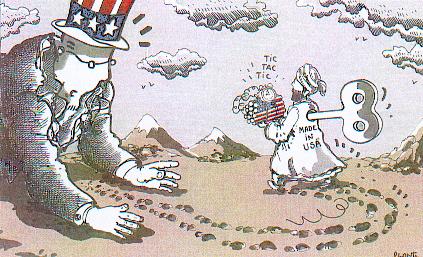
Such was the tenor of Le Monde’s coverage, in effect, just one week after the attacks. The monotonous drone of denunciations continued as the prospect of a military strike against Afghanistan materialized in the weeks ahead, with distraught “New York Jews,” Pashtun warlords and the estranged son of the “O’Dea,” the archetypal all-American family, all chiming in to register their protest and all sounding surprisingly like “third-worldist” Parisian intellectuals – or even indeed like the publisher of Le Monde. (Among other things, the legend of the squandered sympathy occludes the fact that even while a substantial majority of Europeans polled, including in France and Germany, showed spontaneous understanding for American military actions in Afghanistan, large swaths of Europe’s socialist and social-democratic intelligentsia opposed any American military response to the 9/11 attacks whatsoever.) The “boomerang” image went on to become the favored heuristic device of Le Monde and its affiliated publications in their treatment of 9/11. Thus the first issue of the monthly Monde Diplomatique to appear following the events bore the thematic headline “Boomerang Effect” [it also has an article by Maureen Dowd]. In a pictorial variation on the same theme, a special insert in Le Monde itself featured a cartoon depicting a little wind-up Taliban doll, “Made in USA” emblazoned across its back, carrying red, white and blue explosives and circling back toward Uncle Sam.
It was likewise in the pages of Le Monde, and again just one week after the attacks, that the fevered suspicions which would later propel the success of lunatic left best-sellers on both sides of the Atlantic first found their way into print: No, the attacks were not merely a comprehensible, perhaps then even legitimate, response to US domination around the world. The attacks were in fact the work of “the Americans” — the ubiquitous Americans — themselves! In an op-ed piece titled “I Don’t Feel American”, one Marie-José Mondzain of France’s prestigious National Center for Scientific Research (CNRS) offered up a delirious brew of truths, half-truths, confusions, and pure fantasies, all seemingly conspiring, by way of some dizzying logical leaps, toward the conclusion that the U.S. government had itself sponsored the hijackers. …
In this connection as well, incidentally, the New York Times managed to miss the story, even indeed obscure it, while ostensibly reporting the story. The Times mentioned Mme. Mondzain’s piece in an article published on September 22 under the title “In Europe, Some Critics Say the Attacks Stemmed From American Failings”. It neglected, however, to note that the gist of Mme. Mondzain’s piece was not that the attacks “stemmed from American failings”, but that, in effect, America did it. Whether this was the result of mere incompetence or a conscious editorial decision to shield American sensibilities from the extremes of French fury, only the reporter and his editor can know for sure. But it should be noted that the Times piece also misidentifies Mondzain … Such lapses suggest that the New York Times’s reporters lack the requisite linguistic skills and/or cultural familiarity to report accurately even on a country as generally accessible to Americans as France – a possibility which should give us profound cause to pause concerning the accuracy of their dispatches from more exotic venues. And where real knowledge is lacking, ideological "intuitions" can no doubt be expected to fill the void.
“Europe’s Catastrophe”
On the whole, the initial response to the attacks in the German media was more subdued and less equivocal than that in the French media. It was notable, however, and a sign of things to come that the German press very quickly and almost universally adopted words invoking retaliation [Vergeltung] or even revenge [Rache] to describe prospective American military action, thus tacitly dismissing in advance the legal justification for such action, viz. security and legitimate defense. Within just a few months, the prestigious German weekly Die Zeit had begun to play much the same role as respectable “ventilator” of anti-American ressentiments in Germany as Le Monde was playing in France. …
Eschewing the [common] “Hitler” allusion for classical mythology, [the fashionable Slovenian philosopher Slavoj Zizek] made the downright hallucinatory suggestion that America’s response to 9/11 amounted to nothing less than a new “rape of Europa.” This was apparently supposed to be because “the Europeans” had not been able to prevent the attack on Afghanistan, nor impose “their” solution to the Mideast crisis. “The true political-ideological catastrophe of September 11 is in fact Europe’s catastrophe,” Zizek wrote, thus apparently placing European hurt-feelings above the dead and wounded of America, or even indeed Afghanistan, in the scale of human calamities. “It is not the resistance of the Third World against American imperialism,” he concluded, “but only united Europe that is able to stand up to the world powers, the USA and China. The left should therefore without hesitation make its own the motto of a united Europe as a counter-power [sic.] to Americanized Globalism.”
The co-publisher of Die Zeit is, incidentally, Michael Naumann, formerly Minister of Culture in the Schröder government. … Given this context, the seemingly off-the-cuff remarks made a few months after Bush’s Berlin visit by then German Minister of Justice, Herta Däubler-Gmelin, comparing the President’s threats of military action against Iraq to the war-mongering of an Adolf Hitler, should not have come as any surprise. Following the narrow re-election of his “red-green” coalition, Gerhard Schröder quickly let it be known that Frau Däubler-Gmelin would not form part of his new government … however … there is reason to believe that these comments were not so unstudied as has generally been assumed: that, in effect, Frau Däubler-Gmelin may have taken one for the team. …
The Iraq War and European Anti-Americanism
It should be noted that the examples I have here cited come essentially from the first few months after the 9/11 attacks through the middle of May 2002, i.e. before even just the diplomatic mobilization for the Iraq war, let alone the military mobilization, had begun. They are drawn, moreover, from the two newspapers that arguably have the most powerful influence on the formation of “mainstream,” ostensibly educated, opinion in France and Germany respectively. They are not drawn from the fringes. This suggests that there is indeed a relationship between the Bush administration’s Iraq policy and rampant anti-Americanism in the Franco-German “core” of Europe. It is not, however, the relationship that is customarily supposed. It was not the nature of Bush’s policy that provoked the anti-American rage; it was rather the daily dosage of anti-American conditioning in the French and German media that predisposed the more susceptible sections of the public to assume nefarious motives behind a policy whose rationale in light of 12 years of Security Council Resolutions on Iraq and in the aftermath of the 9/11 attacks was reasonably straightforward and obvious. For someone who imaginatively associated America with death’s heads, dollar signs and globes dripping in blood or who believed George W. Bush was the reincarnation of Adolf Hitler — a notion which implies, incidentally, that roughly half of the American electorate are Nazis — it was certainly not a great leap to believe that America invaded Iraq to control Iraqi oil rather than to neutralize a security threat. The fact of the matter is that a public systematically nourished on such phantasms was not by and large going to support Bush’s Iraq policy NO MATTER WHAT.
The conduits by which these European phantasms have in the intervening years managed to infiltrate the political debate in the US as well is a subject deserving attention in its own right.

Blogs on the Block
I've been wanting to give some publicity to a handful of blogs for some time; three French blogs — la minute du sablier, Stalker, balagan (including the latter's support for Dubya) — and two Swedish blögs — Stambord and Gudmundson.
Last, but not least (not by a long shot), there is the Transatlantic Intelligencer…
In Denmark, Leica, Jiminico, Jordan, and Cairo Are OK; Jett, Anus, Pluto, and Monkey Are Not (How About Molli Malou?)
My (Danish) Dad wanted to call me Haldan (a Viking name meaning "half-danish"), an entirely acceptable (if uncommon) name in Denmark. My (American) Mom said "Go jump in the lake, buster!" Tak, Mor.
Denmark, a country that embraces rules with the same gusto that Italy defies them…
Incidentally, what one Dane calls very Scandinavian — the jantelov saying that "You shouldn't stand out from anyone else here; you shouldn't think you are better than anyone else" — is in fact very European, and it regulates much of the Old Continent's condescending attitude towards go-ahead America.
Saturday, October 09, 2004
But Kowtowing and Guang Xi Are Not French Words…
If Boxun News is to be believed, don't fret about losing Saddam as a customer, Chirac has found a new one. But not to worry, there are no weapons involved, and nothing (like oil) that pollutes the environment, so rest assured, this deal is entirely legitimate. (Apparently, while Beijing is involved in human rights talks with the EU, it is cracking down on free expression at home.)
But hey! As long as Chirac knows what's illegal and what isn't and who to criticize and who not to…
But hey! As long as Chirac knows what's illegal and what isn't and who to criticize and who not to…
(Shisheh, GPR)
La différence entre les USA, l'Iran, et les autres dictatures…
En se basant sur des faits divers se passant aux États-Unis (prison pour une journaliste du New York Times refusant de citer ses sources, le site contestataire Indymedia coupé après une descente du FBI), Léon, l'un de nos détracteurs (et grand maître dans l'usage du copier-coller), a l'habitude de poser la question suivante, suivi d'un smiley suffisant et méprisant :
QUELLE EST LA DIFFERENCE FINALEMENT ENTRE LES USA, L'IRAN ... ET LES AUTRES DICTATURES ???????Tentons d'apporter un début de réponse…
La première différence entre les USA, l'Iran, et les autres dictatures, Léon, c'est que tu es au courant de l'évènement qui fait que tu puisses poser cette question. Si cela avait été tenu au secret, s'il n'y avait pas eu de journalistes présents (nationaux ou étrangers, occidentaux ou autres), tu ne saurais pas le nom de la journaliste ou du site, et tu ne serais même pas au courant de ce qui s'était passé (ou qu'il s'était passé un quelconque événement de ce type). (N'est-ce pas là, par ailleurs, l'une des raisons que nombre de gens — et de gouvernements et d'associations caritatives — sont tellement indulgents envers les dictatures — les vraies — de par ce monde?)
Tu es au courant d'évènements de ce type, parce que des journalistes ont écrit à propos de ces évènements, des journalistes qui, pour certains, sont tout aussi outragés que toi, et qui ne craignent pas des sanctions de l'État ou même d'être virés de leur journal. Et qui savent que si sanctions il pourrait y avoir, ces sanctions pourraient facilement, dans l'opinion publique, se retourner contre les sanctionneurs. Dans les "autres" dictatures, il n'y a pas d'opinion publique, ou il n'y en a pas, d'opinion publique, qui vaille. Ce qui nous amène au point suivant…
La seconde différence entre les USA, l'Iran, et les autres dictatures, c'est que l'évènement — étant connu de tous — a suscité une polémique, et a suscité, ou suscitera vraisemblablement, un procès. Si les accusés perdent parfois leurs procès, parfois ils les gagnent, et le tribunal est ouvert aux journalistes — à des journalistes indépendants —, souvent au public. Quel que soit l'issue du procès — et c'est ça qui compte par-dessus tout —, la polémique restera, et sera garant du fait que les adversaires de l'administration au pouvoir peuvent s'en servir pour embarrasser le gouvernement, ou l'attaquer — exactement comme tu le fais — et, qui sait, peut-être le pénaliser lors des prochaines élections.
La troisième différence entre les USA, l'Iran, et les autres dictatures, c'est que la sanction, si sanction il y a, risque d'être fair. Dans les cas de condamnation, l'accusé a le droit de faire appel ; non seulement il a ce droit mais il aura le soutien direct d'organisations, parfois puissantes (comme le New York Times), et il aura le soutien, indirect, d'une partie de la population (comme toi). Au cas où il perdrait son appel (ou ses appels, s'il en fait plusieurs), sa punition n'entraînera rien qui n'ait pas été décidé par un juge officiel selon les lois : pas de coupures de langue, pas d'amputations de bras au niveau de l'épaule, pas d'acide dans le visage, pas de viol collectif de l'épouse enceinte suivi de l'ouverture au couteau du ventre de celle-ci afin d'en arracher le bébé et, ce faisant, tuer et ce dernier et la mère. Et au cas où des gardiens abuseraient du prisonnier, ou de la prisonnière, eux, ainsi que les autorités pénales, seraient sanctionnés eux-mêmes, tandis que le gouvernement souffrirait au moins de l'embarras dans l'opinion publique et par la remise en question par un nombre de ses supporters (cf. la pénalisation lors des élections qui suivent)…
Voilà un petit début de réponse, Léon…
As-tu d'autres questions?
(PS : Sinon, nous serions très heureux de lire les autres commentaires que tu auras écrit ailleurs sur la toile. Nous serions heureux — puisque tu mets les USA, l'Iran, et les "autres" dictatures sur un même plan — que tu nous présentes des hyperliens vers d'autres sites (des permalinks) dans lesquels tu auras écrit et signé des commentaires indignés sur les abus et les dépradations en Iran et dans les autres dictatures… (En attendant, nous retenons notre souffle…))
Histoire de la France (III) — A Man Incapable of Hiding His Disdain for American Policies
 John J. Miller & Mark Molesky:
 … on the day Osama bin Laden's henchmen brought unimaginable terror to the United States, [Jacques] Chirac seemed genuinely moved. In a display of goodwill and solidarity, he rushed to the side of President George W. Bush. His government supported American military action in Afghanistan and sent peacekeepers to assist the post-Taliban government. Yet September 11 did nothing to alter France's fundamental approach to global affairs. Chirac made it clear that he was skeptical of extending the war on terrorism beyond the borders of Afghanistan. When Bush spoke of an "axis of evil" that included Saddam Hussein's Iraq in early 2002, Paris snickered: "The rhetoric of good and evil is not suitable for the reality of today's world," said a Chirac confidant. One top French official, Charles Josselin, told a Saudi newspaper that the Bush administration suffered from "Texas-style diplomacy" — a phrase meant as an insult in European circles. Former foreign minister Hubert Védrine was even more outspoken: "Today we are threatened by a simplicity that reduces all the problems of the world to the struggle against terrorism that is not properly thought through," he said.
Franco-American relations deteriorated at the popular level as well. In France, ugly conspiracy theories about September 11 became disturbingly prevalent. One of the most sinister was cooked up by Thierry Meyssan, a self-styled investigative journalist who claimed in his book L'Effroyable Imposture — "The Big Lie" — that the common understanding of what happened was based on "nothing more than a cover-up" and "lies put forward by officials." According to Meyssan, "the attacks of September 11 were masterminded from inside the American state apparatus" — i.e., George W. Bush — as a justification for reckless warfare. By the summer of 2002 — long before Michael Moore became a household name — L'Effroyable Imposture had sold more than 200,000 copies in France.
As the first anniversary of September 11 approached, Chirac tried to minimize his profound differences with the United States by relying on that old standby in the French politician's playbook: the enduring myth of Franco-American friendship. "When the chips are down," he declared, "the French and Americans have always stood together and have never failed to be there for one another." At the same time, he proved incapable of hiding his disdain for what he took to be America's hamfisted approach to international problems. "I am totally against unilateralism [i.e. American foreign policy] in the modern world," he said. The emerging American doctrine of pre-emptive action to thwart national-security threats, he added, was "extraordinarily dangerous." But after the carnage of 9-11, the United States was not interested in waiting for its enemies to strike. It would move against them before they could mount an effective attack.
(Shookhran beaucoup, Gregory Schreiber)
Histoire de la France (II) — "France and her honor are at stake"
John J. Miller & Mark Molesky:
Disclaimer: You do not need to tell me that Vichy France should not be confused with the rest of the nation and its citizens. We agree on that. And so, I suppose, do the book's authors.
As the lead ship neared the boom at the mouth of the harbor [on November 8, 1942], a single question animated the mind of all on board: Would the French resist? In the weeks leading up to the invasion, diplomats and intelligence officers had assured the American military that they would not. They were counting on French gratitude earned in the First World War. "Our latest and best information from North Africa," wrote President Franklin Roosevelt to British Prime Minister Winston Churchill, "is ... [that] an American expedition led in all three phases by American officers will meet little resistance from the French Army in Africa." …
Then the French guns opened up. Guided by spotlights from shore, machine gun tracers sprayed out across the dark water, followed by a withering artillery barrage. From the docks and jetties, French snipers squeezed off round after round. Neither the large and conspicuous U.S. flags flying from both ships nor the repeated calls over a loudspeaker in American-accented French — "Do not fire! We are your friends! Do not Fire!" — had any effect. …
For the next three days, the Americans faced fierce fighting across twelve separate battlefields in Algeria and French Morocco. American GIs comprised the bulk of the landing force on the theory that they would antagonize the French less than the British. But the French Premier, Marshal Henri Philippe Pétain, refused to back down. "France and her honor are at stake," he cabled President Roosevelt. "We are attacked. We will defend ourselves. This is the order I am giving." Only superior numbers and American tenacity made Operation Torch a success. "Had the landings been opposed by the Germans," admitted General George S. Patton, "we would never have gotten ashore."
It is widely believed that Vichy was a weak puppet regime that cooperated reluctantly with the Nazis and put up only a token resistance to Allied forces. … The reality was quite different, as the Americans discovered in North Africa.
Still, please notice that Pétain uses, if not the same wording, the same sentiments used by leaders of latterday France: La France et son honneur sont en jeu. Tell a citoyen that one should not blindly follow Washington, that allies need to be able to disagree and not ask each other to be each other's poodles — whether a rightist or a leftist — and he will readily agree, not noticing that this statement is never made about any other country (Soviet Union, China, Saddam Hussein's Iraq, etc…), and in agreeing, the citoyen will turn a blind eye to the fact that, willingly or not, the distance taken vis-à-vis the democracy ("false" or otherwise) is often made for the benefit (direct or indirect) of the same authoritarian countries.
Notice also that the "ability to disagree" sentiment does not apply to France itself; other countries are asked to follow Paris blindly, and if not, they can expect to be called poodles, turncoats, or impolite people who would do better to keep quiet.
Finally, it is strange that regarding America, the comment is often (always?) made that we should not trust official history and we should seek out the dark spots ("Tu crois tout ce qu'on te dit? >snicker< "). When this is attempted, even only on a relatively small scale, with French history, a multitude of shields arises in fury.
(Shookhran beaucoup, Gregory Schreiber)
Histoire de la France (I): Some French Allies Showed — Surprise! — Disdain for America's Untrustworthy Provincials
During the War of Independence, the American revolutionaries had invaluable allies and friends noble and true like the legendary Lafayette. They also had Charles-Hector d'Estaing, a headstrong and pompous nobleman who claimed the last king of the Visigoths as an ancestor…
John J. Miller & Mark Molesky:
Even then, Lafayette's mediation failed. A professional military man, d'Estaing regarded the Americans as untrustworthy provincials: "I was forced to show an austere firmness to make the allies understand that while their troops were good for a defensive, they had no qualities necessary for attack." When the Americans attacked a weakness in the British defenses without first consulting d'Estaing, the admiral was furious. "The French officers sounded like women disputing precedence in a country dance," said one of Sullivan's colonels, "instead of men engaged in pursuing the common interest of two great nations."
…As the British sailed for the repair docks of New York, Sullivan decided that his attack had been delayed long enough. Assuming that d'Estaing would soon be landing his soldiers, he struck at Newport on August 14 [1778]. But the Frenchman had other plans. Anxious to patch up his own ships, d'Estaing retreated to Boston without putting any troops ashore.
Sullivan was furious: "I confess that I do most cordially resent the conduct of the Count, or rather the conduct of his officers, who have it seems, compelled him to go to Boston and leave us on an island without any certain means of retreat." Another American commander, John Laurens, complained in a letter to Washington: "The honor of the French Nation, the honor of the Admiral, the safety of the fleet, and a regard for the new alliance required a different conduct."
The alliance that had been born half a year earlier was now in full crisis as d'Estaing considered sailing back to France and urging his king to forsake the vulgar Americans.
(Mes remerciements profonds vous accompagnent,
Sire le Chevallier Grégoire de Schreiber)
Friday, October 08, 2004
How many I's in the word "Europe"?
Today is the birthday of Edward Rickenbacker, the US war hero and airline executive (1890-1973) who said:
The four cornerstones of character on which the structure of this nation was built are: Initiative, Imagination, Individuality, and Independence.
Courage is doing what you're afraid to do. There can be no courage unless you're scared.
Aviation is proof that given the will, we have the capacity to achieve the impossible.
I would rather have a million friends than a million dollars.
I can give you a six-word formula for success: 'Think things through — then follow through.'
3 Weeks Before Election, Book Appears to Show France Would Be Perfect Ally If It Weren't for Dubya
We are informed that a Glenn Kessler article in The Washington Post (regarding alleged French willingness and preparations to assist in the U.S.-led attack on Saddam's Iraq) is something ¡No Pasarán! would never post about. Nonsense. Of course we would (provided we were/are informed of it). And here it is.
After a closer look, it turns out that the article is not — as implied! — a straight news item, the product of independent and objective news reporting (from reporters in the vein of those who uncovered, say, the Watergate scandal), but more of a book review, of a book which happens to be, at least partly, an apology of French government policy. Read excerpts from the Kessler article, then read our comments below…
Apparently, according to our detractor, ¡No Pasarán! would never publish this because it shows France in a good light and Dubya in a bad one, while giving credence to the (self-serving) opinion that, bien sûr, America's traditional allies were totally ready to stand by the side of Uncle Sam, and would have done so, except for the fact that an arrogant neanderthal was occupying the Oval Office. Well, we here at ¡No Pasarán! do not think ourselves as particularly biased, we just think people should think twice before accepting the "peace camp's" (self-serving) anti-Bush points of view…French officials were prepared to provide as many as 15,000 troops for an invasion of Iraq before relations soured between the Bush administration and the French government over the timing of an attack, according to a new book published in France.
The book, Chirac Contre Bush: L'Autre Guerre (Chirac vs. Bush: The Other War), reports that a French general, Jean Patrick Gaviard, visited the Pentagon to meet with Central Command staff on Dec. 16, 2002 — three months before the war began — to discuss a French contribution of 10,000 to 15,000 troops and to negotiate landing and docking rights for French jets and ships.
French military officials were especially interested in joining in an attack, because they felt that not participating with the United States in a major war would leave French forces unprepared for future conflicts, according to Thomas Cantaloube, one of the authors. But the negotiations did not progress far before French President Jacques Chirac decided that the Americans were pushing too fast to short-circuit inspections by U.N. weapons inspectors.
Chirac, the book says, was prepared to join in an attack if Iraqi President Saddam Hussein had not allowed inspectors into Iraq. "Up until December 2002, what everyone told us is that France thought Saddam Hussein was going to make a mistake and not allow inspections," Cantaloube said in an interview. After inspectors appeared to make progress in Iraq, Chirac's thinking changed, especially after polls in France showed vast opposition to an attack. …
Chirac knew Bush's father, former president George H.W. Bush, well, but that relationship actually proved to be a distraction for the current president, according to the book, which says that Bush was annoyed that Chirac kept mentioning his father at every occasion. For months, French diplomats asked Chirac not to refer to Bush's father when he met the president, but he kept doing it.
During one of Bush's first European trips, when the new president impressed other European leaders at a summit, Chirac excitedly pulled out his cell phone to call Bush's father to report that the new president had done a great job. …
And so, we must be led to ask this:
- Why has this, this information of momentous importance, not been seen, or heard of, before? Specifically, why was it not announced, officially or unofficially, in declarations or in leaks, government-controlled or not, after the Iraq war? Why did it not transpire during the Iraq war? Why did it not do so before the Iraq war, during the UN negotiations?
- Does it not make sense that individuals, media outlets, and government officials opposed to Bush (both foreign and American) would have leaked and/or made use of this bit of news had the French preparations really been so extensive?
- Why does the book appear now? Why now, in October 2004?
2) Perhaps, second, it is being transpired now to put the heat back on Bush just as an important report shows that Saddam used cash stolen from the UN's flawed oil-for-food programme to induce the Security Council's "peace camp" members to thwart their Anglo-American allies.
3) Who, in a France that is united behind Chirac and Villepin's "heroic" and principled opposition to the Bush administration, will care (much) about the UN graft scandal, should it turn out that the war-mongering devil incarnate is defeated on November 2?
Might it be that, like the DVD version of Michael Moore's anti-Bush documentary, and with prompting from the Elysée palace, that this book is actually an instrument in the campaign — like Fahrenheit 9/11, unsolicited by the Democrat party, but an instrument nonetheless — to contribute to John Kerry's election victory? And thereby take any heat off the Elysée? (It appears that the timing of the publication of the book turns out to be one more Chirac snub that ought to figure in the book itself. Assuming Kerry wins, you can rest assured that, once he is in the White House, there will feelers sent to the Oval Office for payback in some form or another…)
(Merci to Amatriciana; this is one of
the better items we have received lately)
A POEM TO FRANCE
Eleven thousand soldiers
Lay beneath the dirt and stone,
All buried on a distant land
So far away from home.
For just a strip of dismal beach
They paid a hero's price,
To save a foreign nation
They all made the sacrifice.
And now the shores of Normandy
Are lined with blocks of white :
Americans who didn't turn
From someone else's plight.
Eleven thousand reasons
For the French to take our side,
But in the moment of our need,
They chose to run and hide.
Chirac said every war means loss,
Perhaps for France that's true,
For they've lost every battle
Since the days of Waterloo.
Without a soldier worth a damn
To be found within the region,
The French became the only land
to need a Foreign Legion.
You French all say we're arrogant.
Well hell, we've earned the right
We saved your sorry nation
When you lacked the guts to fight.
But now you've made a big mistake,
And one that you'll regret ;
You took sides with our enemies,
And that we won't forget.
It wasn't just our citizens
You spit on when you turned,
But every one of yours
Who fell the day the towers burned.
You spit upon our soldiers,
On our pilots and Marines,
And now you'll get a little sense
Of just what payback means.
So keep your Paris fashions
And your wine and your champagne,
And find some other market
That will buy your airplanes.
And try to find somebody else
To wear your French cologne,
For you're about to find out
what it means to stand alone.
You see, you need us far more
Than we ever needed you.
America has better friends
Who know how to be true.
I'd rather stand with warriors
Who have the will and might,
Than huddle in the dark
With those whose only flag is white.
I'll take the Brits, the Aussies,
The Israelis and the rest,
For when it comes to valor
We have seen that they're the best.
We'll count on one another
As we face a moment dire,
While you sit on the sideline
With a sign, "friendship for hire."
We'll win this war without you
And we'll total up the cost,
And take it from your foreign aid,
And then you'll feel the loss.
And when your nation starts to fall,
Well Frenchie, you can spare us,
Just call the Germans for a hand,
They know the way to Paris.
Don Fichthorn, Major USMC (Retired)
Thanks to Balagan.
Eleven thousand soldiers
Lay beneath the dirt and stone,
All buried on a distant land
So far away from home.
For just a strip of dismal beach
They paid a hero's price,
To save a foreign nation
They all made the sacrifice.
And now the shores of Normandy
Are lined with blocks of white :
Americans who didn't turn
From someone else's plight.
Eleven thousand reasons
For the French to take our side,
But in the moment of our need,
They chose to run and hide.
Chirac said every war means loss,
Perhaps for France that's true,
For they've lost every battle
Since the days of Waterloo.
Without a soldier worth a damn
To be found within the region,
The French became the only land
to need a Foreign Legion.
You French all say we're arrogant.
Well hell, we've earned the right
We saved your sorry nation
When you lacked the guts to fight.
But now you've made a big mistake,
And one that you'll regret ;
You took sides with our enemies,
And that we won't forget.
It wasn't just our citizens
You spit on when you turned,
But every one of yours
Who fell the day the towers burned.
You spit upon our soldiers,
On our pilots and Marines,
And now you'll get a little sense
Of just what payback means.
So keep your Paris fashions
And your wine and your champagne,
And find some other market
That will buy your airplanes.
And try to find somebody else
To wear your French cologne,
For you're about to find out
what it means to stand alone.
You see, you need us far more
Than we ever needed you.
America has better friends
Who know how to be true.
I'd rather stand with warriors
Who have the will and might,
Than huddle in the dark
With those whose only flag is white.
I'll take the Brits, the Aussies,
The Israelis and the rest,
For when it comes to valor
We have seen that they're the best.
We'll count on one another
As we face a moment dire,
While you sit on the sideline
With a sign, "friendship for hire."
We'll win this war without you
And we'll total up the cost,
And take it from your foreign aid,
And then you'll feel the loss.
And when your nation starts to fall,
Well Frenchie, you can spare us,
Just call the Germans for a hand,
They know the way to Paris.
Don Fichthorn, Major USMC (Retired)
Thanks to Balagan.
In Today's World, What Is the Catastrophe for the World that Chirac Warns Of?
The AFP announces that — once again — the sophisticated citizens of France have their priorities straight and are capable of seeing the true dangers facing the world we live in…
French President Jacques Chirac warned Thursday of a "catastrophe" for global diversity if the United States' cultural hegemony goes unchallenged.Needless to say, once John Kerry has been elected, once Bush has been defeated, France's warnings over the "catastrophe" of a world "choked" by US values will vanish into thin air, there will be no more ranting about "cological catastrophes", the French will once again stand side by side by their American friends, and everything will be alright again…
Speaking at a French cultural centre in Hanoi ahead of Friday's opening of a summit of European and Asian leaders, Chirac said France was right to stand up for cultural and linguistic diversity.
The outspoken French president warned that the world's different cultures could be "choked" by US values.
This, he said, would lead to a "general world sub-culture" based around the English language, which would be "a real ecological catastrophe".
Citing Hollywood's stranglehold over the film industry as an example, Chirac stressed that only with government assistance could countries maintain their cultural heritage.
Vietnam is a former French colony, but only around 375,000 of its 81 million people speak French. English is considered by most people a far more valuable and practical second language, particularly among businessmen.
(Thanks to Gregory Schreiber)
| Chiraq goes for the money shot in Hanoi | Chirak balance la purée à Hanoï |
| Chiraq confirms. It's not just about Bush. It's about across the board hatred of all Americans and their stinking sub-culture. Americans, you are hated here. Hated more than you can possibly imagine.
| Chirak le confirme. Il ne s'agit pas uniquement de George Bush, mais d'une haine universelle contre tous les américains et leur sous-culture merdique. Les américains, vous êtes haïs ici. Haïs bien plus que vous ne pouvez l'imaginer.
|
Thursday, October 07, 2004
If the Iraq Survey Group's report is embarrassing for the British and US governments, for those of Russia, France, and China, it is damning…
…the Iraq Survey Group does not confine itself to WMD. … If the report is embarrassing for the British and US governments, for those of Russia, France and China, it is damning. … The motives of those states that went to war emerge as far less tainted than those that opposed it. If the British and Americans were duped by Saddam, the Russians and French had their palms greased by him. … The stench of his crimes lingers, not only in Iraq but also at the UN.You've heard how the Iraq Survey Group has concluded that Iraq had no weapons of mass destruction. You've also heard about Iraq being Bush's "weapon of mass distraction" and other barbs in the same vein. Now, the Daily Telegraph brings us Saddam's weapons of mass corruption:
Nobody will have been surprised by the conclusion of the Iraq Survey Group that Saddam Hussein did not possess weapons of mass destruction.
Tony Blair and George W. Bush were both mistaken on this point, along with almost everybody else, including UN weapons inspectors and even Saddam's henchmen. But the Iraq Survey Group does not confine itself to WMD. It also marshals a wealth of evidence about Saddam's campaign of bribery, designed to weaken the sanctions regime and persuade the Security Council not to enforce its resolutions or to pass new ones.
If the report is embarrassing for the British and US governments, for those of Russia, France and China, it is damning. Saddam used cash stolen from the UN's flawed oil-for-food programme to induce these permanent members of the Security Council to thwart their Anglo-American allies. The motives of those states that went to war emerge as far less tainted than those that opposed it. If the British and Americans were duped by Saddam, the Russians and French had their palms greased by him.
Even so, the absence of WMD will reinforce doubts about the wisdom of the war on both sides of the Atlantic. Mr Bush was already on the defensive after Donald Rumsfeld's admission that there was no "strong, hard evidence" of Iraq's links with al-Qa'eda, and Paul Bremer's acknowledgement that his task as post-war governor of Iraq was vitiated by too few troops.
Was it all a mistake? On the contrary: the real case for war, consistently argued in these pages, depended neither on WMD nor on the al-Qa'eda connection. Saddam had to be deposed for both strategic and moral reasons, which have broadly been vindicated. Though the war on terror is far from over, the threat from terrorist states has diminished. If free Iraq can stay the course — by holding elections, by putting Saddam on trial, and by defeating the insurgency — it will have a profound impact on the other despots of the Middle East and beyond.
If anything, the report reinforces the case for regime change, by demonstrating the malign influence that Saddam's Iraq exerted over the entire international system. His capacity for genocide had indeed decayed, but by 2003 he was no longer the pariah he had been in 1991.
Having corrupted and undermined the sanctions regime, Saddam was more dangerous than ever before. The stench of his crimes lingers, not only in Iraq but also at the UN. The justification offered for the war by Mr Blair may have been the wrong one, but it was still a just war.
Subscribe to:
Posts (Atom)