
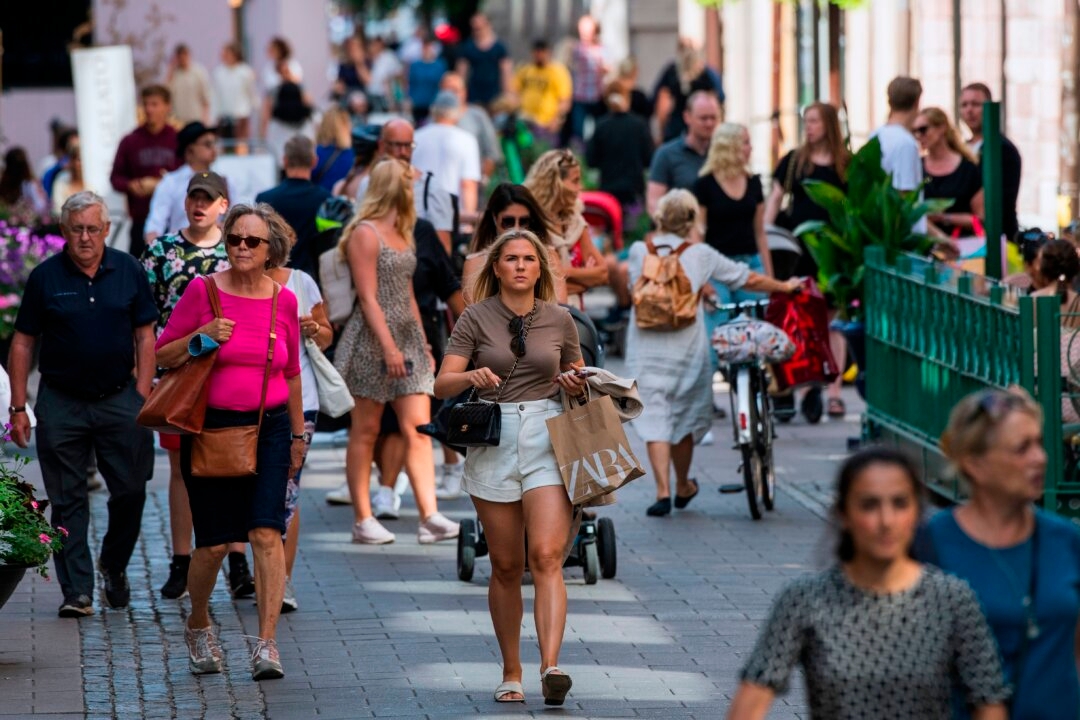
Nordic countries are often used as models of “good” socialism by leftists, such as Sen. Bernie Sanders, the Clintons, and former President Barack Obama. In 2010, National Public Radio praised Denmark as “a country that seems to violate the laws of the economic universe.” Although having high taxes, it had “one of the lowest poverty rates in the world, low unemployment, a steadily growing economy, and almost no corruption.”In 2003, Sweden’s social democratic former Prime Minister Goran Persson used a bumblebee as an example to illustrate his country’s economy: “With its overly heavy body and little wings, supposedly it should not be able to fly—but it does.”
Nima Sanandaji, a Swedish researcher and author, wrote the book “Scandinavian Unexceptionalism: Culture, Markets and the Failure of Third-Way Socialism,” which provides a very good explanation of the realities in Nordic countries. Let me summarize the book for you in case you don’t have time to read it.Culture—Not Welfare State—Led to Nordic Countries’ Success
“A Scandinavian economist once said to Milton Friedman (U.S. economist, 1976 Nobel Prize laureate in economics): ‘In Scandinavia, we have no poverty.’ Milton Friedman replied: ‘That’s interesting, because in America, among Scandinavians, we have no poverty, either.’”—Joel Kotkin, professor, Chapman UniversityThe welfare state isn’t the reason for the Nordic countries’ success. The Scandinavian societies had achieved low income-inequality, low levels of poverty, and high levels of economic growth before the development of the welfare state.
… Protestants tend to have a very strong work ethic; a very hostile natural environment make Scandinavia a difficult place to survive unless a farmer works exceptionally hard; many farmers own their own land and have complete control over the fruits of their labor, so it has been financially rewarding to work hard.
Culture matters. It’s the culture, along with free-market capitalism and the rule of law, that has made the Nordic countries prosperous, and made it possible for them to implement welfare policies without serious adverse consequences. It’s also the culture that has fostered the success of the descendants of Scandinavian immigrants to America. Most of those migrants came to America in the 19th century before the implementation of welfare state policies. They weren’t elite groups, but their descendants are more successful than their cousins in Scandinavia, which suggests that the welfare state policies have impeded the growth of economy.
…
Welfare-State Policies Weaken Nordic Cultures and Values
“It took time to build up the exceptionally high levels of social capital in Nordic cultures. And it took time for generous welfare models to begin undermining the countries’ strong work ethic.”—Nima Sanandaji, Swedish researcherPolicies help to shape the character of a society. As Scandinavians became accustomed to high taxes and generous government benefits, their sense of responsibility and their work ethic gradually deteriorated.
When asked during a 1981–1984 survey if “claiming government benefits to which you are not entitled is never justifiable,” 82 percent of Swedes and 80 percent of Norwegians agreed. But in a similar survey in 2005–08, only 56 percent of Norwegians and 61 percent of Swedes agreed with the statement.
Generous welfare benefits reduce the incentives for taking a job or working hard. It also weakens parents’ incentives to teach their children to work hard. More and more people have become dependent on government welfare payments. And the dependency would pass from one generation to the next. This growing population in turn voted to support more welfare and bigger government, and therefore higher taxation, which has pushed the Nordic countries toward more extremes of socialism.Are Scandinavians More Tolerant of High Taxes? No.
“Fiscal illusion distorts democratic decisions and may result in ‘excessive’ redistribution.”—Jean-Robert Tyran, Swiss economist, and Rupert Sausgruber, Austrian economistScandinavians haven’t been fully aware of the cost of a bigger government. Politicians have created a “fiscal illusion” in which a large portion of taxes is indirect or hidden, such as those in effect before wages are paid, in the form of employers’ fees or employers’ social security contributions, and those included in the listed price of goods, like VAT. These taxes eventually fall on all people, but they aren’t aware of them.… According to a database of the Organization for Economic Co-operation and Development (OECD) and Sanandaji’s calculations, from 1965 to 2013, all Nordic nations’ tax burdens have increased significantly, but most of their visible taxes have decreased, except in Denmark.
This has successfully created an illusion that government expansion wouldn’t cost much. So why not elect politicians who expand government size and increase welfare?A Failed Socialist Experiment in Sweden
“Sweden is the world champion in ‘jobless growth.’”—Headline of a 2006 article in the Swedish business daily Dagens IndustriFrom the beginning of the social democratic era in the 1930s until the 1960s, Nordic countries had remained relatively free market-oriented and had similar tax levels as other industrialized nations. It was at the beginning of the 1970s when radical social democratic policies were adopted, and the fiscal burden and government spending reached high levels.
Sweden went the furthest toward socialism among Scandinavian nations since the late 1960s. The basic idea was to replace free markets with a model closer to a socialist planned economy.
“Not only did the overall tax burden rise, but the new system also discriminated heavily against individuals who owned businesses. As politics radicalized, the social democratic system began challenging the core of the free-market model: entrepreneurship.”
According to Swedish economist Magnus Henrekson, in 1980, “the effective marginal tax rate (marginal tax plus the effect of inflation) that was levied on Swedish businesses reached more than 100 percent of their profits.” This means that a private entrepreneur would actually lose money if he or she made a profit. Henrekson draws the conclusion that the tax policies were “developed according to the vision of a market economy without individual capitalists and entrepreneurs.”
… “When the welfare state could grow no larger, overall job creation came to a halt—neither the private sector nor the public sector expanded.”
…
Finally, Welfare Reform
“Sweden was the more socialist of the Scandinavian countries a few decades ago. It is also the country that has reformed the most.”—Nima Sanandaji, Swedish researcherBeginning in the 1990s, almost all Nordic nations realized that welfare reform is inevitable, except Norway. In 1969, one of the largest offshore oil fields in the world was found in Norwegian waters. The oil wealth makes it possible to sustain its generous welfare systems. Since Sweden and Norway are quite comparable in many ways except for welfare reform, it’s a great experiment to see the impact of the reform.
The reform in Sweden includes reducing welfare benefits, lowering taxes, liberalizing the labor market, and implementing gate-keeping mechanisms for receiving sickness and disability benefits.
Related: Scandalous News from Norway — What If All the Planet's Welfare Systems — Supposedly Proof of the Left's Superiority Over Capitalist America — Prove to Be Little More Than So Many Scams?


5 comments:
Hey! Great information here on this post. Continue writing like this.
I’ve enjoyed browsing this blog posts. Hope you write again soon Thanks.
Thankyou for publishing a wonderful stories. It just great! Thanks again.
Woah! It’s simple article, yet effective for who will read this. Thanks for sharing.
Extremely helpful info. I love this information. Thank you and best of luck.
Post a Comment