Poverty is the natural, initial state. Society wasn’t just born into affluence; it had to be created.
As new Argentine president Javier Milei reminded attendees at the World Economic Forum in Davos, Switzerland, last month, humans trudged along for hundreds of years at little more than subsistence level.
Then, at the elbow of the classic hockey stick graph he cited, economic growth started skyrocketing. A few things coincided with that.
The Industrial Revolution and the publication of Adam Smith’s Wealth of Nations were two. If the only achievement of that book was promoting the virtues of specialization, it would have been enough.
Another thing happened the same year that Mr. Smith’s book was published: the United States was born. When a society prioritizes simplicity in government, citizens are freer. When they’re freer, they produce and trade more. That is what immigrants found when they came here.

Behind the Façades in France: What expats and the mainstream media (French and American alike) fail to notice (or fail to tell you) about French attitudes, principles, values, and official positions…
Tuesday, April 23, 2024
When a society prioritizes simplicity in government, citizens are freer; When they’re freer, they produce and trade more


Monday, April 22, 2024
Mayorkas Trial Dismissed in the Democrat Senate: A Varvel Cartoon on Two-Tiered Justice

A "Monopoly" card (or cartoon) on two-tiered justice.
Why two-tiered? You're joking, right?
Compare with Donald Trump
(not just now, but over the past decade or so)…
Paraphrasing Eisenhower, Richard Nixon warned against "the Media Élitist Complex"; "Sullivan vs New York Times is in effect a license to lie"
On this, the 30th anniversary of the death of Richard Nixon, we get an excerpt from the oral history collections of the University of Georgia (thanks to Vincent Bourdonneau — as well as to Sarah Hoyt), a number of which seem to have started circulating recently.
Notice notably the 37th president's take on the élites, without seemingly realizing to what extent they were united across country boundaries and borders and to what extent they pose a danger to America and to the world…
The élite class is the same all over the world: they go to the same parties and they drink the [same] cocktails, etc, they have the same snobbish characteristics…
Then we have Nixon Warning of the Media's UNLIMITED Power:
The problem is, that [the media in this country] have a sense of self-righteousness, a double standard on issue after issue after issue. They can find everything wrong with somebody else, but they will not look inside, and ever admit they could be wrong themselves. And — what was involved here, in the Watergate thing, was the unfairness of it. Oh, there was a legitimate thing to investigate, but they refused to balance it. They allowed their advocacy to get ahead of their reporting — which is their job to do.
You know, President Eisenhower, in his farewell address, wrote about, and warned against, the power of the military-industrial complex. … When I get old enough, and decide to retire … I think I would warn against the media-élitist complex. You know, the media is always talking about the imperial presidency — the power of the imperial presidency — I think we oughta hear a little bit of discussion of the imperial media, and its power. … The media's power is unlimited. And some would say, "Well, what about libel suits?" Forget it. After the Supreme Court's decision in Sullivan vs New York Times a few years ago. … I wouldn't like to leave the fate of this country to the editors of the Washington Post. …
Let's face it, Sullivan vs New York Times is in effect a license to lie. … I believe in a free press. I do not want government control under any circumstances, or government censorship, of either radio, television, or newspapers. But I am simply suggesting here that all of the media should look within themselves, look through that microscope at themselves, look in the mirror now and then, rather than looking out there to others.
At the same time, we cannot ignore the outstanding book by Evelyne Joslain, a bona fide French conservative who laments that neither Nixon nor Reagan (no "Reagan revolution", alas, on the cultural front), for all their (undeniable) virtues, seemed to show true awareness of the takeover of the culture by the left and their march through the institutions.
Nixon was … the first Republican president confronted with the [Left's] culture war and viciously harassed by the opposition [while] Reagan did nothing about the persecution of political correctness. He let it happen.In the perspective of all the above, let us jump 25 to 30 years forward, to see the treatment of Richard Milhous Nixon compared with that of Donald John Trump (who, according to La Révolution Culturelle, is the only presidential candidate to see the true nature of the Left):
• Watergate—Trump learned from President Nixon's mishandling of the press: "it is not paranoia when they really are out to kill you"
• Nixon and Watergate: What Do the MSM and History Books Fail to Tell Us About the 1970s Scandal?
• Evidence of Fraud in 2008 Election? A Surprising Number of Parallels with JFK's 1960 Campaign
Saturday, April 20, 2024
"The revelations of this man's crimes": Adolf Hitler and the Depraved Nazis in Private Life
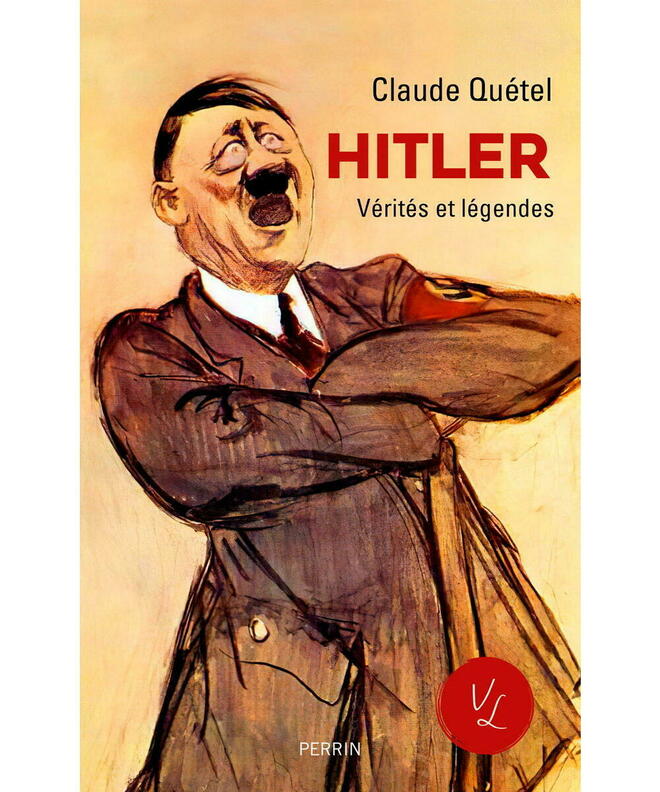
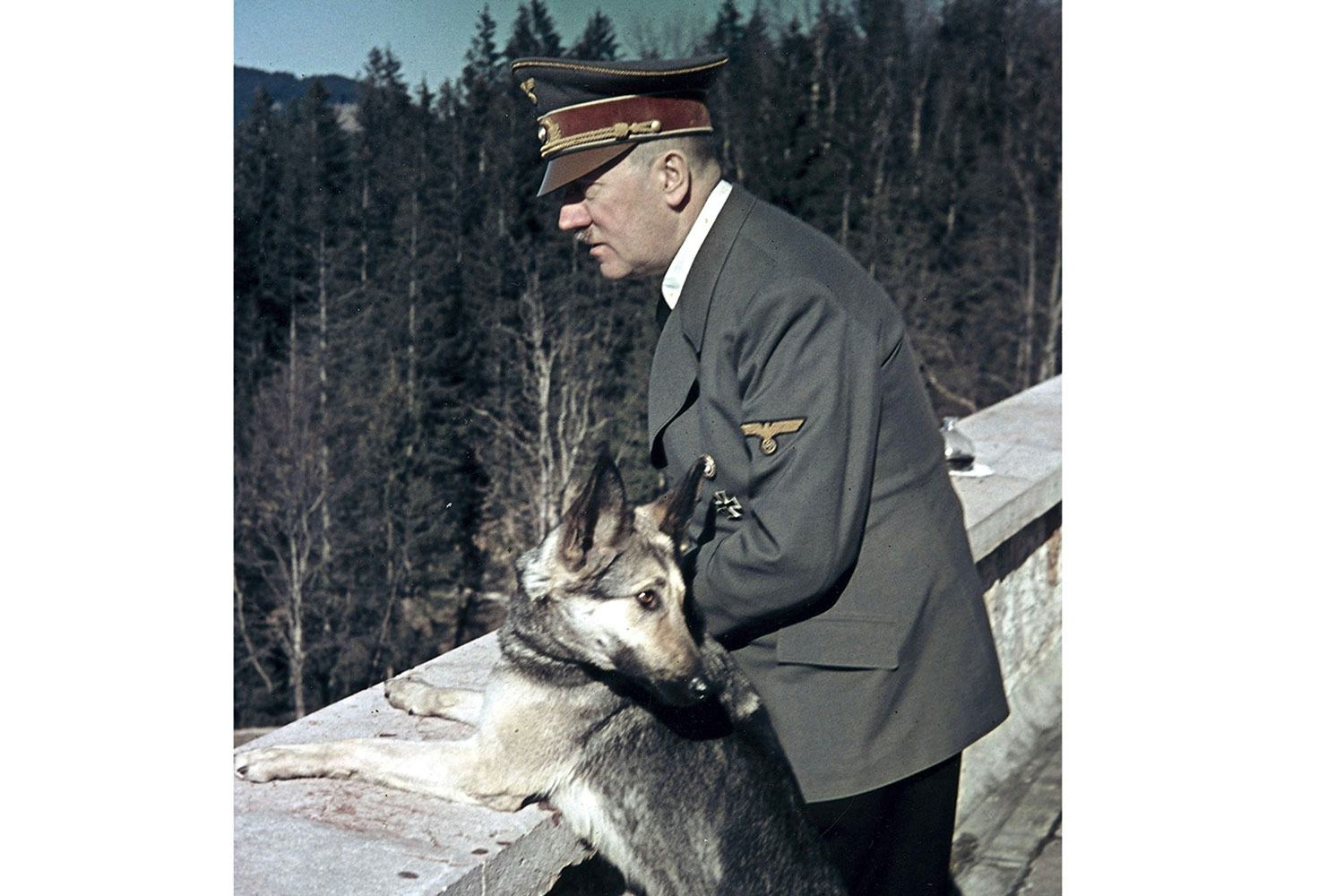 In the past few years, there have been a number of articles and books on Hitler's private life and his inner circle, not least in the Historie monthly, Denmark's History magazine, and the Claude Quétel book
Dans l’intimité d’Hitler (les manies d’un dictateur).
In the past few years, there have been a number of articles and books on Hitler's private life and his inner circle, not least in the Historie monthly, Denmark's History magazine, and the Claude Quétel book
Dans l’intimité d’Hitler (les manies d’un dictateur).
There is much to learn about the Hitler Family and its descendants, including Geli Raubal and Romano Lukas Hitler, along with, needless to say, Eva Braun, Adolf Hitler’s Mistress, Wife, And Suicide Partner — not to mention Hitler's majordomo, Heinz Linge, his personal pilot, Hans Baur, and his secretary (about which, more below).
"Hitler Joins U.S. Navy"
The most interesting member of the Hitler family is perhaps the one who gave rise to the World War II-era newspaper account titled "Hitler Joins U.S. Navy." It turned out not to be Adolf, of course, but Adolf's half-nephew William P. Hitler, who was born and grew up in the British Isles, emigrating eventually to the U.S. not long before Pearl Harbor where he indeed joined the American military during the conflict. (No details on whether William Patrick Hitler served in the Atlantic Ocean, i.e., in the European theater against Germany, or in the Pacific theater — something which seems to be of some importance; by comparison, the 442nd Regimental Combat Team composed of Japanese-American troops [the most decorated unit of the war] did not see action in the Pacific but in Europe.)
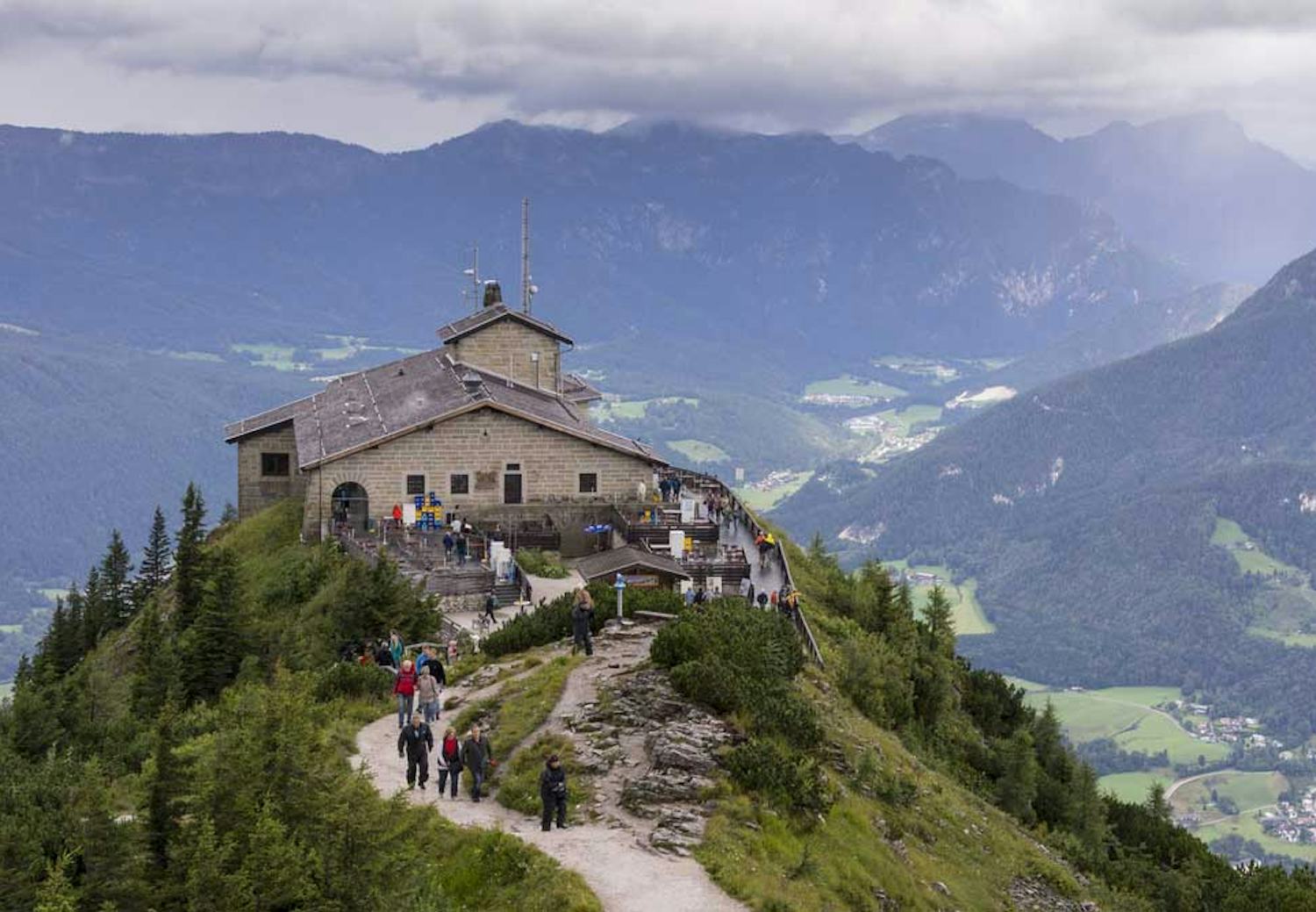
Beyond that, we have information on Hitler's book, Mein Kampf, on Nazi propaganda, on Hitler's Supporters, on Hitler's election, on Kristalnacht, on Hitler's death in The Führerbunker — Adolf Hitler’s Final Hideout — and on conspiracy theories about the Führer's death (or fate). (Some of the hyperlinks point to articles in French, which can be copy/pasted into a translation app.)
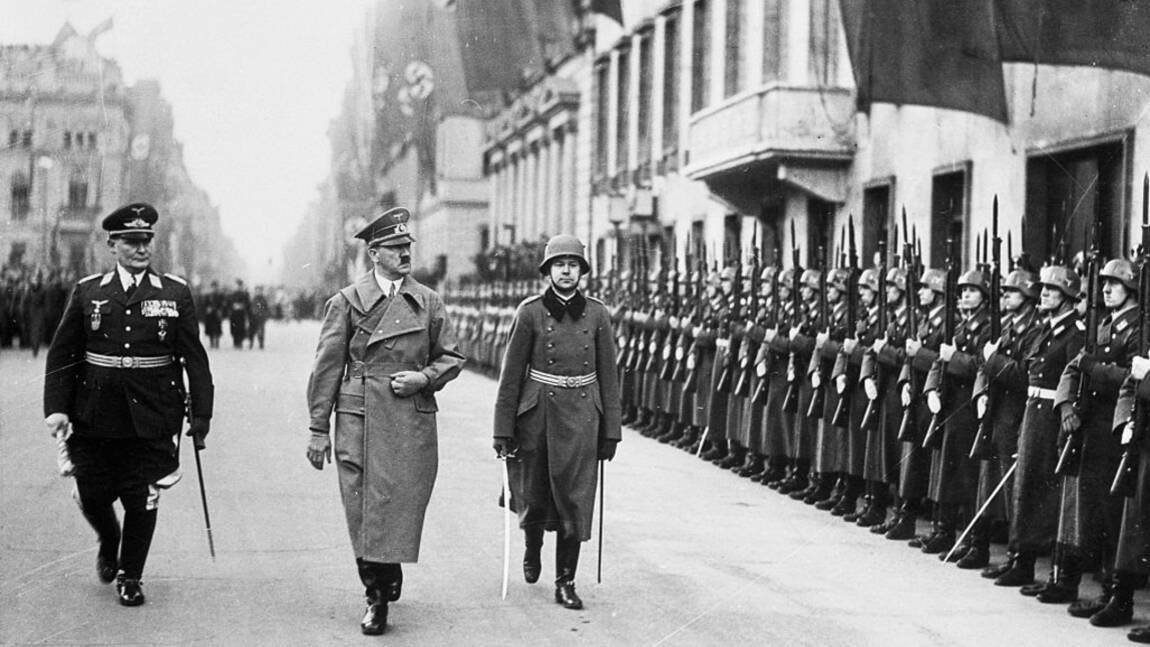 Expanding further, also beyond World War II, we have information about the Mussolini years, about how il Duce was the socialist who invented fascism, about the original significance of the Swastika, about Franco, about the 1934 World Cup, and about the time when the IRA became the ally of Hitler's Germany.
What is perhaps most interesting is the extent to which just about all of the top Nazis turned out to be perverts (remember the brownshirts' Ernst Röhm?), with their fixations on, say, the Third Reich's female movie stars (see the Isabelle Mity investigation). This leads to 's New York post article, The twisted sex lives of Nazis — and the women who loved them…
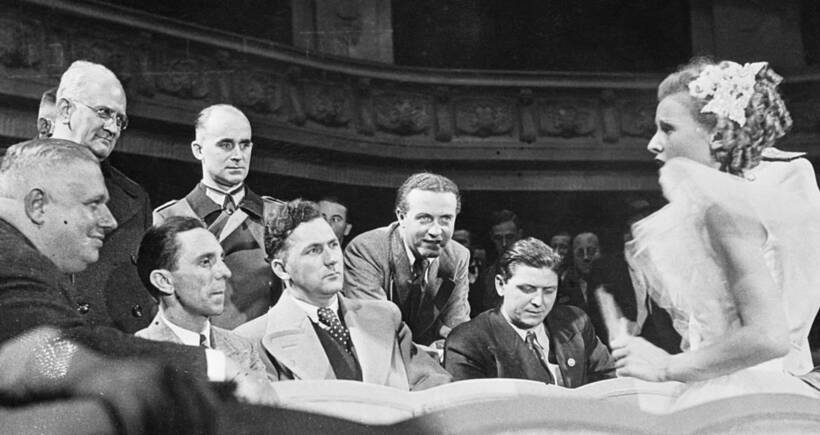
Le rôle des grandes actrices de cinéma pendant le IIIe Reich décrypté dans l'enquête d'Isabelle Mity…
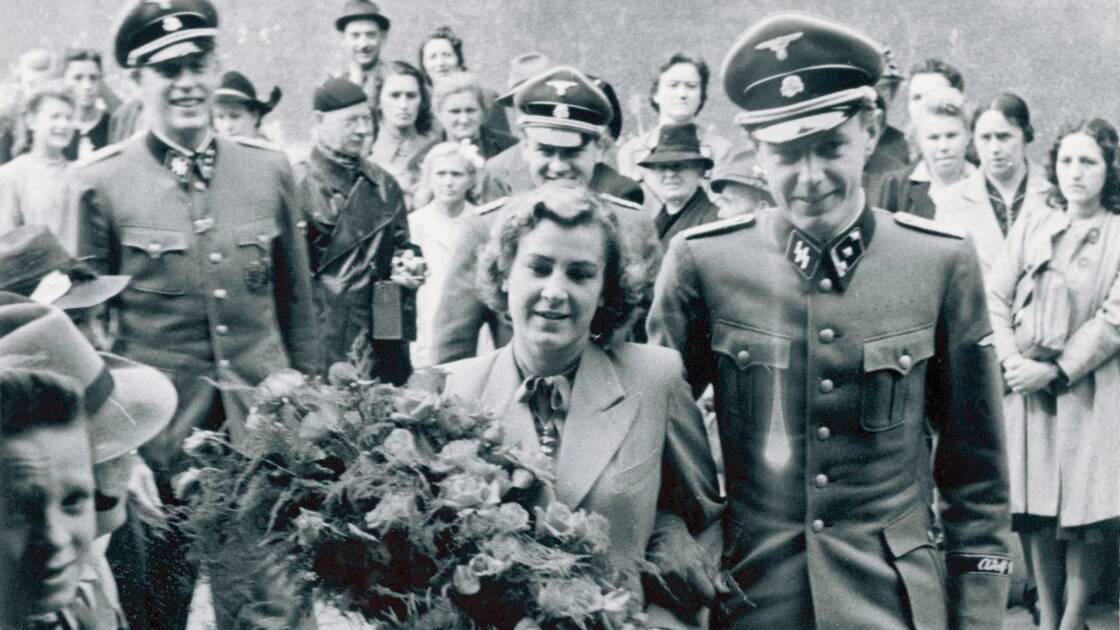
Let Hitler's secretary bring this story together, as recounted by Jean-Jacques Allevi in the Géo monthly:
"After the revelations of this man's crimes, I will live until my last hour with the feeling of having been an accomplice..." Traudl Junge, Hitler's naive and carefree secretary, delivers this confession in her memories (Until the Final Hour), which inspired the film Downfall. Until her death, she will be prey to guilt, undermined by depression taking her back to the time when she lived in the intimacy of the Führer.
... When Hitler goes looking for a new secretary, she is summoned with other employees. Is it her youth, her Munich origins, or her resemblance to Eva Braun? The fact remains that she is recruited to take down the Führer's words in shorthand. “From then on, there were few days when I did not see Hitler, work and share my meals with him. »
At 22, she accompanies him everywhere, to his Berghof chalet, to the Wolf's Lair, his Prussian haunt... She participates in the daily life of the “leader's” inner circle: “Hitler was charming. A simple and good-humored host who entertains in his country house… We laughed a lot.” Fireside discussions sometimes drag on until 6 a.m. without the war or the death camps being discussed. Her role — that of a companion rather than a secretary — becomes burdensome to her. “I had the impression of being a prisoner in a golden cage, from which I would have liked to leave… When I go back, I miss the memory of what was terrible in the world.”
On April 30, 1945, Hitler commits suicide
In 1945, in Hitler's bunker, she celebrated the dictator's birthday on April 20. As a farewell gift, she receives one of the ten poison capsules that the Führer distributes to his loved ones. On April 29, Hitler dictated his will to her. The secretary, who never joined the Nazi party, blackens “the last page of the history of the Reich”. The next day, Hitler committed suicide: “With him disappeared the hypnotic pressure under which we lived. »
... Becoming a member of the cultural forum of the SPD, the social democratic party, she underlined, in 2001, "how easy it was to succumb to the fascination of Hitler and difficult to live knowing that you served a mass criminal. Beautiful facades are often deceptive, it is always worth taking a look behind.” Traudl Junge died in 2002, shortly before the publication of her memories which illustrate “the banality of evil” theorized by Hannah Arendt.
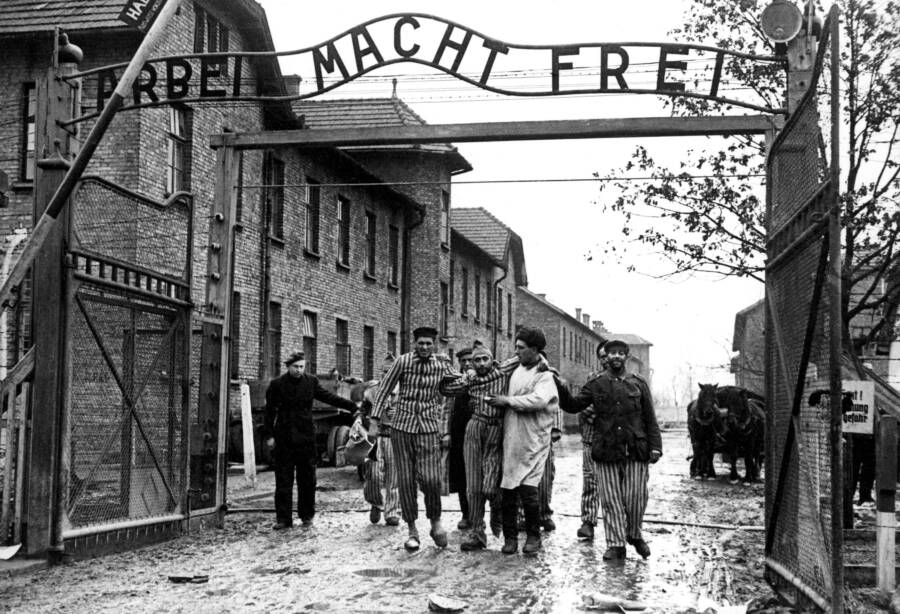
33 Photos Of The Liberation Of Auschwitz, The Nazi Concentration Camp Where More Than A Million People Were Killed
« Après les révélations sur les crimes de cet homme, je vivrai jusqu’à ma dernière heure avec le sentiment d’avoir été complice…» Traudl Junge, la naïve et insouciante secrétaire d’Hitler, livre cette confession dans ses souvenirs (Dans la tanière du loup, éd. Lattès, 2005), qui ont inspiré le film La Chute. Jusqu’à sa mort, elle sera en proie à la culpabilité, minée par une dépression la ramenant à l’époque où elle vécut dans l’intimité du Führer.
… Quand Hitler se met en quête d’une nouvelle secrétaire, elle est convoquée avec d’autres employées. Est-ce sa jeunesse, son origine munichoise ou sa ressemblance avec Eva Braun ? Toujours est-il qu’elle est recrutée pour prendre en sténo les paroles du Führer. « A partir de là, rares furent les jours où je n’ai pas vu Hitler, travaillé et partagé mes repas avec lui. »
A 22 ans, elle l’accompagne partout, dans son chalet du Berghof, dans la Tanière du loup, son repère prussien… Elle participe à la vie quotidienne du cercle restreint du « chef » : « Hitler était charmant. Un hôte simple et de bonne humeur qui reçoit dans sa maison de campagne… On riait beaucoup. » Les discussions au coin du feu s’éternisent parfois jusqu’à 6 heures du matin sans que ne soient abordés la guerre ou les camps de la mort. Son rôle – celui d’une dame de compagnie plus que d’une secrétaire – lui devient pesant. « J’avais l’impression d’être une prisonnière dans une cage dorée, dont j’aurais aimé partir… Quand je reviens en arrière, il me manque le souvenir de ce qui se passait d’effroyable dans le monde. »
Le 30 avril 1945, Hitler se suicide
En 1945, dans le bunker d’Hitler, elle célèbre le 20 avril l’anniversaire du dictateur. En guise de cadeau d’adieu, elle reçoit l’une des dix capsules de poison que le Führer distribue à ses proches. Le 29 avril, Hitler lui dicte son testament. La secrétaire, qui n’a jamais adhéré au parti nazi, noircit « la dernière page de l’histoire du Reich ». Le lendemain, Hitler se suicide : « Avec lui a disparu la pression hypnotique sous laquelle nous avons vécu. »
… Devenue membre du forum culturel du SPD, le parti social-démocrate, elle souligne, en 2001, « combien il était facile de succomber à la fascination d’Hitler et difficile de vivre sachant que l’on a servi un criminel de masse. Les belles façades sont souvent trompeuses, cela vaut toujours la peine de jeter un coup d’œil derrière. » Traudl Junge est décédée en 2002, peu de temps avant la publication de ses souvenirs qui illustrent « la banalité du mal » théorisée par Hannah Arendt.
Related: • 卐mas Caroling: The Extremes Hitler Wanted to Go To in Order to Replace Christianity with the "Religion" of National Socialism.
• Adolf Hitler in Religious Surroundings: Is There Really Evidence That the Führer Was a Christian?
• Worshipping Little Else But the Aryan Race, Hitler Abhorred the Christian Faith and Wanted to Replace Christmas with the Pagans' Yule
• "Out With Jesus" — During His 12 Years in Power, Hitler Tried to Ban the Tradition of Christmas
• "Hitler remained to the end a socialist"; the Führer "was totally irreligious and" wanted to hang the Pope in St Peter's Square

• Ray Comfort, whose “Hitler, God and the Bible” points out
Hitler devised a master strategy to crush all Christian churches, explains that
it would be either ignorant or disingenuous to call Hitler a Christian:
In a special Christian Broadcasting Network program, Comfort cites the head of Hitler Youth, Boldur von Schirach, who said, “Destruction of Christianity was explicitly recognized as a purpose of the National Socialist Movement.”… The CBN program explains how Hitler put on a religious, even Christian, façade, until he became powerful.
… But later one of his inner circle acknowledged: “I’m absolutely clear in my own mind, and I think I can speak for the Fuhrer as well, that both the Catholic and Protestant churches will vanish from the life of our people.”
•
How Hitler's Nazi propaganda machine tried to take Christ out of Christmas
… the way Christmas was used by the atheist Nazis, who tried to turn it into a pagan winter solstice celebration.
… 'Christmas was a provocation for the Nazis - after all, the baby Jesus was a Jewish child,' Judith Breuer told the German newspaper Spiegel. 'The most important celebration in the year didn't fit with their racist beliefs so they had to react, by trying to make it less Christian.'
The exhibition includes swastika-shaped cookie-cutters and Christmas tree baubles shaped like Iron Cross medals.
The Nazis attempted to persuade housewives to bake cookies in the shape of swastikas, and they replaced the Christian figure of Saint Nicholas, who traditionally brings German children treats on December 6, with the Norse god Odin.
The symbol that posed a particular problem for the Nazis was the star, which traditionally decorates Christmas trees.
… The is a legacy of the Nazi Christmas. The wartime version of the traditional Christmas carol 'Unto us a time has come' is still sung. 'The Nazis took out the references to Jesus and made it into a song about walking through the snow,' Breuer said.
Surprisingly, German churches put up little opposition to the Nazification of Christmas. 'You would have expected them to protest loudly and insist that it was a Christian festival,' said Breuer. 'But instead they largely kept quiet, out of fear.'
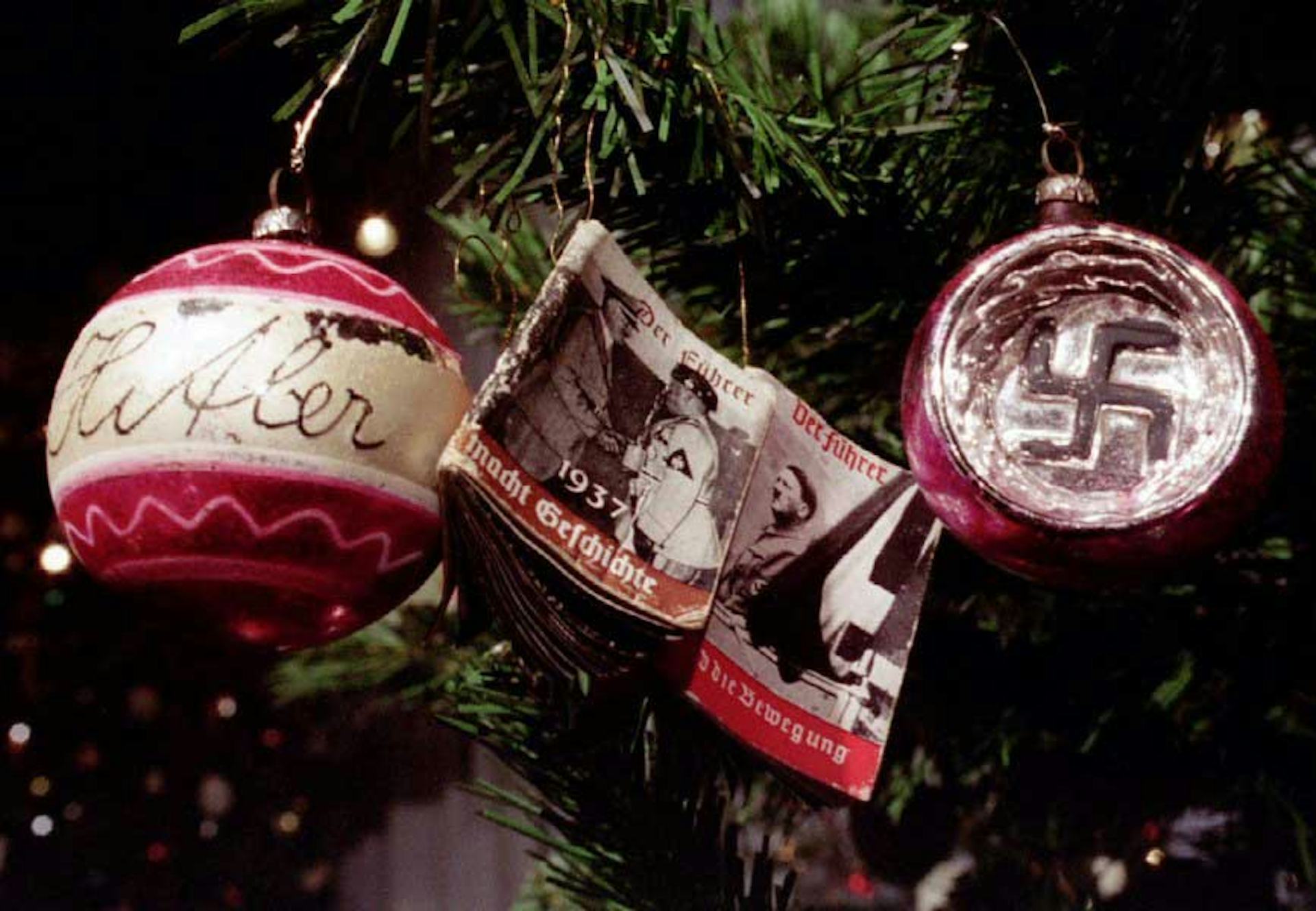
Quelle était la signification de la croix gammée avant d’être l’emblème du parti nazi ?
svastika ou swastika qui signifie bien-être ou encore bonne fortune en sanskrit


Thursday, April 18, 2024
"You Have Wiped Israel Off the Map!" Clash on French TV As Pro-Palestine Speaker Tries to Gaslight the Fact that Her Palestine Logo Has Made Israel Vanish

A conference on Palestine at the university of Lille by one of France's main leftist parties has been shut down after it transpired that the logo of the conference showing a map of the region — a map of, quote, "FREE Palestine" — has made Israel vanish.
More than that: The ban took place in the wake of an LFI poster showing Jean-Luc Mélenchon and Rima Hassan announcing a conference on "the current situation in Palestine" with the word Israel nowhere to be seen and, as mentioned, the Jewish state having totally disappeared in the "FREE Palestine" map (at bottom right).
La France Insoumise (LFI or Unyielding France) is France's most far-left party, a kind of successor to the French Communist Party, with former (?) Communist Jean-Luc Mélenchon as its head and regular presidential candidate.
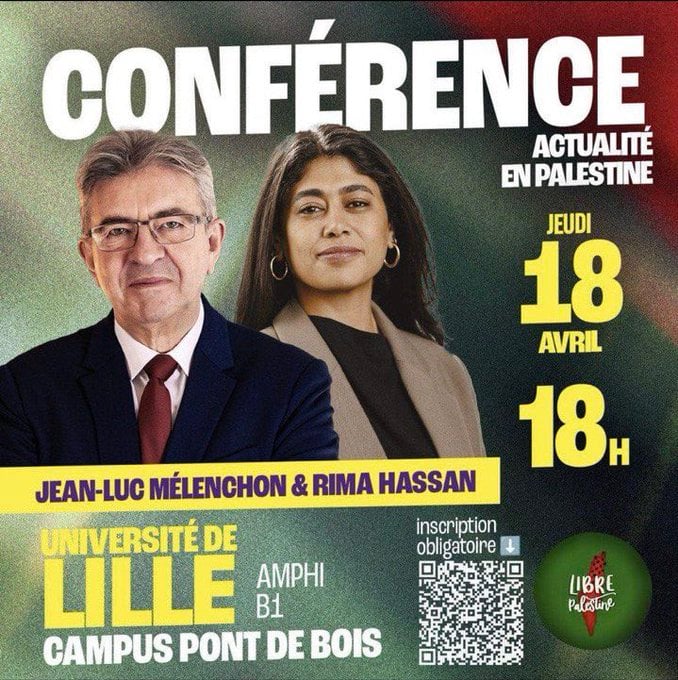
From the Morandini talk show on the C News channel:
“There is no Israel on the poster. Does that mean that you want Israel to disappear?!” Jean-Marc Morandini asked an LFI representative repeatedly. “But not at all! We want the Palestinian people to be free. The logo is very clear,” replied Karima Khatim, an LFI municipal representative from Blanc-Mesnil.
Very quickly, tempers rose. "You are showing bad faith! You don't understand anything! What this poster shows is the destruction of Israel! Your party is an anti-Semitic party!" charged Karim Maloum. “Sir, just for your words, I could sue you! People are fed up with being called anti-Semites when they [do nothing but] defend the Palestinian cause. We want a two-state solution,” declared Karima Khatim.
"You do?!" retorted Jean-Marc Morandini, again and again. "Really?! Where do you see two states on the poster?! There is a difference between what you say and what we see. Where do you see the two states?!" But he never got an answer from his guest.
"You cannot in any way see the presence of Israel on this poster. All the facts speak against you. You are incapable of recognizing what is going on. You are exasperating the viewers of CNews," said Captain Hervé Moreau.
Check out the Morandini website for the videos: the arguing is in French (naturellement), but it is not hard to understand how Karima Khatim is going ballistic, interrupting everybody, and gaslighting her audience (as well as herself?), claiming that she can't see where there is a problem.
This is the second ban in Europe within the space of a day or two — the other on the other side of the spectrum, concerning a conference on National Conservatism in Brussels.
As it happens, President Macron has announced that he disagrees with the Lille region prefect's ban, stating that
I am for respecting the laws of la République. Afterwards, as far as I am concerned, I am always in favor of people being able to express themselves freely, even as I am prepared to fight their ideasBut that might seem to smack of double standards: the C News channel is seen as so far to the right (although not with regards to American issues, not to the point of preferring Trump over Biden) that there have been rumors that there are members of the French government who are attempting to shut it down as well.
Related • To Peacenik Protesters Everywhere (Pro-Palestinian or Other):
The People that Hamas Slaughtered Mercilessly at Israel's Rave — They Are YOU!
• The Genocide Charge Against Israel: What is
the Difference Between War and Genocide in the First Place?
Wednesday, April 10, 2024
RC : Trump — de la victoire aux primaires à l’investiture officielle lors de la Convention, que peut-il arriver ?


Le 3 avril 2024, Evelyne Joslain reçoit :
- Philippe Karsenty, ancien maire adjoint de Neuilly-sur-Seine, porte-parole des Republicans Overseas in France
- Erik Svane, auteur de bandes dessinées
- Marc Amblard, avocat
- Daniel Clément, médecin
Patron d'émission du Libre journal du Nouveau Monde à Radio Courtoisie, Évelyne Joslain est l'auteur d'une poignée de livres sur les États-Unis et l'Occident. Parmi ceux-ci, son chef d'œuvre est paru il y a queques semaines.
Voici la revue de livre de La Révolution Culturelle.
Cliquez sur le lien pour entendre l'émission d'une heure et demie…
Tuesday, April 09, 2024
Photos of World War II's Oskarsborg Fortress During Two Trips up the Oslo Fjord
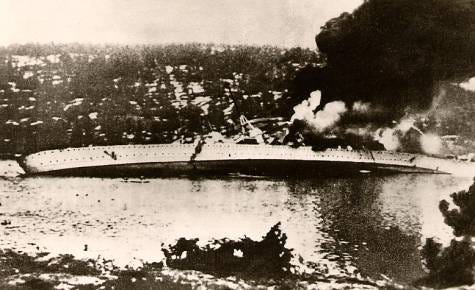
During the night (i.e., the early morning hours) of April 9, 1940 — 84 years ago today —
 |
| Distances from Berlin to neighboring Denmark and to Norway |
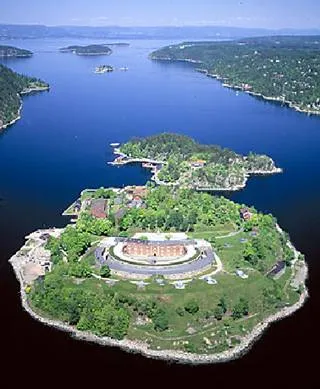
Back to 1940. The direct neighbor of Germany, the tiny flat nation of Denmark, fell only after a few hours. But much further away, the far larger Scandinavian country of Norway, with fjords and mountains and other natural defences, had time — as Commander Salamander has recounted (mange takk til Glenn Reynolds) — to organize a defense as well as the evacuation of Oslo's VIPs, thanks to the Oskarsborg fortress, which managed to sink Germany's most modern battleship as, in the middle of the night, the German fleet attempted to sail up the Oslofjord (120 km in length!) past it in the dark and in total silence with all lights off. This stratagem was unsuccessful, as the fortress and other artillery batteries opened fire. Seeing the Blücher torpedoed and sink under the chilly waters of Drøbak Sound, the rest of the German ships made the wise decision to discontinue the attack.
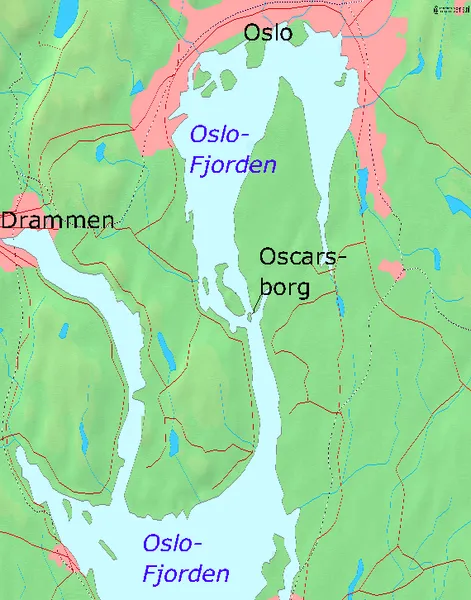
What I'm not sure is clear to many readers is that Oskarsborg's torpedo battery was not directed head-on at (real or would-be) invaders;
 |
| The lengthy Oslo Fjord |
To explain the photos below, you need to know about a familiar Danish pastime: A very popular weekend trip Danish tourists take is the Oslo vacation.
 |
| Copenhagen to Oslo and back |
The photos below come from two trips to and from Oslo (four sails in all), one in September, one the following January. You will excuse a couple of personal and irrelevant photos…
 |
| The guns of the Oskarsborg Fortress can be seen in white |
 |
| Close-up of the Oslo Fjord fortress: four cannon visible, the one furthest to the left in profile |
 |
| A smaller island to the North (tiny bridge straight above my left wrist) is actually linked to fort's main island |


 |
| Leaving the fort behind, the danger has seemingly passed; but that is an illusion — the real threat to enemy ships is the secret (and camouflaged among the rocks) torpedo battery whose warheads will hit you in the stern (Håøya in the rear and the smaller island in the foreground) |
 |
| As the fjord grows narrower, another ferry appears behind us |
 |
| Still followed by another ferry in the distance |
 |
| The width of the fjord tightens considerably |
 |
| Looking over the fjord from its northernmost point, Oslo's Akershus Slott castle |
 |
| Only in Scandinavia: Kondomeriet — the condom boutique on Oslo's Karl Johans Gate (in Norwegian, "Gate" does not mean gate but street) |
 |
| Deciding what, if anything, to buy |
 |
| Good to have a jacuzzi to yourself |
 |
| At the entrance to the fjord, the latter is still wide open |
 |
| Gorgeous sunset on the way home to Copenhagen |
 |
| Man-spreading in the empty jacuzzi |
 |
| Sailing from and (here) back to Copenhagen, the ferry inevitably sails by Hamlet's Elsinore castle, Kronborg |
Other items of interest: the kings of Denmark and Norway were brothers. Only 35 years
earlier, Norway had established its independence from Sweden and the newly-(re)born kingdom
asked the younger brother of Denmark's crown prince Christian to accept the nation's crown. Prince
Carl accepted, and became king under the name of Haakon VII (In the Norwegian movie linked by Cdr Salamander, The King's Choice, all the characters (including the king's son and heir, Prince Olav) are played by Norwegian actors (while the Germans are played by Germans), except the king himself, who is played by a Danish actor, given that Haakon VII never lost his Danish accent).
In that perspective, in the early 1930s, the two brothers almost had no choice but to go to war with each other. Greenland had always been part of Denmark, but Norway (who, for much of her history had been part of Sweden or Denmark) decided that part of the largest island on the planet ought to be called Erik the Red's Land (after the father of the Viking who discovered America) and belonged to Oslo. The issue was eventually resolved by jaw-jawing, by deciding the case at the Permanent Court of International Justice — to Denmark's satisfaction.
Speaking of Greenland, and of World War II, after Denmark was occupied on April 9, 1940, the Danish ambassador to the United States, Henrik Kauffmann, eventually decided to go against the (now-forced-to-cooperate-with-the-Nazis) government in Copenhagen, declared his embassy "independent", and, in that perspective, invited American troops to occupy the island so the Germans could not do so. This has led to another recent film, the Danish production of Vores mand i Amerika (title brilliantly translated as The Good Traitor, as Kauffmann and the Greenland governors were condemned for treason and thus condemned in absentia to death. (Meanwhile, another island in the Atlantic, Iceland, at the time also Danish, was occupied by British forces.) In one 1942 issue of the National Geographic, one of the governors of Iceland welcomes warships of the U.S. Navy to Godthaab (Nuuk). The name of the governor? Aksel Svane — the cousin of my grand-father.

Finally, Churchill was always skeptical of Denmark's reliability as an allied nation, given the speed with which King Christian X (remember, Haakon's elder brother) announced the kingdom's surrender. At least, until the force of the resistance groups to the Germans started growing. Interestingly, Denmark could also have sunk a German troop ship likewise sailing in total silence with all lights off in the dark through Copenhagen on April 9 and thus immediately established its credentials as a fighting or at least a resisting nation. But the guns at the Kastellet were not loaded. His opinion of Denmark was elevated when the Danish authorities learned of the Germans' 1943 decision to disarm the Danish military, and the Danish fleet made the decision to sail for allied or neutral ports or to scuttle their warships.
Friday, April 05, 2024
Shocker: French Weekly Outs One of the KGB's Major Spies During the Cold War — None Other Than Its Own Former Editor-in-Chief
 |
| Philippe Grumbach interviews François Mitterrand at Socialist Party HQs |
A right-leaning conservative French weekly has uncovered one of the Soviet Union's top spies in France during the Cold War, and it turns out to be none other than its own editor-in-chief in the 1970s.
The former honcho at L'Express, Philippe Grumbach (1924-2003) was close to both François Mitterrand and Valéry Giscard d’Estaing (VGE), indeed one of the latter president's closest advisers. (This brings to mind the Stasi's greatest coup during the Cold War, when the East Germans succeeded — also while VGE was growing in power — in placing a communist spy (Günter Guillaume) in Willy Brandt's West German cabinet.)
For 35 years, while (among other things) at the head of one of France's top five weeklies, and the most anti-communist of the lot (Jean-Jacques Servan-Schreiber, Jean-François Revel, François Mauriac, Raymond Aron, etc…), Brok (as Philippe Grumbach was known by his Soviet handlers) spied for the Kremlin.
The revelations come after examination by France's DGSE spy fighters of the Vasili Mitrokhin archive in London, the vast treasure trove that the KGB archivist took with him when he defected to the West in 1992.

From the 1930s and the Cold War to the modern Putin era, Moscow's secret services never seem to have had trouble finding Frenchmen willing to spy for them, from NATO officers to some of the highest VIPs in la République.
/cloudfront-eu-central-1.images.arcpublishing.com/lexpress/273ITM5NH5HMVPOD5ELBR3A2DM.png)
It turns out that suffering from a bad case of ADS (America Derangement
Syndrome), as it has for two or three centuries — anti-Americanism was one of the major reason for the founding of this very blog, 20 years ago — France was a nest for
Russian spies.
As I quote a former KGB agent in my book on anti-Americanism in France, it was never hard to find traitors and spies in France, as they thought that, in truth, they and the Russians were on the same side, the real enemy being the devious and dastardly Uncle Sam. As for Philippe "Brok" Grumbach, it turns out that he was recruited at age 22 by the KGB in 1946, i.e., while Stalin was head of the USSR.
/cloudfront-eu-central-1.images.arcpublishing.com/lexpress/ZF5A5Y55VZFKRHZWUYZ25XAQIQ.jpg)
/cloudfront-eu-central-1.images.arcpublishing.com/lexpress/576QGWJAMVB7XC2MULHMQMB6VY.jpg)
/cloudfront-eu-central-1.images.arcpublishing.com/lexpress/CBNORRMSONDKLFASTDE6OCQPLY.jpg)
 |
| Minister for Air Pierre Cot (glasses, bow tie) in 1933 next to his chief of staff, Jean Moulin |
/cloudfront-eu-central-1.images.arcpublishing.com/lexpress/576QGWJAMVB7XC2MULHMQMB6VY.jpg)