
 Upon reading this headline:
Turtles Are Casualties of Warming in Costa RicaIt is best to gird the loins, render a few garments, find a bit of sackcloth, some ashes and begin gnashing the teeth (preferably your own). The reason, you know it will be coming at you with both barrels, turtles are casualties of warming in Costa Rica. How do we know, the headline says so:
But haphazard development, in tandem with warmer temperatures and rising seas that many scientists link to global warming, have vastly diminished the Pacific turtle population.Note to the reporter, can we please stay on message, this is about global warming. We continue with our lesson:
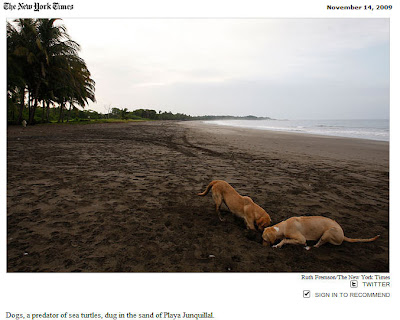
Even before scientists found temperatures creeping upward over the past decade, sea turtles were threatened by beach development, drift net fishing and Costa Ricans’ penchant for eating turtle eggs, considered a delicacy here. But climate change may deal the fatal blow to an animal that has dwelled in the Pacific for 150 million years.Ahem, can we dispense with the facts and just stick with the global warming message please:
Beachside tables have been removed because rising tides have destroyed the restaurant’s concrete terrace and uprooted shading trees there. In different circumstances, the beaches could gradually extend backward as the sea level rose. But along much of Costa Rica’s Pacific coast, the back of the beach is now filled with hotels, restaurants and planted trees, giving the sand no place to go. "The squeezing of the beaches where turtles nest is going to be a big problem," said Carl Safina, head of the Blue Ocean Institute, a conservation group.Precisely what does this have to do with global warming? Please stay on message:
In a country where turtle eggs are traditionally slurped in bars from a shot glass, uncooked and mixed with salsa and lemon, biologists are also promoting cultural change.This is the result of global warming how exactly? Far be it for a blogger to help a professional reporter, but the issue, as the headline points out, is global warming. We have to get these things straight, there may be funding at stake. So, here is our help to the reporter:
Let us put aside the haphazard development, beach development, drift net fishing, Costa Ricans’ penchant for eating turtle eggs, deforestation, natural predators, the squeezing of the beaches and cultural traditions ..... the loss of these turtles is about global warming, get with the programme!


No comments:
Post a Comment